


Key Takeaways
- U.S. deaths from excessive alcohol use averaged about 178,000 per year during 2020–2021, roughly 5% of all deaths, with an average of 24 years of life lost per person 3, 4.
- Counts vary because definitions vary: broader frameworks include cancers, injuries, and heart disease linked to drinking, while narrower counts only list deaths where alcohol was written directly on the certificate 7.
- Alcohol deaths climbed 29.3% in four years, with women rising faster than men and alcohol-associated liver disease hitting adults aged 25–44 harder than past generations 2, 13.
- Daily heavy drinking makes quitting alone dangerous because withdrawal can trigger seizures or delirium tremens, so a medically supervised detox is the safer first step before continuing care.
The honest answer starts with a range, not a single number
If you came here looking for a single death toll, here is the straight answer: in the United States, about 178,000 people die each year from excessive alcohol use, based on CDC estimates for 2020–2021 3. Worldwide, the World Health Organization attributes roughly 2.6 million deaths a year to alcohol 1. Both are real. Both are partial.
You will see other numbers too. Some sources quote narrower counts that only include deaths where alcohol was the direct, immediate cause written on the death certificate. Others cast a wider net, counting cancers, car crashes, falls, heart disease, and liver failure where alcohol was a major contributor. The gap between those approaches is big, and that is why one article says 50,000 and another says 178,000 and a third says millions.
You deserve to understand what is being counted before anyone hands you a statistic. The sections below walk through the main U.S. and global numbers, who is dying more than they used to, and what heavy drinking is actually doing in the background. If you are reading this because you are worried about yourself or someone you love, that worry is a reasonable response to the data. You are not overreacting.
Why there is no single death toll for alcohol
Alcohol kills in a lot of different ways, and that is the whole problem with counting it. A person who dies in a car crash after drinking, a woman who dies of breast cancer linked in part to years of heavy drinking, a man who dies of liver failure at 52, and someone who dies of alcohol poisoning in a single night are all alcohol deaths. But they get counted differently depending on who is doing the counting and what question they are trying to answer.
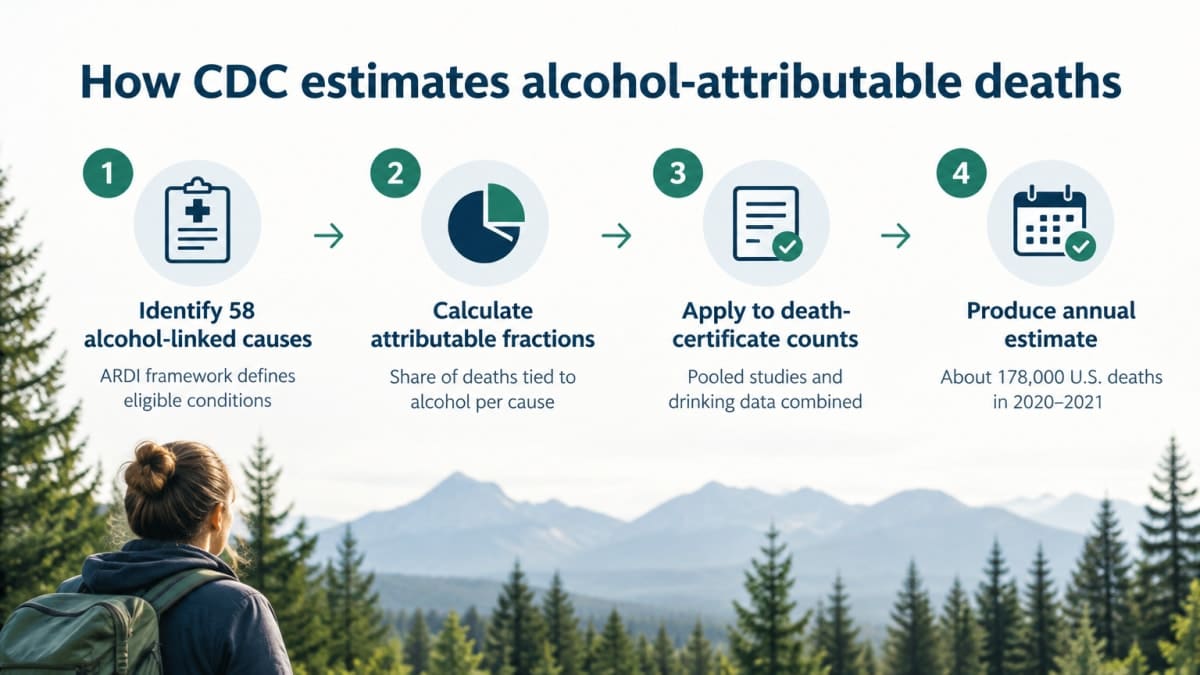
The CDC uses a framework called Alcohol-Related Disease Impact, or ARDI, that currently includes 58 causes of death with enough evidence to link them to alcohol 7. For each cause, researchers calculate what share of those deaths would not have happened without alcohol — a number called an alcohol-attributable fraction. They pull those fractions from pooled studies and drinking-prevalence data, then apply them to actual death-certificate counts 8. That is how you get the figure of about 178,000 excessive-alcohol deaths per year in the U.S. for 2020–2021 3.
A narrower count only includes deaths where alcohol itself is written on the certificate as the direct cause — alcohol poisoning, alcoholic liver disease, alcohol-induced pancreatitis. That number is much smaller because it leaves out the cancers, injuries, and heart conditions where alcohol was a contributor but not the single word on the form.
Neither approach is wrong. The ARDI number tells you the full footprint of heavy drinking on American lives. The narrower number tells you where alcohol was the headline. The WHO uses a similar modeled approach for its global 2.6 million figure 1. When you see different totals in different places, the difference is almost always definitions, not disagreement.
How many Americans die from alcohol each year?
The current U.S. figure: about 178,000 deaths per year
The number most researchers and clinicians use right now is 178,307 deaths per year. That is the average annual total of U.S. deaths from excessive alcohol use during 2020–2021, calculated by the CDC using death-certificate data and the ARDI framework 2. In rounded consumer form, you will see it written as about 178,000 deaths a year from excessive drinking 3.
What does that actually mean on a human scale? CDC pairs the headline figure with two other numbers that matter more than the raw count: roughly 4 million years of potential life lost each year, and an average of about 24 years of life lost per death 3. These are not deaths at the end of a long life. On average, they take decades off a person’s expected time with their family.
NIAAA puts the same figure in a different frame — about 178,000 annual deaths equals roughly 5% of all U.S. deaths, with the biggest categories being liver disease, cardiovascular disease, poisonings, injuries, and cancer 4. If you add those up across any given month in a city like Portland or Salem, alcohol is quietly behind more funerals than most people would guess.
A sharp climb: alcohol deaths rose 29.3% in four years
The 178,000 figure is not a steady baseline. It is the top of a steep hill.
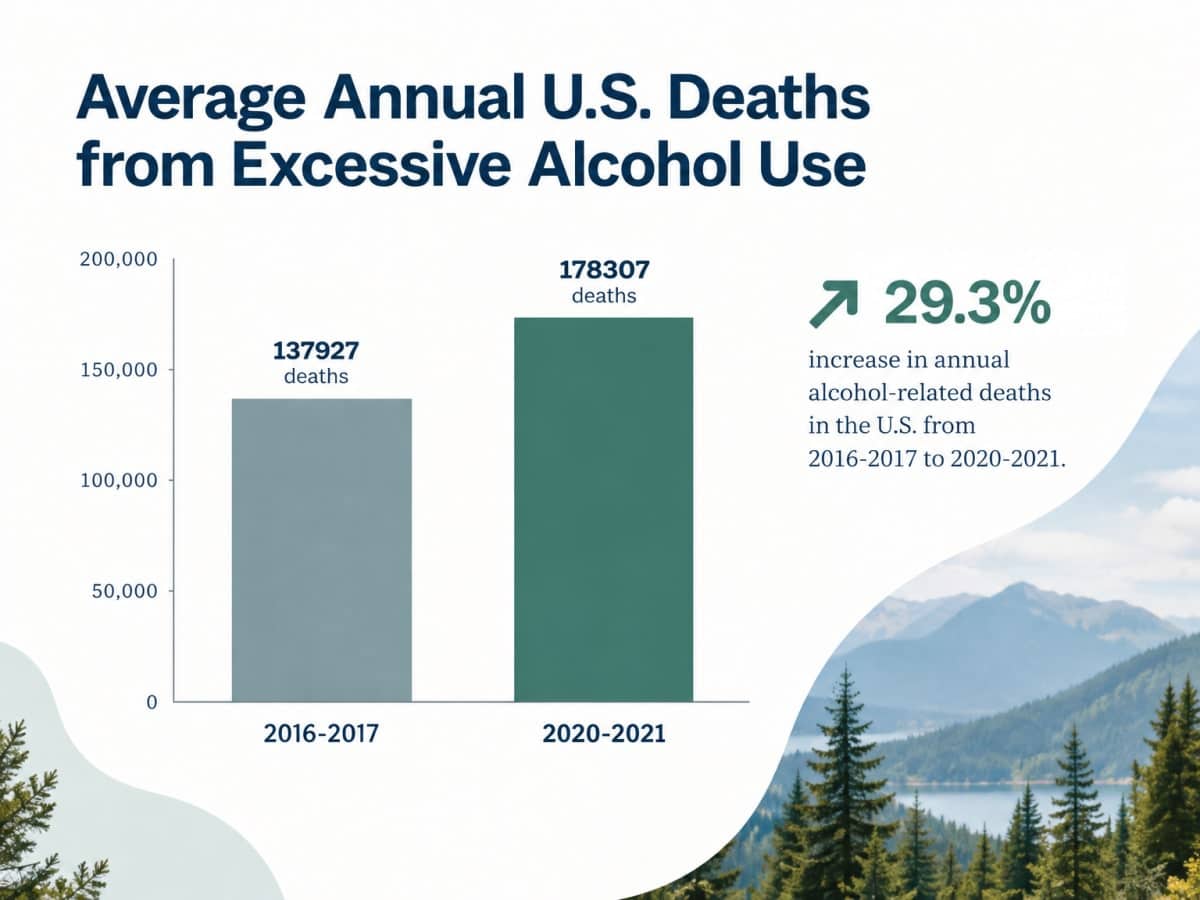
Between 2016–2017 and 2020–2021, average annual deaths from excessive alcohol use in the United States rose from 137,927 to 178,307 — a 29.3% increase in just four years 2. The age-standardized death rate, which adjusts for the fact that the population is aging, climbed from 38.1 to 47.6 per 100,000 over the same window 2. In other words, this is not just more people dying because there are more Americans. More Americans are dying per capita.
The timing matters. The jump between 2018–2019 and 2020–2021 lines up with the first two years of the COVID-19 pandemic, when heavy drinking at home became easier to hide and harder for anyone to interrupt. Jobs, routines, and in-person support systems came apart at the same time. For a lot of people, the drink that used to happen at 6 p.m. started happening at 2 p.m., then at 10 a.m., and the body kept the receipts.
If you were someone whose drinking crept up during those years, you are not an outlier. You are inside the trend line. That is not an excuse — it is context. The same data that shows the problem got worse also shows that it is treatable when people get real medical support instead of trying to white-knuckle it alone. The number went up because circumstances changed. Numbers can change again, person by person.
Alcohol-induced deaths tell a narrower, longer story
There is a second U.S. number worth knowing, and it is a lot smaller. Researchers call these alcohol-induced deaths — the deaths where alcohol itself is the direct, immediate cause written on the certificate, like alcoholic liver disease, alcohol poisoning, or alcohol-induced pancreatitis. Partially attributable deaths from cancer, injuries, and heart disease are left out on purpose.
Even with that narrower definition, the trend is steep. A 2025 peer-reviewed analysis of National Vital Statistics System data found that crude alcohol-induced death rates in the United States rose 89% between 1999 and 2024 11. The 2020 age-adjusted alcohol-induced death rate was 13.1 per 100,000 people, which is the measure CDC uses when comparing periods fairly across time 14.
Think of it this way. The 178,000 figure answers, “How many Americans die each year because they drank too much?” The alcohol-induced number answers a stricter question: “How many Americans die each year of a cause that would not exist at all without alcohol?” Both answers have been getting worse. One tells you the full footprint. The other tells you the deaths where alcohol was unmistakably the headline on the death certificate.
How many people die from alcohol worldwide?
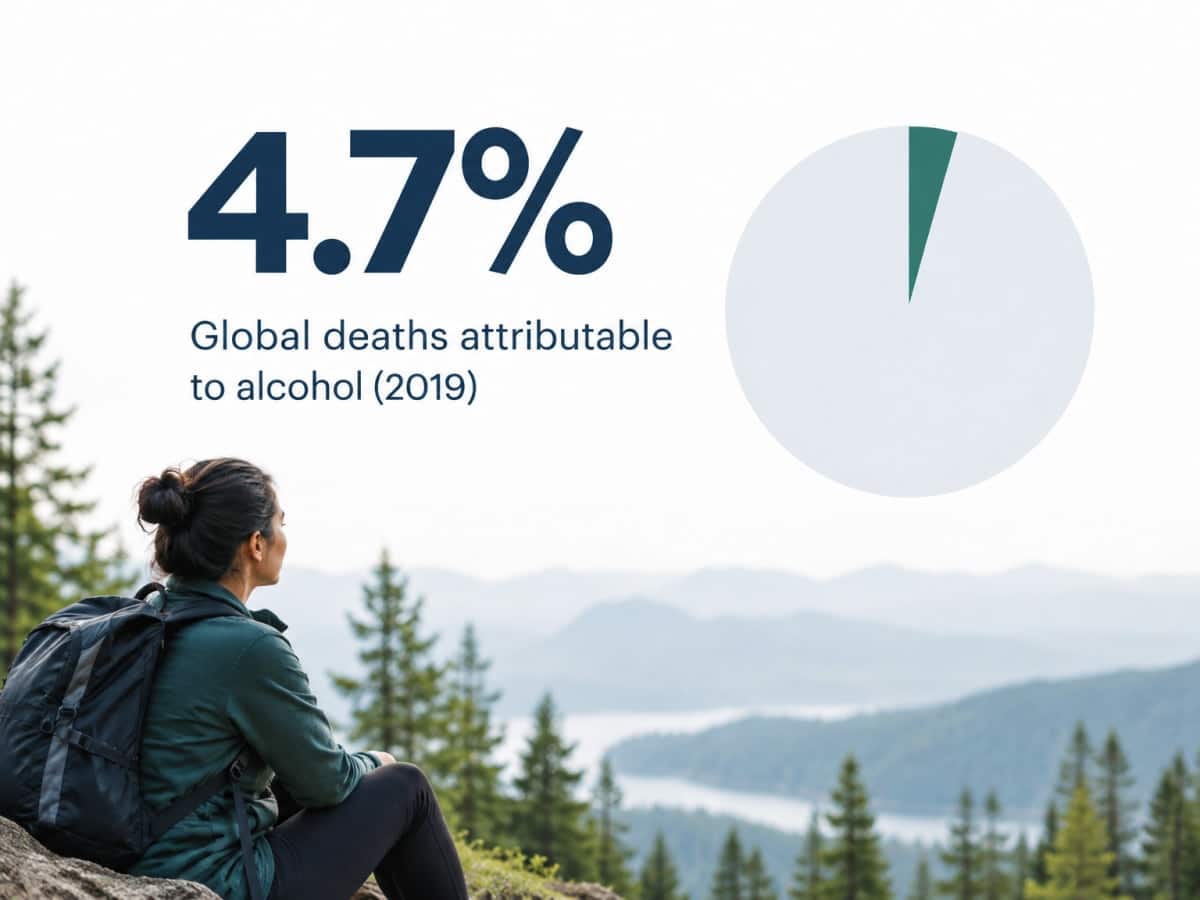
Zoom out from the United States and the picture gets heavier. The World Health Organization estimates that alcohol caused 2.6 million deaths worldwide in 2019, which works out to 4.7% of all deaths on the planet that year 1. That is roughly one in every 21 deaths, from any cause, tied back to drinking.
WHO breaks the 2.6 million figure into three buckets so you can see where the deaths actually happen:
- About 1.6 million were caused by noncommunicable diseases — the slow-burn conditions like liver disease, cardiovascular disease, and several cancers.
- Another 724,000 were injuries: car crashes, falls, drownings, violence, and other sudden deaths where alcohol was in the picture.
- And 284,000 were linked to communicable diseases, where heavy drinking weakened the immune response to infections like tuberculosis and pneumonia 1.
Like the U.S. figure, this is a modeled estimate, not a straight tally of death certificates. WHO uses population-level data on how much people drink and the known risks for each condition, then calculates how many of those deaths would not have happened without alcohol. Different methods, same honest truth: alcohol is one of the largest preventable causes of death on earth.
Who is dying — and who is dying more than before
Women are the fastest-rising group
For most of the modern research on alcohol deaths, men have been dying from drinking at higher raw rates than women. That is still true. What has changed is the direction of travel.
Between 2016–2017 and 2020–2021, average annual deaths from excessive alcohol use in the United States rose 34.7% among females and 26.8% among males 2. Women are not drinking more because men are drinking less. Women’s deaths are climbing faster from a lower starting point, and the gap between the two curves is closing.
Part of this is pattern. Wine at home after the kids are in bed does not look like the stereotype of a drinking problem, which is one reason it often goes unnamed for years.
If you are a woman reading this and recognizing yourself in that pattern, you are not imagining the risk. You are reading the same signal the data is sending. It is also a signal that catching it earlier changes the ending.
Younger adults, rural communities, and racial disparities
Alcohol deaths are not spread evenly across the map or across generations. Three patterns stand out in the recent data, and they matter because they shape who ends up in an emergency room, who gets diagnosed in time, and who dies at home before anyone realizes how bad it got.
First, the age picture is shifting younger. A 2025 JAMA Network Open analysis of 436,814 alcohol-associated liver disease deaths found that increases from 1999 to 2022 were especially pronounced among adults aged 25–44 — a group that used to be considered too young to die of liver failure 13. Livers that took 30 years to fail in previous generations are failing in 10 to 15 for a growing share of younger heavy drinkers.
Second, where you live changes your odds. CDC data on alcohol-induced deaths — the narrower, fully alcohol-attributable count — put the 2020 national age-adjusted rate at 13.1 per 100,000, with notable variation by urban-rural status 14. Smaller towns tend to have fewer detox beds, longer drives to specialty care, and less anonymity around getting help.
Third, racial disparities are real and documented. American Indian and Alaska Native populations saw especially steep rises in alcohol-associated liver disease mortality through 2022 13, and alcohol-associated liver disease death rates climbed in 49 of 50 states between 2019 and 2020 12. Whatever your background, the odds of this killing you depend partly on who gets reached in time.
The liver pathway most people underestimate
If there is one organ that quietly connects heavy drinking to the headline death counts, it is the liver. And this is the pathway most people miss until it is far along, because the liver does not usually hurt when it is being damaged. It just gets worse while you feel fine.
Here is the number that should stop you for a second. In 2023, out of 96,610 liver-disease deaths in the United States among people aged 12 and older, 43,004 — 44.5% — involved alcohol 6. Almost half of every liver-disease death in the country has drinking in the picture. That is not a rare, worst-case story. That is the baseline.
The trend inside that number is what makes it worse. The national age-adjusted alcohol-associated liver disease mortality rate jumped 23.4% in a single year, from 6.4 to 7.9 per 100,000 between 2019 and 2020, with rates rising in 49 of 50 states 12. Over the longer run, a 2025 JAMA Network Open analysis of 436,814 alcohol-associated liver disease deaths found age-adjusted mortality nearly doubled between 1999 and 2022, with the sharpest increases among women, adults aged 25–44, and American Indian and Alaska Native populations 13. People in their 30s are dying of a disease that used to belong to people in their 60s.
Even these numbers probably undercount the problem. NIAAA’s surveillance work notes that only 43.6% to 54.3% of cirrhosis deaths across 2000–2023 were actually coded as alcohol-related on the death certificate, even in years when alcohol was clearly involved 5. A doctor writes “cirrhosis” or “liver failure,” the drinking history does not make it onto the form, and the death quietly leaves the alcohol column.
What this means for you, in plain terms: if your drinking has moved into the daily, heavy range, your liver is almost certainly part of the conversation whether you feel it yet or not. The good news tucked inside the hard news is that liver damage can stabilize, and in some cases improve, when drinking stops under medical care. The sooner that happens, the more liver you have left to work with.
What the statistics still miss
Even the biggest headline numbers probably understate what alcohol is doing. NIAAA notes that only 43.6% to 54.3% of cirrhosis deaths were coded as alcohol-related across 2000–2023, depending on the year, which means almost half the time alcohol was involved but never made it onto the death certificate 5. Every missing code is a death that quietly leaves the alcohol column.
Think about what else does not get captured cleanly. Someone who dies by suicide after a night of heavy drinking. A fatal fall down the back stairs. A single-car crash on a rural road outside Salem with no witness to the drink before the drive. Alcohol was part of the story, but the certificate often lists the fall, the crash, or the overdose as the cause and stops there. CDC’s ARDI framework tries to catch these through alcohol-attributable fractions, but it can only work with what gets reported 7, 8.
Withdrawal deaths at home are another blind spot. When someone with a severe alcohol use disorder tries to quit alone and dies from seizures or delirium tremens before anyone finds them, that death rarely gets coded as alcohol-caused. It gets coded as cardiac arrest or sudden death.
The honest read: the real number is almost certainly higher than any single figure you will see quoted.
What heavy drinking actually does to the body
The death counts are big because the damage is cumulative, and it hits more than one system at once. NIAAA groups the leading categories of alcohol-attributable deaths this way:
- liver disease
- cardiovascular disease
- poisonings
- injuries
- cancer 4
Each one is a different pathway from the same source.
Your liver takes the first hit because it does most of the processing. Over years of heavy drinking, healthy tissue gets replaced with scar tissue, and once enough is gone, the liver cannot keep up. Your heart and blood vessels take a slower hit — raised blood pressure, weakened heart muscle, higher stroke risk. Cancer is also part of the category list NIAAA tracks among alcohol-attributable deaths 4.
Then there are the sudden deaths. Alcohol poisoning when the dose outruns the body’s ability to clear it. Falls, drownings, and crashes when coordination and judgment drop. These are the deaths that happen in one night instead of over 20 years, and they are a real share of the total 4.
Why stopping cold turkey can be dangerous
If your body has adapted to a steady supply of alcohol, pulling it away quickly throws the nervous system into overdrive. Severe withdrawal can bring on seizures and delirium tremens, with confusion, fever, and dangerous swings in heart rhythm. These are the withdrawal deaths that often get coded as cardiac arrest or sudden death and quietly disappear from the alcohol column 5.
Please do not try to taper yourself off at home from a search bar. If you have been drinking heavily for weeks or longer, the safest first move is a medically supervised detox where nurses can watch vitals and a provider can order medication if withdrawal turns.
Where numbers end and next steps begin
You read this far, which means the numbers are doing what numbers can do and not more. They tell you drinking is one of the biggest preventable killers in the country. They cannot tell you what to do tomorrow morning. That part is yours, and it does not have to be done alone.
If you are the person whose drinking has climbed, the first move is not willpower. It is a safe medical evaluation. Alcohol withdrawal can turn dangerous fast when the body has adapted to daily heavy use, which is why detox under 24/7 nursing care exists in the first place. From there, continuing care — a step-down into partial hospitalization, intensive outpatient, outpatient, and aftercare — is what turns a safe start into a different year.
If you are the family member, your job is smaller than you think and more important than it feels. You do not have to diagnose anyone. You have to make one phone call with them, or for them, to a place that answers honestly.
Pacific Crest Trail Detox is a non-hospital, home-like medical detox in Milwaukie, Oregon, serving Portland, Gresham, Beaverton, Salem, Vancouver WA, and out-of-state clients. Owners and staff include people in long-term recovery. Calls are confidential and HIPAA-protected, and the team can verify your insurance benefits. We want to be your last treatment experience, whether we’re your first detox or your fifth.
Check Coverage for Medically Supervised Alcohol Detox
Find out whether your plan may help cover medical support for alcohol withdrawal and the next steps in care.
Frequently Asked Questions
Why do different sources give different numbers for alcohol deaths each year?
Different sources are answering different questions. The CDC’s 178,000-per-year figure uses the ARDI framework, which counts deaths from 58 conditions where alcohol was a cause, including cancers, injuries, and heart disease 7. Narrower counts only include deaths where alcohol was written on the certificate as the direct cause. The WHO’s 2.6 million global figure uses a similar modeled approach 1. Different scopes, different totals.
Is alcohol one of the leading causes of death in the United States?
Yes. NIAAA estimates that excessive alcohol use accounts for about 5% of all U.S. deaths, with the biggest categories being liver disease, cardiovascular disease, poisonings, injuries, and cancer 4. On a human scale, CDC estimates roughly 4 million years of potential life lost each year, with an average of 24 years cut from each person’s expected lifetime 3.
How much drinking actually raises the risk of dying from alcohol?
CDC’s estimates focus on excessive drinking, which includes heavy drinking, binge drinking, and any drinking by people under 21 or pregnant. Risk rises with how much and how often you drink, but there is no safe daily amount that fully eliminates risk for several alcohol-linked cancers and liver conditions. If drinking is a daily event, risk is already in the picture 4.
Can alcohol withdrawal really kill you?
Yes, and this is the part most people underestimate. If your body has adapted to daily heavy drinking, suddenly stopping can trigger seizures or delirium tremens — a severe form of withdrawal with confusion, fever, and dangerous changes in heart rhythm. These can be fatal in otherwise healthy adults. Many of these deaths get coded as cardiac arrest and never make it into the alcohol statistics 5. That is why medically supervised detox exists.
What are the warning signs that someone’s drinking has become life-threatening?
Pay attention to daily heavy drinking, shaking hands or sweats in the morning until the first drink, needing more alcohol to feel the same effect, drinking to prevent withdrawal, blackouts, yellowing skin or eyes, swelling in the belly or legs, vomiting blood, or confusion that is not sleep. Any of these mean the body is already struggling. A medical evaluation is the right next step, not willpower 4.
What is the safest first step if I’m worried about my own drinking or a loved one’s?
Call a medical detox program and ask for an assessment before anyone stops drinking. If daily heavy drinking has been going on for weeks or longer, quitting at home can be dangerous. A supervised detox has nurses on site around the clock and providers who can order medication if withdrawal turns. From there, continuing care — partial hospitalization, intensive outpatient, outpatient, and aftercare — is what turns a safe start into a different year. Calls to Pacific Crest Trail Detox in Milwaukie, Oregon are confidential and HIPAA-protected, and the team serves Portland, Gresham, Beaverton, Salem, Vancouver WA, and out-of-state clients.
References
- Global status report on alcohol and health and treatment of substance use disorders. https://www.who.int/publications/i/item/9789240096745
- Deaths from Excessive Alcohol Use — United States, 2016–2021. https://www.cdc.gov/mmwr/volumes/73/wr/mm7308a1.htm
- Facts About U.S. Deaths from Excessive Alcohol Use. https://www.cdc.gov/alcohol/facts-stats/index.html
- Alcohol-Related Emergencies and Deaths in the United States. https://www.niaaa.nih.gov/alcohols-effects-health/alcohol-topics-z/alcohol-facts-and-statistics/alcohol-related-emergencies-and-deaths-united-states
- Surveillance Report #123. https://www.niaaa.nih.gov/publications/surveillance-reports/surveillance123
- Alcohol and the Human Body. https://www.niaaa.nih.gov/alcohols-effects-health/alcohol-topics-z/alcohol-facts-and-statistics/alcohol-and-human-body
- ARDI FAQ | Alcohol and Public Health. https://www.cdc.gov/alcohol/ardi/faqs.html
- ARDI Methods | Alcohol and Public Health. https://www.cdc.gov/alcohol/ardi/methods.html
- Deaths and Years of Potential Life Lost From Excessive Alcohol Use — United States, 2011–2015. https://www.cdc.gov/mmwr/volumes/69/wr/mm6939a6.htm?s_cid=mm6939a6_w
- Correction and Republication: Deaths and Years of Potential Life Lost From Excessive Alcohol Use — United States, 2011–2015. https://www.cdc.gov/mmwr/volumes/69/wr/mm6939a5.htm?s_cid=mm6939a5_w
- Alcohol-induced deaths in the United States across age, race, gender, geography, and the COVID-19 pandemic. https://pmc.ncbi.nlm.nih.gov/articles/PMC12443242/
- Alcohol-Associated Liver Disease Mortality Rates by Race and Ethnicity in the United States, 2019–2020. https://pmc.ncbi.nlm.nih.gov/articles/PMC10122166/
- Alcohol-Associated Liver Disease Mortality. https://pmc.ncbi.nlm.nih.gov/articles/PMC12159772/
- QuickStats: Age-Adjusted Rates of Alcohol-Induced Deaths, by Urban-Rural Status — United States, 2000–2020. https://www.cdc.gov/mmwr/volumes/71/wr/mm7144a5.htm?s_cid=mm7144a5_w