


Key Takeaways
- Withdrawal symptoms fall into three tiers: green symptoms you can monitor with support, yellow symptoms that need a doctor today, and red symptoms requiring a 911 call right now.
- Alcohol and benzodiazepine withdrawal can become life-threatening through seizures and delirium tremens, while opioid withdrawal is rarely fatal but raises overdose risk afterward because tolerance drops fast 15.
- Medical detox sits between toughing it out and the emergency room, offering round-the-clock monitoring, medication to ease symptoms, and a safer setting when multiple substances are involved 11.
- Getting through the acute window is a starting line, not a finish line — ongoing counseling, medication, and structured care are where lasting recovery actually takes shape 12.
If You’re Reading This at 2 a.m.
Your hands won’t stop shaking. The sheets are damp. Your heart is going faster than it should, and the room feels too bright or too loud or both. Maybe it’s you. Maybe it’s someone you love, curled up a few feet away, and you’re the one holding the phone.
You’re scared. That makes sense. What you’re feeling has a name — withdrawal — and it means your body got used to a substance and is now reacting to its absence 7. That’s not weakness. That’s chemistry.
Here’s what this article is going to do for you in the next few minutes: help you tell the difference between symptoms you can ride out at home with support, symptoms that mean you need to call someone today, and symptoms that mean you call 911 right now. Alcohol and benzodiazepine withdrawal can become life-threatening 2. Opioid withdrawal feels brutal but rarely kills on its own 15. Knowing which one you’re facing changes what you do next.
You don’t have to figure this out alone. Read the next section. Then make the call you need to make.
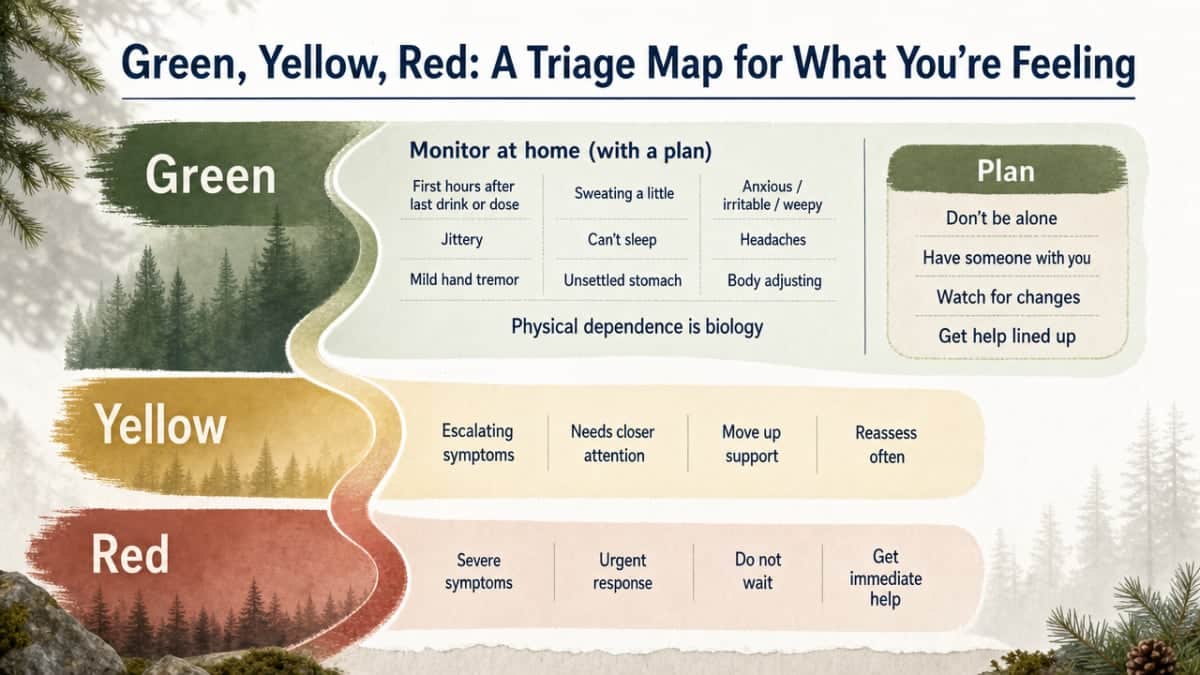
Green, Yellow, Red: A Triage Map for What You’re Feeling
Green: Symptoms You Can Monitor at Home (With a Plan)
Green doesn’t mean fine. It means your body is reacting, and so far the reactions are the kind that can be watched closely while you get help lined up.
Green symptoms usually show up in the first hours after your last drink or last dose. You might feel jittery. Your hands have a mild tremor when you reach for the cup. You’re sweating a little. You can’t sleep, even though you’re exhausted. Your stomach is unsettled. You feel anxious, irritable, maybe weepy. Headaches are common 5.
These are real, and they’re miserable. They also tell you something important: your body got physically dependent, and now it’s adjusting 7. That’s not a character flaw. That’s biology.
If you’re in the green zone, here’s the plan:
- Don’t be alone. Have someone with you who can watch for changes.
- Sip water and an electrolyte drink. Eat something bland if you can keep it down.
- Write down when your last drink or dose was, and what you’ve been using and how much.
- Call your doctor, a nurse line, or the SAMHSA helpline today — not next week 6.
Green can move to yellow or red quickly, especially with alcohol or benzos. Keep reading. Know what you’re watching for.
Yellow: Call a Doctor or Helpline Today
Yellow is the zone where you stop trying to handle this on your own.
Your hands aren’t just shaky — they’re shaking enough that you spill the water. Your heart is pounding even when you’re lying still. The sweating has soaked through your shirt and the pillowcase. You’re throwing up and can’t keep fluids down. You feel waves of panic that don’t match what’s happening in the room. Your blood pressure, if someone checks it, is running high.
You might be more sensitive to light and sound than usual. Your sleep is shredded. Your thinking feels foggy, but you still know where you are and what day it is.
This is the point where alcohol withdrawal can tip toward seizures or worse if it isn’t supervised 3. It’s also the point where opioid withdrawal can leave you so dehydrated from vomiting and diarrhea that you end up in real trouble 15.
Yellow means: get a professional on the phone in the next few hours. A doctor, an urgent care, or the SAMHSA national helpline, which is free, confidential, and answered around the clock 6. Tell them what you’re using, how much, and how long. Ask whether you should come in for evaluation or start a supervised detox.
You are not overreacting by making this call. You’re doing the right thing.
Red: Call 911 Right Now
Stop reading and pick up the phone if any of the following are happening. These are emergencies.
- A seizure — the person stiffens, jerks, loses consciousness, or wakes up confused and doesn’t remember what just happened 2.
- Fever — a real temperature, not just feeling hot from sweating 2.
- Severe confusion — they don’t know where they are, what year it is, or who you are 2.
- Hallucinations — seeing things that aren’t there, hearing voices, or feeling bugs on the skin 2.
- An irregular or racing heartbeat that won’t settle, or chest pain 2.
- Repeated vomiting with someone too drowsy to stay upright — there’s a risk they could choke.
- Severe agitation mixed with confusion and tremors that’s getting worse by the hour. This combination, called delirium tremens or “the DTs,” is a medical emergency and can be life-threatening 10.
When you call 911, say: “I need help. Someone is in alcohol withdrawal” — or opioid, or benzo, whatever fits. Then name the specific symptom: “He just had a seizure.” “She’s seeing things that aren’t there.” “His heart is racing and he doesn’t know where he is.”
Give the address. Unlock the door. Move anything sharp away from the person if they could seize again. Stay on the line. The dispatcher will tell you what to do until paramedics arrive.
The Alcohol Withdrawal Timeline: Hour by Hour
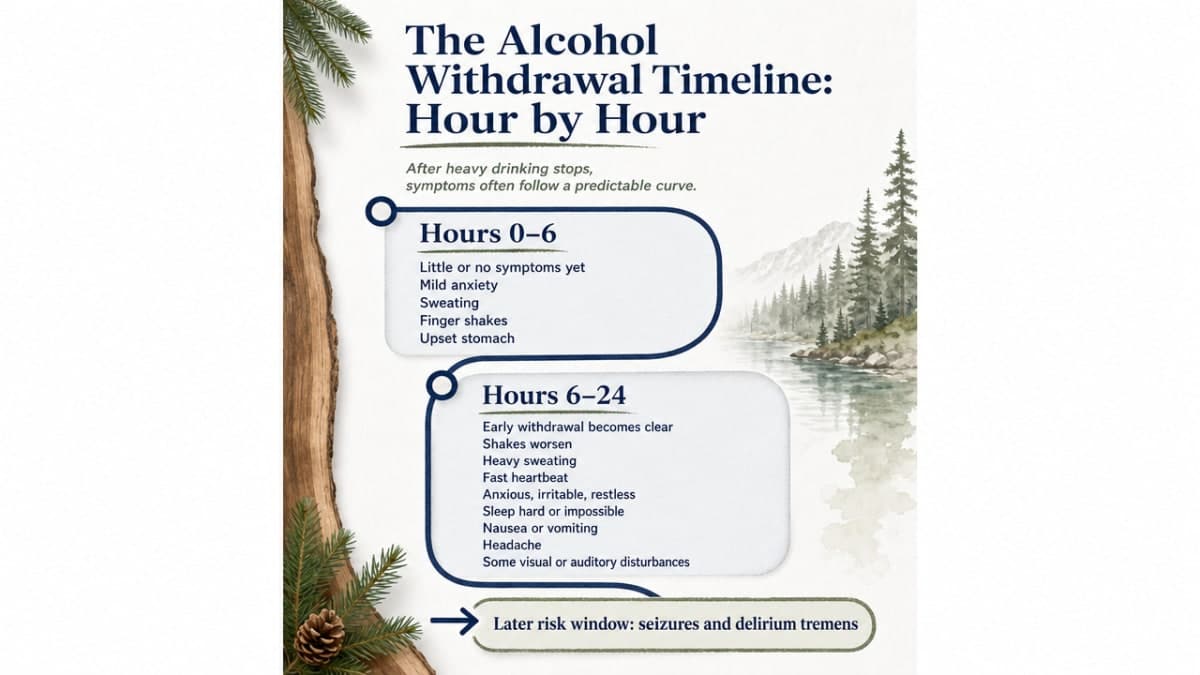
If you’ve been drinking heavily for weeks, months, or years, your brain has rewired itself around alcohol. When you stop, that wiring fires without anything to slow it down. The symptoms move in a fairly predictable pattern, and knowing roughly where you are on the curve can help you decide what to do next.
Hours 0 to 6. Most people don’t feel much yet. Maybe a little anxious. A little sweaty. The shakes might start in your fingers. Your stomach feels off.
Hours 6 to 24. This is when early withdrawal usually shows up clearly. The shakes get more obvious. You’re sweating through your shirt. Your heart is beating faster than it should. You feel anxious, irritable, restless. Sleep is hard or impossible. Nausea, sometimes vomiting. Headaches. Some people start hearing or seeing things that aren’t quite right around the edges of their vision 3.
Hours 12 to 48. For some people, this is when a withdrawal seizure can happen. It usually shows up once, sometimes twice. A seizure during alcohol withdrawal is a medical emergency, even if the person seems okay afterward 3. Call 911.
Hours 24 to 72. Symptoms typically peak. Your blood pressure can climb. Your pulse can race. The tremor gets harder to hide. Hallucinations — seeing, hearing, or feeling things that aren’t there — can show up here without full confusion. This window is the most demanding, and it’s the reason hospital protocols emphasize close monitoring and standardized assessment during these days 4.
Hours 48 to 96. This is the window where delirium tremens, or “the DTs,” can develop in people with heavy, long-term drinking histories. The DTs combine severe confusion, agitation, intense tremors, racing heart, high blood pressure, and hallucinations. It’s a life-threatening emergency 10. Most people don’t develop DTs — but if it happens, it usually happens here.
Day 5 and beyond. For most people, the worst of the physical symptoms ease. You might still feel wrung out, anxious, and sleep-poor for days or even weeks. That’s normal, and it’s the part where ongoing support starts to matter most.
Locate yourself on this timeline. If you’re at hour 8 with the shakes and an anxious heart, you’re still early — that’s the moment to get a professional on the phone before the curve climbs. If you’re at hour 36 and the symptoms keep getting worse, you’re heading into the harder window, not out of it. Don’t wait to see what happens.
Why Alcohol and Benzo Withdrawal Are Different From Opioid Withdrawal
If you take one thing from this article, take this: alcohol and benzodiazepine withdrawal can kill you. Opioid withdrawal usually won’t, but it can hurt you in other ways. The two need different decisions from you and the people helping you.
Here’s how they actually compare:
| What to know | Alcohol / Benzo Withdrawal | Opioid Withdrawal |
|---|---|---|
| When symptoms start | 6 to 24 hours after the last drink or dose | A few hours for short-acting opioids like heroin or oxycodone; 1 to 3 days for longer-acting ones like methadone 15 |
| What it feels like at peak | Shakes, racing heart, high blood pressure, sweating, anxiety, hallucinations, possible seizures, possible delirium tremens 2, 10 | Muscle aches, stomach cramps, vomiting, diarrhea, sweating, runny nose, watery eyes, goosebumps, restless legs, agitation 15 |
| Can it kill you during withdrawal? | Yes. Severe alcohol withdrawal and delirium tremens are life-threatening emergencies 10 | The withdrawal itself is rarely fatal, but vomiting and diarrhea can cause dangerous dehydration, and aspiration can be serious 15 |
| What comes after detox | Lingering anxiety, poor sleep, cravings — the danger curve drops once the acute window passes | Sharply higher overdose risk. Tolerance falls during withdrawal, so a return to a previous dose can be fatal 15 |
What that means in plain terms: if you or someone you love is shaking from alcohol or benzos, the clock is on you. Seizures, fevers, hallucinations, and the DTs cluster in the first few days, and they don’t always announce themselves before they arrive 10. Getting medical eyes on the situation early is the single best thing you can do.
If you’re coming off opioids, the symptoms are going to feel like the worst flu of your life with anxiety bolted on top. It’s awful. It’s also survivable, and the bigger danger is what happens next. Your tolerance drops fast. The same amount you used a week ago can stop your breathing now 15. That’s why getting connected to ongoing care — not just riding it out alone in a bedroom — matters even when the withdrawal feels “only” miserable.
Different bodies, different drugs, different dangers. Same answer: don’t try to read the curve by yourself. Make the call.
When Someone Is Withdrawing From More Than One Substance
A lot of people don’t use just one thing. Maybe you’ve been drinking every night and taking Xanax to sleep. Maybe you’ve been using heroin or fentanyl and chasing it with alcohol to take the edge off. Maybe the prescription pain pills started after the wine stopped being enough. If that’s the picture, withdrawal gets more complicated, and the safest move is not to handle it alone.
The hard part is that the symptoms overlap. Sweating, racing heart, anxiety, nausea, trouble sleeping — all of those can come from alcohol withdrawal, opioid withdrawal, or both at the same time. That overlap makes it hard to tell what’s driving what, and it’s exactly why clinicians flag concurrent withdrawal as a situation that needs close, simultaneous medical monitoring rather than a guess at home 1.
Here’s what matters for you in the room right now: the alcohol or benzo side of the mix is the part that can become life-threatening. Seizures and delirium tremens don’t care that you’re also coming off opioids 10. If you’re withdrawing from both, treat the situation with the urgency of the more dangerous one. That means making the call sooner, not later.
When you reach a doctor or a helpline, list everything. Every substance. How much. How recently. Don’t edit for embarrassment — the people on the other end of that phone have heard it all, and accurate information is what keeps you safe. Supervised detox is built to handle more than one withdrawal at once, and that’s the safer place to be 1.
What to Say When You Call for Help
Calling 911: The Information They Need First
If your hands are shaking too hard to type, the dispatcher will help you. Just dial and start talking. Here’s what to say, in roughly this order:
- Your address. Street number, city, apartment number if there is one. Say it first, in case the call cuts out.
- What’s happening. “My husband is in alcohol withdrawal and just had a seizure.” “My daughter is coming off Xanax and she’s seeing things that aren’t there.”
- What they’ve been using. Alcohol, opioids, benzos, more than one. How much. When the last drink or dose was 2.
- Any medical conditions or medications you know about. Heart problems, diabetes, seizure history, pregnancy.
Unlock the front door. Turn on the porch light. Move sharp objects away if a seizure is possible. Stay on the line.
Calling the SAMHSA Helpline: What Happens Next
If the symptoms aren’t a 911-level emergency but you know you need help, call the SAMHSA National Helpline at 1-800-662-HELP (4357). It’s free, confidential, and answered every hour of every day, in English and Spanish 6.
You won’t get a sales pitch. You’ll get a real person who asks a few questions and connects you to treatment options near you.
Here’s what helps them help you faster:
- What you’re using and how much. Be honest. They’ve heard it all, and they’re not there to judge you 6.
- When your last drink or dose was. This shapes how urgent the next step is.
- What symptoms you’re having right now. Shakes, sweating, vomiting, anxiety, anything else.
- Whether you have insurance. They can route you either way — having or not having coverage doesn’t change whether they’ll help you.
- Where you are. City and state is enough to start.
Ask: “Can you help me find a medically supervised detox today?” That one sentence moves the call forward.
Medical Detox: The Middle Path Between Toughing It Out and the ER
A lot of people don’t know this option exists. They think the choice is white-knuckle it on the couch or end up in an emergency room hooked to monitors. There’s a third door, and for most people coming off alcohol, benzos, or opioids, it’s the one that actually fits.
A medical detox program is a place where doctors and nurses keep you safe, give you medicine so withdrawal hurts less, and connect you to ongoing support. You sleep in a bed, not a hospital gurney. Staff check on you around the clock — blood pressure, pulse, how the shakes are doing, whether you’re holding down water. If symptoms climb toward the red zone, they catch it early and treat it before it turns into a seizure or the DTs 11.
Why this matters: alcohol and benzo withdrawal can move from green to red faster than you can drive yourself to a hospital. Supervised detox shortens that distance. You’re not guessing whether the racing heart is “normal” anymore — someone trained is watching the numbers and adjusting medication to keep you out of trouble 11.
The medicine part is real, and it helps. For alcohol withdrawal, that usually means medications that calm the over-firing brain and replace nutrients heavy drinking depletes 8. For opioids, it means medications that take the edge off the muscle aches, the cramps, the crawling-out-of-your-skin feeling so you can actually sleep and eat. For people withdrawing from more than one substance, supervised care can handle both at once — which is the safer setup when the symptoms overlap 1.
What makes a non-hospital medical detox different from the ER is the setting and the time horizon. An emergency room stabilizes the immediate crisis and sends you home. A residential detox program walks with you through the whole window — the first shaky hours, the peak days, and the handoff into whatever comes next 12. You’re not alone in a waiting room. You’re in a quieter place that feels closer to a home than a hospital, with people who do this every day.
If you’ve been afraid that asking for help means losing your job, your privacy, or your dignity, this is the version of care most people don’t picture. It’s medical, but it’s human. And it exists specifically for the situation you’re in right now.
What Happens After the Worst Days Pass
Around day five or six, the shakes loosen their grip. You can keep food down. You sleep in real stretches instead of jagged half-hours. That’s the body recalibrating, and it’s worth pausing to notice — you got through the hardest window.
What’s also true: you’re not done. The weeks after detox are when a lot of people quietly slide backward, not because they’re weak but because the brain takes time to settle. Anxiety hangs on. Sleep stays choppy. Cravings show up in places you didn’t expect — the smell of beer in a parking lot, the time of day you used to use, an argument with someone you love. Detox by itself is a starting line, not a finish line 12.
If you were withdrawing from opioids, this stretch is the most dangerous one in a different way. Your tolerance is gone. A dose that felt normal a week ago can stop your breathing now 15. The single biggest thing you can do to protect yourself in the next month is stay connected to care — therapy, medication if it’s offered, a group, a person who picks up the phone.
For alcohol, the same logic holds. Withdrawal showing up at all means your body got dependent, and that’s a signal worth taking seriously past the point where the symptoms ease 13. Ongoing support — counseling, group therapy, a structured outpatient program — is where the work of staying out of the next withdrawal actually happens.
You made it through something hard. Let the next call be about what comes after.
Check Your Coverage for Safe Medical Detox
Quickly find out if your insurance covers medical detox and withdrawal support when it’s most urgent.
Frequently Asked Questions
How long do detox symptoms last?
For alcohol, the hardest physical symptoms usually run from about 6 hours after your last drink through day 4 or 5, with the peak between days 1 and 3 3. For short-acting opioids like heroin or oxycodone, symptoms start within hours and ease over 5 to 7 days; longer-acting opioids like methadone can stretch that out 15. Anxiety, poor sleep, and cravings often linger for weeks after.
Can I detox safely at home?
Sometimes, but not always. Mild alcohol withdrawal in a healthy person with someone watching them and a doctor on call can be managed as an outpatient 2. Heavy drinking, a history of seizures or the DTs, mixed substance use, or any benzodiazepine withdrawal changes that answer — those situations need medical supervision because symptoms can turn life-threatening fast 10. If you’re not sure which group you’re in, call the SAMHSA helpline and ask 6.
What’s the difference between feeling sick and a real emergency?
Feeling sick is shakes, sweating, nausea, anxiety, trouble sleeping — miserable, but you still know where you are and you can keep some water down. An emergency is a seizure, a fever, seeing or hearing things that aren’t there, severe confusion about where you are or who’s with you, a racing or irregular heartbeat, or chest pain 2. Any one of those means call 911. Don’t wait for a second symptom to confirm it.
Will I be judged or get in trouble if I call for help?
No. The SAMHSA helpline is free, confidential, and answered 24 hours a day, every day of the year 6. They won’t ask for your name unless you offer it, and they don’t report you to anyone. 911 dispatchers and paramedics are there to keep you alive, not to file paperwork against you. The people who answer these calls have heard every version of this story. You’re not the worst one. You’re not even unusual.
What medications are used during a medically supervised detox?
For alcohol withdrawal, clinicians typically use medications that calm the over-firing brain, along with vitamins like thiamine and folate to replace what heavy drinking strips out 8. Fluids help with dehydration. For opioid withdrawal, medications soften the muscle aches, cramps, and crawling-skin feeling so you can sleep and eat 15. The exact mix is matched to your symptoms, your history, and what else you’ve been using — not a one-size protocol 11.
Is detox enough on its own, or do I need more treatment after?
Detox by itself is a starting line. It clears the substance from your body and gets you through the dangerous window, but it doesn’t teach your brain a new way to handle stress, sleep, or cravings 12. People who stop at detox tend to slide back, especially in the first month when opioid tolerance is gone and overdose risk is highest 15. Counseling, group therapy, medication if offered, and structured outpatient care are where lasting change happens 13.
References
- Concurrent opioid and alcohol withdrawal management. https://pmc.ncbi.nlm.nih.gov/articles/PMC10696169/
- Alcohol withdrawal: MedlinePlus Medical Encyclopedia. https://medlineplus.gov/ency/article/000764.htm
- Alcohol Withdrawal Syndrome – StatPearls. https://www.ncbi.nlm.nih.gov/books/NBK441882/
- Alcohol Withdrawal in Hospitalized Patients. https://www.ncbi.nlm.nih.gov/books/NBK604324/
- Alcohol Use Disorder: Causes, Symptoms, Treatment & Help. https://www.samhsa.gov/substance-use/learn/alcohol
- National Helpline for Mental Health, Drug, Alcohol Issues. https://www.samhsa.gov/find-help/helplines/national-helpline
- Alcohol Withdrawal. https://www.health.harvard.edu/diseases-and-conditions/alcohol-withdrawal-a-to-z
- Clinical management of alcohol withdrawal: A systematic review. https://pmc.ncbi.nlm.nih.gov/articles/PMC4085800/
- Clinical Guidelines for Withdrawal Management and Treatment of Drug Dependence in Closed Settings. https://www.ncbi.nlm.nih.gov/books/NBK310652/
- Delirium tremens: MedlinePlus Medical Encyclopedia. https://medlineplus.gov/ency/article/000766.htm
- The ASAM Clinical Practice Guideline on Alcohol Withdrawal Management Pocket Guide. https://www.samhsa.gov/resource/ebp/asam-clinical-practice-guideline-alcohol-withdrawal-management-pocket-guide
- Quick Guide For Clinicians Based on TIP 45—Detoxification and Substance Abuse Treatment. https://nida.nih.gov/sites/default/files/samhsa_detoxification_and_substance_abuse_treatment.pdf
- Alcohol Use Disorder: From Risk to Diagnosis to Recovery. https://www.niaaa.nih.gov/health-professionals-communities/core-resource-on-alcohol/alcohol-use-disorder-risk-diagnosis-recovery
- Addiction Services (Chapter 415) Rules. https://www.oregon.gov/oha/hsd/pages/addiction-services-rules.aspx
- Opiate and opioid withdrawal: MedlinePlus Medical Encyclopedia. https://medlineplus.gov/ency/article/000949.htm
- Oregon Health Plan 2021–2026 Substance Use Disorder 1115 Demonstration Mid‑Point Assessment Report. https://www.ohsu.edu/sites/default/files/2024-10/SUD%20MPA%20Report%20Final.pdf