


Key Takeaways
- IOP delivers at least nine weekly hours of group therapy, individual counseling, and medication management 9, letting recovery get tested against real work routines rather than treated as a step down from higher care.
- Evidence rates IOP outcomes as comparable to inpatient and residential care 12, and time in treatment predicts fewer drug problems, better employment, and cleaner urine screens more reliably than setting intensity 14.
- Medication is a core piece, not a separate track — detox alone for opioid use disorder raises return-to-use and overdose risk 10, and prescribers should coordinate directly with therapists 4.
- Continuing care after the intensive weeks decides whether year one holds; extended phone check-ins improved alcohol outcomes 15, and structured handoffs kept people engaged significantly longer 16.
The Window Where Recovery Actually Gets Tested
Detox ends. The PHP weeks wrap up. You put on the suit or the scrubs or the work boots again, drive past the exit you used to take, and by Tuesday afternoon your calendar looks the way it always did. This is the stretch nobody warns you about clearly enough. The physical worst is behind you, but the pull of old routines, old contacts, and old five o’clock habits is very much still there.
That is the window an intensive outpatient program is built for. Substance use disorder is a chronic condition, not a one-time event, and the months after acute treatment are when relapse risk is highest 11. IOP keeps the therapy hours, medication support when it fits, and continuing check-ins going while you handle real life. The best outcomes in substance use treatment show up in people who stay connected to care after the intensive phase ends, not those who treat detox as the finish line 1.
If you are reading this after finishing higher-level care, or planning ahead for a spouse or family member, here is the honest frame: IOP is not a step down. It is the part of treatment where recovery actually gets tested against your normal week, and that is exactly why it works.
What ‘Intensive’ Really Means When You’re Still Going to Work
The Nine-Hour Threshold and What Fills Those Hours
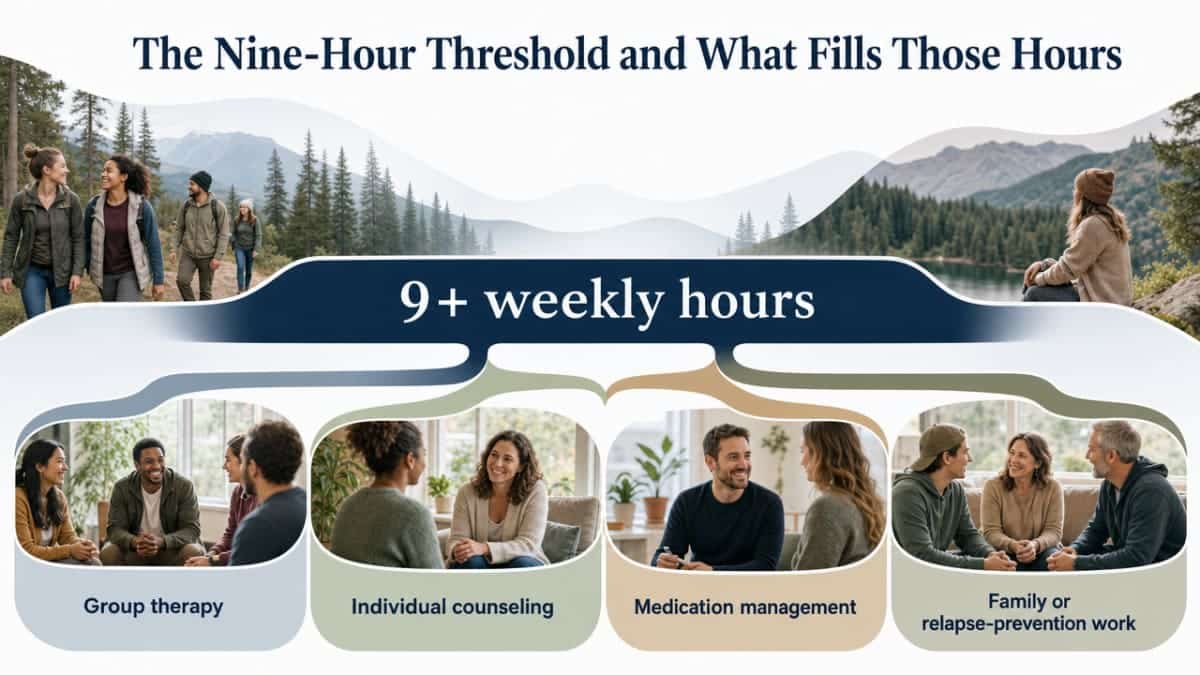
When people hear “intensive,” they picture a facility, a badge, a break from everything. That is not what this level of care looks like on a Wednesday night. A useful benchmark comes from Medicare, which considers someone appropriate for IOP services when the care plan calls for at least nine hours of therapeutic services each week 9. Nine hours is the floor most programs build from, and it is a number you can actually put on a calendar next to depositions, patient loads, or a build schedule.
Those nine-plus hours are not one long session. They break out into a working mix:
- group therapy several times a week
- individual counseling with the same clinician who knows your history
- medication management when it applies
- family or relapse-prevention work that pulls in the people you live with 4, 8
Some programs run three-hour blocks three evenings a week. Others use morning tracks for people whose evenings are unpredictable.
The point of that dosage is repetition. You are practicing new responses to old triggers while those triggers are still active in your life, then coming back the next night to talk through what happened. That rhythm is what makes the hours land differently than a weekly therapy appointment. It is also what lets you stay employed while you do the work — the schedule bends around your job, not the other way around.
Group Work, Individual Counseling, and 12-Step Facilitation as Working Parts
Group can feel like the hardest part to sign up for, especially if part of your job is being the composed person in the room. Here is what tends to surprise people: the group is where the most useful work happens. Sitting with six or eight other adults who are also trying to hold a career and a recovery at the same time changes what you thought was uniquely yours. Someone else describes the exact 4 p.m. slump that used to send you to the bar across the street, and the shame around it loosens.
Individual counseling runs alongside the group and does different work. This is where you unpack the specifics — the marriage, the malpractice worry, the sponsor conversation that went sideways — with one clinician who is tracking your case week over week 4. Groups teach the pattern; individual sessions apply it to your life.
Most programs also weave in 12-step facilitation, which is a structured way of introducing you to peer-support communities outside the clinic walls. The evidence review behind IOP approaches found that 12-step facilitation produced more favorable outcomes for most people with substance use issues 2. You do not have to love every meeting. You do need a community that keeps meeting after your program ends, and this is where you start finding one.
The Evidence That IOP Holds Up After You Go Home
How IOP Compares to Inpatient and Residential Care
You may have been told, gently or otherwise, that residential treatment is the “real” option and outpatient is a compromise. The research tells a different story. An evidence review examining IOPs across multiple studies rated the level of evidence for these programs as high, and found outcomes that were comparable to inpatient and residential care in many of the trials examined 12. The same review flagged an honest caveat worth carrying with you: IOPs vary widely in how they are defined and measured, so program quality matters more than the label on the door.
The federal picture agrees. SAMHSA describes intensive outpatient care as a level that includes one-on-one appointments, group sessions, and coping-skills work — a full clinical package delivered without asking you to move out of your house 8. For a working professional, that is not a lesser dose of treatment; it is the same clinical ingredients arranged so you can keep your license active, your family under one roof, and your absence from work explainable.
An older CADTH review summarized in the NCBI Bookshelf overview reached a similar conclusion when comparing inpatient and outpatient programs for adults with substance use disorders 6. When you look across the literature, the setting matters less than what happens inside it — and how long you stay engaged.
Why Time in Treatment Beats Setting
Scope matters, so read it plainly. This was an RCT in adults with cocaine dependence, not a universal statement about every substance or every person. What it tells you is that within a well-designed outpatient program, the difference between okay outcomes and strong ones was not the intensity of the setting — it was the weeks and months of continuous contact. The same trial found no significant differences among the treatment modalities themselves at follow-up, which is a quiet but important point. The container matters less than whether you stay in it.
A buprenorphine trial comparing intensive outpatient to standard outpatient care for opioid use disorder pointed in a similar direction. Both groups showed substantial improvement over six months on nearly all measures 21. The lesson is not that intensity is irrelevant. It is that medication plus steady, ongoing contact is what carries the weight — and IOP is one of the more reliable ways to keep that contact going while you rebuild a normal week.
Medication Support Is Part of the Program, Not a Separate Track
One of the quiet myths about outpatient recovery is that medication belongs to a different track — something for the people who could not get sober “the real way.” That framing is wrong, and for opioid use disorder it can be dangerous. CDC guidance is direct: detoxification on its own, without medications for opioid use disorder, is not recommended, because it raises the risk of returning to use, overdose, and overdose death 10. If you finished detox and are heading into IOP for an opioid problem, medication is not an add-on. It is a core piece of what keeps you alive long enough for the therapy hours to do their work.
The clinical literature on IOP treats medication the same way. Pharmacotherapy and medication management are described as critical adjuncts to effective substance abuse treatment, sitting alongside counseling rather than replacing it 4. In practice, that looks like a prescriber inside the program who adjusts buprenorphine or naltrexone dosing, checks in on side effects, and coordinates with your therapist so nobody is working with half the picture. For alcohol use disorder, that might mean naltrexone or acamprosate. For opioids, it usually means buprenorphine or extended-release naltrexone.
A randomized trial comparing intensive outpatient with standard outpatient buprenorphine treatment found that both groups showed substantial improvement over six months on nearly all measures 21. The read on that is not that intensity is wasted — it is that steady medication plus regular clinical contact is what carries the outcome. IOP is one of the more reliable containers for keeping both of those steady while you are back at work.
Co-Occurring Anxiety, Depression, and the Job You Still Have to Do
The drinking or the pills were probably doing a job before they became the problem. Quieting the panic before a jury trial. Flattening the low mood on Sunday nights. Taking the edge off after a shift that included a code. When the substance goes away, whatever it was managing tends to come back louder, and it comes back on the same Monday you have twelve patients scheduled or a brief due at four.
This is not a side note. Many people in IOP arrive with a mental health condition running alongside the substance use, and clinical guidance is explicit that programs need to be adapted for co-occurring disorders rather than treating them as a separate referral 3. That means the therapist running your group knows how to work with anxiety and depression, the prescriber can coordinate an antidepressant or a non-addictive anxiety medication alongside any medication for the substance use, and the treatment plan reflects both conditions instead of pretending one exists in isolation 4.
What this looks like on your actual Wednesday: you tell your individual counselor that the cravings spike hardest after difficult client calls, and together you notice the craving is riding on top of untreated anxiety. That is a different intervention than a willpower conversation. Recovery holds better when both pieces get treated at once, which is exactly what IOP is built to do while you keep the job that gives your week its shape.
Eight Stages of the IOP Experience, in Plain Language
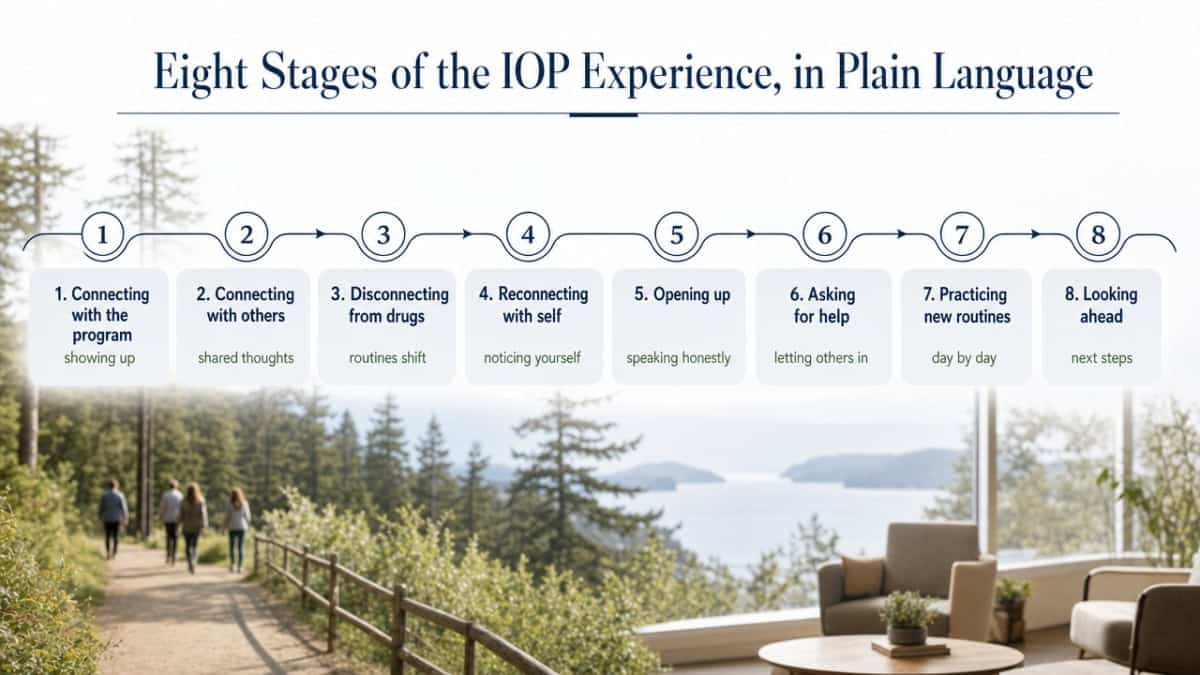
A qualitative study of people going through IOP for opioid use disorder mapped out eight stages that most participants moved through, and the sequence tracks what you will probably feel in your own weeks 19. It helps to see the arc laid out, because when you are in the middle of week three, it is hard to tell whether what you are feeling is progress or a warning sign. Usually it is progress.
- The stages start with connecting with the program — showing up, learning names, deciding you will come back on Thursday.
- Then comes connecting with others, the moment a group member says something you thought only you were thinking.
- Disconnecting from drugs follows, not as a single decision but as a slow rearranging of routines, contacts, and evenings.
- Reconnecting with self comes later, and it is quieter than people expect: noticing you slept through the night, or that you laughed at something without needing anything in your hand.
The remaining stages carry that same shape — deepening trust with the clinical team, taking on harder personal work, testing new coping skills in real situations, and beginning to imagine life past the program. None of it is linear. A rough Monday can push you back a stage; a hard conversation with a partner can pull you forward two. What matters is that the arc exists, and that showing up week after week is what moves you along it.
Why People Stay: Relationships, Not Just Curricula
Ask people who finished an IOP what actually kept them coming back on the nights they wanted to skip, and almost nobody says the worksheets. They say a specific counselor who remembered their kid’s name. A group member who texted on a Sunday. A prescriber who did not flinch when they described a slip. The curriculum matters, but the relationships are what carry you through week seven when the novelty has worn off and the calendar is squeezing.
A 2025 study of clients in an integrated intensive program for substance use disorders found mean satisfaction scores ranging from 9.17 to 9.35 on a 10-point scale, with participants pointing directly to warm staff relationships and self-development opportunities as what made the program work for them 20. That is a narrow study of one integrated program, not a promise about every clinic, but the signal is worth trusting: when people feel known by the team treating them, they stay longer, and staying longer is what protects the sobriety you are working to build.
If you are program-shopping, this is one of the harder things to evaluate from a website. Ask on the intake call who your primary counselor would be, how often you would see them one-on-one, and whether the same faces run group each week. Consistency of people, not just consistency of hours, is what turns an IOP into something you do not want to walk away from.

Continuing Care: The Part That Decides Whether Year One Sticks
Most people picture IOP as the finish line. Twelve or sixteen weeks of hard evenings, a graduation of sorts, and then you go on with your life. The research keeps pointing somewhere different. The best outcomes in substance use treatment show up in people who participate in continuing care after the intensive phase ends, not those who treat the last group session as a stopping point 1.
Continuing care is the part of the plan that runs after your nine-plus hours a week drop down. It can look like a monthly check-in with your counselor, a weekly relapse-prevention group, a standing prescriber appointment for the medication that is keeping cravings quiet, or a scheduled phone call from a clinician who already knows your history. A randomized trial of telephone-based continuing care for alcohol dependence found that adding extended phone check-ins after IOP improved alcohol use outcomes compared to IOP alone 15. It was not a new curriculum. It was a person on the other end of a line, on a schedule, for months longer than the intensive weeks lasted.
A separate study of outpatient patients found that people whose programs actively built continuity-of-care practices into discharge stayed engaged in continuing care significantly longer than those without that structured handoff 16. In plain terms: whether you stick with the follow-up plan has a lot to do with whether the plan was actually built for you before your last IOP night, not left as a vague suggestion afterward.
So when you are evaluating a program, or asking your counselor what week fourteen looks like, get specific:
- Which counselor keeps seeing you?
- How often, and for how long?
- Who manages the medication once the group meetings taper?
- What is the plan if you have a rough weekend six months from now?
Long-term sobriety is not built in the intensive weeks alone. It is built in the quieter months after, when the check-in on your calendar is the thing that reminds you the work is still yours to keep doing.
Cravings, Cognitive Fog, and the Honest Case for Staying Enrolled
Here is something most program brochures skip. A month into IOP, your body will feel noticeably better and your brain will not have caught up yet. A study looking at neuropsychological changes after intensive outpatient treatment found that even though people showed general improvements in executive function, they still had measurable executive dysfunction at the one-month mark 18. Executive function is the part of you that runs meetings, remembers deadlines, and pauses before reacting. It comes back, but slower than the physical recovery you can feel.
That gap is where a lot of people talk themselves out of the program. You feel functional, work is going okay, and the Wednesday night group starts feeling optional. This is exactly when dropping out costs the most. A study of why people leave IOP early found that higher addiction severity was strongly linked to attrition — meaning the people who most need the full course are also the ones most likely to walk 17. Cravings do not track your calendar. They spike on the trip you forgot was coming, the anniversary you did not mark, the night the kids are with their other parent.
Staying enrolled through the quiet weeks is the whole point. Your brain is still catching up. Let it.
What to Look For in an IOP if You Have a License to Protect
You are not just picking a program. You are picking the people who will hold your record, your calendar, and your worst Tuesday for the next several months. A few things separate the programs that quietly protect a professional life from the ones that do not.
Ask about scheduling first. Real evening and early-morning tracks, not “we can sometimes accommodate,” mean the hours line up with court dates and shift changes instead of collapsing them. Confirm the weekly dose meets the working benchmark of at least nine therapeutic hours 9, and ask how missed sessions get made up when a trial runs late.
Ask who prescribes. If medication is part of your plan, you want a prescriber inside the program who coordinates directly with your therapist, not a separate referral you have to chase 4. For opioid use disorder specifically, medication is not optional after detox 10.
Ask about co-occurring care and continuing care in the same breath. Can they treat the anxiety or depression running underneath 3, and what does month four look like after the intensive weeks end 1? A program that cannot answer both questions clearly is not built to hold a career alongside a recovery.
Check If Your IOP Care Is Covered Today
See if your insurance covers confidential, flexible outpatient support for long-term sobriety.
Frequently Asked Questions
Can I keep working full-time while I’m in an IOP?
Yes, and that is a big part of why IOP exists. Most programs run evening or early-morning tracks so the therapeutic hours fit around a full workday 8. Expect at least nine hours a week of therapy, group, and medication management 9. Ask about make-up sessions for court dates or on-call weeks before you enroll.
Is IOP really as effective as inpatient or residential treatment?
For many people, yes. A major evidence review rated the level of evidence for IOPs as high and found outcomes comparable to inpatient and residential care in many studies, while noting programs vary in quality 12. What matters more than the setting is how long you stay engaged and whether medication is part of the plan when appropriate.
Do I need medication if I’m already committed to therapy and group work?
For opioid use disorder, medication is not optional after detox. CDC guidance states detox alone raises the risk of returning to use, overdose, and overdose death 10. For alcohol and other substances, medication is not always required, but it is described as a critical adjunct to counseling 4. Your prescriber inside the program can tell you what fits.
How long does IOP usually last, and what happens after I finish?
Most programs run twelve to sixteen weeks at the intensive dose, then step down into continuing care. That follow-up phase matters: adding extended phone check-ins after IOP improved alcohol outcomes compared to IOP alone 15, and outpatient clients with strong continuity-of-care plans stayed engaged in follow-up significantly longer 16. Ask what month four and month six look like before you graduate.
Will my employer or licensing board find out I’m in treatment?
Your treatment records are protected by federal privacy rules, and IOP is designed to happen outside work hours specifically so you can keep your role without disclosing details 8. Some licensing boards have their own reporting requirements tied to safety-sensitive practice, so a call with a healthcare attorney familiar with your board is worth making before you enroll.
What if I have anxiety or depression alongside substance use?
That is common, and a well-built IOP is prepared for it. Clinical guidance calls for programs to be adapted for co-occurring disorders rather than treating them as separate referrals 3, with therapists and prescribers coordinating on both conditions at once 4. Ask on the intake call whether the same team treats the mental health piece, or whether you would be sent elsewhere.
References
- Chapter 3. Intensive Outpatient Treatment and the Continuum of Care. https://www.ncbi.nlm.nih.gov/books/NBK64088/
- Chapter 8. Intensive Outpatient Treatment Approaches. https://www.ncbi.nlm.nih.gov/books/NBK64102/
- Chapter 9. Adapting Intensive Outpatient Treatment for Specific Populations. https://www.ncbi.nlm.nih.gov/sites/books/NBK64083/
- Chapter 4. Services in Intensive Outpatient Treatment Programs. https://www.ncbi.nlm.nih.gov/books/NBK64094/
- Substance Abuse: Clinical Issues in Intensive Outpatient Treatment. https://www.ncbi.nlm.nih.gov/books/NBK64101/
- Treatment Programs for Substance Use Disorder. https://www.ncbi.nlm.nih.gov/books/NBK584391/
- TIP 47 – Clinical Issues in Intensive Outpatient Treatment. https://www.samhsa.gov/resource/ebp/tip-47-substance-abuse-clinical-issues-intensive-outpatient-treatment
- Treatment Types for Mental Health, Drugs and Alcohol. https://www.samhsa.gov/find-support/learn-about-treatment/types-of-treatment
- Intensive Outpatient Program Services | Medicare Coverage. https://www.medicare.gov/coverage/mental-health-care-outpatient-intensive-outpatient-program-services
- Opioid Use Disorder: Treating. https://www.cdc.gov/overdose-prevention/hcp/clinical-care/opioid-use-disorder-treating.html
- Treatment of Substance Use Disorders. https://www.cdc.gov/overdose-prevention/treatment/index.html
- Substance abuse intensive outpatient programs: assessing the evidence. https://www.pubmed.ncbi.nlm.nih.gov/24445620/
- Efficacy of outpatient intensive treatment for drug abuse. https://pubmed.ncbi.nlm.nih.gov/9083822/
- A randomized controlled study of the effectiveness of intensive outpatient treatment for cocaine dependence. https://pubmed.ncbi.nlm.nih.gov/9634157/
- A randomized trial of extended telephone-based continuing care for alcohol dependence. https://pubmed.ncbi.nlm.nih.gov/20873894/
- Continuity of care practices and substance use disorder patients’ continued care use. https://pubmed.ncbi.nlm.nih.gov/16299435/
- Factors associated with attrition in substance using patients enrolled in intensive outpatient program treatment. https://pubmed.ncbi.nlm.nih.gov/28921780/
- Neuropsychological changes in patients with substance use disorders following intensive outpatient treatment. https://pubmed.ncbi.nlm.nih.gov/30387896/
- Experiences of people with opioid use disorder in intensive outpatient programs. https://pubmed.ncbi.nlm.nih.gov/34772605/
- Clients’ Experiences and Satisfaction with an Integrated Intensive Program for Substance Use Disorders. https://pubmed.ncbi.nlm.nih.gov/40071364/
- A randomized trial of intensive outpatient versus standard outpatient buprenorphine treatment for African Americans. https://pubmed.ncbi.nlm.nih.gov/22999817/
- Preventing Opioid Use Disorder. https://www.cdc.gov/overdose-prevention/prevention/preventing-opioid-use-disorder.html