


Key Takeaways
- The question ‘am I addicted’ actually splits into two: whether tonight’s physical symptoms are a medical emergency, and whether a months-long pattern is costing more than you want to pay.
- Alcohol and benzodiazepine withdrawal can trigger seizures or delirium tremens and require medical supervision, while opioid and stimulant withdrawal rarely kill directly but carry high relapse and overdose risk 5.
- The DSM-5 uses an 11-item checklist where two or three yeses signal mild substance use disorder and six or more indicate severe, meaning you don’t have to hit bottom to qualify for care 17.
- Medical detox stabilizes the first several days with monitoring and medications like buprenorphine or tapered sedatives, but lasting change depends on linking it to ongoing outpatient or residential treatment 7.
Reading This at a Strange Hour
It’s late, or maybe it’s early. The house is quiet. You’re on your phone, and you typed three words into the search bar that you’ve been circling for weeks: am I addicted.
First, take a breath. Reading this took something. Curiosity, fear, exhaustion, some mix of all three — whatever brought you here counts.
You might be sitting up because your hands won’t stop shaking. You might be counting the pills left in the bottle and doing the math on how far they’ll stretch. You might be the partner or parent of someone you love, and you’re the one awake tonight because they aren’t safe and you don’t know what to do next.
You are the expert on your own life. No article can tell you what your last six months have felt like. But there are two things a good article can do for you right now: help you figure out if what you’re feeling in your body is a medical emergency, and give you an honest picture of what asking for help actually looks like.
That’s what the next few minutes are for. No lectures. No dictionary definitions. Just a plain-language look at where you are, and where you could be by tomorrow if you decide to make one call.
Two Questions Hiding Inside One
When you type am I addicted into a search bar, you’re actually asking two questions at once. They feel like the same question. They aren’t.
The first one is about right now. Is what your body is doing tonight — the shaking, the sweating, the racing heart, the pills you’re rationing — a medical situation that needs a professional in the next few hours? That’s a safety question, and it has a fairly clear answer depending on what you’ve been using and how much.
The second one is about the last six months. Is your relationship with this substance costing you more than you want to pay? Sleep, work, the people who used to know you well, money, your own sense of who you are. That’s a pattern question, and clinicians answer it with an 11-item checklist that anyone can walk through in a few minutes 16.
Most articles blur these together and hand you a definition. This one won’t. The safety question comes first, because it can’t wait. The pattern question comes second, because it deserves your full attention when you have some.
The Safety Track: When Withdrawal Is a Medical Emergency
Signs That Mean Call Someone Tonight
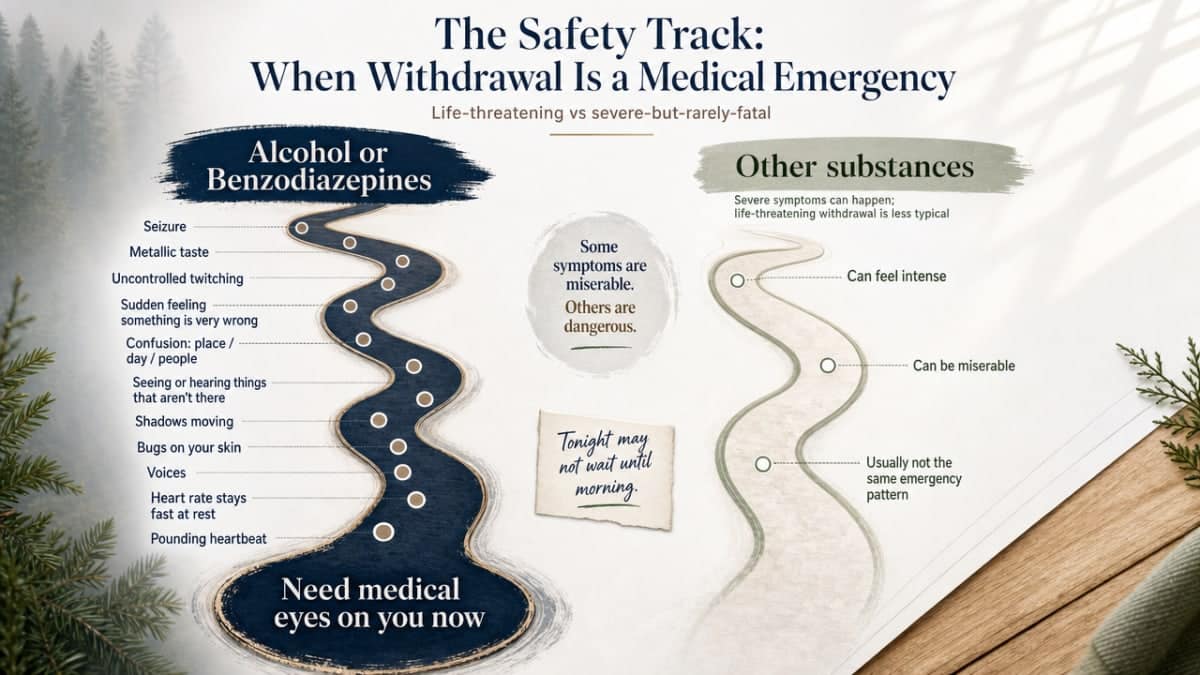
Some withdrawal symptoms are miserable. Others are dangerous. It helps to know which is which before you decide whether tonight can wait until morning.
If you’ve been drinking heavily every day for months or years, or you’ve been taking benzodiazepines like Xanax, Klonopin, Ativan, or Valium regularly, the following signs mean you need medical eyes on you now, not tomorrow:
- A seizure, or the feeling that one might be coming — muscle twitching you can’t control, a strange metallic taste, a sudden sense that something is very wrong
- Confusion about where you are, what day it is, or who’s in the room with you
- Seeing, hearing, or feeling things that aren’t there — shadows moving, bugs on your skin, voices
- A heart rate that stays fast even when you’re lying still, or a pounding you can feel in your neck
- A fever, drenching sweats, or shaking so severe you can’t hold a glass of water
- Vomiting that won’t stop, especially if you can’t keep water down for more than a few hours
Severe alcohol withdrawal can bring on seizures and a condition called delirium tremens — a state of confusion, hallucinations, and dangerous changes in heart rate and blood pressure that can be fatal without treatment 5. Severe withdrawal from sedatives can also cause seizures and muscle breakdown 4.
Why the Substance Matters More Than the Amount
One of the most dangerous myths about quitting is that willpower alone is enough — that if you just white-knuckle it in your bedroom for a few days, you’ll be through the worst. For some substances, that’s roughly true. For others, it can kill you.
Here’s the distinction that most articles skip, and that you deserve to know:
Alcohol and benzodiazepines are the ones that can be fatal to quit alone. Both act on the same calming system in your brain, and when you take that system offline suddenly after long, heavy use, your nervous system can swing so far the other way that it triggers seizures or delirium tremens — the severe confusion-and-hallucination reaction that involves dangerous shifts in heart rate and blood pressure 5. Barbiturates and other sedatives follow the same pattern; severe withdrawal in chronic users can bring seizures and rhabdomyolysis, which is muscle tissue breaking down and flooding the kidneys 4.
Opioids are a different story. If you’ve been using heroin, fentanyl, oxycodone, hydrocodone, methadone, or another opioid, quitting cold turkey is often described by people who’ve done it as the worst flu of their lives — bone aches, chills, nausea, diarrhea, insomnia, waves of anxiety. It’s brutal. It’s rarely fatal on its own. The danger with opioids is different: relapse risk is high, and using again after even a few days off can lead to overdose because your tolerance has dropped 4.
Stimulants like cocaine and methamphetamine tend to produce crash and psychological withdrawal — exhaustion, deep depression, powerful cravings — rather than the physical dangers of the sedative class.
None of this means opioid or stimulant withdrawal is something to tough out at home. It means the reason to seek medical help shifts. With alcohol and benzos, medical detox protects your body. With opioids and stimulants, it protects your resolve, your comfort, and your life the day after you’re clean.
The Pattern Track: 11 Honest Questions About Your Week
The Self-Check, Translated Into Plain Language
Clinicians use an 11-item checklist called the DSM-5 criteria to answer the question you typed into your search bar 16. It isn’t a personality test or a moral judgment. It’s a list of behaviors and experiences, and the number you match tells them how deep the pattern has gone 17.
Here’s the whole thing, in the language you’d actually use with a friend. Think about the last twelve months, or the last six if that’s a clearer window. Answer honestly. Nobody else is reading these.
- Have you used more than you meant to, or for longer than you meant to? The one drink that turned into six. The pill you were going to save for tomorrow.
- Have you tried to cut down or stop, and not been able to make it stick?
- Are you spending a lot of time getting the substance, using it, or recovering from it? Count the hangover hours. Count the drive across town.
- Do you get cravings — a pull toward using that shows up on its own, uninvited?
- Has your use gotten in the way of work, school, or things you’re responsible for at home?
- Have you kept using even though it’s caused problems with people you care about?
- Have you given up or cut back on things that used to matter to you — hobbies, friendships, exercise, time outside — because of your use?
- Have you used in situations that were physically risky? Driving, mixing substances, using alone in a place nobody could reach you.
- Have you kept using even though you know it’s making a physical or mental health problem worse?
- Do you need more than you used to in order to feel the same effect? That’s tolerance.
- Do you get withdrawal symptoms when you stop, or use to keep withdrawal from starting?
Count your yeses. Two or three points to a mild substance use disorder. Four or five is moderate. Six or more is severe 17. The word “disorder” can feel heavy — try to hear it the way a doctor would say it, which is closer to “this has a name, and there’s a plan for it.”
Wherever you landed, that number is information, not a verdict.
Cravings, Tolerance, and ‘Using to Feel Normal’ Are Not Willpower Failures
If several of those questions landed hard, especially the ones about cravings, tolerance, and using to keep withdrawal at bay, you might be doing what a lot of people do at this hour: turning the checklist into a character review.
You don’t need one. What’s happening in your body has a biological explanation that has nothing to do with whether you’re a strong person.
Drugs and alcohol change the brain’s reward and stress systems over time. The circuits that used to give you a lift from a good meal, a walk, a laugh with a friend get quieter. The stress system gets louder 13. That’s why the substance stops feeling like pleasure and starts feeling like the only thing that gets you back to baseline — the thing that makes you feel normal instead of anxious, sick, or flat. Researchers describe addiction as a brain disorder involving changes in reward, stress, and self-control circuits, not a failure of trying hard enough 1.
Life stress makes this worse, not because you’re weak, but because chronic stress itself changes the same systems and makes relapse more likely 14. If the last year has been heavy, that’s part of the picture, not an excuse you’re making.
The point of naming this isn’t to give you a pass. It’s to move the conversation from “what’s wrong with me” to “what would actually help.”
The Shame Layer: ‘Am I Bad Enough to Deserve Help?’
Somewhere between the safety checklist and the pattern checklist, a different question usually shows up. It sounds like this: Am I bad enough for this? Am I really that person?
You picture the people in those chairs in a group room and you don’t see yourself. You still go to work. You still make dinner some nights. You haven’t lost the house. Compared to your uncle, your ex, the guy from high school — you’re fine.
Here’s the thing worth hearing at 2 a.m. You don’t have to earn medical care by getting worse first. Nobody is keeping a scoreboard. The mild end of a substance use disorder is still a substance use disorder, and it’s the easiest place to get help from 17.
The shame you’re feeling isn’t proof you’re a bad person. It’s a symptom of the same brain changes that make the substance feel necessary in the first place — the reward system quieter, the stress system louder, the voice in your head meaner 13. Addiction is understood as a brain disorder, not a character flaw 1.
You are allowed to ask for help before things get worse. That’s not weakness. That’s the smartest move on the board.
What Medical Detox Actually Looks Like
The Room, the People, the First 24 Hours
If the word “detox” makes you picture a locked ward with fluorescent lights and a clipboard at the foot of your bed, put that image down. That isn’t what a good residential medical detox looks like.
Picture a bedroom instead. A real one, with a regular bed, sheets that don’t crinkle, a window you can see out of, a lamp you can turn on when you can’t sleep at 3 a.m. Shared living spaces where you can sit on a couch with a blanket and a cup of tea. A kitchen with actual food. Detox is described in clinical manuals as care that should preserve dignity and treat people humanely, not warehouse them 7.
When you arrive, someone sits down with you. A nurse takes your vitals — heart rate, blood pressure, temperature. A clinician asks what you’ve been using, how much, for how long, and when you last had it. They ask about other medications, past withdrawals, seizures, mental health history. None of it is a test. It’s how they figure out what your body is likely to do in the next 48 hours and what medications will keep you safest 11.
The first 24 hours are the ones you’ll remember least clearly, and that’s usually a mercy. Someone checks on you every few hours through the night. If your heart rate climbs or your blood pressure spikes, a nurse notices before you do. You’re not alone in a bathroom counting the minutes. That’s the whole point.
What Medications Do During Withdrawal
“Medically supervised” is a phrase that sounds official and vague at the same time. Here’s what it actually means in your body.
For alcohol withdrawal, a clinician typically uses a longer-acting sedative — often a benzodiazepine given on a tapering schedule — to keep your nervous system from swinging into seizures or delirium tremens while your brain resets. For opioid withdrawal, medications like buprenorphine or methadone ease the flu-like symptoms and quiet the cravings so you’re not white-knuckling every hour. Other medications treat nausea, sleep, anxiety, and blood pressure as needed.
SAMHSA describes this approach as a “whole-patient” model: FDA-approved medications relieve withdrawal symptoms and cravings, help normalize brain chemistry, and are paired with counseling to support recovery 12. That combination is the current evidence base for treating alcohol and opioid use disorders.
What this feels like from the inside is simpler than the science sounds. The shakes ease. You can keep water down. You sleep in stretches instead of staring at the ceiling. The cravings don’t vanish, but they stop running the room. That space — the one where you can actually think again — is what medication buys you, so the harder work of the next weeks has somewhere to happen.
Inpatient or Outpatient: Which Fits Your Situation
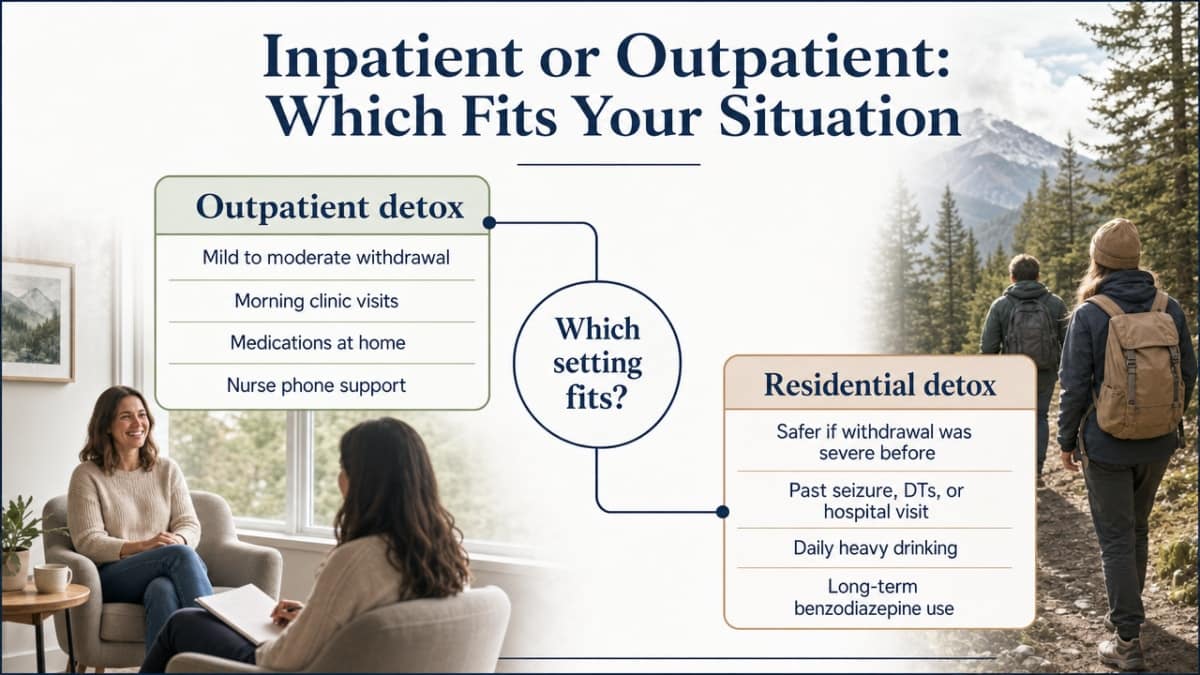
Not everyone who needs medical detox needs to check into a residential program. Some people do better in an outpatient setup — a clinic visit each morning, medications sent home, a nurse on the phone if something changes overnight. For mild to moderate withdrawal, that path can work about as well as staying somewhere 8.
But there are a few situations where residential care is the safer call, and they’re worth knowing by name before you decide.
Lean toward residential detox if any of these are true:
- You’ve had a bad withdrawal before — a seizure, DTs, a hospital visit. History repeats itself here, and the second and third withdrawals tend to be worse than the first 10.
- You’re drinking heavily every day, or you’ve been on benzodiazepines for a long stretch. The sedative class is where the medical stakes climb fastest 6.
- You have another health condition in the mix — heart trouble, uncontrolled diabetes, a seizure disorder, a serious mental health diagnosis. Withdrawal stresses everything at once 10.
- Home isn’t a safe place to detox. Maybe the substance is in the house. Maybe the people in the house are part of the pattern. Maybe you live alone and nobody would notice if you got worse overnight 6.
Outpatient may fit if:
- Your use has been shorter or lighter, and you’ve never had a serious withdrawal.
- You have someone reliable at home who can be with you and drive you to appointments.
- You can get to a clinic daily for the first several days.
If you’re not sure which side you land on, that itself is a reason to call a program and let a clinician help you sort it out. They do this every day. You don’t have to arrive with the answer.
Detox Is a Starting Line, Not a Finish Line
Here’s the honest part, the one you deserve to hear before you make any decisions.
Detox by itself isn’t the whole answer. It’s the first several days — the part where your body gets steady, the fog lifts, and the substance stops running your nervous system. What comes after is where the actual change lives. Clinical guidance is clear that detox should be linked to ongoing treatment, not treated as a standalone fix, because the risk of returning to use is highest in the weeks right after the acute phase 7.
The next 90 days are what “continuum of care” actually means. That might look like a partial hospitalization program a few days a week, then an intensive outpatient schedule of group and individual sessions, then a lighter outpatient rhythm you can keep alongside work or family. Medications from the detox phase — the ones that quiet cravings and steady brain chemistry — often continue into this stretch, paired with counseling 12.
None of this makes detox less worth doing. It makes it more worth doing well. Addiction is treatable, and the people who stack the odds in their favor are the ones who let the first week become the first month, then the third 2.
If You’re Ready to Make One Call Tonight
You don’t have to have a plan. You don’t have to know what program, what insurance, what day. You just have to pick up the phone.
If you’re in danger right now — a seizure, confusion, a heart that won’t slow down — call 911. If you want a human voice who can help you figure out what happens next, SAMHSA’s National Helpline is free, confidential, and open every hour of every day, in English and Spanish, at 1-800-662-HELP (4357) 15.
When you call a residential medical detox program in the Portland area — Pacific Crest Trail Detox is one of them — someone answers. They’ll ask what you’ve been using, how much, and when you last had it. They’ll talk you through what tonight looks like and whether you need to come in now or in the morning. You don’t need the right words. You just need to say you’re scared and you want help. That’s enough.
Check Your Coverage for Safe Medical Detox
Find out if your insurance covers immediate, medically supported detox and care.
Frequently Asked Questions
Is it dangerous to quit drinking or stop taking benzodiazepines on my own?
Yes, and this is the part that catches people off guard. Heavy daily drinking and long-term benzodiazepine use both act on the same calming system in your brain. Stopping cold can trigger seizures or delirium tremens, a severe reaction that involves confusion, hallucinations, and dangerous shifts in heart rate 5. A medically supervised taper is the safe way through.
How do I know if what I’m feeling is normal withdrawal or a medical emergency?
Sweating, nausea, anxiety, and trouble sleeping are miserable but usually manageable. What isn’t normal: a seizure, confusion about where you are, hallucinations, a racing heart that won’t settle, a high fever, or vomiting you can’t stop 4. Any of those means call 911 or SAMHSA’s National Helpline at 1-800-662-HELP now, not in the morning 15.
What actually happens when I call a detox program in the middle of the night?
Someone answers. They ask what you’ve been using, how much, and when you last had it. They walk you through whether tonight needs an emergency room or whether you can come in first thing. You don’t need a plan, insurance details, or the right words. If you’d rather not call a facility yet, SAMHSA’s helpline is open 24/7 15.
Do I have to be ‘bad enough’ before I can go to medical detox?
No. That thought is one of the ways addiction keeps people stuck. The mild end of a substance use disorder is still a substance use disorder, and it’s the easiest place to get help from 17. Addiction involves brain changes in reward and stress systems, not a character grade you have to fail before you deserve care 1.
Can I do outpatient detox and keep working, or do I need to stay somewhere?
For mild to moderate withdrawal with a stable home and someone reliable nearby, outpatient can work about as well as staying at a facility 8. Residential care is safer if you’ve had a serious withdrawal before, have other medical or mental health conditions, drink heavily every day, or don’t have a calm place to be 10. A clinician can help you decide.
What happens after detox is finished?
Detox handles the first several days. What protects the next several months is ongoing care — partial hospitalization, intensive outpatient groups, individual counseling, and often medications that continue quieting cravings 12. Clinical guidance is clear that detox should link to further treatment, not stand alone 7. Addiction is treatable, and stacking those weeks together is how people stay well 2.
References
- Drug Misuse and Addiction. https://nida.nih.gov/publications/drugs-brains-behavior-science-addiction/drug-misuse-addiction
- Treatment and Recovery. https://nida.nih.gov/publications/drugs-brains-behavior-science-addiction/treatment-recovery
- Drug Use and Addiction. https://medlineplus.gov/druguseandaddiction.html
- Withdrawal Syndromes – StatPearls – NCBI Bookshelf. https://www.ncbi.nlm.nih.gov/books/NBK459239/
- Alcohol Withdrawal Syndrome – StatPearls – NCBI Bookshelf. https://www.ncbi.nlm.nih.gov/books/NBK441882/
- An Overview of Outpatient and Inpatient Detoxification. https://pmc.ncbi.nlm.nih.gov/articles/PMC6761814/
- Detoxification and Substance Abuse Treatment. https://www.ncbi.nlm.nih.gov/books/NBK64115/
- Settings, Levels of Care, and Patient Placement. https://www.ncbi.nlm.nih.gov/books/NBK64109/
- Summary of Evidence – Inpatient and Outpatient Treatment Services for Alcohol Withdrawal. https://www.ncbi.nlm.nih.gov/books/NBK507689/
- Who Needs Inpatient Detox? Development and Implementation of a Protocol. https://pmc.ncbi.nlm.nih.gov/articles/PMC3965748/
- Treatment Programs for Substance Use Disorder. https://www.ncbi.nlm.nih.gov/books/NBK584391/
- Treatment Options for Substance Use Disorder. https://www.samhsa.gov/substance-use/treatment/options
- Biology of Addiction. https://newsinhealth.nih.gov/2015/10/biology-addiction
- Chronic Stress, Drug Use, and Vulnerability to Addiction. https://pmc.ncbi.nlm.nih.gov/articles/PMC2732004/
- National Helpline for Mental Health, Drug, Alcohol Issues. https://www.samhsa.gov/find-help/helplines/national-helpline
- DSM-5 Checklist (DSM5). https://arc.psych.wisc.edu/self-report/dsm-5-checklist-dsm5/
- Substance Use Disorders Criteria. https://webcampus.med.drexel.edu/nida/module_2/content/5_0_AbuseOrDependence.htm