


Key Takeaways
- Alcohol withdrawal is a physiological rebound: after heavy daily drinking, the nervous system stays in overdrive when alcohol leaves, causing shakes, racing pulse, sweats, and anxiety 2.
- Symptoms typically start within 8 hours and peak 24–72 hours out, with seizures possible from hours 6–48 and delirium tremens usually appearing 48–96 hours after the last drink 1, 4, 13.
- Prior withdrawal seizures, past delirium tremens, long heavy daily drinking, benzodiazepine use, or serious medical conditions mean home tapering is unsafe and supervised detox is the right call 8.
- Supervised detox combines quiet monitoring of vitals with benzodiazepines — the only medication class consistently effective, safe, and tolerable — plus fluids, thiamine, and sleep to steady the nervous system 16, 17.
What Your Body Is Actually Doing When You Stop Drinking
If you drink heavily most days and then suddenly stop, your body doesn’t just relax back to normal. It goes the other direction — hard.
Here’s what’s happening under the hood. Alcohol is a depressant. When you drink heavily for months or years, your brain adjusts by cranking up its own excitatory chemistry to stay awake and functional despite the sedative flooding through it. Your nervous system essentially learns to shout so it can be heard over the alcohol. Then the alcohol disappears, and the shouting doesn’t stop right away 2.
That’s why the shakes start. That’s why your heart pounds sitting still. That’s why sleep vanishes and anxiety climbs the walls. You’re not being dramatic. Your nervous system is stuck in overdrive with nothing to balance it out 5.
This is physiology, not willpower. People who have been drinking heavily and daily can feel the first symptoms within about 8 hours of their last drink, with things typically peaking somewhere between 24 and 72 hours 1. For some people the whole thing stays uncomfortable but manageable. For others it climbs toward seizures or severe confusion, and that climb can happen fast.
The point of this article is to help you tell which direction your body is heading — and what to do if it’s heading somewhere dangerous. The fact that you’re reading this is already a step.
The Timeline: Hour by Hour After Your Last Drink
Hours 6–12: The First Shakes
You probably won’t notice much for the first few hours. Then, somewhere around hour six or eight, your hands start to feel unsteady. Reach for a glass of water and you’ll see it — a fine tremor you can’t hold still 1.
Other things show up alongside the shakes. A light sweat on your forehead even though the room is cool. A stomach that suddenly doesn’t want breakfast. A pulse that feels faster than it should. Anxiety that has no clear cause. Some people describe it as feeling wired and exhausted at the same time 3.
If you’ve been drinking heavily every day, this window is when your body first realizes the alcohol isn’t coming back. It’s the beginning, not the peak. Most people at this stage can still think clearly, still talk on the phone, still make decisions. That matters — because now is when calling for help is easiest.
Hours 12–24: When Things Get Louder
By the end of the first day, everything you felt at hour eight has turned up the volume. The tremor is more obvious. Your heart is pounding harder. Blood pressure creeps up. Sleep, if it comes at all, is broken and full of vivid, unpleasant dreams 11.
Some people start to see or hear things that aren’t there — a shadow moving in the corner of the room, a voice calling their name from another room, bugs crawling on the sheets. This is called alcohol hallucinosis, and it’s different from the confusion of delirium tremens. You usually still know where you are and what year it is. You just can’t shake the sense that something is off 2.
For a subset of people, seizures can start as early as hour six 4. A withdrawal seizure often comes with almost no warning — one moment you’re sitting on the couch, the next you’re on the floor. If this is you, or you have a history of it, hour 12 is not a moment to tough out at home.
Hours 24–72: The Peak and the Seizure Window
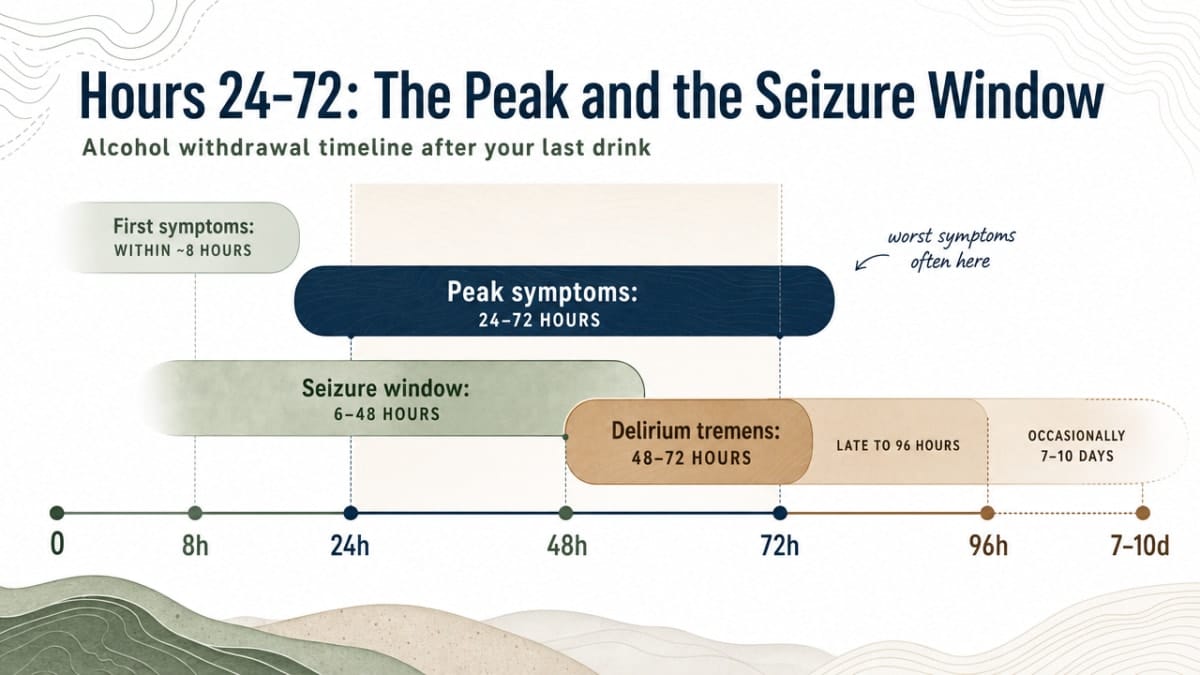
This is the stretch that matters most. Symptoms typically hit their worst somewhere between 24 and 72 hours after your last drink 1. Everything you’ve felt so far can get sharper: harder shakes, heavier sweats, a heart rate that won’t settle, an anxious edge that makes it hard to sit still.
Two dangerous windows overlap in this stretch. Withdrawal seizures usually appear between hours 6 and 48 4. Delirium tremens — the severe confusion, agitation, and unstable vitals that can turn deadly — most often begins 48 to 72 hours after the last drink, though it can arrive as late as 96 hours out and occasionally 7 to 10 days later 4, 13.
If you make it through this window without seizures or severe confusion, the worst is probably behind you. That’s the good news. The harder news is that you can’t reliably predict, from the outside, whether your body is going to sail through hour 60 or crash into it. That unpredictability is the whole reason supervised detox exists — quiet room, medication ready, someone checking your pulse and blood pressure every couple of hours so a rough patch doesn’t become an emergency.
Day 3–7: The Long Tail and the DT Window
By day three, most people who are going to have a straightforward withdrawal start to feel human again. The shakes fade. Sleep, still broken, at least happens. Appetite comes back in pieces. You might feel wrung out and emotional for another week or two, but the physical storm is easing 1.
For a smaller group, day three is when things get harder, not easier. Delirium tremens usually shows up in this window — most commonly 48 to 96 hours after the last drink, though it can appear as late as 7 to 10 days out 13. The signs are hard to miss from the outside: severe confusion about where you are or what day it is, agitation, fever, heavy sweating, and a heart rate and blood pressure that swing wildly. Someone in DT often can’t recognize a family member in the room 1.
Three Tiers of Withdrawal: Uncomfortable, Serious, Life-Threatening
Tier 1 — Uncomfortable: Shakes, Sweats, Bad Sleep
Most people who stop drinking after a stretch of heavy use land here. You feel awful, but you’re safe.
The signs are the ones you probably already recognize from a rough morning after: hands that won’t hold still, a light sweat that keeps coming back, a stomach that turns at the thought of food, a headache that ibuprofen barely touches. Sleep is broken or gone entirely. Your mood is flat one minute and irritable the next. Cravings show up in waves 3.
This tier is genuinely miserable. It is not, by itself, dangerous. What makes it worth taking seriously is that you can’t always tell from the inside whether you’re going to stay in Tier 1 or slide into Tier 2. If you’ve never gone more than a day without a drink in months, the honest answer is you don’t know yet — and that’s a good reason to have someone checking on you.
Tier 2 — Serious: Hallucinations, Racing Heart, Rising Blood Pressure
Tier 2 is where withdrawal stops being just uncomfortable and starts asking for a real answer.
Your pulse sits high even when you’re lying still. Your blood pressure climbs. The shakes become hard to hide — you can’t sign your name, can’t hold a coffee cup without it sloshing. Nausea turns into repeated vomiting, which is a problem on its own because you can’t keep fluids or food down 11.
Then there’s what your senses start doing. Some people begin to see shadows that shouldn’t be there, hear voices from empty rooms, or feel bugs on their skin. This is alcohol hallucinosis, and it’s unnerving but usually different from the deep confusion of Tier 3 — you still know your own name, your address, the day of the week 2.
Being in Tier 2 doesn’t automatically mean you’re heading to the hospital. It does mean this isn’t a solo project anymore. You need eyes on you, a way to measure your vitals, and medication ready if things climb further.
Tier 3 — Life-Threatening: Seizures and Delirium Tremens
Tier 3 is the part of withdrawal that can kill you. It’s rare, but it’s real, and it’s the reason this whole article exists.
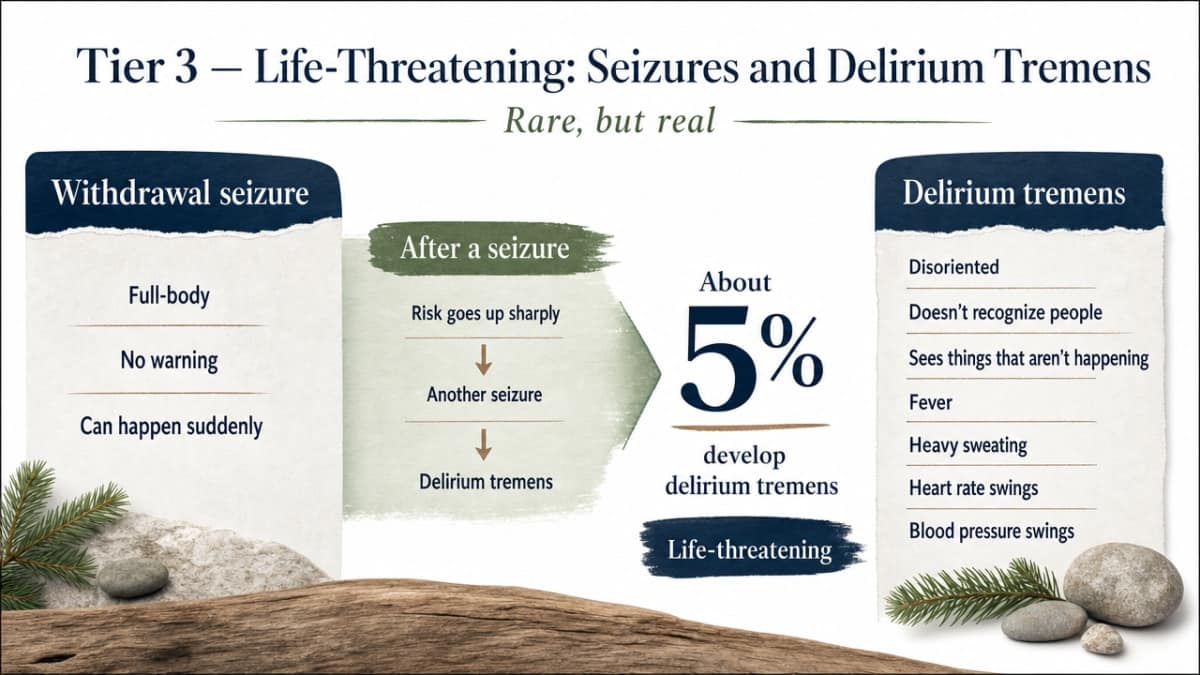
A withdrawal seizure is usually a full-body, out-of-nowhere event. No aura, no warning — one moment you’re sitting up, the next you’re on the floor with people around you 4. Some people have one. Some have several in a row. Either way, once a seizure has happened, the risk of another one, or of delirium tremens on its heels, goes up sharply.
Delirium tremens is the other Tier 3 event. It’s not just “very confused.” It’s not knowing where you are, not recognizing the people in the room, seeing and believing things that aren’t happening, running a fever, sweating through the sheets, with a heart rate and blood pressure that swing hard in both directions 1.
What Pushes You Up the Risk Ladder
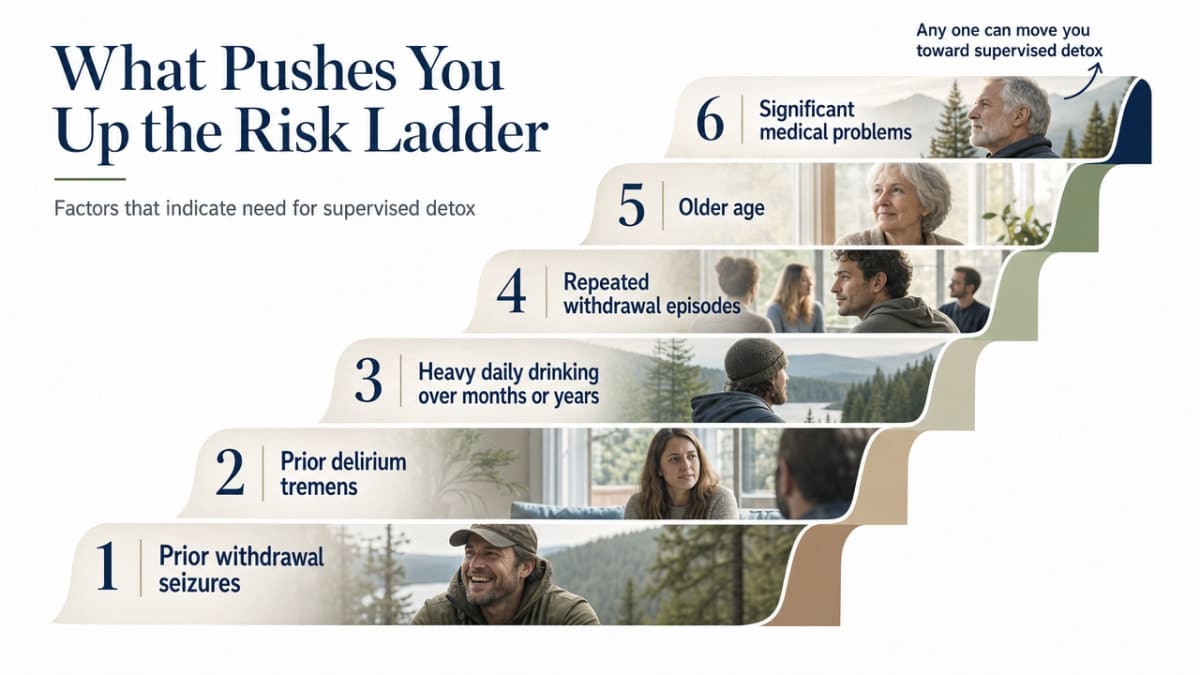
Two people can drink the same amount and have very different withdrawals. The difference isn’t character — it’s history and biology. A short list of factors reliably pushes people from Tier 1 territory into Tier 2 or Tier 3, and if any of them describe you, that’s information worth acting on.
Prior withdrawal seizures. If you’ve ever had a seizure while stopping or cutting back on alcohol, your risk of another one goes up sharply the next time 8. Your nervous system remembers.
Prior delirium tremens. Once someone has been through DT, the odds of it happening again in a future withdrawal are higher. This alone is a strong reason to be admitted rather than tough it out 8.
Heavy daily drinking over months or years. The longer and steadier the drinking, the more your brain has rewired itself around the alcohol — and the louder the rebound when it’s gone 2.
Benzodiazepine use. If you’re also taking Xanax, Ativan, Klonopin, or a similar medication — whether prescribed or not — you’re stacking two withdrawals that work on the same brain system. That combination is not a home project.
Coexisting medical or mental health conditions. Heart disease, uncontrolled diabetes, liver problems, seizure disorders, severe depression or anxiety — any of these raise the stakes if withdrawal turns rough 8.
Older age. Bodies past their forties and fifties tend to handle the autonomic swings — the racing heart, the blood pressure spikes — with less margin for error 5.
If two or more of these describe you, don’t try to detox alone. The safe move is a supervised setting where someone can watch your vitals and step in before a rough hour becomes a hospital run.
The Shame Question, Answered Once
Here’s the thing nobody tells you clearly enough: needing help to stop drinking is not a character flaw. It’s a chemistry problem.
Your brain adapted to alcohol over months or years by rewiring itself. That rewiring is why quitting hurts the way it does — not because you’re weak, not because you didn’t want it enough, not because other people have it easier 2. People who make it through withdrawal safely didn’t out-tough anyone. Most of them had someone watching their vitals and medication ready if things climbed.
Reading this article is not an admission of failure. It’s a reasonable adult looking at a real medical situation and asking honest questions. That’s the whole move. Now let’s talk about what to actually do next.
When Home Tapering Is a Bad Idea
Some people can drink their last beer, ride out a rough couple of days on the couch, and be fine. Others cannot — and the trouble is that the people who cannot often don’t find out until they’re already in it.
Here’s a straight answer instead of a hedge. Do not try to taper at home if any of the following are true for you:
- You’ve had a withdrawal seizure before, even once 8.
- You’ve been through delirium tremens before 8.
- You’ve been drinking heavily every day for months or longer and haven’t gone a full day without a drink in that stretch 2.
- You also take Xanax, Ativan, Klonopin, or another benzodiazepine.
- You have heart disease, uncontrolled diabetes, liver problems, or a seizure disorder 8.
- You already tried to stop in the last few days and felt shaky, sweaty, or saw things that weren’t there.
Home tapering also fails for a quieter reason: alcohol is right there. When hour 20 hits and your hands won’t stop shaking, one drink solves the problem in ten minutes. That’s not weakness — that’s the same physiology this article opened with. A supervised setting removes that variable and hands you medication that does the same job safely 15.
What Supervised Detox Actually Looks Like
The Boring Option: A Quiet Room and Someone Watching
If you’re picturing IV drips, beeping monitors, and fluorescent lights, adjust the image. Non-hospital medical detox in a home-like setting looks a lot more like a quiet bedroom with soft lighting, a shared kitchen down the hall, and a nurse who checks your blood pressure every couple of hours without making a scene about it.
That’s the point. The setting is calm on purpose. Your nervous system is already loud enough — the room shouldn’t be. You sleep when you can. You eat when you can. Someone tracks your pulse, your blood pressure, and how the shakes are trending, and that data is what decides whether you need more medication or you’re actually turning the corner 3.
The word for what supervised detox does most of the time is watching. Watching your vitals for the swings that come before a seizure. Watching your speech and orientation for the confusion that comes before delirium tremens. Watching so that if something climbs, it gets caught in the first minutes, not the first hour 6. That’s what makes it safe. Not drama. Attention.
The Medication Piece: Why Benzodiazepines, and What Else
Here’s the piece that does the heavy lifting. Remember the shouting nervous system from the beginning of this article? Benzodiazepines — medications like diazepam, lorazepam, or chlordiazepoxide — quiet that shouting down in the same way alcohol did, but on a controlled schedule that gets smaller over a few days instead of disappearing all at once. That’s why the shakes ease, the pulse settles, and the seizure risk drops 15.
Across systematic reviews and a network meta-analysis of alcohol withdrawal medications, benzodiazepines are the only class that showed consistent results across effectiveness, safety, and how well people tolerated them 16. That’s why they’re first-line, and that’s why a supervised setting almost always includes them.
Dosing isn’t a fixed recipe. Some programs give a bigger dose up front and let it taper on its own. Others give smaller doses based on how your vitals and symptoms track hour to hour. Severe withdrawal can call for doses every two to three hours until symptoms settle, with staff watching your blood pressure, pulse, and breathing the whole time 17. Anticonvulsants sometimes come in as a helper, especially if there’s a seizure history 15. What matters isn’t which recipe — it’s that someone with a stethoscope is choosing it and adjusting it while you rest.
The Supportive Piece: Fluids, Thiamine, Sleep, Someone to Talk To
Medication is the sharp end of the tool. The rest of what a supervised detox does is quieter and just as important.
Fluids, because you’ve probably been dehydrated for longer than you realize and vomiting doesn’t help. Real meals when your stomach will accept them, because heavy drinkers are often running low on the nutrients the brain needs to steady itself. Thiamine — vitamin B1 — given daily, because long-term drinking depletes it and low thiamine can cause its own serious neurological problems on top of withdrawal 17. A dark room and a real bed, because sleep is one of the things that actually helps your nervous system come back online.
And someone to talk to. Not a lecture, not a treatment plan pitched at hour 30 when you can barely track a sentence. Just a person in the room who has seen this before, who isn’t shocked by any of it, and who can tell you what hour you’re in and what usually comes next 3. That part matters more than most people expect.
How to Reach Out Without Making It a Bigger Deal Than It Needs to Be
You don’t have to have a speech ready. You don’t have to know which program, which insurance code, which level of care. A first phone call is closer to “here’s what I’ve been drinking, here’s how I feel when I stop” than any formal admission.
Say the last time you had a drink. Say roughly how much you’ve been drinking, and for how long. Say whether you’ve ever had a seizure, a blackout that scared you, or a stretch of not knowing where you were after quitting before. That’s enough for someone on the other end to tell you whether you’re safe to stop at home, whether you need to be watched, or whether you need to go straight to an emergency room. A medical detox program in a home-like setting — quiet room, medication that takes the edge off, round-the-clock support like what Pacific Crest Trail Detox provides — exists so this exact conversation has somewhere to go.
Check Your Coverage for Safe Alcohol Detox
Find out if your insurance supports medically supervised alcohol withdrawal care today.
Frequently Asked Questions
How long do alcohol withdrawal symptoms last?
For most people, the physical symptoms start within about 8 hours of the last drink, peak somewhere between 24 and 72 hours, and start easing by day four or five 1. A wrung-out, emotional, sleep-broken feeling can linger for another week or two. If severe symptoms show up, the timeline stretches and the risk goes up.
Can you die from alcohol withdrawal?
Yes, though it’s uncommon. The two events that can kill you are a withdrawal seizure and delirium tremens. DT in particular can be fatal if it isn’t treated promptly 14. That’s why anyone with a history of heavy daily drinking, prior seizures, or prior DT should not stop drinking alone. Medical supervision brings that risk down sharply.
Is it safe to detox from alcohol at home?
Sometimes, if your drinking has been lighter and shorter-term and you have no risk factors. It is not safe if you’ve had a withdrawal seizure before, been through DT, drink heavily every day, also take a benzodiazepine, or have serious medical conditions 8. In those cases, the honest answer is you need someone watching your vitals and medication ready.
What are the first signs that withdrawal is becoming dangerous?
Watch for a pulse and blood pressure that stay high even at rest, repeated vomiting, seeing or hearing things that aren’t there, and confusion about where you are or what day it is 1. A seizure — even a brief one — is a 911 moment. So is not recognizing a family member in the room. Don’t wait it out.
Why are benzodiazepines used during alcohol detox?
Alcohol and benzodiazepines calm the same overactive nervous system. Giving a controlled dose that tapers over a few days quiets the rebound your brain is going through, easing the shakes, settling your pulse, and lowering the seizure risk. Across systematic reviews, benzodiazepines are the only medication class that consistently performs well on effectiveness, safety, and tolerability 16.
How do I know if I need supervised medical detox?
If any of these describe you, choose supervised care: prior withdrawal seizure, prior delirium tremens, heavy daily drinking for months, benzodiazepine use, or serious heart, liver, or seizure conditions 8. Also count it if you tried stopping recently and felt shaky, sweaty, or saw shadows. A single phone call — describing your drinking honestly — gets you a clear answer.
References
- Alcohol withdrawal: MedlinePlus Medical Encyclopedia. https://medlineplus.gov/ency/article/000764.htm
- Introduction to Alcohol Withdrawal. https://pmc.ncbi.nlm.nih.gov/articles/PMC6761824/
- What Nursing Facilities Should Know About Alcohol Withdrawal. https://www.cms.gov/files/document/coe-nf-what-nursing-facilities-should-know-about-alcohol-withdrawal-final-2025.pdf
- Alcohol withdrawal syndrome: mechanisms, manifestations, and management. https://pmc.ncbi.nlm.nih.gov/articles/PMC6084325/
- Alcohol Withdrawal. https://pubmed.ncbi.nlm.nih.gov/39926251/
- Alcohol Withdrawal in Hospitalized Patients. https://www.ncbi.nlm.nih.gov/books/NBK604324/
- Comparative efficacy and safety of pharmacotherapies for alcohol withdrawal: a systematic review and network meta-analysis. https://pubmed.ncbi.nlm.nih.gov/35194860/
- Alcohol Withdrawal Syndrome: Benzodiazepines and Beyond. https://pmc.ncbi.nlm.nih.gov/articles/PMC4606320/
- Management of Alcohol Withdrawal Delirium. http://file.lacounty.gov/SDSInter/dhs/205422_ManagementofAlcoholWithdrawal.pdf
- Alcohol Use. https://www.cdc.gov/alcohol/index.html
- Alcohol Withdrawal Syndrome – StatPearls. https://www.ncbi.nlm.nih.gov/books/NBK441882/
- Alcohol Withdrawal. https://www.health.harvard.edu/diseases-and-conditions/alcohol-withdrawal-a-to-z
- Delirium tremens: MedlinePlus Medical Encyclopedia. https://medlineplus.gov/ency/article/000766.htm
- Delirium Tremens: Assessment and Management. https://pmc.ncbi.nlm.nih.gov/articles/PMC6286444/
- Clinical management of alcohol withdrawal: A systematic review. https://pmc.ncbi.nlm.nih.gov/articles/PMC4085800/
- Pharmacological treatments for alcohol withdrawal: A systematic review and network meta-analysis. https://pmc.ncbi.nlm.nih.gov/articles/PMC9969997/
- Detoxification and Substance Abuse Treatment: Quick Guide for Clinicians Based on TIP 45. https://nida.nih.gov/sites/default/files/samhsa_detoxification_and_substance_abuse_treatment.pdf
- Medically Supervised Withdrawal for Inmates with Substance Use Disorders: Clinical Guidance. https://www.bop.gov/resources/pdfs/medically_supervised_withdrawal_cg.pdf