
Key Takeaways
- A medical detox in Milwaukie sits within the Portland metro care network and about an hour west of the Mt. Hood corridor, keeping hospitals close while the forest stays on the horizon.
- The first 72 hours of alcohol or opioid withdrawal are a medical event that calls for monitoring and medications like buprenorphine, methadone, or a benzodiazepine taper — not white-knuckling at home 5, 6.
- Pacific Crest Trail Detox works with most major commercial insurance but not the Oregon Health Plan; OHP holders can be pointed to certified providers in the state directory 4.
Standing at the Edge of a Hard Decision
You already know something has to change. Maybe you’ve been sitting with that knowledge for weeks, or maybe it hit you at 3 a.m. last night. Either way, the fact that you’re reading this page instead of scrolling past it means part of you is ready to see what’s on the other side of the drink or the pill.
That takes something. Please don’t skip past that.
Most people picture detox and think of two extremes: a sterile hospital hallway on one end, or trying to white-knuckle it alone in their bedroom on the other. Neither one has to be your only option. There is a middle path — a medical detox that keeps you physically safe from alcohol or opioid withdrawal, in a place that feels closer to a house than a ward, within a short drive of the Douglas firs and the shoulder of Mount Hood.
You’re also not doing this in a vacuum. In Clackamas County alone, tens of thousands of your neighbors are living with a substance use disorder and most of them aren’t in specialty care right now 15. That statistic isn’t there to shame anyone. It’s there so you know the phone call you’re thinking about making is a call thousands of other Oregonians are also working up the courage to make.
What follows is a plain, honest look at what a calmer detox near Mount Hood actually involves — what medical care does in those first days, what the Pacific Northwest landscape can and can’t do for you, and what a next step might look like when you’re ready. No pressure. Just information you can trust.
What a Medical Detox Actually Does in the First 72 Hours
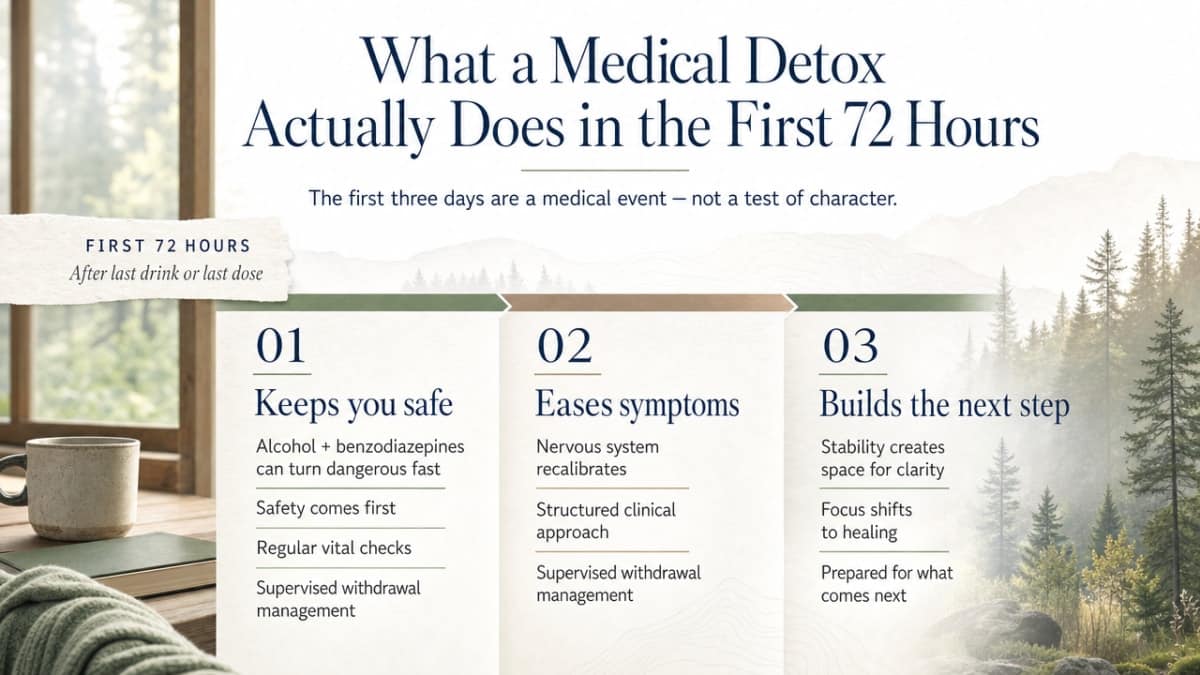
Here’s the part that gets glossed over in a lot of blog posts, so let’s slow down: the first three days after your last drink or last dose are a medical event, not a test of character. Your body has spent months or years adjusting to a substance. When that substance leaves, your nervous system has to recalibrate, and for alcohol and benzodiazepines especially, that process can turn dangerous fast. This is why detoxing alone at home is not a fair fight, and it’s why nobody should feel weak for needing help getting through it.
A medical detox does three things during those first 72 hours:
- it keeps you safe,
- it eases the symptoms, and
- it starts building the next step before you’re through the worst of it.
Safety comes first. For alcohol withdrawal, that means clinicians using a structured approach — checking your vitals on a regular schedule, watching for signs of severe withdrawal like tremors, seizures, or delirium tremens, and adjusting care as your body responds. The ASAM clinical practice guideline that governs this work spells out exactly how to manage alcohol withdrawal syndrome as a medical process with clear decision points, not guesswork 6. For opioid withdrawal, the physical danger is usually lower than with alcohol, but the misery — the nausea, the sweating, the bone-deep aching, the inability to sleep — is what drives people back to using within hours. Medical supervision is what breaks that loop.
Then there are the medications that actually ease what you’re feeling. For opioid use disorder, SAMHSA’s TIP 63 identifies three FDA-approved medications: methadone, buprenorphine, and naltrexone 5. Each one works differently, and the right choice depends on your history, your goals, and what withdrawal looks like for you specifically. For alcohol, medications like benzodiazepines on a taper, along with supportive treatments for sleep, nausea, and anxiety, are standard parts of a supervised withdrawal plan 6. None of this is optional comfort. It’s the difference between white-knuckling a symptom for 72 hours and actually being able to rest.
The third thing a good detox does, and this is the one people underestimate, is start planning day four while you’re still on day two. Detox on its own isn’t treatment. It’s the doorway. The clinicians helping you through withdrawal should already be talking with you about what comes next — whether that’s a partial hospitalization program, an intensive outpatient schedule that fits around your job, or ongoing medication-assisted treatment. That handoff is the whole point.
So when you picture the first three days, don’t picture a hospital gurney and a fluorescent light. Picture a bed, a nurse who checks on you, medication when you need it, food when you can eat it, and someone sitting down with you before you leave to make sure you’re not walking back out into the same day you walked in from.
Milwaukie as the Base, the Mt. Hood Corridor as the Horizon
Geography matters more in recovery than people give it credit for. Where you physically sit during those first days shapes how safe your body feels, and how quickly your mind starts believing that safety is real.
Milwaukie sits on the southeast edge of the Portland metro, tucked along the Willamette. It’s residential, quieter than downtown, and close enough to major hospitals if a medical situation ever needs escalation. That last part matters. A non-hospital detox is not the same as a remote retreat — the safety net is nearby, just not the setting. Pacific Crest Trail Detox is one of the certified detoxification providers listed by the Oregon Health Authority at a Milwaukie address, which places it inside the regional care system rather than off on its own 4.
Now look east. From Milwaukie, U.S. 26 climbs out of the metro and lifts you toward the Mt. Hood National Forest in about an hour. You pass through the last of the suburbs, then farmland, then the trees close in. Douglas firs. Cedar. The kind of light that only exists in the Pacific Northwest, filtered and quiet. On a clear day, the mountain itself shows up in your windshield like a promise.
You are not going to hike Mt. Hood on day two of alcohol withdrawal. Nobody should. But knowing that landscape is twenty minutes further up the road — that the recovery you’re beginning takes place inside a region built around trails, rivers, and open sky — can change how the walls feel around you. The horizon is part of the plan, even before you’re strong enough to walk out into it.
You Are Not the Only One Reaching Out in Clackamas County
If you’re reading this from Milwaukie, Oregon City, Gladstone, Sandy, Estacada, or somewhere further up the Mt. Hood corridor, it can feel like you’re the only person on your street who has been quietly falling apart. You’re not.
The Oregon Health Authority’s gap analysis puts real numbers around that feeling. In Clackamas County, roughly 66,471 residents age 12 and up are living with a substance use disorder. About 65,960 of them are not receiving treatment in a specialty facility — a service gap of roughly 68% 15. That is not a rounding error. That is your county.
Sit with what those numbers actually mean for a second. It means the guy two aisles over at the Milwaukie Fred Meyer is probably in the same math. The parent at your kid’s school pickup. The coworker who has been calling in sick on Mondays. The neighbor whose porch light stayed on all night again. None of you are talking to each other about it. Most of you are not in care yet. And the reason isn’t that people don’t want to get better — it’s that the space between wanting help and asking for it is the loneliest distance in the world.
Here is the part worth holding onto: a gap that size is not a verdict on you. It’s a description of a system that has not made asking easy, and of a culture that still treats a health condition like a personal failure. When you pick up the phone, you are not the exception. You are one of tens of thousands of your neighbors who could be doing the same thing this week and probably should be.
What actually helps is knowing that when you reach out to a place like Pacific Crest Trail Detox, you are stepping into a small, everyday act — not a dramatic one. A nurse answers. Someone asks about your last drink or last dose, your history, your insurance, and whether you have someone who can drive you. It is the same conversation people from your same zip code have been having, quietly, for years.
You are not the first person in Clackamas County to be scared of this call. You will not be the last. You are just the one making it today, and that counts.
Why the Region’s Overdose Numbers Still Matter Even as They Fall
Something real is happening in Oregon, and it deserves to be said out loud before we talk about what still isn’t fixed.
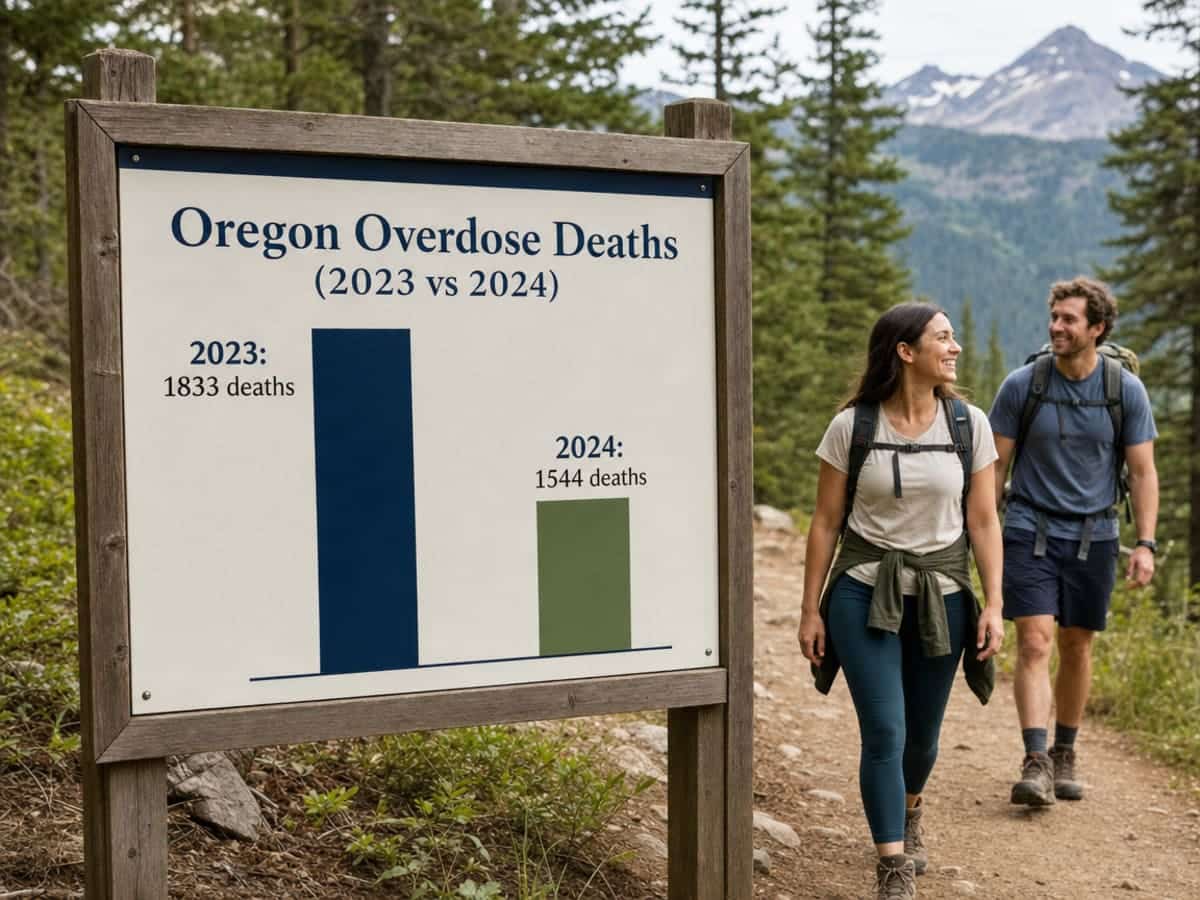
For the first time since 2016, overdose deaths in the state actually went down. Oregon recorded 1,833 overdose deaths in 2023 and 1,544 in 2024 — a drop of roughly 289 people who are still alive because something in the system worked 2. Naloxone got easier to find. More people were connected to medications for opioid use disorder. Word-of-mouth about fentanyl in the drug supply spread through communities that used to whisper about it. Preliminary numbers for 2025 point even lower, near 1,100 deaths, though those figures are still being finalized 2.
You are allowed to feel some relief reading that. The people around you who have been holding their breath for years are allowed to exhale a little.
And then we have to sit with the harder part.
Fifteen hundred neighbors is still fifteen hundred neighbors. That’s more than four Oregonians lost every single day of 2024 — parents, kids, coworkers, the person a few pews back at church. The trendline going the right direction is not the same as the crisis being over. If you’re the one in the middle of it right now, standing in your kitchen at 2 a.m. trying to decide whether to make the call, the state average doesn’t reach you. Your body doesn’t know that overdose deaths dropped 15.8% year over year. Your body knows what it took last night and what it’s going to demand tomorrow.
That’s why detox capacity in the Portland metro and along the Mt. Hood corridor still matters, and why the door at a place like Pacific Crest Trail Detox in Milwaukie needs to stay open. The reason the numbers are moving is that more people are getting to care sooner. If you’re reading this, you could be one of them. The trend keeps bending in the right direction one phone call at a time — and yours would count.
How Nature Actually Fits Into Recovery (and Where It Doesn’t)
Let’s be straight with each other, because this is the part where a lot of pages start selling you a feeling instead of a fact.
The trees are not going to detox you. A view of Mount Hood will not lower your blood pressure enough to make an alcohol withdrawal safe. A morning on a trail will not replace buprenorphine for opioid use disorder. If anyone tells you otherwise, close the tab.
What the research actually says is more interesting than the marketing version. A 2024 review looked at 85 studies of nature-based interventions for people dealing with drug dependence — walks in green spaces, gardening, forest time, views of trees from a window — and found that roughly 85% of those studies reported positive outcomes on things like craving, mood, stress, and well-being 10. That is a genuinely encouraging signal. It is also, honestly, a mixed bag of study designs, small samples, and different definitions of what counts as a good outcome. The reviewers themselves call for more rigorous trials before nature time gets treated as core treatment instead of a helpful add-on 10.
One specific finding from a companion 2024 review is worth holding in your hand, though. After a one-hour walk in nature, people in SUD treatment showed measurably lower cravings than they had before the walk — and lower than after an equivalent walk through a city 11. One hour. Trees over pavement. That is not a cure. That is a tool. A real one, backed by a real measurement, that becomes available to you once your body is stable enough to use it.
The broader picture from a 2021 umbrella review of outdoor therapies lands in the same place: mostly positive effects on mental health, stress, and how people function day to day, with weaker evidence for direct physiological outcomes and no clean causal line from a hike to lasting sobriety 13. Wilderness therapy programs specifically show improvements in things like self-esteem and behavior, but the studies vary widely and the authors are careful about how far to generalize 17.
So here is the honest sequence.
During the first days of withdrawal, the medicine and the monitoring are what keep you safe. The forest is not the intervention — the clinical team is. Once your nervous system settles and you move into the next stage of care, the Pacific Northwest around you becomes something you can actually reach for. A short walk under Douglas firs. A window seat with real light coming through it. A weekend, later on, when the Mt. Hood corridor stops being a horizon in your head and becomes a place your feet have been.
That is what the trees are for. Not to replace the care. To give you a reason to keep showing up for it.
What Care Includes After the First Few Days
Detox is not the finish line. It is more like getting through the storm so you can actually see the road.
Once your body is stable — usually somewhere between day three and day seven, depending on what you were using and how your withdrawal went — the question shifts. It stops being “how do I get through tonight” and becomes “what do I do with the next ninety days so I don’t end up back here.” That’s the part a lot of people don’t have language for, so let’s walk through it.
The most common next step is a partial hospitalization program, often called PHP. You sleep at home or in supportive housing and spend most of your daytime hours in structured treatment — group therapy, individual counseling, medication management, help with the practical stuff like family, work, and legal issues. It’s intensive without being residential. From there, most people step down into an intensive outpatient program, or IOP, which typically runs a few evenings or mornings a week so you can hold a job or care for kids while you keep the work going. After IOP, standard outpatient and alumni groups take over — less frequent, more focused on holding the ground you’ve gained.
Medication often continues through all of that. For opioid use disorder, buprenorphine, methadone, or naltrexone can stay in the picture long after acute withdrawal ends, because the evidence for medication-based treatment is strongest when it’s not treated as a short-term fix 5. The CDC frames the goal plainly: return people to functioning in family, work, and community life 9. That takes months, not days.
Pacific Crest Trail Detox is built around that whole arc — detox, PHP, IOP, outpatient, aftercare — under one roof in Milwaukie, so the handoff between stages is a hallway, not a phone tree. That continuity matters more than any single step in it.
What Happens When You Call: Insurance, Timing, and the First Night
The phone call is smaller than you think it will be. There is no lecture. There is no one asking you to justify why you waited this long. A person answers, and the first thing they usually want to know is whether you’re safe right now.
Here’s what the conversation actually covers. Someone will ask what you’ve been using — alcohol, opioids, benzodiazepines, or some combination — and when your last drink or dose was. That timing matters because it tells the clinical team how close you are to withdrawal, and how urgent the next few hours need to be. They’ll ask about your medical history, any medications you take, and whether you’ve been through detox before. They’ll ask if you have someone who can drive you, or if you need help figuring that part out.
Then comes the insurance question. Pacific Crest Trail Detox works with most major commercial insurance plans. It does not accept the Oregon Health Plan. If you have OHP, the person on the phone can point you toward providers listed in the Oregon Health Authority’s certified detox directory who do take it 4— nobody is going to leave you standing in the parking lot.
If the timing lines up, admission can often happen the same day or the next morning. You’ll pack light. A few changes of clothes, your ID, your insurance card, a phone charger. Leave the work laptop.
The first night is quieter than you’re bracing for. A nurse takes your vitals. Medication starts if you need it. There’s a bed in a room that looks like a room, not a ward. Someone checks on you. You sleep, or you don’t, but you are not alone with it anymore. That is the whole point of walking through the door.
See if your detox near Mount Hood is covered
Find out fast if insurance can help you detox safely in the Mount Hood area.

Frequently Asked Questions
Is medical detox actually safe for alcohol or opioid withdrawal?
Yes, and that’s the whole point of doing it under medical supervision instead of at home. Alcohol withdrawal in particular can turn dangerous fast — seizures and delirium tremens are real risks. The ASAM clinical guideline treats it as a medical event with clear monitoring and medication steps 6. For opioids, the danger is usually lower but the misery drives people back to using; supervision and medications for opioid use disorder change that outcome 5.
How long does detox usually take before I can go home or step down to the next level of care?
For most people, the acute part lands somewhere between three and seven days, depending on what you were using, how much, and how long. Alcohol and benzodiazepines often need a longer, slower taper. Opioid withdrawal peaks earlier but the fatigue lingers. You won’t be sent home the minute symptoms ease — the handoff into partial hospitalization or intensive outpatient care usually gets planned while you’re still stabilizing, so day one of the next step is already waiting for you.
Do you take my insurance, and what if I have the Oregon Health Plan?
Pacific Crest Trail Detox works with most major commercial insurance plans. It does not accept the Oregon Health Plan. If OHP is what you have, that doesn’t mean you’re stuck — the Oregon Health Authority publishes a directory of certified detox providers across the state, and staff on the phone can point you toward programs that do take OHP 4. Nobody who calls should end up with no path forward. Ask that question out loud early.
Can I bring my phone, and what about my job while I’m in detox?
Phone policies vary and get explained at intake — usually there’s some access, with quiet hours so your nervous system can actually rest. On work: federal law protects your job in many situations through FMLA if your employer qualifies, and short-term disability may apply. Detox is a medical event, and you can describe it that way to HR without disclosing the substance. Bring it up on the call — someone can help you think through what to tell whom.
What happens after the first few days of detox are over?
You step down, you don’t stop. The next stage is usually a partial hospitalization program — structured days of group and individual therapy while you sleep at home or in supportive housing. From there, most people move into an intensive outpatient schedule that fits around work or family, then standard outpatient and alumni support. Medication for opioid or alcohol use disorder often continues through all of it, because the evidence for medication-based care is strongest when it’s ongoing 5.
Does being near Mount Hood and the forests actually help with recovery?
It helps — as a companion to treatment, not a substitute for it. A 2024 review of 85 studies on nature-based interventions for drug dependence found about 85% reported positive outcomes on things like craving, mood, and well-being, though the authors call for more rigorous trials before nature time gets treated as core care 10. Once your body is stable, a walk under Douglas firs is a real tool. During withdrawal, the clinical team is what keeps you safe.
References
- Oregon Behavioral Health Residential+ Facility Study. https://www.oregon.gov/oha/HSD/AMH/DataReports/Behavioral-Health-Residential-Facility-Study-June-2024.pdf
- Oregon overdose deaths declined in 2024, 2025. https://www.oregon.gov/oha/erd/pages/oregon-overdose-deaths-declined-in-2024-2025-05.13.2026.aspx
- Oregon Health Authority : Opioid Publications. https://www.oregon.gov/oha/ph/preventionwellness/substanceuse/opioids/pages/publications.aspx
- Oregon Substance Use Disorders Treatment Provider Directory. https://www.oregon.gov/oha/HSD/AMH/Publications/provider-directory.pdf
- TIP 63: Medications for Opioid Use Disorder. https://library.samhsa.gov/product/tip-63-medications-opioid-use-disorder/pep21-02-01-002
- The ASAM Clinical Practice Guideline on Alcohol Withdrawal Management. https://www.samhsa.gov/resource/ebp/asam-clinical-practice-guideline-alcohol-withdrawal-management
- SAMHSA Releases Annual National Survey on Drug Use and Health. https://www.samhsa.gov/newsroom/press-announcements/20260727/samhsa-releases-annual-national-survey-on-drug-use-and-health
- Results from the 2025 National Survey on Drug Use and Health. https://www.samhsa.gov/data/sites/default/files/reports/rpt57150/2025-nsduh-annual-national-report.pdf
- Recovery is Possible: Treatment for Opioid Addiction – CDC. https://www.cdc.gov/overdose-prevention/treatment/opioid-addiction.html
- Harnessing the healing power of nature: a review of natural environments as a treatment in addiction recovery. https://pmc.ncbi.nlm.nih.gov/articles/PMC11570648/
- Recovery Horizons: Nature-Based Activities as Adjunctive Therapeutic Options in Substance Use Disorder Treatment. https://pmc.ncbi.nlm.nih.gov/articles/PMC11571177/
- Nature-based experience in Venetian lagoon: Effects on craving and wellbeing in addict residential inpatients. https://pubmed.ncbi.nlm.nih.gov/38933590/
- Nature’s Role in Outdoor Therapies: An Umbrella Review. https://pmc.ncbi.nlm.nih.gov/articles/PMC8150931/
- Treatment Improvement Protocol (TIP) 63: Medications for Opioid Use Disorder. https://integrationacademy.ahrq.gov/resources/7411
- Oregon Substance Use Disorder Services Inventory and Gap Analysis Report. https://www.oregon.gov/oha/HSD/AMH/DataReports/SUD-Gap-Analysis-Inventory-Report.pdf
- Oregon Health Authority Behavioral Health Residential + Facility Study (January 2024). https://www.oregon.gov/oha/HSD/AMH/docs/OR-BH-Residential-Facility-Study-January-2024.pdf
- Wilderness Therapy Programs: A Systematic Review of Research. https://www.wsipp.wa.gov/ReportFile/1748/Wsipp_Wilderness-Therapy-Programs-A-Systematic-Review-of-Research_Report.pdf
- Informational Bulletin: Coverage of Substance Use Disorder Services. https://www.medicaid.gov/federal-policy-guidance/downloads/CIB-07-11-2014.pdf