


Key Takeaways
- Safety in a treatment center means specific, verifiable markers: a current state license, evidence-based therapies, medication options when appropriate, individualized planning, family involvement, and a written aftercare plan.
- Match the level of care to medical risk first — alcohol and benzodiazepine withdrawal often require supervised detox, while opioids usually need medication plus counseling to prevent fast relapse.
- Medication-assisted treatment combined with behavioral therapy is one of the most studied approaches for opioid and alcohol use disorders, not a substitute drug or a shortcut around real recovery work.
- What happens after detox decides whether recovery holds; insist on a written aftercare plan with scheduled next steps, continuing medications, support groups, and a clear relapse response before discharge.
If you’re reading this after another hard phone call
If it’s late, and you just hung up the phone, and your hands are still shaking — take a breath. You are not failing. You are doing one of the hardest things a parent can do: trying to help an adult child who is struggling with addiction, while accepting that you cannot force the outcome.
Maybe this is the first time you’ve looked into treatment. Maybe it’s the fifth. Maybe your son or daughter has been to a center before, came home, and started using again, and now you’re wondering whether any of this works at all. That exhaustion is real. So is the fear of picking the wrong place.
Here is what this guide will do. It will give you a calm, specific way to tell a safe addiction center apart from one that just markets well. You will learn what to verify, what to ask, and what to expect after detox ends — because detox alone is rarely enough. You’ll also see how to use free public tools, including SAMHSA’s 24/7 National Helpline, when you need a real person to talk you through your options 1.
You have more choices than you think tonight. Let’s walk through them together, one step at a time.
What ‘safe’ actually means when you’re choosing a treatment center
When you hear the word “safe,” you probably picture a clean building with kind staff and a locked door. Those things matter. But safe, in the world of addiction center treatment, has a more specific meaning — and the good news is you can actually check most of it before you ever send your loved one anywhere.
Researchers and federal health agencies have spent years studying what separates a higher-quality program from one that just looks good in a brochure. The markers come up again and again across SAMHSA and NIDA guidance, and they give you a short list you can hold any center against 5, 6.
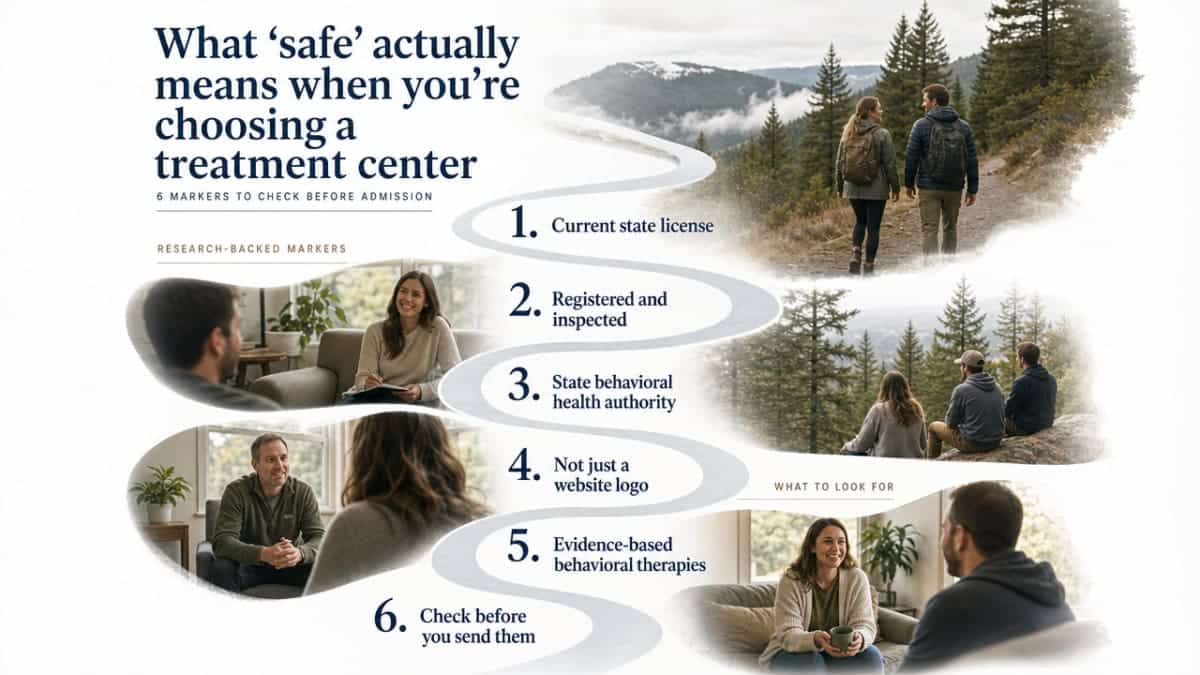
Here is what to look for:
- A current state license. The program is registered and inspected by your state’s behavioral health authority, not just “certified” by a logo on its website 9.
- Evidence-based behavioral therapies. Individual, family, and group counseling that follow approaches studied in real research — not mystery methods or one-size-fits-all programs 5.
- Medication-assisted treatment when it fits. For opioids and alcohol especially, FDA-approved medications combined with counseling are part of standard, science-backed care 6.
- An individualized plan. Your son or daughter is assessed as a whole person, including any co-occurring depression, anxiety, or trauma, and the plan is adjusted as they progress 6.
- Real family involvement. The program offers family counseling or education, not just a polite phone call once a month 8.
- A written aftercare plan. Before detox ends, there is already a next step on paper — outpatient sessions, sober housing, medication follow-up, support groups 6.
If a center cannot speak clearly about all six of these, that tells you something. You are not being picky. You are being a good parent.
Verifying the license before you verify anything else
How state licensing actually works
Every state has a behavioral health authority that licenses and inspects addiction treatment programs. The name changes from state to state — in Oregon, it’s the Oregon Health Authority’s Behavioral Health Division, which oversees residential and outpatient programs that treat substance use disorders 9. In other states, it might be a Department of Health Care Services, a Division of Mental Health and Addiction Services, or something similar. The structure is the same: a public agency that approves the program to operate and checks on it.
You can verify a license in about ten minutes. Open a web search for your state’s name plus “behavioral health licensing.” The official site will end in .gov. Most agencies post a searchable directory of licensed facilities, and many show inspection dates, the level of care the program is approved to provide, and any open complaints or sanctions.
If you can’t find the program in the state directory, call the licensing office directly and ask. You are allowed to do this. You are not being rude. A real, licensed program will be listed, and the staff at the licensing office will tell you plainly whether a facility is in good standing.
Why a license on the wall isn’t the whole story
Here is the harder truth. A license means a program has met a minimum bar — staffing, physical safety, basic record-keeping. It does not guarantee high-quality care. A 2025 California State Auditor review of drug and alcohol treatment oversight found real gaps between what licensing checks on paper and what actually happens day to day inside some facilities 10. That report is about one state, but the lesson travels: licensing is the floor, not the ceiling.
Making that call to the licensing board, or pulling up the state directory on your laptop, is a small thing. It is also the first concrete step in a process where so much feels out of your hands. That step counts.
Matching the level of care to your loved one’s risk
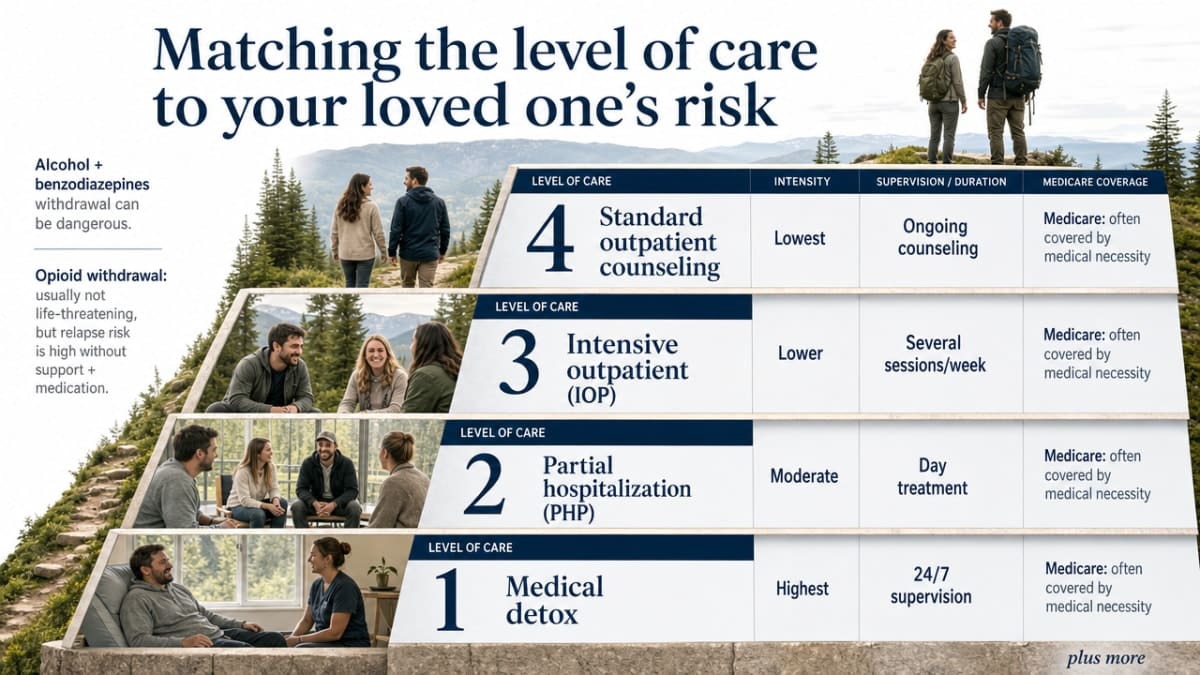
Not every person with a substance use disorder needs the same starting point. The question is not “which program is best,” but “which level of care matches what my loved one is using, how long, and what their body will do when they stop.” Alcohol and benzodiazepines (like Xanax, Klonopin, or Ativan) are the two categories where withdrawal can actually be dangerous — seizures, severe blood pressure spikes, and in rare cases death. Those almost always need medical detox with around-the-clock supervision. Opioids are usually not life-threatening to withdraw from, but they are brutally uncomfortable, and people relapse fast without medical support and medication.
SAMHSA groups treatment into a handful of recognizable levels: medical detox, partial hospitalization (PHP), intensive outpatient (IOP), and standard outpatient counseling — plus medication management and support groups that run alongside any of them 2. Each one trades off intensity for flexibility. Detox is the most hands-on. Outpatient lets your son or daughter live at home and keep a job. PHP and IOP sit in the middle.
If your adult child is on Medicare, here is what helps to know: Medicare Part A covers inpatient hospital stays for substance use treatment, and Part B covers partial hospitalization, intensive outpatient programs, and services delivered through opioid treatment programs and community mental health centers 7. That coverage map matters when you are weighing options.
| Level of care | What it involves | Who it fits | Typical duration | Medicare coverage |
|---|---|---|---|---|
| Medical detox | 24/7 medical supervision, medications to manage withdrawal, residential setting | Alcohol, benzodiazepine, or opioid withdrawal; anyone with a history of seizures or serious medical issues | 3 to 10 days, sometimes longer | Part A for inpatient hospital detox 7 |
| Partial hospitalization (PHP) | Structured day program, 5 to 6 hours a day, several days a week; client sleeps at home or in sober housing | Stepping down from detox, or starting here if detox isn’t needed but daily structure is | 2 to 4 weeks | Part B when criteria are met 7 |
| Intensive outpatient (IOP) | 9 or more hours of group and individual therapy per week, evenings often available | Working adults, those with stable housing and a support system | 8 to 12 weeks | Part B in hospitals, community mental health centers, FQHCs, or opioid treatment programs 7 |
| Standard outpatient | Weekly counseling, medication management, support group participation | Long-term maintenance, relapse prevention, or milder use disorders | Ongoing | Part B for therapy and medication management 7 |
One honest note: if a center suggests a level of care that doesn’t match what you’re describing, ask why. A program that pushes everyone into the same track regardless of risk is not individualizing care — and individualized planning is one of the markers research keeps pointing to 6.
Medication-assisted treatment isn’t ‘trading one drug for another’
This is the question that stops a lot of parents cold. If your son is using heroin, why would a treatment program put him on another opioid? If your daughter is drinking, why suggest a daily pill? It feels like the math doesn’t work.
Here is the actual math. Medication-assisted treatment, often shortened to MAT, uses FDA-approved medications — buprenorphine, methadone, or naltrexone for opioids; naltrexone, acamprosate, or disulfiram for alcohol — alongside counseling and behavioral therapy. The medications don’t get a person high. They steady the brain chemistry that addiction has hijacked, take the edge off cravings, and make it possible to actually do the work of therapy without white-knuckling every hour.
NIDA’s research-based guide on effective treatment is clear about this: medications and behavioral therapies work best together, and patients often need a combination of medication, medical services, family therapy, and other supports to recover 6. Counseling alone, for many people, isn’t enough — especially with opioids, where the relapse risk in the first weeks is brutal. Pulling medication out of the plan because it feels wrong philosophically removes one of the most studied tools in the field.
So when you’re talking to a center, ask whether they offer MAT, who prescribes it, and how long they typically continue it. A program that flatly refuses to consider medication, or one that pushes it without any counseling around it, is missing half the equation 5. The goal isn’t a pill or a lecture. It’s both, used together, for as long as your loved one needs them.
Seven questions to ask before you commit
Before you put down a deposit or sign anything, you get to ask questions. Lots of them. A good intake coordinator will welcome this. A program that gets cagey or rushes you off the phone is telling you something important.
Keep this list nearby when you call. Each question maps to something researchers have flagged as a sign of higher-quality care 5, 6.
- “How do you assess my loved one before deciding on a treatment plan?” You want to hear about a real intake — medical history, substance use history, mental health screening, family situation. NIDA’s research is clear that effective treatment is individualized, not handed out from a template 6.
- “How long do most people stay in your program, and what determines that?” Adequate duration matters. If the answer is “28 days for everyone,” that’s a flag. Length of stay should respond to how your loved one is actually doing 6.
- “Do you offer medication-assisted treatment, and who prescribes and monitors it?” For opioid and alcohol use disorders especially, integrated medication and counseling is the standard 6. You want a licensed prescriber on the team, not a vague answer.
- “What behavioral therapies do you use, and are they evidence-based?” Listen for names like cognitive behavioral therapy, motivational interviewing, or contingency management. These are studied. “Our own proprietary method” is not 5.
- “How is family included in treatment?” Ask whether family therapy or family education is part of the program, how often, and whether it’s in person or virtual 8.
- “What happens if my son or daughter also has depression, anxiety, or trauma?” Co-occurring conditions are common, and they need to be treated alongside the substance use, not after 6.
- “What does the written aftercare plan look like, and when is it created?” The answer should be specific: who builds it, when, what it includes, and how the program helps with the handoff to outpatient care or support groups 6.
Write the answers down as you go. If you have to compare two or three centers later, your notes will tell you more than any glossy brochure.
What real family involvement looks like
You will hear almost every center say they “involve the family.” The question is what that actually means once your loved one is admitted. Sometimes it means a single phone update from a case manager. Sometimes it means real family counseling sessions, parent education groups, and a clinician who treats you as part of the recovery team — not a visitor in the lobby.
The research backs the deeper version. SAMHSA’s family counseling guidance describes how the addiction treatment field has adapted family systems approaches to fit the specific patterns that show up in households where substance use has taken hold — the worry, the over-functioning, the arguments that keep replaying 8. When a program addresses those patterns directly, engagement and recovery stability tend to hold up better.
Ask a center these things plainly. How often does family therapy happen — weekly, biweekly, on request? Who leads it, and what’s their training? Is there a separate family education track where you can learn about addiction, relapse, and how to set limits without cutting off contact? Will you be looped into the aftercare plan before discharge, or told about it after?
SAMHSA also points families toward their own support — peer groups, family-focused resources, and helplines like FindTreatment.gov and the National Helpline that exist specifically for relatives, not just patients 4. You are allowed to use those. Real involvement runs both directions: the program supports your loved one’s recovery, and it also gives you somewhere to put your own questions and fear.
The plan after detox is the plan that matters
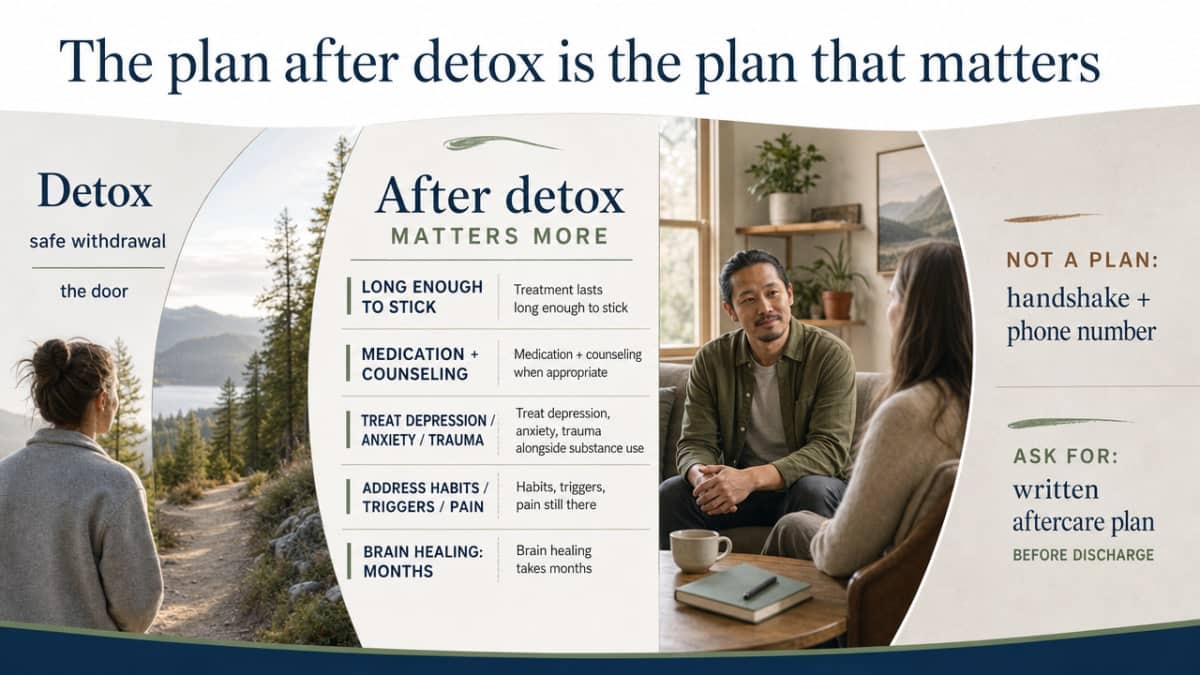
Here is the part most families learn the hard way. Detox is not treatment. Detox is the door. It gets your loved one through the physical withdrawal safely, which is no small thing — especially with alcohol or benzodiazepines, where stopping cold can be dangerous. But once the body clears the substance, the brain still has months of healing to do, and the habits, triggers, and pain that drove the use are all still there.
This is why what comes after detox matters more than detox itself. NIDA’s research on what actually works points to treatment that lasts long enough to stick, combines medication and counseling when appropriate, and treats co-occurring conditions like depression, anxiety, or trauma alongside the substance use 6. A weekend in detox followed by a handshake and a phone number is not a plan. It’s a discharge.
A real aftercare plan is written down before discharge day, not after. Ask to see it. It should name the next level of care — partial hospitalization, intensive outpatient, or standard outpatient counseling — with a start date already scheduled, not a vague “call us when you’re ready” 2. It should list any medications your son or daughter will continue, who will prescribe them, and when the first follow-up appointment is. It should include support groups, sober housing if needed, and a relapse plan that says, in plain language, what everyone does if your loved one slips.
Family is part of this plan too. SAMHSA points families toward FindTreatment.gov and family-focused resources specifically because the handoff from detox to daily life is where things wobble most, and you are part of holding it steady 4. Ask the program who you call if something feels off in week two. A good answer is a specific name and number. A bad answer is silence.
Paying for it: insurance, Medicare, and what to ask up front
Money is the question most parents are afraid to ask out loud, and it’s also the one that determines what’s actually possible. Get it on the table early. A good intake coordinator will walk you through coverage on the first call, not after admission.
If your adult child has Medicare, the coverage map is reasonably clear. Part A covers inpatient hospital stays for substance use treatment. Part B covers partial hospitalization, intensive outpatient programs, and services delivered through opioid treatment programs, community mental health centers, federally qualified health centers, and rural clinics, plus outpatient counseling and medication management 7. Ask the center which of those buckets your loved one would fall into, and what Medicare actually pays versus what’s left over.
For private insurance, ask three things on the first call:
- What’s covered at this level of care?
- What’s the expected out-of-pocket cost after deductible and coinsurance?
- Will you run a verification of benefits in writing before admission?
“In writing” is the part that protects you. Verbal estimates change.
If your loved one is uninsured or underinsured, you still have options. SAMHSA’s free FindTreatment.gov locator filters programs by payment type, including sliding-scale fees and state-funded care 2. State and county behavioral health agencies often fund detox beds for residents who qualify.
One last thing worth saying plainly: the cheapest program is not always the safest, and the most expensive is not always the best. Match the level of care to the medical risk first, then work the money question inside that.
Taking care of yourself while you’re helping someone else
You are allowed to be tired. You are allowed to be scared. You are allowed to grieve a version of your child you used to know, even while you are working hard to help the one who is in front of you now. None of that means you love them less. It means you are human.
Here is something parents rarely hear from treatment centers themselves: there are resources built specifically for you. SAMHSA points families toward peer support groups, family therapy, and helplines you can call for your own questions — not just your loved one’s 4. Groups like Al-Anon and Nar-Anon meet in person and online, in church basements and on Zoom, and they are free. You do not need a crisis to walk in. You just need a chair.
If your own anxiety or depression has crept up over months of this, talk to your doctor. Ask about counseling for yourself. Caring for someone with a substance use disorder is a marathon, and you cannot finish it on no sleep and no support. Setting a small boundary, going to one meeting, making one appointment for yourself — those count as progress too.
What to do this week
You don’t have to solve everything by Friday. You do need a few small moves that turn this guide into something real.
- Make one phone call. If you don’t know where to start, call SAMHSA’s National Helpline. It’s free, confidential, and open 24 hours a day, every day of the year, for people and families dealing with substance use 1. You can ask questions without committing to anything.
- Pull up your state’s licensing directory. Search your state’s name plus “behavioral health licensing.” Bookmark the .gov page. When you have a center in mind, look it up before you call them 9.
- Open FindTreatment.gov. Filter by location, level of care, and payment type. Save two or three programs that look like a match 2.
- Write down your seven questions. Keep them by the phone. Call one center this week and ask them all.
- Find one thing for yourself. A meeting, a friend, a walk, a call to your own doctor 4.
That’s the week. Five small steps. Each one counts.
Check Your Coverage for Safe Detox Options
See if your insurance supports a medically supervised start to recovery for your loved one.
Frequently Asked Questions
How do I check if an addiction treatment center is actually licensed?
Search your state’s name plus “behavioral health licensing” and look for a .gov result. In Oregon, for example, the Oregon Health Authority’s Behavioral Health Division oversees residential and outpatient substance use programs and publishes who’s licensed 9. Most states post a searchable directory. If a center isn’t listed, call the licensing office and ask directly before going further.
What’s the difference between medical detox, PHP, IOP, and outpatient treatment?
SAMHSA groups treatment by intensity 2. Medical detox is 24/7 supervised withdrawal, usually 3 to 10 days. Partial hospitalization (PHP) is a structured day program, often 5 to 6 hours daily, where your loved one sleeps at home or in sober housing. Intensive outpatient (IOP) runs around 9 hours a week, often evenings. Standard outpatient is weekly counseling and medication management for longer-term support.
Isn’t medication-assisted treatment just replacing one drug with another?
No. Medications like buprenorphine, methadone, and naltrexone don’t get a person high. They steady brain chemistry and quiet cravings so therapy can actually do its work. NIDA’s research shows that medication plus counseling, family therapy, and other supports works better than counseling alone for many people with opioid or alcohol use disorders 6. Removing medication on principle pulls out one of the most studied tools available.
Will Medicare or insurance cover addiction treatment for my adult child?
If your loved one has Medicare, Part A covers inpatient hospital stays and Part B covers partial hospitalization, intensive outpatient programs, opioid treatment program services, and outpatient counseling and medication management 7. For private insurance, ask the center to verify benefits in writing before admission. If uninsured, FindTreatment.gov filters by payment type, including sliding-scale and state-funded programs 2.
What should happen after detox ends?
A written aftercare plan, finished before discharge day. It should name the next level of care (PHP, IOP, or outpatient) with a scheduled start date, list any continuing medications and who prescribes them, and include support groups and a relapse plan 6, 2. NIDA stresses that treatment needs to last long enough to stick, and family stays part of the handoff 4.
What can I do right now if my loved one is in crisis tonight?
If there’s any risk of suicide or immediate danger, call or text 988 — the Suicide and Crisis Lifeline offers free, confidential 24/7 support 3. For substance use questions and treatment referrals any hour, call SAMHSA’s National Helpline at 1-800-662-HELP (4357). It’s free, confidential, and answers year-round 1.
References
- National Helpline for Mental Health, Drug, Alcohol Issues – SAMHSA. https://www.samhsa.gov/find-help/helplines/national-helpline
- Treatment Types for Mental Health, Drugs and Alcohol | SAMHSA. https://www.samhsa.gov/find-support/learn-about-treatment/types-of-treatment
- Mental Health & Substance Use Disorder – HHS.gov. https://www.hhs.gov/programs/prevention-and-wellness/mental-health-substance-use-disorder/index.html
- Helping Families Cope with Mental Health and Substance Use …. https://www.samhsa.gov/mental-health/children-and-families/coping-resources
- Table 1, Signs of higher-quality addiction treatment, as identified by …. https://www.ncbi.nlm.nih.gov/books/NBK559647/table/t01/
- Principles of Drug Addiction Treatment: A Research-Based Guide. https://nida.nih.gov/sites/default/files/podat_1.pdf
- Mental health & substance use disorders – Medicare. https://www.medicare.gov/coverage/mental-health-substance-use-disorder
- Chapter 3—Family Counseling Approaches. https://www.ncbi.nlm.nih.gov/books/NBK571088/
- Oregon Health Authority : Licensing and Certification – Residential and Outpatient Behavioral Health. https://www.oregon.gov/oha/hsd/amh-lc/pages/index.aspx
- 2023-120 Drug and Alcohol Treatment Facilities. https://www.auditor.ca.gov/reports/2023-120/