


Key Takeaways
- Quitting Xanax abruptly in Milwaukie or anywhere else carries real seizure risk after long-term or high-dose use, which is why supervised medical withdrawal is the safe baseline.1
- Alprazolam’s short half-life and high potency make it harder to taper than longer-acting benzodiazepines, often requiring small reductions of 5–10% every two to four weeks.2,5
- Non-hospital residential detox in Oregon is a state-licensed, home-like setting with clinical staffing — bedrooms and shared meals rather than hospital wards — close enough to keep family and aftercare local.11
- Before choosing a Milwaukie-area program, compare how they pace the taper, what the living setting looks like, and what step-down care exists after detox ends.3,6
Why Quitting Xanax Alone Can Kill You
If you’re reading this at 2 a.m., scared of what’s happening in your body and scared of what might happen if you stop, take a breath. You’re in the right place to learn what you need to know, and the fact that you’re looking is already something.
The medical logic behind supervised detox isn’t complicated. Benzodiazepines like Xanax calm an overactive nervous system. When you remove them suddenly, that system rebounds hard, and in severe cases it can produce seizures, hallucinations, and delirium. The same class of medications that helps you sleep and slows panic is also what doctors use to safely manage sedative withdrawal, in carefully measured, gradually reduced doses.8
So if you’ve tried to quit on your own and couldn’t, you weren’t weak. You were running into your own biology. A slow, medically supported step-down — in a calm setting, with people watching over you — isn’t extra. It’s the floor. Everything else in this guide is built on that one fact.
What Makes Xanax Harder to Stop Than Other Benzos
If a friend told you they tapered off Klonopin in a few weeks and felt fine, and you’ve been white-knuckling a Xanax step-down that feels nothing like that, you aren’t doing it wrong. The drug itself is different, and the difference matters.
Xanax is the brand name for alprazolam, and alprazolam has two pharmacological traits that make it one of the toughest benzodiazepines to come off of. The first is a short half-life — meaning the drug clears your system fast. The second is high potency, meaning a small milligram amount produces a strong effect. Together, those properties can lead to more pronounced withdrawal symptoms than what people experience with longer-acting benzodiazepines. Stopping abruptly after long-term use can also trigger significant symptoms, including seizures.5
Here’s what that feels like in real life. A longer-acting benzo like diazepam (Valium) leaves your bloodstream slowly. Even between doses, the level stays relatively steady, so your nervous system never gets a sharp drop. Alprazolam doesn’t behave that way. It peaks and falls within hours, and between doses your body can start signaling withdrawal before the next pill is due. Many people describe this as “interdose withdrawal” — anxiety that comes roaring back a few hours after a dose, sometimes worse than the anxiety the prescription was meant to treat.
That short-acting nature is also why simply skipping a dose to “taper faster” tends to backfire. Each gap your body feels is a small spike of withdrawal, and stacking those spikes is hard on your nervous system and your morale.
This is part of why clinicians sometimes substitute a longer-acting benzodiazepine like diazepam during a supervised step-down. Switching to a steadier medication can smooth out the peaks and valleys, then reductions are made from that more stable baseline with psychological support along the way. That substitution isn’t automatic, and it isn’t right for everyone — but the fact that it’s even on the table tells you something important. Xanax tapers often need a different strategy than other benzo tapers, not the same plan with a different name on the bottle.6
If you’ve tried to step down on your own and felt like your body was fighting you harder than you expected, that wasn’t a character flaw. It was alprazolam doing what alprazolam does. The good news: a team that understands this pharmacology can build a plan around it, instead of asking you to power through.
What a Safe Xanax Taper Actually Looks Like
If you’ve imagined detox as a few rough days and then it’s over, that picture comes from movies about heroin, not benzodiazepines. A safe Xanax step-down is measured in weeks and months, not hours, and that slow pace is the whole point. Your nervous system needs time to adjust to lower levels of the medication, and rushing that math is what creates the seizure risk.
Here’s the number that should anchor your expectations. The 2025 joint clinical practice guideline from the American Society of Addiction Medicine recommends an initial taper pace of roughly 5 to 10 percent dose reductions every two to four weeks, and the guideline draws a hard line at 25 percent every two weeks as the upper limit of what should typically be attempted. That ceiling matters. Anything faster than that pushes you out of the evidence base and into territory where withdrawal symptoms — including seizures — become much more likely. The guideline also names what the math doesn’t capture: shared decision-making, monitoring for withdrawal as you go, and adjustments for co-occurring substance use or mental health conditions.2
Do the arithmetic on your own dose and you’ll see why this isn’t a one-week event. If you’re at 2 milligrams a day and your team plans a 10 percent reduction every two weeks, the first cut is to 1.8 mg, the next to about 1.6 mg, and so on. That’s a deliberate, gradual descent — not a cliff.
State guidance reinforces the same idea from a different angle. The Oregon Health Authority’s practical taper document is blunt that there’s no single schedule that fits every person, and it sets a minimum of at least one week between dose reductions, with the next cut timed to how your withdrawal symptoms are actually behaving. Read that sentence twice, because it changes the power dynamic. Your symptoms set the pace. If a reduction lands hard — sleep falls apart, anxiety spikes, your hands won’t stop shaking — the response isn’t to push through. The response is to hold at that dose, or even step back up briefly, and let your nervous system catch up before trying again.3
In a residential detox setting, that flexibility is easier to deliver. Someone is checking on you, asking specific questions, and writing down what they see. Medication adjustments can happen the same day instead of waiting for a follow-up appointment in three weeks. Some teams will also consider switching you to a longer-acting benzodiazepine like diazepam first, then making the reductions from that steadier baseline, paired with psychological support and clear explanations of what’s happening in your body. That isn’t a shortcut. It’s a way to spread the medication’s effect more evenly across the day so each step down feels less jagged.6
What a safe taper looks like, in plain terms: small cuts, long gaps between them, your symptoms steering the timing, and people around you who can change the plan when your body says the plan needs changing. That’s the floor — and it’s far gentler than what most people imagine when they hear the word “detox.”

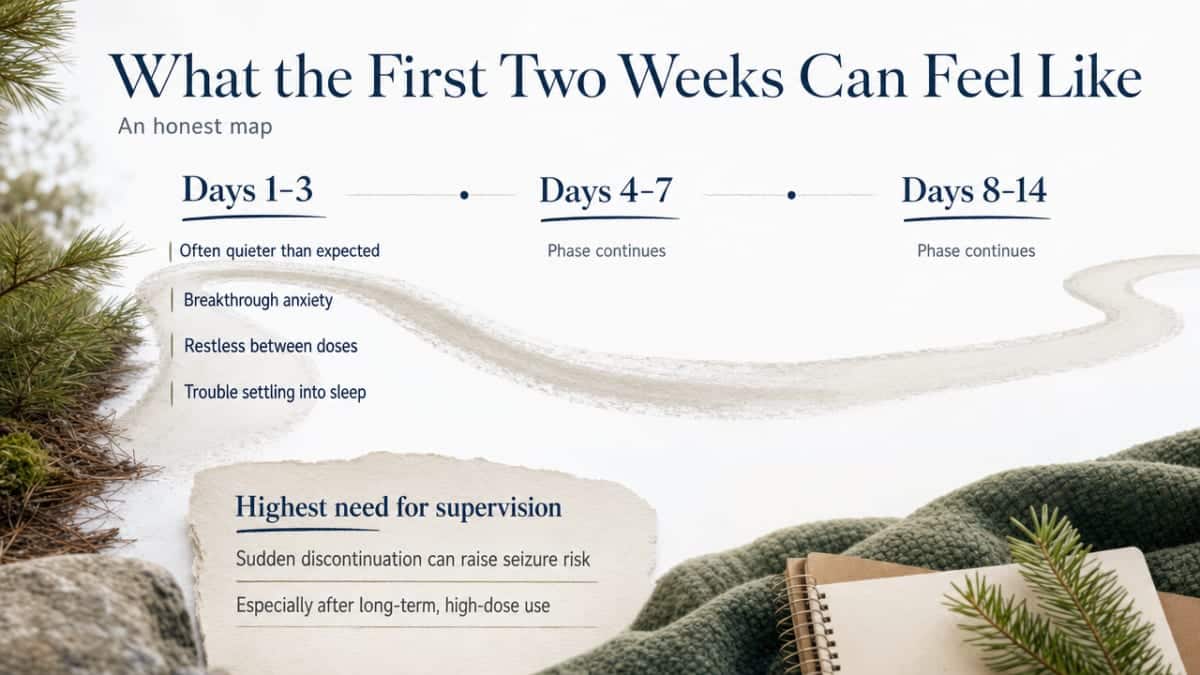
What the First Two Weeks Can Feel Like
If you’ve been awake at 3 a.m. wondering what tomorrow will actually feel like, here’s an honest map. Every body is different, and your taper plan will shape your experience, but there are patterns worth knowing so the next two weeks feel less like a black box.
| Timeline | Symptoms |
|---|---|
| Days 1 to 3 | If you’re starting from a stable dose and your team is making a small, measured reduction, the first few days are usually quieter than people expect. You might notice some breakthrough anxiety, a restless feeling between doses, or trouble settling into sleep. This is the window where supervision matters most for anyone coming off high doses or abruptly cutting back — withdrawal seizures from benzodiazepines have been documented across short-, medium-, and long-acting agents when discontinuation is sudden, especially after long-term, high-dose use. In a supervised setting, staff are checking vital signs, asking how you’re sleeping, and watching for the warning signs you might miss on your own.1 |
| Days 4 to 7 | This is often when rebound symptoms peak. The anxiety alprazolam was prescribed to quiet can come back loudly for a few days, and that doesn’t mean the original problem was worse than you thought — it means your nervous system is recalibrating. Sleep tends to fragment. Some people feel waves of irritability, muscle tension, sensitivity to light or sound, or a low-grade hum of dread that has no specific story attached to it. Clear explanations of what’s happening, paired with psychological support, make a real difference here — adherence and comfort both improve when you understand the symptoms instead of fearing them. |
| Days 8 to 14 | For most people on a careful taper, the second week feels steadier than the first. Symptoms don’t vanish, but they tend to come in shorter waves with longer calm stretches between them. This is when group conversations, one-on-one check-ins, and small routines — a walk, a meal at the table, a real night of sleep — start doing quiet work. If a reduction landed harder than expected, this is also when your team may hold the dose flat or step it back briefly before the next cut. Your symptoms set the cadence, not the calendar. |
What this map doesn’t show is the part that matters most: someone is with you. You aren’t reading your own pulse at 4 a.m. and guessing. You aren’t deciding alone whether the shaking in your hands is normal. That’s the difference a residential team makes during these fourteen days — not erasing the discomfort, but making sure you’re never alone inside it.
What a Home-Like Residential Setting Means in Oregon
When you hear “residential detox,” you might picture a hospital ward — fluorescent lights, vinyl chairs, a clipboard at the end of a bed. That isn’t what non-hospital residential detox in Oregon looks like, and the difference shapes how the next two or three weeks of your life will feel.
Under Oregon Health Authority rules, residential treatment facilities are licensed by the state and grouped into specific categories with defined expectations for staffing, safety, and services. A non-hospital residential detox sits in that licensed space — medical enough to manage benzodiazepine withdrawal safely, but designed as a place where people live for a short while, not a place where people are admitted as patients in gowns. Think a house on a quiet street, with bedrooms, a kitchen, common rooms with couches, and a clinical team coming to you rather than the other way around.11
That matters for Xanax detox specifically. A slow alprazolam step-down isn’t a procedure that happens to you in a few intense hours. It’s a stretch of days where your sleep is off, your nervous system is loud, and small comforts do real work. A mug of tea at 6 a.m. when you couldn’t sleep. A walk in the yard instead of a hallway. A meal at a table with other people who understand exactly what you’re going through. Those details aren’t decoration. They’re part of the reason supervised tapers go better when they include psychological support, clear explanations, and flexible schedules that respond to how you’re actually feeling.6
The clinical backbone is still there. Medications to take the edge off withdrawal, vital-sign checks, a team that can adjust your taper the same day if a reduction lands hard. What’s different is the container around all of it. Milwaukie itself helps — a small, mostly middle-income city of about 21,000 just south of Portland, quieter than the urban core, close enough that family can visit and that your aftercare can continue locally once detox ends. A home-like setting in a calm neighborhood isn’t a luxury upgrade. For a nervous system that’s been running hot for months or years, it’s part of the medicine.7
If You Were Prescribed Xanax and Did Everything Right
Maybe your story starts in a doctor’s office. A panic attack that wouldn’t stop. A loss that shattered your sleep. A doctor who listened, wrote a prescription, and told you to take it as directed. You did. And now, months or years later, you’re here — physically dependent on a medication you never abused, ashamed of a problem you didn’t choose.
That shame doesn’t belong to you. Set it down for a minute.
Physical dependence on alprazolam can develop with regular therapeutic use, especially as the weeks stretch into months. Your body adapts to the medication, and when the level drops, it protests. That’s biology, not weakness. The clinical literature is clear that significant withdrawal symptoms — including seizures after long-term use — can follow even prescribed dosing if the medication is stopped abruptly. Nothing about that fact makes you irresponsible. It makes you human.5
What it does mean is that getting off Xanax safely isn’t a matter of willpower or moral cleanup. It’s a medical process, and the right team will treat it that way. Good care for prescribed-medication dependence looks like clear explanations of what’s happening in your nervous system, a taper schedule built around your actual life, and psychological support that helps you understand your symptoms instead of fighting them blindly. Nobody should be lecturing you. They should be working with you.6
If you took this medication exactly the way it was given to you and still ended up needing help to come off it, you didn’t fail. The drug did what the drug does. Asking for support now is the next responsible thing — same instinct that brought you to a doctor in the first place.
How to Know It’s Time to Ask for Help
You don’t have to be in crisis to deserve help. That sentence is worth reading twice, because a lot of people wait until something breaks before they reach out, and with Xanax that wait can be dangerous.
Here are the signals that your body and your life are telling you it’s time:
- You’ve tried to cut back on your own and couldn’t get past a certain dose.
- You’re feeling withdrawal between doses — anxiety, sweating, a hum of dread a few hours after the last pill — and you’re watching the clock for the next one.
- You’ve started taking more than was prescribed, or borrowing from a friend’s bottle, or stretching a prescription by combining it with alcohol or other sedatives.
- Your sleep is wrecked.
- The medication that used to quiet your panic now feels like the thing causing it.
Two situations deserve special weight. The first is high-dose, long-term use — that’s the population where withdrawal seizures are most likely if the medication is stopped abruptly. The second is mixing Xanax with alcohol or opioids, because layered sedatives compound the withdrawal picture and the medical management gets more complex.1,8
You don’t have to have all the answers before you make a call. You just have to be willing to let someone who does this work for a living help you figure out the next two weeks. That’s not surrender. That’s the same instinct that made you read this far.
What Happens After Detox Ends
Here’s something worth knowing before you walk in the door: finishing detox isn’t the finish line. It’s the part of the climb where you’ve got your footing back, and that footing is what makes the rest of the work possible.
For Xanax specifically, the taper itself often continues after you leave a residential setting. A careful step-down can stretch over months, with reductions timed to how your symptoms are actually behaving rather than a fixed calendar. That means the people who help you in those first weeks should hand you off cleanly to whoever picks up the taper next — a prescriber who understands benzodiazepines, a therapist who knows what a nervous system in repair looks like, and a schedule that doesn’t ask you to figure it out alone.3
The clinical literature is clear that successful withdrawal is more likely when the taper is paired with psychological support and patient education, not just dose math. That’s because the anxiety alprazolam was prescribed to quiet is often still there underneath, and now you’re meeting it without a chemical cushion. Group therapy, one-on-one counseling, and time spent learning what your own warning signs look like — those aren’t extras tacked onto detox. They’re the work that keeps the gains.6
This matters because Oregon’s broader picture isn’t simple. The state continues to report substantial need for addiction and mental health services, with long-term patterns of prescription misuse and treatment demand across combined survey years. A recent Oregon Health Authority report did note an encouraging roughly 22% decline in overdose deaths involving stimulants and opioids — a number that speaks to those specific drugs, not benzodiazepines, but it tells you something about what coordinated care can do when it’s available. Detox plus a real plan for what comes next is how that coordination shows up in one person’s life.4,10
Step-down levels of care — partial-day programs, intensive outpatient groups, regular therapy, alumni connections — exist so you don’t go from twenty-four-hour support to nothing overnight. Ask about that bridge before you check in anywhere. The answer tells you whether a program is treating detox as an event or as the opening chapter.

Choosing a Milwaukie-Area Program Without Getting Overwhelmed
You don’t need to compare twenty websites at midnight. You need a short list of honest questions, and the answers will tell you most of what you need to know.2,11
- Ask how they handle the taper math. A real benzodiazepine program should be able to explain, in plain terms, that initial reductions are small and spaced out — the kind of pace reflected in current clinical guidance — and that your symptoms, not a fixed calendar, decide when the next cut happens. If the answer sounds rushed or one-size-fits-all, keep looking.
- Ask what the setting actually looks like. Under Oregon licensing, a non-hospital residential detox is a real medical program housed in a place designed to feel livable, not clinical. You should hear words like bedrooms, common rooms, and shared meals — not wards and gowns.
- Ask what happens after. A program that talks only about your first week and shrugs about week four isn’t seeing the whole picture. Step-down care — outpatient groups, therapy, a prescriber who can continue your taper — should be part of the conversation before you ever pack a bag.
If you’re in the Portland metro area, a local option keeps your family close and your aftercare continuous. Pacific Crest Trail Detox is one Milwaukie program built around exactly this kind of slow, supported step-down. Whatever you choose, choose people who answer these questions clearly. That’s the floor — and you’ve earned the right to stand on it.
Check Your Insurance For Xanax Detox Coverage
Find out if your benefits cover safe, medically supervised Xanax withdrawal in Milwaukie.
Frequently Asked Questions
Is it actually dangerous to quit Xanax cold turkey?
Yes. Stopping alprazolam abruptly after long-term or high-dose use can trigger withdrawal seizures, and those seizures have been documented across short-, medium-, and long-acting benzodiazepines when discontinuation is sudden 1. The risk is highest if you’ve been on higher doses for a while. That’s why a slow, supervised step-down — not willpower — is the safe path off this medication.
How long does a safe Xanax taper usually take?
Weeks to months, not days. Current clinical guidance points to small, gradual reductions with at least a week between each cut, adjusted to how your withdrawal symptoms are actually behaving 3. Your starting dose, how long you’ve been taking it, and any co-occurring conditions all shape the timeline. The honest answer is that your symptoms set the pace — your team’s job is to listen and respond, not push.
Why is Xanax harder to come off than Klonopin or Valium?
Alprazolam has a short half-life and high potency, meaning it clears your system quickly and packs a strong effect per milligram. Those two properties together can produce more pronounced withdrawal symptoms than longer-acting benzodiazepines, and abrupt discontinuation after long-term use can trigger seizures 5. The peaks and valleys between doses are sharper. That’s the biology — not anything you’re doing wrong.
What if I was prescribed Xanax and took it exactly as directed?
You’re not alone, and you didn’t do anything wrong. Physical dependence can develop with regular therapeutic use, and significant withdrawal symptoms — including seizures after long-term use — can follow even prescribed dosing if the medication stops abruptly 5. Coming off safely is a medical process, not a moral one. A good team will build a taper around your actual life and pair it with support 6.
What does a non-hospital residential detox in Oregon actually look like?
Picture a licensed home-like setting rather than a hospital ward. Under Oregon Health Authority rules, residential treatment facilities are state-licensed with defined expectations for staffing, safety, and services 11. You’ll have a bedroom, common rooms, shared meals, and a clinical team that comes to you. The medical care — vital signs, taper adjustments, medications to ease withdrawal — happens inside a place designed to feel livable.
Do I need more help after detox ends?
Most people do, and that isn’t a failure — it’s how this works. A Xanax taper often continues for weeks or months after a residential stay, with reductions timed to your symptoms rather than a fixed calendar 3. Successful withdrawal is more likely when the taper is paired with psychological support and patient education, not just dose math 6. Ask any program what their plan looks like after week one.
References
- Benzodiazepine withdrawal seizures and management. https://pubmed.ncbi.nlm.nih.gov/21815323/
- Joint Clinical Practice Guideline on Benzodiazepine Tapering. https://pmc.ncbi.nlm.nih.gov/articles/PMC12463801/
- How to approach a benzodiazepine taper. https://www.oregon.gov/oha/HPA/DSI-Pharmacy/MHCAGDocs/Tapering-Benzodiazepines.pdf
- Substance Use Disorder Integration Report. https://www.oregon.gov/oha/HSD/AMH/DataReports/SUD-Integration-Report.pdf
- Alprazolam (StatPearls). https://www.ncbi.nlm.nih.gov/books/NBK538199/
- Management of Benzodiazepine Misuse and Dependence (NCBI Bookshelf). https://www.ncbi.nlm.nih.gov/books/NBK279318/
- Milwaukie city, Oregon – U.S. Census Bureau QuickFacts. https://www.census.gov/quickfacts/fact/table/milwaukiecityoregon/RHI225224
- Alcohol Withdrawal Syndrome: Benzodiazepines and Beyond. https://pmc.ncbi.nlm.nih.gov/articles/PMC4606320/
- OREGON – National Survey on Drug Use and Health, 2022 State Tables. https://www.samhsa.gov/data/sites/default/files/reports/rpt44486/2022-nsduh-sae-state-tables/NSDUHsaeOregon2022.pdf
- Oregon (OR) | CBHSQ Data. https://www.samhsa.gov/data/report/oregon-or
- Oregon Health Authority: Residential Treatment Facilities. https://www.oregon.gov/oha/hsd/amh-lc/pages/rt.aspx