
Key Takeaways
- Rapid detox under anesthesia does not reduce withdrawal symptoms more than standard detox, and a CDC investigation documented two deaths and five life-threatening complications among 75 patients at one clinic 6.
- A Columbia University trial found anesthesia-assisted rapid detox ineffective and unsafe, with risks of death, psychosis, and cardiovascular stress rather than the promised faster recovery 2.
- The pattern holds across independent research: systematic reviews and WHO analysis found no better outcomes than standard care, while buprenorphine-based detox performed clearly better 1, 4.
- Withdrawal involves the whole nervous system, heart, and hormones, so speeding it up under sedation concentrates the stress rather than easing it, and addiction pathways remain untouched afterward 2, 9.
- Safer care uses buprenorphine or methadone to ease withdrawal while you stay awake, in a calm home-like setting with round-the-clock monitoring, tied to counseling and continued medication 5, 9.
- For alcohol or benzodiazepine withdrawal, abrupt stopping can trigger seizures and other emergencies, so a gradual, medically supervised taper is the correction, not any rapid procedure 3.
The 2 a.m. Wish for a Shortcut
It’s late. Maybe you’re on the bathroom floor, or maybe you’re staring at the ceiling counting hours until the next dose. Somewhere in the scrolling, you typed “rapid detox centers” into the search bar. You wanted the words to mean what they sound like: a door you walk through sick and walk out of clean, with the worst part skipped while you sleep.
That wish makes sense. If you’ve tried to quit before, your body already remembers what withdrawal feels like, and your mind is bargaining with anything that promises to make it stop faster. You are not weak for wanting a shortcut. You are tired, and you are trying to survive.
Here’s the honest part, said gently. The fastest-sounding option is not the safest one, and in some cases it has been the most dangerous 6. There is a calmer path that actually works: medicine to ease withdrawal, people watching over you, and a place that feels more like a home than a hospital 9. This article walks you through what the research shows, what to avoid, and what safer care looks like tonight.
What Rapid Detox Actually Promises (and What It Delivers)
The pitch is easy to understand, which is part of why it works on tired minds. You pay a large fee, often out of pocket. A team puts you under general anesthesia or heavy sedation. While you’re unconscious, they give you a medication called an opioid antagonist that pulls the drugs off your brain’s receptors all at once. The idea is that you skip the shaking, sweating, and sleepless hours and wake up on the other side, done.
That’s the promise: a few hours of sleep instead of a week of suffering. If you’ve been dreading withdrawal, it can sound like mercy.
Here is what it actually delivers, according to the people who studied it. The procedure does not reduce the withdrawal you feel more than standard, non-anesthesia detox does 6. Your body still goes through the physical storm; the anesthesia just hides the first part of it from your awareness. When you wake up, symptoms often continue for days, sometimes with added complications from the sedation itself 1.
It also does not fix the part that matters most: what happens after. Cravings, sleep problems, and the pull toward using again don’t disappear because a machine helped you sleep through hour one. Major clinical guidelines are direct about this. Detox alone, no matter how fast, is not a treatment for addiction. It has to be linked to ongoing medication, counseling, and support to give recovery a real chance 9.
So the shortcut isn’t really a shortcut. It’s a more expensive, riskier version of the beginning, with the middle and end still waiting for you.
What the Research Found When People Tried It
Deaths and Life-Threatening Complications in a Real Clinic
In 2012, public health investigators in New York City took a close look at one clinic offering anesthesia-assisted rapid opioid detoxification. What they found is the kind of number you don’t forget once you’ve read it.
Out of 75 patients who went through the procedure at that clinic, two died and five more had life-threatening complications 6. That’s seven serious events in a group small enough to fit into a single classroom. The investigators also concluded that the procedure did not reduce the withdrawal symptoms people actually felt any more than standard, non-anesthesia detox did 6. So the trade was this: the same withdrawal, plus the risks that come with being sedated for hours while your body is in the middle of a chemical storm.
It matters that this wasn’t a lab experiment. These were real people who walked into a real clinic hoping to feel better. Some of them didn’t walk back out. The report was serious enough that the CDC published it in their Morbidity and Mortality Weekly Report, which is the same channel used for outbreak warnings and other public health emergencies 6.
If you’re weighing rapid detox for yourself or someone you love, this is the part the glossy websites usually leave out. Not everyone who has the procedure is harmed. But the harm that has happened is not rare enough to dismiss, and the promised benefit, less suffering, didn’t hold up when someone actually measured it.
The Columbia Trial: Ineffective and Unsafe
A group of psychiatrists at Columbia University wanted to know if anesthesia-assisted rapid detox for heroin dependence lived up to what its providers were promising. So they ran a clinical trial and published the results in a major medical journal.
Their finding was blunt. The procedure was ineffective and unsafe. It carried risks of death, psychosis, and increased stress on the body, without producing better outcomes than the safer, awake methods it was supposed to replace 2.
Read that again slowly if you need to. Psychosis means people’s minds broke, at least for a while. Increased stress means the heart, lungs, and hormonal system were pushed harder than they would have been in ordinary detox. And the whole reason someone would accept those risks, faster and easier recovery, wasn’t there in the data 2.
What makes the Columbia work important is who did it and where it landed. This wasn’t a rival clinic trying to knock a competitor. It was a research team at a well-known medical school, publishing in a journal read by other doctors. When that kind of study says a heavily marketed procedure doesn’t work and can kill people, it changes how careful clinicians think about it.
The next time you see a rapid detox center’s ad promising a painless overnight cure, remember that the people who actually tested that promise, in a controlled setting, could not find it.
One Bad Study, or a Pattern?
It would be easy to hope that the NYC clinic was an outlier or that the Columbia trial got unlucky. That’s a fair question to ask. Medicine is full of one-off findings that don’t hold up when other researchers try to repeat them.
This isn’t one of those cases.
A systematic review, the kind of study where researchers gather all the available evidence on a question and weigh it together, looked at opioid antagonists used under heavy sedation or anesthesia across multiple trials. Its conclusion matched the individual studies: there was not enough evidence that the procedure worked better than standard detox, and there were serious adverse events, including deaths, documented across the literature 1.
The World Health Organization’s own review of opioid detoxification methods reached a similar place. Ultra-rapid detox did not improve outcomes compared with standard care, and it carried substantial risks. Buprenorphine-based detox, by comparison, showed clearly better results on most measures, including how many people finished treatment and how bad their withdrawal was 4.
So it’s not one clinic, one city, one trial, or one bad year. It’s a consistent picture across independent research groups, drawn together by public health agencies and international medical bodies. When that many careful people look at the same procedure and come to the same worry, it’s worth trusting what they see.

Why the Idea Sounds Right and Still Goes Wrong
The logic of rapid detox has a certain neat appeal. Drugs are on your brain’s receptors. A medication can knock them off. If you’re asleep while it happens, you skip the pain. Problem solved.
Your body is not that neat. Withdrawal isn’t just a light switch flipping in your brain. It’s your whole nervous system, your heart, your gut, and your hormones adjusting to the sudden absence of something they had learned to expect. Speeding that adjustment up doesn’t make it gentler. It concentrates it. Blood pressure swings, the heart works harder, and stress hormones spike, all while you’re unconscious and can’t tell anyone something feels wrong 2.
There’s a second reason the idea falls apart. Even if the first hours were smooth, addiction isn’t stored in the drugs still floating in your bloodstream. It lives in the pathways your brain has built around using, in the sleep you’ve lost, in the reasons you started, and in the people and places around you. Clearing the substance out doesn’t clear any of that. Guidelines from the leading addiction medicine group in the country are clear that getting through withdrawal has to be tied to ongoing medication and support, not treated as the finish line 9.
So the shortcut sounds right because it targets the part you can picture. It goes wrong because the part you can picture was never the whole problem.
What Safer Detox Looks Like Right Now
Medicine That Eases Withdrawal Instead of Bypassing It
Here’s the part that surprises a lot of people the first time they hear it: there are medicines that can take the sharpest edge off opioid withdrawal while you stay awake, aware, and safe. You don’t have to be knocked out to be spared the worst of it.
The two names to know are buprenorphine and methadone. Both are FDA-approved for opioid use disorder, both have decades of evidence behind them, and both do something rapid detox cannot. They calm the withdrawal from the inside instead of trying to shove it through your body in one violent afternoon 5. Buprenorphine, in particular, has stood out in the research. When investigators compared different detox approaches side by side, people using buprenorphine achieved clearly better outcomes on most measures, including how many finished treatment and how bad their withdrawal felt, than people using clonidine, lofexidine, or antagonist-based rapid detox 4.
The leading addiction medicine group in the country recommends using methadone or buprenorphine for withdrawal, rather than going cold turkey 9. That guidance is not a compromise. It’s the standard of care because it works.
You may have heard that taking one of these medicines is just “trading one drug for another.” That framing gets used a lot, and it isn’t fair to what the medicines actually do. They ease the physical symptoms, quiet the cravings that pull people back to using, and keep people alive and in treatment long enough for the rest of recovery to take hold 5. That’s a different job than the drugs that hurt you, and the outcomes show it.
A Home-Like Setting, Not an Operating Room
Picture where you’d want to be during the hardest few days of your year. Probably not on a gurney under fluorescent lights, with strangers in surgical masks watching monitors.
Safer detox doesn’t have to look like a hospital. In a home-like residential setting, you have your own bed, meals someone else cooks, and staff a short walk away when you can’t sleep at 3 a.m. Medical people check on you, take your vital signs, and adjust your medicines so you stay comfortable and stable. But the room around you feels closer to a house than an operating theater.
That matters more than it sounds. Withdrawal is hard on the nervous system, and the environment you’re in either turns the volume down or up. A calm room, a quiet hallway, and someone who talks to you like a person rather than a case number are part of the medicine, not extras around it.
You also get to be awake for your own recovery. You meet the people helping you, you remember what they said, and you start building trust with the humans you’ll need when things get hard again in a few weeks. None of that happens under anesthesia.
Detox Is the First Mile, Not the Whole Road
If you take one thing from this article, let it be this: getting the drugs out of your body is the beginning of recovery, not the end. The centers that promise otherwise are selling you a finish line that isn’t there.
Every major clinical group that has looked at this agrees. Withdrawal management, no matter how it’s done, has to be linked to ongoing care to actually protect the person going through it 9. That means the medicine you started in detox often continues after, sometimes for months, sometimes longer, at a dose that keeps cravings quiet 5. It means counseling to work on the reasons you started using and the situations that pull you back. It means group time with people who understand what your Tuesday nights feel like.
Public health guidance describes this as a whole-patient approach: medicine plus counseling plus behavioral therapy, working together rather than any single piece carrying the whole weight 10. That’s why the same guidelines that discourage rapid detox also emphasize what comes next, not just what happens in the first 72 hours.
You don’t have to figure all of this out tonight. You just need a first step that keeps you safe and hands you off to the second step. A good detox program is already thinking about the aftercare piece the day you walk in, so you’re not sent home in a week with a pat on the back and no plan.
If Withdrawal Is From Alcohol or Benzodiazepines, Read This First
Most of what you read about rapid detox is about opioids. If you’re coming off alcohol or benzodiazepines like Xanax, Klonopin, or Ativan, the picture is different, and the stakes are higher in a specific way you need to know about.
Safer care here looks like a gradual, medically supervised taper rather than any kind of rapid procedure. Clinical guidelines are clear that gradual, closely watched withdrawal, with medicine to calm the nervous system, is the safer path 3. You want people checking your blood pressure, your pulse, and how you’re feeling, several times a day, in a place where help is a hallway away.
If you’re already shaking, seeing things, or feeling your heart race after cutting back, please don’t wait to see if it passes. Call for help now 11. Safer detox for alcohol and benzos is real, and it starts with someone answering the phone.
Rapid Detox vs. Medically Supervised Detox at a Glance
If you’re scanning this article between waves of symptoms, here is the short version, side by side.
Rapid detox under anesthesia: You’re asleep. A team gives you an opioid-blocking medicine that pulls drugs off your brain’s receptors all at once, over a few hours. In the New York City clinic the CDC investigated, 2 of 75 patients died and 5 more had life-threatening complications, and the procedure did not reduce withdrawal symptoms more than standard detox 6. The link to ongoing treatment is often weak or missing, and the evidence across multiple studies has not shown it works better than safer methods 1.
Medically supervised detox with medication: You’re awake. Staff check on you around the clock in a calm, home-like room. You get medicines like buprenorphine or methadone to ease withdrawal from the inside, which the research shows produce clearly better outcomes on most measures than antagonist-based rapid detox 4. The plan already includes what happens next: counseling, peer support, and continued medication, because leading guidelines are clear that detox has to be tied to ongoing care 9.
Same goal. Very different odds of getting there safely.
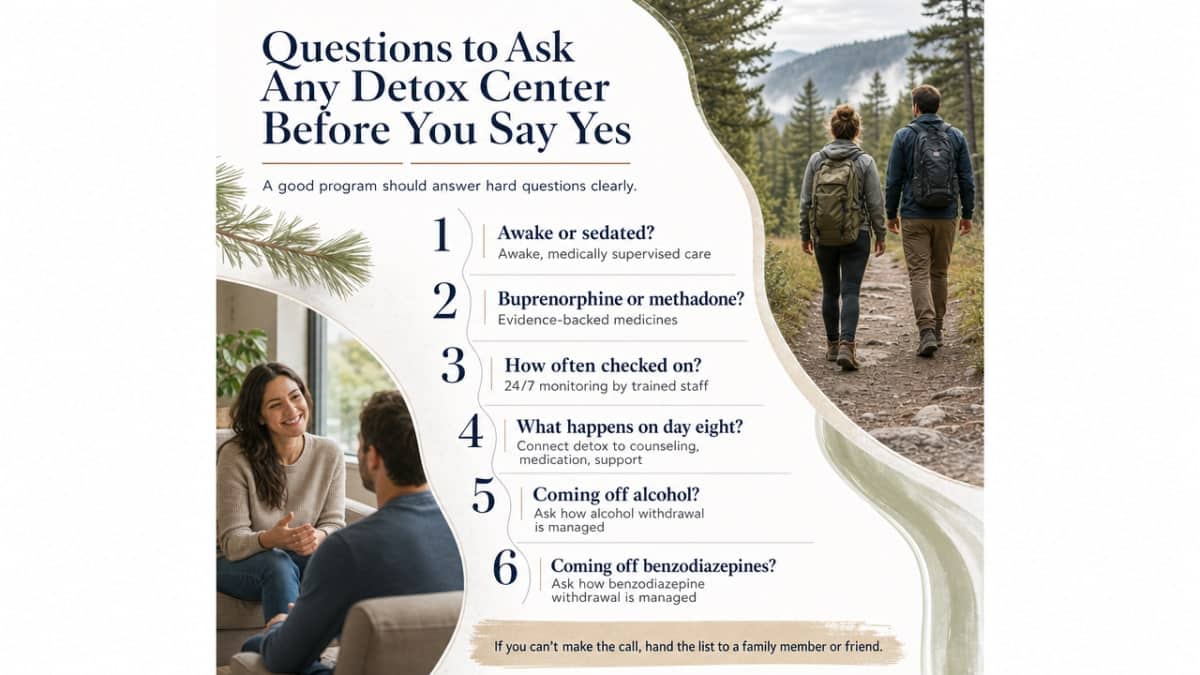
Questions to Ask Any Detox Center Before You Say Yes
You are allowed to ask hard questions, even at your worst moment. A good program will answer them without getting defensive. If you can’t get through the list yourself, hand it to a family member or friend and let them make the call for you.
Here’s what to ask, and why it matters:
- Will I be awake or sedated during detox? Awake, medically supervised care is the standard the research supports 9.
- Do you use buprenorphine or methadone to ease withdrawal? These are the medicines with the strongest evidence behind them 5.
- How often will someone check on me, and by whom? You want round-the-clock monitoring by trained staff, not a check-in twice a day.
- What happens on day eight? Detox has to connect to counseling, ongoing medication, and support, or the risk of relapse climbs 9.
- If I’m coming off alcohol or benzodiazepines, how do you handle seizure risk? The answer should include a gradual, supervised taper 3.
- Will you take my insurance, and what will I actually owe? Get the number in writing before you commit.
If a center dodges any of these, that’s your answer.
Making the Call When You’re Exhausted
You’ve read a lot of hard things in this article. If your eyes are burning and your hands are shaking, that’s okay. You don’t have to make a perfect decision tonight. You have to make a safe one.
The next step is smaller than it feels. Pick up the phone. If you’re not ready to call a specific center yet, the SAMHSA National Helpline is free, confidential, and answered around the clock, every day of the year 11. You can ask questions without giving your name. You can ask them to help you find a place near you that offers medically supervised detox with real medicine and real people who stay with you afterward.
If Portland or the Pacific Northwest is where you are, Pacific Crest Trail Detox is one of the places that does this work in a home-like setting. Either way, the call is the win. Making it while exhausted counts more, not less. You showed up for yourself at the hardest hour, and that’s how this starts.
Check Your Coverage for Safe, Medically Guided Detox
See if your insurance will cover safer detox options beyond rapid detox centers.
Frequently Asked Questions
Is rapid detox under anesthesia safe?
No, and this is where the research is clearest. A CDC investigation of one New York City clinic found that out of 75 patients, two died and five had life-threatening complications 6. A systematic review across multiple studies documented serious adverse events, including deaths, and could not find good evidence it works better than standard detox 1. Safer methods exist and are widely available.
Does rapid detox actually make withdrawal less painful than standard detox?
Not really. The CDC investigation found the procedure did not reduce subjective withdrawal symptoms any more than standard, non-anesthesia detox did 6. Anesthesia hides the first few hours from your awareness, but the physical symptoms often continue for days after you wake up. Medicines like buprenorphine can ease withdrawal from the inside without putting you under 5.
What is the safer alternative to a rapid detox center?
Medically supervised detox with medication. You stay awake in a calm, home-like setting while staff monitor you around the clock and use medicines like buprenorphine or methadone to ease withdrawal 9. The leading addiction medicine group recommends this over abrupt cessation 9, and research shows buprenorphine-based detox produces clearly better outcomes than antagonist-based rapid detox 4. Good programs also connect you to counseling and ongoing care afterward.
Isn’t taking buprenorphine or methadone just trading one drug for another?
That framing is common, and it doesn’t match what the medicines actually do. Buprenorphine, methadone, and naltrexone are FDA-approved for opioid use disorder and have strong evidence behind them. They improve survival, reduce illicit use, and keep people in treatment long enough for recovery to take hold 5. Public health guidance describes them as part of a whole-patient approach alongside counseling, not a substitution 10.
Is withdrawal from alcohol or benzodiazepines different from opioid withdrawal?
Yes, and the difference matters. Opioid withdrawal is miserable but rarely fatal for a healthy person. Alcohol and benzodiazepine withdrawal can trigger seizures and other emergencies when someone stops suddenly on their own. Clinical guidelines call for a gradual, medically supervised taper with medicine to calm the nervous system, in a place where help is close by 3. Please don’t try this alone.
What should I do right now if I’m not ready to call a specific detox center?
Call the SAMHSA National Helpline. It’s free, confidential, and answered 24 hours a day, every day of the year 11. You don’t have to give your name. You can ask questions, describe what you’re feeling, and get pointed toward medically supervised detox near you. Making the call while exhausted counts more, not less. It’s a real first step, and it keeps you safe tonight.
References
- Opioid antagonists under heavy sedation or anaesthesia for opioid withdrawal. https://pmc.ncbi.nlm.nih.gov/articles/PMC7065589/
- Study Finds Rapid Heroin Detoxification Procedure Under Anesthesia Does Not Work and Can Result in Death. https://www.cuimc.columbia.edu/news/study-finds-rapid-heroin-detoxification-procedure-under-anesthesia-does-not-work-and-can-result
- Withdrawal Management (Clinical Guidelines for Withdrawal Management and Treatment of Drug Dependence in Closed Settings). https://www.ncbi.nlm.nih.gov/books/NBK310652/
- Pharmacological and Physical Interventions in Opioid Detoxification. https://www.ncbi.nlm.nih.gov/books/NBK50618/
- Medications for Opioid Use Disorder. https://nida.nih.gov/research-topics/medications-opioid-use-disorder
- Deaths and Severe Adverse Events Associated with Anesthesia-Assisted Rapid Opioid Detoxification — New York City, 2012. https://www.cdc.gov/mmwr/preview/mmwrhtml/mm6238a1.htm
- Rapid opioid detoxification during general anesthesia. https://pubmed.ncbi.nlm.nih.gov/10598605/
- Lofexidine versus clonidine in rapid opiate detoxification. https://pubmed.ncbi.nlm.nih.gov/11516922/
- The ASAM National Practice Guideline for the Treatment of Opioid Use Disorder (2020). https://www.dhcs.ca.gov/services/MH/EQRO/data/DMC/EQRO%20Resources/Opioid%20Use%20DIsorder/ASAM+2020+OUD.pdf
- Treatment Options for Substance Use Disorder. https://www.samhsa.gov/substance-use/treatment/options
- National Helpline for Mental Health, Drug, Alcohol Issues. https://www.samhsa.gov/find-help/helplines/national-helpline