


Key Takeaways
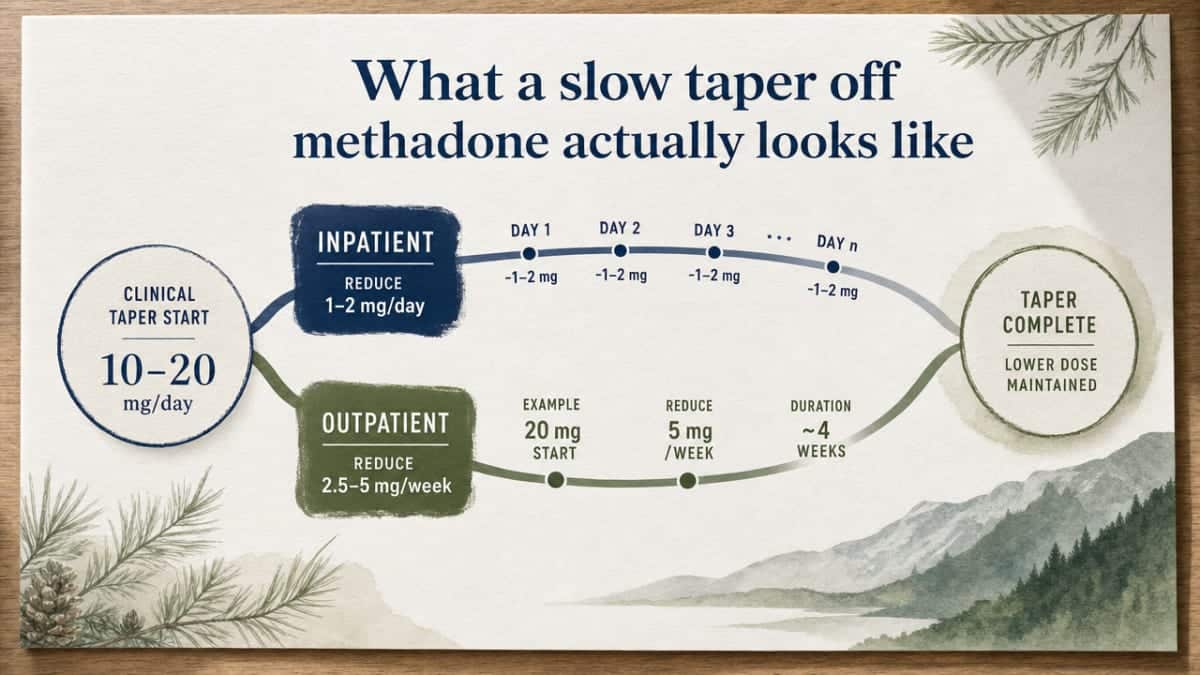
- A slow methadone taper in Portland typically starts at 10–20 mg and steps down 1–2 mg daily inpatient or 2.5–5 mg weekly outpatient, with clinical monitoring to pause or adjust when withdrawal outpaces the schedule.5
- Portland’s 2025 landscape is shifting — overdose deaths dropped 22% year over year — but fentanyl still dominates the street supply, making supervised detox safer than solo attempts during a period of rapidly falling tolerance.6
- The 2024 SAMHSA rule expanded telehealth intake and take-home dosing eligibility, but Oregon programs adopted these changes unevenly, so ask each clinic directly about flexibility before committing.
- Compare programs on taper math, overnight staffing, setting (home-like residential vs. hospital), post-detox handoff to PHP or IOP, and whether naloxone is prescribed at discharge before choosing where to start.2,10
What a slow taper off methadone actually looks like
You already know what withdrawal feels like. So the honest question isn’t whether coming off methadone is uncomfortable — it’s whether the discomfort can be small enough that you keep going instead of walking out on day three.
A slow taper is what makes that possible. Clinical guidance for methadone detox Portland typically starts somewhere in the 10–20 mg daily range and steps down from there, either by about 1–2 mg per day in a more supervised inpatient setting, or by 2.5–5 mg per week in a slower outpatient schedule that most people tolerate without severe withdrawal. Those numbers matter because they’re the difference between feeling shaky-but-functional and feeling like you got hit by a truck.5
Here’s what that looks like in practice. If you’re stepping down at 5 mg per week from a 20 mg starting dose, you’re looking at roughly a four-week taper — with days where you barely notice the drop and days where sleep gets rough and your legs feel restless. If you’re going slower, at 2.5 mg per week, that same run stretches to about eight weeks and the peaks flatten out. Neither pace is “the right one.” The right pace is the one your body tolerates while you stay in treatment.
A good program doesn’t just hand you a schedule and wave. Nurses check on you. Someone watches for signs the taper is moving faster than your body wants — cold sweats that don’t quit, blood pressure changes, insomnia that stacks night after night. If that happens, the dose holds. Sometimes it steps back up a little. That’s not failure. That’s the taper doing its job.
Comfort medications fill in the gaps. Clonidine for the sweats and restlessness. Something non-narcotic for the muscle aches. Sleep support that isn’t habit-forming. Hydration, real food, a quiet room. None of it erases withdrawal, but together they turn a week that used to feel unbearable into a week you can actually get through.
Ask any Portland program to walk you through their taper math before you commit. If they can’t say the numbers out loud — starting dose, weekly reduction, what triggers a hold — that tells you something.
Why supervised beats going it alone
You’ve probably thought about doing this on your own. Maybe you’ve tried. Cutting your dose in half over a weekend, white-knuckling through Monday, telling yourself you can push through if you just want it badly enough. Wanting it isn’t the problem. Methadone has a long half-life — that’s what makes it work for maintenance, and it’s also what makes an unsupervised drop so brutal. Withdrawal shows up late, hits hard, and lasts.
The bigger issue is what happens next. When people quit methadone on their own and hit the wall, most go back to using something — and in Portland right now, whatever’s on the street is almost certainly fentanyl. Your tolerance drops fast during a taper gone wrong. A dose that felt normal three weeks ago can stop your breathing today. That’s the math nobody talks about at 3 a.m. when you’re sweating through the sheets and reaching for your phone.
What supervision actually buys you is boring, and boring is the point. A nurse who takes your vitals in the morning. Someone who notices you didn’t eat lunch. A doctor who can pause the taper before you break, not after. Comfort medications ready before symptoms peak, not scrambled together at 2 a.m. from whatever’s in the medicine cabinet. Group therapy that reminds you other people are three days ahead of you and still standing.
Going it alone means carrying every decision by yourself while your body is in revolt. That’s a lot to ask of anyone. Letting other people carry some of it — the dosing, the monitoring, the middle-of-the-night reassurance — isn’t weakness. It’s how this actually works.
The Portland picture in 2025
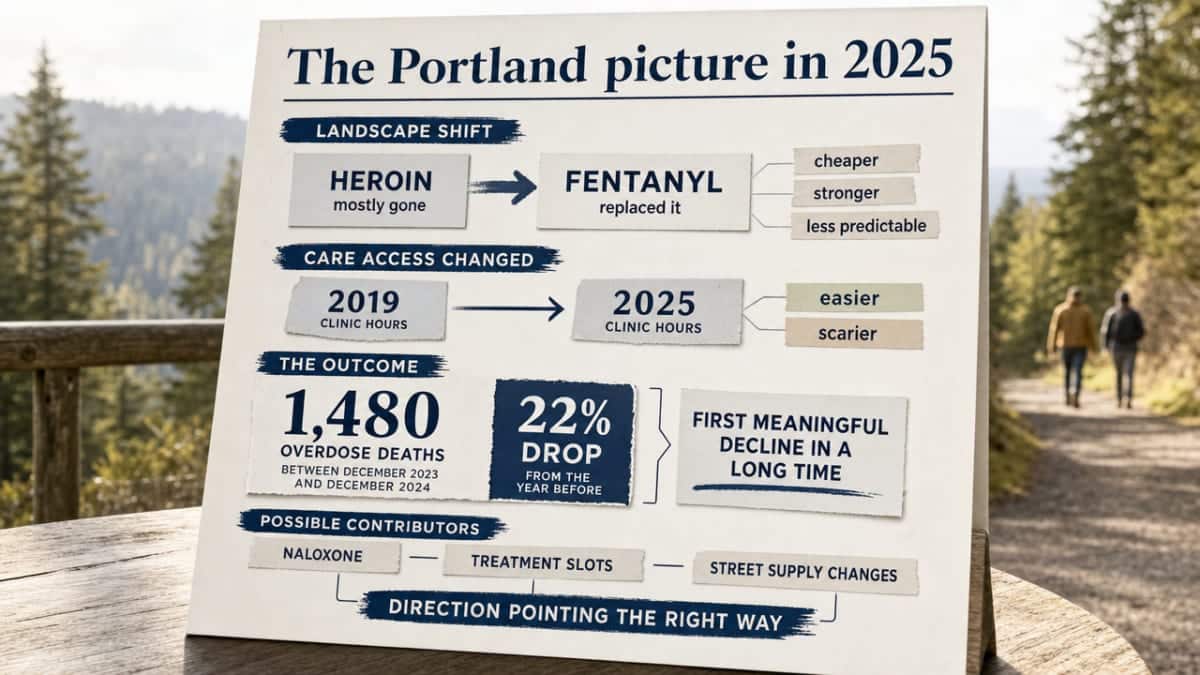
If you’ve been dependent on opioids in Portland for any stretch of years, you’ve watched the landscape shift under your feet. The heroin you might’ve started on is mostly gone. Fentanyl replaced it — cheaper, stronger, less predictable. The clinic hours you remembered from 2019 aren’t the same clinic hours in 2025. Some things got easier. Some things got scarier.
Here’s the good news, and it’s real. Between December 2023 and December 2024, Oregon recorded 1,480 overdose deaths — a 22% drop from the year before, according to CDC provisional data cited by the Oregon Health Authority. That’s the first meaningful decline the state has seen in a long time. More naloxone in more hands, more treatment slots opening up, changes in what’s circulating on the street — it’s a mix of factors, but the direction is finally pointing the right way.6
The harder news is what that 22% doesn’t say. Nearly 1,500 people still died in a single year. Oregon had one of the fastest-growing fentanyl overdose death rates in the country from 2019 to 2023, and the drug supply that made that possible hasn’t disappeared. If you’re on methadone right now, part of what’s keeping you alive is that you’re not out there testing that supply every day.9
What this means for you, practically: Portland in 2025 has more entry points into methadone detox than it did five years ago. Opioid treatment programs in the metro — from clinics along the east side near Lents and Foster-Powell to programs closer to Milwaukie and Sellwood — have expanded slots. Settlement money from opioid manufacturers is funding MAT capacity across the state. Telehealth check-ins that used to be impossible are now standard for some visits.
But access alone isn’t the same as safe detox. A slot at an OTP window where you dose and leave is different from a program that walks you through a taper with counseling, monitoring, and a plan for what happens after your last dose. Both exist here. Knowing the difference is the first thing that protects you.
What the SAMHSA rule change means for your access
The rules for how methadone gets to you changed in 2024, and they changed in your favor.
In February 2024, SAMHSA finalized a rewrite of the federal regulations that govern opioid treatment programs. The new rule expanded telehealth for admissions, updated who qualifies for treatment, and loosened the criteria for take-home methadone doses. The updated federal guidelines that programs actually follow now allow patients to be eligible for take-home doses on entry into treatment, depending on clinical judgment. That’s a real shift from the old model, where you dosed at the window every single morning for weeks or months before anyone considered letting you take a bottle home.2,8
For you, what this can look like in Portland: a first appointment done partly over video instead of a full in-person marathon. Fewer daily trips across town once you’re stable. A taper schedule that doesn’t require you to reorganize your entire work life around a clinic window in Lents or Milwaukie. Oregon has already seen what more flexibility can do — during the COVID emergency, expanded take-home rules meaningfully cut the number of daily dosing visits Oregon patients had to make, without wrecking safety outcomes 3.
Here’s the honest catch. The rules changed. Every program didn’t. An OHSU survey found many treatment programs were slow to loosen take-home methadone access even after federal regulations gave them room. Some clinics still run tight. Others have leaned in. Two programs a few miles apart in the Portland metro can offer very different day-to-day experiences.10
So ask. When you call, ask about telehealth intake, take-home eligibility, and how quickly a stable patient can move off daily window dosing. The regulation gave you leverage. Using it is on you.
Home-like residential vs. hospital detox
Picture two versions of your first week off methadone.
In one, you’re in a hospital bed. Fluorescent lights, a curtain instead of a door, the sound of a monitor beeping from the room next to yours. Someone comes in every few hours to check on you, but they’re also managing four other patients on the floor with problems that have nothing to do with opioids. You eat what a tray brings you. You sleep when the hallway quiets down, which isn’t often.
In the other, you’re in a house. A bedroom with a door that closes. A kitchen where someone cooks real meals. A living room where other people going through the same taper are watching TV or playing cards at 10 p.m. because none of you can sleep. Medical staff are there — nurses on shift, a doctor on call, the same comfort medications available — but the walls aren’t tile and the schedule isn’t built around hospital rounds.
Both settings can run a safe methadone taper. The clinical piece — the dose reductions, the vitals checks, the medications that soften withdrawal — doesn’t change much between them. What changes is everything around it.
Home-like residential detox is quieter. Your nervous system is already on high alert during a taper. Fluorescent light, hospital noise, and constant interruption make sleep harder and anxiety louder. A calmer environment doesn’t erase withdrawal, but it stops adding to it. Meals happen at a table. You can go outside. The staff you see in the morning are the same ones you see at night.
Hospital detox makes sense when there’s a medical complication that needs an acute-care setting — serious cardiac issues, an active overdose situation, withdrawal from multiple substances where things could turn fast. For a straightforward methadone taper in someone who’s otherwise stable, that level of infrastructure is overkill, and it can make the week feel more like something being done to you than something you’re doing.
When you call a Portland program, ask what the setting actually looks like. A house or a floor? Shared common space or a hallway? That answer tells you what your week will feel like.
The fentanyl-era relapse risk after detox
The window right after your last dose is the most dangerous window in this whole process. Not during the taper. After.
Here’s why. Your tolerance has been coming down for weeks. The dose that used to hold you steady in the morning would knock you flat now. Your body has been rebuilding its baseline. That’s the goal — and it’s also the exact thing that makes a relapse in the first few weeks after detox more likely to kill you than a relapse would have three months ago.
Then layer in what’s actually being sold in Portland right now. Nationally, heroin-involved overdose deaths dropped 35.7% between 2021 and 2022, but that’s not because opioids got safer — it’s because fentanyl replaced heroin in the supply. What used to be a semi-predictable bag isn’t anymore. Pressed pills sold as anything — oxy, Xanax, Percocet — routinely test as fentanyl. A dose that feels like a small slip can be a fatal one.7
You already know this in your gut. You’ve probably lost people to it. Naming it here isn’t to scare you — it’s to be honest about why the days and weeks after your last methadone dose need a plan, not just a hope.
What actually protects you in that window:
- staying connected to treatment instead of walking out the door with a discharge summary and no follow-up
- a prescription for naloxone and someone in your life who knows how to use it
- a transition to buprenorphine or naltrexone if that fits your situation, so you’re not standing between medications with nothing in between
- counseling appointments already on the calendar before you finish detox, not something you’ll get around to next week
Relapse isn’t a moral event. It’s a medical risk that spikes in a specific timeframe, and it responds to specific interventions. If it happens, calling your program the same day matters more than feeling ashamed about it. Getting back on a medication that stabilizes you is not starting over. It’s staying alive long enough to try again.
What comes after the last dose: counseling, PHP, IOP
The day you take your last dose of methadone isn’t a finish line. It’s more like the day you leave the hospital after surgery — the hard part is technically done, but the healing hasn’t happened yet.
This is the part that gets skipped, and it’s the part that decides whether the taper you just finished holds. Detox on its own — no counseling, no follow-up, no next step — has a rough track record. The reason isn’t willpower. It’s that opioid use disorder rewired things in your brain and your life that a two-week taper doesn’t undo. The medication came off. The rest is still there.
What comes next in Portland typically looks like a step-down structure. Partial hospitalization programs — usually shortened to PHP — run five or six days a week for most of the day. You come in, do individual and group therapy, meet with a doctor, work on the stuff underneath the using. You sleep at home or in supportive housing. It’s intensive without being residential, and it’s often where people spend the first few weeks post-detox while their sleep and appetite are still uneven.
Intensive outpatient — IOP — is the next step down. Three days a week, a few hours at a time. Enough structure to keep you accountable, loose enough to work a job around it. Standard outpatient after that: weekly counseling, medication check-ins, a group if you want one. Oregon’s MAT framework explicitly pairs medication with counseling and ongoing support because the combination is what moves the numbers on retention and overdose risk.1
Somewhere in there, you and your doctor decide whether buprenorphine or naltrexone makes sense to hold your baseline steady. Not everyone needs it. A lot of people do, especially in the first six months. Staying on a medication after methadone isn’t going backward — it’s a different tool for a different phase.
Ask about the continuum before you start detox, not after. Programs that already have PHP and IOP under one roof — like the model Pacific Crest Trail Detox runs out of Milwaukie — mean you’re not scrambling to find a next step during the week you can least afford to.
Questions worth asking any Portland program before you commit
You’re about to hand a program some real trust. That earns you the right to interview them back. Most intake calls will lean on you to book fast. Slow the call down. Ask five or six things, and listen for whether the answers sound rehearsed or specific.
What’s your starting dose and taper schedule? A program should be able to tell you the range they typically start at and how many milligrams per day or per week they usually come down by. If they get vague, that’s a flag. The clinical baseline sits around a 10–20 mg starting range with reductions of about 1–2 mg per day or 2.5–5 mg per week. They don’t have to match those numbers exactly — your dose and history matter — but they should know them.5
What triggers a hold or a dose bump? Ask what happens if the taper is moving faster than your body can handle. A program that says “we just push through” is not the one. The right answer involves pausing, adjusting, and checking vitals before restarting.
Who is in the building overnight? Nurse coverage at 2 a.m. matters more than the tour photos. Ask specifically.
What comes after my last dose? If they can’t name the PHP, IOP, or outpatient step they hand you off to — under their roof or with a partner — you’ll be scrambling in the worst week to scramble.
Do you offer telehealth intake and flexible take-home dosing once I’m stable? The 2024 federal rule opened both up, but not every program uses that room. Knowing where a clinic sits on that spectrum tells you what your daily life will look like.10
Will you write a naloxone prescription before discharge? The answer should be yes, without a pause.
When you’re ready to make the call
Making the call is the hardest single step. Not the taper. Not the first night. The call.
You don’t have to be sure. You don’t have to have your work situation figured out or your family briefed or a bag packed. You just have to pick up the phone and say some version of, “I’m on methadone and I want to come off. What does that look like with you?” That sentence is enough.
What happens next is a conversation, not a commitment. A good intake team will ask about your current dose, how long you’ve been on it, what else is going on medically, and what your life at home looks like. They’ll tell you what a taper with them actually involves — the pacing, the setting, the counseling, the step-down after. If something they say doesn’t match what you need, you can hang up and call somewhere else.
Pacific Crest Trail Detox is one of the places in the Portland metro that takes those calls. Whatever you decide, calling today counts as the first step.
See If Your Methadone Detox Is Covered
Find out if your insurance covers a safe, supportive methadone detox in Portland.
Frequently Asked Questions
How long does a methadone detox taper usually take in Portland?
It depends on your starting dose and how fast your body handles reductions. Clinical guidance points to a 10–20 mg starting range with cuts of about 1–2 mg per day inpatient or 2.5–5 mg per week outpatient. That works out to roughly two to eight weeks for the active taper. Some people go slower. A good program lets your body set the pace instead of the calendar.5
Can I detox from methadone at home, or do I need residential care?
Some people do outpatient tapers successfully, especially at lower starting doses with strong support at home. Residential care makes sense if your dose is higher, you’ve relapsed before, your housing isn’t stable, or the idea of white-knuckling nights alone feels like the thing that pulls you back to using. A home-like residential setting gives you medical staff, comfort medications, and other people going through it, without the noise of a hospital.
Will I be comfortable during withdrawal, or should I expect to suffer?
You won’t feel great. That’s the honest answer. But a slow, medically supervised taper paired with comfort medications — something for the restlessness, muscle aches, and sleep — turns a week that used to feel unbearable into one you can get through. If symptoms get bigger than the plan, the dose holds or steps back up. Suffering through it on purpose isn’t part of the treatment. That’s an old idea, not a clinical one.
What happens if I relapse after detox in a fentanyl-heavy drug supply?
Your tolerance is lower now, and the supply is unpredictable. A relapse in the first weeks after your last dose carries real overdose risk. Have naloxone on hand and someone who knows how to use it. If you use again, call your program the same day — not next week. Getting back on a stabilizing medication like buprenorphine or naltrexone isn’t starting over. It’s staying alive long enough to keep trying.
Do I need counseling or a PHP/IOP program after I finish detox?
Yes, and it matters more than most people expect. Oregon’s MAT framework specifically pairs medication with counseling because the combination is what moves retention and overdose numbers, not the taper alone. Partial hospitalization or intensive outpatient in the first weeks post-detox gives your sleep, appetite, and nervous system time to catch up while you work on what was underneath the using. Detox is step one. This is step two.1
What should I ask a Portland detox program before I commit?
Ask five things. What’s your starting dose and weekly reduction? What triggers a hold or dose bump if I struggle? Who’s on staff overnight? What PHP or IOP do you hand me off to after my last dose? Do you offer telehealth intake and flexible take-home dosing once I’m stable — a right the 2024 federal rule expanded, though not every program uses fully? Also: will you send me home with naloxone?10
References
- Oregon Health Authority: Medication-Assisted Treatment for Opioid Dependence. https://www.oregon.gov/oha/hsd/amh/pages/mat.aspx
- Medications for the Treatment of Opioid Use Disorder (Final Rule). https://www.federalregister.gov/documents/2024/02/02/2024-01693/medications-for-the-treatment-of-opioid-use-disorder
- Reduction in Oregon’s Medication Dosing Visits After the SARS-CoV-2 Emergency. https://pmc.ncbi.nlm.nih.gov/articles/PMC8339128/
- New Opioid Treatment Programs to Serve Rural Oregon. https://www.oregon.gov/oha/erd/pages/newopioidtreatmentprogramsserveruraloregon.aspx
- Prescribing guidelines for opioid agonist maintenance treatment. https://www.ncbi.nlm.nih.gov/books/NBK143167/
- Oregon overdose deaths are down, CDC data shows. https://www.oregon.gov/oha/erd/pages/oregon-overdose-deaths-are-down-cdc-data-shows.aspx
- Drug Overdose Deaths in the United States, 2002–2022. https://www.cdc.gov/nchs/products/databriefs/db491.htm
- Federal Guidelines for Opioid Treatment Programs (PEP24-02-011). https://www.med.unc.edu/fammed/nctac/wp-content/uploads/sites/1256/2025/01/federal-guidelines-opioid-treatment-pep24-02-011-1.pdf
- Oregon Health Authority: Reducing Opioid Overdose and Misuse. https://www.oregon.gov/oha/ph/preventionwellness/substanceuse/opioids/pages/index.aspx
- Treatment programs reluctant to allow take-home methadone, survey indicates. https://news.ohsu.edu/2021/11/04/treatment-programs-reluctant-to-allow-take-home-methadone-survey-indicates
- Vital Statistics Rapid Release: Provisional Drug Overdose Data. https://www.cdc.gov/nchs/nvss/vsrr/drug-overdose-data.htm