


Key Takeaways
- Rehab pricing isn’t a single number but a stack of choices: detox, level of care, cravings medication, therapy, and aftercare, each with its own cost and impact.
- Federal law requires ACA plans and most employer coverage to treat alcohol care as an essential benefit with parity to medical services, though networks and denials still create gaps 7, 3.
- Matching intensity to risk matters more than spending the most, since outpatient care with medications like naltrexone or acamprosate often delivers strong cost-effectiveness 2, 5.
- Focus next on one insurance call using the script, a SAMHSA referral if uninsured, and a short list of three programs judged by aftercare planning 14.
What You’re Actually Paying For When You Pay for Rehab
If you’re reading this, you’ve probably already been through a lot. Maybe you’ve paid for a program that didn’t stick. Maybe you’ve said no once and lost sleep over it. Either way, you deserve a straight answer about what rehab actually costs and what that money buys.
Here’s the honest starting point: there is no single price. A number you see online is almost always an average pulled from very different kinds of care, and it can either scare you into doing nothing or lull you into thinking one flat fee covers everything. Neither is fair to you.
What you’re really paying for is a stack of decisions. Each one has its own cost, and each one changes the odds of your adult child staying sober. The main pieces look like this:
- Medical detox — round-the-clock supervision while the body clears alcohol safely, since alcohol withdrawal can turn dangerous fast.
- The level of care after detox — residential, day treatment, evening groups, or weekly outpatient. Each step down usually costs less.
- Medicine to ease cravings and support recovery — sometimes called medication-assisted treatment, or MAT for short.
- Therapy and group work — the counseling that helps the changes actually take root.
- Aftercare — the check-ins, alumni support, and continuing therapy that keep early sobriety from unraveling.
Insurance, in many cases, covers a real share of this stack under federal rules most families don’t know they have 7. And research consistently shows that treatment, especially when it combines counseling with medicine like naltrexone or acamprosate, tends to be cost-effective or even cost-saving compared with letting the drinking continue 4.
So take a breath. The number isn’t one number. It’s a series of choices, and you have more control over them than you think.
The Cost Stack: Breaking Down Rehab by Level of Care
Medical Detox: The First Line Item
Detox is where most alcohol rehab journeys begin, and it’s usually the most medically intense part of the stack. That’s because alcohol withdrawal isn’t like quitting caffeine. For someone drinking heavily every day, stopping cold can trigger seizures, dangerous blood pressure spikes, and delirium tremens. Those are real medical emergencies, and they’re the reason detox has a price tag attached at all.
What you’re paying for during those first three to seven days is a small clinical team keeping your adult child safe. That includes 24-hour nursing, physician oversight, medications to calm the nervous system as alcohol leaves the body, and a bed in a setting that isn’t a hospital emergency room. Some programs run detox inside a home-like residence rather than a clinical ward, which tends to feel less frightening to the person going through it and, honestly, to the parent visiting.
Detox is typically billed by the day, and the daily rate reflects that around-the-clock staffing. Insurance often covers a meaningful share of medically necessary detox under federal rules, which we’ll get to in the next major section 7.
Residential, PHP, IOP, and Outpatient: Where the Big Ranges Live
Once detox is behind you, the next question is where your adult child spends the following weeks or months. This is where the price ranges get wide, and where the labels start to blur together. Let’s slow down and translate them.
- Residential
- Living at the facility full-time. Meals, groups, therapy, medical checks, and sleep all happen under one roof. It’s the most immersive option and, unsurprisingly, the most expensive. A 2024 NIH report on adolescent residential addiction facilities found an average daily cost of $878, or roughly $26,000 for a typical month-long stay, with about half of facilities having no bed immediately available and average waitlists of 28 days 13. That study looked at teen programs specifically, so the numbers don’t map perfectly to adult rehab, but they show the economic shape of residential care: high daily rate, meaningful wait times, real access friction.
- Partial hospitalization (PHP)
- The next step down. Your adult child spends most of the day in treatment — usually five to six hours, five days a week — then sleeps at home or in sober living. You’re paying for clinical hours, not a bed.
- Intensive outpatient (IOP)
- Drops to about nine to twelve hours a week, often in evening groups, so someone can hold a job or care for a child while still in treatment. Costs are typically a fraction of residential.
- Standard outpatient
- Weekly therapy plus check-ins. It’s the least expensive tier by far.
Here’s the part that surprises most parents: less expensive doesn’t mean less effective. A classic comparison of treatment modalities found that outpatient drug-free programs delivered the best cost-effectiveness of the options studied, with similar outcomes to more intensive care for many patients 2. Translation: sometimes stepping down is the right clinical call, not a compromise.
The honest way to think about this tier: match the intensity to the risk. A first serious attempt at sobriety after years of heavy daily drinking often warrants residential or PHP at the start. Someone with strong home support, a stable job, and a shorter drinking history may do well starting at IOP. A good admissions team will tell you which end of the stack fits, and they should be willing to say “you probably don’t need our most expensive option” without flinching.
Medicine to Ease Withdrawal and Cravings (MAT)
There’s a category of medicine that quietly changes the math on alcohol recovery, and a lot of families have never heard about it. In shorthand it’s called medication-assisted treatment, or MAT. In plain terms, it’s a small set of prescription medicines that reduce cravings and blunt the pull to drink so the counseling and life changes have room to work.
The two most common for alcohol are naltrexone and acamprosate. Neither is a sedative. Neither creates a new dependency. They simply make the day-to-day of not drinking feel more manageable, especially in the first several months when relapse risk is highest.
The cost is modest compared to the rest of the stack — think a regular prescription rather than a hospital bill — and the return on it is remarkable. A systematic review of economic studies found that adding pharmacotherapy to counseling was cost-effective from both healthcare and societal perspectives 5. In patients with more advanced alcohol-related liver disease, adding these medicines and counseling actually saved money overall while producing better health outcomes 4.
If a program you’re evaluating doesn’t discuss MAT at all, that’s worth a question. Not every person needs it, but every person should be offered a real conversation about it.
Aftercare: The Line Item Most Families Underestimate
Aftercare is the part of the stack that looks small on paper and matters enormously in real life. It’s the ongoing therapy, group meetings, alumni check-ins, and continued MAT prescriptions that fill the weeks and months after a formal program ends.
Families tend to think of rehab as a finish line — 30 days, 60 days, done. Recovery doesn’t actually work like that. The first year after treatment is where habits either take root or fall apart, and aftercare is what holds the line during that stretch.
The good news is that aftercare is usually the least expensive tier in the whole stack. Weekly outpatient therapy, a monthly medication follow-up, and free peer support meetings can add up to a fraction of what residential care cost, while doing much of the heaviest lifting for long-term sobriety.
When you’re comparing programs, ask what aftercare is included in the initial price and what continues separately. A program that hands your adult child a printed list of meetings on discharge day is not offering aftercare. A program that schedules the next therapy appointment before discharge, keeps them connected to their group, and stays reachable when things wobble — that’s the line item worth paying for.
What Insurance Actually Covers (and Where the Gaps Hide)
The ACA and Parity Backbone
Here’s something a lot of families don’t know until they’re already deep into worry: alcohol rehab is not an optional add-on that insurance can wave away. Under the Affordable Care Act, every Marketplace plan has to cover mental health and substance use services as one of the essential health benefits, and insurers cannot slap lifetime or annual dollar caps on that care 7. That protection extends to most employer plans too.
The second layer is called parity, from the Mental Health Parity and Addiction Equity Act. In plain terms, it means your adult child’s insurer can’t make the copay for addiction treatment worse than the copay for a knee surgery, and can’t impose stricter visit limits or prior-authorization hoops than it uses for medical or surgical care 8. Deductibles, out-of-pocket maximums, and network rules have to line up.
That’s the good news. Here’s the honest part: parity on paper is not always parity in practice. Researchers looking at the years after the ACA found that families still run into narrow networks, denials, and inconsistent coverage of medications and specific services 3. So the law is on your side, and it’s still worth reading your plan documents with a pen in your hand.
Medicare, Medicaid, and the Residential Coverage Gap
If your adult child is on Medicare — which happens more often than people expect, through disability or age — the coverage picture shifts. Medicare covers screenings for alcohol use, outpatient counseling, medications, and certain intensive outpatient and partial hospitalization programs for substance use disorders 9. That’s a real benefit, and it’s grown in recent years.
The gap to know about: traditional Medicare does not cover residential (non-hospital) rehab the way it covers inpatient hospital care. So if a residential stay is what a clinician is recommending, you may need to look at Medicare Advantage details, supplemental coverage, or pair Medicare with other resources to close the gap 9.
Medicaid varies by state and often covers a broad set of services, but families in Oregon and elsewhere should know that Medicaid doesn’t always cover every medication or level of care for alcohol use disorder 3. Ask specifically about detox, MAT prescriptions, and continuing therapy, since these are the three places coverage most often thins out.
A Script for the Phone Call With Your Insurer
“Call your insurance” is advice everyone gives and nobody explains. So here’s what to actually say, and what to write down when they answer. Have your adult child’s member ID handy, and ask if you can be on the call with them, or if they can add you as an authorized contact for treatment questions.
Open with this: “I’m calling about coverage for substance use disorder treatment, specifically alcohol. Can you confirm my in-network benefits for the following levels of care?” Then walk through each tier:
- Medical detox — inpatient and residential detox. Ask about the daily rate covered, prior authorization requirements, and any day limits.
- Residential rehab — same questions, plus whether the plan requires a step-down from detox first.
- Partial hospitalization and intensive outpatient — how many hours or days per week are covered, and for how many weeks.
- Standard outpatient therapy — copay per session, session limits, and any telehealth coverage.
- Medications for alcohol use disorder — specifically naltrexone (oral and injectable) and acamprosate. Ask which tier they fall on and what the copay looks like.
Then ask the questions parity protects: “Are the copays, deductibles, and visit limits for these services the same as for medical or surgical benefits?” and “What’s the appeals process if a service is denied?” Write down the reference number for the call. If something feels off later, that number is your paper trail.
Is It Worth It? The Math Parents Rarely See
You’ve probably done the mental math already. Maybe you’ve done it at two in the morning, sitting up with a calculator and a pit in your stomach. The question underneath the question is always the same: is this money going to make a difference, or are we about to spend our savings on something that might not stick?
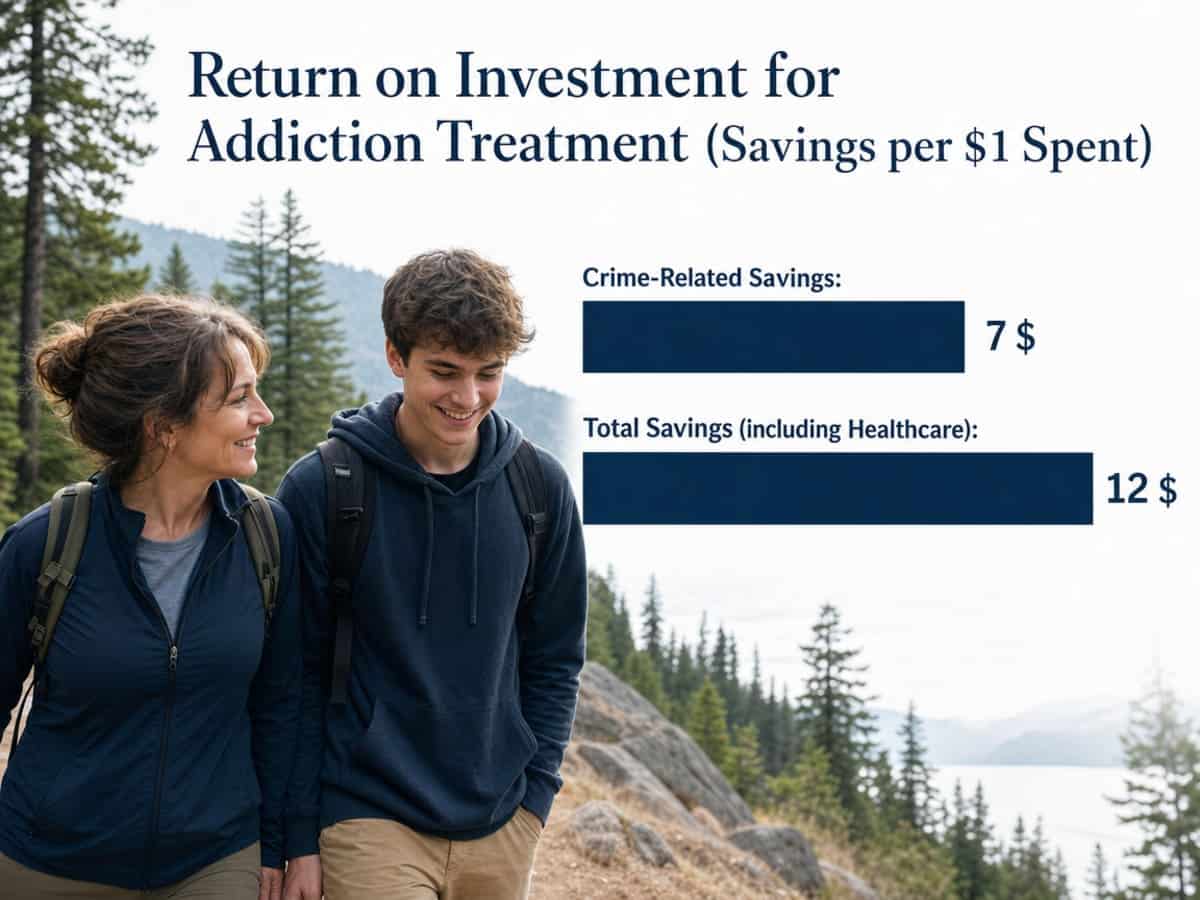
Here’s the number that reframes it. When researchers add up what happens after treatment — fewer arrests, fewer emergency room visits, fewer missed workdays, fewer hospitalizations for alcohol-related illness — every dollar spent on addiction treatment returns about $7 in crime and criminal justice savings, and roughly $12 in total savings once healthcare costs are included 6. That’s not a marketing figure from a rehab website. It comes from a legislative briefing summarizing multiple studies of treatment outcomes across the country 6.
Now, those savings don’t all land in your checking account. Some of them are absorbed by insurers, some by public systems, some by employers. But a real share of them does land at home — in the phone calls that stop coming from a hospital, in the job that doesn’t get lost, in the car that doesn’t get totaled, in the grandchildren who get their parent back.
The comparison that matters is not “rehab vs. no expense.” It’s “rehab vs. the ongoing cost of active alcohol use,” and the second column tends to be bigger than families let themselves see. Unpaid medical bills. Legal fees. Lost wages. The second and third attempts to help that always seem to arrive.
You are not buying a product. You are funding a chance — one that the evidence says is a reasonable bet, not a long shot. That reframing doesn’t make writing the check easy. It does make it defensible, to yourself and to anyone else at the kitchen table with you.
What a Good Program Should Feel Like
Price matters, but it isn’t the whole story. When you tour a program or take a call with an admissions counselor, the feel of the place tells you almost as much as the invoice does. A good program has a certain steadiness to it — and once you know what to listen for, you can hear it in the first ten minutes.
It should feel safe and medical without feeling like a hospital ward. Alcohol withdrawal can be dangerous, so there should be a nurse and physician oversight built into the schedule, not tacked on. A home-like residence with real bedrooms and a kitchen tends to lower the wall your adult child puts up on day one, which matters more than any brochure.
It should feel honest about medicine. If cravings-reduction medicines like naltrexone or acamprosate are never mentioned, that’s a gap 5. A program that treats these as normal tools, not a last resort, is aligned with the evidence.
It should feel connected to what comes next. Ask, on the first call: “What does the week after discharge look like?” A good answer names appointments, groups, and a person who stays in touch. A vague answer is a warning.
And it should feel respectful of you, the parent, without pretending you’re in charge of your adult child’s recovery. That balance — warm, clear, unhurried — is the sound of a program worth paying for.
Oregon and the Pacific Northwest: A Regional Note
If you’re reading this from Oregon, Washington, or somewhere else in the Pacific Northwest, the national picture only tells you so much. The regional one is worth understanding, because it shapes what beds are available, how long the wait can be, and how much of the cost stack falls on your family versus the state.
Oregon has carried a heavier alcohol burden than most states for years. A legislative analysis found that by 2017, Oregon ranked fourth in the country for both alcohol use disorders and substance use disorders — a level of need well above the national average 12. That ranking hasn’t translated into a matching level of care. A more recent state financial analysis put the gap between what Oregon spends on substance use services and what would actually meet the need at roughly $6.83 billion 11.
What that means, practically, for you: waitlists at publicly funded programs can be long, and private residential beds fill quickly. Insurance-covered detox with a clear step down into outpatient care is often the fastest way in. Programs based in the Portland metro area that combine medical detox with ongoing therapy and aftercare tend to be your best chance at moving quickly without sacrificing quality.
First Steps If You’re Ready to Make the Call
If you’ve read this far, you already know more than most parents do when they start. The question now is smaller than it feels: what do you do this week?
- Start with one phone call. SAMHSA’s National Helpline (1-800-662-HELP) is free, confidential, and answered around the clock every day of the year 14. You can call it yourself, without your adult child on the line, to ask questions and get referrals in your area. Nobody there is selling anything.
- Next, pull your adult child’s insurance card and use the script from earlier in this article. Ask about detox, residential, day and evening programs, outpatient therapy, and cravings medications like naltrexone and acamprosate. Write down the reference number.
- Then make a short list — three programs, no more. Call each one. Notice which admissions team asks about your adult child before quoting a price, and which one names what happens after discharge without being prompted.
You don’t have to have the whole plan by Friday. A first honest phone call is a real step, and small steps are how this actually starts. When you’re ready to talk with a program directly, Pacific Crest Trail Detox is one place that answer begins.
Check Your Coverage for Alcohol Detox Today
See if your insurance helps cover alcohol detox and recovery costs in just a few minutes.

Frequently Asked Questions
Does insurance really cover alcohol rehab, or is that just marketing?
Yes, it genuinely does, and the law backs it up. Under the Affordable Care Act, alcohol treatment is an essential health benefit, and parity rules require insurers to treat it comparably to medical care 7. That said, coverage isn’t automatic — you’ll still need to check your specific plan for network rules, prior authorization, and which medications are on formulary 3.
What if my adult child doesn’t have insurance at all?
There are real options. Call SAMHSA’s National Helpline at 1-800-662-HELP — it’s free, confidential, and open every day of the year, and they’ll refer you to sliding-scale and state-funded programs in your area 14. Many people also qualify for Medicaid, which covers a range of alcohol treatment services, though specific medications and levels of care vary by state 3. Ask directly about detox, therapy, and cravings medication.
Is outpatient treatment really enough, or do we need residential rehab?
It depends on the risk, but outpatient can be genuinely effective. A well-known study comparing treatment modalities found outpatient drug-free programs delivered the strongest cost-effectiveness with outcomes similar to more intensive care for many patients 2. Heavy daily drinking usually calls for medical detox first, then a step-down plan. Someone with strong home support and a stable job may do well starting at intensive outpatient. Match intensity to risk.
How long does alcohol rehab usually last, and does length affect cost?
Detox typically runs three to seven days. Residential stays often last 28 to 90 days, and outpatient care can continue for months. Longer stays cost more upfront, but the real cost driver is the daily rate of the setting, not the calendar. A shorter residential stay followed by strong outpatient and aftercare often costs less overall than a long residential stay with weak follow-through — and holds up better long-term.
As a parent, am I financially responsible for my adult child’s treatment?
Legally, no. Your adult child is responsible for their own medical bills, and treatment providers bill them, not you, unless you sign as a guarantor. Many parents choose to help voluntarily, and that’s a personal decision, not an obligation. If you do contribute, consider paying providers directly rather than handing over cash, and keep the conversation focused on the care itself — not on rescuing every past debt.
What happens if we pay for rehab and my child relapses?
Relapse is painful, and it’s also part of how many people eventually reach lasting sobriety. It doesn’t mean the money was wasted or that treatment failed — it usually means the aftercare piece needs to be stronger, or that cravings medications like naltrexone or acamprosate deserve another conversation 5. A good program stays reachable after discharge and helps you regroup. Progress in recovery is rarely a straight line.
References
- The Economic Costs of Substance Abuse Treatment. https://pmc.ncbi.nlm.nih.gov/articles/PMC2614666/
- Effectiveness and Cost‑effectiveness of Four Treatment Modalities for Substance Use Disorders. https://pmc.ncbi.nlm.nih.gov/articles/PMC1360883/
- Insurance Barriers to Substance Use Disorder Treatment After the Affordable Care Act. https://pmc.ncbi.nlm.nih.gov/articles/PMC9948907/
- Cost‑effectiveness of Alcohol Use Treatments in Patients with Alcohol‑Related Cirrhosis. https://pubmed.ncbi.nlm.nih.gov/33326815/
- Economic Evaluations of Alcohol Pharmacotherapy. https://pmc.ncbi.nlm.nih.gov/articles/PMC10838482/
- Cost Offset of Treatment Services. https://www.akleg.gov/basis/get_documents.asp?docid=10655
- Mental Health & Substance Abuse Coverage. https://healthcare.gov/coverage/mental-health-substance-abuse-coverage/
- Mental Health and Substance Use Disorder Parity. https://www.dol.gov/agencies/ebsa/laws-and-regulations/laws/mental-health-and-substance-use-disorder-parity
- Mental Health & Substance Use Disorders – Medicare. https://www.medicare.gov/coverage/mental-health-substance-use-disorder
- National Survey of Substance Abuse Treatment Services (N‑SSATS) 2020. https://www.samhsa.gov/data/sites/default/files/reports/rpt35313/2020_NSSATS_FINAL.pdf
- Oregon Substance Use Disorder Financial Analysis Report. https://www.oregon.gov/adpc/MeetingDocuments/SUD-Financial-Analysis-Report-0424.pdf
- Analysis of Oregon’s Publicly Funded Substance Abuse Treatment System. https://www.oregonlegislature.gov/citizen_engagement/Reports/2019-OCJC-SB1041-Report.pdf
- Residential Addiction Treatment for Adolescents Is Scarce and Expensive. https://www.nida.nih.gov/news-events/news-releases/2024/01/residential-addiction-treatment-for-adolescents-is-scarce-and-expensive
- National Helpline for Mental Health, Drug, Alcohol Issues. https://www.samhsa.gov/find-help/helplines/national-helpline