


Key Takeaways
- Medical detox is the short, intensive process of getting your body safely stable after stopping a substance — usually days to a week, though benzodiazepines run weeks to months.12,8
- Timelines vary by substance: alcohol peaks at 24–72 hours, short-acting opioids ease by day 5–7, long-acting opioids take 10–20 days, and stimulants leave a lingering low-mood phase.1,6,4,13
- Dose history, polysubstance use, prior withdrawal seizures or DTs, and co-occurring conditions all stretch the timeline and shape how much monitoring your body actually needs.3,10,15
- Finishing detox is stabilization, not treatment — a 26.5% readmission rate in one initiative shows why continued medication, counseling, and structure carry the work forward.14,12,15
The honest answer: days for some substances, weeks for others
If you’re reading this in the middle of the night, scared, with shaky hands or a knot in your stomach, you’re asking the right question. How long will this last? You deserve a real answer, not a brochure.
Here it is: medical detox usually takes a few days to about a week — but the truth depends on what your body has been used to. Alcohol withdrawal symptoms tend to start within 8 hours of your last drink, peak somewhere between 24 and 72 hours, and ease off over the following week . How long does medical detox take, short-acting opioids like heroin or oxycodone typically improve 5 to 7 days after the last dose. Long-acting opioids such as methadone can stretch that timeline to 10 to 20 days. Stimulants like meth and cocaine often clear in days, though low mood can linger for weeks. Benzodiazepines — Xanax, Klonopin, Ativan — are different. Safe withdrawal is measured in weeks or months of careful tapering, not a single hospital stay.1,4,6,8,13
That variation isn’t a vague answer. It’s the honest one. Detox is the short, intensive part where your body gets stable and safe. What follows matters more than how many days you spent in a bed. The sections below break down each substance, the dangerous windows to watch for, and what makes your own timeline shorter or longer.12
Medical detox timelines by substance
Side-by-side: typical duration for alcohol, opioids, benzos, and stimulants
Before you read about your specific substance, it helps to see them lined up next to each other. The differences are bigger than most people expect.
Here’s what the clinical guidelines actually say about how long withdrawal lasts:
- Alcohol: Symptoms start within 8 hours of your last drink, peak between 24 and 72 hours, and ease over the following week.1.
- Short-acting opioids (heroin, oxycodone, hydrocodone): Withdrawal usually improves 5 to 7 days after the last dose, though some people feel off for weeks afterward.6
- Long-acting opioids (methadone, extended-release formulations): Withdrawal can last 10 to 20 days, with onset delayed 12 to 48 hours after the last dose.4
- Benzodiazepines (Xanax, Klonopin, Ativan, Valium): Safe withdrawal is a taper, not an event. Dose reductions should be spaced at least a week apart, which puts the full process in the range of weeks to months.8
- Stimulants (methamphetamine, cocaine): Acute withdrawal lasts days to weeks, with a longer phase of low mood and fatigue that can stretch beyond the physical symptoms.13
If you’re scanning this and your substance falls into more than one category, that’s worth a real conversation with a medical team. Withdrawal from two things at once doesn’t average out — it stacks. You don’t have to figure out which timeline is yours alone. That’s what the people doing intake assessments are trained for. The sections below walk through each substance so you know what to expect on the days that matter most.
Alcohol: why day 2 to day 4 is the dangerous window
If alcohol is what you’ve been drinking heavily and you’ve stopped — or you’re about to — the next few days are the ones that matter most. This is the part nobody wants to say out loud, but you deserve the truth so you can be somewhere safe for it.
Symptoms usually start within 8 hours of your last drink. That first wave often looks like shakiness, sweating, a racing heart, anxiety, nausea, and trouble sleeping. It can feel like a brutal hangover that won’t lift. Then it gets worse before it gets better.1
The peak danger window sits between 24 and 72 hours after your last drink. This is when seizures are most likely and when symptoms can get severe enough to need real medical intervention. Hospital guidelines specifically defer discharge until withdrawal has resolved, because clinicians know this stretch is when things can turn quickly.1,3
Then there’s a second window layered on top. Delirium tremens — DTs, a severe form of alcohol withdrawal that causes confusion, hallucinations, dangerous changes in heart rate and blood pressure, and can be fatal — most often appears between 48 and 96 hours after the last drink. Not everyone gets DTs. But the people who do almost never see it coming, which is exactly why medical monitoring through this window isn’t optional for anyone with heavy, long-term drinking, prior withdrawal seizures, or other risk factors.2
Here’s the part worth holding onto: making it through hour 72 is a real milestone. By day 4 or 5, the worst symptoms usually start tapering. Sleep is still rough, anxiety can linger, and you may not feel like yourself for a while 1. But the medical danger zone narrows. The reason medical detox exists isn’t because detox is impossible — it’s because this specific stretch of hours is when the right medications and the right monitoring can keep you safe. You don’t have to white-knuckle it alone.

Opioids: 5–7 days for short-acting, 10–20 days for long-acting
Opioid withdrawal is rarely life-threatening on its own, but anyone who’s been through it will tell you that doesn’t make it easier. It feels like the worst flu you’ve ever had, layered with deep restlessness, muscle aches, sweating, stomach cramps, diarrhea, and a kind of bone-deep agitation that makes it impossible to get comfortable.5
The timeline depends on which opioid your body has been used to. For short-acting opioids — heroin, oxycodone, hydrocodone, immediate-release pain pills — symptoms typically start within hours of the last dose, peak around day 2 or 3, and improve significantly by day 5 to 7. Some people feel off, exhausted, or low for a few more weeks after the acute symptoms fade. That’s normal, and it’s not a sign you’re failing.6
For long-acting opioids — methadone, extended-release morphine, some fentanyl patches — the timeline stretches. Withdrawal onset is delayed 12 to 48 hours after the last dose, and the full course can last 10 to 20 days. That’s a meaningful difference. If you’ve been on methadone, going in expecting a 5-day detox sets you up to feel blindsided on day 8 when you’re still struggling.4
Medication helps. Buprenorphine, used under medical supervision, can shorten the acute phase of opioid detox and make symptoms more manageable. So can supportive medications for nausea, muscle aches, and sleep. The point of medically supervised opioid detox isn’t to make withdrawal disappear — it’s to take the edges off the worst of it and keep you safe through dehydration, vomiting, and the very real risk of leaving early to use again. Most people need ongoing treatment after the acute detox days are done. That isn’t failure. It’s how the body and brain actually heal from opioid dependence.7
Benzodiazepines: weeks to months of careful tapering, not a 5-day detox
If you’ve been taking Xanax, Klonopin, Ativan, Valium, or another benzodiazepine for more than a few weeks, please read this section slowly. Benzo withdrawal is different from everything else on this page, and a lot of generic detox content gets it wrong in ways that can hurt you.
Clinical guidance generally recommends initial reductions of 10% to 25% of the current dose, with later reductions adjusted based on how your body is responding. Some doses can be cut every couple of weeks for shorter tapers down to 10% reductions every 1 to 2 weeks (or slower) for people who’ve been on benzos a long time. The full process, depending on your starting dose and how long you’ve been taking them, often runs weeks to months.8,9
That can feel discouraging if you came in hoping to be done in a week. Try to reframe it: a slower taper is the safer taper. Going slowly is the whole point. Medically supervised benzo tapers usually combine the gradual dose reduction with monitoring, support for sleep and anxiety as doses drop, and a treatment plan that continues well past the day the last pill comes out. The timeline is longer because your nervous system needs that time to rewire.8
Stimulants: days to weeks, with a low-mood phase that lingers
Stimulant withdrawal — from methamphetamine, cocaine, or prescription stimulants used heavily — looks different from alcohol or opioid withdrawal. The acute physical risks are generally lower, but that doesn’t mean it’s easy 13.
What usually happens: after the last use, you crash. Hard. The first few days bring intense fatigue, heavy sleeping, increased appetite, and a flatness that feels like every color has been turned down. Most people who use stimulants regularly experience withdrawal when they stop. The acute phase often clears within a week or so. Then comes the part that surprises people.13
A longer, more protracted phase of low mood, low motivation, sleep disturbances, and powerful cravings can stretch for weeks beyond the physical symptoms. There’s no medication that cleanly resolves it the way buprenorphine helps with opioids. What helps is supportive care, monitoring, structure, and being somewhere you’re not alone with your own brain during the weeks the low mood is loudest. That’s why even a short medical detox for stimulants is usually followed by structured ongoing treatment — the cravings outlast the crash.13
What makes your detox longer or shorter
How long, how much, and which substances you used
Two people can drink the same beer, take the same pill, or use the same powder and end up with very different detox timelines. The biggest factor is how long your body has been adapting to the substance and at what dose.
If you’ve been drinking heavily every day for years, your nervous system has rewired itself around alcohol — and pulling that support out triggers a bigger, longer reaction than someone who’s been drinking heavily for a few months. Same with opioids. Higher daily doses and longer use generally mean stronger withdrawal and a longer recovery curve. And the specific substance matters: a long-acting opioid like methadone can keep producing withdrawal symptoms 10 to 20 days out, while a short-acting one is usually done with the worst by day 7.1,4,6
None of this is a verdict on you. It’s information about your body. The honest intake conversation — what you used, how much, for how long, and when you last used — is what lets a medical team predict your specific window instead of guessing.
Polysubstance use and concurrent withdrawal
If you’ve been using more than one substance — drinking and taking benzos, using opioids and drinking, mixing stimulants with anything to sleep — your detox doesn’t follow one tidy timeline. It follows several at once, layered on top of each other.
Concurrent alcohol and opioid withdrawal is common, and clinicians describe it as a challenging scenario with limited published guidance to draw from. That doesn’t mean it can’t be managed safely. It means the team needs a fuller picture than a one-substance plan would require, and your timeline may stretch because two withdrawal curves rarely peak on the same day.10
Please be honest about everything you’ve been using, including alcohol on top of pills, or a benzo you’ve been taking just to sleep. Nobody is keeping score. The medical team is trying to keep you safe through a window where surprises are the dangerous part.
Medical history, age, and co-occurring conditions
Your body brings its own history into detox, and that history shapes how long the process takes. A prior withdrawal seizure is one of the strongest signals that the next withdrawal needs close medical monitoring, often for longer than a textbook timeline would suggest. So is a history of delirium tremens — once your brain has been there, the threshold for going there again is lower.2,3
Other things matter too. Liver function affects how your body clears medications used during detox. Heart conditions raise the stakes during the high-adrenaline peak of alcohol withdrawal. Older bodies generally need longer to stabilize than younger ones. And if you live with anxiety, depression, PTSD, bipolar disorder, or another mental health condition — which is true for a lot of people in detox — those symptoms often get louder before they get quieter, and the care plan has to account for that.15
This isn’t a list of strikes against you. It’s the reason a good intake assessment takes time. The more your team knows, the better they can match the length and intensity of detox to what your body actually needs.
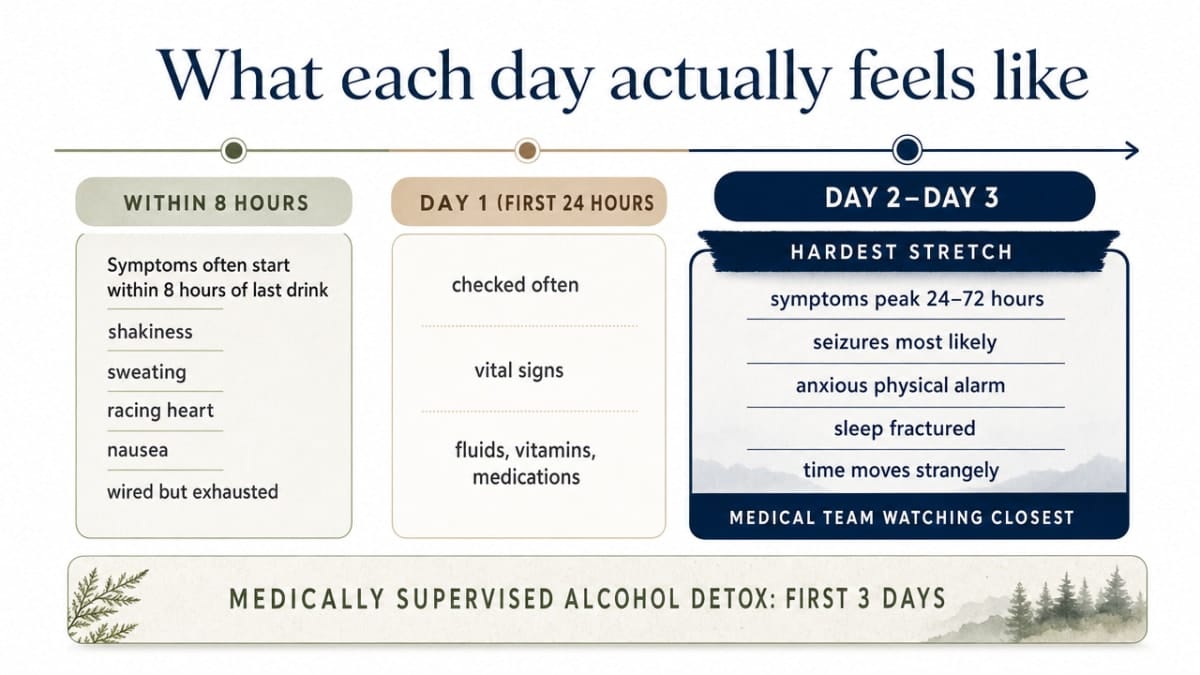
What each day actually feels like
If you’re trying to picture what the next week looks like, here’s a rough map for someone going through medically supervised alcohol detox. Your timeline may shift earlier or later depending on the substance, but the shape of it tends to rhyme.1,2,3
| Timeline | Symptoms |
|---|---|
| Day 1 (first 24 hours) | The first symptoms usually start within 8 hours of your last drink — shakiness, sweating, a racing heart, nausea, that wired-but-exhausted feeling. You’ll likely be checked often. Vital signs taken. Fluids, vitamins, and medications offered to ease the worst of it. |
| Day 2 to Day 3 | This is the hardest stretch. Symptoms typically peak between 24 and 72 hours, and it’s when seizures are most likely. You may feel anxious in a way that has nothing to do with your thoughts — pure physical alarm. Sleep is fractured. Time moves strangely. The medical team is watching closest here for a reason. |
| Day 3 to Day 4 | The delirium tremens window overlaps this stretch, most often appearing between 48 and 96 hours after the last drink. Most people don’t develop DTs, but this is why someone is checking on you through the night. |
| Day 4 to Day 5 | Something shifts. The acute symptoms start tapering. You might eat a real meal. Sleep gets a little longer, even if it’s still broken. Your hands steady. |
| Day 6 to Day 7 | Energy is still low. Mood may be flat or tearful. That’s normal — your brain is recalibrating without a substance it had built itself around. Making it here is not a small thing. Your body did something brave. |
What medical supervision changes
You can stop drinking or using on your own. People do. The question isn’t whether it’s possible — it’s whether it’s safe, and whether you’ll have to go through it again next month because the worst hours broke you.
Medical supervision changes a few specific things. First, somebody is watching your vital signs through the peak danger window — the 24 to 72 hours when alcohol withdrawal symptoms are most likely to turn severe. Blood pressure, heart rate, temperature, tremor, confusion. Numbers that tell a trained person whether you’re trending toward a seizure or toward calmer water. You’re not the one tracking that. You get to stop drinking and just try to sleep.1,3
Second, medications. The right ones, at the right doses, given when symptoms tell the team to give them — not when you can flag down help. For opioid withdrawal, buprenorphine can shorten the worst stretch and take the edges off the cramping, sweating, and restlessness. For alcohol withdrawal, benzodiazepines given on a structured schedule are how clinicians prevent seizures and DTs through the dangerous window. For benzodiazepine taper, the whole point is a slow, monitored dose reduction your body can tolerate.7,8,11
Third, you’re not alone at 3 a.m. when the anxiety crests. In a home-like residential setting, that means a quiet room, somebody nearby, and a plan for what comes next — not an ER waiting chair.
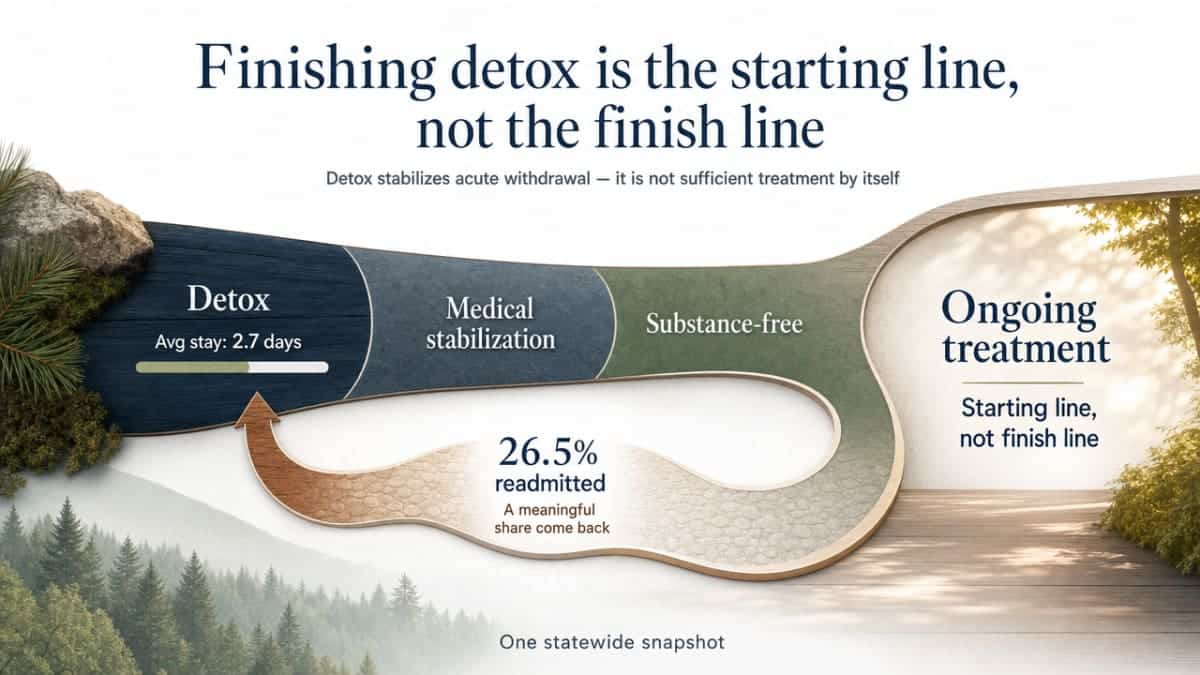
Finishing detox is the starting line, not the finish line
Here’s something worth sitting with: in one statewide quality improvement initiative that tracked inpatient detox, the average length of stay was 2.7 days, and the readmission rate was 26.5%. That’s a specific snapshot — inpatient stays during a particular measurement window in one state’s system, not every detox program everywhere. But the shape of it tells you something honest. Detox stays are often short, focused on immediate medical stabilization, and a meaningful share of people come back through the door.14
That isn’t a story about people failing. It’s a story about what detox can and can’t do on its own. The clinical guides are direct about this: detox is the process of managing acute withdrawal so your body becomes medically stable and substance-free, and it isn’t sufficient treatment by itself. The hard part — the part that actually changes the trajectory — is what comes after the acute days are over.12
That’s where the continuum-of-care idea earns its weight. Medications combined with counseling and behavioral therapies are what address the whole person, not just the withdrawal. For some people, that means stepping into a partial hospitalization or intensive outpatient program where the days still have structure but you sleep in your own bed. For others, it means continued medication support, group therapy, and a plan for the moments cravings arrive uninvited at 7 p.m. on a Tuesday.15
Making it through detox is real. Your body did the hardest physical part. What you build next is what carries the work forward.
When detox needs more than a few days of monitoring
Most detox stays are short because most people stabilize quickly. Some don’t, and recognizing yourself in that second group early is what keeps you safe.
You likely need a longer, more closely monitored stay if you have a history of withdrawal seizures or delirium tremens, since once your brain has been there, the threshold for going there again is lower. The same is true if you’re coming off long-acting opioids like methadone, where withdrawal can keep producing symptoms 10 to 20 days out instead of resolving by day 7. Benzodiazepine dependence is its own category — safe withdrawal is a taper measured in weeks to months, not a single admission. Concurrent withdrawal from more than one substance also tends to stretch the timeline, because two curves rarely peak on the same day.2,3,4,8,10
Hospital guidelines defer discharge until withdrawal symptoms have resolved and you’re no longer at risk of rebound. If your symptoms are still climbing on day 4, that isn’t a setback. It’s information, and it’s exactly what the monitoring is for.3
See If Medical Detox Is Covered For You
Find out if your insurance covers a safe, medically supported detox process.
Frequently Asked Questions
Can I do medical detox at home?
For alcohol or benzodiazepines with heavy or long-term use, please don’t. The 24 to 72 hour window after your last drink is when seizures and severe symptoms are most likely, and benzo withdrawal carries similar risks if you stop suddenly. Opioid withdrawal is rarely deadly on its own, but supervised care still makes it more bearable and far safer.1,3,5.8
How long does alcohol detox take, and when is it most dangerous?
Symptoms usually start within 8 hours of your last drink, peak between 24 and 72 hours, and ease over the following week. The peak window is when seizures are most likely. Delirium tremens — a severe form of withdrawal with confusion and dangerous vital sign changes — most often appears 48 to 96 hours after the last drink. Medical monitoring through this stretch is what keeps you safe.1,2,3
Why does benzodiazepine detox take weeks or months instead of days?
Because stopping benzos abruptly after long-term use can cause seizures. Safe withdrawal is a gradual taper, with dose reductions spaced at least a week apart and often longer. Initial reductions are typically 10% to 25%, adjusted based on how your body responds. A slower taper is the safer taper. Your nervous system needs the time, and that isn’t a setback — it’s the protection.8,9
Does medication-assisted treatment make opioid detox shorter?
Yes, and it makes it more bearable. Buprenorphine, given under medical supervision, can shorten the acute phase of opioid detox and take the worst edges off symptoms like cramping, sweating, and restlessness. Supportive medications for nausea, muscle aches, and sleep help too. Most people still need ongoing treatment after the acute days are done — that’s how the brain actually heals from opioid dependence.7
What happens if I leave detox early or relapse right after?
You’re not alone in it. One statewide initiative found a 26.5% readmission rate after short inpatient detox stays. Detox handles acute withdrawal, but it isn’t sufficient treatment on its own. What changes the trajectory is the care that comes next — medication support, counseling, and structure for the moments cravings hit hardest. Coming back isn’t failure. It’s information about what your recovery actually needs.12,14,15
How long will I feel bad after the acute detox days are over?
Longer than the brochure version suggests, and that’s normal. After alcohol detox, sleep, mood, and energy can stay rough for weeks. Opioid withdrawal usually improves by day 5 to 7, but some people feel unwell for weeks afterward. Stimulant users often face a longer phase of low mood, fatigue, and cravings beyond the physical crash. Your brain is recalibrating. Give it time.1,6,13
References
- Alcohol withdrawal: MedlinePlus Medical Encyclopedia. https://medlineplus.gov/ency/article/000764.htm
- Delirium tremens: MedlinePlus Medical Encyclopedia. https://medlineplus.gov/ency/article/000766.htm
- Alcohol Withdrawal in Hospitalized Patients. https://www.ncbi.nlm.nih.gov/books/NBK604324/
- Clinical Guidelines for Withdrawal Management and Treatment of Drug Dependence in Closed Settings. https://www.ncbi.nlm.nih.gov/books/NBK310652/
- Opioid Withdrawal – Stat Pearls. https://www.ncbi.nlm.nih.gov/books/NBK526012/
- A Patient’s Guide to Opioid Tapering. https://www.hss.edu/health-library/conditions-and-treatments/patient-guide-opioid-tapering
- Opiate and opioid withdrawal: MedlinePlus Medical Encyclopedia. https://medlineplus.gov/ency/article/000949.htm
- How to Approach a Benzodiazepine Taper. https://www.oregon.gov/oha/HPA/DSI-Pharmacy/MHCAGDocs/Tapering-Benzodiazepines.pdf
- Helping Patients Taper from Benzodiazepines. https://www.va.gov/painmanagement/docs/OSI_6_Toolkit_Taper_Benzodiazepines_Clinicians.pdf
- Concurrent opioid and alcohol withdrawal management. https://pmc.ncbi.nlm.nih.gov/articles/PMC10696169/
- The ASAM Clinical Practice Guideline on Alcohol Withdrawal Management. https://pubmed.ncbi.nlm.nih.gov/32511109/
- Quick Guide for Clinicians Based on TIP 45—Detoxification and Substance Abuse Treatment. https://nida.nih.gov/sites/default/files/samhsa_detoxification_and_substance_abuse_treatment.pdf
- Clinical Management of Psychostimulant Withdrawal. https://pmc.ncbi.nlm.nih.gov/articles/PMC10069411/
- Who Needs Inpatient Detox? Development and Implementation of a Statewide Quality Improvement Initiative. https://pmc.ncbi.nlm.nih.gov/articles/PMC3965748/
- Treatment Options for Substance Use Disorder. https://www.samhsa.gov/substance-use/treatment/options
- Portrayal of Hospital Alcohol Detoxification in France. https://clinicaltrials.gov/study/NCT04973202