
Key Takeaways
- Milwaukie sits about seven miles south of Portland along the Willamette, close enough for quick hospital access if withdrawal escalates but quiet enough for a residential, home-like setting.
- A safe home-like detox has 24-hour nursing on site, medications ready before symptoms peak, and an intake that screens for seizure history, DTs, pregnancy, or unstable medical conditions 5.
- Ask on the first call whether buprenorphine or methadone is offered on day one for opioid withdrawal, since many residential programs still don’t consistently provide these medications 7.
If you’re reading this at 2 a.m.
If you’re reading this at 2 a.m., you’re not the first. Maybe your hands are shaking. Maybe you’ve been counting hours since the last drink, or the last pill, and doing the math on whether you can make it until morning. Maybe you’re not the one detoxing at all. You’re the sister, the partner, the parent scrolling with the phone tilted away from someone who’s finally asleep on the couch.
Either way, take a breath. You don’t have to figure out your whole recovery tonight. You only have to figure out the next safe step.
A detox center near you in Milwaukie is one of those next steps. Not a hospital hallway under fluorescent lights. Not white-knuckling it alone in your bedroom, hoping the shakes don’t turn into something worse. Something in between: a house on a quiet street, with nurses and counselors who do this every day, medicine that actually helps with withdrawal, and a bed with sheets that don’t crinkle like a hospital gown.
This guide walks you through what that looks like, what to ask, and what comes after the worst days pass. Making it through tonight is the whole job tonight. The rest can wait for daylight.
What a detox on a quiet Milwaukie street actually looks like
Picture a house. Not a facility with a wayfinding sign and a badge reader at the door. A house, on a street where the neighbors put pumpkins out in October and recycling bins out on Wednesday. There’s a porch. Inside, someone is making coffee in a real kitchen, not pouring it from an urn on a cafeteria line.
That’s what a home-like detox center in Milwaukie is trying to do on purpose. National detox guidance from SAMHSA is direct about it: withdrawal should happen in the least restrictive setting that’s still safe 14. For a lot of people, that isn’t a hospital ward, and it isn’t the bedroom floor either. It’s somewhere in the middle. A residential house, with medical staff on site, medications ready, and a couch you’re actually allowed to fall asleep on.
You’ll have your own bed. You’ll share meals with a small group of other people going through the same thing, which sounds uncomfortable and turns out to be one of the parts people remember most. A nurse checks on you. A counselor sits down next to you, not across a desk. The lighting is warm because someone chose lamps instead of overheads.
Milwaukie helps this feel real. It’s a small suburban city just south of Portland, tucked along the Willamette, close enough to specialty care if something needs to escalate, far enough from downtown noise that you can hear yourself think. Oregon licenses these residential programs through the Oregon Health Authority, so “home-like” doesn’t mean unregulated 2. It means the clinical work happens inside a place that still feels like somewhere a person could live.
The three withdrawals people are actually scared of
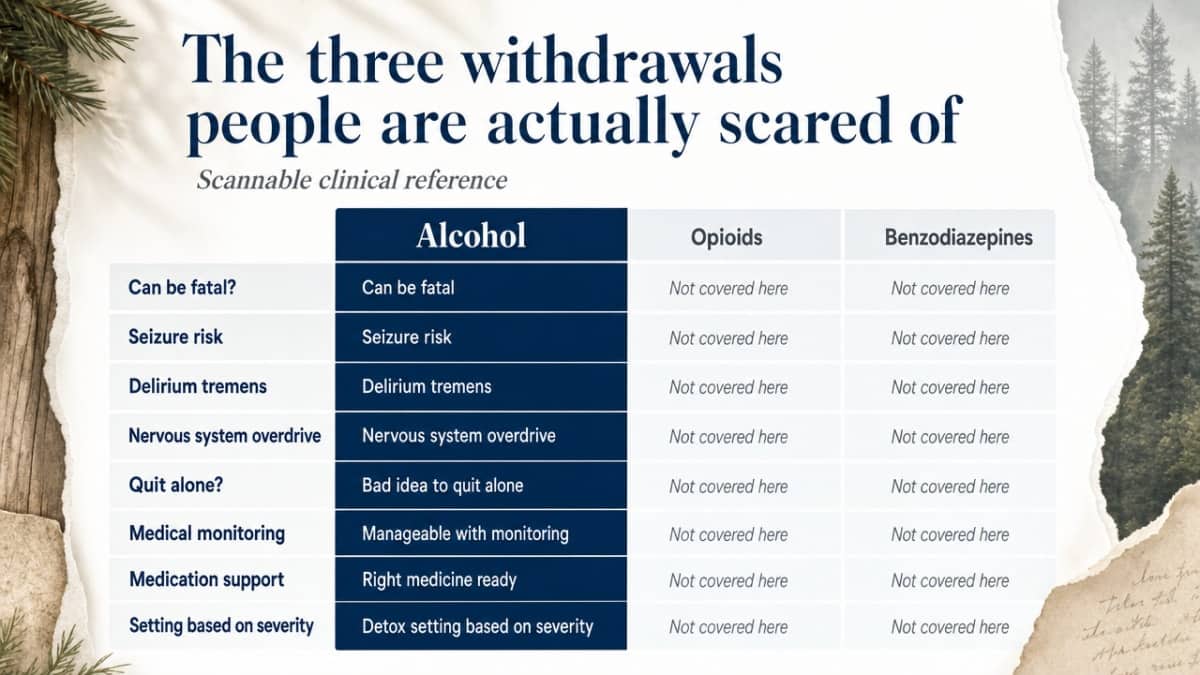
Alcohol: the one that can kill you if you quit alone
Let’s start with the hardest truth, because you deserve it plainly: alcohol withdrawal is the one that can actually kill you. Not opioids, not weed, not most stimulants. Alcohol. If you’ve been drinking heavily for months or years and you stop cold without help, your nervous system can go into overdrive. That’s where seizures come from. That’s where the shakes escalate into something called delirium tremens, which is a medical emergency.
This is why quitting alone in your kitchen is a bad idea, and it’s also why the internet is full of scary stories. What the internet often leaves out is that this is very manageable when someone is watching you and has the right medicine ready. The ASAM guideline that clinicians actually use lays out how to figure out where you should detox based on your risk factors 5. A residential home-like setting is safe for a lot of people. A hospital is the right call for others.
Here’s the short version of what tips the scale toward hospital-level care: a history of withdrawal seizures, a previous episode of DTs, serious medical problems like heart or liver disease, being pregnant, or having nobody around who can get you to help if something changes fast. If none of those apply, a residential detox with 24-hour nursing, medication on hand, and quick access to a hospital if needed is usually the right fit. A good detox center near you will ask these questions before you walk in the door, not after.
Opioids: painful, rarely fatal, and where the medicine matters most
Opioid withdrawal feels like the worst flu of your life plus a panic attack that won’t end. Bones ache. Skin crawls. Your stomach turns inside out. You can’t sleep and you can’t stay awake. People describe wanting to jump out of their own body. It is genuinely awful.
Here’s what’s true and often unsaid: unlike alcohol, opioid withdrawal is almost never fatal on its own. That’s the good news. The harder news is that the misery of it is what sends most people back to using within a day or two of trying to quit on their own. This is where medicine changes everything.
Buprenorphine (you may hear the brand name Suboxone) and methadone quiet the withdrawal so completely that people are often surprised. Not high. Not numbed out. Just… normal. Able to eat a sandwich. Able to sleep. A big review of the evidence found that staying on one of these medicines along with counseling works far better than trying to detox and stop 11. Methadone in particular has decades of research behind it, and its safety and effectiveness are, in the review’s words, unequivocally established 11.
Benzodiazepines: the slow taper nobody warns you about
Benzos are Xanax, Klonopin, Ativan, Valium. Maybe a doctor prescribed them years ago for panic attacks or sleep. Maybe the dose crept up. Maybe you started buying them somewhere else. However you got here, this one needs its own paragraph, because it doesn’t behave like the others.
You cannot stop benzos cold. Like alcohol, benzo withdrawal can cause seizures. Unlike alcohol, it can also drag on for weeks, with waves of anxiety, insomnia, and strange sensory symptoms that come and go. This is why a good detox center will almost always taper you down slowly, using a longer-acting medication, rather than trying to wrench you off in three days.
Fast detox from benzos is not brave. It’s dangerous, and it usually backfires. A calm, home-like setting with medical staff who understand the taper is a much better fit than a rushed hospital stay for most people. If you’re on benzos and alcohol together, tell whoever is admitting you. That combination changes the plan and it should.
The medicines a good detox will actually offer you
The word “detox” makes it sound like the medicine is a mystery, or worse, like there isn’t any. There is. And the list of what’s approved and what actually works is shorter and clearer than most people expect.
For alcohol, three medications have FDA approval as part of what SAMHSA calls a whole-patient approach: acamprosate, disulfiram, and naltrexone 3. In plain terms: one helps your brain settle back to normal after long heavy drinking, one makes drinking physically unpleasant if you slip, and one blunts the reward of alcohol so it doesn’t grab you the same way. Naltrexone comes as a daily pill or a monthly shot (the extended-release version). None of these are addictive. None get you high. They’re tools that come out during and after detox depending on what fits your body and your goals.
For opioids, the list is buprenorphine, methadone, and naltrexone (again, often the monthly shot) 3. Buprenorphine is the one most home-like residential detox centers can offer directly on site. Methadone is usually dosed through a licensed clinic you’d connect with as you step down. Naltrexone works differently from the other two, so it’s usually started after you’ve been fully off opioids for a stretch, not on day one.
During the actual withdrawal days, you may also get medications that aren’t on the FDA “disorder-specific” list but make you a lot more comfortable: something for nausea, something for muscle aches, something to help you actually sleep, and for alcohol withdrawal, a short course of a benzodiazepine to calm your nervous system while it stabilizes. These aren’t extras. They’re the reason a medically supervised detox feels survivable when a bedroom-floor detox doesn’t.
One thing worth saying out loud: medicine is not a moral failing. Taking buprenorphine to stay off heroin is not “replacing one drug with another,” no matter what a well-meaning uncle at Thanksgiving says. SAMHSA explicitly frames MAT as evidence-based treatment, not substitution 3. If a program in your search results seems squeamish about offering these medications, keep scrolling.
What to ask before you say yes to any detox nearby
You are allowed to interview a detox center. On the phone, at 3 p.m. on a Tuesday, with a lump in your throat. This is not being difficult. This is being awake.
Here’s the one that matters most, and it’s the one families forget to ask: Do you offer buprenorphine or methadone on site for opioid withdrawal, starting the first day? A 2024 peer-reviewed study looked specifically at non-hospital residential programs and found that many of them still don’t consistently offer these medications, even though the paper calls FDA-approved medications for opioid use disorder the gold standard of care 7. Translation: some places near you will hand you a bed and a blanket and call that treatment. That’s not enough anymore, and you’re allowed to know that before you pack a bag.
A few more, in the voice you’d use if you were asking for a friend:
- What does day one actually look like for someone withdrawing from what I’m withdrawing from? If they can’t answer specifically, keep looking.
- Are there nurses on site around the clock, or just on call?
- What’s your plan if my withdrawal turns out to be more severe than expected? How fast can I get to a hospital, and who decides?
- What medications will I be offered, and which ones can I say no to?
- What happens on day six? Do you help me line up the next step, or do I leave with a printout of phone numbers?
- Are you licensed by the Oregon Health Authority? (The answer should be yes.)
- Do you take my insurance, and if not, what does this cost in real dollars?
You don’t have to ask all of these. Ask the ones your gut lands on. A good program will not be annoyed by the questions. They’ll sound relieved you asked.
Your first 24 hours: what the room, the night, and the morning feel like
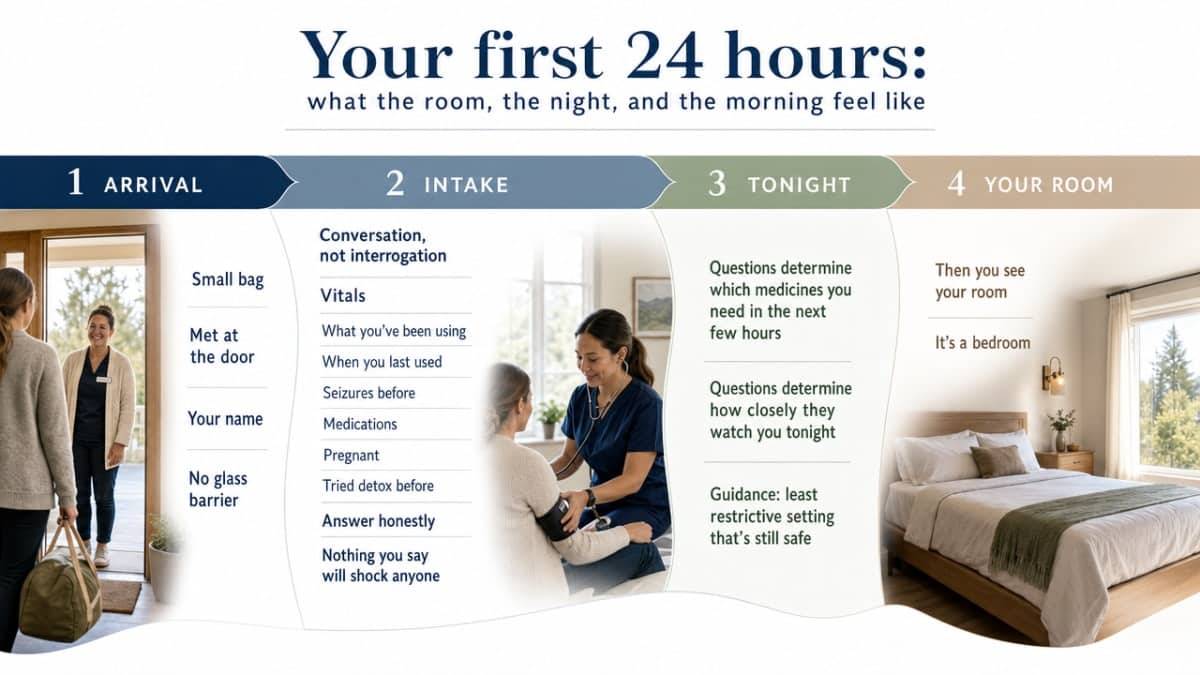
You’ll probably arrive with a small bag. Someone will meet you at the door. Not a receptionist behind glass. A person, on foot, who says your name.
The intake is a conversation, not an interrogation. A nurse takes your vitals, asks what you’ve been using and when you last used, whether you’ve had seizures before, what medications you’re on, whether you’re pregnant, whether you’ve tried to detox before. Answer honestly. Nothing you say is going to shock anyone in this room. They’ve heard it. The whole point of asking is to figure out which medicines you need in the next few hours and how closely they need to watch you tonight. National detox guidance calls this matching you to the least restrictive setting that’s still safe 14, and it starts with these questions.
Then you’ll see your room. It’s a bedroom. There’s a bed, a nightstand, a lamp, and usually a window that opens. If you’re detoxing from alcohol or benzos, the nurse will start you on medication before you’re feeling the worst of it — the goal isn’t to let you white-knuckle it and then rescue you, it’s to stay ahead of the withdrawal curve 5. If you’re detoxing from opioids, you’ll have a conversation about starting buprenorphine, usually once you’re in enough withdrawal for it to work safely.
The first evening is quieter than you expect. Someone will offer you food, even if you can’t imagine eating. Toast. Broth. A banana. You’ll sit in the living room, or in your bed, or on the porch if the weather is decent. A staff member will check in, not with a clipboard but with a chair pulled up.
The night is honest. You may not sleep well. You may sweat through a t-shirt. You may wake up at 3 a.m. and forget where you are for a second. When you remember, the light in the hallway is on and somebody is awake. That’s the part a hospital gets right too, but a hospital does it with a beeping monitor and a curtain. Here, it’s a lamp and a person who says, “You made it a few more hours. Do you want water?”
Morning smells like coffee. Someone is up, someone else is still asleep, and a nurse comes by to take your vitals again and adjust your medications based on how the night went. This is where a lot of people cry a little, and that’s fine. Making it to breakfast is the whole job right now. Everything else — the counseling, the plan for next week, the phone calls to family — that starts today or tomorrow, at a pace your body can actually handle.
Is a home-like setting actually safe enough?
This is the question that keeps families up at night, and it deserves a straight answer: yes, for most people, and no, for some. The honest work is figuring out which one you are before you walk in the door.
The NIH-backed research comparing inpatient and outpatient detox settings puts it plainly: both can be safe and effective, but the choice depends on medical risk and whether you have people around you 9. A house with 24-hour nursing and medication on hand is not the same as detoxing alone. It’s also not a hospital ICU. It sits between them on purpose.
What makes a home-like setting safe enough for most people:
- A nurse on site around the clock, not just on call.
- An intake assessment that actually screens for the risk factors ASAM names — seizure history, prior severe withdrawal, medical problems, pregnancy 5.
- Medications ready before symptoms peak, not after.
- A hospital close enough that if something changes, you’re there in minutes, not hours. Milwaukie sits within easy reach of Portland’s hospital systems, which is not a small thing.
What tips someone out of this setting and into a hospital: a seizure during a previous detox, delirium tremens history, heart or liver disease that’s already unstable, pregnancy in the second or third trimester, or an active psychiatric crisis that needs locked-door safety. A good detox center will tell you honestly if you’re one of those people. That’s not a rejection. That’s care.
Detox is the first week. Recovery is the year after.
Here’s the thing nobody wants to say out loud when you’re still deciding whether to go: detox by itself doesn’t fix addiction. It gets your body out of danger. It clears the chemicals. It gives you a week or so of sleep, food, and safety while your nervous system remembers how to run without the substance. That’s not nothing. That’s actually a lot. But it’s not the finish line, and any place that pretends otherwise is setting you up.
National detox guidance is unusually blunt on this point. SAMHSA’s TIP 45 states plainly that detoxification alone is rarely sufficient to keep someone off substances long-term, and that it must be followed by real treatment — counseling, medication, community, structure 10. That’s not a sales pitch. That’s the federal clinical protocol.
For opioids in particular, the research is even sharper. A review of medication-assisted treatment for opioid use disorder found that staying on buprenorphine or methadone alongside counseling works significantly better than short-term detox followed by nothing 11. Opioid dependence acts like a chronic condition. You wouldn’t stop blood pressure medicine after a week and expect the problem to be solved. Same principle.
So when you’re looking at a detox center near you, look past the first week. Ask what happens on day eight. A good program hands you off to something — a day program where you spend most of your waking hours in group and individual therapy, then an intensive outpatient schedule a few evenings a week, then a lighter outpatient rhythm, then an alumni community that keeps a chair open for you a year from now. Each step is less intensive than the one before, on purpose, so you can rebuild a normal life while still having support.
You don’t have to commit to a year tonight. You just need to know the door on the other side of detox opens onto something, not onto a parking lot with a bus schedule.
Getting there today: Milwaukie, Portland, and the practical logistics
You don’t need a referral. You don’t need a diagnosis on paper. You can call a residential detox center directly, and a person will pick up. If the line goes to voicemail, try another. The good ones answer.
Milwaukie sits about seven miles south of downtown Portland along the Willamette, close enough that a friend or family member can drive you in twenty minutes on a weekday afternoon. If nobody’s available, the MAX Orange Line runs from Portland straight into downtown Milwaukie. Rideshare works too, and most programs will help coordinate the trip if getting there is the last hurdle between you and a bed.
Bring an ID and your insurance card if you have one. Bring a phone charger, a few changes of comfortable clothes, and any prescription medications you’re currently on, in the original bottles. Leave the laptop and the work stress at home. Oregon licenses these programs through the Oregon Health Authority, so any legitimate center near you should be listed and reachable through the state’s provider directory or your health plan 2.
Call now if you can. Making the call is the hardest part. Everything after is somebody’s job to help you carry.
Check Your Coverage for Local Detox Support
See if your insurance covers safe, home-like detox care near Milwaukie.
Frequently Asked Questions
Can I go to a detox center in Milwaukie today, or do I need a referral first?
You don’t need a referral. Call directly, and a person will answer or call you back the same day. They’ll ask a few questions about what you’ve been using, your health history, and your insurance, then walk you through what to bring. Same-day admission is common when a bed is open. If it isn’t, they’ll help you find one nearby rather than leave you hanging.
Is a home-like residential detox safe for alcohol withdrawal, or do I need a hospital?
For most people, yes, a residential program with 24-hour nursing and medication on hand is safe. Hospital-level care is the right call if you’ve had a withdrawal seizure before, an episode of delirium tremens, unstable heart or liver disease, are pregnant, or are in psychiatric crisis 5. A good intake screens for those factors before you’re admitted and refers you to the hospital if that’s what your body actually needs.
Will I be offered buprenorphine or methadone if I’m detoxing from opioids?
You should be. Both are FDA-approved and considered the standard of care for opioid use disorder 3. Buprenorphine is usually started on site once you’re in enough withdrawal for it to work safely. Methadone is typically coordinated through a licensed clinic. A 2024 study found many residential programs still don’t consistently offer these medications 7, so ask on the first phone call. If the answer is vague, keep calling.
How long does detox take, and what happens after the worst of withdrawal?
Most medical detoxes run about five to seven days, sometimes longer for benzodiazepines or complicated cases. Your body clears, sleep starts coming back, and eating stops feeling impossible. But detox alone isn’t treatment. SAMHSA’s clinical protocol is clear that stabilization has to be followed by ongoing care 10. A good program hands you off to a day program, intensive outpatient, or outpatient therapy so momentum doesn’t disappear on day eight.
What should I bring, and can my family visit or call?
Pack light: comfortable clothes for a week, a phone charger, toiletries, your ID, insurance card, and any current prescriptions in the original bottles. Skip the laptop and work materials. Most programs have set phone and visiting hours, usually starting a day or two after intake once you’re stable. Family calls, and sometimes family therapy sessions, are built into the plan when that supports your recovery.
How is a home-like detox center regulated in Oregon?
The Oregon Health Authority licenses residential substance use treatment facilities and maintains a provider directory people can search directly 2. “Home-like” describes the setting, not the oversight. A legitimate detox center near you will be state-licensed, staffed by credentialed nurses and counselors, and reachable through your health plan’s network. If a program can’t confirm its license when you ask, that’s your answer to keep looking.
References
- Oregon Summary – State Residential Treatment for Behavioral Health Conditions. https://aspe.hhs.gov/sites/default/files/2021-08/StateBHCond-Oregon.pdf
- Oregon Health Authority: Residential Treatment Facilities. https://www.oregon.gov/oha/hsd/amh-lc/pages/rt.aspx
- Treatment Options for Substance Use Disorder. https://www.samhsa.gov/substance-use/treatment/options
- Quick Guide for Clinicians Based on TIP 45—Detoxification and Substance Abuse Treatment. https://nida.nih.gov/sites/default/files/samhsa_detoxification_and_substance_abuse_treatment.pdf
- The ASAM Clinical Practice Guideline on Alcohol Withdrawal Management. https://www.samhsa.gov/resource/ebp/asam-clinical-practice-guideline-alcohol-withdrawal-management
- ASAM Alcohol Withdrawal Management Pocket Guide. https://www.samhsa.gov/resource/ebp/asam-clinical-practice-guideline-alcohol-withdrawal-management-pocket-guide
- Buprenorphine Use Among Non-Hospital Residential Programs. https://pmc.ncbi.nlm.nih.gov/articles/PMC11527563/
- Substance Use Disorder Integration Report. https://www.oregon.gov/oha/HSD/AMH/DataReports/SUD-Integration-Report.pdf
- An Overview of Outpatient and Inpatient Detoxification. https://pmc.ncbi.nlm.nih.gov/articles/PMC6761814/
- Detoxification and Substance Abuse Treatment (TIP 45). https://www.ncbi.nlm.nih.gov/books/NBK64115/
- Medication Assisted Treatment for Opioid Use Disorder. https://pmc.ncbi.nlm.nih.gov/articles/PMC8389722/
- Oregon Health Authority: Youth Substance Use Disorder Programs. https://www.oregon.gov/oha/hsd/bh-child-family/pages/youth-sud.aspx
- Substance use disorder treatment and technology access among people who inject drugs in rural US communities. https://pmc.ncbi.nlm.nih.gov/articles/PMC10293469/
- TIP 45: Detoxification and Substance Abuse Treatment (GovInfo PDF). https://www.govinfo.gov/content/pkg/GOVPUB-HE20_400-PURL-gpo124442/pdf/GOVPUB-HE20_400-PURL-gpo124442.pdf
- An Overview of Outpatient and Inpatient Detoxification (PDF). https://pmc.ncbi.nlm.nih.gov/articles/PMC6761814/pdf/nihms-1013337.pdf