
Key Takeaways
- Medically supervised oxycodone detox in Portland pairs comfort medications, buprenorphine or methadone, and around-the-clock staff to manage the withdrawal window when solo attempts most often fail.8
- Portland’s treatment landscape has shifted, with Fire & Rescue offering buprenorphine after non-fatal overdoses and Oregon overdose deaths dropping from 1,833 in 2023 to 1,544 in 2024.4,7
- Before choosing a program, compare which FDA-approved medication they use, bed availability in the next 24 to 72 hours, and how they hand you off to ongoing care.
- Detox alone is not treatment, and tolerance drops fast afterward, so a plan for week two — medication, counseling, and a prescriber handoff — matters more than night one.1
If you’re reading this at 2 a.m., start here
You made it to this page. That already counts.
Maybe the pills ran out. Maybe you took your last one six hours ago and your legs are starting to ache. Maybe you’re the person sitting up next to someone you love, watching them shiver under a blanket, wondering what to do. Whatever brought you here at this hour, take a breath. You do not have to figure everything out tonight.
What you actually need is medicine that quiets withdrawal, people who stay awake so you don’t have to, and a plan for the week after the worst of it passes. If you are searching for an oxycodone detox Portland program, that specific help exists, and access to it has grown. The next sections walk you through what to expect, in plain language, at a pace you can handle.
Why stopping oxycodone alone tends to fail
If you’ve tried to quit at home, you already know how the story goes. You white-knuckle it through the first night. By hour thirty-something, your skin is crawling, your gut is in knots, and every part of you is begging for relief. You take a pill. The relief hits. And then the shame does. That is not weakness. That is how physical dependence works.
Two things make solo detox so brutal. The first is that abrupt discontinuation of an opioid you’ve been taking regularly can hit hard, which is why the CDC specifically tells clinicians not to stop opioids suddenly and to offer medicine-assisted treatment when someone wants to stop. The second is quieter and more dangerous: after a few days without oxycodone, your tolerance drops fast. If you return to using at the dose you took before, your body may not be able to handle it. Most opioid overdose deaths happen in people who just came off opioids.2,8
This is the piece that gets missed at home. The hardest part isn’t the shivers or the sleepless nights. It’s what happens on day four, when you’re exhausted, still uncomfortable, and one bad hour away from a dose your body can no longer take. Detox by itself is not a treatment for opioid use disorder, and it does not lower that risk on its own.1
You are not failing at willpower. You are running a medical process without the medicine and the people it needs to work.
What withdrawal actually feels like, hour by hour
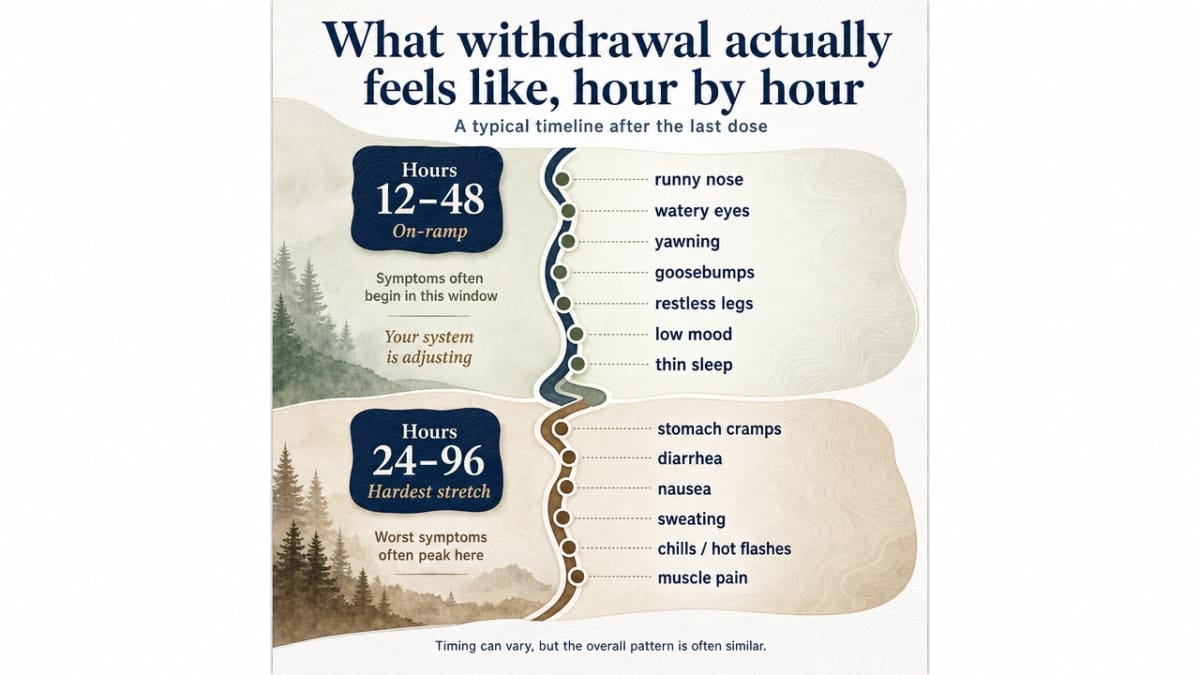
One of the worst parts of oxycodone withdrawal is not knowing when it will end. So here is the map, based on what clinicians actually see. Your body may run a little faster or slower than this, but the shape is usually the same.1,8,9
| Timeline | Symptoms |
|---|---|
| Hours 12 to 48 after your last dose | This is the on-ramp. Symptoms typically start somewhere in this window. You might notice a runny nose, watery eyes, yawning that won’t stop, goosebumps, and a restless ache in your legs. Your mood drops. Sleep gets thin. You are not imagining it, and you are not overreacting. Your nervous system is looking for a chemical it has come to expect. |
| Hours 24 to 96 | This is the hardest stretch. The worst symptoms usually land somewhere in these three or four days. Stomach cramps, diarrhea, nausea, sweating, chills that flip to hot flashes, muscle pain that seems to come from your bones, and a kind of exhausted anxiety that makes it hard to sit still or lie down. This is when people quitting alone almost always use again. It is also when medically supervised care does the most work — comfort medications, fluids, someone checking on you, and the option of buprenorphine or methadone to quiet the storm. |
| Days 5 to 7 | The physical symptoms start to ease. You may feel wrung out, like you’re recovering from a bad flu, but the sharpest edges soften. Appetite starts to return. You can usually sleep in stretches again. |
| Weeks 2 to 8 | This is the part nobody warns you about. Cravings come in waves. Sleep is uneven. Your mood can dip without warning. This is not relapse, and it is not failure — it is your brain recalibrating. It is also exactly why detox alone is not treatment, and why the plan for these weeks matters as much as the plan for night two. |
Knowing the shape of this week does not make it easy. It does make it finite. You are looking at a hard stretch with an end, not an open-ended punishment.
What medically supervised detox in Portland actually looks like
Forget what you’ve seen on TV. A good detox is not a locked hospital ward with fluorescent lights and clipboards. In Portland, the residential, non-hospital model looks closer to a house than a clinic. Think a quiet bedroom, a shared kitchen where someone is making soup at odd hours, a common room with soft chairs, and staff who are awake when you can’t sleep.
When you arrive, someone sits down with you. Not to interrogate you, but to understand what you’ve been taking, how much, how long, and what else is going on — pain, other medications, mental health, a history of seizures, anything that changes the plan. This is where a clinician builds your withdrawal plan and decides which medicine will do the heavy lifting. The framing in clinical literature is useful here: your liver handles the biological detox on its own, and the staff’s job is to manage the withdrawal your body creates while that happens. You are not being cleansed. You are being cared for through a hard week.10
The first 24 to 72 hours involve the most check-ins. Vitals, hydration, medicine for nausea, sleep, muscle aches, and anxiety, plus a starting dose of buprenorphine or methadone if that’s the path you and the clinician chose. Somebody walks past your door at 3 a.m. If you’re awake and miserable, you can ask for help without waking anyone you love. That is the quiet difference between doing this alone and doing this with support.
As you move past the peak, the days get more structured. Short group conversations, one-on-one time with a counselor, meals you can actually keep down, walks outside when your body can handle it. Nothing dramatic. The point of the residential setting is that it removes the two things that make home detox fail: access to more pills, and the loneliness that convinces you the pain will never end. You get a room, a schedule, and a team that already knows what tonight will feel like because they’ve sat with dozens of people through the same hours.
The three medicines that quiet withdrawal
Buprenorphine, methadone, and naltrexone in plain language
There are three medicines the FDA has approved for opioid use disorder, and Oregon Health Authority lists all three as effective options for people trying to stop taking opioids like oxycodone. You do not need to memorize them. You just need to know what each one does, in plain terms, so you can have a real conversation with the clinician who meets you at the door.3
Buprenorphine. This is a partial opioid. It sits on the same receptors oxycodone sits on, but it only turns them partway on. That is enough to stop most of the withdrawal — the aching, the sweating, the crawling skin — without producing the high you were chasing. It is usually the first medicine offered during detox because it works fast and can be started in an outpatient or residential setting. Portland has leaned into this option so hard that the city’s Fire & Rescue team now offers buprenorphine right after a non-fatal overdose and links people directly to ongoing care.7
Methadone. This is a full opioid, taken once a day, that holds your system steady so you are not swinging between withdrawal and use. It has the strongest track record of the three — Oregon Health Authority cites research showing methadone treatment is associated with up to 30% reduced mortality. The trade-off is that in Oregon, methadone can only be dispensed through licensed opioid treatment programs, which means daily visits at first.3
Naltrexone. This one is different. It blocks the opioid receptor entirely, so if you use, you feel nothing. It is not used during acute withdrawal — you need to be fully off opioids for about a week before starting it — but it can be a good fit after detox, especially as a monthly injection. There is no right medicine, only the right medicine for you.8
Fast taper vs. slow taper: what a clinician is deciding
When a clinician builds your plan, one of the first questions is pace. A fast taper usually means cutting the total daily dose by 20% to 25% every few days, wrapping up in about a week. A slower taper stretches that reduction over weeks, with smaller cuts spaced further apart. Both are legitimate. Neither is a shortcut.9
What tips the decision? How long you have been taking oxycodone, at what dose, whether you have pain that still needs managing, whether you have used other substances alongside it, and how your body has handled past attempts to stop. A fast taper gets you through the worst of it sooner, but the symptoms are sharper, which is exactly why the residential setting matters — someone is watching, adjusting comfort medicines, and staying with you. A slower taper eases the intensity but asks you to sit with mild withdrawal longer, which some people can do and some cannot.9
The CDC is firm on one point: abrupt discontinuation is not the plan. Whatever pace you choose, it should be a pace, not a cliff. You and the clinician decide together. That is the whole idea.2
What’s actually happening in Portland right now
If the news has ever made you feel like Portland is a lost cause on opioids, put that idea down for a minute. It isn’t true, and the data is finally starting to say so.
Statewide, drug overdose deaths dropped from 1,833 in 2023 to 1,544 in 2024. That’s every drug, every county, every age — a wide-lens number, not a Portland-only one. But Portland is the largest metro in the state, so a shift that size is not happening without the Portland area moving with it. Oregon Health Authority attributes the decline to strengthened treatment infrastructure, naloxone getting into more hands, prevention work, and changes in the illicit drug supply.4
You can also see the city itself acting on this. Portland Fire & Rescue now runs a pilot that offers buprenorphine right after a non-fatal overdose and connects the person to wraparound care instead of just handing them a discharge paper. That is a real change from a few years ago, when the standard response ended at the ER door. Public dollars are behind this too — Oregon’s opioid settlement funds are being routed into prevention, treatment, and recovery, with 55% of the money flowing to cities and counties above 10,000 people.6,7
None of this makes your night easier. But it does mean the room you’d walk into for detox in Portland is part of a system that is bigger, better staffed, and better funded than it was even three years ago. You are not asking for help in a place that has given up.
Why local treatment access matters more than it did five years ago
Five years ago, if you decided at 11 p.m. that you wanted to stop taking oxycodone, your options in the Portland metro were thin. You could try to get through the night, call around in the morning, and hope someone had a bed or an intake slot open that week. A lot of people gave up in the gap between deciding and getting seen. That gap is smaller now, and it matters.
Two shifts are behind that. First, more clinicians in the community can actually prescribe the medicines that make oxycodone withdrawal survivable. An OHSU study found that the number of health care professionals able to prescribe a key addiction medication quadrupled at Oregon community health clinics from 2016 onward. That means the handoff from detox to ongoing care is no longer a six-week wait for a specialist. It can be a primary care visit at a clinic you already know.11
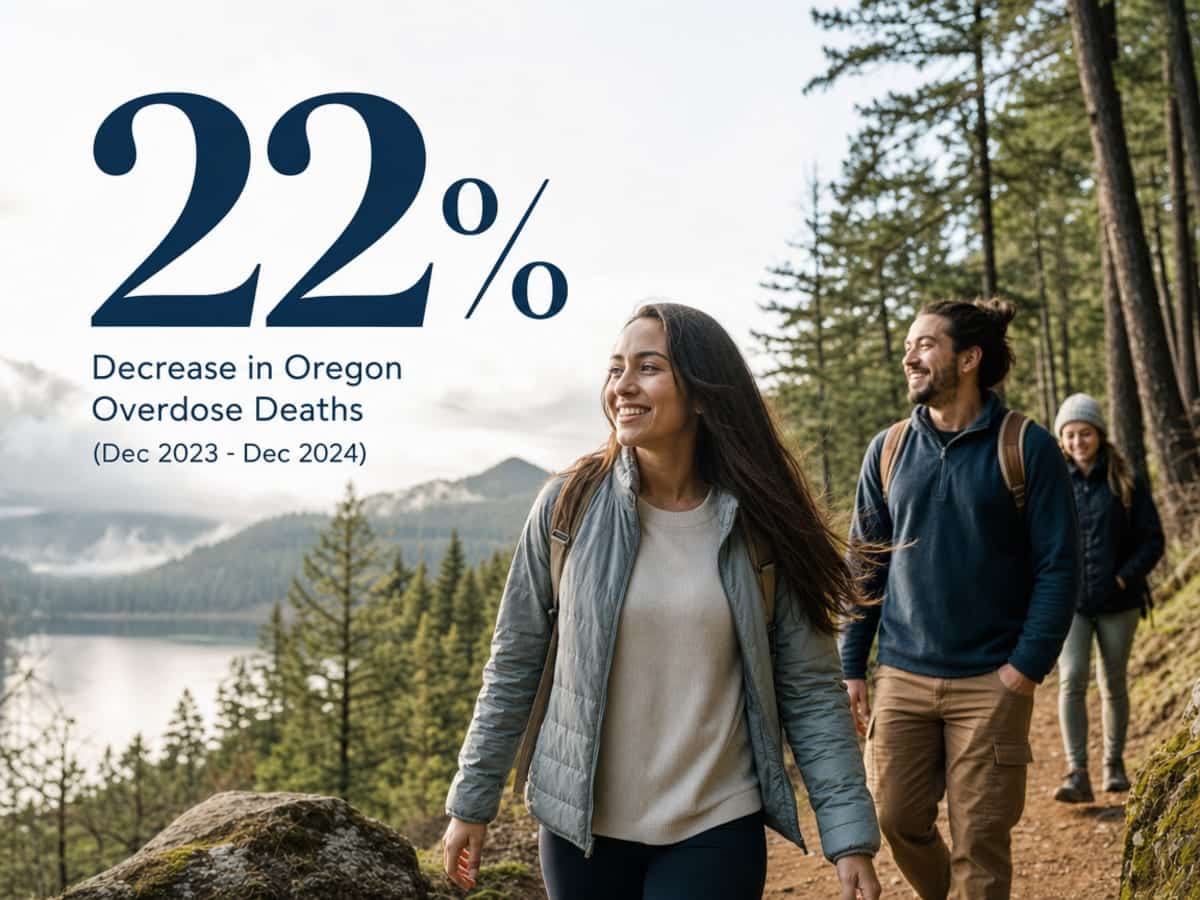
Second, the outcomes are moving in the right direction. CDC provisional data show a 22% decrease in Oregon overdose deaths between December 2023 and December 2024, and Oregon Health Authority ties that shift to strengthened treatment infrastructure, wider naloxone distribution, and prevention work. A 22% drop in a single year is not small. It is the difference between a system that could not keep up and one that is starting to.5
The practical version of this for you: the person answering the phone tomorrow morning has more places to send you than they did in 2020, and the medicine that quiets your withdrawal is more likely to be waiting on the other end of detox instead of six weeks out. You are asking for help at a better moment than the people who came before you.
The days after detox: where the real work begins
Here is the honest part nobody wants to say out loud on day one: finishing detox is not finishing. It is the doorway. The CDC is direct about this — detoxification on its own is not recommended as a treatment for opioid use disorder, because on its own it raises the risk of returning to use and of overdose death.1
The reason is your body, not your character. After a week without oxycodone, your tolerance is much lower than it was. A dose that felt routine two weeks ago can stop your breathing now. That is why the days right after detox are the most dangerous days in the whole process, and it is exactly why the plan for week two matters more than the plan for night two.8
A real aftercare plan usually includes three things:3,11
- Ongoing medicine — buprenorphine, methadone, or naltrexone — to keep withdrawal and cravings quiet while your brain resets.
- Regular contact with a counselor or group, because the loneliness that fed the cycle does not disappear when the shivers do.
- A warm handoff to a prescriber who can keep the medicine going, which is easier now than it used to be: OHSU found the number of clinicians prescribing addiction medicine at Oregon community health clinics quadrupled from 2016 onward.
You do not have to build this plan yourself at 3 a.m. That is what the team around you does while you rest. Your job in week two is smaller than it sounds — show up, take the medicine, talk to the person on the other end of the phone. The system does the rest of the reaching.
The practical side: cost, privacy, and what to bring
You have enough on your mind. Let’s put the logistics in one place so you’re not chasing them across ten browser tabs.
Cost. Most medical detox programs in the Portland area take commercial insurance, and staff can usually run a benefits check over the phone in under an hour. If you don’t have insurance, ask about sliding-scale options and about Oregon’s opioid settlement dollars, which the state is routing toward prevention, treatment, and recovery work at the local level. Money is a real barrier, but it is rarely the wall it feels like at 2 a.m.6
Privacy. Your treatment records are protected by federal health privacy law. Your employer, your family, and your prescriber do not get told you were here unless you sign a release asking someone to share information. If you want your partner looped in and your boss kept out, that is your call to make.
What to bring. Comfortable clothes you can sleep in, a phone charger, a photo ID and your insurance card if you have one, any current prescriptions in their bottles, and something small that comforts you — a book, a photo, a hoodie that smells like home. Leave anything you’re not sure about; staff will tell you at intake.

How to take the next step today
You do not need a big decision right now. You need one small one.
Pick up the phone and call a medically supervised detox program in the Portland area. Ask three questions:
- Do you use buprenorphine or methadone during oxycodone withdrawal?
- Do you have a bed available in the next 24 to 72 hours?
- What does the handoff to ongoing care look like after I leave?
Any program worth walking into will answer all three without making you feel small.
If you cannot make the call yourself, ask someone you trust to sit next to you and make it with you. If you are worried about tonight specifically, keep naloxone within reach and do not use alone.
You have already done the hardest quiet thing, which is admitting that this is bigger than you can carry alone. Pacific Crest Trail Detox is one place that answers that call. Wherever you go, go somewhere.
Check Your Coverage for Oxycodone Detox Today
See if your insurance covers medically supervised oxycodone detox in Portland before you take your next step.
Frequently Asked Questions
How long does oxycodone withdrawal last?
The physical part usually runs about a week. Symptoms start 12 to 48 hours after your last dose, peak somewhere between 24 and 96 hours, and start easing by days five to seven. The longer tail — cravings, uneven sleep, mood dips — can last weeks as your brain resets. That is normal, and it is the reason ongoing care after detox matters as much as the first week.1,9
Is medically supervised detox safer than quitting oxycodone at home?
Yes, and by a wide margin. Quitting alone can be dangerous, and most opioid overdose deaths happen in people who just came off opioids, because tolerance drops fast. The CDC also warns against abrupt discontinuation and recommends offering medicine-assisted care instead. In a supervised setting, someone is watching your vitals, easing symptoms with medicine, and keeping you away from the dose your body can no longer handle.2,8
Will I be given medication to ease the withdrawal symptoms?
In most cases, yes. Buprenorphine and methadone quiet the aching, sweating, and cravings by acting on the same receptors oxycodone did, without the high. Comfort medicines for nausea, sleep, and muscle pain are also standard. Naltrexone comes later, after you’ve been off opioids for about a week. You and the clinician pick the medicine that fits your history, your pain, and your goals.3,8
What happens after detox ends?
Detox is the doorway, not the finish line. The CDC is clear that detoxification on its own is not a treatment for opioid use disorder. A real plan continues the medicine — buprenorphine, methadone, or naltrexone — and adds counseling or group support. The handoff is easier than it used to be: the number of Oregon community-clinic prescribers of addiction medicine quadrupled after 2016, so ongoing care is closer to home.1,3,11
Will my employer, family, or doctor find out I went to detox?
Not unless you say so. Substance use treatment records are protected by federal privacy rules that are stricter than standard medical privacy. Nothing goes to your employer, your family, or your outside prescriber without a release you sign, naming exactly who gets what. You can loop in a partner and keep your workplace out. You can share with your primary care doctor and no one else. The choice stays with you.
What if I’ve tried to quit before and returned to using?
Returning to use is common, and it is not proof that you can’t stop. It usually means the last attempt was missing something — medicine, support, a plan for week two, or all three. Detox by itself has a short shelf life without follow-up care. Bring what you learned from the last try to the intake conversation. Clinicians use that history to build a better plan, not to judge you.1
References
- Opioid Use Disorder: Treating | Overdose Prevention. https://www.cdc.gov/overdose-prevention/hcp/clinical-care/opioid-use-disorder-treating.html
- Guideline Recommendations and Guiding Principles – CDC. https://www.cdc.gov/overdose-prevention/hcp/clinical-guidance/recommendations-and-principles.html
- Oregon Health Authority: Medication-Assisted Treatment for Opioid Use Disorders. https://www.oregon.gov/oha/hsd/amh/pages/mat.aspx
- Oregon overdose deaths declined in 2024, 2025. https://www.oregon.gov/oha/erd/pages/oregon-overdose-deaths-declined-in-2024-2025-05.13.2026.aspx
- Oregon overdose deaths are down, CDC data shows. https://www.oregon.gov/oha/erd/pages/oregon-overdose-deaths-are-down-cdc-data-shows.aspx
- Oregon Health Authority : Oregon Opioid Settlement Funds. https://www.oregon.gov/oha/ph/preventionwellness/substanceuse/opioids/pages/settlement-funds.aspx
- Responding to the Opioid Crisis – Portland.gov. https://www.portland.gov/fire/community-health/moud-ort
- Opiate and opioid withdrawal: MedlinePlus Medical Encyclopedia. https://medlineplus.gov/ency/article/000949.htm
- A Patient’s Guide to Opioid Tapering – Hospital for Special Surgery. https://www.hss.edu/health-library/conditions-and-treatments/patient-guide-opioid-tapering
- Withdrawal Management – NCBI (Substance Use in Canada Resource). https://www.ncbi.nlm.nih.gov/books/NBK310652/
- OHSU study finds big jump in addiction treatment at community health clinics. https://news.ohsu.edu/2024/04/26/ohsu-study-finds-big-jump-in-addiction-treatment-at-community-health-clinics