


Key Takeaways
- The weeks after detox carry the sharpest relapse risk, and a Portland IOP is dosed for that window with at least 9 structured hours of care weekly 3.
- IOP sits between PHP’s 20-plus hours and standard outpatient’s 1 to 3, letting Portland residents keep jobs, housing, and family while practicing recovery in real life.
- Genuinely relapse-focused programs support medication for opioid use disorder, name specific skills in their curriculum, keep groups small, and step you up rather than out when things get harder 10, 13.
- Before committing, compare weekly schedule, clinical approach, medication coordination, and cost under OHP, Medicare Part B, or private insurance, and get benefits verified in writing 8, 3.
The week after discharge is when relapse risk peaks
You made it through detox. Maybe you finished a residential stay. Either way, the front door closed behind you, and now you’re standing in your kitchen in Portland or Milwaukie, holding your keys, wondering what tonight looks like without the thing you used to reach for.
This is the stretch that scares people, and it should get named honestly. The first weeks after discharge are when cravings sharpen, sleep gets weird, and old routines come knocking. Getting clean is not the same as staying clean, and pretending otherwise sets you up for a fall.
The National Institute on Drug Abuse is direct about this: detoxification alone is not enough to help someone recover, and for opioid use disorder, treatment usually needs to include medication that steadies the brain while behavioral work catches up 10. Detox opens a door. What you walk into next is what actually decides the next year of your life.
An intensive outpatient program (IOP) is built for exactly this window. You sleep at home, keep working or caring for your kids if you can, and spend several structured hours each week in group therapy, individual sessions, and skills practice aimed squarely at relapse prevention 14. It is not lighter counseling. It is serious clinical care that lets you rebuild a normal life around your recovery instead of pausing life to chase it.
If you’re reading this at 11 p.m. after a hard day, that already counts. Showing up for yourself is not a small thing. The rest of this guide walks you through what a Portland IOP actually looks like, how coverage works in Oregon, and how to tell a genuinely relapse-focused program from one that just fills the schedule.
Where IOP sits between PHP and standard outpatient
The 9-hour threshold that defines IOP intensity
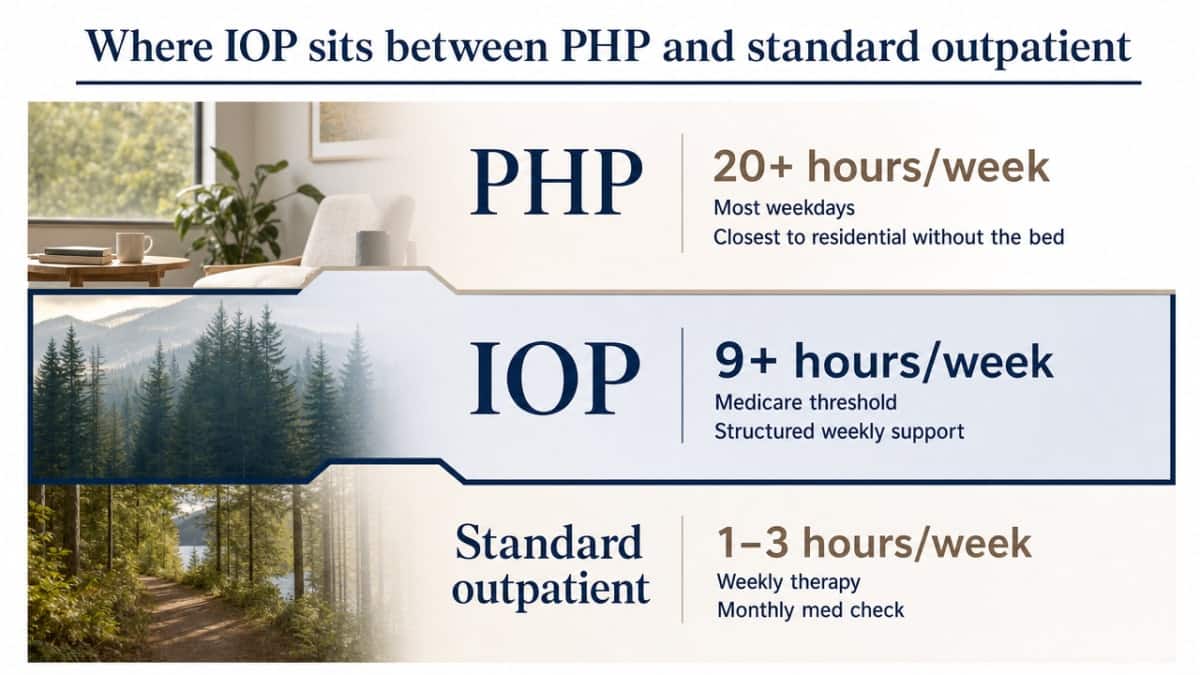
The clearest way to picture an IOP is by the clock. Medicare draws a bright line here: a care plan qualifies for intensive outpatient program services when it calls for at least 9 hours of therapeutic services each week 3. That number is not arbitrary. It is the dosage of structured contact that turns a treatment plan into something a brain in early recovery can actually lean on.
- Partial hospitalization (PHP) usually runs 20 or more hours a week. You show up most weekdays for the better part of the day, and evenings are yours to sleep, eat, and rest. It is the closest thing to residential care without the bed.
- Standard outpatient sits at the other end, generally 1 to 3 hours a week. That is a weekly therapy appointment, maybe a monthly medication check, and a lot of trust in your own routine.
- IOP lives in between. Nine hours or more, spread across three or four days, is enough repetition to catch a shaky week before it becomes a lost weekend, and light enough that you can hold a job, pick up your kids, or keep your housing 14.
That middle-ground math matters for relapse prevention specifically. One hour a week is often not enough contact to interrupt the pattern of cravings, isolation, and old triggers that build up between sessions. A full clinical day, five days a week, may be more than your life can carry after you have already been away in detox or residential. IOP is dosed for the moment when you still need frequent structure but also need to start practicing recovery inside your actual Portland life, not around it.
After detox, which level of care fits you
Picking your next step is not about which program sounds most impressive. It is about matching the level of support to what your days honestly look like right now. Clinicians describe this as a continuum of care, where you step up when things get harder and step down when your footing steadies 13. You are allowed to move between levels. That is how the system is designed to work.
A quick way to sort it out:
PHP fits when home feels shaky, your withdrawal symptoms are still settling, you are managing a co-occurring mental health condition that needs daily eyes on it, or you left residential last week and stepping straight to evenings feels too fast. Think of it as a bridge that keeps most of the structure of inpatient care without the overnight stay.
IOP fits when you have a safe place to sleep, a support person or two you can call, and you are ready to practice recovery inside real life. You can hold a schedule. You want to keep working, parenting, or studying, and you need several structured touch points each week to keep cravings and old routines from taking the wheel. Most people spend 8 to 12 weeks at this level, sometimes longer.
Standard outpatient fits when you have already completed PHP or IOP, your cravings have cooled from a roar to a hum, and a weekly session plus medication management is enough to keep you honest. It is a maintenance level, not an entry point after detox.
One caveat worth naming: relapse is not failure, and moving up a level is not going backwards. If IOP starts to feel too loose or you slip, the right response is often more structure for a stretch, not less. Programs that treat step-ups as neutral clinical decisions instead of punishment are the ones you want 13.
Take the level of care that matches the week you are actually living, not the one you wish you were living. That is the honest place to start.
What a week inside a Portland IOP actually looks like
Evening groups, one-on-ones, and medication check-ins
The best way to picture your week is to picture the clock in your kitchen. IOP is not a mystery box. It is a repeating pattern of a few evenings, one daytime hour, and a handful of shorter appointments that add up to at least nine structured hours 3.
A typical Portland IOP week looks something like this. Monday, Wednesday, and Thursday evenings hold the three main group blocks, usually from about 5:30 to 8:30 p.m. That timing exists on purpose. It lets you finish a shift, catch the MAX or a bus from downtown, or hand off dinner at home before you walk in. Groups run three hours with a short break, and attendance is expected, not optional.
One weekday, often Tuesday, you meet with your individual counselor for 50 minutes. This is where the private work happens: the specific trigger that came up Saturday night, the argument with your partner, the sponsor call you skipped. Group teaches the skills. This hour is where you apply them to your actual life.
Once a week, most programs add a family or skills session. Family sessions bring a partner, parent, or adult child into the room so the people closest to you learn what recovery looks like from the inside. Skills sessions cover concrete things: sleep hygiene, budgeting through early recovery, handling a work event with alcohol, filing for FMLA if you need it.
If you are on medication for cravings, like buprenorphine or naltrexone, expect a brief medication check-in every one to two weeks with a prescriber or nurse. These are short, practical visits. Dose adjustments, side effects, refills. NIDA is clear that for opioid use disorder, medication combined with behavioral therapy outperforms either alone 10.
Add it up and you land between 10 and 12 hours of clinical contact most weeks, with two evenings and Sundays generally open for rest, meetings, or family. That rhythm is what makes IOP a serious level of care rather than a weekly check-in 14.
What relapse-prevention work looks like in group
If you have never sat in a clinical group, the word probably conjures folding chairs and someone saying “and how did that make you feel.” Real IOP group is more practical than that, and more useful.
A typical group opens with a check-in. You say your name, how the last 24 hours went, and where your craving level sits on a simple scale. This is not filler. It gives the clinician a read on who is white-knuckling and who is steady, and it teaches you to name what is happening inside you before it drives the car.
The middle of group is where the relapse-prevention work lives. One night you might map your personal warning signs, the specific sequence that used to end in using: skipped meal, boss email, drive past the old spot, isolation, story in your head that one wouldn’t hurt. Another night the group might rehearse hard conversations, like telling a friend you cannot go to their birthday at a bar this year. Cognitive behavioral work, motivational interviewing, and coping-skills training are the standard tools, and they are used because they work 11.
You will hear other people say things you thought only you thought. That is the part no worksheet can replicate. Watching someone six weeks ahead of you handle a rough Monday gives you a template you can borrow. Watching someone one week behind you reminds you how far you have already come.
Groups close with a commitment. One specific thing you will do before the next session: call your sponsor, go to a Wednesday meeting in Sellwood, tell your partner about the craving instead of hiding it. Small, concrete, and reported back. That accountability loop is what turns three evenings a week into a real defense against relapse rather than three evenings of talking about it 14.
Signs a Portland IOP is genuinely relapse-focused
Not every program that calls itself an IOP is actually built around keeping you sober. Some are structured around filling seats and billing hours. You have already done too much work to land in one of those. Here is what to look for, and what to walk away from.
Medication is on the table, not off it. If you have opioid use disorder and the program discourages buprenorphine, methadone, or naltrexone, that is a red flag. NIDA is clear that for opioid addiction, treatment usually needs to include medication, and medication combined with behavioral therapy outperforms either one alone 10. A relapse-focused IOP either prescribes on-site or coordinates closely with a prescriber who does. Abstinence-only ideology at the intake desk is a warning, not a virtue.
The curriculum names relapse prevention out loud. Ask what they teach in weeks one through four. If the answer is a list of specific skills, mapping warning signs, urge surfing, refusal scripts, sleep and nutrition basics, a plan for high-risk situations, you are in the right place 11. If the answer is vague (“we do group”), keep looking.
They step you up when things get harder, not out. A program that treats a slip as a reason to increase support, add a session, revisit medication, tighten check-ins, is practicing the continuum of care the way it is meant to work 13. A program that discharges you for struggling is not aftercare. It is a filter.
Groups stay small enough to be real. Eight to twelve people is a working size. Twenty-plus is a lecture. You cannot practice hard conversations in a room where you barely get a turn.
They plan for after IOP from day one. A good clinician starts talking about your step-down, standard outpatient, alumni groups, sober support, sponsor work, in the first two weeks. Recovery does not end at week twelve, and your program should be building the next handoff while you are still in the room 13.
Trust your gut on the intake call. If the person on the phone sounds rushed, generic, or more interested in your insurance card than your last thirty days, that is data. You are choosing where to spend some of the most important evenings of your year. It is fair to be picky.
How Oregon coverage pays for IOP
Oregon Health Plan, Medicare, and private insurance
Money should not be the thing that stops you from getting the next 12 weeks of care. In Oregon, most people can find a way to pay for an IOP, but the path depends on which card is in your wallet.
- Oregon Health Plan (OHP).
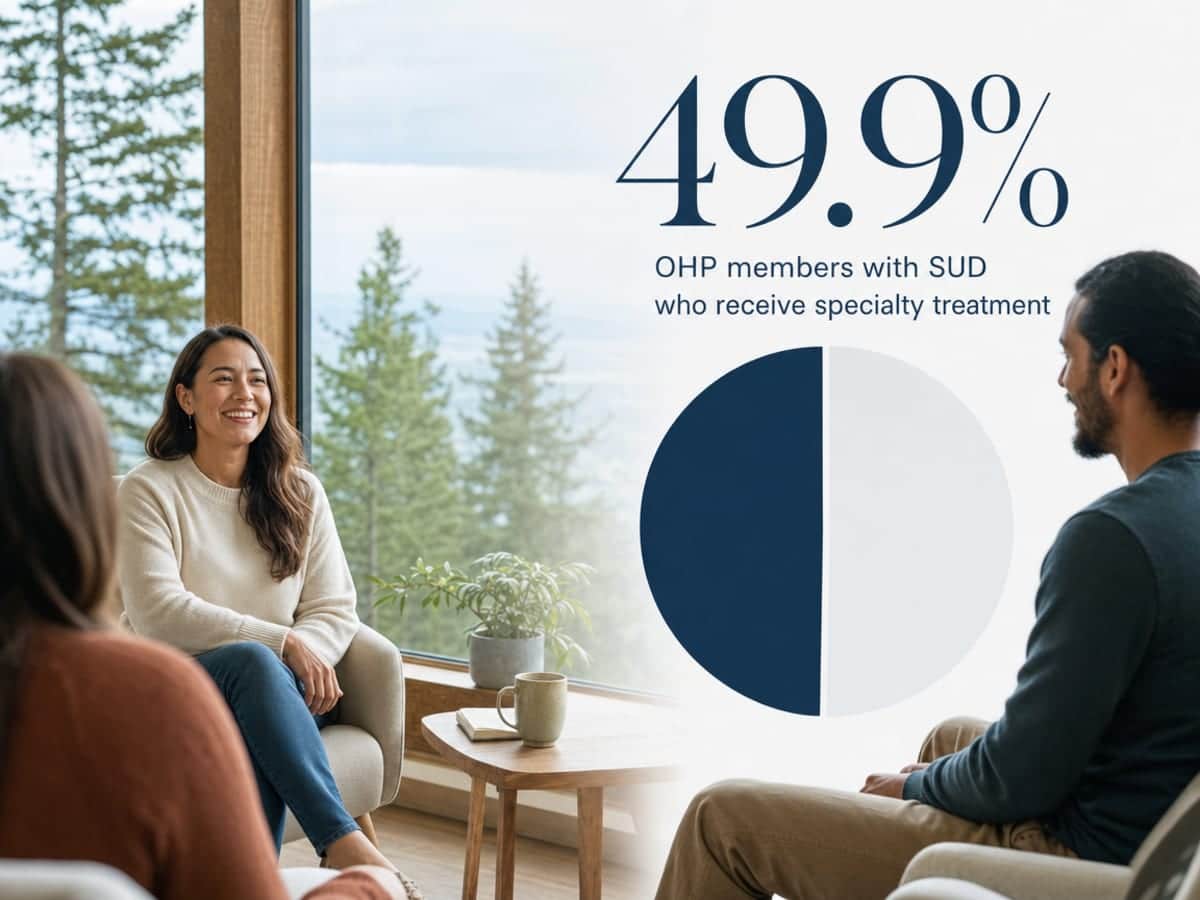
- If you have OHP, behavioral health coverage includes substance use treatment, counseling, detox, and medication-assisted treatment, and you do not need a referral from your primary care provider to start 8. That last part matters. You can call an OHP-contracted provider directly and get an assessment set up. One honest note: not every Portland treatment center accepts OHP, so if a program tells you they cannot bill your plan, ask for a warm handoff to one that can. A statewide review found that fewer than half of OHP members with a substance use disorder actually receive specialty treatment 1, and a big piece of closing that gap is knowing which doors are open to you.
- Medicare.
- If you are on Medicare because of age or disability, Part B covers intensive outpatient program services when your care plan calls for at least 9 hours of therapeutic services a week 3. Covered settings include hospitals, community mental health centers, Federally Qualified Health Centers, Rural Health Clinics, and Opioid Treatment Programs 12. Expect the standard Part B cost share: 20% of the Medicare-approved amount after you meet your deductible 4. A Medigap plan or Medicare Advantage plan may pick up some of that; call the number on your card and ask specifically about IOP.
- Private insurance.
- Most commercial plans in Oregon cover IOP as a behavioral health benefit. Your out-of-pocket cost usually comes down to whether the program is in-network, your deductible, and your copay per visit. Ask the intake coordinator to run a verification of benefits before your first day, and get the estimated cost per week in writing.
- Self-pay.
- If you are between insurance plans, many Portland IOPs offer sliding-scale rates or payment plans. It is worth asking directly rather than assuming the sticker price is the final number.
Questions to ask before your first day
By the time you sit down for intake, you have already done the hard part. Now it is about making sure the program you picked will actually hold up when your Tuesday gets rough. Bring this short list to the phone call or the first meeting.
- On schedule and structure: How many hours per week, on which days, and at what times? Are groups held in the evening so I can keep working? What happens if I miss a session because of a shift change or a sick kid?
- On clinical fit: Who will my individual counselor be, and how often will we meet? What does the first four weeks of curriculum cover? Do you use cognitive behavioral therapy, motivational interviewing, or other evidence-based approaches 11?
- On medication: If I am on buprenorphine, naltrexone, or another medication for cravings, will you coordinate with my prescriber, or do you have one on staff? Detox alone does not sustain recovery, and medication paired with therapy is the standard for opioid use disorder 10.
- On money: What will this cost me per week after insurance? Is there a sliding scale? Will you verify my benefits before I start so there are no surprises?
- On what happens next: When do we start planning my step-down to standard outpatient, and what does aftercare look like here 13?
Write the answers down. If the person on the other end of the phone cannot answer clearly, that is information you can use.
For family members supporting someone in an IOP
If you are the parent, partner, sibling, or grown child of someone starting an IOP this week, a few things will help you help them.
Ask what nights groups run and protect that time like a doctor’s appointment. Dinner shifts earlier. The soccer carpool gets handed off. Missing a group to be at a family thing sends the wrong message about which comes first right now.
Show up when you are invited. Most Portland IOPs run a family session weekly or every other week. That hour is not a performance review. It is where you learn what cravings actually feel like from the inside, and what phrases help versus which ones land like a slap. The people closest to someone in recovery need their own education, and family involvement is a standard part of serious outpatient care 14.
Do not play detective. Breath checks, phone searches, and daily interrogations erode trust faster than they catch anything. If you are worried, say so plainly: “I noticed you seemed off last night. Are you okay?” That is a bid for connection, not a trap.
Take care of your own nervous system too. Al-Anon meetings around Portland, a therapist of your own, or a family group at the IOP itself all count. You cannot pour from an empty cup, and your steadiness is one of the strongest recovery supports in the room.
See If Your IOP and Detox Are Covered
Quickly find out if your insurance covers intensive outpatient programs in Portland.

Frequently Asked Questions
How many hours per week does an intensive outpatient program in Portland require?
Most Portland IOPs run at least 9 hours of clinical contact per week, which is the threshold Medicare uses to define this level of care 3. In practice, that usually means three evenings of group (about 3 hours each), one weekly individual counseling session, and short medication check-ins as needed. If a program you are considering runs fewer than 9 hours, it is standard outpatient with a fancier name. Ask for the full weekly schedule in writing before you commit.
How is IOP different from PHP and standard outpatient after detox?
The difference is how many hours per week you spend in structured care. PHP runs about 20 or more hours a week, close to a full-day program without the overnight stay. IOP sits in the middle at 9 or more hours, usually across three evenings. Standard outpatient is 1 to 3 hours a week, typically a single therapy appointment. You are meant to step between these levels as your footing steadies or shakes, not lock into one 13.
Does Oregon Health Plan or Medicare cover intensive outpatient treatment?
Yes to both, with different rules. OHP covers substance use treatment, counseling, and medication-assisted treatment, and you do not need a referral from your primary care provider to start 8. Not every Portland program bills OHP, so ask directly. Medicare Part B covers IOP when your care plan calls for at least 9 hours of therapy per week, at settings including hospitals, community mental health centers, and Opioid Treatment Programs 3, 12. Expect 20% cost-sharing after your Part B deductible 4.
Can I keep working or caring for family while attending an IOP in Portland?
Yes, and that is much of the point. Most Portland IOPs schedule group blocks in the evening, often 5:30 to 8:30 p.m., so you can finish a shift, catch a bus, or hand off dinner before you walk in. You sleep at home. You keep your job, your kids, your housing. That real-life practice is what makes IOP work for relapse prevention: you learn the skills on Monday and use them Tuesday, inside the same life that triggered you 14.
Can I continue medication for cravings, like buprenorphine or naltrexone, during IOP?
Yes, and you should if it is part of your recovery plan. NIDA is direct that for opioid use disorder, treatment usually needs to include medication, and medication paired with behavioral therapy outperforms either alone 10. A relapse-focused IOP either prescribes on site or coordinates closely with your outside prescriber. If a program pressures you to taper off medication as a condition of attending, that is a warning sign, not a clinical standard. Ask about their approach during the intake call.
How long does a Portland IOP typically last, and what happens after?
Most people spend 8 to 12 weeks in IOP, though some stay longer if life gets bumpy or step up briefly to PHP for extra support. A good program starts planning your step-down in the first two weeks, not the last 13. After IOP, you usually move to standard outpatient (a weekly session and medication management), an alumni group, and outside supports like a sponsor or peer meetings. Recovery does not end at week twelve. It changes shape.
References
- Oregon Substance Use Disorder Services Inventory and Gap Analysis. https://www.oregon.gov/oha/HSD/AMH/DataReports/SUD-Gap-Analysis-Inventory-Report.pdf
- Oregon overdose deaths are down, CDC data shows. https://www.oregon.gov/oha/erd/pages/oregon-overdose-deaths-are-down-cdc-data-shows.aspx
- Intensive Outpatient Program Services | Medicare Coverage. https://www.medicare.gov/coverage/mental-health-care-outpatient-intensive-outpatient-program-services
- Mental health care (outpatient) – Medicare. https://www.medicare.gov/coverage/mental-health-care-outpatient
- Oregon Health Authority: Intensive Treatment Services (Children’s System). https://www.oregon.gov/oha/hsd/bh-child-family/pages/intensive-services.aspx
- Solving Rising Youth Substance Use Rates Through Regulation. https://pdxscholar.library.pdx.edu/hgjpa/vol9/iss1/9/
- Age trends in rates of substance use disorders across ages 18–90. https://pmc.ncbi.nlm.nih.gov/articles/PMC5757874/
- Oregon Health Plan (OHP) Behavioral Health Coverage. https://www.oregon.gov/oha/hsd/ohp/pages/behavioral-health.aspx
- Behavioral Health Outpatient Treatment Programs – Oregon.gov. https://www.oregon.gov/oha/hsd/amh-lc/pages/op.aspx
- Treatment and Recovery | National Institute on Drug Abuse (NIDA). https://nida.nih.gov/publications/drugs-brains-behavior-science-addiction/treatment-recovery
- Treatment | National Institute on Drug Abuse (NIDA). https://nida.nih.gov/research-topics/treatment
- Mental health & substance use disorders – Medicare. https://www.medicare.gov/coverage/mental-health-substance-use-disorder
- Chapter 3. Intensive Outpatient Treatment and the Continuum of Care. https://www.ncbi.nlm.nih.gov/books/NBK64088/
- Substance Abuse: Clinical Issues in Intensive Outpatient Treatment. https://www.ncbi.nlm.nih.gov/books/NBK64093/