


Key Takeaways
- Morphine detox in Milwaukie can happen in a home-like residential setting with 24/7 nursing, pairing the first hard days with buprenorphine or methadone rather than a hospital environment.10
- Choosing a local program means weighing medication options, how detox hands off to ongoing MAT and outpatient care, and whether the setting can safely manage co-use of benzodiazepines or alcohol.3
- Detox alone raises the risk of relapse and overdose because tolerance drops quickly, so CDC guidance treats it as a doorway to continued medication and counseling, not a finish line.1
- Before calling, compare insurance acceptance (commercial plans versus Oregon Health Plan), which FDA-approved medication a program uses, and how the team addresses honesty at intake about every substance in the mix.9
If you’re reading this at 2 a.m., start here
If your feet are cold, your back is sweating, and you’re scrolling for the third time tonight trying to figure out how to stop taking morphine without ending up in an ER hallway, take a breath. You’re in the right place. Nothing you read here is going to lecture you.
Here’s the truth in plain words. Morphine dependence is a medical condition, not a character flaw. Your body has adjusted to the drug, so stopping suddenly makes you feel awful. That part is chemistry, not weakness. And there is medicine that quiets most of the worst of it, prescribed by people who won’t raise an eyebrow at your story.11
In Morphine Detox Milwaukie, you don’t have to choose between a fluorescent hospital room and toughing it out alone at home. A supervised detox in a calm, home-like setting can pair those first hard days with medications like buprenorphine or methadone, so withdrawal becomes something managed instead of something survived.10
The rest of this page walks you through what happens next: what withdrawal actually feels like, how the medicine works, what a residential detox in Clackamas County looks like, and what to do if you also drink or take Xanax. Read as much or as little as you need tonight. Then close the tab and get some water. You made it this far.
Why morphine grabs on so hard
Morphine is one of the oldest painkillers in modern medicine, and it works because it fits into your brain and body like a key in a lock. Those same locks, called opioid receptors, also handle stress, mood, and how much pain you notice on a normal Tuesday. When morphine sits in those receptors for weeks or months, your body quietly rewires itself around the drug being there.
That rewiring is what doctors call physical dependence. It is not the same as being a bad person or lacking discipline. It means your nervous system has adjusted to a new normal, and now it needs the drug just to feel level. This is why stopping morphine cold turkey feels so brutal. The receptors are suddenly empty, and your body reacts the way it would react to any sudden loss of something it has come to expect: pain signals crank up, sleep breaks apart, your gut revolts, and anxiety climbs the walls.11
Many people who become morphine-dependent didn’t start out seeking a high. Often, it begins with a legitimate prescription for conditions like back surgery, a car accident, chronic pain, or cancer treatment. The medication initially provides relief, but over time, tolerance can develop, requiring higher doses for the same effect. This progression is common and has been tracked by federal health agencies as part of the broader prescription opioid issue.4
None of this means you’re stuck. It means your body has a chemistry problem, and chemistry problems have medical answers. That is exactly what the next sections are about.
What withdrawal actually feels like, hour by hour
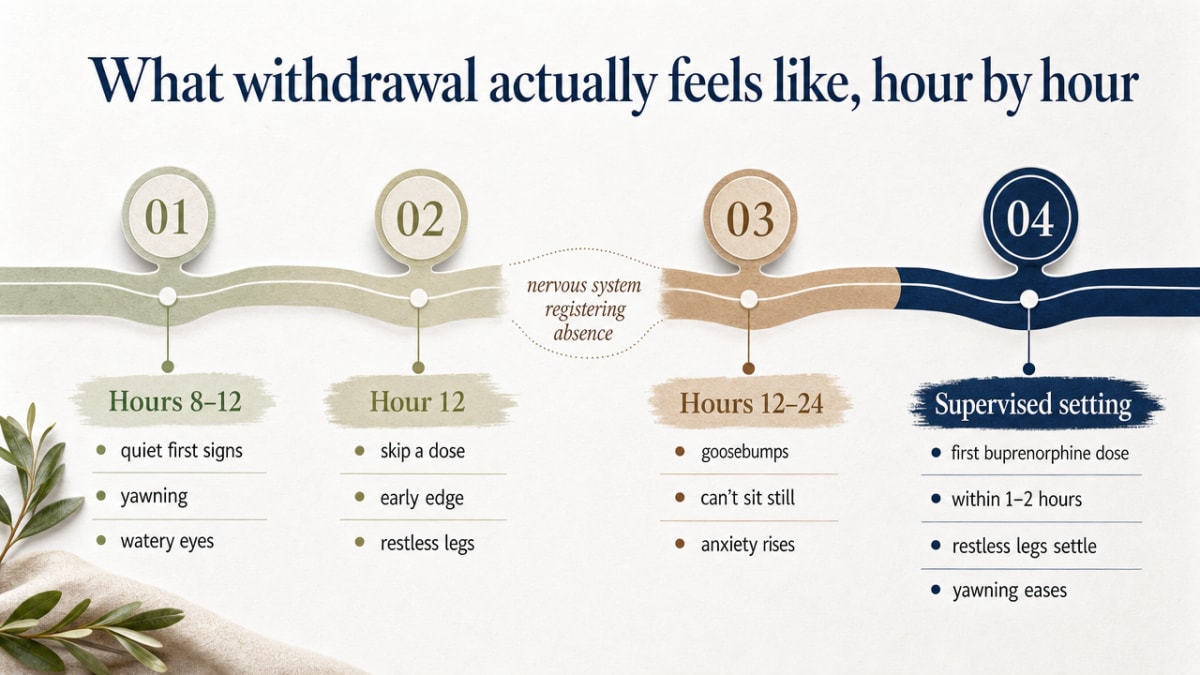
The scariest part of stopping morphine is usually the not-knowing. You’ve heard stories. Maybe you’ve felt the early edge of it before, at hour 12 when you tried to skip a dose. Let’s walk through what actually happens, and where the medicine steps in.
Hours 8 to 24. The first signs are quiet and then loud. Yawning that won’t stop. Watery eyes. A restless feeling in your legs that makes it impossible to sit still. Your skin gets goosebumps out of nowhere. Anxiety rises like a tide. You are not imagining it, and you are not being dramatic. Your nervous system has adjusted to morphine being there, and it’s registering the absence. In a supervised setting, this is often the window when the first dose of buprenorphine can be given, and the difference is usually noticeable within an hour or two. The restless legs settle. The yawning stops. You can actually breathe.11
Days 1 to 3. This is the peak. Without medication, you’d be dealing with deep muscle aches, cramping, sweating that soaks the sheets, diarrhea, nausea, and a kind of bone-level exhaustion that still won’t let you sleep. Blood pressure and heart rate climb. Emotionally, this is where a lot of people relapse when they try it alone. With buprenorphine or methadone on board and dosed correctly, most of the physical symptoms are dramatically softened. You’re still tired. You’re still tender. But you’re not writhing.10
Days 3 to 7. The sharpest edges start to dull. Appetite comes back in small waves. You might get a few hours of real sleep. Muscle aches fade first, then the sweating. This is often when people begin to feel like a person again, not a set of symptoms. Group therapy and counseling start to actually land, because your brain has enough bandwidth to hear them.
Week 2 and beyond. Physical withdrawal is largely done, but sleep can stay choppy for a while, and mood can dip. Cravings come in waves rather than a constant hum. This is exactly why the medicine keeps going after detox. Buprenorphine or methadone continues to quiet the receptors that would otherwise keep pulling at you, giving your brain time to rebuild its own balance.10
Here is what to hold onto: none of the hard hours are wasted. Each one is your body relearning how to run itself. And you don’t have to do that relearning alone in a dark room. A supervised detox exists so a nurse can check on you at 3 a.m., adjust your medication, hand you a cold washcloth, and remind you that the worst hour is not the whole week.
The medicine that quiets the noise
The word “medication-assisted treatment” sounds bigger than it is. In plain language, it means using a medicine to turn down the volume on the part of your brain that has been screaming for morphine. Not to get you high. Not to swap one habit for another. Just to give your nervous system enough steady footing that you can actually think, sleep, eat, and start doing the work of recovery.
There are three FDA-approved medicines for opioid use disorder, and all three have been shown to be safe and effective. You don’t need to memorize them. You just need to know what each one does in real terms, because one of them is probably going to be part of your first week.2
Buprenorphine is the one most people start with in a home-like detox setting. It settles into the same receptors morphine has been using, but only partway. That partial fit is enough to stop the withdrawal symptoms and quiet the cravings, without producing the same high. For a lot of people, the first dose is the moment the sweating stops and the restless legs finally go still.10
Methadone is the older, stronger cousin. It also fills those receptors, prevents withdrawal, and reduces cravings, but it’s dispensed daily through licensed clinics rather than taken home from day one. For someone with a long history of heavy morphine use or previous relapses on buprenorphine, methadone can be the more stable choice.
Naltrexone works the opposite way. It blocks the receptors entirely, so if you were to use morphine again, it wouldn’t do much. Because it doesn’t ease withdrawal, it isn’t used during the first hard days. It comes in later, after you’re fully detoxed, usually as a monthly injection.
What all three share is the mechanism NIDA describes as helping to “normalize brain chemistry,” ease cravings, and steady the body’s functions. That is the science underneath the plain promise: the noise gets quieter, and you get room to breathe.12
Detox is step one, not the finish line
Here’s the part most quick-fix programs won’t tell you: getting through the first week is the beginning, not the end. If you stop morphine, your body clears the drug, and then you walk out the door with nothing between you and your cravings, the odds of relapse climb sharply. So does the risk of overdose, because your tolerance has dropped and the dose that felt normal a week ago can now stop your breathing.
What comes after detox is where the real work lives. Buprenorphine or methadone often continues for months or longer, at a steady dose that keeps cravings quiet while your brain rebuilds its own balance. Counseling, whether one-on-one or in a group, gives you a place to put down the shame you’ve been carrying and figure out what you actually need. Peer support, family sessions, help with sleep, help with pain that never got treated right the first time — all of it stacks on top of the medicine.
Programs in and around Milwaukie are built to hand you off, not release you. Detox in a home-like setting flows into a partial hospitalization schedule, then into intensive outpatient, then into a lighter weekly rhythm, so you keep the support you need without your whole life pausing indefinitely. Every step forward counts, and every step is meant to connect to the next one. That is what makes the first hard week actually mean something.
What a home-like detox in Milwaukie actually looks like
Picture a two-story house on a quiet street a few blocks from the Willamette. There’s a porch. There are throw pillows on the couch that don’t match. Someone left a paperback face-down on the arm of a chair. That is closer to what a residential detox in Milwaukie looks like than anything you’ve seen on a hospital drama.
Your room has a real bed, not a gurney. There’s a window that opens. You bring your own soft clothes, your own toothbrush, maybe a photo. Nurses are on-site around the clock, but you don’t hear beeping monitors down the hall. You hear a kettle. Someone in the next room laughing at something on their phone. Rain, most of the year.
The clinical piece is still there, quietly. A nurse checks your vitals in the morning and again at night. A prescriber meets with you on day one to figure out the right starting dose of buprenorphine, and adjusts it over the next few days based on how you’re actually feeling, not a chart on a wall. When the restless legs come back at 4 a.m., someone is awake to help. WHO withdrawal protocols exist for exactly this kind of setting, so the medicine and monitoring are the same rigor you’d get in a hospital, without the hospital.10
Days have a loose shape. Breakfast in a shared kitchen, if you can eat. A short check-in group where people talk about how the night went. One-on-one time with a counselor when you’re ready for it. A nap. More water than you’d think possible. In the afternoon, maybe a walk to the yard, or a movie in the common room with a heated blanket. Meals are cooked on-site and simple, because your stomach is still figuring itself out.
The staff mix matters. Some of them have medical training. Some of them have been through their own recovery and remember what hour 36 felt like. Nobody talks down to you. Nobody flinches when you say what you were taking or how much. You’re a person named whatever you’re named, not a case number.
By day four or five, when you can hold a conversation and hold down toast, the team starts talking with you about what comes next — which outpatient schedule fits your life, whether you’ll stay on buprenorphine, how to tell your family what you need. That handoff is built into the walls of the place.
If you also use benzos, alcohol, or drink to sleep
Read this part carefully, because it’s the part a lot of people are afraid to ask about. If you take Xanax, Klonopin, or Ativan on top of morphine, or if a glass or three of wine is how you fall asleep, you are not disqualified from treatment. You are not going to get turned away at the door. You are exactly the kind of patient a supervised detox is built for.
Here’s what changed the picture. The FDA specifically advised that buprenorphine and methadone should not automatically be withheld from patients who also take benzodiazepines or other central nervous system depressants, even though the combination carries added risk. The point is careful monitoring, not exclusion. Denying MAT to someone who also uses benzos or alcohol usually leaves them worse off, because untreated opioid dependence carries its own overdose risk.3
What that looks like in practice: your intake team asks about everything you’re taking, including the wine, the leftover Klonopin from an old prescription, the edible before bed. They plan a taper for the substances that need one, especially alcohol and benzodiazepines, which can be dangerous to stop suddenly. Your buprenorphine dose gets adjusted around that. Someone checks on you more often, not less. Honesty at intake is what keeps you safe, so tell them the whole picture. Every piece you name gets a plan attached to it.
Oregon is turning a corner, and Clackamas County is part of it
You’re not doing this alone, and you’re not doing it in a state that’s given up. For years, the overdose numbers in Oregon only pointed one direction. That changed.
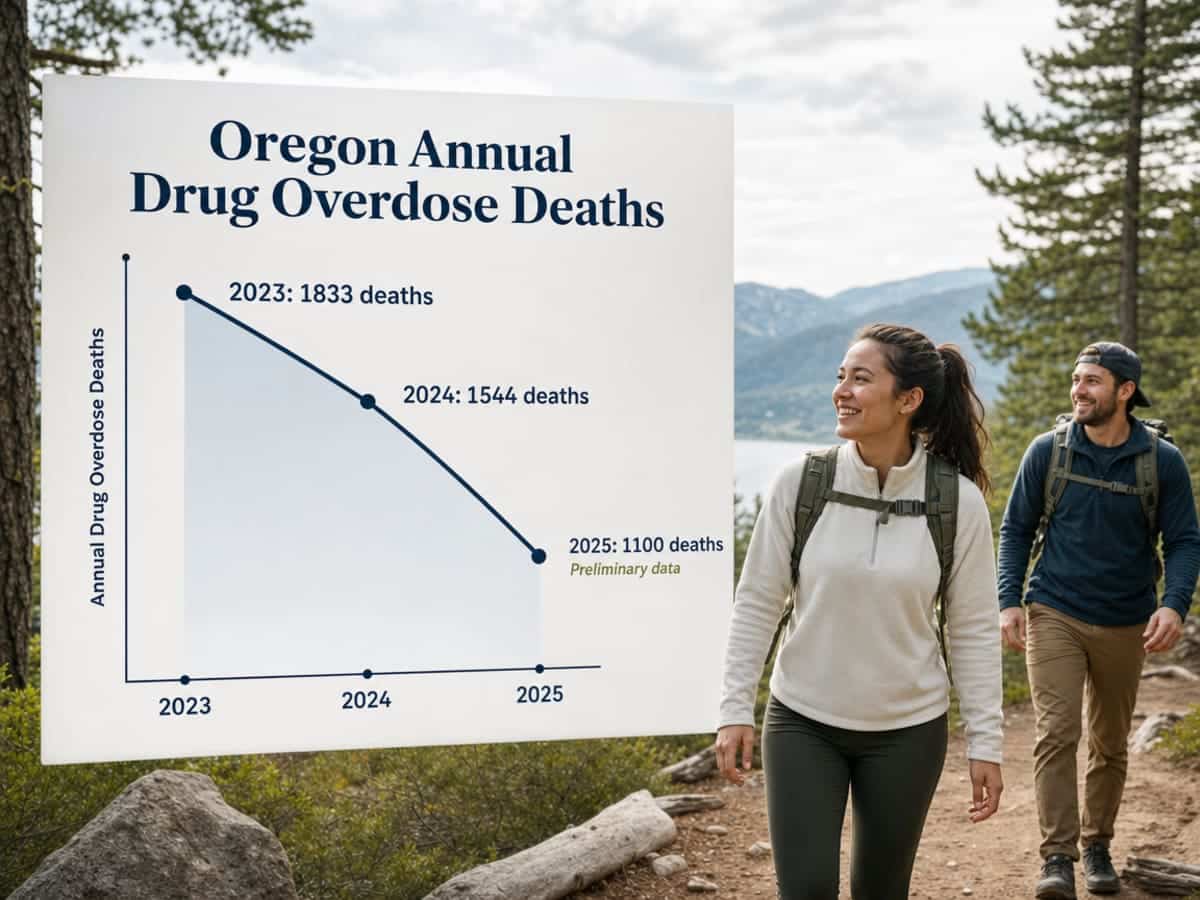
In 2023, 1,833 Oregonians died from a drug overdose. In 2024, that number fell to 1,544 — the first year-over-year drop since 2016. Preliminary 2025 data puts the count near 1,100. Those aren’t just figures on a state dashboard. They’re people who got naloxone in time, people who found a treatment bed, people who started buprenorphine and stayed on it long enough for the medicine to do its work.7
The turn didn’t happen by accident. It followed real investment in naloxone distribution, in treatment access, and in recovery support across the state. Oregon Health Authority points to medication-assisted treatment as a central piece of that infrastructure, framing it as evidence-based medical care, not a substitute habit. That distinction matters when you’re the one deciding whether to make the call.7,9
Clackamas County is part of this picture, and Milwaukie sits inside it. The county carries a share of Oregon’s opioid burden that shows up in emergency department visits and overdose data tracked by state committees, with Western Oregon consistently registering higher opioid-related ED rates than much of the state. That means the need here is real, and so is the response. Local treatment capacity, including home-like residential detox linked to ongoing MAT, exists because this county’s numbers demanded it.8
There’s one more thing worth naming. The people bearing the heaviest weight of this crisis in Oregon are not evenly distributed. Black and African American Oregonians and American Indian and Alaska Native Oregonians are experiencing the highest rates of fatal overdose, and OHA has been direct that culturally responsive care has to be part of the answer. If you’ve ever hesitated to walk into a treatment setting because you weren’t sure you’d be met with respect, that hesitation is legitimate — and the standard the state is pushing toward is one where you shouldn’t have to weigh it.6
So when you make the call from a house in Milwaukie, or from an apartment off McLoughlin, you’re stepping into a moment when the trend is finally moving with you, not against you. That doesn’t make the next week easy. It does mean the next week is worth doing.
For the family member who found this page
If you’re the parent, partner, sibling, or friend reading this because someone you love is using morphine and won’t quite say it out loud, this part is for you. You don’t need to have the perfect words. You just need to know a few things.
First, this is not a willpower problem. Morphine changes how the body works at the receptor level, and quitting suddenly triggers real physical withdrawal, not a mood. Understanding that changes the tone of the conversation. You’re not asking someone to try harder. You’re offering to help them get medical care for a medical condition.11
Second, don’t push a cold-turkey attempt at home. Unsupervised morphine withdrawal is miserable, and it raises the risk of relapse and overdose because tolerance drops fast. A supervised detox in a home-like setting, paired with buprenorphine or methadone, is the safer path — and one they don’t have to earn by hitting some imagined bottom first.1
Third, small offers land better than big speeches. Drive them to the intake call. Sit on the porch while they make it. Pack a bag with soft socks and a phone charger. Ask what they want you to tell the kids or their boss, and honor that. And when they take the first dose and the sweating stops, notice it out loud. Every step forward counts, for them and for you.
Cost, insurance, and the first phone call
You’ve read this far, so let’s talk about the practical stuff standing between you and picking up the phone.
Most private insurance plans cover medically supervised detox and MAT, because it’s evidence-based medical care, not a lifestyle service. That includes commercial plans through an employer, plans bought on the marketplace, and many union and trust plans. Oregon Health Plan (OHP) is handled differently, and not every private detox program takes it — so if OHP is your coverage, ask up front and get pointed to a program that does.9
Here’s what the first call actually sounds like. Someone picks up. They ask what you’re taking, how much, how long, and what else is in the mix. They ask about your insurance card, or take your information if you don’t have one nearby. They don’t ask you to justify anything. If there’s a bed available, they can often walk you through intake the same day or the next morning.
You don’t have to have your speech ready. You can say, “I’m taking morphine and I want to stop.” That’s enough. Pacific Crest Trail Detox in Milwaukie is one place that answers that call. Every step forward counts, and this one is the smallest and the biggest at the same time.
Check Insurance for Morphine Detox Coverage Now
See if your insurance covers safe, supportive morphine detox in Milwaukie.

Frequently Asked Questions
How long does morphine withdrawal last in a supervised detox?
The sharpest symptoms usually run from hour 8 through day 3, ease noticeably by day 5, and mostly settle by the end of week one. With buprenorphine or methadone on board, most of the physical misery is dramatically softened from the first dose forward 10. Sleep and mood can stay a little uneven into week two, which is exactly why the medicine keeps going after detox.
Will I have to switch to methadone, or can I use buprenorphine instead?
Most people starting morphine detox in a home-like setting begin with buprenorphine, because it eases withdrawal and quiets cravings without a daily clinic visit 2. Methadone is a solid option if you’ve had heavy long-term use or previous relapses on buprenorphine. Your prescriber picks based on your history, not a formula. Both are FDA-approved and shown to be safe and effective, so neither is a downgrade.
Can I still get MAT if I also take Xanax, Klonopin, or drink alcohol?
Yes. The FDA specifically advised that buprenorphine and methadone should not automatically be withheld from patients taking benzodiazepines or other central nervous system depressants 3. The plan is careful monitoring, not exclusion. Alcohol and benzodiazepines often need their own supervised taper because stopping them suddenly can be dangerous, so tell the intake team everything you’re using. Honesty at intake is what keeps you safe.
Does insurance cover morphine detox in Milwaukie?
Most commercial and employer-based plans cover medically supervised detox and ongoing MAT, because Oregon and federal guidance treat it as evidence-based medical care 9. Marketplace plans and many union or trust plans do too. Oregon Health Plan (OHP) is handled differently and not every private detox program accepts it, so ask on the first call. Bring your card if you have one; if you don’t, they’ll walk you through it.
What if I became dependent on morphine from a legitimate prescription?
You’re in good company, and you didn’t do anything wrong. Physical dependence can develop from taking prescription opioids exactly as directed over time, because the body adjusts to the drug being present 11. That’s chemistry, not a moral failing. Treatment doesn’t require a dramatic origin story. A supervised detox with buprenorphine or methadone works the same way whether your first pill came from a surgeon or a friend.
Can I detox from morphine at home instead of going to a facility?
Home detox usually goes badly, and the risk isn’t just discomfort. CDC guidance is direct that detox without ongoing medications for opioid use disorder raises the odds of returning to use, overdose, and overdose death, because tolerance drops fast 1. A supervised setting gives you buprenorphine or methadone in the first hard hours, a nurse at 3 a.m., and a warm handoff to what comes after — which is what actually makes the week stick.
References
- Opioid Use Disorder: Treating | Overdose Prevention. https://www.cdc.gov/overdose-prevention/hcp/clinical-care/opioid-use-disorder-treating.html
- Information about Medications for Opioid Use Disorder (MOUD). https://www.fda.gov/drugs/food-and-drug-administration-overdose-prevention-framework/information-about-medications-opioid-use-disorder-moud
- FDA issues medication-assisted treatment guidance. https://www.aha.org/news/headline/2017-09-21-fda-issues-medication-assisted-treatment-guidance
- Prescription Opioid Analgesic Use Among Adults. https://www.cdc.gov/nchs/products/databriefs/db189.htm
- Opioid Abuse in the U.S. and HHS Actions to Address Opioid-Drug-Related Overdoses and Deaths. https://aspe.hhs.gov/reports/opioid-abuse-us-hhs-actions-address-opioid-drug-related-overdoses-deaths-0
- Oregon Health Authority: Reducing Opioid Overdose and Misuse. https://www.oregon.gov/oha/ph/preventionwellness/substanceuse/opioids/pages/index.aspx
- Oregon overdose deaths declined in 2024, 2025. https://www.oregon.gov/oha/erd/pages/oregon-overdose-deaths-declined-in-2024-2025-05.13.2026.aspx
- County-level data for ADPC Committees. https://www.oregon.gov/adpc/SiteAssets/Lists/MeetingEvents/EditForm/ADPC%20County%20Overdose%20Data%204.9.24.pdf
- Medication-Assisted Treatment for Opioid Dependence – Oregon Health Authority. https://www.oregon.gov/oha/hsd/amh/pages/mat.aspx
- Clinical Guidelines for Withdrawal Management and Treatment of Drug Dependence in Closed Settings. https://www.ncbi.nlm.nih.gov/books/NBK310652/
- Prescription Opioids DrugFacts. https://nida.nih.gov/publications/drugfacts/prescription-opioids
- How Do Medications to Treat Opioid Use Disorder Work?. https://nida.nih.gov/publications/research-reports/medications-to-treat-opioid-use-disorder/how-do-medications-treat-opioid-use-disorder