


Key Takeaways
- Partial hospitalization is a structured daytime program running 4-8 hours a day, at least 20 hours a week, where you get intensive treatment then sleep at home 14, 13.
- PHP fills the gap between inpatient care and weekly therapy, giving people who don’t need 24-hour supervision hospital-level therapeutic work while practicing real life at night 1.
- Addiction and mental health are treated together by one team in the same room, so cravings, anxiety, medications, and trauma get worked on as connected pieces rather than separate charts.
- Most stays run two to six weeks and end with a planned step-down to intensive outpatient, keeping therapy and prescriber support as more of daily life returns 11, 12.
The space between the hospital and your kitchen table
If you’re reading this at 11 p.m. with a family member on the couch beside you, or between calls with an insurance rep, or the day after detox ended — you’re in the right place. A partial hospitalization program, or PHP, is one of the harder things to picture from the outside. It’s not a hospital stay. It’s not weekly therapy. It sits somewhere in between, and that in-between is exactly where a lot of people land when they’re managing both a substance use issue and something like depression, anxiety, PTSD, or bipolar disorder.
Here’s the short version: you show up in the morning, you spend most of the day in group and individual sessions, you meet with a prescriber about your medications, and you sleep in your own bed. Then you do it again the next day.
That’s the shape of it. The rest of this article walks through what those days actually feel like — the schedule, the people, the awkward parts, and what happens when the program ends. You deserve specifics, not a brochure.
Where PHP sits between hospital and home
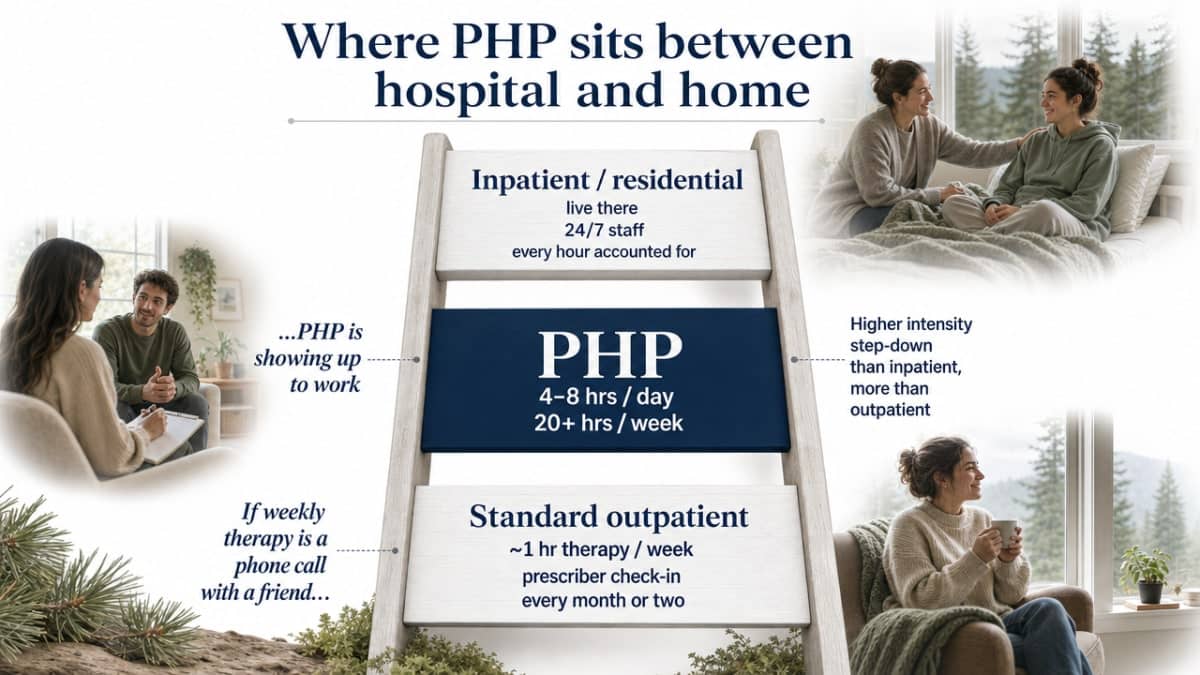
Picture a ladder. At the top rung is inpatient or residential treatment — you live there, staff are with you around the clock, and every hour is accounted for. At the bottom rung is standard outpatient therapy, which for most people means one hour with a therapist each week and maybe a check-in with a prescriber every month or two.
PHP sits high on that ladder, but not at the top. Medicare defines partial hospitalization as a structured program that runs about 4 to 8 hours per day and adds up to at least 20 hours per week 14. Federal guidance from CMS and SAMHSA uses that same 20-hours-per-week floor to distinguish PHP from lighter step-down options 13. That’s a real difference in intensity. If weekly therapy is a phone call with a friend, PHP is showing up to work — five days a week, with a team that knows your name and your treatment plan.
The other piece worth naming: PHP is designed for people who would otherwise need inpatient psychiatric care but don’t require 24-hour supervision to stay safe 1. That’s the specific gap it fills. You get the therapeutic firepower of a hospital-level program during the day, and you get to sleep in your own bed at night. For someone leaving detox or stepping down from residential, that combination matters. You keep the structure while you start practicing what your regular life is going to look like.
Here’s how the weekly hours stack up across the levels of care most people move through:
- Standard outpatient therapy: roughly 1–2 hours per week.
- Intensive outpatient (IOP): roughly 9–15 hours per week, usually three to five afternoons or evenings.
- Partial hospitalization (PHP): 20+ hours per week, typically 4–8 hours per day, five days a week 14, 13.
- Residential or inpatient: 24 hours a day, seven days a week.
Seeing it laid out that way tends to help. PHP isn’t a lighter version of the hospital. It’s its own thing — full days of care, then you go home.
What a weekday actually looks like
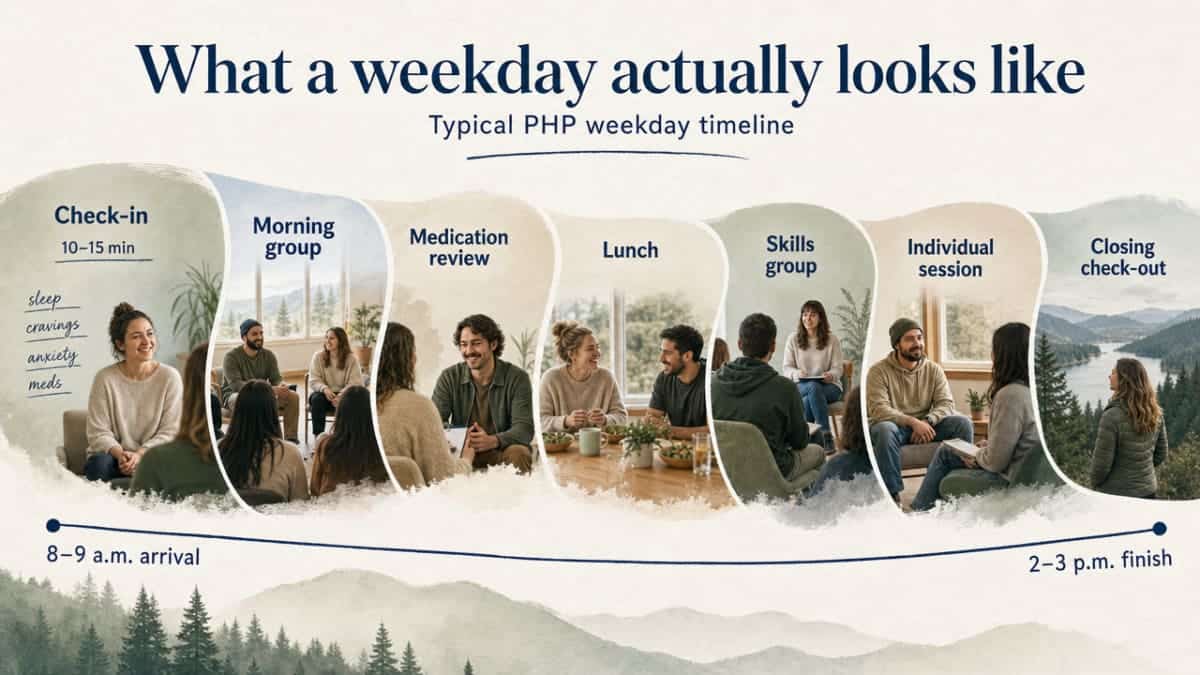
Most PHPs run Monday through Friday. You arrive between 8 and 9 a.m. and you’re done sometime in the mid-afternoon — usually around 2 or 3 p.m. That gives you the 4 to 8 hours a day that Medicare uses to define this level of care 14. The exact schedule shifts from program to program, but the bones tend to look the same.
Here’s what a typical Tuesday might feel like from the inside.
The check-in. You walk in, sign in, and settle into a room that probably looks more like a living room than a hospital ward — couches, chairs in a loose circle, coffee brewing. A staff member does a quick 10 or 15-minute check with you. How did you sleep? Any cravings? Any spikes in anxiety or depression overnight? Did you take your morning medications? This isn’t small talk. It’s the team catching problems early, before they turn into a rough day.
Morning process group. This is usually the longest block, maybe 90 minutes. Six to twelve people sit in a circle with one or two clinicians. You go around and share where you’re at. Some days you talk. Some days you listen. If someone else’s story lands hard for you, that’s material for later. Group work is one of the three anchors that PHP research keeps coming back to, along with medication management and psychoeducation 12.
Medication review. Once or twice a week, you’ll meet with a prescriber — a psychiatrist, nurse practitioner, or physician — to go over your medications. We’ll get into what that looks like in the next section. On days you’re not meeting with them, a nurse might still do a quick med pass.
Lunch. Usually 45 minutes to an hour. Some programs provide food, some ask you to bring your own. This block is quieter than it sounds. You might eat with people you were crying next to an hour ago. That’s normal.
Skills group or psychoeducation. Afternoons tend to be more structured and less emotionally raw. You might work through a DBT skill like distress tolerance, or a CBT worksheet on catching a thought before it spirals. Other days it’s psychoeducation: how alcohol affects sleep architecture, how trauma changes the nervous system, what to expect when a specific medication starts working. You take notes. You get handouts. It feels a little like school, in a good way.
Individual session or family/discharge planning. Two or three times a week, you’ll have a one-on-one with your primary therapist for 45 minutes. On other afternoons, this slot might be a family session over Zoom, or a discharge planning meeting where you and a case manager start mapping what comes after PHP.
Closing check-out. Before you leave, the group gathers one more time. Ten minutes. One word or one sentence about how you’re heading home. It sounds small. It’s not. It gives staff a last read on you, and it gives you a moment to name what you’re carrying out the door.
Then you go home. You eat dinner with whoever you live with, or by yourself. You go to bed. You do it again tomorrow.
That’s a weekday. Not every day feels the same. Some are heavy. Some are almost boring, in the useful way that structure can be boring. The predictability is part of what makes it work — you don’t have to decide what happens next, because the schedule already knows.
How addiction and mental health get treated in the same room
This is the part that matters most if you’re carrying two things at once — say, drinking that got out of hand and a depression that’s been sitting on your chest for years, or opioid use that started after a trauma you’ve never really talked about. In older treatment models, those two things got split up. You’d go to one place for the substance piece, another for the mental health piece, and the two teams rarely talked. You’d end up explaining yourself twice and getting advice that sometimes contradicted itself.
A good PHP doesn’t do that. The whole point of this level of care is that both things get worked on in the same building, by the same team, often in the same conversation.
Here’s what that looks like in practice. In morning group, someone might share that they didn’t sleep because their anxiety spiked, so they thought about drinking. The clinician doesn’t pick one thread and drop the other. The group talks about the anxiety — what set it off, what the body was doing — and about the craving that showed up on its back. Both get named. Both get worked on. That’s integrated care, and it’s the standard PHPs are built around: active treatment of a serious condition with an expectation that things can actually improve 2.
The skills groups blend the same way. A DBT skill like opposite action works on a depressive urge to isolate and on a craving to use — it’s the same skill, applied to two problems that feed each other. Psychoeducation sessions do this too. You might spend a Wednesday afternoon learning how alcohol interacts with an SSRI, or how untreated PTSD raises relapse risk. You leave with information that connects the dots, not a stack of unrelated handouts.
Your primary therapist knows both sides of your chart. Your prescriber knows you’re in recovery and adjusts medications accordingly. The case manager helping you plan discharge is thinking about your mental health follow-up and your recovery support at the same time. That coordination is one of the reasons PHP exists as a formal alternative to inpatient psychiatric care — it’s structured enough to hold complex, overlapping needs without splitting them apart 1.
If you’ve bounced between programs before and felt like nobody had the full picture of you, this is the piece that tends to feel different. You’re one person in the room. The team treats you that way.
The medication piece: meeting with a prescriber during the week
If you’re on medication for anxiety, depression, bipolar, or PTSD — or you’re starting something new to help with cravings — the prescriber meeting is where a lot of quiet, important work happens. In most PHPs, you’ll sit down with a psychiatrist, psychiatric nurse practitioner, or physician once or twice a week for about 20 to 30 minutes.
The first visit is longer. You’ll go through every medication you’re currently taking, when you started, what’s helped, what hasn’t, and any side effects you’ve been living with. Bring the bottles if you can, or a photo of them on your phone. If you came in from detox, the prescriber already has notes from that stay, but they’ll want to hear it from you too.
After that, the visits are shorter and more focused. Is the SSRI starting to lift the depression, or is it flattening you out? Is the mood stabilizer helping you sleep? If you’re on medication to reduce alcohol or opioid cravings, is it doing its job? Prescribers know that medication response is personal — what works for one person can miss for another, so adjustments happen slowly and with your input 3.
Your prescriber talks with your therapist. That coordination is the whole point of being here.
The feelings most PHP guides skip
Most guides describe PHP like it’s a schedule and a set of services. What they leave out is how it feels — the parts of your body and your calendar that have to adjust to being in a room with strangers, talking about the hardest things in your life, then driving home to make dinner. Those feelings are real, they’re normal, and the program is built to hold them. Let’s name a few of them out loud.
The first-day awkwardness and the tired-after-group fog
The first morning is weird. You’ll probably sit in your car for a minute before going in. That’s okay. Inside, you don’t know anyone. People already have their spots on the couch. Someone will point you to a chair. You’ll fill out paperwork you’ve filled out before. You might cry, or you might feel nothing, and both are common.
Then there’s the fatigue nobody warns you about. After a 90-minute group where people talked about overdoses and childhood and the argument they had last night, your body will feel like you ran a few miles. That’s not weakness. Emotional work is metabolic. Plan for a nap or a quiet afternoon. Rest is part of the treatment, not a break from it.
Going home each night and running into your old life
Going home is the hard part nobody advertises. In a hospital, the building holds you. In PHP, you hold yourself — with the skills you’re learning and the phone numbers of people in your group. You might pass the liquor store you used to stop at. You might see a text from someone you used to use with. You might sit at your own kitchen table and feel lonelier than you did in group.
Who PHP tends to help, based on the research
You might be wondering if this level of care actually fits your situation, or if you’d be better off with something lighter or heavier. The research isn’t perfect — most PHP studies are smaller than we’d like, and they tend to focus on specific groups. But there are a few clear signals worth knowing.
For adults dealing with anxiety and mood disorders — which covers a lot of people with co-occurring substance use — a recent pilot study of an adult PHP found meaningful drops in anxiety and depression symptoms across the course of treatment, along with high ratings from the people who went through it 5. It was a pilot, so the sample was small, but the direction it points matters: adults with common co-occurring conditions tend to respond to this level of care.
For people carrying a borderline personality diagnosis, or borderline traits that show up as intense mood swings, self-harm urges, and unstable relationships, a PHP built around structured psychotherapy showed reductions in self-harm and clinical improvement that held up over follow-up 9. If that description fits parts of you, know that PHP has been specifically studied for this and can work.
There’s also an older, foundational finding worth naming: for people who don’t need round-the-clock supervision, PHP has been shown to produce clinical outcomes comparable to inpatient care at lower cost 6. That study is decades old now, and treatment has evolved, but the core insight still holds — you don’t have to be in a hospital bed to get hospital-level therapeutic work done.
In person, hybrid, or virtual: how PHPs actually get delivered
Most PHPs still meet in person, and for good reason — the couch, the coffee, the person sitting three feet away from you nodding when you talk about a rough night, that stuff is hard to replicate through a screen. If you can get to a program in person, that’s usually the recommendation, especially early in recovery.
But full-time in-person isn’t the only option anymore. Since the pandemic, a lot of programs run some or all of their groups over secure video, and the research that came out of that shift is more encouraging than people expected. A study of virtual intensive outpatient and PHP services during COVID-19 found that telehealth delivery kept engagement high and produced meaningful symptom reductions — not a stopgap, a real option 10. Some programs now offer hybrid schedules where you come in a few days a week and log in from home the others. That can help if you live an hour from the nearest program, have a job you’re phasing back into, or care for someone at home. Ask what’s available. Ask how they handle a crisis if you’re on video from your kitchen. The right answer exists.
What comes after PHP: the next rung down
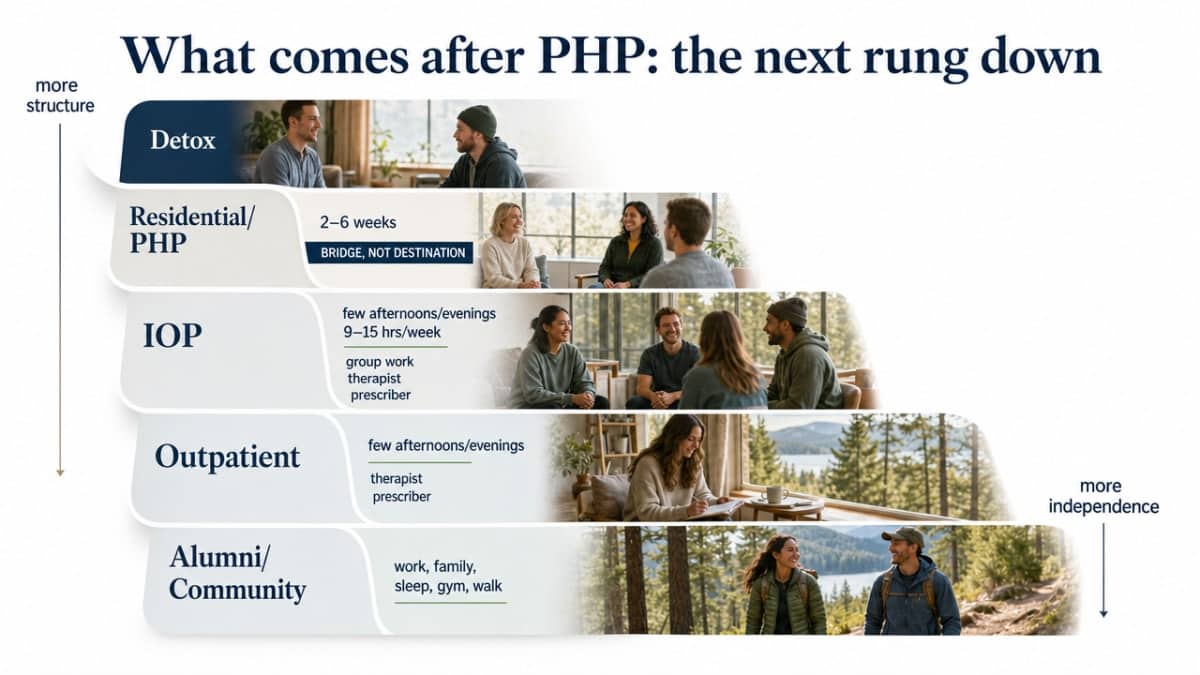
PHP is a bridge, not a destination. Most people spend somewhere between two and six weeks in a PHP, and then they step down to something lighter. That next rung is usually an intensive outpatient program — a smaller step-down program you attend a few afternoons or evenings a week, typically for 9 to 15 hours total. You keep the group work, you keep meeting with a therapist, you likely keep your prescriber. You just have more of your week back for the things a full life includes — work, family, sleep, boredom, the gym, a walk.
SAMHSA describes this continuum of care as a series of levels — inpatient and residential at the top, then partial hospitalization, then intensive outpatient, then standard outpatient — each one dialing down the hours and dialing up your independence 11. PHP researchers describe the same idea from a clinical angle: partial hospitalization sits as a midpoint along the treatment intensity continuum, built to bridge crisis stabilization and long-term recovery 12. That midpoint framing matters here. PHP isn’t where the work finishes. It’s where the work gets consolidated before you carry it into a lighter structure.
Here’s the ladder most people move down, one rung at a time:
- Medical detox: where the body gets safe.
- Residential or PHP: where the day is held for you while you stabilize.
- Intensive outpatient: where you keep the therapy and add real life back in.
- Standard outpatient: weekly therapy and a prescriber check-in.
- Alumni and community supports: the people who knew you at your hardest, and still pick up the phone.
Your discharge planner starts mapping this with you weeks before PHP ends. That’s not a formality — it’s the piece that turns a good few weeks into something that lasts.
How to tell if a PHP is the right next step for you
Some quick, honest questions to sit with. If you just finished detox and the idea of going straight home feels like standing on ice, PHP is probably the right catch. If your mental health symptoms — the depression that won’t lift, the panic, the flashbacks, the mood swings — are loud enough that weekly therapy alone won’t touch them, that’s another signal. If you’ve tried standard outpatient before and slipped, a higher rung with more hours and more people around you can change the outcome.
On the other side: if you’re safe at home, sleeping okay, and mostly steady, an intensive outpatient program a few afternoons a week may be enough. If you can’t stay safe without someone watching you at night, PHP isn’t the level you need yet — inpatient or residential comes first.
You don’t have to figure this out alone. A phone call with an admissions team, like the one at Pacific Crest Trail Detox, gets you a real assessment and a clear recommendation — not a sales pitch. That call is often the hardest part. Making it counts.
Check Your Coverage for Partial Hospitalization Today
Find out if your insurance covers the support you need for your next step in recovery.
Frequently Asked Questions
How long does a partial hospitalization program usually last?
Most people stay in PHP for about two to six weeks, though the exact length depends on how you’re doing, not on a fixed calendar. Your team reassesses you often. When your symptoms are steadier and you’re using the skills at home, they’ll step you down to a lighter level of care. Some people move on sooner, some take longer. Both are normal.
Can I keep working or go to school while I’m in a PHP?
Not usually, at least not full-time. PHP runs about 4 to 8 hours a day, five days a week, which takes up most of your workday 14. Some people arrange short-term leave through their employer or school, sometimes using FMLA or disability paperwork the program can help with. A few keep light evening or weekend work. Talk to admissions early — they’ve helped many people sort this out.
Will a PHP treat my addiction and mental health at the same time?
Yes — that’s exactly what this level of care is built for. In a program that handles co-occurring conditions, the same team works on both in the same room. Your therapist knows both sides of your story. Your prescriber adjusts medications with your recovery in mind. Group work weaves the two together instead of splitting them apart. You shouldn’t have to explain yourself twice or piece together separate treatment plans.
What’s the difference between PHP and IOP?
Hours and independence. PHP is a full-day program, roughly 20 or more hours a week, and usually your main activity that week. An intensive outpatient program is smaller — around 9 to 15 hours a week, often three or four afternoons or evenings — so you can fit work, school, or family around it. Most people step down from PHP into IOP rather than choosing between them.
Do I have to stop my current medications before starting PHP?
No. Bring everything you’re taking — psychiatric medications, medications for cravings, anything else. Your prescriber reviews the full list and decides with you what stays, what gets adjusted, and what might change 3. Nothing gets pulled out from under you. If a change is worth trying, it happens slowly and with your input, so you always know what’s shifting and why.
What happens if I have a rough night at home during the program?
Rough nights are expected — the program plans for them. Before you leave each day, you’ll have crisis numbers, a safety plan, and names of people in your group you can text. If something serious happens, most programs have an on-call line. If you’re unsafe, call 988 or go to an ER. Then bring it into check-in the next morning. That’s the material your team works with.
References
- Medicare Benefit Policy Manual, Chapter 6: Hospital Services Covered Under Part B. https://www.cms.gov/regulations-and-guidance/guidance/manuals/downloads/bp102c06.pdf
- Definition of partial hospitalization. The National Association of Private Psychiatric Hospitals and the Association for Ambulatory Behavioral Healthcare. https://pubmed.ncbi.nlm.nih.gov/10106610/
- Mental Health Medications. https://www.nimh.nih.gov/health/topics/mental-health-medications
- Mental Illness. https://www.nimh.nih.gov/health/statistics/mental-illness
- Pilot effectiveness and acceptability of partial hospitalization among adults with anxiety and mood disorders. https://pubmed.ncbi.nlm.nih.gov/38937048/
- Partial hospitalization: An alternative to inpatient treatment. https://pubmed.ncbi.nlm.nih.gov/2115539/
- Effectiveness of a partial hospitalization program for depressed adolescents. https://pubmed.ncbi.nlm.nih.gov/11515252/
- Adolescent partial hospitalization: Outcomes and predictors of improvement. https://pubmed.ncbi.nlm.nih.gov/18444033/
- A partial hospitalization program for patients with borderline personality disorder. https://pubmed.ncbi.nlm.nih.gov/7713868/
- Telehealth delivery of intensive outpatient and partial hospitalization programming for adults and youth during the COVID-19 pandemic. https://pubmed.ncbi.nlm.nih.gov/33633986/
- Treatment Types for Mental Health, Drugs and Alcohol. https://www.samhsa.gov/find-support/learn-about-treatment/types-of-treatment
- Providing Crisis-oriented and Recovery-based Treatment in Partial Hospitalization Programs. https://pmc.ncbi.nlm.nih.gov/articles/PMC2848466/
- Joint CMCS and SAMHSA Informational Bulletin on Coverage of Behavioral Health Services for Youth with Substance Use Disorders. https://www.medicaid.gov/federal-policy-guidance/downloads/cib-01-26-2015.pdf
- Mental health care (outpatient): Partial hospitalization. https://www.medicare.gov/coverage/mental-health-care-outpatient-partial-hospitalization