


Key Takeaways
- Relapse after treatment is the norm, not proof of failure — 40 to 60 percent of people relapse within a year because addiction behaves like a chronic condition 4.
- Most failed attempts share structural gaps: detox with no handoff, no medication support for opioids or alcohol, untreated mental health conditions, and discharge back into unchanged environments.
- A connected attempt links detox to therapy, medication when appropriate, and at least 12 months of ongoing contact, which is when abstinence rates climb meaningfully 5.
- Plan for the handoff before it happens — ask specifically who calls you after detox, how medication decisions get made, and how the program responds to a slip without shaming.
If You’re Reading This After Another Relapse
You already know how this feels. The quiet after. The phone call you haven’t made yet. The bathroom mirror you’ve been avoiding. Maybe someone drove you to the ER last night, or maybe you’re just sitting on the edge of the bed at 6 a.m. wondering how you ended up here again after everything you put yourself through the last time.
First — take a breath. You’re still here. That matters more than it feels like it does right now.
If you’ve been through detox or rehab before and you’re using again, you’re probably carrying two things at once: the physical pull of the substance, and the heavier weight of thinking you’re the problem. That maybe you’re one of the ones who can’t get it. That your family’s patience is thinner this time. That the counselor from three years ago would be disappointed. That trying again means admitting the last attempt didn’t take.
None of that is the truth of what’s happening to you. It’s the story shame tells after a relapse, and it’s a story worth interrupting before you make any decision about what comes next.
Here’s what the research actually says, and what the next few sections will walk through: repeated attempts are the norm for a chronic condition, not proof that you’re broken. Whether this is your first attempt or your fifth, the thing that changes the outcome usually isn’t more willpower — it’s a different structure around you. That’s what we’re going to talk about.
Why Repeated Attempts Are the Rule, Not the Exception
Here’s the number that almost no one hands you on the way out of rehab: after any given treatment episode for a substance use disorder, 40 to 60 percent of people relapse within one year 4. That’s not a fringe finding. That’s the review literature summarizing what happens across programs, substances, and settings. If you relapsed after your first attempt — or your third, or your fifth — you landed inside the range that the research already predicted.
That’s not permission. It’s context. And context matters, because the story you’ve probably been telling yourself sounds something like: Other people go once and it takes. I’m the one who can’t do it. The data says the opposite. Most people who eventually reach long stretches of recovery got there across several attempts, not on the first try.
The reason is boring and it’s medical. Addiction behaves like a chronic condition — closer to how the body handles high blood pressure or type 2 diabetes than how it handles a broken bone. Chronic conditions don’t get fixed in a week. They get managed across years, with adjustments when symptoms flare. Guidance from the chronic care model for addiction lays this out directly: the strategies that actually change long-term outcomes are continuity of care, monitoring, early re-intervention when things slip, and steady recovery support around a person’s life 2.
Read that list again. Notice what’s not on it: willpower, hitting bottom, wanting it badly enough. Those framings still hang around in the culture, and they’re brutal to carry when you’re the one relapsing. They also don’t match what the medicine says.
So when you count your attempts and feel that familiar heaviness — the sense that each one is another mark against you — try counting them differently. Each attempt taught your body and brain something. Each one gave you real information about what worked, what didn’t, and what got missed. Whether this is your first attempt or your fifth, you’re not starting from zero. You’re starting from data. The next section walks through the most common thing that data reveals: not that you failed, but that the structure around your last attempt was too short or too disconnected to hold.
What Actually Went Wrong Last Time
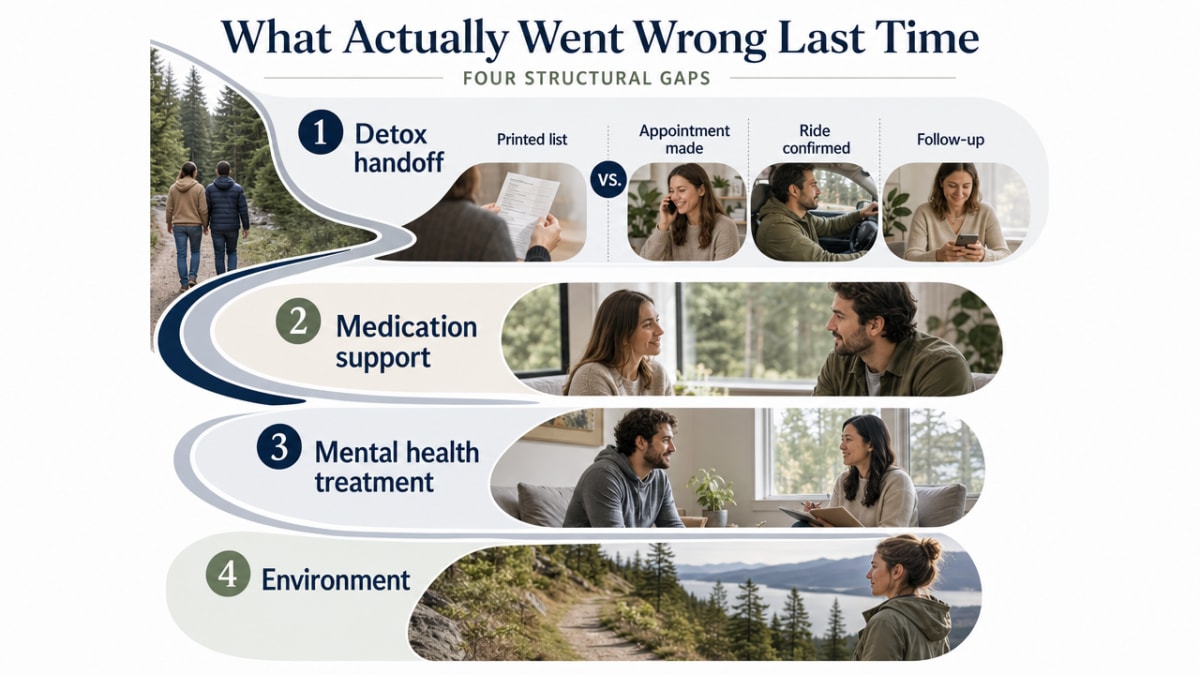
Before we talk about what to do differently, it helps to name what usually breaks down in a treatment attempt that doesn’t hold. Not to assign blame — to a program, a family, or to you — but to give you something specific to look at. If you can name what was missing, you can ask for it this time. Most people who’ve been through rehab more than once are carrying a vague sense that “it didn’t work” without ever having someone sit with them and walk through the four or five structural gaps that make relapse much more likely. That’s what this section is for.
Detox That Stopped at the Door
Think back to your last detox. How many days were you there? What happened on the day you left? Did someone hand you a printed list of phone numbers, or did someone actually make an appointment for you, confirm you had a ride, and follow up two days later to see if you went?
If you’re like most people, it was closer to the list of phone numbers. And that gap — between finishing detox and actually landing in ongoing care — is where a huge share of relapses happen. It’s not because you didn’t care. It’s because detox alone, without an active handoff into what comes next, isn’t really a treatment for a chronic condition. It’s a physical reset.
The research on this is uncomfortably clear. A recent study of inpatient detox found that 61 percent of admissions eventually result in a future readmission, and the authors pointed directly at the reason: without further treatment, relapse rates are high, and many people are simply not connected to services after the detox stay ends 9. That’s a majority of people cycling back, not because detox failed medically, but because the door at the end opened onto the same street they came in from.
If your last attempt ended with a discharge paper and a good-luck handshake, that wasn’t a full treatment plan. It was step one of a plan that got interrupted.
Opioid Withdrawal Without Medication Support
If opioids were part of what you were using — heroin, fentanyl, oxycodone, hydrocodone, whatever the pill or the powder was — there’s a specific gap worth naming honestly. A lot of programs still treat opioid detox as a matter of getting through the physical withdrawal and then sending you into counseling. No buprenorphine. No methadone. Nothing to steady the brain chemistry that’s been rewired by months or years of daily opioid use.
That approach doesn’t match what the research shows. Studies of people leaving inpatient opioid detox find that those who start maintenance medication — buprenorphine or methadone — after detox stay in treatment longer and use opioids less often than those who don’t 14. This isn’t a moral question or a substitution question. It’s a matter of what the brain needs to stop screaming for a substance long enough for therapy, sleep, work, and relationships to have any chance of stabilizing.
If your last attempt at opioid recovery didn’t include the option of medication support — or if you were told that “real recovery” meant doing it without any medication at all — that framing may have set you up for a much harder climb than you needed. Medication-assisted treatment isn’t a shortcut. For opioid use disorder, it’s often the missing piece.
Anxiety, Depression, or Trauma That Was Never Really Treated
Here’s a question worth sitting with: what were you using the substance for? Not in the addiction sense — in the very practical sense. To sleep. To stop the loop of thoughts at 2 a.m. To feel something other than numb. To make a memory quieter. To get through a shift at a job you hate. To be in a room full of people without your chest tightening.
If any of that sounds familiar, and if your last treatment attempt focused almost entirely on the substance without touching the anxiety, depression, or trauma underneath it, that’s a structural gap. SAMHSA’s guidance on co-occurring disorders is direct about this: people leaving treatment need mental health services woven into their recovery plan, not offered as a separate referral to figure out on your own months later 3. When the underlying condition doesn’t get treated, the thing you were using to manage it comes back into the picture, often within weeks.
This isn’t a failure of your character. It’s the predictable result of treating half of the problem. If nobody screened you for depression, PTSD, or an anxiety disorder during your last stay — or if they screened you but nothing came of it — that’s information you can carry into the next conversation.
Discharge Back Into the Same Rooms and Relationships
The last one is the hardest to talk about, because it involves people you love. You finished treatment, and then you went back — to the same apartment, the same job stress, the same partner or roommate whose use never paused, the same three friends who show up with a bottle every Friday. Nothing about the environment had changed. And within a few weeks, or a few months, neither had you.
This isn’t a moral failing on anyone’s part. It’s a structural mismatch. You spent 7 or 28 days in a place designed to hold recovery, and then walked back into a place designed for the life you had before. Guidance on continuing care recognizes this directly, listing housing support, employment help, and involvement in new activities as core parts of what keeps recovery going after treatment ends 7.
If your last attempt didn’t include an honest conversation about where you’d be sleeping and who you’d be spending your evenings with, that piece got missed. It doesn’t have to get missed again.
What a Connected Attempt Actually Looks Like
So what does a treatment attempt with all four of those pieces actually look like from the inside? Not in theory — in a week, a month, six months from the day you walk in.
The short version: it looks longer than you’re probably picturing. Not longer in the sense of being locked in somewhere for months, but longer in the sense that someone is still checking on you at month three, month six, month nine, and month twelve. That extended arc is the piece that most first, second, or third attempts don’t include, and it’s the piece the research keeps pointing at.
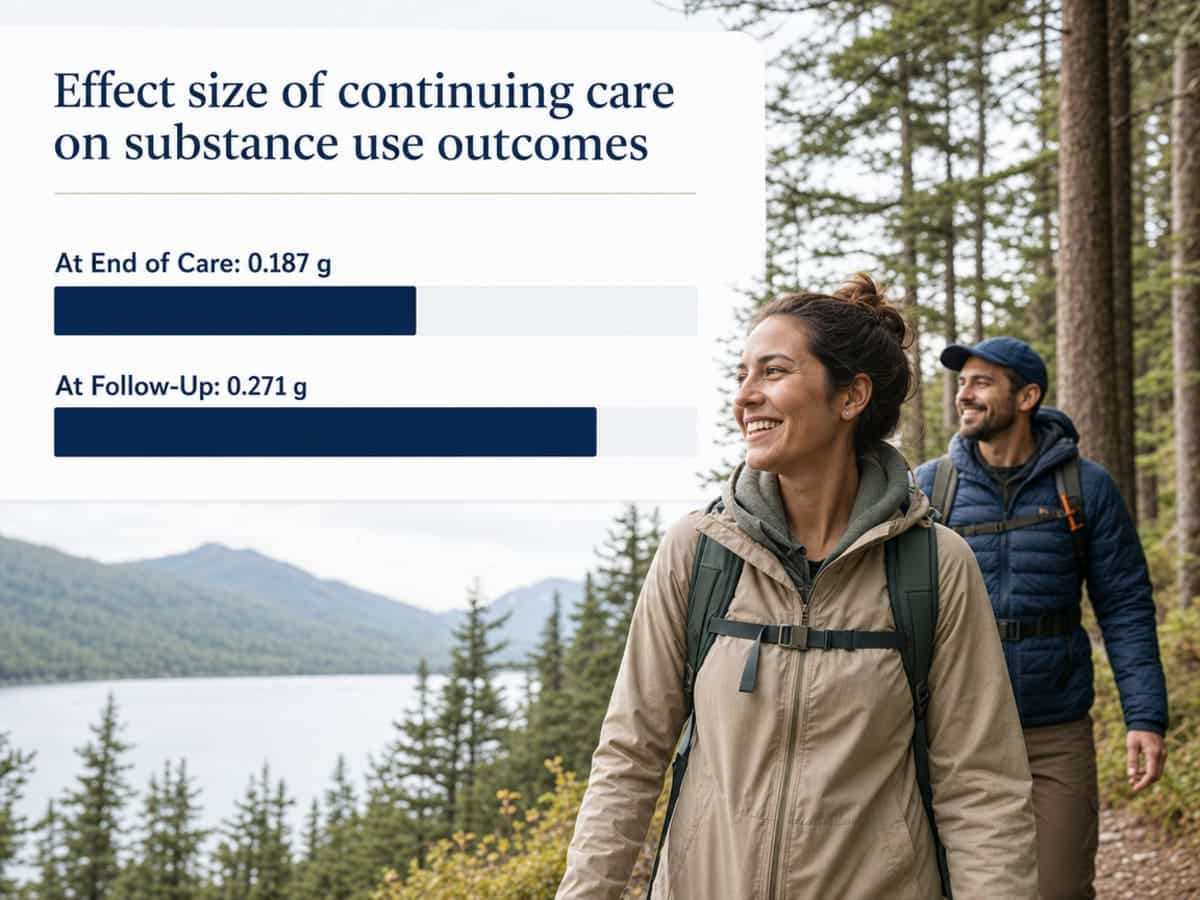
And here’s the part that’s worth sitting with: the benefit of that continuing contact doesn’t fade as time goes on. It grows. A meta-analysis pooling data across multiple continuing care trials found the effect size on substance use outcomes was small but real at the end of the care period (Hedges’ g of 0.187), and larger at follow-up (0.271) 1. In plain terms, the people who stayed connected didn’t just do better while someone was actively helping them — they did even better later, once the habits of ongoing support had settled in.
A connected attempt, from the inside, looks something like this. Week one: medical detox in a place where you’re physically safe and the withdrawal is managed carefully. Week two through week four or six: a step-down into structured therapy — sometimes a partial hospitalization program during the day, sometimes an intensive outpatient schedule a few evenings a week — while you’re either living at home or in supportive housing. If opioids or alcohol were part of the picture, medication support runs in the background the whole time, quieting the cravings enough that therapy has room to work.
Then the arc keeps going. Month two through month twelve: less intensive but still real. A weekly therapy appointment. A group you’re part of. A counselor who screens for the anxiety or depression underneath. A recovery community — alumni contact, peer support, a phone that rings on the hard days. If something slips, someone notices within a week, not six months later at the next crisis.
That’s the structure. It’s not glamorous. It’s not a breakthrough. It’s a longer, gentler line of contact that treats what you have like the chronic condition it is.
A Diagnostic You Can Run on Your Last Attempt
Here’s something practical you can do, maybe today, maybe when the noise in your head quiets down a little. Sit somewhere with a piece of paper or the notes app on your phone, and answer five questions about the last time you tried. Not to grade yourself. To find the gaps.
One. How long did your last detox actually last, and what happened in the 72 hours after you walked out? If the answer is “a few days” and “nothing much,” you already know one thing that has to be different this time.
Two. Was there a specific person — with a name and a phone number — whose job it was to check on you at week one, week four, and month three? If nobody was that person, the arc of care stopped at the door.
Three. If opioids or alcohol were part of your use, were you offered medication support — buprenorphine, methadone, naltrexone — as a real option, explained without judgment? Or was it framed as a crutch, or not offered at all?
Four. Did anyone screen you for depression, anxiety, PTSD, or another mental health condition, and did that screening turn into actual treatment — a therapist, a psychiatrist, a medication if needed? SAMHSA’s guidance on co-occurring conditions is clear that this needs to be woven in, not offered as a separate homework assignment after discharge 3.
Five. Where did you sleep the night you left treatment, and who was in that space with you? Was any part of your plan about changing that environment, even a little?
Look at your answers. You’re probably going to see two or three clean gaps — places where something the research says matters just wasn’t there. That’s not a verdict on you. It’s a shopping list for what to ask about next time.
What to Ask For This Time
If you decide to try again — and only you can decide that — the conversation you have with the next program matters more than the brochure they hand you. Most people who’ve been through detox before have never actually been coached on what to ask. So here’s the short list. Read it, screenshot it, bring it to the phone call.
Ask what happens on day one after detox. Not in general terms. Specifically. Who calls you? Who has your appointment on their calendar? If they can’t name a person and a date, the same gap that swallowed your last attempt is still there.
Ask about medication support directly. If opioids were part of your use, ask whether buprenorphine or methadone is offered, and how the decision gets made 14. If alcohol was part of it, ask about naltrexone. If the answer is that medication isn’t really their thing, keep looking.
Ask who treats the mental health piece. Depression, anxiety, PTSD — ask whether there’s a therapist and, if needed, a psychiatrist inside the same program, or whether you’ll be referred out to figure it out alone 3. “Woven in” is the phrase you want to hear.
Ask how long they stay in contact. Twelve months is the honest answer to look for 5. Not twelve days, not twelve weeks. Ask what that contact actually looks like — a group, a check-in call, an alumni community, a counselor who notices when you go quiet.
Ask what happens if you slip. Not if you fail, but if something wobbles. A program that can tell you calmly how they respond to a lapse — early re-intervention, an adjusted plan, no shaming — is a program built for a chronic condition, not for a one-shot attempt.
Whether this is your first try or your fifth, these five questions will tell you more about a program in fifteen minutes than any tour or website ever will.
How Pacific Crest Trail Detox Structures the Next Attempt
If you’ve read this far, you already know what to look for. Here’s how Pacific Crest Trail Detox tries to answer those specific gaps — not as a pitch, but so you can measure it against the diagnostic you just ran.
Detox happens in a home-like residential setting in Milwaukie, not a hospital ward. Medical supervision is there for the parts that can be dangerous — alcohol and benzodiazepine withdrawal in particular — but the space you sleep in looks like a house, because that’s a gentler place to start again after a hard year. If opioids or alcohol are part of your use, medication support is on the table as a real, non-judgmental option, discussed as what the evidence supports rather than as a moral debate 14.
The arc keeps going after detox. There’s a step-down into partial hospitalization or intensive outpatient, therapy for the anxiety, depression, or trauma sitting underneath the substance, and an alumni community that stays in contact well past the intensive phase — the kind of extended, connected care the research points to as the piece that changes long-term outcomes 5. Outcomes get tracked, not promised.
Whether this is your first attempt or your fifth, it doesn’t have to look like the last one. If you want to talk through what a different structure could look like for you, Pacific Crest Trail Detox is a phone call away.
For Family Members Watching Someone Try Again
If you’re the parent, partner, sibling, or adult child in this story, the exhaustion you’re carrying is real. You’ve made the calls before. You’ve helped pack the bag before. You’ve felt hope curdle into dread more than once, and you’re probably scared to feel hope again.
A few things worth holding onto. Their relapse is not a verdict on your love or your effort. Repeated attempts are the norm for a chronic condition, not evidence that you failed them or that they can’t get well. The most useful thing you can offer this time isn’t a bigger speech — it’s steady, non-shaming presence and a willingness to ask the same practical questions the person in recovery needs to ask: who calls them after detox, is medication support on the table, is the mental health piece being treated, how long does contact last 5.
If you need somewhere to start when the house is quiet, SAMHSA runs a free, confidential helpline 24 hours a day that can point you toward options in your area 11. Whether this is their first attempt or their fifth, you’re allowed to ask for a different structure this time too.
Check Your Coverage for a Safer Detox Start
Find out if your insurance supports your next step toward safe, medically supervised detox and recovery.
Frequently Asked Questions
Does going back to treatment after multiple relapses actually work?
Yes, and the research is on your side more than shame lets you feel. People who stay connected to some form of care after treatment are roughly twice as likely to reach remission as those who don’t, even across long stretches of time 6. Multiple attempts aren’t a sign the door is closing. They’re how most people eventually get through it.
How is a next attempt different from what I already tried?
The biggest difference usually isn’t the detox itself — it’s what comes after. A different attempt links detox to therapy, medication support when it fits, treatment for underlying anxiety or depression, and a full year of steady contact instead of a discharge handshake. Whether this is your first attempt or your fifth, that longer, more connected arc is what tends to change the outcome.
Do I have to go through medical detox again if I’ve done it before?
If you’re actively using alcohol, benzodiazepines, or opioids, medical detox is about physical safety, not punishment. Withdrawal from alcohol and benzos can be dangerous without supervision. Having done detox before doesn’t lower that risk — sometimes it raises it. A brief conversation with a medical team can tell you whether supervised detox is needed this time and what a gentler version might look like.
Should I ask about medication support for opioid or alcohol use this time?
Yes, especially if opioids were part of what you were using. Studies of people leaving inpatient opioid detox show that those who start buprenorphine or methadone afterward stay in treatment longer and use less than those who don’t 14. For alcohol, naltrexone is worth asking about. Medication isn’t a shortcut or a substitution — it quiets cravings enough that therapy has room to work.
What can family members do when someone they love is trying again?
Steady, non-shaming presence matters more than another speech. Ask the same practical questions they need to ask: who calls after detox, is medication support on the table, is the mental health piece treated, how long does contact last. If you need somewhere to start when the house is quiet, SAMHSA runs a free, confidential helpline 24 hours a day that can point you toward options 11.
How long should continuing care last after detox?
Longer than most first attempts include. The continuing care research points to at least 12 months of ongoing contact after the intensive phase to see abstinence rates climb above roughly 65 percent 5. That doesn’t mean a year locked in a program. It means a counselor, a group, a check-in call, or an alumni community that stays in touch — someone who notices when you go quiet.
References
- How effective is continuing care for substance use disorders? A meta‑analytic review. https://pmc.ncbi.nlm.nih.gov/articles/PMC3840113/
- Managing Addiction as a Chronic Condition. https://pmc.ncbi.nlm.nih.gov/articles/PMC2797101/
- Chapter 7—Treatment Models and Settings for People With Co‑Occurring Disorders. https://www.ncbi.nlm.nih.gov/books/NBK571024/
- Recovery Support Research Literature Review (Recovery Research Institute). https://www.mass.gov/doc/recovery-support-research-literature-review-submitted-by-kim-krawczyk/download
- The Continuing Care Model of Substance Use Treatment. https://pmc.ncbi.nlm.nih.gov/articles/PMC4007701/
- Continuing Care and Long-Term Substance Use Outcomes in an Integrated Health Plan. https://pmc.ncbi.nlm.nih.gov/articles/PMC3242696/
- Impact of Continuing Care on Recovery From Substance Use Disorders. https://pmc.ncbi.nlm.nih.gov/articles/PMC7813220/
- Continuing Care Research: What We’ve Learned and Where We’re Going. https://pmc.ncbi.nlm.nih.gov/articles/PMC2670779/
- Barriers to accessing treatment for substance use after inpatient detoxification: A qualitative study. https://pmc.ncbi.nlm.nih.gov/articles/PMC10084712/
- TIP 35: Enhancing Motivation for Change in Substance Use Disorder Treatment. https://library.samhsa.gov/product/tip-35-enhancing-motivation-change-substance-use-disorder-treatment/pep19-02-01-003
- SAMHSA’s National Helpline. https://www.samhsa.gov/find-help/helplines/national-helpline
- Substance Use Disorder Treatment Outcomes. https://pmc.ncbi.nlm.nih.gov/articles/PMC12180564/
- Continuing Care and Long-Term Substance Use Outcomes in an Integrated Health Plan (PDF). https://pmc.ncbi.nlm.nih.gov/articles/PMC3242696/pdf/nihms328718.pdf
- Maintenance pharmacotherapy for opioid use disorder after inpatient detoxification. https://pubmed.ncbi.nlm.nih.gov/31339680/