


Key Takeaways
- Routine in recovery simply means your day has a predictable shape—known times for sleep, meals, medication, and human contact—not a rigid schedule or personality overhaul.
- Structure works as medicine because repeated healthy behavior helps reset the reward, stress, and self-control circuits that substances hijacked.4,3
- The first year is fragile, with roughly 85 percent of adults experiencing a relapse, which is why consistent activities, social support, and scaffolding matter most then.11
- Protect four anchors—sleep, meals, medication and therapy on schedule, and daily connection—and adjust the routine when it chafes rather than abandoning it entirely.1,12
The Quiet Relief of a Predictable Day
If you’re reading this after a hard week, or from a bed in detox, or from your couch at 3 a.m. wondering how anyone lives sober, take a breath. You don’t need to figure out the rest of your life tonight. You just need to know what tomorrow morning looks like.
That’s really what routine is. Not a color-coded schedule. Not a personality change. Just knowing what happens next.
Active addiction is loud. Your days get shaped by cravings, by hiding things, by the next dose or drink, by the crash after. Even sleep stops belonging to you. When that noise finally stops, a strange thing happens: the quiet can feel worse than the chaos. Your brain has forgotten how to fill regular hours with regular things.
This is where a predictable day starts to help. Not because structure is a virtue, but because a healing brain and body do better when they can guess what’s coming next. When asking why does routine matter in recovery, federal guidance describes it as building health, home, purpose, and community back into daily life, one small piece at a time. At a place like Pacific Crest Trail Detox, that looks less like a hospital ward and more like a house where meals happen, meds happen, sleep happens, and someone notices how you’re doing. That’s the whole point of routine. Relief, not restriction.2
What Routine Actually Means After Detox
Let’s clear something up before we go any further. Routine, in the sense we’re talking about, is not a spreadsheet. It’s not a 5 a.m. cold plunge and a stack of self-help books. It’s not becoming a different, more disciplined person by Friday.
After detox, routine just means your day has a shape. You know roughly when you’ll wake up. You know when you’ll eat. You know when you’ll take your medication, if you’re on something like buprenorphine or a medicine that helps with alcohol cravings. You know when someone will check in with you—a counselor, a group, a friend from the program. You know when the day ends and sleep begins. That’s it. That’s the whole framework.9,8
The reason this matters so much after detox is that your brain is trying to relearn how to run itself without the substance that was steering the ship. Federal treatment guidance describes recovery as a slow rebuild of health, home, purpose, and community—four ordinary domains that hold a life together. Substances used to fake those four things: the fake reward, the fake calm, the fake belonging. Now real versions of them have to grow back in, and they grow back in through repetition.2
Here’s the part people miss. A helpful routine is not a rigid one. Research on treatment settings shows that programs offering residents real say in their day still produce strong outcomes. Structure that respects you works better than structure that controls you. At Pacific Crest Trail Detox, that shows up as a home-like place to heal, where the day has anchors but you’re still a person, not a patient number. Routine is the shape. You get to live inside it.12
How a Healing Brain Uses Structure
Reward, Stress, and the Circuits Substances Hijacked
Here’s what happened to your brain, in plain words. Substances taught three important circuits to lie:4
- The reward circuit learned to fire hardest for the drug or the drink, not for food, rest, a laugh, or a hug.
- The stress circuit learned to panic without the substance, so ordinary discomfort started feeling like an emergency.
- The self-control circuit—the part that pauses, plans, and says wait a minute—got quieter and slower.
That’s not a character flaw. That’s biology. The U.S. Surgeon General’s neurobiology chapter describes addiction as a chronic brain condition with real potential for recurrence and for recovery, and it takes repeated healthy behavior over time to help those circuits reset. NIDA puts it more simply: treatment helps people counteract addiction’s effects on the brain and behavior, and that counteracting happens through what you do every day, not through one big decision.3,4
This is where routine stops sounding like a lifestyle trend and starts sounding like medicine. Every time you eat breakfast at roughly the same hour, your stress circuit gets a little quieter. Every time you go to a group session you said you’d go to, your reward circuit gets a small, real hit of belonging. Every time you follow a plan you made yesterday, your self-control circuit gets a rep in the gym. You’re not being disciplined. You’re rewiring. And you’re allowed to do it clumsily. The reps still count even when the day feels flat.
Why the First Year Needs the Most Scaffolding
Nobody wants to hear this part, so let’s say it gently. The first year after you stop using is the fragile year. A peer-reviewed study of adults in early substance use disorder recovery found that roughly 85 percent experienced a relapse within that first year. That number isn’t a verdict on you. It’s a description of a period when the brain is still healing, sleep is still uneven, moods still swing, and the old cues—people, places, playlists, smells—still light up circuits that haven’t fully calmed down.11
If you’re in that window right now, please read this next line twice. That statistic is the reason you need scaffolding, not the reason to give up. The same research points to what actually protects people during this stretch: consistent daily activities, steady social support, and a structured environment. Not willpower. Not a personality overhaul. Scaffolding.11
Think of it like a cast on a broken bone. You don’t wear the cast because you’re weak. You wear it because bones knit better when the pieces are held still. In early recovery, your scaffolding is the boring stuff: the same wake-up time, the same medication reminder, the same Tuesday group, the same person you text when a craving hits. Continuing care research shows that scheduled, planned check-ins after treatment improve abstinence and help people get back to care faster if they do slip. That’s why Pacific Crest Trail Detox doesn’t hand you a diploma at the end of detox and wave goodbye. The scaffolding continues, because the healing continues, and you deserve a soft place to lean while your brain catches up.1
The Four Anchors of a Recovery Day
Sleep: Rebuilding the Body’s Reset Button
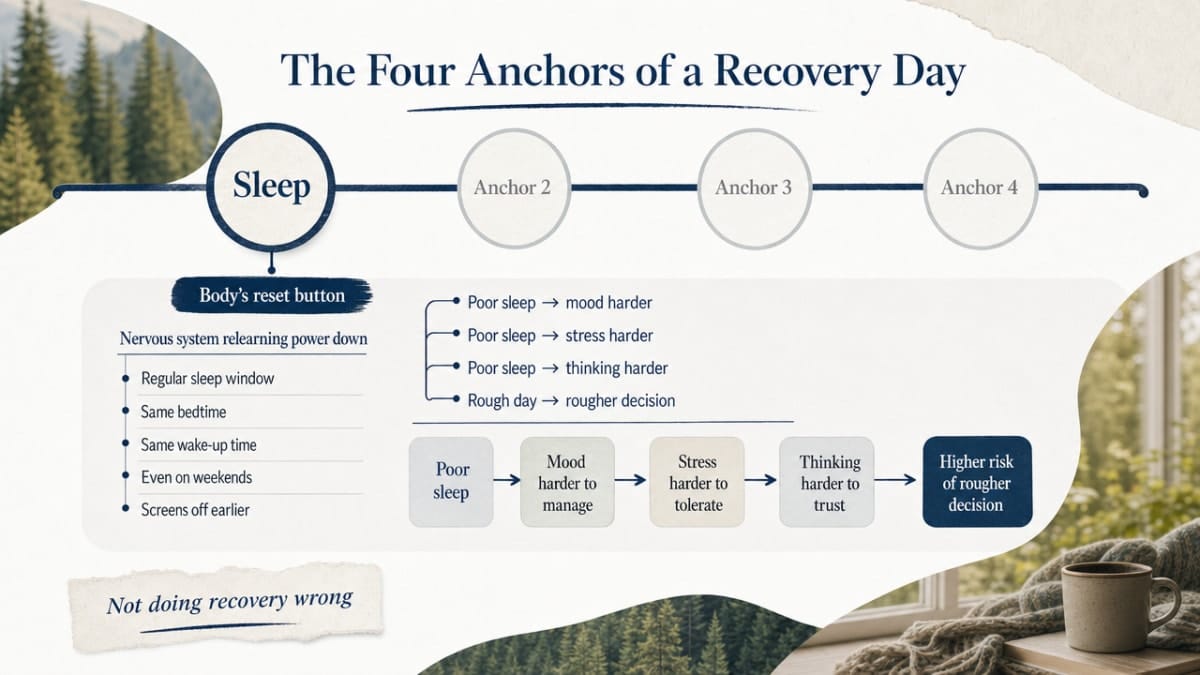
Sleep is often the first thing addiction breaks and one of the last things to come back. If you’re a few weeks out from your last drink or last dose and you’re still staring at the ceiling at 2 a.m., you are not doing recovery wrong. Your nervous system is relearning how to power down without a chemical off-switch.
Here’s why this matters more than people say. Poor sleep makes mood harder to manage, stress harder to tolerate, and thinking harder to trust—and all three of those raise the odds of a rough day tipping into a rougher decision. A regular sleep window is not a luxury in early recovery. It’s part of the treatment.10
You don’t need a perfect wind-down ritual. You need a boring one. Same bedtime, give or take. Same wake-up time, even on weekends, especially on weekends. Screens off a bit earlier than feels natural. A dim room. Maybe a shower or a few pages of something not too exciting. If sleep still won’t come, get up, sit somewhere soft, and try again in twenty minutes. Tell your care team what’s happening—sleep problems in early recovery are common and often treatable, and no one at a place like Pacific Crest Trail Detox will think less of you for asking.
Meals and Hydration: Small Choices, Steady Mood
If sleep is the reset button, food and water are the fuel that keeps the reset holding. Long-term substance use often leaves the body depleted—missed meals, low hydration, sometimes vitamin gaps that make fatigue and irritability worse. When you feel foggy, shaky, or randomly weepy at 4 p.m. on day ten, sometimes the answer really is a sandwich and a glass of water.5
Balanced meals help mood and physical healing, which are both directly tied to whether you can show up for the rest of your recovery day. You don’t need to become a nutrition expert. You need three roughly-on-time meals, a couple of snacks that aren’t just coffee, and enough water that you stop forgetting to drink it.5
What this looks like in a home-like setting: breakfast happens because it’s breakfast time, not because you feel like it. Someone put the meal on the table. You sit down. You eat what you can. Later there’s lunch. Later there’s dinner. That predictable rhythm does quiet work on your stress circuits, even when the food itself is unremarkable. A protein bar you actually ate beats a beautiful plan you didn’t. Small choices. Steady mood. That’s the whole game here.
Medication and Therapy: Showing Up on a Schedule
If you’re on medication that helps with cravings or withdrawal—buprenorphine, methadone, naltrexone, something for alcohol cravings—your medication schedule is not optional structure. It’s the structure. Those medicines work best when they’re taken as prescribed, on time, alongside counseling and support. Missing doses isn’t a moral failure; it’s a medical problem that your team can help you solve. If a dose keeps slipping, tell someone before it becomes a pattern.9,8
Therapy and groups belong on the same shelf as your medication. Not because someone said so, but because scheduled, planned contact with people who are helping you heal keeps you steadier between sessions. Continuing care research shows that consistent, planned check-ins after primary treatment improve abstinence rates and help people get back into care faster if they do slip. Translation: the Tuesday group you almost skipped is doing more than you think.1
Here’s a small trick people underestimate. Put your medication and your therapy appointments on the same calendar, at the same time each week if you can. Set two alarms. Tell one person in your house or your program what your week looks like. If depression is riding along with the addiction—which it often is—simple activity scheduling is one of the best-studied ways to fight the pull of the couch. Pacific Crest Trail Detox tracks how you’re actually doing over time, not just at discharge, so the schedule can adjust as you do.13
Connection: People, Groups, and Purpose
Addiction is lonely work, even when it looks social. Recovery has to be the opposite. The federal working definition of recovery names four things that hold a life together: health, home, purpose, and community. Notice that three of those four are about being connected to something outside yourself—a stable place to live, a reason to get up, and people who know your name.2
Connection as a daily anchor doesn’t have to be dramatic. It can be a morning check-in text with someone in the program. A group session where you don’t say much but you show up. A short call with a sibling who finally has your new number. Sitting on the porch with a housemate at Pacific Crest Trail Detox and not talking about anything important. All of it counts as a rep for the reward circuit that used to only fire for the substance.
Purpose is the quieter one. In early recovery, purpose is not a career pivot. It’s a small reason today mattered. You cooked. You went to group. You called your mom back. You helped a newer resident find the coffee. Federal recovery guidance treats meaningful roles and community participation as core, not extra. Build one connection point into every day, on purpose. Then let it grow.2
What a Real Day Looks Like in a Home-Like Setting
Here’s a walk-through of an ordinary Tuesday, because sometimes it’s easier to picture than to explain.
You wake around 7. Not because an alarm is screaming, but because you went to bed around 10 the night before, and your body is finally getting the memo. Someone in the kitchen has coffee going. You take your morning medication with a nurse or tech who knows your name and asks how you slept. If you’re on buprenorphine or a medication that helps with alcohol cravings, this same check-in happens at the same time tomorrow, and the day after that.9,8
Breakfast is on the table by 8. Eggs, toast, fruit, whatever. You eat what you can. A housemate is quiet at the other end of the couch. That’s fine. Mid-morning is group—an hour where you might talk, might not, but you’re in the room. After group, there’s a short walk outside if the Oregon weather cooperates, or stretching in the living room if it doesn’t. Movement counts even when it’s small.
Lunch happens around 12:30. Afternoon has individual therapy or a skills session, then a quieter block where you can nap, journal, call a family member, or just sit. Dinner around 6. Evening is community—a meeting, a movie, a card game, sometimes just tea and conversation. Meds again. Lights lower around 9. Bed by 10.
Nothing about that day is dramatic, and that’s the point. Continuing-care research shows that scheduled, planned contact—morning check-ins, group at the same hour, an evening wind-down someone else keeps track of—is what actually protects abstinence and helps people get back to care fast if they slip. A home-like setting doesn’t make the day less clinical by accident. It’s designed to feel survivable, so the healing has room to happen.1
The Fragile Handoff: Your First Week Home
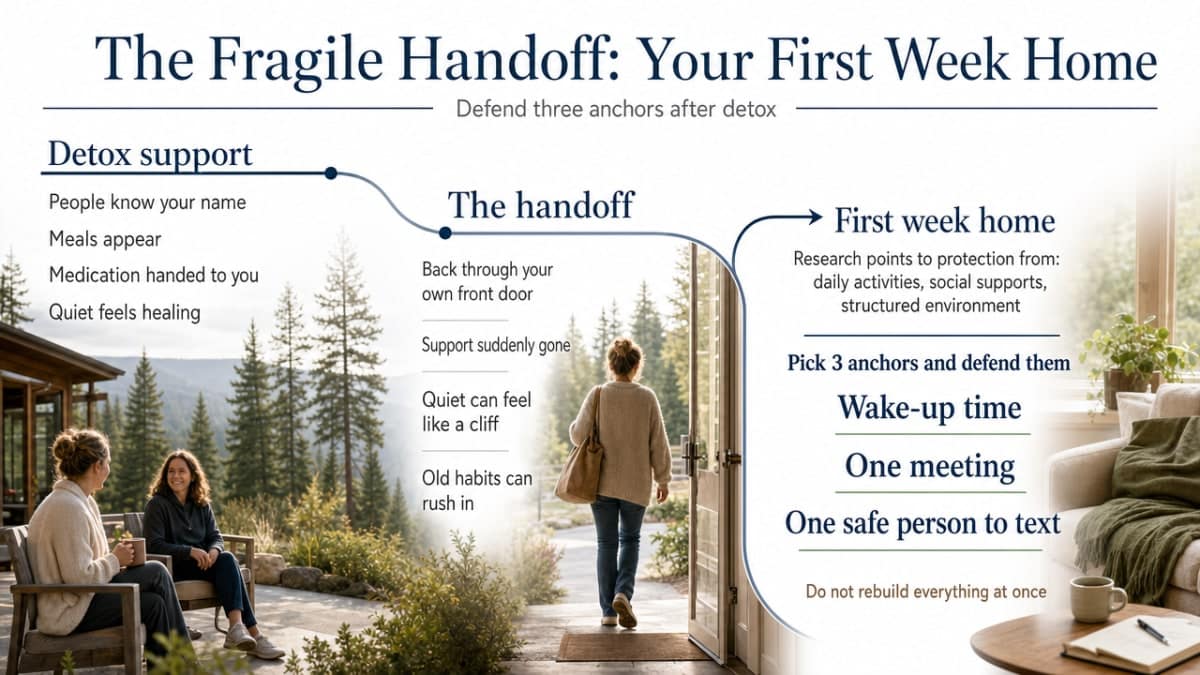
Leaving a home-like detox and walking back into your own front door is one of the strangest days in early recovery. The people who knew your name are suddenly not there. The meals stop appearing. Nobody hands you your medication. The quiet that felt healing in the residence can feel like a cliff in your own kitchen.
This is the handoff nobody warns you about, and it’s where a lot of first-year slips happen. The peer-reviewed research on early recovery is clear that consistent daily activities, social supports, and a structured environment are what actually protect people through this stretch. When you leave a setting that provided all three, you have to build small versions of them yourself, fast, before the vacuum fills with old habits.11
Expect the first week to feel wobbly. Sleep may go sideways again. Meals may get skipped. That is not you failing. That is the scaffolding being thinner than it was inside the house. Tell your Pacific Crest Trail Detox team what’s happening—their aftercare exists precisely for this week, and reaching out early is the whole point of it.5,10
When Structure Feels Like a Cage
Somewhere around week two or three, a lot of people hit a wall with routine. The same wake-up time starts feeling like a prison alarm. Group feels performative. You catch yourself thinking, if this is what sober life is, I don’t want it. That thought is not a red flag about your recovery. It’s a normal reaction to a nervous system that used to run on intensity and now has to learn to trust calm.
Here’s the reframe. Structure that respects you is different from structure that controls you. Research on treatment settings found that facilities giving residents real say in their day still produced strong outcomes, and sometimes better ones, than programs built on rigid contingencies. The point of the anchors—sleep, meals, medication, connection—is to hold you steady, not to shrink your life.12
If your routine feels like a cage, don’t burn it down. Adjust one bar. Move the walk to after lunch. Swap the evening meeting for a different one. Tell your Pacific Crest Trail Detox team what’s chafing. A routine you helped shape is one you’re more likely to keep, and keeping it, even imperfectly, is what protects the healing underneath.
Routine as an Act of Self-Compassion
Somewhere along the way, routine got a bad reputation. It started sounding like punishment. Like something you impose on a version of yourself you don’t trust. If that’s how your daily schedule feels right now, it’s worth turning the whole idea upside down.
A recovery routine is not a leash. It’s a way of being kind to a body and brain that are still healing. When you go to bed at roughly the same time, you’re not being strict. You’re giving your nervous system a fair shot at rest. When you eat lunch even though you’re not hungry, you’re not obeying a rule. You’re keeping your mood from crashing at 3 p.m.. When you show up to therapy on a tired Tuesday, you’re not performing recovery. You’re letting people help you.1,5,10
The federal definition of recovery frames it as health, home, purpose, and community—four soft things, not four demands. Your routine is just how you tend those four things on ordinary days. Some days you’ll tend them well. Some days you’ll do one out of four and go to bed. Both count. That’s not lowering the bar. That’s what healing actually looks like.2
Check Your Coverage for a Consistent Recovery Path
See if your insurance supports a steady routine for safe, supported detox and ongoing care.
Frequently Asked Questions
How long does it take for a recovery routine to start feeling normal?
Most people feel the shape of a new routine start to soften somewhere between the third and sixth week, though sleep and mood can stay bumpy longer while the brain keeps healing. Be patient with the wobble. You’re not behind. Consistent daily activities and steady support are what help the pieces settle, one ordinary day at a time.4,11
What if I miss a day or fall off my routine—does that mean I’ve relapsed?
No. Missing a group, sleeping through a wake-up time, or skipping a meal is not a relapse. It’s a wobble, and wobbles are part of the process. What matters is what happens next. Tell someone on your care team, get back to one anchor tomorrow—your medication, one meal, one check-in—and keep going. Continuing care is designed for exactly this kind of course correction.1,3
Do I really need a strict schedule, or can I be flexible in early recovery?
Flexibility is fine. Chaos is not. Research on treatment settings shows that programs giving residents real say in their day still produce strong outcomes, so structure doesn’t have to feel controlling to work. Aim for a few non-negotiable anchors—sleep window, medication time, one human contact—and let the rest of the day breathe. A routine you helped shape is one you’re more likely to keep.12
How can family members help without pushing too hard?
Be a steady presence, not a supervisor. Share a meal at roughly the same time. Offer a ride to a session without lecturing on the way. Ask how sleep went, not whether they’ve been perfect. Federal recovery guidance points to home and community as core supports, and that’s really what families provide—predictable warmth. If you’re worried, tell the care team, not just your loved one.2,10
What should my routine include if I’m on medication for opioid or alcohol use disorder?
Same dose, same time, every day, taken as prescribed—that’s the foundation. Pair it with a counseling or group session on a regular cadence, because these medications work best alongside therapy and support, not on their own. Add a simple food and sleep rhythm around the dose. If a dose starts slipping, call your team before it becomes a pattern. That’s what they’re there for.9,8
Why is sleep so hard in early recovery, and what can help?
Your nervous system is relearning how to power down without a chemical off-switch, so broken sleep is common for weeks or months. What helps: a steady bedtime and wake time even on weekends, a dim room, screens off earlier than feels natural, and no doom-scrolling in bed. Tell your care team if sleep won’t come—it’s often treatable, and poor sleep raises the risk of harder days.10
References
- Impact of Continuing Care on Recovery From Substance Use Disorder. https://pmc.ncbi.nlm.nih.gov/articles/PMC7813220/
- Recovery and Support. https://www.samhsa.gov/substance-use/recovery
- Treatment and Recovery. https://nida.nih.gov/publications/drugs-brains-behavior-science-addiction/treatment-recovery
- The Neurobiology of Substance Use, Misuse, and Addiction. https://www.ncbi.nlm.nih.gov/books/NBK424849/
- Substance Use Recovery and Diet. https://medlineplus.gov/ency/article/002149.htm
- Evidence-Based Practices Resource Center. https://www.samhsa.gov/libraries/evidence-based-practices-resource-center
- Substance Use Disorder. https://medlineplus.gov/ency/article/000947.htm
- Alcohol Use Disorder. https://medlineplus.gov/ency/article/002496.htm
- Opioid Use Disorder. https://medlineplus.gov/ency/article/000884.htm
- Sleep and Mental Health. https://medlineplus.gov/ency/article/002241.htm
- Habits and Routines of Adults in Early Recovery From Substance Use Disorders. https://pmc.ncbi.nlm.nih.gov/articles/PMC9926005/
- Association of Facility Characteristics and Substance Use Disorder Treatment Outcomes. https://pmc.ncbi.nlm.nih.gov/articles/PMC8940653/
- Evidence Base for Behavioral Activation (BA). https://aims.uw.edu/wordpress/wp-content/uploads/2025/05/Evidence-Base-for-BA.pdf