


Key Takeaways
- Klonopin’s long half-life delays withdrawal onset, with seizure risk peaking 1 to 6 days after the last dose, making unsupervised discontinuation genuinely dangerous 2.
- Oregon clinical guidance recommends roughly 10% dose reductions at least a week apart, often with a diazepam cross-taper for long-term users 14.
- Choosing between hospital-based detox and OHA-licensed residential care depends on dose, seizure history, other substances, and whether home is a safe place to withdraw 6.
- Compare programs by license type, taper flexibility, handling of co-occurring opioid or alcohol use, and what continuing care follows detox 5.
Why Klonopin Is Harder to Stop Than Most Medications
If you have been taking Klonopin for months or years and the idea of stopping scares you, that fear is not weakness. It is your body telling you something true. Klonopin (clonazepam) rewires the way your nervous system calms itself, and the longer you take it, the more your brain leans on it to feel steady. Pulling that support out from under yourself, especially quickly, is what makes this medication genuinely dangerous to stop on your own.
The FDA label for Klonopin is unusually blunt about this. Abrupt discontinuation or rapid dose reduction after continued use can trigger acute withdrawal reactions that are life-threatening, including seizures 13. This is not a warning about feeling anxious or shaky for a few days. It is a warning about your brain, in the absence of the drug it has grown used to, becoming electrically unstable.
Two things make Klonopin particularly tricky compared to shorter-acting medications:
- First, it has a long half-life, so it clears your system slowly. That can delay when withdrawal hits, sometimes by several days, and lull you into thinking you are in the clear when you are not 1.
- Second, withdrawal seizures from benzodiazepines like clonazepam can range from a single episode to status epilepticus, coma, and death when the drug is stopped abruptly after long-term use 10.
You are not being dramatic for wanting help with this. You are being accurate. What you need is a slow, guided step-down with people watching over you, not more willpower.
What Withdrawal Actually Looks Like on a Long Half-Life Benzo
Here is the part that catches most people off guard: you can take your last Klonopin on Monday and feel more or less okay for a few days. That is not a good sign. That is the drug’s long half-life still buffering you. Clonazepam leaves the body slowly, which means withdrawal often does not fully arrive until day two, three, or even later 1. If you have ever quit and thought the worst was behind you by day four, only to be blindsided by day six, you were not imagining it.
The seizure-risk window is the piece worth understanding clearly. In a clinical study of clonazepam discontinuation, seizure flare-ups after abrupt stops happened 1 to 6 days later 2. That gap between your last dose and the danger is why home detox can feel deceptively calm right up until it is not. Seizures from benzodiazepine withdrawal can range from a single episode to status epilepticus, coma, and death when someone has been on the drug long-term and stops suddenly 10.
The acute phase, if you are tapering carefully rather than quitting cold, usually stretches across one to four weeks. Expect waves rather than a straight line. Anxiety comes roaring back, often sharper than what put you on Klonopin in the first place. Sleep gets fragmented. Your body may feel electric, tremor-prone, sensitive to light and sound. Some people describe a metallic taste, muscle twitches, or a strange sense that their skin does not fit right. Confusion and hallucinations can happen at the harder end 1.
Then there is what clinicians call protracted withdrawal. For a subset of long-term users, symptoms like anxiety, insomnia, and low-grade nervous system agitation can linger for weeks or months after the last dose 7. This is not failure on your part. It is your brain slowly rebuilding its own calming system after leaning on an outside source for so long.
Naming this ahead of time matters. If you know the delayed onset, the 1 to 6 day seizure window, and the possibility of a long tail, you can plan for medical eyes on you during the risky stretch instead of hoping you got lucky.
The Case for Medical Supervision, Not Willpower
There is a story people tell themselves before a Klonopin taper: that if they just wanted it badly enough, they could tough it out. That story ends in an emergency room more often than anyone talks about. Wanting to be free of this medication is not the same as being safe from what happens when your brain loses it.
Medical supervision is not there to judge your choices or slow you down for no reason. It is there for the specific things that go wrong with Klonopin withdrawal that you cannot manage from your kitchen. Blood pressure and heart rate can climb without warning. Sleep can vanish for days at a stretch, which itself lowers the seizure threshold. If you have any history of seizures, or you are on other medications that make seizures more likely, the taper needs to go slower and someone needs to know that before you start 9.
There is also the part willpower cannot solve: the dose adjustments themselves. Klonopin comes in small tablets, and the reductions that keep you safe are often smaller than what you can accurately cut at home. A supervising clinician can compound doses, switch you to a longer-acting benzodiazepine to smooth the drops, and hold a step longer when your body is telling you it needs more time 11.
Detox is also not the whole answer. Federal guidance is clear that managing withdrawal is one intervention, not a complete treatment for dependence, and outcomes are better when detox flows into ongoing care rather than ending at the door 5. That does not mean you are signing up for the rest of your life. It means the first two to four weeks are not the finish line, and a good program plans for what comes after.
You are not failing by needing help. You are choosing the version of this that keeps you alive and gives your nervous system a real chance to heal.
How a Real Taper Works in Oregon
The 10% Step-Down and the Ashton Approach
You do not need a pharmacology degree to understand what a good taper looks like. You just need to know the shape of it, so when a program describes their plan, you can tell whether they are being careful or being cavalier.
Oregon’s own clinical advisory guidance is specific. For long-term benzodiazepine users, the recommended approach is dose reductions of up to about 10% at each step, with intervals of at least one week between drops. Longer intervals make withdrawal safer and more comfortable 14. That is the whole framework in one sentence. Small cuts. Enough time between them for your nervous system to catch up. Repeat.
The other move that experienced clinicians use, especially if you have been on Klonopin for a year or more, is a cross-taper to diazepam. Oregon guidance recommends slowly transitioning long-term benzodiazepine users to diazepam over a few weeks before starting the step-down 14. Diazepam has a much longer half-life, which means the drug level in your blood stays more even between doses. Instead of the low-grade wave of mini-withdrawals some people feel between Klonopin doses, you get a flatter, steadier baseline to reduce from. This is the Ashton method, and it is not new or fringe. It is the framework Oregon’s Mental Health Clinical Advisory Group put in front of clinicians statewide 15.
What does that mean in real life? If you have been taking 2 mg of Klonopin a day, a 10% step is 0.2 mg. Small. Almost anticlimactic. That is on purpose. If the first cut feels manageable and you hold that new dose for a week or longer, you build evidence that your body can handle the next one. If it does not feel manageable, a good clinician holds you at that step, or pauses entirely, before dropping again 4.
You may hear the phrase “personalized taper” and roll your eyes. Here it means something concrete: how long you have been on Klonopin, your dose, your seizure history, and how you respond in the first few weeks all change the math. There is no calendar that fits everyone 9. What stays constant is the direction: small, slow, and watchable.
What Structured Tapering Can Achieve
It helps to see a real number here, because so much of what you have probably read online is either doom or hype. In one clinical study of 23 patients with active epilepsy who were tapered off clonazepam at a rate of 1 mg per week, 17 of them, or 74%, discontinued the medication successfully. Of the six who saw seizures increase, reintroducing clonazepam quickly brought things back under control 3.
That is a small study, and the participants had epilepsy, which is not the same as being on Klonopin for anxiety or sleep. So do not read that 74% as a promise about your own outcome. Read it as evidence that structured tapering, with medical eyes on the person during the drops, actually works for most people who try it. Even the ones who ran into trouble were caught quickly and stabilized. Nobody had to white-knuckle their way through a seizure alone.
The point is not to guarantee you a percentage. The point is that a slow, watched taper is not just harm reduction. It is a real path to being off this medication, with a real success rate, when it is done with support instead of alone in your bedroom.
If you have been telling yourself that tapering never works, or that you have failed at it before so you cannot try again, please hear this: previous attempts that hurt were almost always too fast, too unsupported, or both. A different structure produces a different result.

Hospital Detox or Licensed Residential Detox: How Portland Programs Differ
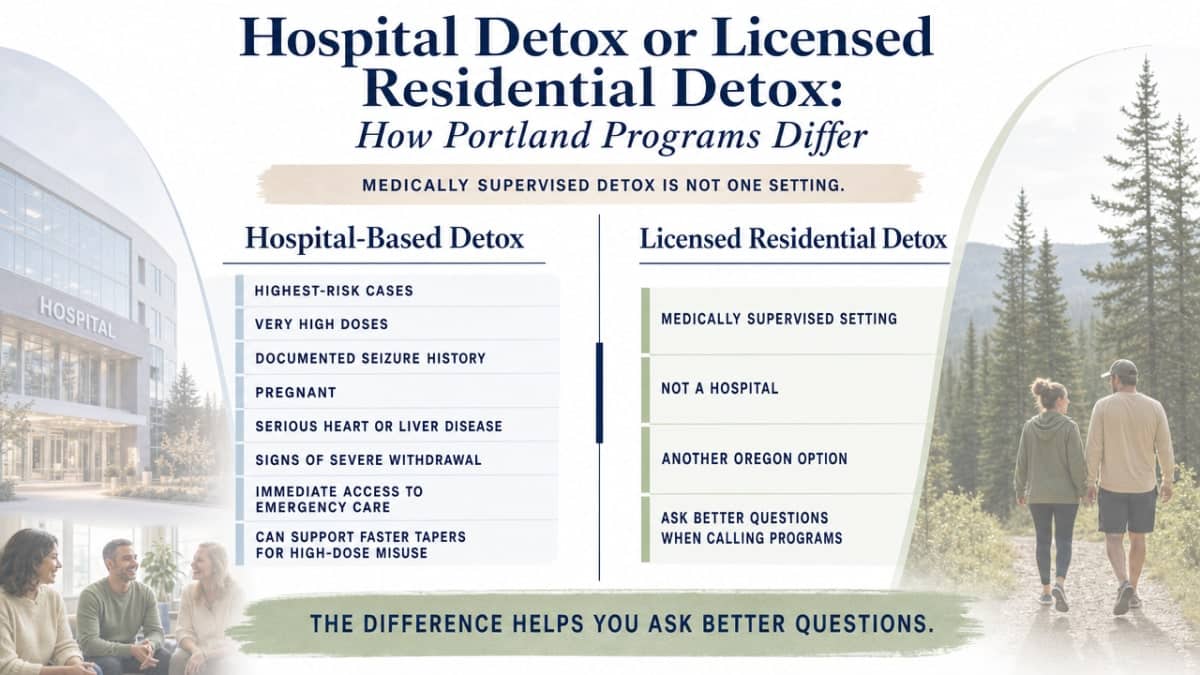
When people picture detox, they picture a hospital bed with rails and a beeping monitor. That is one real option, and for some Klonopin situations it is the right one. But it is not the only medically supervised setting in Oregon, and knowing the difference helps you ask better questions when you call around.
Hospital-based detox is built for the highest-risk cases. If you have been on very high doses, have a documented seizure history, are pregnant, have serious heart or liver disease, or are already showing signs of severe withdrawal, an inpatient hospital setting gives you immediate access to emergency care if something breaks bad. The clinical literature is straightforward here: hospital settings can support faster tapers for people who have been abusing high doses, because the safety net is right there in the same building 10. That matters if your body cannot tolerate the slow approach outpatient tapers require.
Licensed non-hospital residential detox is the other option, and in Oregon it is a real, regulated level of care. The Oregon Health Authority licenses residential treatment facilities to provide 24-hour care for adults with substance use disorders, with specific rules around staffing, medication management, and safety 6. That is not a spa or a sober living house. It is a home-like setting with clinical staff on-site around the clock, where your vitals are checked, your taper is managed by a prescriber, and someone is watching for the warning signs during that 1 to 6 day seizure window.
The difference in feel is real. A hospital room is a hospital room. A licensed residential detox often looks more like a house with bedrooms, a kitchen, a common room, and other people going through something similar a few doors down. For someone whose anxiety is already screaming, the environment itself can be part of what makes the taper survivable.
Neither setting is universally better. The honest way to think about it: what does your dose, your history, and your home life actually call for? If you have a seizure history, are on medications that lower the seizure threshold, or have been taking very high doses of Klonopin, ask about hospital-level care first 9. If your risk profile is moderate, your home is not a safe place to withdraw in, and you want clinical eyes on you without the fluorescent-light intensity of a hospital floor, a licensed residential program is a legitimate fit under Oregon rules 6. Bring your actual dose, your years on the medication, and your other substance use to the intake call. The answer to which setting fits should come out of that conversation, not a website.
When Klonopin Isn’t the Only Substance in the Picture
For a lot of people in the Portland area, Klonopin is not a solo problem. It sits alongside a nightly drink, or an opioid prescription that grew, or something from off the street that helps with sleep. If that describes you, please know two things at once: this is more common than the shame around it suggests, and it changes what a safe detox has to look like.
Oregon’s own overdose data tells the story. Benzodiazepines show up regularly in multi-drug overdose deaths across the state, most often alongside opioids 8. The combination is dangerous because both slow your breathing, and the effects stack in ways your body cannot fully warn you about. That is exactly why any decent intake conversation will ask about every substance in your life, not just the one you called about.
If you are on buprenorphine or methadone for opioid use, do not stop either one to “clean up” before your Klonopin taper. SAMHSA guidance is direct: keep the opioid treatment in place, get a medically supervised benzodiazepine withdrawal, and coordinate the prescribers so nobody is working blind 12. Two clinicians talking to each other is safer than you trying to time both on your own.
Alcohol is the other one worth naming out loud. Drinking during a Klonopin taper raises seizure risk and muddies which symptoms are coming from which substance. A program that knows benzo detox will screen for this on day one and adjust the plan, sometimes managing alcohol withdrawal first because that timeline is faster and more predictable 11.
Bring the whole picture to intake. Not the version that sounds cleaner. The real one. That is what lets the people helping you actually help you.
The Weeks After: Rebound, Sleep, and Protracted Symptoms
Nobody tells you that the hardest part of Klonopin detox often starts after the taper ends. The dose is at zero. The clinical eyes drop away. And your nervous system, which spent months or years leaning on an outside source of calm, has to figure out how to do that job again on its own.
Expect rebound. Anxiety often surges back in the first few weeks, sometimes sharper than what put you on Klonopin in the first place 1. That does not mean the medication was doing something you cannot live without. It means your brain is recalibrating, and the noise gets loud before it gets quiet. Sleep is the other big one. Insomnia after benzo withdrawal can last for weeks, and the nights you do sleep may feel thin and broken. This is not permanent. It is a phase your body has to move through.
Then there is protracted withdrawal, the long tail. For some long-term users, low-grade anxiety, insomnia, tremor, or that electric-under-the-skin feeling can linger for weeks or months after the last dose 7. If this is happening to you, you are not doing it wrong. You are in the slower part of nervous system healing, and it does end.
This is exactly why detox alone is not the whole plan. Federal guidance is clear that managing withdrawal is one piece, not a complete answer, and outcomes are better when detox connects to ongoing therapy and support 5. A first full night of sleep, one afternoon without a panic wave, a week where you notice you laughed at something, those count. Track them. They are the shape of a nervous system coming back online.
Choosing a Program in the Portland Metro
By the time you are ready to make calls, the fatigue of researching this is real. Here is what actually matters when you narrow the list.
Ask whether the program is licensed by the Oregon Health Authority as a residential treatment facility, or whether it is a hospital-based detox unit. Both are legitimate; unlicensed “detox houses” are not. OHA licensure means 24-hour clinical staffing, medication management protocols, and safety standards that were reviewed by the state 6. If someone cannot tell you their license type in one sentence, keep dialing.
Ask about the taper itself. A program that knows Klonopin will talk about small step-downs, holding a dose when your body needs it, and a possible cross-taper to a longer-acting benzodiazepine for people who have been on clonazepam a long time 14. If the answer is a flat number of days with no mention of adjusting to how you respond, that is a red flag 4.
Ask what happens after detox. Managing withdrawal is one intervention, not the whole plan, and the programs with better long-term outcomes hand you off to therapy, group support, or outpatient care rather than to a parking lot 5. A home-like residential setting with a real continuum of care, from medical detox through outpatient counseling, is what you are looking for.
If you do not know where to start, the SAMHSA national helpline is free, confidential, and open around the clock, and it will connect you to local options 16. In the Portland metro, programs like Pacific Crest Trail Detox exist specifically for this: a safe, watched Klonopin taper in a home-like setting, with what comes next already built in. You do not have to figure this out alone. Making the call is the first small step, and it counts.
Check Your Coverage for Safe Klonopin Detox
See if your insurance covers medically supervised detox and support for Klonopin withdrawal.
Frequently Asked Questions
How long does Klonopin detox take?
For most people, the taper itself runs several weeks to a few months, not days. Oregon guidance recommends dose reductions of around 10% with at least a week between drops, and longer holds are safer 14. The exact length depends on your starting dose, how long you have been on Klonopin, and how your body handles each step. A taper that respects your nervous system is not slow because someone is being cautious. It is slow because that is what works.
Can I stop Klonopin cold turkey if my dose is low?
Please do not. Even at lower doses, abrupt discontinuation of Klonopin after continued use can trigger acute withdrawal, including seizures that can be life-threatening 13. Seizure flares have been documented 1 to 6 days after stopping 2. “Low dose” is not the same as “safe to stop suddenly,” especially if you have been taking it for months. Talk to a clinician about a gradual step-down. Your future self will thank you for the extra weeks.
Do I need inpatient detox or can I taper at home with my doctor?
It depends on your dose, your history, and what home actually looks like. If you have a seizure history, are on high doses, use other substances, or live somewhere unsafe to withdraw in, inpatient or licensed residential care is the right call 9. Outpatient tapers with a prescriber can work for lower-risk situations, but they must be slower and closely monitored 10. An honest intake conversation with a benzo-experienced program will tell you which setting fits.
What happens if I’m also using opioids, alcohol, or other substances with Klonopin?
Say so at intake. Benzodiazepines show up often in Oregon’s multi-drug overdose deaths, most often with opioids 8. If you are on buprenorphine or methadone, do not stop them to “clean up” first. SAMHSA guidance says to keep the opioid treatment in place and get medically supervised benzo withdrawal, with prescribers coordinating 12. Alcohol during a Klonopin taper raises seizure risk, so a good program screens for it and often manages that piece first 11.
Will the anxiety and insomnia come back worse after I stop Klonopin?
Rebound is real, and it can feel sharper than what put you on Klonopin at first 1. Sleep may stay thin for weeks. For some long-term users, low-grade anxiety, insomnia, and that wired feeling can linger for months as your nervous system rebuilds its own calming system 7. This is a phase, not your new normal. Ongoing therapy and support after detox make a real difference, which is why federal guidance treats detox as a start, not the finish 5.
How do I find a licensed Klonopin detox program in the Portland area?
Start with two questions on every call: Are you licensed by the Oregon Health Authority, and how do you handle a Klonopin taper for someone with my history 6? A program that knows benzos will describe small step-downs, holding doses when needed, and possibly a diazepam cross-taper for long-term users 14. If you want a neutral place to start, SAMHSA’s national helpline is free, confidential, and open 24/7, and it connects you to local options 16.
References
- Clonazepam – StatPearls – NCBI Bookshelf. https://www.ncbi.nlm.nih.gov/books/NBK556010/
- Seizures with clonazepam: discontinuation and recommendations for safe discontinuation. https://pubmed.ncbi.nlm.nih.gov/8243361/
- Discontinuation of clonazepam in patients with active epilepsy. https://pubmed.ncbi.nlm.nih.gov/8162399/
- Joint Clinical Practice Guideline on Benzodiazepine Tapering. https://pubmed.ncbi.nlm.nih.gov/40526204/
- Detoxification and Substance Abuse Treatment (TIP 45). https://www.ncbi.nlm.nih.gov/books/NBK64115/
- Oregon Health Authority: Residential Treatment Facilities and Homes. https://www.oregon.gov/oha/hsd/amh-lc/pages/rt.aspx
- Benzodiazepine Toxicity – StatPearls. https://www.ncbi.nlm.nih.gov/books/NBK538197/
- 2025 – Opioids and the Ongoing Drug Overdose Crisis in Oregon. https://www.oregon.gov/oha/PH/PREVENTIONWELLNESS/SUBSTANCEUSE/OPIOIDS/SiteAssets/Lists/feature/EditForm/2025%20Oregon%20Opioid%20Overdose%20Report.pdf
- Joint Clinical Practice Guideline on Benzodiazepine Tapering. https://pmc.ncbi.nlm.nih.gov/articles/PMC12463801/
- Benzodiazepine withdrawal seizures and management. https://pubmed.ncbi.nlm.nih.gov/21815323/
- Quick Guide for Clinicians Based on TIP 45—Detoxification and Substance Abuse Treatment. https://nida.nih.gov/sites/default/files/samhsa_detoxification_and_substance_abuse_treatment.pdf
- Recommendations from SAMHSA (TIP 63) Regarding Benzodiazepines and Buprenorphine. https://www.mass.gov/doc/recommendations-from-samhsa-re-benzo-and-bupe/download
- KLONOPIN Tablets (clonazepam) Prescribing Information. https://www.accessdata.fda.gov/drugsatfda_docs/label/2023/017533s062lbl.pdf
- How to Approach a Benzodiazepine Taper. https://www.oregon.gov/oha/HPA/DSI-Pharmacy/MHCAGMeetingDocs/MHCAG%20Special%20Meeting%20Materials.pdf
- Mental Health Clinical Advisory Group Executive Summary. https://www.oregonlegislature.gov/citizen_engagement/Reports/Final%202022%20MHCAG%20Executive%20Summary.pdf
- National Helpline for Mental Health, Drug, Alcohol Issues. https://www.samhsa.gov/find-help/helplines/national-helpline