


Key Takeaways
- The nearest medically supervised detox for many Vancouver, WA residents sits about 20 minutes south in Milwaukie, Oregon, because Clark County’s system leans toward outpatient and MAT services.
- Clark County saw 128 overdose deaths and 898 EMS overdose calls in 2022, and withdrawal from alcohol, benzos, or opioids can turn dangerous without medical monitoring 1.
- Non-hospital medical detox (ASAM Level III.7-D) offers 24-hour nursing and doctor-directed medication in a residential setting, filling the gap between social detox and a hospital ER 9.
- Before calling, weigh insurance acceptance, state licensing, and aftercare — detox alone “does little to change long-term drug use” without a step-down plan into ongoing treatment 21.
The 20-Minute Drive That Changes Everything
If you’re reading this at 2 a.m., or you’re a spouse pacing the kitchen while someone you love shakes on the couch, take a breath. Opening this page is already a step. A real one.
Here’s the thing most people in Vancouver, WA don’t realize when they’re searching for a detox center: the closest medically supervised detox that can take you this week might not be inside Washington at all. It’s a 20-minute drive across the I-205 bridge to Milwaukie, Oregon.
That short drive can feel enormous when you’re scared. Crossing a state line sounds like paperwork, insurance headaches, unfamiliar territory. It’s not. Southwest Washington and the Portland metro have shared hospitals, doctors, and treatment providers for decades. Your Washington insurance almost certainly works. Your Washington ID is fine. And Pacific Crest Trail Detox (PCTD) in Milwaukie is listed in the Oregon Health Authority’s approved substance use disorder provider directory as a recognized non-hospital medical detox facility 15.
Most Clark County treatment listings you’ll find point you toward outpatient counseling, assessments, or medication-only opioid programs 13, 14. Those are valuable. But if you or the person you love is in active withdrawal from alcohol, benzodiazepines like Xanax or Klonopin, or opioids like fentanyl, you need something different first: a bed, a nurse, a doctor, and medication that eases the worst of it while your body resets.
That’s what a non-hospital medical detox does. It’s not an ER. It’s not a locked hospital ward. It’s a home-like place with medical staff around the clock, where the goal is to keep you safe for the next few days and then walk you into the next step of recovery.
The drive is 20 minutes. The decision is bigger. But you don’t have to make the whole plan tonight. You just have to make the next call.
Why This Feels So Urgent Right Now
You already know something is wrong. Maybe you’ve watched a friend nod off mid-sentence. Maybe you’re the one waking up shaking, counting hours until the next drink or pill just to stop the sick feeling. That fear is not overreacting. Clark County is in the middle of the hardest stretch of overdose harm it has ever seen.
In 2022 alone:
- 128 Clark County residents died from a drug overdose
- EMS crews responded to 898 overdose-related calls
- More than 122,000 residents were prescribed some type of opioid 1
Those are your neighbors. Your coworkers. The person ahead of you in line at Fred Meyer. If the situation you’re facing tonight feels heavier than it should, that’s because the ground under all of Southwest Washington has shifted.
This didn’t start yesterday. Between 2014 and 2018, Clark County’s opioid overdose death rate sat at 8.5 per 100,000, accounting for 195 deaths before fentanyl fully took over the local drug supply 8. Statewide, any-drug overdose deaths climbed from 1,163 in 2017 to 1,687 in 2020 5. Then fentanyl arrived, and the numbers went vertical.
Here’s what that means for you, practically. The system around you is stretched. Local outpatient programs, county assessments, and helplines are doing real work, but they were built for a slower crisis. If you’re in active withdrawal from alcohol, benzodiazepines, or opioids right now, a two-week intake wait isn’t just inconvenient — it can be dangerous. Alcohol and benzo withdrawal can cause seizures. Opioid withdrawal can push someone back to the same dose their body no longer tolerates, and that’s how post-detox overdoses happen.
So if it feels urgent, trust that feeling. It is urgent. And urgent does not mean hopeless. It means the next 24 to 72 hours matter, and getting into a bed with medical staff and the right medication changes what happens next. You don’t have to fix everything tonight. You just have to get somewhere safe while your body rests.
The Real Gap: Vancouver Has Help, Just Not This Kind of Help
Here’s what makes the search so frustrating. You type “detox center Vancouver WA” into your phone at midnight, and you get pages of listings. Real agencies. Real phone numbers. Real people who care. But when you actually call in the morning, you start to notice a pattern: assessments, outpatient counseling, group meetings, methadone or buprenorphine prescribing clinics. All valuable. None of them is a bed with a nurse walking past your door at 3 a.m. while your body detoxes.
Look at what’s actually on the ground. The Clark County District Court’s own treatment agency list leans heavily toward evaluation and outpatient services, including agencies like Columbia River Mental Health Services and MAT-focused clinics such as Vancouver Treatment Solutions 13. The county’s Behavioral Health page describes its funded services as assessment and referral, outpatient alcohol and drug treatment, programs for people with co-occurring diagnoses, and opiate substitution treatment 14. The Washington DOH Behavioral Health Agencies Directory tells a similar story for the Vancouver area — a strong outpatient and MAT footprint, not a row of medically staffed detox beds 16. Community resource guides published by Clark County Public Health point residents toward AA, NorthStar Services, and Community Services Northwest for outpatient and support work 18. The 2023 Clark County Mental Health and Substance Use Treatment report even flags waitlists for intensive services and gaps in continuity of care 20.
None of that is a criticism of the people doing the work. It’s a description of what the system was built for.
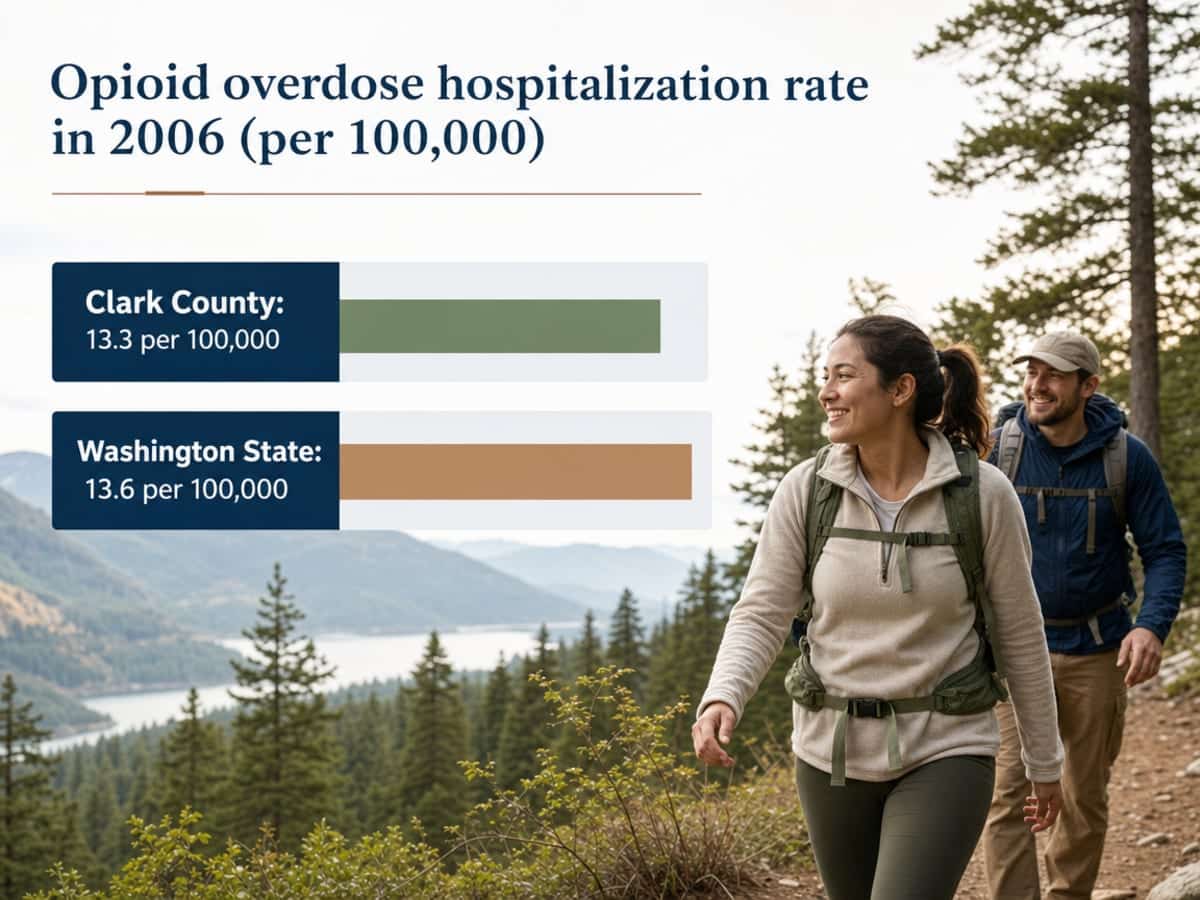
This gap isn’t new, either. Back in 2006, Clark County’s opioid overdose hospitalization rate was already 13.3 per 100,000, almost identical to Washington State’s 13.6 per 100,000 4. Clark County has quietly tracked the statewide crisis for nearly twenty years, but the local infrastructure kept pointing residents toward outpatient care and helplines like 1-800-562-1240 17. When fentanyl arrived, the mismatch got sharper. The need became acute, but the beds didn’t multiply.
So here’s the honest map:
- If you need someone to talk to weekly, Vancouver has that.
- If you need a daily dose of buprenorphine or methadone to hold cravings steady, Vancouver has that.
- If you need somewhere to physically go tonight while your body comes off alcohol, benzos, or opioids under medical eyes — that piece is thin on this side of the river.
Not because your neighbors don’t care. Because that specific service, non-hospital medical detox, is mostly located a short drive south.
That’s why the 20-minute drive to Milwaukie isn’t a workaround. It’s the piece that completes what you already have close to home.
What Non-Hospital Medical Detox Actually Means
The phrase “medical detox” gets thrown around like everyone knows what it means. You probably don’t, and that’s fine. Nobody teaches you this until you need it.
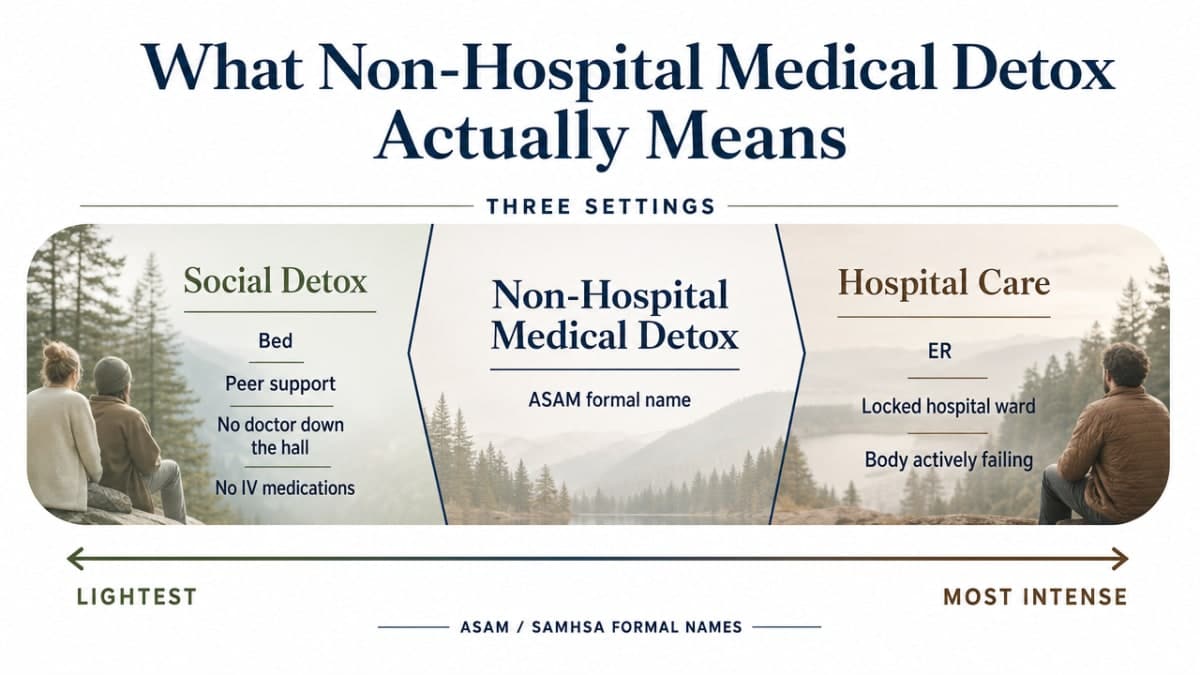
Here’s a simple way to picture it. When it comes to detox, there are basically three settings, and they sit on a shelf from lightest to most intense:
- On one end is what people used to call “social detox” — a place where you get a bed and peer support while you ride out withdrawal, but there isn’t a doctor down the hall and there aren’t medications flowing through an IV pole.
- In the middle is non-hospital medical detox.
- On the other end is a hospital emergency room or a locked hospital ward, where you go if your body is actively failing.
SAMHSA and the American Society of Addiction Medicine (ASAM) actually give these settings formal names. Non-hospital medical detox is what ASAM calls Level III.7-D: Medically Monitored Inpatient Detoxification — a freestanding, non-hospital setting that provides 24-hour medically supervised withdrawal management. That’s different from Level III.2-D: Clinically Managed Residential Detoxification, which leans on peer and social support rather than continuous medical oversight 9.
Translated into plain English: at a place like Pacific Crest Trail Detox in Milwaukie, there are nurses on shift around the clock. A doctor sets the plan and adjusts it as your body changes. You get real medications that take the edge off the shakes, the nausea, the pounding heart, the panic. If you’re coming off alcohol or benzodiazepines like Xanax or Klonopin, those medications can literally prevent seizures. If you’re coming off fentanyl, heroin, or pain pills, they can stop the sick, crawling feeling that pushes so many people back to using within 24 hours.
What it is not: it is not a hospital. There are no fluorescent lights, no gurneys in the hallway, no beeping monitors on every wall. PCTD is a residential home-like setting where you have a bed, meals, and quiet — with the clinical safety net wrapped around it. You keep your dignity. You are not a patient number on a whiteboard.
Why does the middle path exist? Because most people in withdrawal don’t need a hospital, but they absolutely need more than a couch and a friend checking on them. An ER can stabilize a crisis, then it discharges you back to your life, often within hours. A social detox can hold you, but if your withdrawal turns dangerous at 3 a.m., the staff there aren’t equipped to intervene. A non-hospital medical detox is built exactly for the space in between — dangerous enough to need medicine and monitoring, not sick enough to need a cardiac unit.
That’s the setting that fits most Vancouver residents facing alcohol, benzo, or opioid withdrawal. And it’s the setting that’s genuinely hard to find on the Washington side of the river, which is why the 20-minute drive south keeps coming up. You’re not settling for something less than local. You’re getting the specific level of care that matches what your body is actually doing.
What the First 72 Hours Actually Look Like
One of the scariest parts of deciding to detox is not knowing what happens after you walk through the door. Your imagination fills in the blanks, and it usually fills them badly. Let’s replace that with what actually happens.
Hour zero to hour six. You arrive. Someone greets you by name, not by case number. A nurse takes your vitals and asks what you’ve been using, how much, and when you last used. Be honest. This is not a court intake. The staff have heard every version of this story, and the honest version is what keeps you safe. A doctor reviews your history and writes a medication plan that fits your body, not a template. If you’re coming off alcohol or benzos like Xanax or Klonopin, you’ll likely start on a medication that quiets the nervous system before withdrawal peaks. If it’s opioids, you may start a medication like buprenorphine that stops the sick, crawling feeling within about an hour.
Hour six to hour twenty-four. This is when your body starts to notice something is different. Sleep may come in pieces. You may be nauseous, sweaty, restless. Staff check on you every few hours through the night. Your medications get adjusted as your symptoms shift. You eat when you can. You drink water. You may cry, and no one will make it weird.
Day two. For most people, this is the hardest day. Alcohol and benzo withdrawal usually peaks somewhere between 24 and 72 hours in — which is exactly why medical monitoring at this stage matters. Opioid withdrawal peaks earlier but drags. The medication keeps the worst edges dull. You sleep more. You start to feel like a person who has been through something, not a person still trapped inside it.
Day three and beyond. The fog lifts a little each shift. You start meeting with a counselor. You start hearing about what comes next — because detox by itself isn’t a cure. As NIDA puts it plainly,
detoxification is only the first stage of addiction treatment
, and on its own itdoes little to change long-term drug use
21. The team is already talking with you about the step-down programs, whether that’s partial hospitalization a few days a week, intensive outpatient, or standard outpatient with therapy and alumni support.
Three days. That’s the window you’re being asked to get through. Not a lifetime. Not a year. Just the next few days, in a bed, with people who know exactly what your body is doing and how to help it.
Why Detox Alone Isn’t Enough — And What Comes Next
Here’s the truth that a lot of glossy rehab ads leave out: detox by itself is not recovery. It’s the first door. A really important one — you have to walk through it — but if the hallway on the other side is empty, most people end up back where they started, sometimes worse.
The National Institute on Drug Abuse says it plainly: “detoxification is only the first stage of addiction treatment,” and on its own it “does little to change long-term drug use” 21.
That isn’t a scare line. It’s the reason a good detox center spends part of your stay talking with you about what happens on day four, week two, and month three.
Your brain and body take time to relearn what “normal” feels like without the substance. The cravings that fade in the detox bed can come roaring back when you walk into your own kitchen, past the liquor store, or into a group text that used to mean using. Without a plan, that first week home is where most people slip. Not because they’re weak. Because withdrawal is only the physical part. The rest — the sleep, the anger, the shame, the relationships you want to repair — takes longer than 72 hours.
That’s why Pacific Crest Trail Detox is set up as a continuum, not a single stop. After detox, most people step down into a partial hospitalization program, which is basically structured treatment several days a week while you sleep in supportive housing or at home. From there, intensive outpatient meets a few evenings or mornings a week so you can start working or being a parent again. Standard outpatient follows — therapy, check-ins, medication management if you need it. And after all of that, an alumni community stays in your corner. People who went through it before you. People who remember your name.
You do not have to commit to all of it tonight. You just have to know it exists, so “detox” doesn’t feel like a cliff. It’s a staircase, and someone walks it with you.
Insurance, Licensing, and the Questions You’re Afraid to Ask
Let’s clear the fog on the three things that stop most people from picking up the phone: money, paperwork, and the nagging fear that this place isn’t the real deal. You deserve straight answers on all of it in one place, so you can stop opening tabs and start making a call.
- Insurance.
Pacific Crest Trail Detox accepts most commercial insurance plans, including the ones Washington residents typically carry through work, a spouse, or the individual marketplace. The one significant exception is Oregon Health Plan (OHP). If you’re on Apple Health (Washington Medicaid), call and ask before you assume anything — coverage for out-of-state detox can be handled case by case, and the admissions team does this verification every day. You don’t need to know your deductible off the top of your head. You just need your insurance card near you when you call.
- Licensing.
Crossing the river doesn’t mean crossing into unregulated territory. Oregon licenses substance use disorder treatment providers through the Oregon Health Authority, and PCTD is listed in OHA’s approved provider directory as a recognized non-hospital medical detox facility 15. Washington has its own parallel framework — Chapter 246-341 WAC sets the standards for licensed behavioral health agencies, including secure withdrawal management 10. Both states run real oversight. The regulator’s name on the door is different. The clinical accountability is not.
- The question you’re afraid to ask.
If you’ve tried treatment before and left early, you may be quietly convinced no one will take you again. Washington law is actually explicit on this. Under RCW 71.24.037, an agency providing voluntary inpatient or residential substance use disorder treatment or withdrawal management
may not prohibit a person from receiving services or being admitted
solely because they previously left before completing treatment 11. Oregon providers, including PCTD, operate with the same understanding. Relapse and returning to care are part of the story for most people who eventually get well. Coming back is not a failure. It’s the pattern.
One call. Card in hand. That’s the whole administrative lift.
How to Take the Next Step Tonight
You don’t have to build a treatment plan tonight. You have to make one phone call. That’s it.
Here’s the whole sequence, so nothing feels mysterious. You pick up the phone and call Pacific Crest Trail Detox. Someone answers who does this every day. They’ll ask what’s going on, what’s being used and how much, when the last use was, and whether you have insurance. If a bed is available, they’ll walk you through what to bring — an ID, your insurance card if you have one, comfortable clothes, any current medications. If you need help figuring out the drive, they’ll help with that too.
One call. That’s the next step. Washington residents don’t have to wait — Pacific Crest Trail Detox is 20 minutes from Vancouver.
See if your insurance covers detox near Vancouver
Find out in minutes if your insurance can help cover your detox stay just 20 minutes from Vancouver.
Frequently Asked Questions
Is it safe to drive from Vancouver, WA to a detox center in Oregon during withdrawal?
You should not drive yourself if you’re in active alcohol or benzodiazepine withdrawal — those can cause seizures without warning. Ask a family member, friend, or rideshare to take you. Opioid withdrawal is miserable but usually safe to ride through as a passenger. If nobody is available, call Pacific Crest Trail Detox’s admissions line before you leave. The drive from most of Vancouver is about 20 minutes south on I-205.
Will my Washington insurance work at an Oregon detox center?
In most cases, yes. Pacific Crest Trail Detox accepts most commercial insurance plans that Washington residents carry through work, a spouse, or the marketplace. The main exception is Oregon Health Plan (OHP). If you’re on Apple Health (Washington Medicaid), call and ask — cross-state coverage is handled case by case. You don’t need to memorize your deductible. Just have your insurance card near you when you call, and admissions will verify benefits on the spot.
How is non-hospital medical detox different from going to the ER?
An ER stabilizes a crisis and usually discharges you within hours, often back to the same environment. Non-hospital medical detox — what ASAM calls Level III.7-D, medically monitored inpatient detoxification — gives you a bed for several days with 24-hour nursing and doctor-directed medication that eases withdrawal from alcohol, benzos, or opioids 9. It’s residential and home-like, not a hospital ward. And you leave with a plan for what comes next, not a discharge paper.
I’ve left treatment before. Can I still be admitted again?
Yes. Washington law is explicit on this. Under RCW 71.24.037, an agency providing voluntary inpatient or residential substance use disorder treatment or withdrawal management “may not prohibit a person from receiving services or being admitted” solely because they previously left before completing treatment 11. Oregon providers, including Pacific Crest Trail Detox, follow the same principle. Coming back after a relapse isn’t a black mark. For most people who eventually get well, returning to care is part of the path.
How long does detox take, and what happens after?
Most medical detox stays run about 5 to 7 days, depending on what you’re coming off and how your body responds. Alcohol and benzo withdrawal often peak between 24 and 72 hours in. Opioid withdrawal peaks earlier but takes longer to fully fade. After detox, you step down into ongoing care — partial hospitalization, intensive outpatient, standard outpatient with therapy, and alumni support. NIDA is clear that detox alone “does little to change long-term drug use” 21.
Can I get in this week, or is there a long waitlist?
Often yes, this week — sometimes the same day. Non-hospital medical detox centers in Oregon typically have faster access than the intensive services flagged with waitlists in Clark County’s own behavioral health planning 20. Availability shifts hour to hour, so the only real answer comes from a phone call. Admissions will ask what you’re using, how much, and when you last used, then tell you honestly whether a bed is open now or when the next one opens.
References
- LEWPRO November 2023 Meeting Presentation. https://governor.wa.gov/sites/default/files/2023-11/LEWPRO%20PowerPoint%20Slides%2020231116.pdf
- Opioid Data | Washington State Department of Health. https://doh.wa.gov/data-and-statistical-reports/washington-tracking-network-wtn/opioids
- Unintentional Drug Overdose Data (SUDORS) | Washington State Department of Health. https://doh.wa.gov/data-and-statistical-reports/washington-tracking-network-wtn/opioids/unintentional-drug-overdose-data-sudors
- Opioid Hospitalizations – Clark County (2006–2017). https://clark.wa.gov/sites/default/files/media/document/2020-08/OpioidHosps.pdf
- Washington Overdose Workgroup Presentation (May 2021). https://www.hca.wa.gov/assets/program/Overdoes-workgroup-20210521.pdf
- Washington state opioid trends – UW ADAI. https://adai.uw.edu/wadata/opiate_home.htm
- Risk and Protection Profile for Substance Use – Vancouver SD. https://www.dshs.wa.gov/sites/default/files/rda/riskprofiles/research-4.53-SD-Vancouver.pdf
- Washington State Opioid Overdose Prevention Data Brief. https://doh.wa.gov/sites/default/files/legacy/Documents/Pubs/971-043-OpioidOverdoseDatabrief.pdf
- 2 Settings, Levels of Care, and Patient Placement – TIP 45 (SAMHSA/NCBI). https://www.ncbi.nlm.nih.gov/books/NBK64109/
- Chapter 246-341 WAC – Behavioral Health Agencies. https://apps.leg.wa.gov/wac/default.aspx?cite=246-341
- RCW 71.24.037 – Licensed or certified behavioral health agencies—Minimum standards—Inspections. https://app.leg.wa.gov/rcw/default.aspx?cite=71.24.037
- WSR 24-17-003 – Proposed Rule Making (Behavioral Health Agency Fees). https://lawfilesext.leg.wa.gov/law/wsrpdf/2024/17/24-17-003.pdf
- Treatment Agency List – Clark County District Court. https://clark.wa.gov/district-court/treatment-agency-list
- Behavioral Health – Clark County Community Services. https://clark.wa.gov/community-services/behavioral-health
- Oregon Substance Use Disorders Treatment Provider Directory (OHA). https://www.oregon.gov/oha/HSD/AMH/docs/provider-directory.pdf
- Behavioral Health Agencies Directory (DOH 606-019). https://doh.wa.gov/sites/default/files/2022-02/606019-BHADirectory.pdf
- Clark County Alcohol and Drug Program Directory. https://clark.wa.gov/sites/default/files/fileuploads/community-services/2015/07/AD_Program_Directory.pdf
- Clark County Public Health Community Resources (Updated November 2022). https://ccteentalk.clark.wa.gov/uploads/1/1/8/4/118498475/clark_county_public_health_community_resources_-_updated_november_2022.pdf
- Opioid and Drug Use Data – Washington State Department of Health. https://doh.wa.gov/data-and-statistical-reports/washington-tracking-network-wtn/opioids/overdose-dashboard
- Clark County Mental Health and Substance Use Treatment (MHST) Report 2023. https://clark.wa.gov/sites/default/files/media/document/2024-10/mhst2023_web_10724.pdf
- Treatment Approaches for Drug Addiction – NIDA DrugFacts. https://nida.nih.gov/publications/drugfacts/treatment-approaches-drug-addiction