


Key Takeaways
- Washington’s detox capacity is stretched thin, with roughly one in four residents needing substance use treatment actually receiving it, leaving families in Seattle, Tacoma, and Olympia facing dangerous waitlists 3.
- Alcohol and benzodiazepine withdrawal can trigger seizures within hours, so a two- to three-hour drive to a licensed Oregon detox is often safer than waiting days for an in-state bed.
- Apple Health and most Washington commercial plans include pathways for out-of-plan and out-of-state substance use care, and Oregon covers medically monitored withdrawal without prior authorization 6, 10.
- Families can start the process with one intake call — verifying benefits, confirming bed availability, and arranging the drive — while planning a Washington-based aftercare step-down before leaving Milwaukie.
When staying in Washington isn’t the fastest path to safe detox
If you’re reading this late at night from Seattle, Tacoma, or Olympia — or you’re the spouse, parent, or adult child doing the reading for someone you love — take a breath. You’re already doing something hard, and something right.
Here’s the part most articles won’t tell you plainly: the closest detox bed isn’t always the safest one, and the safest one isn’t always in your state. Washington’s treatment system is stretched. Waitlists in the Puget Sound corridor can stretch days when withdrawal from alcohol, benzodiazepines like Xanax or Klonopin, or opioids can turn dangerous within hours. Alcohol and benzo withdrawal, in particular, can cause seizures. That’s not a scare tactic. That’s the reason time matters.
Crossing into Oregon isn’t exotic. For many Washington families, a licensed non-hospital detox in Milwaukie — about a two- to three-hour drive down I-5 from Seattle, and closer from Tacoma or Olympia — is simply the next available, medically supervised option. Oregon licenses these residential detox centers through its state health authority, and they’re designed to feel more like a home than an ER 11, 12.
And your Washington insurance? It often travels with you. Apple Health and most commercial plans have pathways for out-of-plan and out-of-state substance use care when the medical need is there 4, 6. We’ll walk through exactly how that works, what the drive looks like, what happens once you arrive, and how you come home to Washington with a real plan. One step at a time.
Why Washington’s detox capacity feels tight when you need a bed today
You’re not imagining the wait. If you’ve called three intake lines in Seattle this week and been told to try back Monday, or you’re in Tacoma watching someone shake through another night on the couch, the shortage you’re bumping into is real and it’s measured.
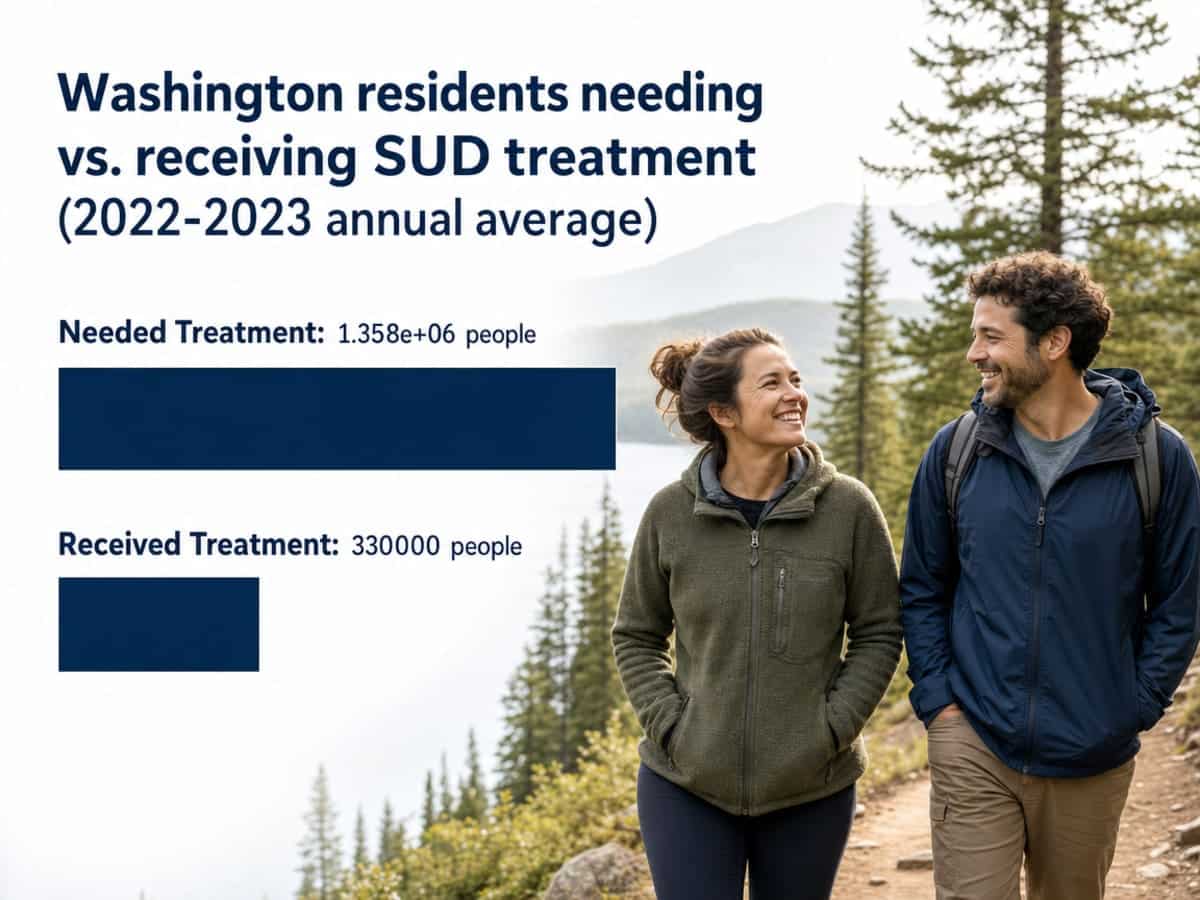
Across Washington, an annual average of 1.358 million residents aged 12 and older were classified as needing substance use treatment in 2022–2023 — and only 330,000 actually received it 3. That’s roughly one in four getting care. Oregon’s numbers tell a similar story on a smaller scale: 852,000 people needed treatment and 219,000 received it 14. Two states, one regional bottleneck. The Puget Sound corridor holds most of Washington’s population, which means most of that unmet demand is concentrated in the same cities where you’re trying to make calls right now.
What that looks like in practice: detox beds fill quickly, especially the medically supervised ones equipped to handle alcohol and benzodiazepine withdrawal safely. Hospital emergency departments can stabilize someone in immediate danger, but they aren’t set up to hold a person for the three to seven days a full detox usually takes. Standalone detox programs in-state often have waitlists. Intake teams may ask you to call back each morning to check bed availability. If you’re the one making those calls between work meetings or after the kids are in bed, the exhaustion is its own kind of injury.
Here’s where the map matters. Oregon’s system faces its own capacity pressures, but the state has invested in licensed non-hospital residential withdrawal management and covers medically monitored detox under the Oregon Health Plan without requiring prior authorization 10. That regulatory setup means beds exist in facilities specifically built for calm, medical detox — not hospital wings retrofitted for it. For a family in Bellevue or Olympia hitting a wall with in-state options, that changes the math.
The next question most families ask is the obvious one: what does that drive actually look like, and who does it? That’s next.
The Seattle-to-Milwaukie drive, in plain terms
Drive times, traffic, and who actually does the driving
Let’s talk about the map, because the map is less scary than it sounds. Milwaukie sits just south of Portland, right off I-5. From downtown Seattle, you’re looking at roughly a three-hour drive in clean traffic — sometimes closer to three and a half if you leave during rush hour or hit weather near Chehalis. From Tacoma, you save about 45 minutes. From Olympia, it’s closer to two and a half hours. From Everett or Bellevue, add a bit to the Seattle number.
Here’s the practical piece: you don’t have to make that drive alone, and the person in withdrawal shouldn’t be the one behind the wheel. If a spouse, adult child, close friend, or sibling can drive, that’s the first call to make. If nobody in your circle can, medical transport services exist, and many detox facilities can help arrange one when you call intake. Rideshare across state lines works too, though it’s expensive and doesn’t come with anyone to help if things get hard mid-drive.
Pack light. A change of clothes, ID, insurance card, a list of any current medications with doses, and a phone charger cover the essentials. Everything else can wait. Leaving in the morning is usually calmer than leaving at night — daylight, less truck traffic on I-5, and you arrive during the shift when the most staff are around to welcome you in.
Why a two- to three-hour drive can be safer than a two-week wait
Here’s the trade-off most people don’t quite see when they’re staring at Google Maps. A three-hour drive today means detox starts today. A two-week wait for a Seattle bed means two more weeks of the exact thing you’re trying to stop — and for alcohol and benzodiazepines like Xanax, Klonopin, or Ativan, those extra days aren’t neutral. Withdrawal from these substances can trigger seizures and, in the worst cases, be fatal without medical supervision. Opioid withdrawal is rarely deadly on its own, but it’s brutal enough that most people give up and use again before they get to a bed.
Oregon covers medically monitored withdrawal management under its state health plan without requiring prior authorization, which is one reason non-hospital detox beds there tend to move faster than an insurance-heavy in-state process 10. Those beds are in facilities the Oregon Health Authority licenses specifically for withdrawal care — not hospital wings, not repurposed clinics 11, 12.
So yes, three hours in a car feels like a lot when you’re already exhausted. But three hours today, with a bed waiting on the other end, beats two more weeks of white-knuckling it while the calendar barely moves. You are allowed to choose the faster, safer option. That’s not weakness. That’s the whole point.
What medical detox actually looks like (and how it differs from an ER)
Most people picture detox and see fluorescent lights, a shared curtain, and a clipboard clicking past every hour. That’s the ER version. It’s what happens when someone shows up in acute crisis and the hospital stabilizes them, then discharges them once the immediate danger passes. That’s a critical service. It is not, for most people, a full detox.
A licensed non-hospital residential detox is a different setting entirely. Oregon licenses these programs through the Oregon Health Authority specifically for withdrawal care, and the state covers medically monitored withdrawal management under the Oregon Health Plan without requiring prior authorization 10, 11, 12. In plain terms: it’s a real medical program, run by nurses and clinicians trained in withdrawal, in a house-like building where you sleep in an actual bed, eat real meals, and stay for as long as your body needs — usually three to seven days, sometimes longer for alcohol or benzodiazepines.
Here’s what that looks like day to day. A nurse checks your vitals on a schedule and adjusts medicines that ease the worst of withdrawal — the nausea, the shaking, the anxiety that climbs the walls at 3 a.m. For opioids, that often includes medicines that stop the sickness within hours. For alcohol and benzos, it means monitoring for the dangerous stuff (seizures, blood pressure spikes) and using medicines to keep you safe while your nervous system settles. You’re not white-knuckling it. You’re being cared for.
The other piece that separates residential detox from an ER: therapy starts while you’re still there. Not intense therapy — you’re too tired for that in the first few days — but a counselor sits with you, listens, and starts building the picture of what comes after detox. By the time you’re stable enough to think about the future, someone has already helped you sketch one. That’s what “aftercare planning” means in plain English: a plan for the day you leave, not a stack of pamphlets pushed at you on the way out.
The setting matters more than most people expect. A living room. A kitchen where meals are cooked, not delivered on trays. A walking path outside. Other people going through the same thing, quietly, in the next chair. It’s not luxury and it’s not a resort — it’s just a place that feels like a place, not a wing. For someone who’s spent the last week convinced they’re the only one, that shift alone is medicine.
Washington insurance, Oregon care: how coverage actually travels
What Apple Health covers for detox and withdrawal
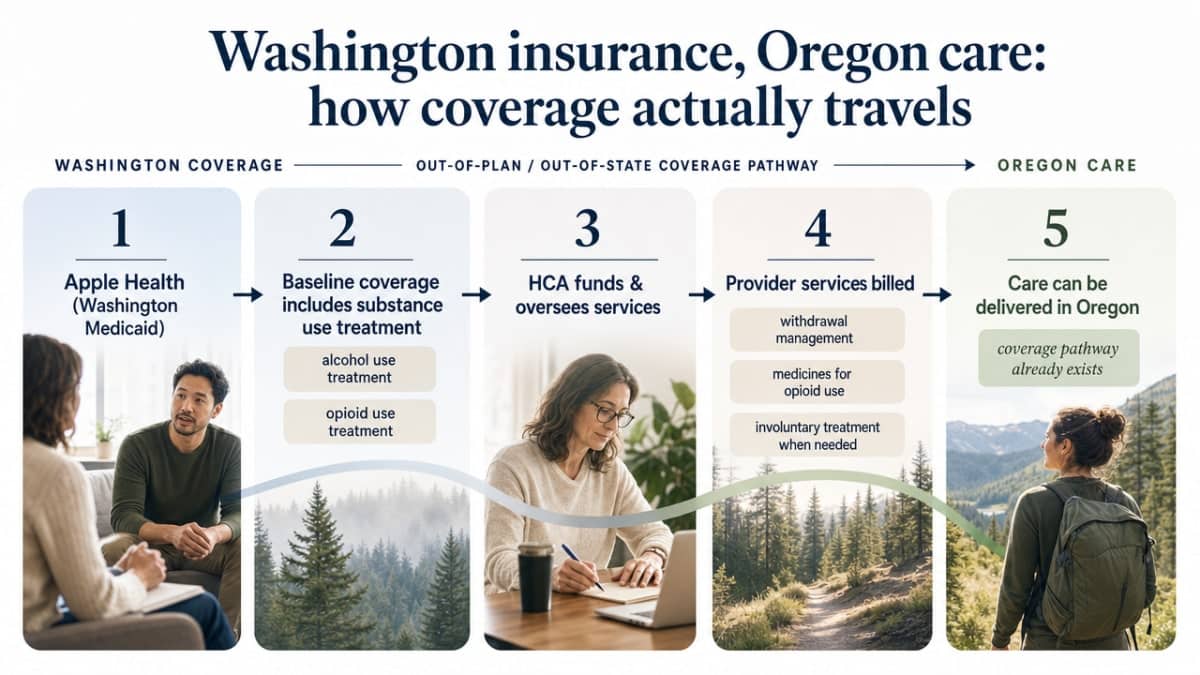
If you have Apple Health — Washington’s Medicaid — your coverage already includes substance use treatment. That’s not a workaround. That’s baseline benefit design. Apple Health for adults explicitly lists substance use treatment, alcohol use treatment, and opioid use treatment among its covered services 8, and the Health Care Authority funds and oversees these services for enrolled residents 4.
On the provider side, the coverage picture gets more specific. Apple Health pays for alcohol use treatment, involuntary treatment when it’s needed, medicines that help people stop using opioids safely, and opioid use treatment itself 5. Acute withdrawal management — the medical piece of detox — is a covered benefit under fee-for-service Apple Health, billed once per day per client 7.
The practical translation: if you’re on Apple Health in King, Pierce, Thurston, or Snohomish County, your insurance is designed to pay for the medical part of getting through withdrawal. What varies is where and how, which is the next piece to sort out. Coverage exists. The question is which door it walks through.
Out-of-plan and out-of-state pathways that already exist
Here’s the part that surprises most families: Apple Health managed care clients can receive substance use disorder treatment services outside their plan. That’s not an exception the state grants reluctantly — it’s written into the provider guide as a standing rule 6. Managed care plans coordinate physical, mental, and substance use care under one roof 9, and when the SUD care someone needs sits outside that roof, the pathway to reach it is already built.
The steps look roughly the same whether you’re calling from Bellevue or Lacey.
- First, someone verifies your Apple Health eligibility and confirms which plan you’re on 7.
- Second, medical necessity gets documented — the clinical picture that says detox is the right level of care right now.
- Third, the detox facility either bills through the out-of-plan SUD pathway or works with your plan on a single-case arrangement.
- Fourth, you complete medically monitored withdrawal management at the licensed Oregon facility.
- Fifth, you transition to aftercare — often back in Washington, sometimes continuing with the Oregon program’s outpatient services.
None of that is fast in the abstract. It moves fast when the intake team on the other end has done it before. Pacific Crest Trail Detox in Milwaukie has walked Washington families through this exact sequence enough times that the paperwork isn’t the bottleneck — the drive is.
Commercial insurance and the phone call that verifies everything
If you have commercial coverage through a Washington employer — Premera, Regence, Kaiser, Aetna, United, the alphabet soup — the mechanics are a little different but the shape is the same. Most commercial plans have out-of-network benefits for substance use care, and many will approve a single-case agreement when the in-network detox options in your area have waits that make care unsafe.
The one call that unlocks all of this is a benefits verification. A detox facility’s intake team calls your insurance, reads them the specific codes for medical detox, and comes back with what your plan will cover, what your out-of-pocket responsibility looks like, and whether a single-case agreement needs to be requested. This isn’t a red flag. It’s the standard first step for any medically supervised admission, in-state or out.
You don’t have to make that call yourself. Have your insurance card, ID, and a rough medical history handy when you call intake, and let them do the verification while you focus on getting there.
What the first 72 hours feel like
The first day is mostly quiet, in a way that surprises people. You arrive, you meet a nurse, you answer questions about what you’ve been using and how much and when the last dose was. Someone takes your vitals. Someone shows you your room. If you’re shaky or nauseous or your skin is crawling, medicines start soon after intake — not on a hospital schedule, but on your schedule, adjusted as the day goes on.
Day one is the hardest for opioids. Day two and three are the hardest for alcohol and benzodiazepines, when the risk of seizures peaks and monitoring gets closest. You’ll sleep more than you expect and less than you want. Meals show up. You may not eat much at first. That’s normal. A nurse will check on you through the night, quietly, without waking you unless something needs attention.
By hour 48, the worst of the physical piece usually starts to loosen. The shaking eases. Food sounds like food again. You might sit in the common room for a few minutes, or take a short walk outside. A counselor introduces themselves — no heavy conversation yet, just a face and a name. This is when aftercare planning quietly begins: what medications you’ll continue, what kind of therapy fits your life back in Washington, whether outpatient care makes sense once you’re home.
By hour 72, most people can think again. Not perfectly. But enough to notice that the panic of a week ago has softened into something more like tired relief. You made it through the part you were most afraid of. That’s not nothing. That’s the beginning.
After detox: coming home to Washington with a plan
Detox is the door, not the room. What matters most for staying well starts on day four or five, when your body has settled enough that a real conversation about what comes next can happen. By the time you leave Milwaukie, you shouldn’t be leaving with a handshake and a phone number scribbled on a napkin. You should be leaving with a plan that already has your Washington zip code on it.
That plan usually has three pieces.
- Medicines that keep working after detox ends — for opioid use, that often means continuing something like buprenorphine, which Apple Health covers under its opioid use treatment benefits 5, 8. For alcohol use, there are medicines that reduce cravings and make relapse less likely. These aren’t crutches. They’re the same kind of ongoing care a person with diabetes or high blood pressure would get.
- Therapy that fits your actual life. If you can’t take a month off work in Seattle, a partial hospitalization or intensive outpatient program that meets several times a week is often the right shape. If you need something lighter, standard outpatient counseling and group therapy can hold the frame while you rebuild. Pacific Crest Trail Detox offers these step-down programs directly, and many Washington residents choose to stay connected for a few weeks of outpatient care before transitioning to a Washington-based provider closer to home.
- People. Alumni groups, peer support, a sponsor if that fits your path. The quiet truth of recovery is that it’s held together by other humans who’ve been where you’ve been. Coming home to Washington with those connections already started — that’s the difference between white-knuckling week two and actually building something.
If you’re the family member reading this
A note directly to you — the spouse, parent, sibling, or adult child who has been doing the calling, the Googling, and the quiet crying in the car. You are not overreacting. You are also not in charge of fixing this alone.
Here is what actually helps in the next 24 hours. Pick up the phone yourself and call an intake line — you don’t need your loved one on the call to get started. Have their date of birth, insurance card, and a rough list of what they’ve been using and how much. The intake team can start a benefits check and hold a bed conversation while your person rests, showers, or works up the nerve. If they have Apple Health, out-of-plan substance use care is already part of the design, not a favor you have to beg for 6.
Ask three plain questions:
- When is the next bed available,
- what will insurance cover, and
- who arranges the drive.
Write the answers down. If the first place can’t help today, ask them who can. Good intake teams answer that question without flinching.
Check If Your Washington Insurance Covers Detox
See your options for safe, covered detox care before you make your next move.
Frequently Asked Questions
Can I use my Washington insurance for detox in Oregon?
Usually, yes. Apple Health covers substance use and opioid use treatment for enrolled adults, and managed care clients are specifically allowed to receive SUD services outside their plan when needed 6, 8. Commercial plans typically have out-of-network or single-case pathways too. A quick benefits check by the detox intake team confirms exactly what your plan will pay before you drive down.
How long does the drive from Seattle to Milwaukie really take?
Plan on about three hours from downtown Seattle in reasonable traffic, sometimes three and a half if you hit rush hour or weather near Chehalis. Tacoma trims roughly 45 minutes off that. Olympia is closer to two and a half hours. Leave in the morning if you can — daylight and lighter I-5 truck traffic make the trip calmer.
What’s the difference between hospital ER detox and residential medical detox?
An ER stabilizes someone in immediate danger and discharges when the crisis passes — usually hours, not days. A licensed non-hospital residential detox is a full medical program in a home-like setting, staffed by nurses and clinicians, where you stay three to seven days (sometimes longer for alcohol or benzos) with medicines managing withdrawal and therapy quietly starting before discharge 10, 11, 12.
How fast can someone from Washington actually get a detox bed in Oregon?
Often within 24 to 48 hours, sometimes same-day. Oregon covers medically monitored withdrawal management under its state health plan without prior authorization, which removes one of the biggest delays 10. The actual bottleneck is usually bed availability and the drive itself. A single call to intake starts the benefits check and holds the bed conversation while you pack.
What happens after detox ends and I come back to Washington?
You leave with a plan, not a pamphlet. That usually means ongoing medicines for opioid or alcohol use (both covered by Apple Health) 5, 8, a step-down program like partial hospitalization or intensive outpatient that fits your schedule, and connections to peer or alumni support. Many Washington residents stay linked to their Oregon outpatient program for a few weeks before transitioning to a provider closer to home.
I’m the family member making calls. What do I ask first?
Ask three things: when is the next bed available, what will insurance cover, and who arranges the drive. Have their date of birth, insurance card, and a rough list of what they’ve been using and how much. You don’t need your loved one on the call to start the process. If the first place can’t help today, ask them who can — good intake teams answer that without hesitating.
References
- Opioid and Drug Use Data. https://doh.wa.gov/data-and-statistical-reports/washington-tracking-network-wtn/opioids/overdose-dashboard
- Unintentional Drug Overdose Data (SUDORS). https://doh.wa.gov/data-and-statistical-reports/washington-tracking-network-wtn/opioids/unintentional-drug-overdose-data-sudors
- WASHINGTON – National Survey on Drug Use and Health State Tables (2022–2023). https://www.samhsa.gov/data/sites/default/files/reports/rpt56188/2023-nsduh-sae-state-tables_0/2023-nsduh-sae-state-tabs-washington.pdf
- Substance use treatment | Washington State Health Care Authority. https://www.hca.wa.gov/free-or-low-cost-health-care/i-need-behavioral-health-support/substance-use-treatment
- Substance use treatment | Program information for providers. https://www.hca.wa.gov/billers-providers-partners/program-information-providers/substance-use-treatment
- Substance Abuse Disorder Provider Guide (Washington HCA). https://www.hca.wa.gov/assets/billers-and-providers/substance_abuse_disorder_bi_07012015-09302015.pdf
- Substance Use Disorder Billing Guide (2024 FFS). https://www.hca.wa.gov/assets/billers-and-providers/SUD-FFS-bg-20240101.pdf
- Apple Health for Adults. https://www.hca.wa.gov/free-or-low-cost-health-care/i-help-others-apply-and-access-apple-health/apple-health-adults
- Apple Health managed care. https://www.hca.wa.gov/free-or-low-cost-health-care/i-need-medical-dental-or-vision-care/apple-health-managed-care
- Substance Use Disorder Integration Report (Oregon Health Authority). https://www.oregon.gov/oha/HSD/AMH/DataReports/SUD-Integration-Report.pdf
- Oregon Summary – State Residential Treatment for Behavioral Health Conditions. https://aspe.hhs.gov/sites/default/files/2021-08/StateBHCond-Oregon.pdf
- Licensing and Certification – Behavioral Health Providers (Oregon). https://www.oregon.gov/oha/BH/Providers/Pages/Licensing-Certification.aspx
- The 2026–2030 Comprehensive Plan (Oregon Alcohol and Drug Policy Commission). https://www.oregon.gov/adpc/pages/plan.aspx
- OREGON – National Survey on Drug Use and Health State Tables (2022–2023). https://www.samhsa.gov/data/sites/default/files/reports/rpt56188/2023-nsduh-sae-state-tables_0/2023-nsduh-sae-state-tabs-oregon.pdf
- 2023 Healthy Youth Survey results offer signs of hope and resiliency among Washington students. https://doh.wa.gov/newsroom/2023-healthy-youth-survey-results-offer-signs-hope-and-resiliency-among-washington-students
- Washington EMS Opioid Surveillance Report (October 2024). https://doh.wa.gov/sites/default/files/2024-11/346-106-October2024.pdf