


Key Takeaways
- Staying in a sober living home for at least six months is the threshold where residents show durably lower substance use, higher employment, and fewer pending criminal charges 1.
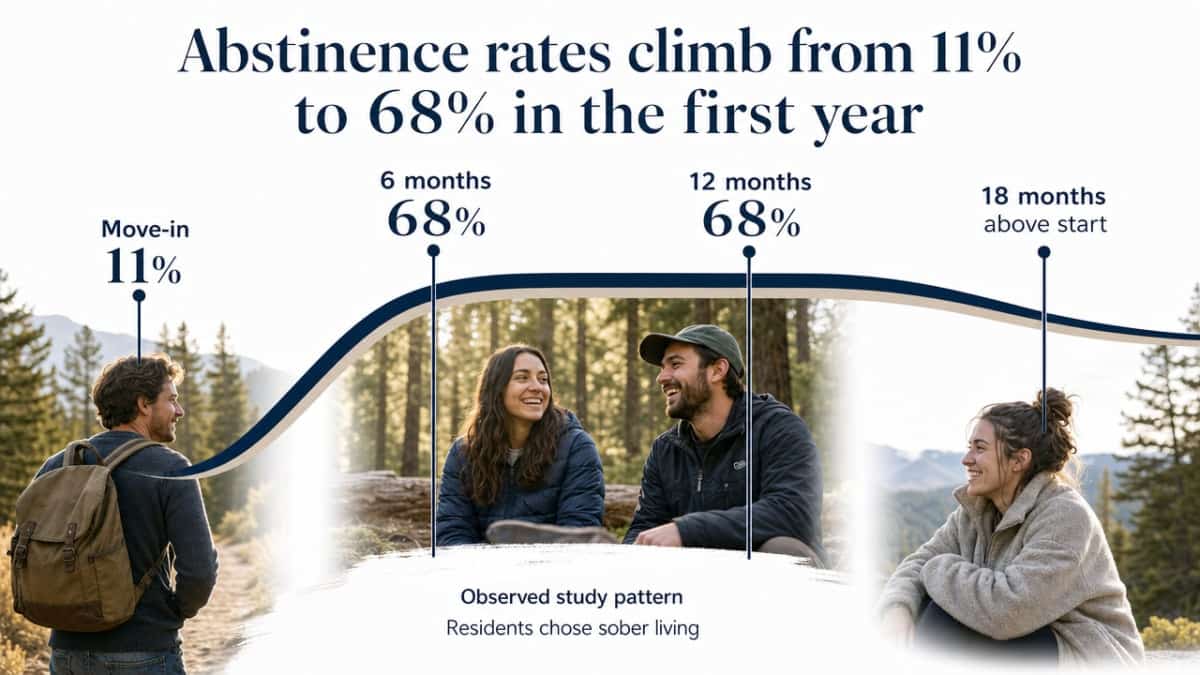
- Abstinence rates among California sober living residents climbed from 11% at intake to 68% at six months, driven largely by mutual-help involvement and peer networks 8.
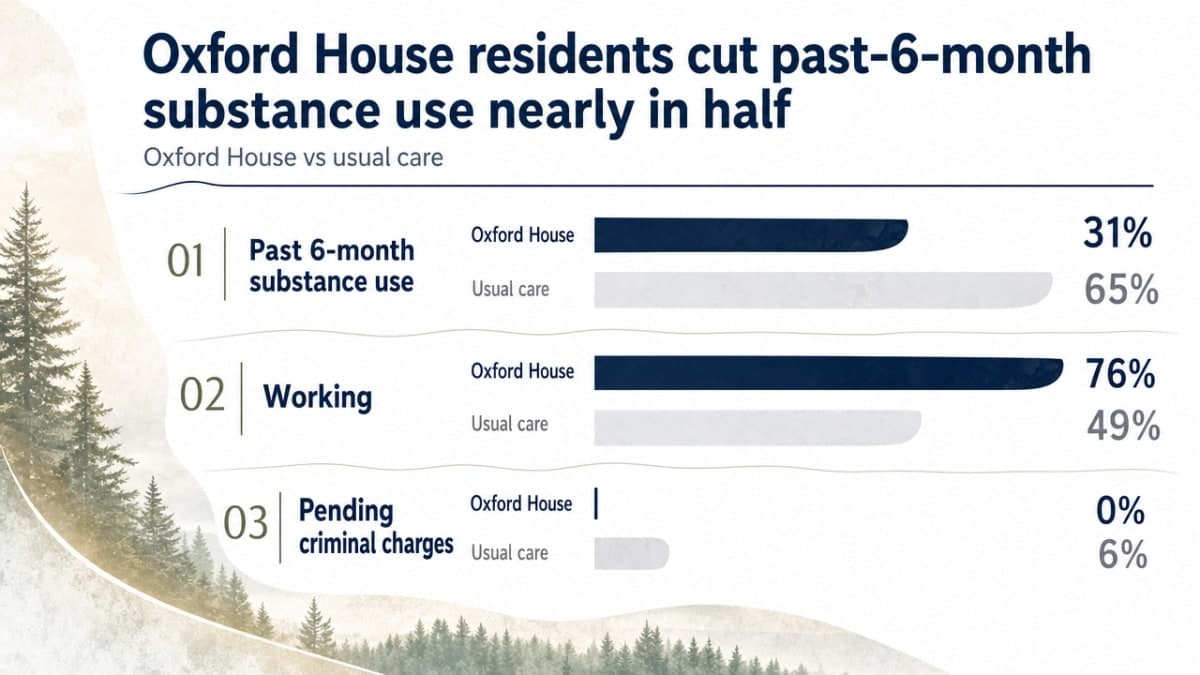
- Oxford House residents reported past-six-month substance use at 31% versus 65% in usual care, with higher employment and no pending criminal charges 4.
- Among people leaving Oxford House residences in a two-year randomized trial, 81.5% reported no substance use during the following year, suggesting gains are portable 9.
- Pairing outpatient treatment with sober living across 18 months produced simultaneous drops in substance use and arrests alongside more days worked, with 12-step involvement driving results 3.
- Structured sober housing is linked to longer outpatient retention and higher rates of satisfactory discharge, making the living environment a practical retention strategy 10.
- Contingency management extends treatment engagement and abstinence stretches whether or not a person is in a housing program, so behavioral tools matter alongside where someone sleeps 5.
- Sober living residents in neighborhoods with more nearby AA meetings and outpatient services had more abstinent days, and perceived cohesion supported recovery capital 11.
- Stable housing itself, through models like Housing First and permanent supportive housing, improves substance use outcomes and treatment engagement, functioning as clinical infrastructure 7.
- Medication for opioid use disorder inside recovery homes extends support and reduces illicit use, but abstinence-based house cultures can create stigma that families should screen for 6.
- A cost-benefit analysis estimated Oxford House stays returned roughly $29,000 per person over two years versus usual care, reflecting gains in employment and reduced criminal activity 2.
What the research actually says about life after detox
If you’re reading this, you’ve probably already done more research than most people ever will. You know detox is just the first step. You’ve watched your adult child try, stumble, try again. And you’re looking for something more honest than a brochure.
Here’s what the last two decades of peer-reviewed research keeps showing: recovery holds when people have a safe place to live, a peer community around them, and continuing care after the medical piece is done 4. Sober living homes and recovery housing aren’t a nice-to-have add-on. In study after study, they change the numbers that matter to you, abstinence, employment, arrests, and how long someone stays engaged in treatment 4.
The ten findings below aren’t cherry-picked. They come from randomized trials, longitudinal studies, and a 2025 systematic review. Each one answers a worry you’ve likely carried, whether length of stay really matters, whether medication for opioid use disorder complicates housing, whether the neighborhood around the home makes a difference 1, 6, 11. Read them as a decision framework, not a pep talk.
The six-month threshold that changes everything
If there’s one number to hold onto from the entire body of recovery housing research, it’s six months. That’s the length of stay where the outcomes stop looking like a fragile hope and start looking like a durable shift.
A two-year longitudinal study of Oxford House residents tracked what happened when people stayed at least six months versus those who left sooner. The residents who stayed six months or longer reported significantly less alcohol and drug use, were more likely to be employed, and were less likely to have criminal charges pending against them 1. Same houses. Same peer structure. The variable that moved the outcomes was time.
You may be doing quiet math right now. Six months feels long when you’re the one paying, waiting, worrying. It can feel even longer to your adult child, who may be asking why they can’t just come home after 30 days. Here’s the honest read on that math: the first months in a sober living home are when your child is still learning the rhythms of a life without substances, still building the peer relationships that carry them later, still testing whether stress or boredom or a bad day will pull them back. Leaving before six months means leaving before the protective effects have fully taken hold.
The same study noted no significant difference between Oxford Houses and a therapeutic community model on some outcomes, which is worth knowing 1. The specific brand of housing matters less than the duration and the structure inside it. When you’re weighing a continuing-care plan, the question isn’t only where your child lives after detox. It’s how long the plan actually keeps them there.
Abstinence rates climb from 11% to 68% in the first year
You know what relapse looks like. You’ve probably lived through one, or several. So when someone tells you sober living “works,” your first question is fair: how much, and for how long?
Here’s the number that keeps showing up in the research. In a body of California sober living house studies synthesized by Polcin and colleagues, abstinence rates jumped from 11% at the time residents moved in to 68% at six months. That rate held steady at 12 months, and while it settled somewhat by 18 months, it stayed well above where residents started 8. Read that again slowly. Roughly one in ten people were abstinent walking in the door. Nearly seven in ten were abstinent half a year later.
The scope matters, so weigh it honestly. These were people who chose sober living, which means motivation was already in play. The designs were not randomized, so you can’t say the housing alone caused every gain 8. But the pattern is consistent, and the researchers identified what predicted the strongest outcomes: involvement in 12-step or mutual-help groups and building a supportive social network inside and outside the house 8.
Here’s the part that speaks directly to you. If your adult child is walking out of detox at 11% abstinent, that isn’t a failure. It’s a baseline. The environment they move into next is what shapes the six-month number. A sober living home with peers who show up to meetings, a house culture that expects participation, and a rhythm of accountability is the difference between the intake bar on that chart and the six-month bar. You are not choosing between hope and realism. You are choosing the setting that changes the slope.
Oxford House residents cut past-6-month substance use nearly in half
This is the finding that tends to stop parents mid-scroll, because it puts a number on the question you’ve been carrying: does adding sober housing to the plan actually change what happens next?
A 2025 systematic review pulled together the strongest studies comparing recovery housing against usual continuing care, the standard aftercare path most people follow after treatment. The Oxford House data inside it is striking. Residents reported any substance use in the past six months at less than half the rate of their usual-care peers, 31% versus 65% 4. Employment went the other direction, 76% of Oxford House residents were working compared with 49% in usual care 4. And 0% of Oxford House residents had criminal charges pending, compared with 6% of the usual-care group 4.
Sit with those three numbers together for a minute. They tell a connected story. When your adult child has a stable, peer-supported place to live, substance use drops, work becomes possible, and the legal complications that can trail addiction for years start to fade. One outcome feeds the next. A job makes rent and dignity easier. Fewer legal problems mean more energy for recovery instead of court dates.
You should also know what the review flags honestly. Studies of recovery housing vary in quality and design, and researchers are still working toward standard definitions of what counts as “recovery housing” across programs 4. What the evidence does show, across settings, is that adding housing to continuing care outperforms usual care on the outcomes families care about most. If a plan you’re being offered doesn’t include a housing piece after detox and outpatient work, this is the finding to bring into that conversation.
81.5% report no substance use in the year after leaving Oxford House
Here’s a worry that probably sits close to the surface for you: what happens after the sober living home ends? Your child moves out, gets their own apartment or comes home, and then what? Does the whole thing unravel?
A randomized trial that followed more than 200 people for two years put a number on that question. Among participants who left Oxford House residences, 81.5% reported no substance use during the following year 9. Roughly four out of five held onto what they built. The same trial tracked 89% of Oxford House participants and 86% of the usual-care group for the full two years, so the follow-up itself was rigorous, not a self-selected snapshot of the people doing best 9.
That 81.5% figure is worth naming plainly for what it is. It’s not a promise. It’s evidence that the peer relationships, the routines, and the sober identity your child builds inside a recovery home don’t evaporate the moment they walk out the front door. Something portable is being made in there.
The researchers do flag that questions remain about how well the Oxford House model translates across regions, populations, and formal treatment systems 9. Still, if you’ve been quietly bracing for the exit as the next relapse trigger, this study offers a different frame. Leaving well is possible, and the year that follows can look nothing like the year that came before.
18 months of combined outpatient care and sober living improves work, arrests, and use
One of the questions that probably keeps you up is whether the pieces of a continuing-care plan add up to more than the sum of their parts. Detox alone is one thing. Outpatient counseling alone is another. What happens when your adult child does both while living in a sober living home?
A study followed 55 people who received outpatient substance use treatment while also living in a sober living house, and tracked them for 18 months 3. Across successive six-month check-ins, the researchers saw significant improvements on three things you care about together: alcohol and drug use dropped, arrests dropped, and days worked went up 3. Not one gain that fades while another slips. All three moving in the right direction, quarter after quarter.
The piece the researchers singled out as a driver was 12-step involvement. Participation in mutual-help groups was linked to reductions in alcohol and drug use over the full window 3. The housing wasn’t doing the work alone. Neither was the outpatient counseling. The combination, with peer meetings woven through it, is what moved the numbers.
Be honest about the scope. This was 55 people, not a randomized trial, and the authors say plainly that larger, more rigorous studies are still needed 3. What the finding does give you is a working blueprint. When you’re looking at a continuing-care plan for your child, ask whether an intensive outpatient program and a sober living arrangement are meant to run together, not one after the other. That overlap is where the 18-month gains showed up.
Structured sober housing keeps people in outpatient treatment longer
One of the quiet fears you carry is probably this: your adult child starts an outpatient program with real intention, and six weeks in, they stop showing up. The counselor calls. The bed at home feels safer than the group room. And the plan you fought to build unravels.
A multi-level analysis of people in outpatient substance use treatment looked at whether the living situation itself changed how long people stayed in care. Living in structured sober housing was linked to a greater likelihood of a satisfactory discharge and a longer length of stay in outpatient treatment 10. In plain terms, when your child sleeps somewhere with house rules, sober peers, and a rhythm that expects them to keep their appointments, they are more likely to finish what they started.
The researchers are careful about causality. They can’t prove the housing alone drove the retention, and they note that motivation and other factors likely play a role too 10. Fair. But the practical read still holds. If you’re piecing together a post-detox plan, pairing an intensive outpatient program with a structured sober living arrangement isn’t just a comfort choice. It’s a retention strategy, and retention is where the other outcomes in this article live.
Contingency management works whether or not a resident is housed
Here’s a piece of the puzzle that doesn’t get talked about enough with parents: the behavioral supports layered on top of housing and outpatient care can do real work on their own. Contingency management is one of them. In plain terms, it’s a structured approach where clean drug screens and treatment attendance earn small, tangible rewards, which sounds almost too simple until you see what it does to the numbers.
A randomized study looked at whether contingency management helps people in housing programs during substance use treatment as much as it helps people who aren’t housed. The finding cuts both ways in a useful sense. Participants assigned to contingency management stayed in treatment longer and achieved longer stretches of abstinence than those in standard care, regardless of whether they were living in a housing program at the time 5. The behavioral support pulled its weight whether the person went home to a sober living house or somewhere else.
What this tells you as a parent is practical. When you’re asking questions about a continuing-care plan, don’t stop at where your child will sleep and which counseling they’ll attend. Ask what specific behavioral tools the outpatient program uses to reinforce showing up and staying clean. Housing sets the stage. The tools inside the treatment do their own separate work.
The neighborhood around the house shapes abstinent days
You might assume a sober living home is a sealed environment, that what happens inside the four walls is what determines whether recovery holds. The research says otherwise. The street the house sits on matters too.
A study of sober living residents looked at how neighborhood features related to abstinent days and recovery capital, the internal and external resources people draw on to stay sober. Residents living in neighborhoods with a higher density of outpatient substance use treatment services and more Alcoholics Anonymous meetings within reach had more abstinent days than those in resource-thin areas 11. Perceived neighborhood cohesion, the sense that neighbors look out for each other, and lower perceived crime were linked to higher recovery capital 11.
What this means in practical terms is worth translating. When you tour a sober living home or ask questions from a distance, ask what’s within walking or a short drive. Are there AA and NA meetings running most nights nearby? Is there an outpatient program in the same community, or does every appointment require a long trip? Does the block feel safe enough for your child to walk to a meeting after dark? The researchers found that neighborhood variables didn’t predict psychiatric symptoms, so this isn’t about mental health support specifically 11. It’s about substance use, and the environment around the door has a measurable role.
Stable housing itself moves the needle on substance use outcomes
Zoom out for a moment past sober living homes specifically. A broader body of public health research has been asking a bigger question: does having a stable place to live, of any kind, change how well someone recovers from a substance use disorder?
A Johns Hopkins review of the evidence lays out a clear answer. Preventing homelessness and providing long-term housing stability, through approaches like Housing First and permanent supportive housing, improves substance use outcomes and helps people stay engaged in treatment 7. Recovery is not just about willpower or the right counselor. It is about whether the person has a safe door to close behind them at night.
Medication for opioid use disorder inside recovery homes: the honest tension
If your adult child is on buprenorphine, methadone, or naltrexone, you’ve probably run into a version of this question already: will a sober living home accept them, and if it does, will they feel judged for the medication that’s keeping them stable?
The research on this is candid, which is what you need. A paper examining medication for opioid use disorder inside recovery homes documented real benefits, extended support, reduced illicit opioid use, and the housing stability that helps medication actually work as intended 6. It also documented tensions. Some recovery homes and residents hold abstinence-based philosophies that treat prescribed medication as inconsistent with real recovery, which can produce stigma inside a house that is supposed to be a safe place to land 6.
Here’s what to do with that honesty. Before your child moves into a sober living home, ask directly whether residents on medication for opioid use disorder are welcomed without conditions, how the house handles medication storage and privacy, and whether staff and peers are trained to understand that this medication is treatment, not a substitute high. The evidence supports medication as part of a recovery plan. Your job is to make sure the house your child enters supports it too 6.
The $29,000 question: what recovery housing returns to families and communities
You’ve probably had at least one late-night conversation about money. What continuing care costs. What another month of sober living will run. Whether the family can keep this up. It’s a fair question, and the research has an answer that might surprise you.
A cost-benefit analysis drawn from a randomized controlled trial estimated the net benefit of an Oxford House stay at roughly $29,000 per person over two years compared with usual care 2. That figure isn’t a discount on rent. It accounts for the economic pieces that shift when someone stabilizes in recovery housing, less substance use, less criminal activity, less incarceration, and more employment income coming in 2. The 2025 systematic review reached a similar conclusion, finding recovery housing more cost-effective than the comparison conditions it studied 4.
The honest caveat sits alongside that number. The same authors flag that recovery homes remain underused, held back by funding gaps, zoning barriers, and stigma 2. Access is not evenly distributed. What the finding does give you is permission to stop framing extended care as a financial burden you’re absorbing alone. It’s an investment with measurable returns to your household and your community.
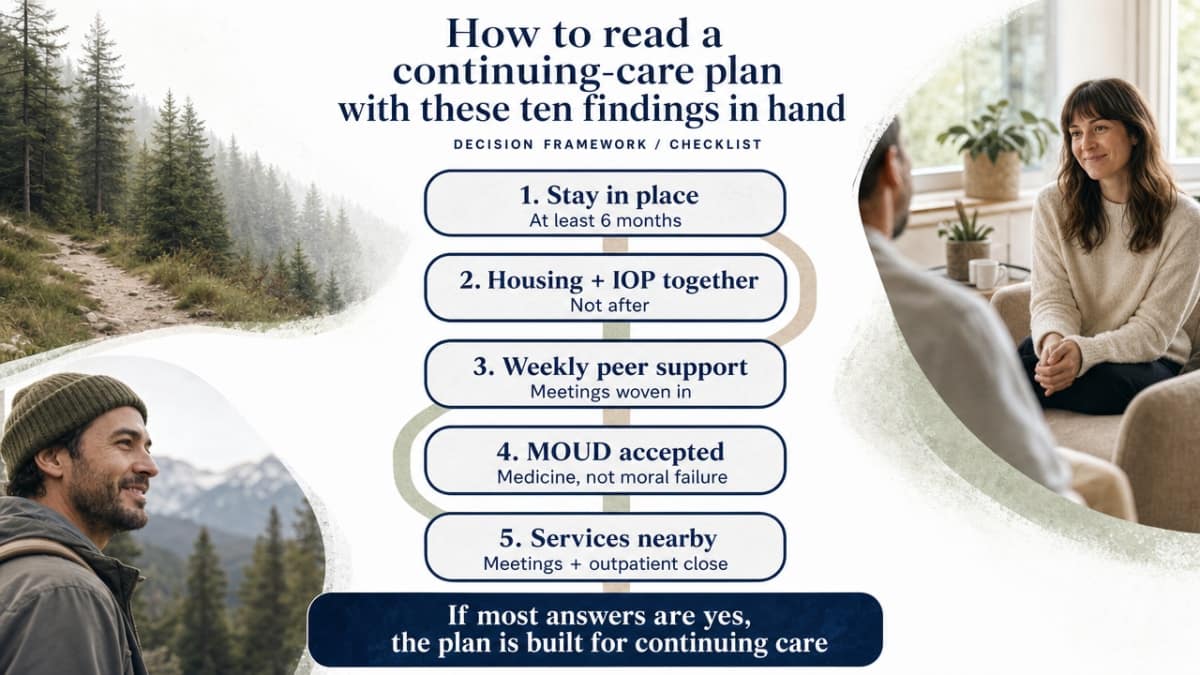
How to read a continuing-care plan with these ten findings in hand
You started this article looking for proof. What the research keeps giving you is something more useful, a set of questions to ask before your adult child moves into whatever comes next.
Use the findings as a checklist:
- Does the plan keep your child in place for at least six months, the window where outcomes durably shift 1?
- Does the sober living arrangement run alongside an intensive outpatient program, not after it, so retention and abstinence gains can compound 3, 10?
- Are peer meetings and mutual-help groups woven into the weekly rhythm 8?
- If your child takes medication for opioid use disorder, will the house treat that as medicine, not a moral failure 6?
- Is the neighborhood around the door rich in meetings and outpatient services within a short walk or drive 11?
You have carried this longer than anyone should have to. The evidence says the pathway that works is a home-like place to land, peers who understand, and step-by-step care that doesn’t end when detox does. Pacific Crest Trail Detox was built around that same belief.
See if recovery support is covered for you
Check your insurance to find out if structured sober living and ongoing care are included.
Frequently Asked Questions
How long should my adult child stay in a sober living home?
Aim for at least six months. That’s the threshold where the research shows durable change. Residents who stayed six months or longer in Oxford House recovery homes reported significantly less substance use, higher employment, and fewer pending criminal charges than those who left sooner 1. Shorter stays can still help, but the protective effects of peer routines and sober identity take time to settle in.
Is sober living actually more effective than going straight home after detox?
The evidence points clearly toward recovery housing. A 2025 systematic review found Oxford House residents had roughly half the past-six-month substance use rate of people receiving usual continuing care, higher employment, and fewer legal charges pending 4. Going straight home isn’t a failure path, but it removes the peer structure and accountability that studies keep linking to better outcomes. Housing works as clinical infrastructure, not scenery.
Can my child stay in a recovery home if they’re on buprenorphine or methadone?
Often yes, but ask directly before they move in. Research on medication for opioid use disorder inside recovery homes documents real benefits, extended support and reduced illicit use, alongside real tensions, including stigma from residents or staff holding abstinence-only philosophies 6. Confirm the house welcomes residents on prescribed medication without conditions, handles storage privately, and trains peers to treat the medication as legitimate care.
What should I look for when comparing sober living homes?
Look at length-of-stay expectations, whether the house pairs with an intensive outpatient program, and whether mutual-help meetings are woven into weekly life 1, 8. Also look outside the door. Sober living residents in neighborhoods with more outpatient services and AA meetings within reach had more abstinent days than those in resource-thin areas 11. Ask about medication policies, house rules, and how peer accountability actually works day to day.
Does sober living work better when combined with outpatient treatment?
Yes, and the combination is where the strongest gains show up. A study of 55 people who received outpatient treatment while living in a sober living house tracked significant improvements in substance use, arrests, and days worked across 18 months 3. A separate multi-level analysis found structured sober housing was linked to longer outpatient retention and better discharge status 10. Run them together, not one after the other.
What happens to people after they leave a sober living home?
The exit isn’t the cliff you might fear. In a randomized trial that followed more than 200 people for two years, 81.5% of those who left Oxford House residences reported no substance use during the following year 9. The peer relationships, routines, and sober identity built inside the house appear to be portable. Leaving well is possible, especially when the six-month threshold has been cleared first.
References
- Oxford Recovery Housing: Length of stay correlated with improved outcomes. https://pmc.ncbi.nlm.nih.gov/articles/PMC4826029/
- Benefits and Costs Associated with Mutual-Help Community-Based Recovery Homes. https://pmc.ncbi.nlm.nih.gov/articles/PMC3596872/
- Eighteen Month Outcomes for Clients Receiving Combined Outpatient Substance Abuse Treatment and Sober Living House Residence. https://pmc.ncbi.nlm.nih.gov/articles/PMC3008818/
- Recovery housing for substance use disorder: a systematic review. https://pmc.ncbi.nlm.nih.gov/articles/PMC11922849/
- Substance Abuse Treatment Patients in Housing Programs Respond to Contingency Management Interventions. https://pmc.ncbi.nlm.nih.gov/articles/PMC5154858/
- Medication assisted therapy and recovery homes. https://pmc.ncbi.nlm.nih.gov/articles/PMC9149684/
- How Stable Housing Supports Recovery from Substance Use Disorders. https://opioidprinciples.jhsph.edu/how-stable-housing-supports-recovery-from-substance-use-disorders/
- What Did We Learn from Our Study on Sober Living Houses and Where Do We Go from Here?. https://pmc.ncbi.nlm.nih.gov/articles/PMC3057870/
- Oxford House Recovery Homes: Characteristics and Effectiveness. https://pmc.ncbi.nlm.nih.gov/articles/PMC2888149/
- The Role of Recovery Housing During Outpatient Substance Use Disorder Treatment: A Multi-level Analysis. https://pmc.ncbi.nlm.nih.gov/articles/PMC8748296/
- Do Neighborhood Characteristics of Sober Living Houses Impact Recovery Outcomes?. https://pmc.ncbi.nlm.nih.gov/articles/PMC9928842/