


Key Takeaways
- A DUII often signals an underlying pattern of heavy drinking or untreated mental health issues, not a one-time mistake, and shame keeps most people from getting help 13.
- Oregon diversion pairs six concrete steps — fees, assessment, treatment, victim impact panel, abstinence, and interlock if ordered — with a DUII Treatment Completion Certificate that unlocks license reinstatement 1, 2.
- The strongest path combines medical detox when withdrawal is risky, followed by a Division-approved program using cognitive-behavioral therapy, mutual-help groups, and integrated care for co-occurring conditions 7, 8.
- Plan for the paperwork trap: completing treatment at a program that is not Division-approved leaves you without the DTCC the DMV requires, delaying license return 11.
If you’re reading this the morning after
If you’re reading this at 2 a.m. after the worst day of your life, breathe. You’re already doing something right.
A DUII arrest has a way of shrinking your whole world down to a jail cell, a court date, and a knot in your stomach that won’t go away. Maybe you haven’t slept. Maybe you haven’t told anyone yet. Maybe you’re staring at a bail slip and wondering how you’re going to explain this to the people you love, or whether you’ll still have a job on Monday, or a driver’s license by the end of the month.
Here is what you need to hear first: yes, you can recover after a DUII. People do it every day in Oregon, and the path is more defined than you might think. It has real steps, real support, and a real ending where you have your license, your job, and a clearer head than you’ve had in a long time.
You made it to this page. That counts. Keep going.
The short answer, and why Oregon’s system is built to help you get there
Here is the honest answer: yes, you can recover after a DUII, and Oregon’s response to your case is designed to move you toward that outcome, not away from it.
The federal safety framework that shapes state DUI policy explicitly pairs accountability with treatment. NHTSA guidelines for state impaired driving programs call for research-based sanctions combined with close supervision, screening, and treatment, alongside tools like ignition interlocks that are described as among the most effective actions to prevent repeat offenses 12. That is why your court date, your assessment, and your treatment referral all show up in the same conversation. They are meant to work together.
The research behind this approach is not soft. In a National Institute of Justice review of drug courts, participation in treatment-oriented court programs reduced re-arrest by 17 to 26 percent compared to traditional processing, with average public savings of $6,744 per participant 4. That study looked at drug court participants specifically, not every DUII case, but the principle carries: when courts route people into structured treatment instead of pure punishment, fewer people come back through the same door.
Translation for you, right now: the steps ahead are hard, but they add up to something. Keep reading.
What Oregon actually requires after a DUII
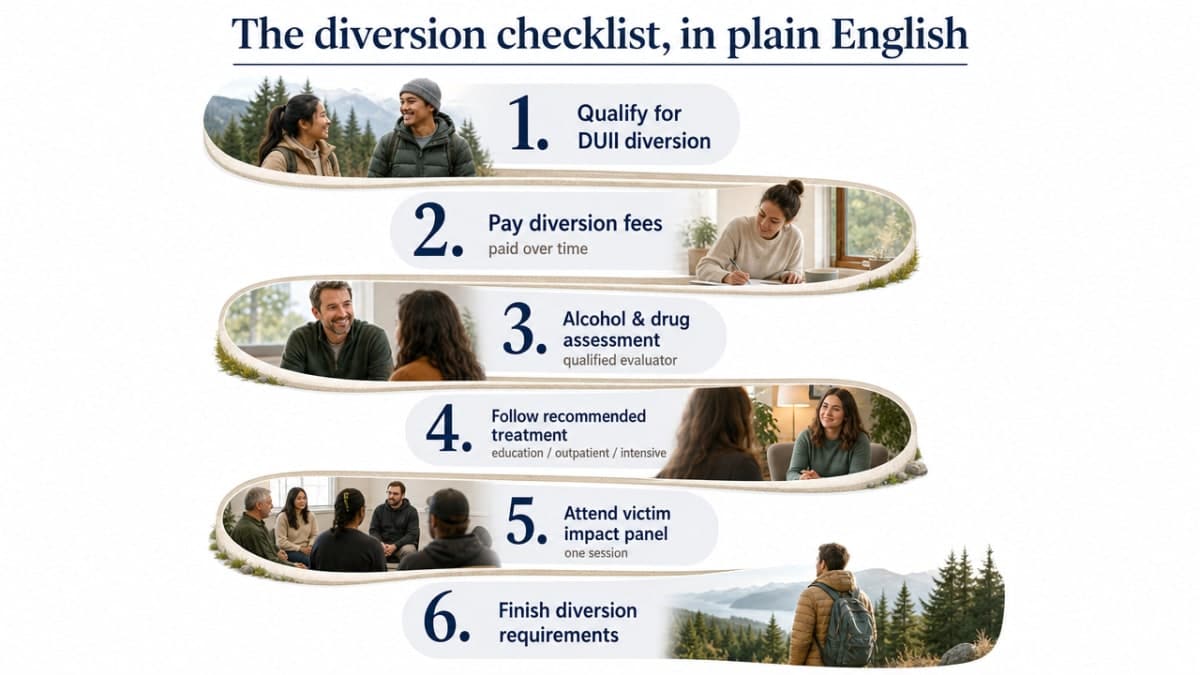
The diversion checklist, in plain English
If your case qualifies for Oregon DUII diversion, Oregon gives you a list. It is not a mystery. It is not a trick. It is six concrete things you need to do to have the charge dismissed, and once you see them written out, the whole thing feels less like a cliff and more like a set of stairs.
Here is what the court will ask of you 1:
- Pay the diversion fees. These are set by the court and paid over the diversion period, not all at once on day one.
- Complete an alcohol and drug abuse assessment. A qualified evaluator meets with you, asks honest questions, and recommends a level of treatment. Your job here is to tell the truth. The assessment guides everything else.
- Complete the recommended treatment program. Whatever the assessment says you need — education, outpatient, or more intensive care — you finish it.
- Attend a victim impact panel. One session, usually a few hours, where people affected by impaired driving speak. It is hard. It is also important.
- Do not use any alcohol or other intoxicant during the diversion period. This is monitored.
- Install an ignition interlock device if ordered. The small breath-test unit in your car that has to read clean before it starts.
That is the list. Six items. Do them, and the door to dismissal opens. Miss them, and the original charge comes back. So print it, tape it to the fridge, and start checking boxes.
The 12-hour education minimum and what a real program looks like
When the assessment points you toward a DUII services program, Oregon has a floor for what that program has to include. At minimum, you complete 12 hours of education spread across at least four sessions over four weeks, and you have to show you are not using — clean urinalysis tests during the program 3. That is the state floor. Many people need more than the minimum, and the assessment will say so.
What does a real program feel like from the inside? Small groups, a facilitator who has usually been in the field a long time, workbooks, honest talk about what led you here, and practical tools for what to do when the next stressful Friday night rolls around. It is not a lecture. It is not you sitting silently in a folding chair while someone shames you. A good program treats you like an adult who is figuring something out — because that is what you are.
If a program you are considering cannot tell you clearly how they meet these state standards, that is a signal. Ask the question out loud before you sign anything.
The paper the court needs: the DUII Treatment Completion Certificate
Here is the piece that matters more than almost anything else on paper: the DUII Treatment Completion Certificate, sometimes called the DTCC. It is the document that tells the court and the DMV that you did what you were asked to do.
The DTCC is a four-part form with a unique identification number, and it can only be issued by a Division-approved DUII services program in Oregon 11. That is not a small detail. If you complete a program that is not on the approved list, you can have done all the work and still be missing the one piece of paper the state will accept. Confirm your program is Division-approved before your first session.
Your first 90 days: a realistic timeline
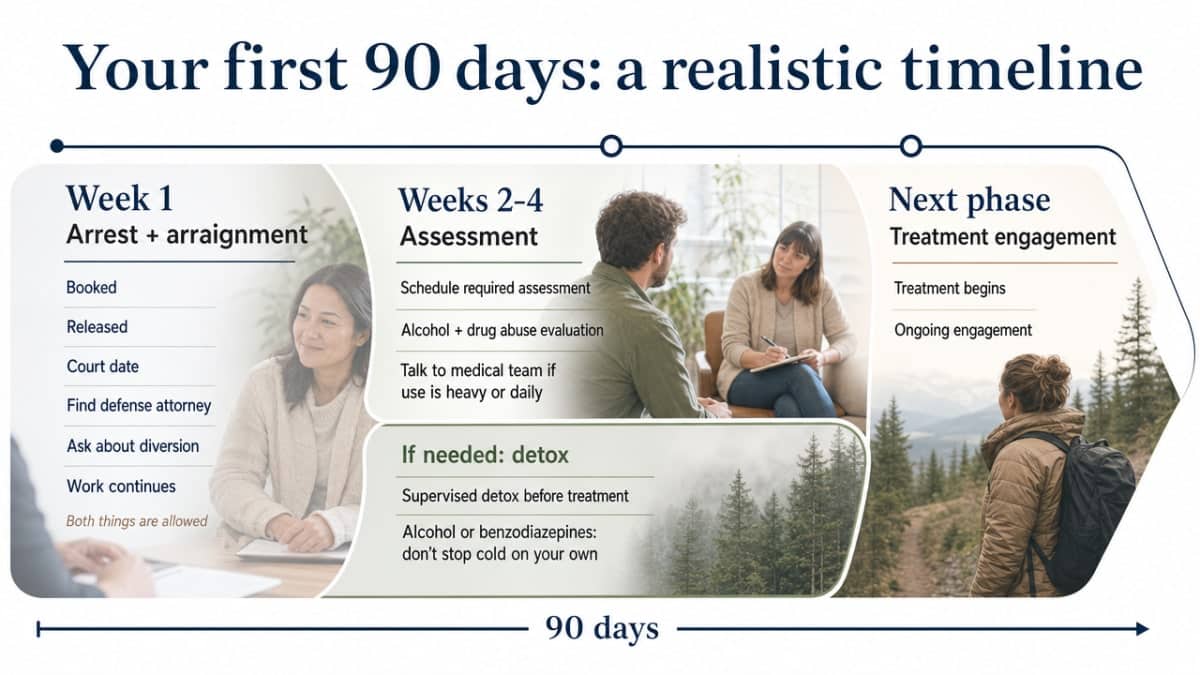
The scariest part of a DUII is not knowing what happens next. So here is what the next three months usually look like, laid out on a calendar you can actually picture.
Week 1 — Arrest and arraignment. You get booked, released, and given a court date, usually within a week or two. This is the week you find a defense attorney if you can, and start asking whether you qualify for diversion. It is also the week most people cry in the car and then get up the next morning and go to work anyway. Both things are allowed.
Weeks 2 to 4 — Assessment and, if needed, detox. You schedule the alcohol and drug abuse assessment the court requires. If your drinking or drug use has been heavy or daily, this is when you talk to a medical team about whether you need supervised detox before treatment begins. Stopping alcohol or benzodiazepines cold on your own can be dangerous — that call matters.
Months 1 to 3 — Treatment engagement. This is where the real work lives. At the state minimum, a DUII services program runs at least 12 hours of education across four or more sessions over four weeks, with abstinence confirmed through negative urinalysis 3. Many people are placed in longer or more intensive tracks based on the assessment. You show up. You take the tests. You start collecting the sessions that add up to the DUII Treatment Completion Certificate the DMV needs before you can drive again.
Ninety days in, you will not be done. But you will be in motion, and your file will show it.
When medical detox is the right first step
Signs your body needs medical support to stop safely
Not everyone with a DUII needs medical detox. Some people can taper, get support, and start outpatient care without a hospital-level intervention. Others cannot stop safely on their own, and pretending otherwise is dangerous.
Pay attention if any of these describe your last few weeks:
- You have been drinking daily, or close to it.
- You wake up shaky and need a drink or a pill just to feel level.
- You have been mixing alcohol with benzodiazepines like Xanax, Klonopin, or Ativan.
- You have had a withdrawal seizure before.
- You sweat through your shirt when you try to skip a night.
- Your heart races. You throw up. You cannot sleep without something.
Alcohol and benzodiazepine withdrawal can be life-threatening. That is not a scare tactic — it is why 24/7 nursing exists. If any of the above sounds like you, call a medical detox program before you try to white-knuckle it. In the Portland and Milwaukie area, Pacific Crest Trail Detox is one option built for exactly this moment. The call itself is free. Making it counts.
Why detox alone isn’t enough — and what comes next
Here is a hard truth that will actually save you time and money: detox is a doorway, not a destination.
SAMHSA’s clinical guidance is direct about this. Detoxification is a first step in treating a substance use disorder, and by itself it does little to change long-term drug or alcohol use without follow-up care 8. Translation: if you go through five to seven days of medically supported withdrawal and then walk out the door without a plan, your body feels better and your risk of going back is still high. You have not addressed the reasons you were drinking or using in the first place. You also will not have the paper the court needs.
What comes next is the continuum. After detox, most people step into a partial hospitalization program (a few hours a day, several days a week), then an intensive outpatient program, then standard outpatient with alumni support. Each step turns the volume down a little, and each step keeps you connected to a team while you rebuild the ordinary parts of life — work, family dinners, the drive home on a Friday.
The good news is this continuum lines up with what the court is asking of you anyway. Detox, then treatment, then documented completion. One path, not two.
What a home-like detox actually feels like
When people hear “detox,” they picture fluorescent lights, a gown, and a hospital hallway. That is one model. It is not the only one.
A non-hospital residential detox looks more like a house than a ward. There are bedrooms, not hospital beds. A living room where people sit with coffee. A kitchen where meals actually get cooked. Nurses are on site around the clock and a medical team manages your withdrawal with the right medications, but the setting itself is calm. You are not a chart. You are a person in a rough week getting through it with support.
Research on recovery-oriented systems of care backs up why this matters. People engage longer and do better when services are person-centered, strengths-based, and delivered in welcoming, community-linked settings 10. Pacific Crest Trail Detox has run this kind of setting in Milwaukie since 2017, and they work regularly with people facing a DUII. If the idea of a hospital was part of what was keeping you frozen, a home-like option might be the unlock you did not know existed.
Does court-ordered treatment actually work?
You are going to think this at least once, probably at 11 p.m. on a Tuesday: I’m only doing this because a judge is making me. It’s not going to stick. That fear is fair. It is also, according to the research, mostly wrong.
A review of mandatory treatment for substance use disorders found that legally coerced treatment is not less effective than voluntary treatment, and can produce comparable reductions in substance use when the programs themselves are evidence-based and respectful 9. Read that again. The outcomes for people who walk in because a court sent them look a lot like the outcomes for people who walk in on their own. Motivation shows up during the work, not before it.
There is even a wrinkle that cuts the other way. In a national study of adults with alcohol use disorders, justice referral was associated with higher treatment completion rates — meaning the people ordered into care actually finished at better rates than some who came in voluntarily 14. The external structure — court dates, check-ins, the DTCC waiting at the end — turns out to be useful scaffolding, not a punishment that ruins the work.
So when the shame voice tells you the treatment won’t count because your heart wasn’t in it on day one, tell it to sit down. Show up. Do the sessions. Take the tests. The data is on your side.
The fears you probably haven’t said out loud
Your license, your job, and your family
Let’s name the three things keeping you up at night.
Your license. Yes, a DUII suspension is real, and yes, you will need to get through the process to get driving privileges back. The DMV will not reinstate after a DUII suspension without proof of treatment completion — specifically, the DTCC from a Division-approved program 2. So the work you are doing is not busywork. It is the actual path to your keys.
Your job. Most people do not lose their job over a DUII, especially a first one, especially if they get ahead of it. Talk to a defense attorney before you talk to HR. Some jobs require disclosure. Many do not. If your work involves driving, an ignition interlock or a hardship permit conversation matters early. Do not guess — ask someone who reads Oregon employment situations for a living.
Your family. They already know something is wrong. What they need from you is not a perfect apology. It is a plan. Telling your partner or your parents, “I have an assessment scheduled Thursday, and I am starting a program,” lands very differently than “I don’t know what’s going to happen.” A plan is a gift you give the people who love you.
The shame spiral, and why you are not a moral outlier
The shame after a DUII can feel like proof that you are uniquely broken. You are not.
NIAAA data shows that millions of American adults meet criteria for alcohol use disorder in a given year, and only a small share of them receive any treatment 13. Read that carefully. Heavy drinking that quietly crosses a line is common. Getting help for it is rare. You are not the strange one for having the problem. You are actually doing the less common, harder thing by looking at it.
Shame tells you to hide. The next right move is to do the opposite — make one phone call, keep one appointment, tell one person the truth. Small, and it counts.
What good treatment looks like for alcohol-involved offenses
Not all DUII treatment is the same, and knowing what actually moves the needle helps you choose well.
A review of treatment for justice-involved adults with alcohol use disorders points to a specific combination:
- Cognitive-behavioral therapy that teaches you how to spot triggers and interrupt them
- Mutual-help participation like AA or SMART Recovery for the between-session hours
- Integrated care when there is a mental health condition sitting under the drinking 7
Anxiety, depression, PTSD, and unresolved trauma feed alcohol use. Treating one without the other is why some people cycle through programs twice.
That is why a place equipped to handle co-occurring disorders matters. Pacific Crest Trail Detox runs programs for people with anxiety, depression, PTSD, and trauma alongside the substance piece, and works with specific populations — veterans, LGBTQ+ individuals, working professionals — where the surface story and the underlying story are often not the same. Ask any program you are considering how they handle the mental health side. If the answer is vague, keep looking. If it is specific, you have found the kind of care that tends to hold.
Life after the certificate: staying steady
The day your DUII Treatment Completion Certificate goes to the DMV is a real milestone. It is not, however, the finish line. Staying steady after the paperwork is a different job than getting through it, and the people who do it well tend to keep a few things in place.
Keep one clinical thread active. Standard outpatient sessions, a therapist you actually like, or an alumni group at the place that treated you — pick one and protect the time on your calendar. Recovery-oriented care research points to person-centered, community-linked support as what keeps people engaged past the crisis phase 10. Translation: the connection is the medicine.
Add mutual-help support if you have not already. AA, SMART Recovery, Refuge Recovery — the meeting format matters less than the fact that you have somewhere to be on a hard Wednesday.
Pacific Crest Trail Detox runs alumni services for exactly this stretch, because the months after a certificate are when steady, low-key contact matters most. One year from tonight, this can be a story you tell, not a story you are living.
Check If Your Treatment After DUII Is Covered
See if your insurance covers detox and recovery support after a DUII.
Frequently Asked Questions
Will a DUII stay on my record forever in Oregon?
A DUII conviction stays on your driving record permanently in Oregon. Diversion is different — if you complete every requirement, the charge itself can be dismissed 1. That is a real, meaningful difference on paper and in your day-to-day life. Talk to a defense attorney about whether your specific case qualifies. That conversation is worth having early.
Do I have to go to detox before I can start DUII treatment?
Not always. Detox is a medical decision based on how your body will react to stopping, not a court checkbox. If you have been drinking daily or using benzodiazepines, a medical team should weigh in first — those withdrawals can be dangerous. Detox is a first step, not the whole treatment, and it works best when it connects directly into ongoing care 8.
How long does it take to get my license back after a DUII?
Timelines vary by case, but one thing is fixed: the DMV will not reinstate your driving privileges after a DUII suspension until it receives proof of treatment completion, with narrow exceptions 2. In practice, that means finishing your Division-approved program and getting the DUII Treatment Completion Certificate in the system. Start the assessment fast — every week you delay is a week added to the wait.
Does court-ordered treatment really work if I’m only doing it because I have to?
Yes, more often than people expect. A review of mandatory treatment found that legally coerced treatment is not less effective than voluntary treatment when the programs are evidence-based and respectful 9. You do not need to feel ready on day one. You need to show up, do the sessions, and stay honest. Motivation tends to build during the work, not before it.
What if I have anxiety, depression, or PTSD along with the drinking?
Then you need a program that treats both, not one at a time. Research on justice-involved adults with alcohol use disorders points to combining cognitive-behavioral therapy, mutual-help groups, and integrated care for co-occurring mental health needs 7. Ask any program directly how they handle the mental health piece. Pacific Crest Trail Detox works with anxiety, depression, PTSD, and trauma alongside the substance side.
Do I have to tell my employer or family about my DUII?
Family is your call, but a plan lands better than silence — “I have an assessment Thursday” is more useful to them than a vague apology. Employer disclosure depends on your contract, licensing board, or whether driving is part of the job. Ask a defense attorney before you say anything at work. Do not guess. One wrong conversation on Monday can be hard to undo.
References
- DUII Diversion : Programs & Services (Douglas County Circuit Court). https://www.courts.oregon.gov/courts/douglas/programs-services/pages/duii-diversion.aspx
- Proof of Treatment Completion Required for Reinstatement of DUII Suspension. https://www.law.cornell.edu/regulations/oregon/Or-Admin-Code-SS-735-070-0085
- DUII Services – Oregon Health Authority. https://www.oregon.gov/oha/hsd/amh-duii/pages/services.aspx
- Do Drug Courts Work? Findings From Drug Court Research. https://nij.ojp.gov/topics/articles/do-drug-courts-work-findings-drug-court-research
- Treating Substance Use Disorders in the Criminal Justice System. https://pmc.ncbi.nlm.nih.gov/articles/PMC3859122/
- The Effectiveness of Drug Treatment Courts: A Meta-Analysis of Outcomes. https://pmc.ncbi.nlm.nih.gov/articles/PMC3518785/
- Treatment of Offenders With Alcohol Use Disorders. https://pmc.ncbi.nlm.nih.gov/articles/PMC3423152/
- Detoxification and Substance Abuse Treatment (Treatment Improvement Protocol Series, No. 45.). https://www.ncbi.nlm.nih.gov/books/NBK64058/
- The Effectiveness of Mandatory Treatment for Substance Use Disorders: A Review. https://pmc.ncbi.nlm.nih.gov/articles/PMC4669581/
- Recovery-Oriented Systems of Care: A Review of the Evidence. https://pmc.ncbi.nlm.nih.gov/articles/PMC6599095/
- DUII Treatment Completion Certificate. https://www.oregon.gov/oha/hsd/amh-duii/pages/certificate.aspx
- Impaired Driving | Uniform Guidelines for State Highway Safety Programs. https://www.nhtsa.gov/uniform-guidelines-state-highway-safety-programs/impaired-driving
- Alcohol Facts and Statistics. https://www.niaaa.nih.gov/publications/brochures-and-fact-sheets/alcohol-facts-and-statistics
- Criminal Justice and Alcohol Treatment: Results from a National Study. https://pmc.ncbi.nlm.nih.gov/articles/PMC3518736/