
Key Takeaways
- Oregon Health Authority licensure is legally required for detox facilities, with two-year cycles and unannounced inspections that weed out non-compliant operators 1.
- LegitScript certification confirms a facility’s business identity, ownership, address, and honest marketing, filtering out patient brokering and deceptive advertising practices 2.
- Clinical accreditation from The Joint Commission or CARF, though voluntary in Oregon, signals a facility’s willingness to meet national standards for patient care 8.
- A 15-minute verification walkthrough covers checking OHA licensing, LegitScript’s directory, accreditation databases, staff credentials, and admission timelines to expose weak or fraudulent programs.
- Watch for red flags like vague addresses, pressure to travel out of state, wired-money demands, and admission waits beyond 48 hours 5.
- Legitimate medical detox includes evaluation, stabilization, and a clear transition plan into ongoing care rather than treating detox as a standalone service 9.
- Detox programs and Opioid Treatment Programs serve different purposes, with OTPs carrying separate federal certification, DEA registration, and accreditation requirements 3.
Is This Detox Actually Real? How to Verify an Oregon Facility
When a loved one needs help, the search for a detox facility can be overwhelming. You might find yourself staring at a website late at night, wondering if the promises are real. The addiction treatment landscape can be complex, with some operations not being as legitimate as they appear. Federal agencies even provide guides to help families navigate this, emphasizing the importance of verifying credentials before making a commitment 2.
This guide will empower you to quickly assess any Oregon detox facility, including Pacific Crest Trail Detox in Milwaukie, against three crucial credentials: state licensure, LegitScript certification, and clinical accreditation. By understanding what each of these verifies, you can confidently determine if a facility is legitimate and trustworthy.
The Three-Layer Trust Stack for an Oregon Detox
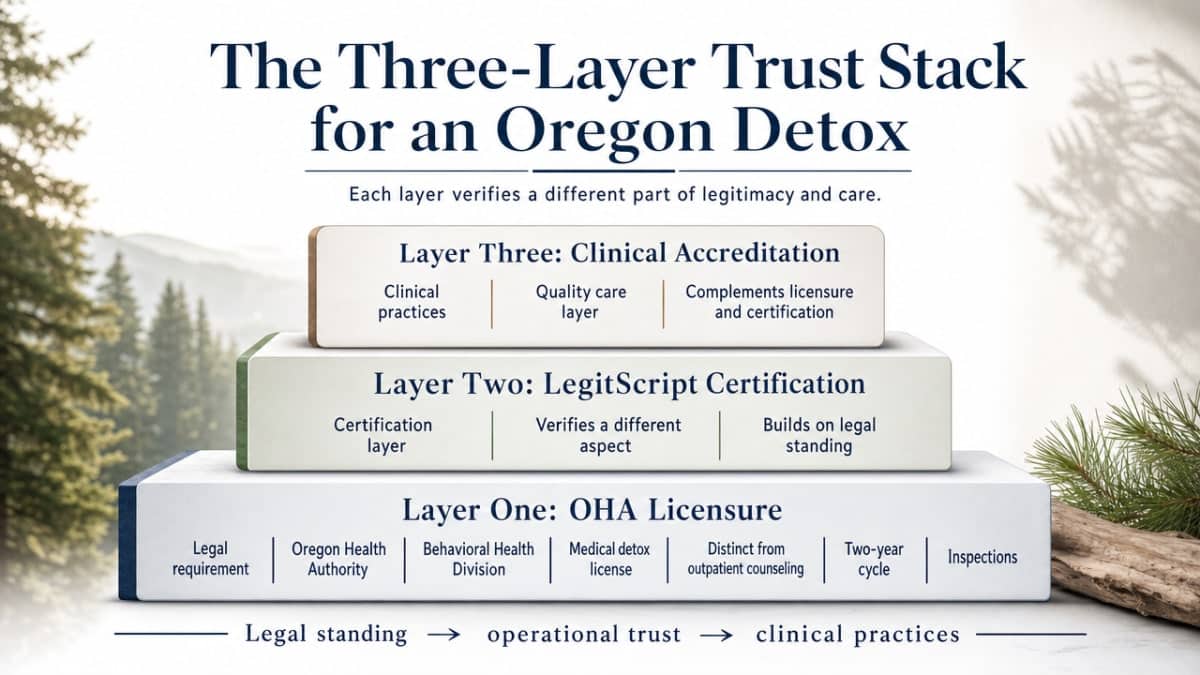
To ensure a detox facility is legitimate and provides quality care, it’s helpful to think of its credentials as a three-layer trust stack. Each layer verifies a different aspect of the operation, from its legal standing to its clinical practices.
Layer One: Oregon Health Authority Licensure
The foundational layer for any legitimate Oregon detox is a license from the Oregon Health Authority (OHA). This isn’t an optional badge; it’s a legal requirement. The OHA’s Behavioral Health Division oversees various behavioral health facilities, and withdrawal management programs have specific regulations 1. This means a facility offering medical detox must hold a license specifically for that service, distinct from licenses for outpatient counseling.
OHA licenses operate on two-year cycles, and the authority can conduct inspections with or without prior notice 1. This regulatory oversight makes it difficult for non-compliant operations to maintain their status. If a facility cannot readily provide its current OHA license number or is vague about its licensed service categories, it’s a significant red flag.
Layer Two: LegitScript Certification
LegitScript certification addresses the business and marketing integrity of a facility. Major platforms like Google and Facebook rely on LegitScript to verify addiction treatment advertisers. To achieve this certification, a facility must provide verifiable information about its physical address, ownership, staff credentials, and state licenses. It also commits to ongoing monitoring of its marketing practices.
This certification is crucial because it helps filter out deceptive practices, such as patient brokering or facilities that misrepresent their services. While LegitScript doesn’t evaluate clinical quality, it confirms that the business is real, operates at a legitimate address, holds the licenses it claims, and markets itself honestly. SAMHSA’s guidance for families emphasizes the importance of programs being transparent about their identity 2, and LegitScript plays a key role in verifying this transparency.
Layer Three: Clinical Accreditation (Joint Commission or CARF)
The third layer focuses directly on the quality of clinical care. National accrediting bodies like The Joint Commission (formerly JCAHO) and CARF conduct thorough reviews. Their surveyors visit facilities, examine patient records, observe medication administration, assess emergency procedures, and interview staff. This process ensures compliance with national standards for patient care, mirroring the onsite evaluation model used by federal regulators for opioid treatment programs 8.
In Oregon, this accreditation is voluntary for detox facilities. However, the state does require facilities to use standards endorsed by national accrediting bodies for credentialing their providers 10. SAMHSA recommends looking for accreditation as one of the five indicators of a quality treatment center 4. A facility that voluntarily undergoes this rigorous external review demonstrates a commitment to high clinical standards.
Comparing the Credentials
In summary, Oregon Health Authority licensure is a legal mandate, ensuring the facility meets state operational requirements and undergoes periodic inspections 1. LegitScript certification verifies the business’s authenticity and ethical marketing practices, a critical step for online visibility 2. Clinical accreditation from The Joint Commission or CARF, while voluntary in Oregon, provides an independent assessment of the quality of patient care through onsite evaluations against national standards 8. A facility possessing all three credentials offers a robust assurance of legitimacy and quality.
Your 15-Minute Verification Walkthrough
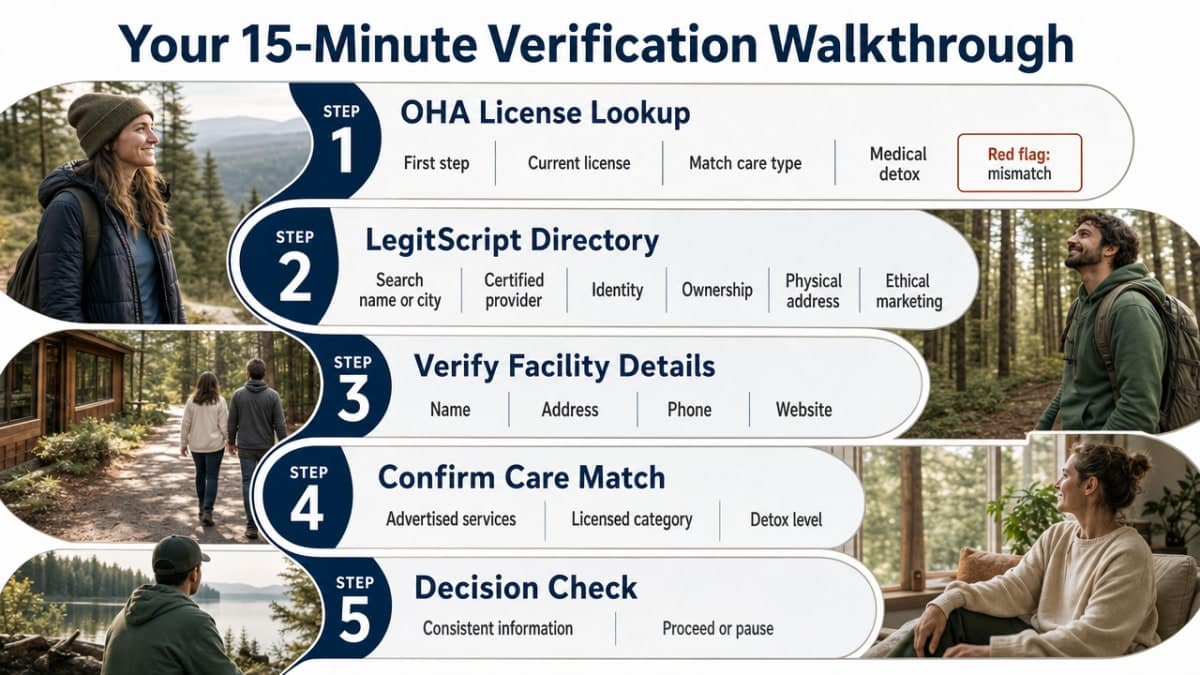
Here’s a practical, step-by-step guide to verify an Oregon detox facility, ensuring you have all the necessary information to make an informed decision.
1. Search the Oregon Health Authority License Lookup
Begin by visiting the Oregon Health Authority’s Behavioral Health licensing page. This is the non-negotiable first step. Confirm that the facility holds a current license for the specific type of care it advertises, especially for medical detox, which falls under distinct regulations 1. A mismatch between advertised services and licensed categories is a critical red flag.
2. Check the LegitScript Certified Provider Directory
Next, use LegitScript’s public certified provider lookup. Search for the facility by name or city. A listing here confirms that the business has been vetted for its identity, ownership, physical address, and ethical marketing practices. While not all legitimate programs are certified, its presence offers an additional layer of assurance that the facility is transparent about its operations 2.
3. Confirm Clinical Accreditation Directly
Do not rely solely on logos displayed on a facility’s website. Go directly to The Joint Commission’s Quality Check tool or CARF’s provider search. Verify the facility’s accreditation status, category (e.g., behavioral health care, substance use treatment), and current standing. Independent verification of accreditation is a key indicator of a quality treatment center 4.
4. Ask Key Staffing Questions
When you call the facility, ask specific questions about their clinical team: Who is the medical director, and are they licensed in Oregon? What are the credentials of the nurses and counselors who will be directly involved in care? Who supervises the clinical staff, and what licenses do they hold? Oregon regulations require clinical supervisors and staff to meet state licensure or certification standards 11, so a legitimate facility should answer these questions clearly and without hesitation.
5. Evaluate Admission Timelines
Recognizing Red Flags and Green Lights
Beyond official checks, your intuition can be a powerful tool. Pay attention to how a facility communicates and the overall impression it leaves. Red flags often include:
- reluctance to provide a physical street address or a mismatch with online maps;
- aggressive pressure to commit to out-of-state travel;
- vague answers about the medical director or staff credentials;
- demands for wired money or deposits before clear admission details are provided; and
- admission promises that extend beyond the critical 48-hour window 5.
Additionally, a focus solely on admission without discussing post-detox care is a concern 9.
Conversely, green flags indicate a trustworthy operation: a clearly named medical director, a verifiable Oregon address, transparent information about OHA license categories, and a clear plan for ongoing care after detox. If the person you speak with sounds knowledgeable and focused on clinical care rather than sales, you’re likely on the right track. Always compare notes from multiple facilities to make the best decision.
What Legitimate Medical Detox Should Include
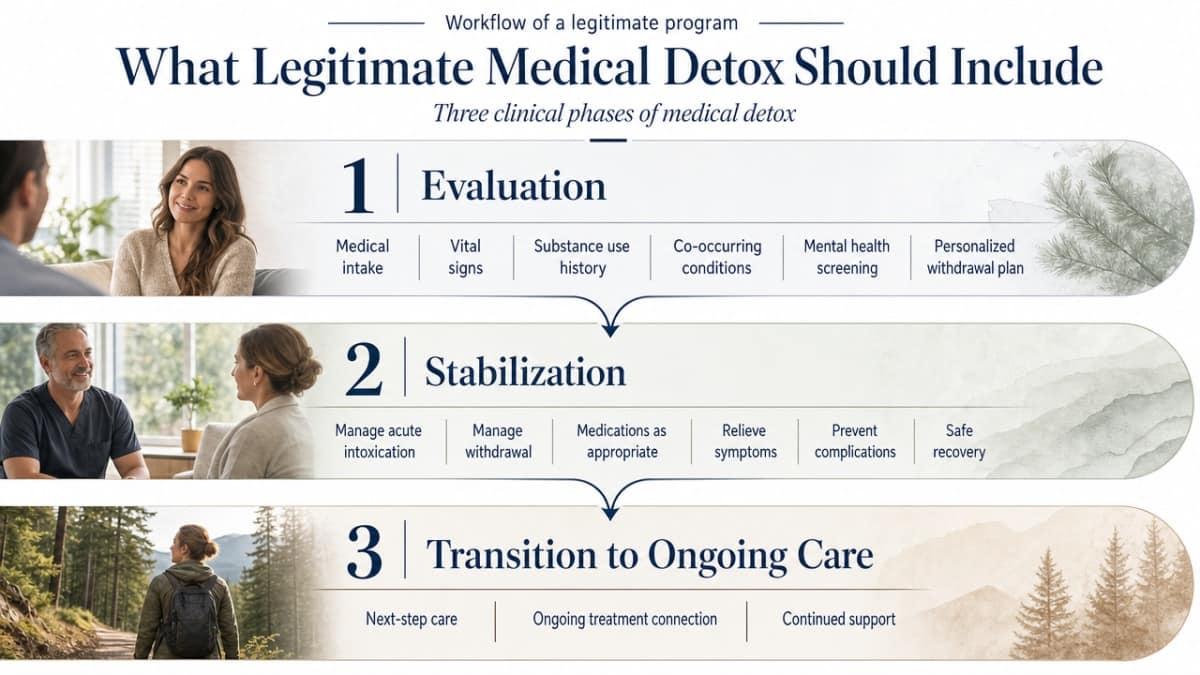
Once you’ve confirmed a facility’s legitimacy, understanding the components of effective medical detox is crucial. Federal clinical guidelines outline three essential phases that a quality program should provide 9.
Evaluation, Stabilization, and Transition to Ongoing Care
The first phase is a comprehensive evaluation. This involves a thorough medical intake, including vital signs, a detailed substance use history, assessment of co-occurring health conditions, and a mental health screening. This evaluation informs a personalized plan for managing withdrawal symptoms over the coming days.
Next is stabilization, which is the core of medical detox. This phase focuses on safely managing acute intoxication and withdrawal. Medications are used as appropriate to alleviate symptoms and prevent dangerous complications, allowing the body to safely clear substances 6, 9.
The third, and often overlooked, phase is fostering readiness for ongoing care. Detox is not a standalone treatment; it’s a critical first step. Federal guidelines emphasize that detox must be linked to subsequent treatment 9. A legitimate facility will discuss options for outpatient care, residential treatment, therapy, and medication management from the outset, not just at discharge.
Matching Care to Individual Needs
Effective detox is not one-size-fits-all. Clinical guidelines describe a spectrum of care intensity, ranging from ambulatory detoxification (daily monitoring while living at home) to medically managed intensive inpatient detoxification for the most severe cases 7. The specific level of care should align with the individual’s needs. For instance, alcohol and benzodiazepine withdrawal can be life-threatening and often require higher levels of medical supervision. Milder opioid withdrawal might be managed at a lower level with appropriate medications.
When inquiring, ask about the different levels of detox care offered and how the facility assesses an individual’s needs to determine the most appropriate placement. A facility that prioritizes matching intensity to the person’s clinical profile demonstrates a commitment to individualized, effective treatment, rather than simply filling beds 7.
Detox vs. Opioid Treatment Programs (OTPs)
It’s important to distinguish between a medical detox facility and an Opioid Treatment Program (OTP). An OTP is a federally designated clinic that dispenses medications like methadone for long-term opioid use disorder treatment. OTPs are subject to stringent federal regulations, requiring certification, accreditation, state licensure, and DEA registration 3. Their accreditation surveys specifically review compliance with national opioid treatment standards 8.
A medical detox, in contrast, is a short-term, supervised process focused on safely managing acute withdrawal symptoms and preparing an individual for the next phase of treatment 9. While a detox may use medications during withdrawal, it is not an OTP. An individual may need both services at different points in their recovery journey. A legitimate facility will clearly articulate its service category.
Verifying Pacific Crest Trail Detox
At Pacific Crest Trail Detox, we believe in transparency and accountability. We encourage families to use the same rigorous verification process outlined in this guide to confirm our credentials. As a non-hospital medical detox in Milwaukie, Oregon, we operate under the Oregon Health Authority’s regulations for residential withdrawal management and hold a current OHA license in that category 1. We invite you to look up our license and confirm that it specifically covers medical detox services.
You can also search for Pacific Crest Trail Detox in LegitScript’s public certified provider directory to verify our business and marketing integrity. Additionally, we encourage you to visit The Joint Commission’s Quality Check tool or CARF’s search directly to confirm our accreditation status, rather than relying solely on website badges 4.
When you call us, we welcome questions about our medical director, the credentials of our nursing and clinical staff, and their Oregon licenses 11. We are also prepared to discuss our comprehensive approach to transitioning patients to ongoing care after detox, as we understand that detox is just the beginning of the recovery journey 9. Our goal is to provide clear, specific answers that build trust and confidence in our commitment to ethical, high-quality care.
Check Your Insurance for Detox Coverage Now
See if your insurance supports LegitScript-accredited detox care in Oregon in just a few minutes.
Frequently Asked Questions
Is LegitScript certification mandatory for detox facilities in Oregon?
No, LegitScript certification is voluntary. However, Oregon does require a license from the Oregon Health Authority for residential facilities and detox centers 10. LegitScript certification indicates that a facility’s business and marketing practices have been verified, which is often a requirement for advertising on major platforms. Its absence doesn’t automatically mean a program is illegitimate, but its presence is a positive indicator.
What is the difference between LegitScript certification and Joint Commission accreditation?
LegitScript certification verifies the business operations and marketing ethics of a facility, ensuring it is a real entity with legitimate licenses and honest advertising. Joint Commission accreditation, on the other hand, involves an onsite review by trained surveyors who assess the quality of clinical care against national standards, similar to how federal regulators evaluate opioid treatment programs 8. One focuses on business integrity, the other on clinical excellence.
How can I verify an Oregon detox facility’s state license?
You can verify an Oregon detox facility’s license by visiting the Oregon Health Authority’s Behavioral Health licensing page. Search for the facility by name and confirm that its license is current and specifically covers withdrawal management services, as these are regulated separately from other behavioral health services 1. The OHA conducts both scheduled and unannounced inspections to maintain these records 1.
What questions should I ask a detox facility before admitting a loved one?
Key questions to ask include: the name and Oregon licensure status of the medical director; the credentials of the nurses and counselors providing direct care during withdrawal; the supervisor of the clinical team and their license; and details about the facility’s plan for transitioning patients to ongoing care after detox. A legitimate facility will provide clear answers to these questions, as Oregon regulations require clinical staff to meet specific licensure standards 11, and effective detox includes a plan for continued treatment 9.
How quickly should a legitimate detox program be able to admit someone?
According to SAMHSA’s guidance for families, if a program cannot admit a person within 48 hours, it is advisable to consider other providers 5. The urgency of withdrawal requires prompt intervention, and a reputable detox facility is structured to accommodate this need. Significant delays or pressure to travel long distances without immediate admission should be viewed as potential red flags.
Is a detox program the same as an Opioid Treatment Program (OTP)?
No, a detox program and an OTP are distinct. An OTP is a federally regulated clinic that provides long-term medication-assisted treatment for opioid use disorder, requiring specific certifications, accreditations, state licenses, and DEA registration 3. A medical detox, conversely, is a short-term process focused on safely managing acute withdrawal symptoms and preparing an individual for subsequent treatment 9. While both are crucial for recovery, they serve different purposes, and an individual may need both at various stages.
References
- Oregon Health Authority : Licensing and Certification : Providers. https://www.oregon.gov/oha/BH/Providers/Pages/Licensing-Certification.aspx
- Quality Treatment for Mental Health, Drugs and Alcohol. https://www.samhsa.gov/find-support/learn-about-treatment/finding-quality-treatment
- Become an Opioid Treatment Program (OTP). https://www.samhsa.gov/substance-use/treatment/opioid-treatment-program/become-otp
- Finding Quality Treatment for Substance Use Disorders. https://library.samhsa.gov/product/finding-quality-treatment-substance-use-disorders/pep18-treatment-loc
- Finding Quality Treatment for Substance Use Disorders. https://library.samhsa.gov/sites/default/files/pep18-treatment-loc.pdf
- Detoxification and Substance Abuse Treatment – NCBI – NIH. https://www.ncbi.nlm.nih.gov/books/NBK64115/
- Ambulatory detoxification in alcohol use disorder and opioid use disorder. https://pmc.ncbi.nlm.nih.gov/articles/PMC7653729/
- 93 PART 8—MEDICATION ASSISTED TREATMENT FOR OPIOID USE DISORDER. https://www.govinfo.gov/content/pkg/CFR-2020-title42-vol1/pdf/CFR-2020-title42-vol1-part8.pdf
- Quick Guide For Clinicians Based on TIP 45: Detoxification and Substance Abuse Treatment. https://nida.nih.gov/sites/default/files/samhsa_detoxification_and_substance_abuse_treatment.pdf
- Oregon Summary – State Residential Treatment for Behavioral Health Conditions. https://aspe.hhs.gov/sites/default/files/2021-08/StateBHCond-Oregon.pdf
- Permanent Administrative Order BHS 18-2026 – Oregon.gov. https://www.oregon.gov/oha/HSD/HSDRules/PERM_309-019-0125_0130.PDF