


Key Takeaways
- Stopping Ativan abruptly can trigger seizures, so a medically supervised taper in the Portland area—often converting lorazepam to a longer-acting benzodiazepine like diazepam—is the safer path 2.
- Modern guidance favors slow reductions of roughly 5–10% every 2 to 4 weeks, with pauses when symptoms flare, meaning a full Ativan taper often spans months rather than days 9, 10.
- Before choosing a program, compare intake thoroughness, medication and monitoring protocols, counseling access, the physical setting, and how the team handles co-use of alcohol or opioids 11.
- Ask about payment upfront: Oregon Health Plan supports detox through the state’s Section 1115 waiver, and most Portland-area residential programs also work with commercial insurance 8.
Why stopping Ativan on your own is dangerous
If you’ve been taking Ativan for an extended period, your body adapts to its presence. This biological adjustment means that suddenly stopping the medication can be risky. Ativan (lorazepam) is a benzodiazepine, and abrupt cessation can lead to severe withdrawal symptoms, including seizures. The safest method involves a slow, medically supervised reduction of the dose, often transitioning to a longer-acting medication to help your nervous system adjust gradually 2.
National guidelines, such as the 2025 joint clinical guideline on benzodiazepine tapering, recommend gradual, individualized dose reductions with careful monitoring for complications, especially if other medications like opioids are also being used 9. Oregon’s clinical advisory for prescribers reinforces this, stating that there’s no universal schedule and the tapering pace must align with your body’s response 10.
Choosing supervised detox is a proactive step towards safety. The challenges of withdrawal are significant, and having a medical team to monitor and manage symptoms makes the process much safer than attempting it alone. Reaching out for help is a sign of strength, not weakness.
How a supervised Ativan taper works
The taper math: slow reductions, not a countdown
A supervised Ativan taper is a deliberate, step-by-step process designed to allow your nervous system to adapt. It’s not about speed but about careful progression.
The 2025 joint clinical practice guideline on benzodiazepine tapering, developed by the American Society of Addiction Medicine and other specialty societies, advises reducing the dose by approximately 5–10% every 2 to 4 weeks. It specifically cautions against reductions exceeding 25% at once due to the significantly increased risk of withdrawal symptoms 9. This means your care team will make small adjustments to your daily dose, allowing your body several weeks to stabilize before the next reduction.
This modern approach contrasts with older protocols, such as a 1990s paper that described inpatient tapers of roughly 10% per day for individuals on high doses 12. Current guidance prioritizes slower, smaller reductions, emphasizing listening to the body’s response.
Similarly, the California Medicaid clinical review suggests an initial cut of 5–25%, followed by 10–25% reductions every two weeks, with the pace adjusted if symptoms intensify 1. These plans intentionally avoid fixed timelines, recognizing that individual responses vary.
The slow pace is crucial. A gradual reduction typically leads to milder symptoms, better sleep, and a significantly lower risk of severe withdrawal that could necessitate emergency care. This method gives your brain the necessary time to recalibrate effectively. Even maintaining a lower dose for a couple of weeks is significant progress.
Why lorazepam is often converted to a longer-acting benzodiazepine
Ativan is a short-acting medication, meaning it works quickly but also exits your system rapidly. This can lead to “inter-dose withdrawal,” where you experience symptoms like shakiness or jitters between doses, and disrupted sleep.
To mitigate this, many supervised tapers begin by switching from lorazepam to a longer-acting benzodiazepine, most commonly diazepam. The benefit is that a longer-acting medication maintains more stable levels in your body, reducing the intense peaks and valleys and making the taper reductions gentler 2.
The NCBI withdrawal management guidance explicitly states that managing benzodiazepine withdrawal safely often involves administering a benzodiazepine and gradually reducing the dose, frequently after converting to diazepam equivalents 2. Your medical team handles these conversion calculations.
While conversion is common, it’s not universal. Some tapers continue with lorazepam in progressively smaller doses. The decision is made thoughtfully, considering your dose history, other medications, and current symptoms.
The Oregon clinical view: no one-size-fits-all schedule
Oregon’s guidance for prescribers, from the Oregon Health Authority, emphasizes that there’s no single, universally effective approach to benzodiazepine tapering. The pace should always be determined by how the individual is experiencing withdrawal 10.
This means a quality detox program in the Portland area won’t adhere to a rigid, pre-set schedule. Instead, they will monitor your sleep, heart rate, anxiety levels, and mood, adjusting the plan as needed. If a reduction is manageable, the next step proceeds as planned. If symptoms intensify, the plan slows down or pauses at the current dose until stability returns. This flexibility is not a sign of poor planning but rather an adherence to modern, patient-centered guidance 9, 10.
Your input is vital. Communicating how you’re sleeping, how you feel in the mornings, or whether a recent dose reduction was difficult helps shape the taper. Your feedback is an integral part of the process.
What to expect during detox, week by week
Understanding the general progression of detox can provide a helpful framework, though individual experiences will vary.
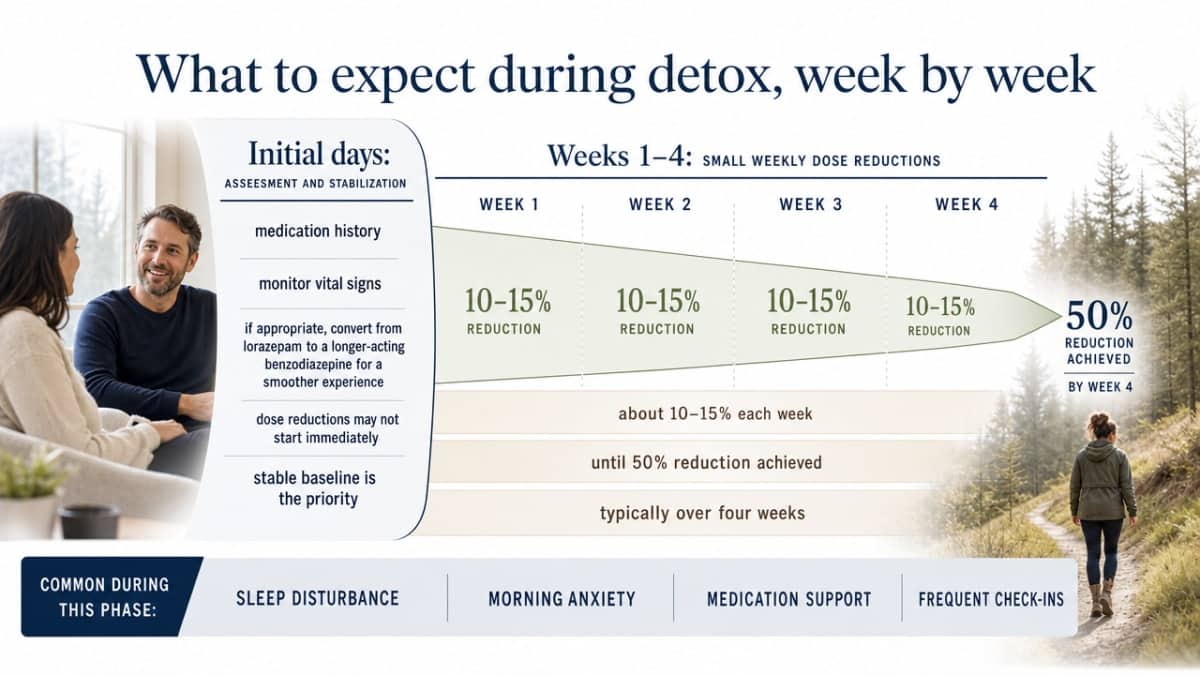
The initial days focus on assessment and stabilization. Your care team will gather your medication history, monitor vital signs, and, if appropriate, begin the conversion from lorazepam to a longer-acting benzodiazepine to create a smoother experience 2. Dose reductions may not start immediately, as establishing a stable baseline is the priority.
Weeks one through four often involve small, weekly dose reductions. For example, a VA quick-reference plan suggests cutting the dose by about 10–15% each week until a 50% reduction is achieved, typically over four weeks 13. During this phase, sleep disturbances and increased morning anxiety are common. Your team will provide medication support, conduct frequent check-ins, and adjust the pace if any step feels too challenging.
Following these initial reductions, a period of holding steady at a reduced dose is often recommended. The same VA guide suggests maintaining the 50% reduced dose for one to two months before further cuts 13. This pause allows your nervous system to reset at the new baseline before further changes are introduced. Achieving consistent sleep at a lower dose is a significant accomplishment during this period.
After the holding period, subsequent reductions typically become smaller and slower. The VA plan describes roughly 25% cuts every two weeks from that point 13. The 2025 ASAM joint guideline recommends 5–10% reductions every 2 to 4 weeks, strongly advising against reductions greater than 25% at once due to heightened withdrawal risk 9. The final stages of tapering, involving the lowest doses, often take the longest to complete.
Inside a home-like residential detox in the Portland area
Intake and assessment: the questions worth answering honestly
The initial phase of detox is characterized by thorough assessment. You’ll discuss your Ativan use history—dosage, frequency, duration, and any changes made by prescribers. Questions will also cover other medications, alcohol, opioids, cannabis, sleep aids, and any other substances used. Honesty during this conversation is crucial, as the tapering plan is directly informed by this information. The 2025 joint clinical guideline emphasizes that safe tapering relies on an accurate assessment of current substance use, co-occurring substances, and any conditions that increase withdrawal risk 9. Providing complete information ensures your care team has a full understanding of your needs.
You’ll also be asked about your history with anxiety, panic, trauma, and sleep—factors that often contribute to initial Ativan use. Your home support system will also be discussed. All these details help shape a personalized plan without judgment.
Medication support, monitoring, and counseling under one roof
A supervised detox program integrates three key components:
First, medication support involves the taper itself—gradual reductions of lorazepam or conversion to a longer-acting benzodiazepine like diazepam to stabilize levels 2. It also includes non-addictive medications to manage specific withdrawal symptoms, such as sleep aids, blood pressure medication, or muscle relaxants. The California Medicaid clinical review highlights the importance of adjunctive treatments when withdrawal risk is elevated 1.
Second, monitoring is continuous. Nurses regularly check vital signs, observing for subtle changes like increased heart rate, blood pressure fluctuations, or tremors, which could indicate that a dose reduction was too significant. If any concerning shifts occur, the taper pace is adjusted or paused.
Third, counseling provides essential emotional and psychological support. This includes one-on-one sessions to process emotions and experiences that emerge as the medication is reduced. Group sessions offer a supportive environment with peers undergoing similar processes, which can significantly reduce feelings of shame. Family sessions are also available when beneficial.
Having all these services coordinated by the same team in one location eliminates the stress of managing multiple appointments while your body is recovering.
Why the setting itself matters for a shaky nervous system
A benzodiazepine taper involves the nervous system gradually learning to function without the medication. A calm, supportive environment is crucial for this process. Traditional hospital settings, with their bright lights, loud announcements, and frequent disruptions, can exacerbate anxiety and make recovery more challenging.
A residential, home-like detox environment is a clinical choice designed to support healing. Features like quiet halls, comfortable beds, scheduled meals, and natural surroundings contribute to a sense of safety and stability. When your primary task is to help your brain feel secure again, the physical environment plays a significant role. Oregon’s addiction services framework supports this type of person-centered, community-based care as part of its comprehensive approach 5. The setting complements medical care and monitoring, rather than hindering it.
When Ativan isn’t the only substance in the picture
It’s common for individuals entering Ativan detox to have a history of using other substances. This might include alcohol to aid sleep, opioid prescriptions for pain, or other substances. Such co-use significantly influences the detox plan.
Practically, this often means detoxing from alcohol or stabilizing opioid use either before or concurrently with your Ativan taper. The sequence is determined by your care team to ensure maximum safety. Nurses provide more intensive monitoring, and all medications are carefully coordinated to prevent adverse interactions.
It is essential to be completely transparent with the intake team about all substances you are using. This honesty allows for the development of a safe and effective personalized plan.
What healing actually looks like after the taper
Completing an Ativan taper is a significant achievement, but it’s important to understand that it’s a milestone, not the end of the journey. For many, it marks the beginning of a slower, ongoing recovery process.
Some withdrawal symptoms resolve relatively quickly. Many individuals experience improved sleep within weeks of their final dose, and the inter-dose jitters cease. Appetite often returns to normal.
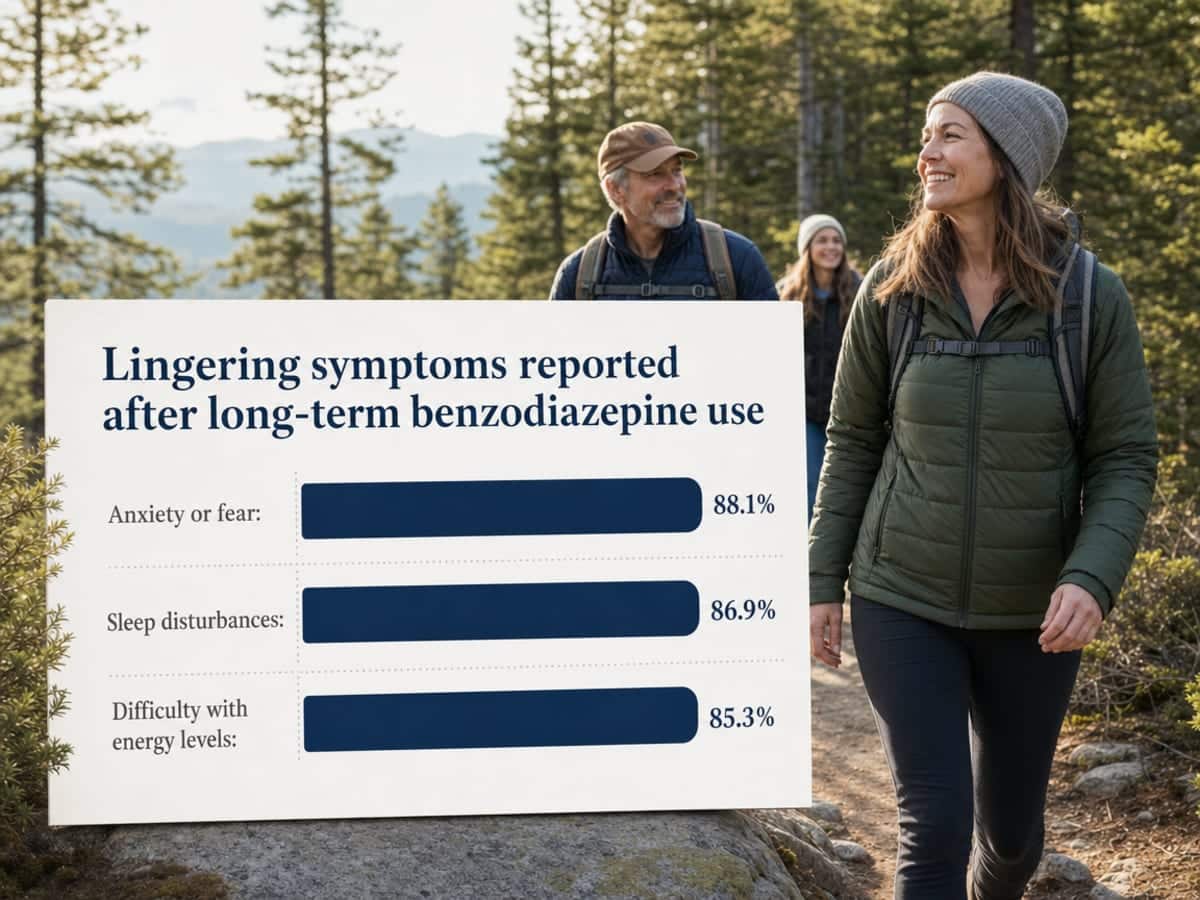
However, other symptoms can persist for months. A 2023 study involving individuals who reported long-term benzodiazepine-related issues found high rates of ongoing symptoms:
- 88.1% reported anxiety or fear
- 86.9% experienced sleep disturbances
- 85.3% struggled with energy levels 3
While this doesn’t represent everyone’s experience with Ativan, it highlights that lingering symptoms are a real possibility for some. Acknowledging this upfront helps manage expectations and build trust.
Understanding this reality is crucial. If you experience uneven sleep or unexpected waves of anxiety weeks after your last dose, it doesn’t mean you’re failing at recovery; it means your brain is still recalibrating. This is why continued counseling, group support, and regular check-ins with a clinician are vital after the medical detox phase. These supports can include talk therapy for underlying anxiety, guidance on sleep hygiene, or non-addictive medications for specific symptoms. Connecting with others who have navigated similar paths can also provide immense encouragement.
Healing is not a linear process. There will be good weeks and challenging weeks, but over time, the good weeks tend to outnumber the difficult ones. Continued engagement with your support system is key to sustained well-being.
Paying for detox in Oregon: OHP, commercial insurance, and access
Concerns about cost are common when considering detox. It’s important to get clear answers about payment options.
If you have the Oregon Health Plan (OHP), benzodiazepine detox and follow-up care are typically covered. Oregon’s Section 1115 waiver was specifically designed to expand access to substance use treatment for adults across the state 8. Coverage details can vary by facility, so it’s best to inquire directly about OHP acceptance.
Most private residential detox programs in the Portland area accept commercial insurance, such as plans obtained through employers or the marketplace. A quick call to the admissions team with your insurance information can usually provide a clear understanding of your coverage and any out-of-pocket expenses within a day.
Oregon’s addiction services framework aims to connect individuals with appropriate care regardless of their starting point 5. When you call to inquire about tapering, also ask about payment options; both are essential parts of the conversation.
For family members: how to help without pushing too fast
For partners, parents, adult children, or close friends supporting someone through Ativan tapering, the natural inclination might be to expedite the process. However, it’s crucial to resist this urge.
The most beneficial action you can take is to respect and protect the slow pace of the taper. A supervised Ativan taper is intentionally gradual because dose reductions exceeding 25% significantly increase withdrawal risk 9. If your loved one is having a difficult week, it’s not a signal to push harder; it often means the care team needs to maintain the current dose until symptoms stabilize 10. Trusting these clinical decisions, even if the timeline extends, is vital.
Practical support, such as ensuring quiet mornings, providing predictable meals, offering rides to appointments, and asking “what do you need today?” instead of “when will this be over?” can be incredibly helpful. Acknowledge small victories, like a full night’s sleep or a calm afternoon. Ask your loved one what they find comforting or helpful when anxiety spikes, and use those specific words or actions.
Remember to also prioritize your own well-being. Your stability and calm presence are a significant source of support.
Making the first call
Initiating the detox process can feel daunting, but the first step is often just gathering information. You don’t need to commit to anything immediately. Inquire about what a taper would look like for your specific dose, whether your insurance is accepted, and potential bed availability.
When you call, have your current prescription bottle, a rough history of your dosage, and an honest list of any other substances you’re using. This information is sufficient for a team like Pacific Crest Trail Detox to begin planning a medically supervised taper, offering counseling, and providing a supportive environment for your nervous system to regain stability.
Check Your Coverage for Ativan Detox Support
Find out if your insurance covers safe, supervised Ativan detox in Portland.

Frequently Asked Questions
How long does Ativan detox usually take in a supervised program?
A full Ativan taper often runs several months, not several days. Current national guidance suggests dose reductions of about 5–10% every 2 to 4 weeks, with holds when symptoms flare 9. Your exact timeline depends on your starting dose, how long you’ve been on it, and how your body responds. Slower is safer, and steady progress counts.
Is it safe to stop taking Ativan cold turkey at home?
No. Stopping benzodiazepines abruptly is one of the few withdrawals that can cause seizures. The safest approach is a gradual dose reduction under medical supervision, sometimes after converting to a longer-acting benzodiazepine 2. Oregon’s clinical guidance is direct that pace should be adjusted to your symptoms rather than forced 10. Please don’t try to power through this alone.
What withdrawal symptoms should I expect during an Ativan taper?
Common symptoms include anxiety, disrupted sleep, muscle tension, tremor, irritability, and sensitivity to light or sound. Severe risks like seizures are why supervision matters 9. In a well-paced taper, symptoms are usually manageable and often lessen between reductions. If a step feels too sharp, your care team slows the pace or holds the current dose until things settle 10.
Does Oregon Health Plan (OHP) or commercial insurance cover Ativan detox?
Oregon’s Section 1115 waiver was designed to expand Medicaid access to substance use treatment for adults, so OHP does support detox and follow-up care at participating facilities 8. Coverage varies by program, so ask directly. Most private residential detox centers in the Portland area accept commercial insurance — a call to admissions with your card in hand usually gets a clear answer quickly.
What happens if I’m using Ativan along with alcohol or opioids?
Tell your care team. Combining Ativan with opioids or alcohol raises the risk of dangerous breathing suppression during withdrawal, which is why clinicians treat it as a higher level of care from the start 11. The 2025 joint guideline flags concurrent opioid use as a reason for closer monitoring 9. Your plan will coordinate substances so the sequence keeps you safest.
Will I feel completely back to normal once the taper is done?
Many people feel steadily better in the weeks after their final dose. Some experience symptoms that linger longer — uneven sleep, waves of anxiety, low energy — as the nervous system keeps recalibrating 3. That doesn’t mean you’re doing recovery wrong. Ongoing counseling, group support, and clinical check-ins help with the parts that take longer. Healing here isn’t linear, and it does continue.
References
- Clinical Review: Recommendations for the Tapering of Benzodiazepines. https://medi-calrx.dhcs.ca.gov/cms/medicalrx/static-assets/documents/provider/dur/educational-articles/dured_31028_Clinical_Review_Recommendations_for_the_Tapering_of_Benzodiazepines.pdf
- Withdrawal Management. https://www.ncbi.nlm.nih.gov/books/NBK310652/
- Long-term consequences of benzodiazepine-induced neurological dysfunction. https://pmc.ncbi.nlm.nih.gov/articles/PMC10309976/
- Substance Use. https://www.oregon.gov/oha/ph/preventionwellness/substanceuse/pages/index.aspx
- Oregon Health Authority : Addiction Services. https://www.oregon.gov/oha/hsd/amh/pages/addictions.aspx
- Substance Use Disorder Integration Report. https://www.oregon.gov/oha/HSD/AMH/DataReports/SUD-Integration-Report.pdf
- State Variation in Opioid and Benzodiazepine Prescriptions by Provider Type. https://pmc.ncbi.nlm.nih.gov/articles/PMC4754105/
- Oregon Health Plan 2021-2026 Substance Use Disorder 1115 Waiver (SUD MPA Report). https://www.ohsu.edu/sites/default/files/2024-10/SUD%20MPA%20Report%20Final.pdf
- Joint Clinical Practice Guideline on Benzodiazepine Tapering. https://pmc.ncbi.nlm.nih.gov/articles/PMC12463801/
- How to Approach a Benzodiazepine Taper. https://www.oregon.gov/oha/HPA/DSI-Pharmacy/MHCAGDocs/Tapering-Benzodiazepines.pdf
- Risks, Management, and Monitoring of Combination Opioid, Benzodiazepine, and/or Alcohol Use. https://pmc.ncbi.nlm.nih.gov/articles/PMC4057040/
- Detoxification from Benzodiazepines: Schedules and Strategies. https://pubmed.ncbi.nlm.nih.gov/1675694/
- Re-evaluating the Use of Benzodiazepines: A Quick Reference Guide. https://www.pbm.va.gov/PBM/AcademicDetailingService/Documents/508/10-1527_BENZOS_QRG_508conformant.pdf