


Key Takeaways
- Start with a medical assessment from a licensed clinician before changing your Ambien use, since dose, duration, and other substances in the mix shape a safe plan.14
- Know the difference between rebound insomnia and true withdrawal: shaking, vomiting, sweating, confusion, or seizures signal a medical emergency, not something to wait out alone.1, 17
- Supervised withdrawal management moves through assessment, active detox with vitals monitoring, stabilization, continued care, and aftercare, with each step reducing the chance of relapse or harm.13
- Treat the insomnia, anxiety, or stress underneath the pill using approaches like cognitive behavioral therapy for insomnia, so you aren’t just trading one medication for another.4
- Vet Oregon programs by confirming Oregon Health Authority licensure, ASAM withdrawal-management level (3.2-WM or 3.7-WM), 24/7 nursing, and written sedative-hypnotic protocols.9, 18
- Match the setting to your risk: medically monitored inpatient fits higher doses or co-use of alcohol and benzodiazepines, while residential or outpatient can work for lower-risk situations.9
- Plan for life after detox through PHP, IOP, outpatient, and alumni support, because months three through twelve are when people most often drift back toward old patterns.
- Geography is flexible; what matters is one honest phone call where admissions asks about your dose, co-use, and prior attempts, then helps you find the right level of care.
When a prescription sleeping pill becomes something harder to stop
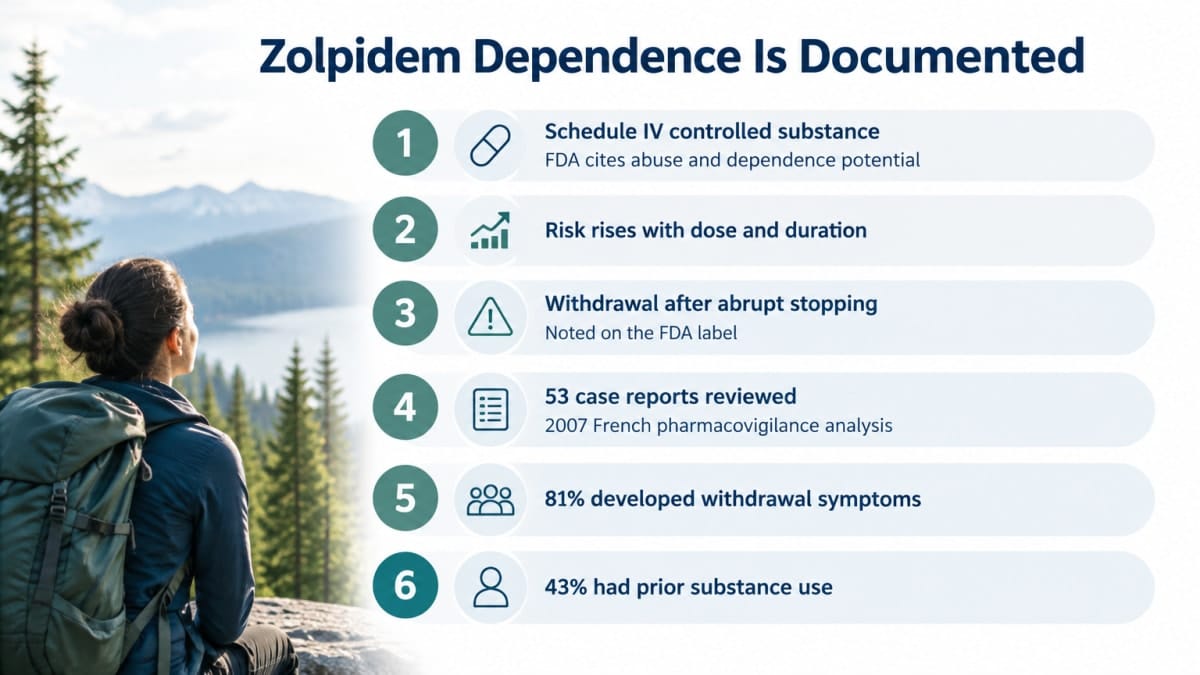
If you’re searching for Ambien addiction treatment, the safest first step is a medical assessment with a licensed clinician, not a cold-turkey attempt at home. Zolpidem (the generic name for Ambien) is a Schedule IV controlled medicine, and the FDA label warns that stopping it suddenly can cause tremors, vomiting, sweating, convulsions, and delirium.1 Supervised care, individualized to your dose and history, is the path with the fewest surprises.
You probably didn’t picture yourself here. A doctor handed you a prescription for sleep, and it worked, and then one pill stopped being enough, or the thought of a night without it became unbearable. That isn’t weakness. Physical dependence on zolpidem is documented in the official prescribing information, and the risk climbs with higher doses and longer use.14 You deserve calm, honest information and real help, in that order.
Is Ambien really addictive, or is this just a bad habit?
You’re not imagining it, and you’re not making it up to feel better about a hard month. Zolpidem has a documented potential for abuse and physical dependence, which is why the FDA classifies it as a Schedule IV controlled substance and warns that risk climbs with dose and duration of treatment.14 The label specifically notes reports of withdrawal signs after rapid dose decrease or sudden stopping.1 That’s not a lifestyle problem. That’s pharmacology.
Here’s where it gets more concrete. A 2007 pharmacovigilance review from the French drug-dependence network pulled together 53 published case reports of zolpidem use. Of those patients, 81% developed withdrawal symptoms after stopping, and 43% had a prior history of substance use.6 Two scope notes matter: these numbers come from selected case reports in the medical literature, not from everyone who has ever been prescribed Ambien, and the review itself is older data. Published cases skew toward the more severe end. What they do tell you is that dependence on zolpidem is real enough that clinicians have been writing it up for decades.
Peer-reviewed reviews echo that pattern. Rebound insomnia and withdrawal symptoms have been linked to sudden discontinuation, including at therapeutic doses, with greater risk among people who also have alcohol or other drug use in the mix.5 So if you’ve been taking Ambien every night for a year, started needing a second pill to get the same quiet, or feel panicky when you think about running out, that isn’t a willpower failure. It’s your nervous system telling you it got used to the medicine.
Calling it addiction doesn’t make you weak. It makes you accurate, and accuracy is what gets you to the right kind of help.
Warning signs that Ambien use has crossed a line
Most people don’t wake up one morning and realize they’re dependent on a sleeping pill. It creeps in. One night you take an extra half-tablet because the first one didn’t work. A few months later, you’re refilling early, or asking a second prescriber, or feeling a quiet dread at 10 p.m. because what if tonight is the night it stops working. If any of that sounds like you, pay attention.
Here are the patterns clinicians look for when they’re trying to tell ordinary insomnia treatment apart from something that needs more care:
- You’ve needed more to get the same effect. Case literature documents patients whose daily zolpidem use climbed well above prescribed doses over time, sometimes into the hundreds of milligrams.4 Tolerance developing over time with later withdrawal symptoms has also been documented.7
- You panic at the thought of running out. That’s not drama. It’s your body anticipating withdrawal.
- You’ve tried to stop and couldn’t. Symptoms like tremors, sweating, and bounce-back insomnia pull you right back to the bottle.1
- You’re combining Ambien with alcohol, opioids, or benzodiazepines to sleep or to feel calm. The FDA specifically warns about this combination because of respiratory risk.12, 14
- You’ve had sleep-driving, sleepwalking, or memory gaps you can’t explain. FDA added a boxed warning in 2019 after serious injuries and deaths linked to these complex sleep behaviors.15 These aren’t proof of addiction on their own, but they’re a signal that something about this medication isn’t safe for you.
You don’t have to check every box. Two or three is enough reason to talk to someone who treats this for a living.
What Ambien withdrawal actually feels like
Before you can decide what kind of care you need, it helps to know what you’re actually dealing with. Two very different things can happen when you stop taking Ambien, and people (sometimes even clinicians) mix them up. One is uncomfortable but passes. The other can land you in an emergency room.
Rebound insomnia vs. true withdrawal
Rebound insomnia is the sleep problem that comes back shortly after you stop zolpidem. It can feel worse than the insomnia you had before you ever started the medicine, which is cruel but typically short-lived. Peer-reviewed reviews describe this as a rebound that has been reported even at normal, prescribed doses, with the risk running higher in people who also use alcohol or other drugs.5 If you stop one night and lie awake staring at the ceiling, that alone doesn’t mean your body is in medical trouble. It means your sleep system is adjusting.
True withdrawal is a different animal. The FDA label for Ambien lists the signs that have been reported after rapid dose decrease or abrupt stopping: stomach or muscle cramps, vomiting, sweating, tremors, convulsions, and delirium.1 Those symptoms involve your whole nervous system, not just your sleep. The label specifically notes that risk is greater in people who have had a problem with drugs or alcohol in the past.1
Why abrupt stopping can be dangerous
Here is the part people underestimate. In the published medical literature, there is a case of a patient taking roughly 100 to 150 milligrams of zolpidem daily who had generalized tonic-clonic seizures about 16 hours after their last dose.17 That is a single case, not a prevalence number, and most people who stop Ambien will not have a seizure. But seizures from sedative-hypnotic withdrawal are real enough that SAMHSA groups zolpidem’s drug class with alcohol and benzodiazepines when it says medical intervention may be required during withdrawal.13
The risk climbs if you’ve been taking Ambien at doses above what was prescribed, taking it for a long time, or combining it with alcohol, benzodiazepines, or opioids. CDC guidance flags non-benzodiazepine sedative-hypnotics like zolpidem specifically when they’re mixed with opioids, because of respiratory depression risk.12 Your nervous system has been quieted by this medicine, sometimes for years. Pulling that quiet away all at once can leave it in overdrive.
None of this is meant to scare you into another refill. It’s meant to make the case for stopping with someone qualified next to you, not alone in your bedroom at 2 a.m. hoping it passes.
What safer Ambien care actually looks like
Safer care isn’t a secret protocol. It’s a sequence: someone qualified looks at the whole picture, then helps you come off the medicine at a pace your nervous system can handle, then helps you learn to sleep without it. Each step matters, and skipping any one of them is where people get hurt.
The medical assessment that should come first
Before anyone talks about tapering, stopping, or switching medicines, a clinician needs the full story. A good assessment is a conversation, not a form. Expect questions about your current Ambien dose, how long you’ve been taking it, whether you’ve increased it on your own, and what happens on nights you skip. The FDA label specifically asks prescribers to weigh dose, duration, and prior substance use when thinking about withdrawal risk, so these questions aren’t nosy. They’re how a safe plan gets built.14
The assessment should go wider than the pill in your bedside drawer. CDC guidance encourages clinicians to review prescription-drug-monitoring data to spot overlapping controlled-substance prescriptions and the overdose risks that come with them.11 That means someone should ask about any opioids you take for pain, any benzodiazepines like Xanax or Klonopin, how much alcohol you drink, and other sedating medications. Mixing zolpidem with opioids or alcohol raises the risk of respiratory problems, and the CDC calls out non-benzodiazepine sedative-hypnotics like Ambien by name in that warning.12
You’ll also be asked about sleep behaviors you may be embarrassed to describe: sleep-driving, sleep-eating, texts you don’t remember sending, mornings you woke up bruised. The FDA added a boxed warning in 2019 because these complex sleep behaviors have caused serious injuries and deaths.15 Say it out loud. It changes the plan.
Supervised withdrawal management, step by step
SAMHSA groups sedative-hypnotics alongside alcohol, opioids, and benzodiazepines as substances where medical intervention is likely to be required during withdrawal.13 That’s the plain reason supervised care exists. Here’s what the actual sequence usually looks like, so you aren’t walking in blind.
- Assessment and planning. A clinician reviews your dose, your other medications, your medical history, and your prior attempts to stop. The current FDA label is clear that abrupt discontinuation can trigger tremors, vomiting, sweating, convulsions, and delirium, which is why no one should set this plan alone.1
- Medically supervised withdrawal management. This is the active phase, done with nurses and providers watching your vitals and your symptoms. There is no single consensus protocol for zolpidem detoxification. The published case literature describes options like substitution with a longer-acting benzodiazepine followed by a gradual taper, individualized to the patient.3, 4 What matters is that the plan is written for your body, not pulled off a shelf.
- Stabilization and sleep support. Once the acute symptoms settle, the focus shifts to helping your body remember how to sleep without zolpidem. That’s where behavioral approaches start pulling weight.
- Continued care. Detox alone rarely holds. The next step is usually a partial hospitalization program, intensive outpatient, or standard outpatient care, chosen based on how much structure your life needs.
- Aftercare and alumni support. Months three through twelve are where a lot of people slip. Groups, check-ins, and a community you can call matter here, especially if insomnia or anxiety flares back up.
Picture it as five rooms you walk through, not five hoops to jump. Each one has a job. Skip one and the next one gets harder.
Treating the insomnia and life stress underneath the pill
Here’s the honest part. If no one addresses the reason you started taking Ambien in the first place, your odds of staying off it drop. The pill was a tool for a problem, and that problem is usually some combination of chronic sleep trouble, anxiety, grief, pain, a brutal work schedule, or trauma that gets loud at night. Trade one medication for another and you haven’t actually learned to sleep.
The recent clinical literature discusses CBT-I as one component clinicians may incorporate into zolpidem detoxification planning, alongside medication options, with treatment individualized to the patient.4 CBT-I is behavioral work: resetting your sleep schedule, retraining your brain to associate bed with sleep, loosening the grip of nighttime anxiety. It doesn’t require a prescription, and it tends to hold up over time.
Good continued care also makes room for the life stuff. Individual therapy for the anxiety or depression that was running in the background. Group therapy where you hear other people describe your exact 3 a.m. If a mental health condition needs higher-level treatment, your team should say so and help you get it, not pretend it isn’t there.
You stopped taking the pill. Now you get to build something better than what the pill was patching.
How to vet a withdrawal-management program in Oregon
Not every program that says it does detox is set up to safely bring you off Ambien. In Oregon, withdrawal-management programs have to be licensed by the Oregon Health Authority to provide detoxification services, and they’re approved at specific ASAM levels of care.18, 9 Knowing what to ask turns a confusing phone call into a short list of yes-or-no answers.
Here’s the shortlist to run through before you commit to a bed:
- Is the program licensed by the Oregon Health Authority for withdrawal management? OHA licenses or certifies substance-use and co-occurring treatment providers for the specific levels of care they offer.10 Ask for the license category in plain language, not a brochure.
- What ASAM withdrawal-management level are you approved for? OHA recognizes levels like 3.2-WM (adult clinically managed residential withdrawal management) and 3.7-WM (adult medically monitored inpatient withdrawal management).9 If you’ve been on high-dose Ambien, mixing it with alcohol or benzodiazepines, or you have a history of seizures, 3.7-WM is the more medically watched setting.
- Who’s on-site, and when? Ask about 24/7 nursing, how often a prescriber rounds, and what happens if you have a seizure or your blood pressure spikes at 3 a.m.
- Do you have written protocols for sedative-hypnotic withdrawal? SAMHSA groups zolpidem’s drug class with alcohol and benzodiazepines as substances where medical intervention may be required.13 A real program has written policies for this, not improvisation.
- How do you handle the handoff to continued care? Ask whether PHP, IOP, and outpatient are part of the same organization or a trusted partner, and how quickly the transfer happens after discharge.
- Is the setting hospital-based or residential? Both can be appropriate. For many people, a home-like residential detox staffed by nurses and providers feels less jarring than a hospital floor, as long as the medical oversight is real.
If a program hedges on licensure, won’t name an ASAM level, or can’t explain how it will keep you safe the first 72 hours, keep calling. The right place will answer every question above without defensiveness.
Inpatient, residential, or outpatient: which setting fits
The right setting depends on your dose, your history, and what else is in your bloodstream. There isn’t one answer, and anyone who gives you one without asking questions should give you pause.
A medically monitored inpatient setting, which Oregon licenses as adult 3.7-WM, makes sense when the risk of a serious withdrawal event is higher: you’ve been on high doses of zolpidem, you’ve been mixing it with alcohol or benzodiazepines, you have a history of seizures, or you have other medical conditions that need close watching.9 This is the level where nurses check vitals through the night and a prescriber can adjust medications quickly. The published case of generalized seizures roughly 16 hours after stopping high-dose zolpidem is the kind of event this level is designed to catch.17
A clinically managed residential setting, licensed in Oregon as 3.2-WM, is a step down in medical intensity but still 24/7 care in a home-like environment, with nursing support and provider oversight.9 For many people coming off Ambien at or modestly above prescribed doses, without heavy co-use of other sedatives, this feels less like a hospital and more like a safe place to actually rest.
Outpatient tapering can be reasonable for lower-dose, shorter-duration use with no complicating factors, but it has to be run by a prescriber who sees you often. SAMHSA groups sedative-hypnotics with alcohol and benzodiazepines as substances where medical intervention is likely to be required during withdrawal, which is why self-managed outpatient tapers off higher doses aren’t a safe default.13 If you’re unsure which level fits, call a licensed program and describe what you’re actually taking. They’ll tell you honestly.
What happens after detox: PHP, IOP, outpatient, and alumni
Detox gets the medicine out of your system. It does not teach you how to fall asleep without it, handle the first stressful week back at work, or sit with the 2 a.m. anxiety that used to send you to the medicine cabinet. That’s what the rest of the continuum is for.
A partial hospitalization program (PHP) is usually the first step after you leave a detox bed. You live at home or in supportive housing and come in during the day, five or six days a week, for structured therapy, groups, and clinical check-ins. It’s the level people choose when they need a lot of support but don’t need a 24-hour setting anymore.
Intensive outpatient (IOP) steps the structure down to about three days a week. Standard outpatient is a weekly rhythm of individual therapy, groups, or both, and it’s where many people stay for months while they rebuild sleep, work, and relationships. The recent clinical literature discusses cognitive behavioral therapy for insomnia as one component clinicians may incorporate into zolpidem detoxification planning, and this is where that work actually happens week after week.4
Alumni and aftercare are the long tail. Months three through twelve are when people drift, so a community you can call, groups you keep showing up to, and a counselor who already knows your story matter more than another new program. Picture detox as the first eight to ten days, and the next year as what makes those days stick.
Starting care from Portland, Vancouver WA, or out of state
Geography matters less than you’d think. People drive to Milwaukie from Portland, Gresham, Beaverton, and Salem for detox beds every week, and plenty cross the river from Vancouver WA or fly in from farther out. What matters is finding a program licensed by the Oregon Health Authority for the withdrawal-management level you actually need, with the staffing and medical oversight to back it up.9, 18
Start with one phone call. A good admissions team will ask about your Ambien dose, how long you’ve been taking it, what else is in the mix (alcohol, benzodiazepines, opioids, pain medications), and whether you’ve tried to stop before. They should help you verify insurance benefits without naming a carrier back to you as a yes-or-no, and they should be honest if their level of care isn’t the right fit for your situation. Ask about the handoff into PHP, IOP, or outpatient care after the detox days end, because that transition is where a lot of people lose momentum.
If you’re calling for someone you love, you can make the first call yourself. Share what you know and let the clinicians ask the rest when they talk to the person directly. Pacific Crest Trail Detox in Milwaukie, Oregon takes confidential, HIPAA-protected calls seven days a week. Create your path to recovery with one honest conversation, then let the next step be theirs.
Check Coverage for Safer Ambien Care
Find out whether your plan may help cover medically supervised detox and continued support.
Frequently Asked Questions
Can you get addicted to Ambien if a doctor prescribed it?
Yes. A prescription doesn’t protect your body from the pharmacology. The FDA classifies zolpidem as a Schedule IV controlled substance precisely because it carries abuse and dependence potential, with risk climbing as dose and duration go up.14 The label also notes withdrawal signs after rapid dose decrease or stopping.1 If you started with a legitimate prescription and ended up unable to stop, that’s a known pattern, not a personal failing.
Is it dangerous to stop taking Ambien cold turkey?
It can be. The FDA label lists tremors, vomiting, sweating, convulsions, and delirium among possible withdrawal signs after abrupt discontinuation.1 SAMHSA groups zolpidem’s drug class with alcohol and benzodiazepines as substances where medical intervention may be required during withdrawal.13 Published case literature even documents generalized seizures after stopping high-dose zolpidem.17 Please talk to a clinician before you stop, especially if you’re on high doses or using alcohol or other sedatives.
How long does Ambien withdrawal last?
There’s no single timeline, which is honest if frustrating. Rebound insomnia can appear shortly after stopping and is typically short-lived.5 The FDA label notes that withdrawal signs have been reported after rapid dose decrease or abrupt discontinuation of zolpidem.1 Sleep and anxiety may stay unsteady for weeks. A supervised plan built for your dose and history gives you the clearest picture.
Do I need inpatient detox, or can I taper off Ambien at home?
That’s a question for a licensed clinician who knows your dose, history, and what else is in your bloodstream. SAMHSA names sedative-hypnotics as a class where medical intervention is likely to be required during withdrawal.13 At-home tapering can be reasonable for lower doses with no complicating factors, but it needs a prescriber actively managing it. Higher doses, long-term use, or co-use of alcohol, benzodiazepines, or opioids point toward a monitored setting.
What should I ask when choosing an Ambien detox program in Oregon?
Ask whether the program is licensed by the Oregon Health Authority for withdrawal management and which ASAM level it’s approved for, such as 3.2-WM or 3.7-WM.9, 18 Ask about 24/7 nursing, how often a provider rounds, written protocols for sedative-hypnotic withdrawal, and how the handoff to PHP, IOP, or outpatient care happens after discharge. If anyone hedges on licensure or staffing, keep calling until someone answers plainly.
What happens after detox if the insomnia comes back?
Expect it, and plan for it. The recent clinical literature discusses CBT-I as one component clinicians may incorporate into zolpidem detoxification planning, alongside medication options, with treatment individualized to the patient.4 A good continued-care plan through PHP, IOP, or outpatient makes room for CBT-I, individual therapy for anxiety or depression, and groups where you aren’t the only one awake at 3 a.m. Trading one pill for another isn’t the goal. Learning to sleep again is.
References
- AMBIEN (zolpidem tartrate) tablets, for oral use, C-IV. https://nctr-crs.fda.gov/fdalabel/services/spl/set-ids/747949c5-2c91-4909-8a07-71b6826f8e97/spl-doc
- AMBIEN (zolpidem tartrate) tablets, for oral use, C-IV. https://www.accessdata.fda.gov/drugsatfda_docs/label/2018/019908s042lbl.pdf
- Zolpidem-related euphoria, addiction and detoxification: A case report and review of the literature. https://pmc.ncbi.nlm.nih.gov/articles/PMC11537603/
- Two Case Reports of Zolpidem Abuse and a Contemporary Review. https://pmc.ncbi.nlm.nih.gov/articles/PMC13034761/
- Zolpidem: Efficacy and Side Effects for Insomnia. https://pmc.ncbi.nlm.nih.gov/articles/PMC8567759/
- Evidence of zolpidem abuse and dependence: results of the French Centre for Evaluation and Information on Pharmacodependence network survey. https://pmc.ncbi.nlm.nih.gov/articles/PMC2000636/
- Zolpidem dependence, abuse and withdrawal: A case report. https://pmc.ncbi.nlm.nih.gov/articles/PMC3906775/
- Quetiapine Treatment of Zolpidem Dependence. https://pmc.ncbi.nlm.nih.gov/articles/PMC2669661/
- Licensing and Certification. https://www.oregon.gov/oha/BH/Providers/Pages/Licensing-Certification.aspx
- Residential Treatment Facilities. https://www.oregon.gov/oha/BH/Providers/Pages/RT.aspx
- Prescription Drug Monitoring Programs (PDMPs). https://www.cdc.gov/overdose-prevention/hcp/clinical-guidance/prescription-drug-monitoring-programs.html
- Continuing Opioid Therapy. https://www.cdc.gov/overdose-prevention/hcp/clinical-care/continuing-opioid-therapy.html
- Quick Guide for Mental Health Professionals: Substance Use Disorders in People with Co-Occurring Disorders. https://library.samhsa.gov/sites/default/files/sma10-4531.pdf
- ZOLPIDEM TARTRATE TABLETS, for oral use C-IV. https://www.accessdata.fda.gov/spl/data/c3cbe05c-6d45-a374-e053-2995a90a16ed/c3cbe05c-6d45-a374-e053-2995a90a16ed.xml
- Certain Prescription Insomnia Medicines: New Boxed Warning – Due to Risk of Serious Injuries Caused by Sleepwalking, Sleep Driving and Engaging in Other Activities While Not Fully Awake. https://www.fda.gov/safety/medical-product-safety-information/certain-prescription-insomnia-medicines-new-boxed-warning-due-risk-serious-injuries-caused
- Changes in emergency department visits for zolpidem-attributed adverse drug reactions in the United States, 2010–2017. https://pmc.ncbi.nlm.nih.gov/articles/PMC7263461/
- Zolpidem Dependency and Withdrawal Seizure: A Case Report Study. https://pmc.ncbi.nlm.nih.gov/articles/PMC4329938/
- Action Request Transmittal. https://www.oregon.gov/oha/HSD/AMH-LC/Documents/2025%20-%20Keys%20Amendment.pdf