
Key Takeaways
- Prognosis for alcohol use disorder works more like a forecast than a verdict, shaped by severity, overall health, support at home, and whether real medical care is involved.1, 2
- People with a registered AUD diagnosis in one large Swedish study had about six times the risk of dying during follow-up compared to peers, though that trajectory shifts when drinking stops and care steps in.6
- Three medications are FDA-approved for AUD (naltrexone, acamprosate, and disulfiram, with naltrexone available in oral and extended-release injectable forms), yet only about 2.1% of U.S. adults with the disorder receive any of them in a given year, which is a prescribing gap rather than a sign they do not work.8
- Persistence through setbacks predicts long-term improvement more than any single stretch of sobriety, so re-engaging with care quickly after a return to drinking matters more than starting over from zero.5
The honest answer about where alcohol use disorder leads
If you are reading this at the kitchen table, or at 2 a.m. with the lights off, the honest answer is this: the prognosis for alcohol use disorder is more hopeful, and more individual, than most people have told you. The majority of people with alcohol use disorder reduce or resolve their drinking problems over time, especially when they get treatment that lasts longer than a few days of detox.1
That does not mean it is easy. It does not mean one try is enough. Recovery is usually measured in months and years, not a single stay, and setbacks happen along the way without erasing the progress.2
Your outlook is not fixed by a diagnosis. It is shaped by how severe the drinking has gotten, your physical and mental health, what support you have at home, and whether you can get real medical care when you stop. This article walks through what the evidence actually says, so you can decide your next step with your eyes open.
What does prognosis actually mean for alcohol use disorder?
Prognosis is a medical word for what is likely to happen next. For alcohol use disorder (AUD), it is less a verdict and more a weather forecast: shaped by current conditions, open to change, and best read as a range of possibilities rather than a fixed date on a calendar.
What it is not: a sentence handed down the moment someone meets diagnostic criteria. The National Institute on Alcohol Abuse and Alcoholism is direct about this. Most people with AUD reduce or resolve their drinking problems over time, and recovery is better understood as a long-term change process than a single pass through a treatment program.1, 2
What it actually describes is the likely trajectory of three things over months and years: how often and how heavily you drink, how your body and mind are doing, and how well you can live the life you want. Those three move together, but not always in lockstep. Some people stop drinking entirely. Others cut back significantly and see real improvements in health, work, and relationships, even when heavy days still happen.2
Prognosis also shifts. The outlook for a 45-year-old drinking a bottle of wine a night with no medical care is not the outlook for the same person three months into treatment with a doctor, a therapist, and people around them who know what is going on. That is the honest frame to carry into the rest of this article.
How severity shapes your outlook
Mild, moderate, and severe AUD: why the label matters
Clinicians sort alcohol use disorder into mild, moderate, or severe based on how many of 11 diagnostic criteria you meet in the past year. Two or three criteria is mild. Four or five is moderate. Six or more is severe. The criteria cover things like craving, tolerance, drinking more than you meant to, pulling back from people or activities you used to care about, and continuing to drink even when it is hurting your health or relationships.1
The label matters for one reason: it points toward the kind of care that tends to work and the medical risks you need to take seriously. Severe AUD usually means a higher chance of dangerous withdrawal when you stop drinking suddenly, which is why alcohol withdrawal is one of the few substance withdrawals that can actually kill you and needs medical supervision.1
Here is the part that gets missed: the label is not your prognosis. People with severe AUD recover. People with mild AUD sometimes struggle for years. Severity tells your doctor where to start, not where you will end up.1, 5
What makes prognosis better or worse
Think of prognosis as a short list of levers, most of them movable.
Things that tend to improve the outlook:
- getting evidence-based treatment instead of trying to white-knuckle it alone
- staying connected to care for months rather than days
- treating any depression, anxiety, chronic pain, or trauma that is sitting underneath the drinking
- having at least one person who knows what is going on and is in your corner
- using medication when a prescriber thinks it fits.1, 4
Persistence matters more than perfection. The NIAAA is direct that most people do not attend treatment once and never drink again, and that staying engaged after a setback is a stronger predictor of long-term improvement than any single stretch of sobriety.5
Things that tend to weigh the outlook down:
- untreated withdrawal risk
- serious liver disease or other medical complications already in motion
- isolation
- housing instability
- untreated co-occurring mental health conditions
- the quiet decision to keep handling it privately.1
Almost every item on both lists is something you or your doctor can act on. That is why prognosis is better read as a forecast than a verdict. Change the inputs, and the forecast changes with them.2
What severe untreated drinking costs the body
This is the part most articles lead with, and most readers quietly scroll past. We are going to look at it anyway, because you deserve the actual numbers, not vague warnings.
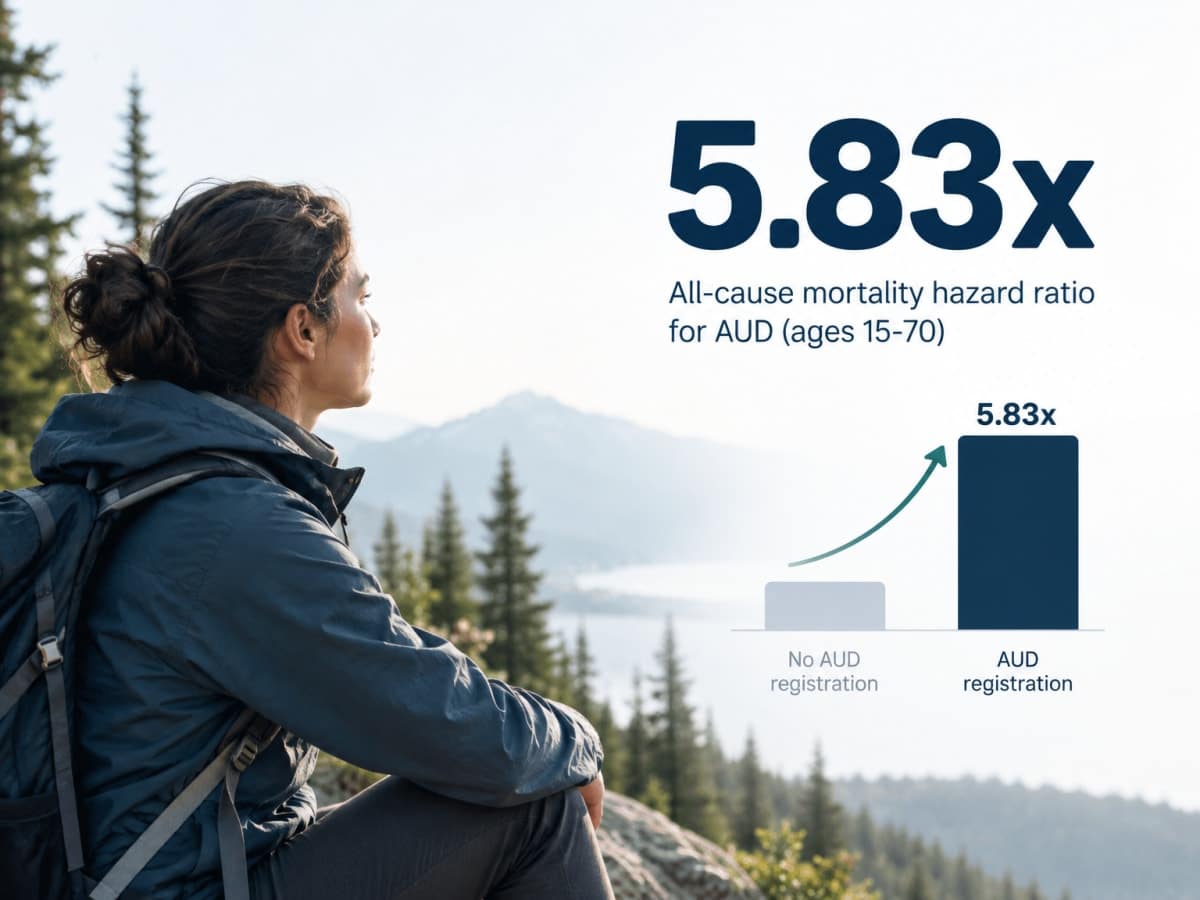
A large Swedish population study followed people from ages 15 to 70 and found that having an alcohol use disorder diagnosis on record was associated with an all-cause mortality hazard ratio of 5.83 compared to the general population, after adjusting for sex, education, and birth year. In plain words: across that age range, people with a registered AUD diagnosis had about six times the risk of dying during follow-up compared to people without one.6
Read that number carefully. It describes a population, not you. The study identified people through registries, which tends to capture more severe or treatment-engaged cases than the general AUD population. It also does not directly estimate how much mortality risk changes after remission or treatment. The 5.83 figure tells you that AUD can carry a real medical cost. It does not tell you what will happen to any single person who gets care.6
The body keeps a running tab in the meantime. Heavy drinking over years can damage the liver, raise blood pressure, strain the heart, inflame the pancreas, and increase the risk of several cancers. Add in accidents, falls, and alcohol-involved overdoses, and you have a condition that quietly shortens lives when nothing changes.1
Here is the warmer half of the same truth: those numbers describe a trajectory, not a destiny. When drinking stops or drops significantly and medical care steps in, the body often has more room to heal than people expect. The outlook changes when the inputs change.
What recovery actually looks like over time
Detox is the start, not the finish
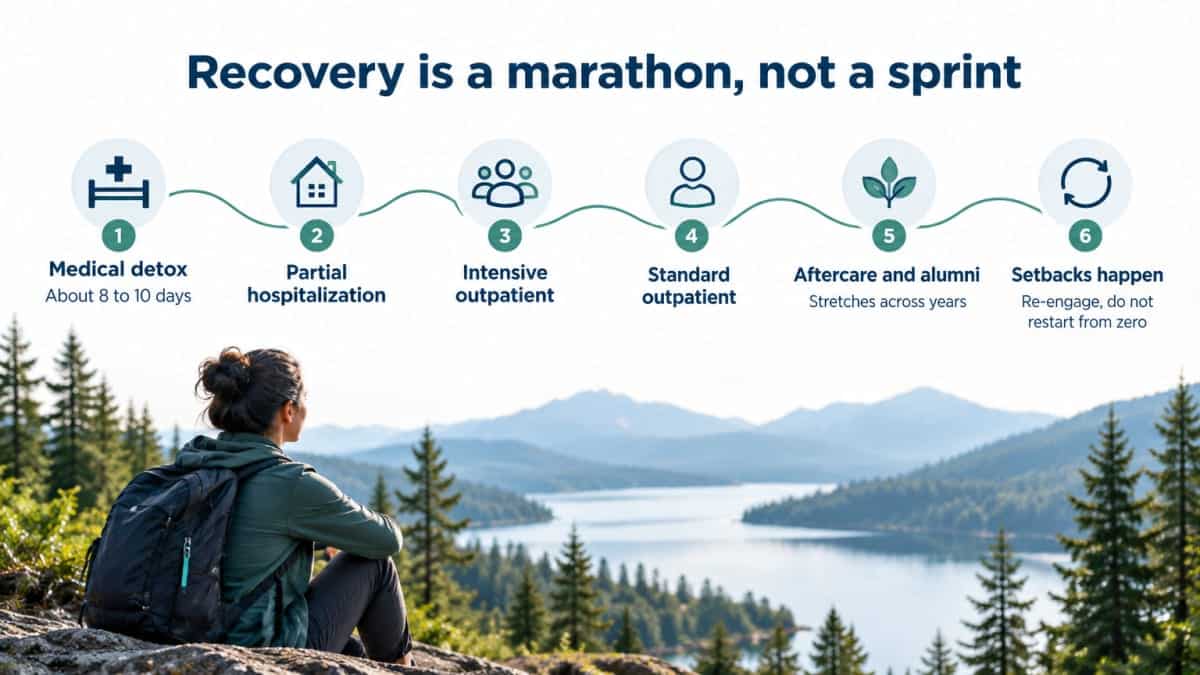
Detox is the medical part of getting the alcohol out of your system safely. At Pacific Crest Trail Detox, that typically takes about 8 to 10 days of round-the-clock monitoring, medication to manage withdrawal, sleep, food, and fluids. It is the first chapter, not the whole book. NIAAA is clear that detox alone is a safety step, and that treatment and continuing care for alcohol use disorder are usually measured in months and sometimes years.1
Here is what tends to go wrong when people stop at detox: the body is stable, the shakes are gone, and the brain is still rewiring. The cravings, the sleep problems, the anxiety that drove drinking in the first place, and the daily habits around alcohol do not disappear in eight days. Without a plan for what comes next, the odds of going back to heavy drinking climb quickly.5
A better frame: detox gets you out of medical danger so the real work can start. That real work usually looks like partial hospitalization, intensive outpatient, standard outpatient, and some form of aftercare over months, often with medication and therapy running alongside.1, 4
Why NIAAA calls recovery a marathon
The National Institute on Alcohol Abuse and Alcoholism uses a specific phrase for this: recovery is a marathon, not a sprint. They mean it literally. Recovery from alcohol use disorder is a long-term change process that unfolds over months and years, often with occasional returns to heavy drinking along the way, and most people with AUD can and do recover when they stay connected to care.2
A realistic timeline looks more like a horizontal line than a finish ribbon. At Pacific Crest Trail Detox, medical detox typically lasts about 8 to 10 days. From there, PCTD’s continuum of care steps down in intensity: partial hospitalization, then intensive outpatient, then standard outpatient, then aftercare and alumni support that can stretch across years. NIAAA frames this longer arc as treatment and continuing care that are measured in months and sometimes years, not days.1 Setbacks can show up anywhere on that line. Re-engagement is the move, not restart from zero.2
What that means for you or someone you love: a good outcome is rarely built in a single stretch of perfect sobriety. It is built by staying in contact with care long enough for the brain, the body, and the daily routines to settle into something that works. The people who do well are usually not the ones who tried hardest for 30 days. They are the ones who stayed in the conversation for a year or more.2, 5
When drinking returns: how to read a setback
If drinking comes back after a stretch of sobriety, read it as information, not a verdict. NIAAA is direct about this: it is uncommon for someone to go to treatment once and never drink again, and persistence through setbacks is one of the strongest predictors of long-term improvement.5
A setback usually tells you something useful. Maybe the medication was not the right fit, or was not being taken consistently. Maybe an untreated co-occurring condition like depression or chronic pain quietly took over. Maybe life got loud: a job loss, a death, a holiday. Maybe the support that worked at week three stopped being enough at month six.1, 2
What matters more than whether a setback happens is what happens next. Calling your treatment team the same week, going back to a higher level of care for a stretch, adjusting medication, adding therapy, or re-engaging with mutual support can turn a weekend back into a data point rather than a spiral.2, 4
What helps: medications, therapy, and support
The FDA-approved medications for AUD
Three medications are FDA-approved for alcohol use disorder (naltrexone, acamprosate, and disulfiram), with naltrexone available in two forms. Most people have never heard a doctor name a single one of them. That is worth fixing.4
- Naltrexone
- Comes in two forms. The daily pill blocks the opioid receptors that make drinking feel rewarding, which tends to lower both cravings and the pull to keep drinking once you start. The monthly extended-release injection does the same work without the daily decision.
- Acamprosate
- A pill taken three times a day that helps settle the brain chemistry that stays stirred up for weeks after you stop drinking, which can make the first few months steadier.
- Disulfiram
- Works differently: if you drink while taking it, you get sick, so it works best for people who want a strong daily barrier between an impulse and a bottle.3, 4
No single medication wins for everyone. The right fit depends on your drinking goals, your liver and kidney function, whether you take opioid pain medication, and what your prescriber sees in your history. Any of these can be used alongside therapy and mutual support, and most people do best with that combination rather than medication by itself.3, 4
If you have never been offered one of these options, that is not because they do not exist. It is because the system is slow to prescribe them, which is the next piece.
Behavioral therapy and mutual support
Medication quiets the biology. Therapy and support help you build the life that makes not drinking actually workable.
NIAAA includes behavioral treatments among evidence-based options for AUD and notes they can be combined with medication or mutual-support groups.4 These can happen in individual sessions, groups, partial hospitalization, intensive outpatient, or standard outpatient care, depending on how much structure your week needs.1
Mutual support is a separate layer, not a replacement for treatment. Twelve-step groups, SMART Recovery, and other peer communities give people a place to show up, be known, and borrow experience from others further down the road. NIAAA lists mutual support alongside medication and therapy as part of a full treatment picture, not as the only path.4
Pick what you will actually attend. The group you keep going to beats the one that looks best on paper.
The treatment gap almost no one talks about
Here is the part that quietly explains why so many families feel like they tried everything and nothing worked: most people with alcohol use disorder are never offered the medications that could help.
That is not a typo. The medications exist, insurance often covers them, and the research is solid enough that FDA approved them, but they almost never leave the pharmacy. A national analysis of prescribing patterns from 2016 to 2021 found that when medication was ordered, oral naltrexone accounted for 51% of those orders, and that the estimated number needed to treat to prevent a return to drinking is about 18 for naltrexone and 11 for acamprosate.9 In plain terms: about 11 people need to be treated with acamprosate for one additional person to avoid a return to drinking compared to no medication, which is a meaningful effect for a condition this common.9
Two honest caveats. These medications help some people and not others, and the average effects are real but modest.8 They are not a cure, and they work best alongside therapy, support, and continuing care.4 What they are not is optional window dressing. If no one has walked you through the options, that is a conversation to have with a prescriber who treats AUD regularly, not a sign the medications would not work for you.
How to improve the odds for yourself or someone you love
What tends to predict a better outcome
If you want a short list of what actually moves the needle, here it is.
- Stay in care longer than feels necessary. The strongest single predictor of a durable improvement is not willpower or a perfect first attempt; it is persistence, which usually means staying connected to treatment well past the point where you feel fine.5 Most people do not go once and never drink again. The ones who do well are the ones who keep showing up through the uneventful months.5
- Ask about medication by name. If no prescriber has walked you through naltrexone, acamprosate, or disulfiram, bring the names into the conversation yourself.3, 4 The right fit is a clinical question, not a character question.
- Treat what is underneath the drinking. Depression, anxiety, chronic pain, trauma, and sleep problems do not politely wait their turn. Addressing them alongside AUD, instead of after, improves the odds that the sober version of your life feels livable.1
- Pick one person who knows the whole story. One honest ally beats a crowded support list on paper.2
What a safer next step looks like in the Portland metro and SW Washington
If you live in Portland, Milwaukie, Gresham, Beaverton, Salem, or across the river in Vancouver, Washington, a safer next step usually starts with a phone call to a medical detox program, not a solo attempt at quitting.
Alcohol is one of the few substances where stopping suddenly on your own can be dangerous. Severe withdrawal can include seizures and delirium tremens, which is why medical supervision is the standard of care, not an upgrade.1 Pacific Crest Trail Detox is a non-hospital medical detox in a home-like setting, with registered nurses on site around the clock and providers rounding daily. Our typical detox stay is about 8 to 10 days, during which real conversations about what comes next can begin.
From there, the plan should connect directly into continuing care: partial hospitalization during the day, intensive outpatient a few evenings a week, standard outpatient, and alumni support that keeps going after the structured weeks end.1, 4 If medication fits, it starts here, not months later.3
Out-of-state families call too. The right program will handle travel logistics, insurance verification, and the handoff from detox into longer care without making you figure it out alone.
If you are the family member reading this
You are not the one with the diagnosis, but you are the one awake right now reading about it. That counts for something, and it comes with its own weight.
A few things worth knowing. You cannot run anyone’s recovery for them, and trying to usually backfires. What you can do is stay informed, stay honest, and stay safe. Learn what alcohol withdrawal actually looks like so you know when to call for medical help instead of waiting it out, because severe withdrawal can include seizures and needs supervision.1 Keep the door open without pretending nothing is happening. Love with an edge, not love that covers for one more morning.
Expect setbacks and plan for how you will respond before one happens. NIAAA is clear that returning to drinking is common and does not mean the work is over; what tends to matter is whether the person re-engages with care quickly.2, 5 Your calm response to a hard week can be the thing that shortens it.
Take care of yourself too. Family therapy, your own counselor, or a support group for people who love someone with AUD are not extras.4
A warm next step when you are ready
If any part of this article landed, the next step is smaller than it feels. One phone call to a medical detox program starts the conversation. You do not have to have a plan, a packed bag, or the right words. You just have to pick up the phone.
Pacific Crest Trail Detox is a non-hospital medical detox in Milwaukie, in the Portland metro, with registered nurses on site around the clock, home-cooked meals, and a direct handoff into continuing care so detox is not where the help stops. Many staff are in recovery themselves. Out-of-state callers from SW Washington and beyond are welcome. Calls and insurance verification are confidential and HIPAA-protected. Create your path to recovery when you are ready.
Check Coverage for Alcohol Treatment
See what your plan may cover for medically supervised alcohol detox and continuing care.
Frequently Asked Questions
Is alcoholism always progressive and fatal?
No. That older story does not match the evidence. Most people with alcohol use disorder reduce or resolve their drinking problems over time, especially when they get treatment and stay connected to care for months rather than days.1, 2Severity, health, and whether you get real help all shape where it goes next.
How long does recovery from alcohol use disorder take?
Longer than detox, shorter than forever. At Pacific Crest Trail Detox, medical detox typically runs about 8 to 10 days, and treatment and continuing care are measured in months and sometimes years.1NIAAA frames recovery as a long-term change process, not a single event, and people who stay engaged over that longer arc tend to do better than those who stop early.2
Does a return to drinking mean treatment failed?
No. It is uncommon for someone to go to treatment once and never drink again, and persistence through setbacks is one of the strongest predictors of long-term improvement.5A return to drinking is information: something in the plan needs adjusting. Calling your treatment team quickly and re-engaging with care often turns a hard week into a data point, not a spiral.2
Can I safely detox from alcohol at home?
Please do not try. Alcohol is one of the few substances where sudden withdrawal can be life-threatening, with risks that include seizures and delirium tremens, which is why medical supervision is the standard of care.1A non-hospital medical detox with nurses on site around the clock, like Pacific Crest Trail Detox’s typical 8 to 10 day program, can manage this period safely and connect you to what comes next.
Do medications for alcohol use disorder actually work?
Yes, for many people, though not everyone. Naltrexone, acamprosate, and disulfiram are FDA-approved and work best alongside therapy and support.3, 4The average effects are real but modest, and only about 2.1% of U.S. adults with AUD receive any medication in a given year, which is a treatment gap, not a sign the medications do not help.8
What should I do if someone I love won’t admit they have a problem?
Stay honest, stay safe, and stay informed. You cannot run their recovery, but you can learn what withdrawal looks like so you know when to call for medical help, keep the door open without covering for them, and have a plan for how you will respond to a hard day.1, 2Your own counselor or a family support group is not optional.4
References
- Alcohol Use Disorder: From Risk to Diagnosis to Recovery. https://www.niaaa.nih.gov/health-professionals-communities/core-resource-on-alcohol/alcohol-use-disorder-risk-diagnosis-recovery
- Support Recovery: It’s a Marathon, Not a Sprint. https://www.niaaa.nih.gov/health-professionals-communities/core-resource-on-alcohol/support-recovery-its-marathon-not-sprint
- TIP 49: Incorporating Alcohol Pharmacotherapies. https://library.samhsa.gov/product/tip-49-incorporating-alcohol-pharmacotherapies-medical-practice/sma13-4380
- Recommend Evidence-Based Treatment: Know the Options. https://www.niaaa.nih.gov/health-professionals-communities/core-resource-on-alcohol/recommend-evidence-based-treatment-know-options
- Treatment for Alcohol Problems: Finding and Getting Help. https://www.niaaa.nih.gov/publications/brochures-and-fact-sheets/treatment-alcohol-problems-finding-and-getting-help
- Alcohol Use Disorder and Mortality Across the Lifespan. https://pmc.ncbi.nlm.nih.gov/articles/PMC4889524/
- Facts About U.S. Deaths from Excessive Alcohol Use. https://www.cdc.gov/alcohol/facts-stats/index.html
- Expanding Treatment Options for Alcohol Use Disorder. https://pmc.ncbi.nlm.nih.gov/articles/PMC11759923/
- Clinician Prescribing Practices Involving Medications for Alcohol Use Disorder. https://pmc.ncbi.nlm.nih.gov/articles/PMC11830549/