


Key Takeaways
- Your liver clears roughly one standard drink per hour at about 15 mg/100 mL, and nothing — not coffee, cold showers, or sweating — speeds that pace up 3, 5.
- Elimination varies up to threefold between people based on genetics, sex, body composition, liver health, and whether food was in the stomach before drinking 6.
- Alcohol leaves the blood in hours, but EtG can flag drinking for 24 to 72 hours and PEth can show heavier use for 60 days or longer 11, 12.
- If quitting feels hard or withdrawal symptoms appear, stopping heavy daily drinking alone can be life-threatening and deserves medically supervised detox rather than willpower 14.
The Short Answer: One Drink an Hour, and Only Time Clears It
If you’re trying to figure out how long to metabolize alcohol, here’s the honest answer: your body processes roughly one standard drink per hour, and only time will lower your blood alcohol. Coffee, cold showers, big meals after drinking, and sleep do not speed this up. A standard drink holds 14 grams of pure ethanol, and most people clear alcohol at a fairly steady pace once the liver gets to work.2, 5
That pace varies more than people expect. Genetics, sex, body composition, liver health, and whether you ate before drinking all shift the timeline, sometimes by a factor of three between two people drinking the same amount.6 And while alcohol itself leaves your blood in hours, certain tests can detect it for days or weeks after your last drink.9, 12 The rest of this guide walks you through what to expect, honestly.
What Your Liver Actually Does With a Drink
From Ethanol to Water: The Pathway in Plain Words
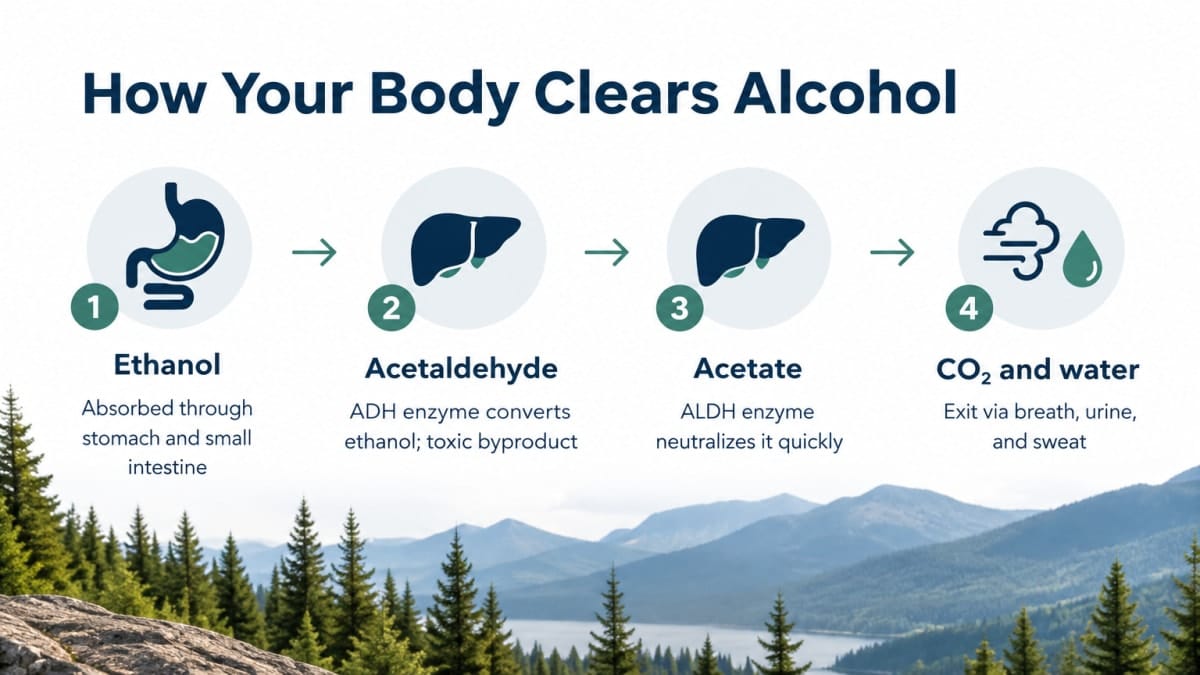
Here’s what happens inside you when you take that first sip. Alcohol slips through your stomach and small intestine into your bloodstream within minutes, and then your liver takes over the slow work of breaking it down.1 The liver uses an enzyme called alcohol dehydrogenase (ADH) to turn ethanol into acetaldehyde, a toxic byproduct that’s actually harder on your body than alcohol itself. A second enzyme, aldehyde dehydrogenase (ALDH), quickly converts that acetaldehyde into acetate, a much safer compound. From there, your body breaks acetate down into carbon dioxide and water, which leave through your breath, your kidneys, and your skin.1
That whole pathway handles roughly 94 to 98 percent of the alcohol you drink.8 The small remainder, just a few percent, exits unchanged through your breath, urine, and sweat. That tiny leftover is what a breathalyzer measures, and it’s why your breath can give a reasonably accurate read on what’s circulating in your blood.8
The pace of this chain reaction depends on how much ADH and ALDH your liver has to work with, and that’s partly written into your genes. Some people inherit enzyme variants that work faster or slower, which is one reason the same two beers can hit two friends very differently.1, 8
Why ‘A Drink’ Is Rarely Just One Drink
Before you can estimate how long alcohol will take to clear, you have to be honest about how much you actually drank. In the U.S., a standard drink is defined as 14 grams of pure ethanol.2 That translates to:
- 12 ounces of regular 5% beer
- 5 ounces of 12% wine
- 1.5 ounces of 40% spirits4
Simple enough on paper.
Real life rarely pours that neatly. A pint of craft IPA at 7.5% ABV is closer to one and a half standard drinks. A generous home pour of wine into a large glass can easily hit 8 or 9 ounces, which is nearly two drinks. A tall vodka soda at a bar often holds two shots, not one. And a 24-ounce can of 8% malt liquor packs almost four standard drinks into a single container.4
This matters because alcohol is absorbed into your bloodstream faster than your liver can process it.2 When you have a second drink before the first is cleared, the surplus stacks up and your blood alcohol concentration keeps climbing. If you’re trying to do mental math about when you’ll be sober, start by counting standard drinks, not glasses or bottles. You may find the number is higher than you thought, and the timeline longer.
How Fast Your Body Clears Alcohol — and Why It Varies
The Average: About 15 mg/100 mL per Hour
If you want a number to work with, here it is: a moderate drinker’s blood alcohol concentration tends to drop by roughly 15 milligrams per 100 milliliters of blood every hour. That’s the figure forensic researchers reach for when they need a reasonable average, drawn from decades of real human data.5 In plain terms, that’s close to one standard drink per hour for many adults, though the real range runs from about 10 to 35 mg/100 mL per hour depending on the person.5
Here’s something that surprises people: once your liver enzymes are fully engaged, alcohol leaves your blood at a nearly fixed pace rather than a percentage pace. Pharmacologists call this zero-order kinetics, which just means your body removes about the same amount per hour whether your BAC is high or moderate.6 You can’t speed the line up by drinking more water or pacing the room. The enzymes work at the speed they work.
So if you stopped drinking at midnight with a BAC of 0.12, you’re not back to zero by 3 a.m. You’re closer to 0.075 — still legally impaired in every U.S. state. Give it a few more hours. Alcohol doesn’t negotiate with your morning schedule, and no amount of mental math will shrink the gap.
What Changes the Pace: Genetics, Sex, Body Composition, Liver Health
That 15 mg/100 mL per hour average hides a lot of individual difference. Research shows roughly a threefold spread in how quickly people clear alcohol, and about a twofold difference in how alcohol spreads through the body based on age, sex, and body composition.6 Two people the same height and weight can finish identical drinks and still show meaningfully different blood alcohol levels an hour later.
Genetics do a lot of the heavy lifting. The alcohol dehydrogenase and aldehyde dehydrogenase enzymes that break alcohol down come in different variants, and the version you inherited affects how fast your liver can keep up.1, 8 Some people flush, feel nauseated, or get a pounding headache quickly because their enzymes let acetaldehyde build up. Others barely feel the first drink.
Body composition matters because alcohol distributes through body water, not fat. People with more lean mass have more water to dilute alcohol into, which usually means a lower peak BAC from the same drink. On average, this is one reason women tend to reach higher BACs than men from the same amount of alcohol.2
Liver health is the quieter variable. A liver stressed by heavy long-term drinking, hepatitis, or other disease often processes alcohol less predictably, which is one reason heavy drinkers can show elimination patterns different from occasional drinkers.5
Does Eating Really Help? What the Numbers Say
You’ve probably heard the advice: eat before you drink. There’s real science behind it, but it doesn’t do what most people think it does. A 2023 pharmacokinetic study found that food slowed how fast alcohol was absorbed and raised the modeled maximum elimination rate by about 1.39 times compared with drinking on an empty stomach.7 Food shifts the curve. It does not make you sober faster in any meaningful real-time sense.
What a meal actually does is flatten the spike. When your stomach is full, alcohol trickles into your small intestine more slowly, so your peak BAC stays lower and arrives later. That can mean fewer wobbly moments and a less punishing morning. It does not mean the alcohol disappears sooner than the clock allows.
If you’ve already been drinking, eating now won’t rescue you either. The alcohol already circulating in your blood still has to wait its turn with your liver enzymes. A late-night burger might settle your stomach, but it won’t lower a BAC that’s already climbing. The honest translation of the research: eating with alcohol can soften the ride, but only time clears your system.3
How Long Alcohol Stays Detectable on Common Tests
Breath, Blood, Urine, EtG, and PEth at a Glance
Here’s where a lot of people get caught off guard. Feeling sober and testing clean are two different things. Alcohol itself leaves your body in hours, but the byproducts your liver creates on the way out can hang around for days, and in some cases, weeks.
- Breath.
- A breathalyzer measures the small fraction of alcohol you exhale unchanged. It’s accurate for recent drinking and typically useful for a few hours after your last drink, roughly as long as alcohol is still circulating in your blood.8
- Blood.
- A blood alcohol test measures ethanol directly. It’s the gold standard for current intoxication and reflects the same timeline as breath, usually a matter of hours depending on how much you drank.10
- Urine (alcohol).
- Standard urine testing for ethanol itself gives a short window. SAMHSA puts it at roughly 7 to 12 hours, and other reviews note alcohol may no longer be detectable in urine around 10 to 12 hours after the last drink.9, 16
- Urinary EtG.
- Ethyl glucuronide is a byproduct your liver makes after you drink. EtG tests typically detect alcohol use for about 24 to 72 hours, and research has documented detection up to roughly 130 hours after excessive consumption.9, 11 This is the test that catches people who thought a Friday night was long gone by Monday morning.
- PEth (blood).
- Phosphatidylethanol forms in red blood cells only in the presence of alcohol, and it sticks around. PEth can extend the detection window to 60 days or longer after chronic heavy drinking.12, 13 Clinicians think of BAC as a short-term marker, EtG and EtS as intermediate markers covering roughly two days, and PEth as a longer-term indicator of repeated exposure.10
What a Positive Test Does — and Doesn’t — Prove
A positive test and a legal or clinical conclusion aren’t the same thing, and it helps to know the difference before you walk into a lab or a probation appointment worried.
A blood or breath result that shows ethanol means alcohol is in your system right now. That’s the test to lean on when the question is current impairment.10 An EtG or PEth result is different. It tells a clinician that your body processed alcohol during a prior window, but it doesn’t tell them how much you drank, exactly when, or whether you were impaired at any point.11, 12
That matters in both directions. EtG can turn positive after fairly small exposures and after longer periods than many people expect, so a single result rarely tells the whole story on its own.9 PEth, on the other hand, is harder to produce from incidental exposure and more useful for seeing a pattern of regular heavier drinking over weeks.12 Different tests answer different questions, and results that seem to disagree may both be technically correct.13
If you’re facing a test and feel anxious, the honest move is to be straight with the clinician or monitor about your recent drinking rather than trying to time the window. And if you’re reading this because you’re trying to figure out whether you can hide a problem from a test, that’s often the signal underneath the question. The timeline worth your attention isn’t the detection window. It’s what your drinking is doing to your life.
The Myths: Coffee, Cold Showers, Sweating It Out
Pretty much every trick you’ve heard for sobering up faster is folklore. NIAAA puts it as plainly as a federal agency ever puts anything:
“There are no quick cures—only time will help.”3
Your liver sets the pace, and the liver does not care about your 7 a.m. meeting.
Coffee. Caffeine can make you feel more awake, which is exactly the problem. It masks drowsiness without touching your blood alcohol or restoring your judgment and coordination.3 A wide-awake drunk is still drunk, and often more willing to make a bad decision because they feel sharper than they are.
Cold showers. A cold shower might shock you into alertness for a few minutes. It does nothing to the alcohol circulating in your blood. The ADH and ALDH enzymes in your liver keep working at their own speed regardless of water temperature.1
Sweating it out. Only a small fraction of alcohol leaves your body unchanged through breath, urine, and sweat. The oxidative pathway in your liver handles roughly 94 to 98 percent of it.8 You cannot meaningfully sweat alcohol out at the gym or in a sauna, and dehydration can make you feel worse.
Eating after you drink. Food eaten before drinking can slow absorption, but once alcohol is already in your bloodstream, a late-night meal won’t lower your BAC.3, 7
When the Real Question Isn’t Timing — It’s Safety
Signs You’re Asking This Question More Than You’d Like
Here’s something worth sitting with for a minute. The question “how long until this is out of my system” is a reasonable thing to Google once or twice. If you’re asking it on a regular basis, that pattern itself is telling you something.
You might notice you’re checking the clock before bed to see if you’ll be clear by morning. You might be timing drinks around a drug test, a court date, or a doctor’s appointment, and the math is getting harder. Maybe you’ve started drinking earlier in the day to steady your hands, or you feel shaky, sweaty, or anxious the morning after even a moderate night. Maybe you’ve tried to take a few days off and found yourself back at it faster than you planned.
None of this makes you a bad person. These are common signals that alcohol has moved from something you do into something your body expects. If a partner, parent, or friend has asked you about your drinking recently, that outside view usually sees the pattern before you do. The next section explains why stopping on your own, especially after months or years of heavy daily drinking, deserves medical attention rather than willpower alone.
Why Alcohol Withdrawal Can Be Dangerous to Handle Alone
Here’s what happens biologically. When you drink heavily over months or years, your brain and nervous system adapt to a constant alcohol presence by cranking up excitatory signals to stay balanced. Pull the alcohol away suddenly and that revved-up system has nothing to push against. For a light or occasional drinker, that imbalance is uncomfortable. For someone with a heavy daily pattern, withdrawal can include seizures and, in some cases, progress to delirium tremens.14
The hard part is that you can’t always predict who will have a mild withdrawal and who will have a dangerous one. A person’s drinking history, prior withdrawal episodes, age, nutrition, and other health conditions all play in. That’s why the honest advice for anyone drinking heavily every day is not a tapering schedule you found online. It’s a conversation with a medical professional before you stop. If you’ve already stopped and you’re shaking, confused, or seeing things, that’s an emergency room situation, not a wait-and-see.
What Medically Supervised Detox Actually Looks Like
If the words “medical detox” bring up images of a sterile hospital hallway and a hospital gown, that’s not the only version. A non-hospital medical detox is a residential setting where nurses are on site around the clock, providers check in daily, and medications are available to keep withdrawal symptoms safe and tolerable. For alcohol, that usually means medications given on a schedule that eases your nervous system down instead of letting it crash.
A typical stay at Pacific Crest Trail Detox runs about 8 to 10 days, depending on how your body responds. The first 72 hours tend to be the most intense, when vital signs are watched closely and medication doses are adjusted to keep seizures and severe symptoms off the table. From there, sleep starts coming back, appetite returns, and the fog lifts enough that you can start thinking about what comes next. Home-cooked meals, a bed that isn’t a hospital bed, and daily groups with other people going through the same thing make a real difference in whether you want to stay.
Detox by itself is the beginning, not the finish. Continuing care gives people the best chance to build on it, whether that’s a partial hospitalization program, intensive outpatient, standard outpatient, or an alumni community that keeps them connected. The next section talks about what reaching out actually looks like.
A Warm Next Step If You’re Ready to Stop
If you’ve read this far, you probably already have your answer about the clock. The harder question is what to do next. Reaching out is not a commitment to anything except a conversation. A confidential call with an admissions team can walk you through what your drinking pattern looks like, whether home withdrawal is safe for you, and what medically supervised detox would involve if it’s not. Insurance verification takes a few minutes and tells you what’s covered before you make a decision.
Pacific Crest Trail Detox has served the Portland metro, Milwaukie, and SW Washington since 2017, with nurses on site around the clock, a home-like residential setting, and staff who have been through recovery themselves. Detox connects into partial hospitalization, intensive outpatient, standard outpatient, and alumni care so you’re not handed a discharge paper and left to figure out the rest. We want to be your last treatment experience, whether we’re your first detox or your fifth.
Get Support for Alcohol Withdrawal
Check your coverage and learn what medically supervised alcohol detox may involve.
Frequently Asked Questions
How long does it take to metabolize one drink?
For most adults, your liver clears about one standard drink per hour, which is 14 grams of pure ethanol — roughly a 12-ounce beer, a 5-ounce glass of wine, or a 1.5-ounce shot.2, 4 That’s an average, not a promise. Real pours are often larger than one standard drink, so your actual timeline may be longer than you think.
Can I speed up how fast alcohol leaves my system?
No. NIAAA puts it plainly: there are no quick cures, only time will help.3 Coffee makes you feel more alert without lowering your blood alcohol or restoring judgment. Cold showers, exercise, chugging water, and sweating in a sauna do not meaningfully change how fast your liver works. The enzymes break alcohol down at their own pace, regardless of what you try.
How long does alcohol show up on a urine or EtG test?
Standard urine testing for alcohol itself usually catches drinking within about 7 to 12 hours of your last drink.16 An EtG test looks for a byproduct your liver creates and typically detects alcohol use for roughly 24 to 72 hours, with longer windows after heavier drinking.11 Exact timing depends on how much you drank, your metabolism, and the lab’s cutoff.
Why does alcohol affect some people longer than others?
Elimination rates vary roughly threefold between individuals, so the same two drinks can hit two people very differently.6 Genetics shape how much ADH and ALDH enzyme activity your liver has.1 Body composition matters because alcohol spreads through body water, not fat. Sex, age, liver health, and whether you ate before drinking all shift the timeline. There’s no single number that fits everyone.
Is it safe to stop drinking on my own?
For light or occasional drinkers, usually yes. For anyone drinking heavily every day for months or years, stopping suddenly can be dangerous. NIAAA warns that alcohol withdrawal can be life-threatening and may include tremors, elevated vitals, nausea, seizures, and delirium tremens.14 If you shake in the morning, drink to steady yourself, or have had withdrawal before, talk to a medical professional before you quit.
When should I consider medically supervised detox?
Consider it if you drink heavily daily, have withdrawal symptoms within hours of your last drink, have had a seizure during a past attempt to quit, or have other health conditions that make withdrawal riskier.14 A confidential call with an admissions team at a place like Pacific Crest Trail Detox in Milwaukie can help you figure out whether supervised care is the safer path for you.
References
- Alcohol Metabolism. https://www.niaaa.nih.gov/publications/alcohol-metabolism
- The Basics: Defining How Much Alcohol is Too Much. https://www.niaaa.nih.gov/health-professionals-communities/core-resource-on-alcohol/basics-defining-how-much-alcohol-too-much
- The Truth About Holiday Spirits. https://www.niaaa.nih.gov/publications/brochures-and-fact-sheets/truth-about-holiday-spirits
- Facts About Excessive Drinking. https://www.cdc.gov/drink-less-be-your-best/facts-about-excessive-drinking/index.html
- Evidence-based survey of the elimination rates of ethanol from blood with applications in forensic casework. https://pubmed.ncbi.nlm.nih.gov/20304569/
- Pharmacokinetics of Ethanol – Issues of Forensic Importance. https://pubmed.ncbi.nlm.nih.gov/26231237/
- Population Pharmacokinetics as a Tool to Reevaluate the Complex Disposition of Ethanol in the Fed and Fasted States. https://pubmed.ncbi.nlm.nih.gov/36688276/
- Recent advances in alcohol metabolism: from the gut to the brain. https://pubmed.ncbi.nlm.nih.gov/40637545/
- Alcohol Biomarkers in Clinical and Forensic Contexts. https://pmc.ncbi.nlm.nih.gov/articles/PMC5987059/
- The Role of Biomarkers in the Treatment of Alcohol Use Disorder. https://www.niaaa.nih.gov/sites/default/files/SAMHSA-Advisory-Role-of-Biomarkers-in-the-Treatment-of-Alcohol-Use-Disorder-2012.pdf
- Concordance of Ethyl Glucuronide, Blood Alcohol Content, and Self-Reported Alcohol Use. https://pmc.ncbi.nlm.nih.gov/articles/PMC11571234/
- The roles of phosphatidylethanol, ethyl glucuronide, and other direct alcohol biomarkers in clinical and forensic settings. https://pmc.ncbi.nlm.nih.gov/articles/PMC8406557/
- Phosphatidylethanol, ethyl glucuronide and ethanol in blood as complementary biomarkers for alcohol consumption. https://pmc.ncbi.nlm.nih.gov/articles/PMC8662321/
- Alcohol Use Disorder: From Risk to Diagnosis to Recovery. https://www.niaaa.nih.gov/health-professionals-communities/core-resource-on-alcohol/alcohol-use-disorder-risk-diagnosis-recovery
- Understanding the Dangers of Alcohol Overdose. https://www.niaaa.nih.gov/publications/brochures-and-fact-sheets/understanding-dangers-of-alcohol-overdose
- Clinical Drug Testing in Primary Care. https://library.samhsa.gov/sites/default/files/sma12-4668.pdf
- Screen and Assess: Use Quick, Effective Methods. https://www.niaaa.nih.gov/health-professionals-communities/core-resource-on-alcohol/screen-and-assess-use-quick-effective-methods