


Key Takeaways
- Benzodiazepine dependence can build even with prescribed use, and stopping abruptly risks seizures, rebound anxiety, hallucinations, and rarely death, which is why clinicians recommend a slow, supervised taper 1, 3.
- Current guidelines suggest reducing the dose by roughly 5% to 10% every 2 to 4 weeks, so a Portland-area taper is realistically measured in months rather than weeks 1.
- Choosing outpatient tapering versus residential detox in the Portland metro depends on dose, length of use, seizure history, co-use of alcohol or opioids, and whether someone at home can watch for warning signs 1, 4.
- Before committing to a program, compare insurance acceptance, Oregon Health Plan withdrawal management coverage, taper pacing, overnight medical oversight, and aftercare planning 10.
If you tried to stop and it went sideways, you are not the problem
Maybe you took a Klonopin at bedtime for two years and figured you could just skip a dose. Maybe your doctor told you to cut your Xanax in half, and by day three your hands were shaking, your heart was pounding, and sleep felt like something other people did. If that is your story, please hear this: your body did not fail you. The medicine changed how your nervous system runs. When you pull it away too fast, the alarm bells go off.
That is not weakness. That is pharmacology.
Federal regulators have been clear that benzodiazepines can create physical dependence even when taken exactly as prescribed, and stopping suddenly can set off serious withdrawal reactions 2. The current clinical consensus is to come off slowly, with someone who knows what to watch for 1.
So if you are reading this from a kitchen table in Milwaukie, a bedroom in Beaverton, or a quiet spot in Gresham after a rough night, you are already doing the right thing. You are asking how to do this safely instead of white-knuckling it alone. The rest of this guide walks you through what a supervised taper actually looks like in the Portland metro, what to expect week by week, and how to find people who will watch over you while your nervous system finds its footing again.
Why cold turkey is the wrong answer for benzodiazepines
Here is the part that surprises most people: benzodiazepines can be harder to stop safely than alcohol or opioids. Not more painful in the same way. Harder to stop safely. Your brain, after months or years of Xanax, Klonopin, Ativan, or Valium, has adjusted to having that medicine on board. Pull it out all at once and the electrical system that was being quieted comes back online with the volume cranked up.
The CDC spells out what that can look like in plain language: rebound anxiety, hallucinations, seizures, delirium tremens, and rarely death 3. Read that list again. Those are not scare tactics. They are documented consequences of stopping too fast.
How often do seizures actually happen? One retrospective clinical review of acute benzodiazepine withdrawal found seizures in 10% of the cases studied 6. That number comes from patients who were already in a hospital setting, so it is not a general-population rate for everyone who quits at home. But it tells you the risk is real enough that clinicians who see this every day take it seriously. Heavy or long-term users sit at the higher end of that risk 7.
The other reason cold turkey backfires is that the symptoms themselves make you want to reach for the pill bottle again. Tremor, weakness, gut trouble, sleep that will not come, and a wave of anxiety that feels bigger than anything the original prescription was written for 5. That is not you losing your grip. That is a nervous system asking for the thing it got used to.
How a safe taper actually paces itself
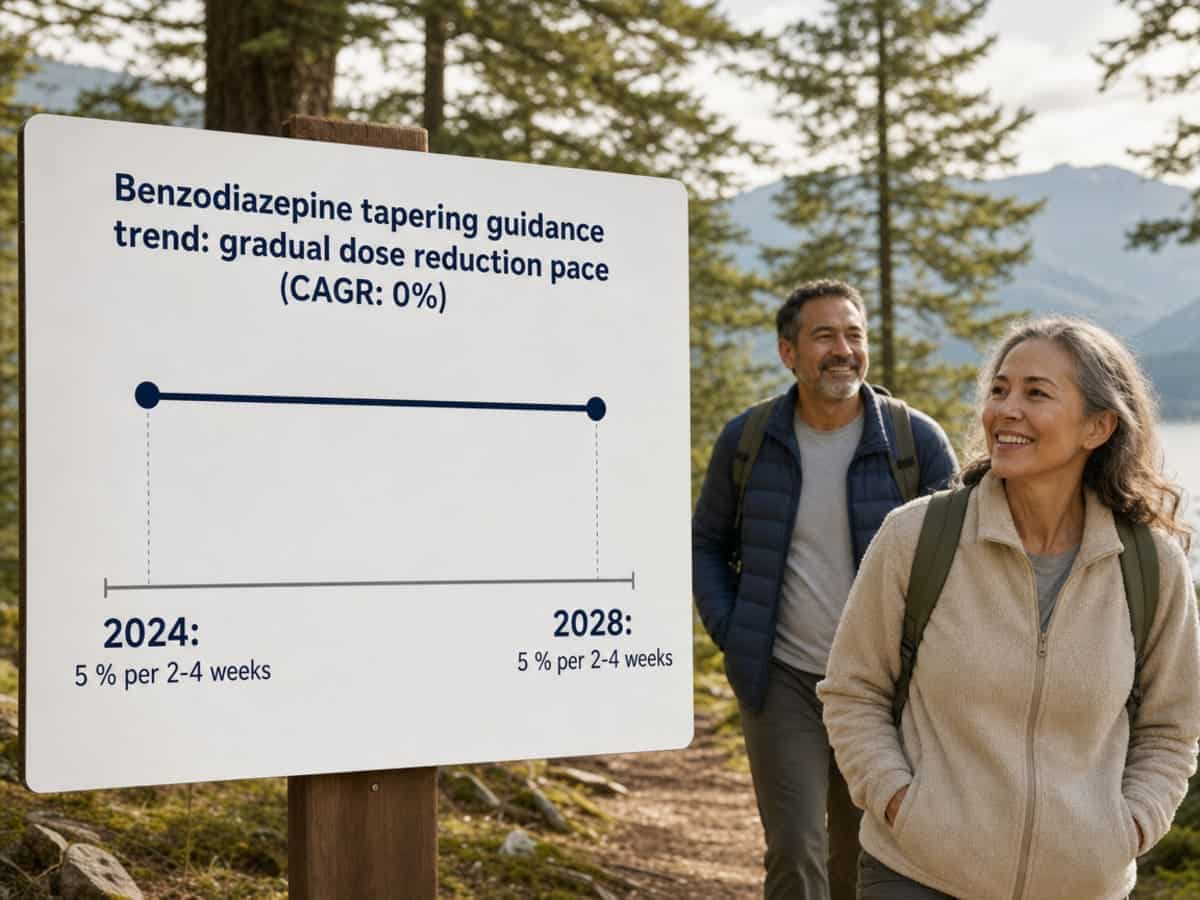
The question you probably want answered first is the simplest one: how fast is too fast? The 2024 ASAM-led Joint Clinical Practice Guideline gives a real number instead of a shrug. For most people who have been on benzodiazepines long enough to develop physical dependence, the recommended pace is a dose reduction of about 5% to 10% every 2 to 4 weeks 1. The upper ceiling, when a faster pace is truly needed and closely watched, is around 25% every 2 weeks 1. Anything faster than that is where the trouble usually starts.
Read those numbers again, because they matter. A 5% cut every month is slow on purpose. It gives your nervous system time to adjust one small notch at a time, so the alarm bells stay quiet.
Here is what that looks like in practice. If you take 2 milligrams of Klonopin a day, a 10% cut is 0.2 milligrams. Not a half pill. Not a whole pill. A small shave. You hold at the new dose for two to four weeks, see how you feel, and only then consider the next step down. If sleep gets rocky or the anxiety spikes, you hold longer. You do not push through.
The guideline also points to two moves that make the pace more forgiving. The first is switching from a short-acting benzodiazepine like Xanax or Ativan to a longer-acting one like diazepam before you start cutting. Longer-acting means the blood level stays steadier between doses, so the dips that trigger symptoms are gentler 1. The second is spacing cuts further apart in the last third of the taper, when the smallest doses often feel the hardest. Many people find the jump from 0.5 milligrams to zero harder than the jump from 4 milligrams to 3.
One thing the guideline explicitly warns against is using flumazenil to speed things up. It carries seizure and cardiac risks that outweigh the appeal of a faster finish 1.
What the numbers really mean is this: a safe taper is measured in months, not days. A six-month plan is common. A twelve-month plan is not unusual for someone who has been on a high dose for years. That can feel discouraging when you just want to be done. But every held dose, every steady week, is your brain quietly rebuilding the balance the medicine took over. You are not stalling. You are healing on a timeline your body can actually keep up with.
What withdrawal actually feels like, week by week
Nobody hands you a map for this, so here is one. Every body is different, and where you are on your taper matters more than the calendar. But there is a rough shape to what most people go through, and knowing it ahead of time takes some of the fear out of the middle of the night.
Days 1 to 4. If you have been on a short-acting benzodiazepine like Xanax or Ativan, the early hours after a missed or reduced dose can bring the first wave: a jittery restlessness, hands that will not sit still, a heart that seems to beat too loudly, and sleep that keeps sliding away. Longer-acting medicines like Klonopin or Valium can delay this by a few days because they leave the body more slowly. This is the window where seizure risk is highest for people coming off fast or unsupervised, which is why supervision matters most here 1, 5.
Days 5 to 14. Symptoms usually peak somewhere in this stretch. Expect the classic list: tremor, muscle tension, gut trouble, sweating, headaches, ringing in the ears, and an anxiety that feels sharper than what you had before you ever started the medicine 5. Some people describe it as their skin being on backwards. Rebound anxiety and, for some, brief hallucinations or perceptual weirdness can show up in this window 3. If you are tapered slowly, this stretch is uncomfortable but manageable. If you stopped abruptly, this is the danger zone.
Weeks 2 to 6. The sharp edges start to soften. Sleep is still uneven. Mornings can feel worse than evenings. You may notice waves, meaning you have a good afternoon and then a hard night for no obvious reason. That is normal. Your nervous system is recalibrating, and it does not do it on a straight line.
Two more things worth naming. First, symptoms often flare briefly right after each dose reduction, then settle. That flare is not a sign the taper is failing. It is a sign your body noticed the change. Second, if something feels genuinely alarming, like a seizure, confusion, a fever, or thoughts of hurting yourself, that is a call-someone moment, not a wait-it-out moment. You are allowed to ask for help before it gets worse. Every steady day you string together is real progress, even the ones that do not feel like it.
The Oregon picture: why local context matters
You are not doing this in the abstract. You are doing it in Oregon, and the local numbers change how seriously to take the plan.
The 2025 Oregon Opioid Overdose Report tracked benzodiazepine-involved overdose deaths in the state across four years: 96 in 2021, 132 in 2022, 119 in 2023, and 106 in 2024 9. The count has come down from its 2022 peak, which is real progress, but it has not fallen to zero. Benzodiazepines keep showing up in the medication histories of people who die from overdoses here. That is not a reason to panic. It is a reason to take the taper seriously and to have someone medical in the loop.
Two other Oregon numbers deserve your attention. In 2023, 14% of people who had a fatal or nonfatal overdose in the state had been dispensed a benzodiazepine within the year leading up to it 9. Many of those prescriptions were legitimate, written for anxiety or sleep. The point is not that the medicine is evil. The point is that a lot of Oregonians are on it, and combined with other sedating substances, the risk goes up.
The harder number is this one: in 2024, only 7.7% of Oregonians who died from an overdose had any record of substance use disorder treatment 9. Read that slowly. More than nine out of ten had never connected with a treatment program. If you are reading this and thinking about picking up the phone, you are already doing something the majority of people at risk never got the chance to do.
There is also good news on the capacity side. Oregon’s 2025 legislative session funded an estimated 196 new beds for adult mental health services, substance use disorder residential treatment, and withdrawal management 11. That does not fix waitlists overnight, and it does not mean a bed is guaranteed the day you call. But the direction of the state’s investment is toward more places, not fewer, where you can go through this with people watching.
Put those pieces together and the local picture is clearer. Benzodiazepines are still part of the overdose story in Oregon. Most people at risk never make it to care. And the state is adding capacity for the kind of supervised withdrawal you are considering. You are asking the right question at a moment when more doors are opening, not closing.

Outpatient taper or residential detox: how to think about the choice
Not everyone needs a bed. Not everyone is safe at home. The honest answer is that the right level of care depends on a handful of specific things about your situation, not on what a slick website tells you to pick.
An outpatient taper can work when your dose is on the lower side, your use has been steady rather than escalating, you have a prescriber willing to write a slow schedule, and you have someone at home who will notice if things go sideways. You keep sleeping in your own bed. You keep going to work if you can. You come in for regular check-ins and adjust the pace based on how you feel.
A residential or medically supervised detox setting makes more sense when the picture is heavier:
- High daily doses.
- Years of use.
- A history of seizures, whether from benzodiazepines, alcohol, or anything else.
- Concurrent alcohol or opioid use, which the CDC specifically flags as a caution because sedating substances stack in dangerous ways 4.
- A previous attempt to taper that ended in the ER.
- Serious co-occurring anxiety, PTSD, or depression that is likely to spike hard when the medicine comes down.
- Living alone with no one to call at 3 a.m.
A few concrete questions you can sit with:
- Have you tried to cut down before, and what happened?
- Are you also drinking daily, or using opioids, or taking other sedating medicines?
- Do you have a seizure history, or a family member who does?
- Is there a person in your home who can watch for warning signs?
- Can your prescriber actually write the slow schedule the guideline recommends, or are they pushing you to finish in weeks 1?
If the answers point toward higher risk, a supervised setting is not a defeat. It is the version of this where someone is watching the monitors while you sleep, adjusting the plan when your body tells them to, and keeping the acute-withdrawal window from becoming an emergency 2. If the answers point toward lower risk and a strong support system, an outpatient taper with a careful prescriber can absolutely work.
You do not have to figure this out by yourself. A phone call to a local program will usually include a free assessment that helps sort which path fits your situation. Making that call counts as a real step forward.
What a home-like residential detox looks like in the Portland metro
When most people picture detox, they picture a hospital: fluorescent lights, a bed with rails, someone in scrubs writing on a clipboard behind glass. That is one version. It is not the only one, and for benzodiazepine tapers it is often not the best fit.
A non-hospital residential detox in the Portland metro looks more like a house than a ward. There are bedrooms instead of hospital rooms. A shared kitchen. A living room with couches. Windows that open onto the kind of evergreen and gray-sky quiet the Pacific Northwest does well. You wear your own clothes. You eat real meals at a table. You go to bed in a room, not a hallway.
What makes it medical is the people in it, not the furniture. Nurses check on you around the clock. A physician oversees the taper schedule and adjusts it based on how your body is responding, in line with the slow, individualized pacing the current clinical guideline recommends 1. Medication-assisted treatment is used where it helps, whether that means transitioning to a longer-acting benzodiazepine for a steadier taper or managing sleep, blood pressure, and anxiety symptoms as they show up. If something starts to look like an emergency, staff are trained to respond and hospitals are close by.
The rest of the day is where the home-like setting earns its name. Group therapy in the afternoon. One-on-one counseling. A quiet hour where you can actually rest instead of being woken for vitals every two hours. Meals someone else cooked. Other people in the house who are going through their own version of the same thing, which turns out to matter more than you might expect.
This category sits between two extremes many readers already know: the ER, which handles the acute crisis but sends you home once you are stable, and outpatient-only care, which never puts eyes on you overnight. A residential setting gives you the medical watch and the space to sleep, eat, and start feeling human again.
Protracted withdrawal: the honest 6–12 month conversation
Here is the part a lot of pages skip, and it is not fair to leave you without it. For some people, the acute withdrawal window closes and things get noticeably better, and that is the end of the story. For others, a quieter version of symptoms lingers for months after the last dose. This is called protracted withdrawal, and it is real.
The medical literature has described this pattern for a long time. A peer-reviewed review of dependence and withdrawal from central nervous system drugs notes that protracted benzodiazepine symptoms can last 6 to 12 months or longer in some people 8. What that usually looks like is not the dramatic acute stuff. It is uneven sleep. A layer of anxiety that hums under everything. Brain fog that makes reading feel like wading. Sensitivity to light or noise. Muscle tension that comes and goes. Waves of feeling almost like yourself, and then a bad week for no clear reason.
Two things are worth holding onto here.
First, protracted symptoms are not proof that you did something wrong or that the taper failed. They are your nervous system taking the long way back to its own baseline. The direction of travel is still toward better, even when the day-to-day does not show it.
Second, you do not have to white-knuckle this stretch alone either. Continued therapy, sleep support, movement, and regular check-ins with a prescriber who understands what you are going through make the tail end easier. A good aftercare plan is not a bonus feature. It is part of the treatment.
Paying for it: Oregon Health Plan, private insurance, and what to ask
Money worries can be the thing that keeps you from picking up the phone. Let’s take some of that guesswork off the table.
If you have the Oregon Health Plan, medically supervised withdrawal management is a covered benefit under the state’s Medicaid plan 10. That means the taper itself, the medical oversight, and the withdrawal management piece are things OHP is set up to pay for. The state’s substance use benefit also targets a statewide average residential stay of 30 days or less, so if a program recommends residential care, expect a stay measured in weeks, not months 10. Aftercare and outpatient follow-up are separate services with their own coverage rules.
Not every private program accepts OHP, and that is worth asking about directly before you fall in love with a specific place. If you have commercial insurance through an employer or the marketplace, most Portland-area detox programs will run a benefits check for you at no cost. That call usually takes about a day and tells you what your plan covers for inpatient detox, residential treatment, and outpatient care, plus your deductible and any copays.
When you call, here is what to ask so you are not guessing:
- Do you accept my specific insurance plan, and can you verify benefits before I commit?
- What is covered: the medical detox itself, room and board, medications, and therapy?
- If residential care is recommended, what is the expected length of stay?
- What does aftercare look like, and is it billed separately?
- If I do not have insurance, what payment options are available?
Cost should not be the reason you white-knuckle this. Ask the questions. Get the numbers in writing. Then decide.
A short, practical first-week plan
If you are still reading, you are probably ready to do something today. Here is a plan for the next seven days that does not require you to be brave, just willing.
- Today. Write down what you are taking, how much, and how long you have been on it. That single piece of paper is the most useful thing you can hand a clinician.
- Day 2. Call one program in the Portland metro and ask for a free assessment. Making the call counts. You do not have to commit to anything on the phone.
- Day 3. If you have insurance, ask them to run a benefits check. If you have the Oregon Health Plan, ask specifically about withdrawal management coverage 10.
- Days 4 to 6. Do not change your dose on your own. Keep taking what you are taking until a prescriber gives you a schedule.
- Day 7. Show up to the appointment. That is the win this week. Everything else follows from there.
Check Your Coverage for Safe Benzodiazepine Detox
Find out if your insurance supports supervised detox for benzodiazepine withdrawal in Portland.

Frequently Asked Questions
How long does a benzodiazepine taper usually take in Portland?
Most safe tapers are measured in months, not weeks. The current clinical guideline points to dose reductions of about 5% to 10% every 2 to 4 weeks, which usually adds up to a six-month plan and sometimes twelve months for people who have been on higher doses for years 1. Your prescriber sets the pace based on how your body responds, not a calendar.
Can I detox from Xanax or Klonopin at home, or do I need residential care?
It depends on your dose, how long you have been on it, whether you also drink or use opioids, and whether you have any seizure history. Lower-dose, stable use with a willing prescriber and someone at home can often work as an outpatient taper. Higher doses, co-use, prior failed attempts, or living alone usually point toward a medically supervised setting where staff can watch for complications 1, 4.
Does the Oregon Health Plan cover benzodiazepine withdrawal management?
Yes. Medically supervised withdrawal management is a covered benefit under Oregon’s Medicaid State Plan, so the medical piece of the taper is something OHP is set up to pay for 10. Residential stays under the state’s substance use benefit target an average of 30 days or less. Not every private program accepts OHP, so ask directly before you commit to a specific place.
What happens if I stop benzodiazepines cold turkey?
Abrupt stopping can trigger serious withdrawal, including rebound anxiety, hallucinations, seizures, delirium tremens, and rarely death 3. Even without those extremes, most people get hit with tremor, insomnia, gut trouble, and anxiety sharper than what the medicine was originally treating 5. The FDA specifically instructs clinicians to use a gradual taper for this reason 2. Do not change your dose on your own.
Why do some people still feel off months after their last dose?
That is called protracted withdrawal, and it is documented in the medical literature. Symptoms like uneven sleep, low-grade anxiety, brain fog, and sensitivity to light or noise can linger for 6 to 12 months or longer in some people 8. It does not mean your taper failed. It means your nervous system is taking the long way back to baseline. Ongoing therapy and prescriber check-ins help.
What should I ask when I call a Portland-area detox program?
Ask whether they offer a free assessment, whether they accept your insurance, and whether they can verify benefits before you commit. Ask what the taper schedule looks like and who oversees it. Ask what happens overnight and whether medication-assisted treatment is used. Ask about aftercare, because detox without follow-up rarely sticks. Making the call and asking the questions counts as a real step forward.
References
- Joint Clinical Practice Guideline on Benzodiazepine Tapering. https://pmc.ncbi.nlm.nih.gov/articles/PMC12463801/
- Benzodiazepine Drug Class: Drug Safety Communication. https://www.fda.gov/safety/medical-product-safety-information/benzodiazepine-drug-class-drug-safety-communication-boxed-warning-updated-improve-safe-use
- CDC Clinical Practice Guideline for Prescribing Opioids for Pain — United States, 2022. https://www.cdc.gov/mmwr/volumes/71/rr/rr7103a1.htm
- Guideline Recommendations and Guiding Principles. https://www.cdc.gov/overdose-prevention/hcp/clinical-guidance/recommendations-and-principles.html
- Withdrawal Syndromes – StatPearls. https://www.ncbi.nlm.nih.gov/books/NBK459239/
- A Retrospective Review of Morbidity and Mortality Associated With Acute Benzodiazepine Withdrawal. https://pmc.ncbi.nlm.nih.gov/articles/PMC7984739/
- Benzodiazepines: Uses, Dangers, and Clinical Considerations. https://pmc.ncbi.nlm.nih.gov/articles/PMC8629021/
- Dependence, withdrawal and rebound of CNS drugs. https://pmc.ncbi.nlm.nih.gov/articles/PMC7425303/
- 2025 – Opioids and the Ongoing Drug Overdose Crisis in Oregon. https://www.oregon.gov/oha/PH/PREVENTIONWELLNESS/SUBSTANCEUSE/OPIOIDS/SiteAssets/Lists/feature/EditForm/2025%20Oregon%20Opioid%20Overdose%20Report.pdf
- 11-W00362/10 TITLE: Oregon Health Plan Substance Use. https://www.oregon.gov/oha/HSD/Medicaid-Policy/SUDWaiver/STCs-040821.pdf
- OHA-2025-End-of-Session-Legislative-Report. https://www.oregon.gov/oha/ERD/Documents/OHA-2025-End-of-Session-Legislative-Report.pdf