


Key Takeaways
- Stopping Klonopin abruptly after long-term use can trigger rebound anxiety, hallucinations, seizures, delirium, or rarely death, which is why supervised tapering exists 3.
- Seizure risk during withdrawal climbs with longer use, higher doses, co-use of opioids or alcohol, prior withdrawal seizures, and older age 11.
- Medically supervised detox follows three connected jobs—evaluate, stabilize, and prepare for ongoing treatment—so the underlying anxiety or insomnia gets its own care plan 9, 4.
- A safe taper in Oregon means reducing the daily dose by about one-tenth every one to two weeks under one prescriber and one pharmacy 1.
- Choose supervised detox over a home taper if you’ve used daily for a year, had past withdrawal seizures, combine sedatives, or live alone 11.
- Residential detox pairs round-the-clock clinical monitoring with a calmer, home-like setting that helps a raw nervous system settle during the hardest days 9, 7.
- Vet programs by asking about 24/7 clinicians, single-prescriber tapering, flexibility when symptoms flare, experience with long-term clonazepam users, and post-detox planning 1, 7, 11.
- Small preparation steps—writing your dose history, listing all medications, saving SAMHSA’s 1-800-662-HELP line, and telling one trusted person—make the eventual call easier 12.
The fear you’re feeling about stopping Klonopin is reasonable
If you’ve been searching for safe Klonopin detox near Milwaukie, take a breath. You’re already doing something brave. Looking for help instead of just stopping the pills on your own is the single most protective choice you can make right now.
Here’s the honest part. Klonopin (the brand name for clonazepam) belongs to a family of medicines called benzodiazepines. When your body has been taking it daily for a while, it adjusts. Stopping suddenly can shock your nervous system, and the symptoms aren’t just uncomfortable. Federal guidance is blunt about this: abrupt withdrawal can cause rebound anxiety, hallucinations, seizures, delirium, and, in rare cases, death 3. That’s why the fear you’re feeling isn’t dramatic or weak. It’s accurate.
If you’ve been on Klonopin for more than a month, your odds of having real withdrawal symptoms go up 2. Months or years? More so. Knowing this isn’t meant to scare you further. It’s meant to explain why a slow, supervised plan exists in the first place, and why people in Milwaukie don’t have to figure this out alone at the kitchen table.
One small thing you can do today: keep reading. Every page you finish is information your future self will thank you for.
Why quitting Klonopin cold turkey is the real danger
What can actually happen when a long-term user stops suddenly
You might be picturing withdrawal as a bad week of anxiety and shaky sleep. For someone who’s only taken Klonopin a few times, that picture isn’t far off. For someone who’s been on a daily dose for months or years, it’s incomplete in ways that matter.
When you stop a benzodiazepine abruptly, your nervous system, which had quietly adapted to the medicine, suddenly has nothing dampening it. The CDC describes the possible fallout plainly: rebound anxiety that can feel worse than what put you on the medicine in the first place, hallucinations, seizures, delirium, and, in rare cases, death 3. Read that list slowly. It’s not meant as a scare tactic. It’s the reason every major guideline tells clinicians not to stop benzodiazepines suddenly in people who are physically dependent 7.
The body of real-world evidence backs this up without exaggerating it. A retrospective study of acute benzodiazepine withdrawal cases found that the numbers of severe withdrawal events have grown, and while deaths were uncommon in that cohort, there was still measurable harm: prolonged hospital stays, agitation, autonomic instability 6. “Uncommon mortality” is not the same as “safe.”
You are not weak for needing help getting off this medicine. Your nervous system is doing what it was designed to do.
Who carries the highest seizure risk during withdrawal
Seizure risk during Klonopin withdrawal isn’t random. Researchers who study benzodiazepine withdrawal seizures have identified a fairly specific group of factors that push someone from “uncomfortable taper” toward “medical emergency” 11. Knowing where you sit on this list is the most useful thing you can do before making any decisions.
The factors that matter most:
- How long you’ve been taking it. Months of daily use raise risk. Years of daily use raise it more. Withdrawal effects are notably more likely past the one-month mark 2.
- Your daily dose. Higher doses mean a deeper physical adaptation, and a steeper cliff if you stop fast 11.
- What else is in the mix. Co-use of opioids, alcohol, or other sedatives compounds the danger and changes who needs to be involved in your care 3.
- Whether you’ve had a withdrawal seizure before. A prior seizure during a past attempt to stop is one of the strongest signals that the next attempt needs to happen under medical supervision 11.
- Your age. Older adults face higher stakes from both the medicine and the withdrawal, including falls and cognitive changes layered on top of seizure risk 8.
If you’re reading that list and counting two, three, or more that apply to you, that’s not bad news. It’s clarifying news. It tells you what kind of help you actually need, which is a supervised setting that can monitor you around the clock and respond if something shifts. Long-term clonazepam users are exactly the group these guidelines were written for, and a gradual, supervised taper is what reduces the risk in a measurable way 11.
One kind thing you can do right now: write down your current daily dose, how long you’ve been taking it, and any other medicines or substances you use. That short list is the single most useful thing to hand a clinician on a first call.
What ‘safe detox’ actually means in plain language
Detox is three things: evaluate, stabilize, prepare
The word “detox” gets thrown around a lot. In a medical setting, it has a specific shape, and knowing that shape will help you ask better questions when you call a program.
The federal guide that most American detox programs are built on (SAMHSA’s TIP 45) defines medically supervised detox as three connected jobs: evaluate, stabilize, and prepare you for ongoing treatment 9.
- Evaluate is the first day or two. A clinician sits down with you and gets the full picture: how much Klonopin you take, how long you’ve been on it, what else is in your system, your medical history, your mental health history, your living situation. This isn’t a quiz. It’s how they figure out how fast or slow your taper should go and what they need to watch for.
- Stabilize is the heart of it. You’re somewhere safe, on a taper schedule a clinician is adjusting in real time, with people checking on you around the clock. Sleep gets supported. Anxiety gets supported. If something shifts, someone is there.
- Prepare is the part a lot of people don’t expect. Before you leave, the team helps you line up what comes next: therapy, a primary care follow-up, a plan for the anxiety or sleep issues that were underneath the Klonopin in the first place 9.
If a program can’t explain those three pieces to you in plain English, keep looking.
Detox is the first chapter, not the whole book
Here’s something worth knowing before you start: detox, on its own, is not the same as recovery. Federal guidance is direct about this. Detox is a starting point that gets your body through withdrawal safely. It is not, by itself, treatment for the reasons Klonopin became part of your life 4.
That matters because the anxiety, the insomnia, the panic, the trauma, the chronic pain (whatever the medicine was quieting) those things don’t disappear when the last pill does. They need their own care plan. Therapy, a thoughtful approach to anxiety, sometimes a different non-habit-forming medication, sometimes a support group, sometimes all of it.
A good program tells you this up front. They’ll walk you through what happens after detox before you ever check in. If a place treats those ten or fourteen days as the finish line, they’re handing you half a plan.
You don’t have to have the whole road mapped today. You just need a first step that doesn’t leave you stranded after it ends.
How a safe Klonopin taper actually works
The Oregon approach: slow, flexible, one prescriber
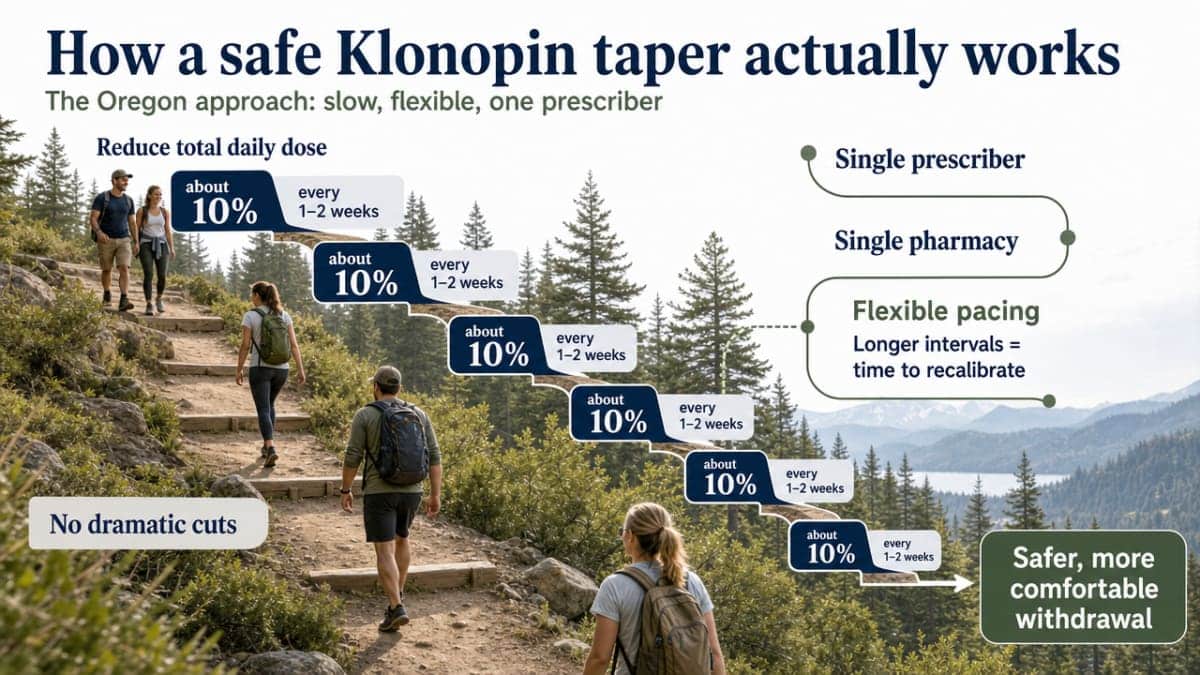
Here’s the part of detox that often surprises people: the actual taper is slower and gentler than you’d expect. The Oregon Health Authority’s clinician guide spells out a pacing that’s become the working standard in this state. You reduce the total daily dose by about one-tenth every one to two weeks, and you do it under the care of a single prescriber working with a single pharmacy 1. That’s it. No dramatic cuts. No willpower contests.
The reason for that pace isn’t caution for caution’s sake. Longer intervals between dose reductions give your nervous system time to recalibrate at each step, which the OHA guide describes as producing safer and more comfortable withdrawal
1. A taper that looks slow on paper feels survivable in the body. That trade is worth it.
Two more pieces of the Oregon approach matter. First, the schedule is flexible, not fixed. The current joint guideline from ASAM and partner societies is explicit that if withdrawal symptoms flare, the taper should be slowed or paused rather than pushed through on a rigid timeline 7. Second, having one prescriber and one pharmacy keeps everyone looking at the same picture. No conflicting instructions, no medications that quietly interact with each other.
Why some people switch from clonazepam to diazepam first
You may hear a clinician suggest switching you from Klonopin to diazepam (the generic name for Valium) before the taper actually starts. That can sound alarming at first. Why add a medicine when the goal is to come off one?
The reason is practical. Klonopin leaves the body in shorter, choppier waves than diazepam, which has a long, smooth half-life. That smoother curve means smaller swings between doses, which makes the slow step-down easier to feel and easier to control. The Oregon guide specifically recommends that people who’ve been on benzodiazepines for more than a year transition to diazepam before tapering 1.
The switch isn’t automatic, and it isn’t right for everyone. It’s a conversation. But if a clinician suggests it for you, they’re not adding a step. They’re picking a smoother road for the same trip.
The myth of a magic add-on pill
Somewhere along the way, you may read online that a medicine called pregabalin can take the edge off Klonopin withdrawal. It’s worth pausing on that claim.
A systematic review looked at pregabalin as an add-on during benzodiazepine discontinuation. The honest finding: it may ease some withdrawal and anxiety symptoms, but it does not meaningfully improve the odds of actually getting off the benzodiazepine, and the authors concluded pregabalin is not recommended for this purpose 10. Pregabalin also carries its own dependence and misuse concerns 10.
The takeaway isn’t that medicine can’t help during a taper. It’s that no single add-on shortcuts the work. A safe Klonopin taper is built on time, pacing, and supervision, not a second pill that does the heavy lifting.
Do you need supervised detox, or can you taper as an outpatient?
Signs you should not try to taper alone at home
Some Klonopin tapers can be done safely at home with a careful prescriber, a pharmacist who knows your full medication list, and someone nearby paying attention. Others really should not. The difference comes down to risk, and being honest with yourself about which group you’re in is one of the kindest things you can do for yourself.
Lean toward a supervised setting (residential or another 24/7 environment) if any of the following are true for you:
- You’ve taken Klonopin daily for a year or more, especially at a moderate to high dose 11.
- You’ve tried to stop or cut down before and had a seizure, severe panic, hallucinations, or had to go to the ER 11.
- You’re also using opioids, alcohol, or another sedative regularly. The combination raises the stakes and needs coordinated care 3.
- You live alone, or there isn’t a sober adult who can check on you daily during the hardest weeks.
- You have a seizure disorder, heart condition, or untreated severe anxiety or PTSD that would make symptom spikes especially dangerous.
- You’ve been doubling up on doses or running out early. That’s information, not a moral failing, and it changes what you need.
If two or more of those describe you, an outpatient taper at home is likely the harder, riskier road, not the easier one. A small thing you can do today: read that list once more and put a checkmark next to anything that applies. You don’t have to share it with anyone yet. You’re just getting clear with yourself.
A note for older adults and anyone on several medicines
If you’re over 65, or you’re helping a parent who is, this part is for you.
In June 2025, federal health officials sent clinicians a direct message about benzodiazepines in older adults. The concerns are real: higher risk of falls, memory and thinking changes, and overdose risk when these medicines mix with opioids or alcohol 8. The same letter is clear that the answer is not to stop suddenly. It asks clinicians to weigh alternatives, honor the patient’s goals and values, and use careful, evidence-based tapering 8.
That balance matters. An older body processes medicines more slowly, so withdrawal symptoms can land harder and last longer. A fall during a shaky night is its own emergency. At the same time, a panicked abrupt stop is more dangerous, not less, in this age group.
The same caution applies if you take several medicines for blood pressure, sleep, pain, mood, or seizures. Interactions and dose timing get complicated fast. A supervised setting with one team watching the whole picture is often the safest place for that puzzle to be sorted out.
One gentle step today: write down every prescription, over-the-counter pill, and supplement currently in the cabinet. That single page is gold to whoever helps you next.

What to expect inside a residential detox program near Milwaukie
Why a home-like setting helps your nervous system settle
Picture the difference between trying to fall asleep in a fluorescent-lit hallway and falling asleep in a quiet room with a real bed, soft light, and a door that closes. Your nervous system can feel the difference. That’s not a marketing line. It’s biology. A body that’s coming off Klonopin is already on high alert, and the setting around you either turns the volume up or turns it down.
A non-hospital residential detox is built for that second job. You still get the medical part of medically supervised detox (round-the-clock monitoring, a clinician adjusting your taper, someone watching for the symptoms a long-term clonazepam user is more likely to develop) 9, 11. But the rooms look like rooms. There’s a couch. There’s a kitchen. Other people in the house are walking through the same days you are.
For most long-term Klonopin users, that combination (clinical safety plus a calmer environment) is what makes the slow, gradual taper the guidelines call for feel possible instead of impossible 7.
Sleep, anxiety, and the days that feel the hardest
Be ready for this part. The first stretch is usually the roughest. Sleep gets thin. Anxiety can spike higher than it did before you ever started the medicine. You may feel jumpy, foggy, irritable, weepy, or all of it in the same hour. That’s withdrawal doing exactly what withdrawal does, especially after a month or more of daily use 2.
What a good program does on those days is small and steady. Your taper gets slowed or paused if symptoms flare, instead of pushed through on a fixed schedule 7. Sleep gets supported with non-habit-forming options and routine. Anxiety gets met with people, not just pills. A nurse checks in. A peer who’s been here before sits with you.
The hard days don’t last forever. Getting through one of them counts. So does asking for help on the next.
How to evaluate a local detox program without the jargon
Once you start calling places, you’ll notice they all sound a little similar on the phone. Warm voices, reassuring words, a willingness to schedule you tomorrow. That’s not a bad thing, but it makes it hard to tell programs apart. Here’s a short list of plain-English questions that will help you find out who actually knows how to detox a long-term Klonopin user safely.
- “Is a clinician on site around the clock?” For someone tapering off a benzodiazepine, 24/7 monitoring is the whole point. If the answer is vague, that’s an answer 9.
- “Will one prescriber manage my taper, working with one pharmacy?” Oregon’s own clinical guide is direct about this single-prescriber, single-pharmacy approach 1. Multiple cooks in the kitchen is how mistakes happen.
- “How do you decide my taper pace, and what happens if symptoms flare?” A good program will say the schedule is individualized and that the taper can be slowed or paused if you struggle, not pushed through 7. If they quote you a fixed number of days, that’s a red flag.
- “Do you have experience with long-term clonazepam users, especially at higher doses?” This is the population that carries the most seizure risk, and it shows in how a program answers 11.
- “What does the day after I leave look like?” They should have an answer ready: therapy, a plan for the anxiety underneath the medicine, follow-up appointments. Detox is the starting line, not the destination 4.
- “What does the room look like, and who else will be there?” A residential, home-like setting helps a raw nervous system settle in ways a fluorescent ward cannot.
You don’t need to memorize this list. Screenshot it. Read it during the call. Hearing yourself ask one of these questions out loud is a small win, and it counts.
What you can do today, even if you’re not ready to call
You don’t have to decide anything big right now. Reading this far is already doing something. If you want to take one more small step before the day ends, here are a few that cost nothing and commit you to nothing.
- Write down your current daily Klonopin dose and how long you’ve been taking it. That short note saves a future conversation.
- List every other medicine, supplement, or substance you use, including alcohol. One page is enough.
- Save SAMHSA’s free, confidential helpline in your phone: 1-800-662-HELP. It runs 24/7, every day of the year, in English and Spanish 12. You can call just to ask questions.
- Tell one person you trust that you’re thinking about this. Out loud counts.
None of this means you’ve signed up for anything. It means you’re getting ready. That’s how most safe detoxes actually start.
Check Your Insurance for Klonopin Detox Options
Quickly find out if your insurance covers safe, supervised Klonopin detox in Milwaukie.
Frequently Asked Questions
How long does Klonopin detox usually take?
There’s no single answer, and a program that promises a fixed number of days for a long-term Klonopin user is one to question. A gradual taper that reduces the daily dose by about one-tenth every one to two weeks can stretch over many weeks, especially for someone who’s been on the medicine for years 1. The pace is built around your body, not a calendar.
Can I detox from Klonopin at home if my dose is small?
Sometimes, yes, with a prescriber managing the taper and someone checking on you. But “small dose” isn’t the only question. Duration matters, other medicines matter, and any past withdrawal seizure changes the math entirely 11. Talk to a clinician before you decide. Stopping suddenly, even from a low daily dose taken for a long time, is the part to avoid 7.
Will I have to stop my anxiety treatment completely?
No. Coming off Klonopin doesn’t mean leaving the underlying anxiety untreated. A good plan does the opposite. It lines up therapy, often a non-habit-forming medication option, and skills for managing panic and sleep, so the reason the Klonopin was prescribed gets care of its own 4. The goal is fewer symptoms long-term, not white-knuckling without support.
What happens if withdrawal symptoms get worse during the taper?
The plan changes. Current clinical guidance is clear that if symptoms flare, the taper should be slowed or paused rather than pushed through on a rigid timeline 7. In a supervised setting, a clinician adjusts your dose in real time and watches for warning signs like severe agitation, confusion, or seizure activity, which need immediate care 5. Speaking up about hard symptoms helps, not hurts.
Is residential detox confidential if I have a job or family responsibilities?
Yes. Substance use treatment records carry strong federal privacy protections, and reputable programs will walk you through exactly what is and isn’t shared. Many working adults use FMLA or short-term leave for detox without disclosing details to an employer. If you’re worried about a specific situation (a license, a custody concern, a security clearance) bring it up on the first call. They’ve heard it before.
What should I do if a loved one refuses to consider detox?
Stay in the conversation without forcing it. Share what you’ve learned about the real risks of stopping suddenly 3. Offer to help with logistics, not ultimatums. You can also call SAMHSA’s free, confidential helpline at 1-800-662-HELP for guidance on how to talk with them, available 24/7 in English and Spanish 12. Your steady presence matters more than a perfect script.
References
- How to Approach a Benzodiazepine Taper. https://www.oregon.gov/oha/HPA/DSI-Pharmacy/MHCAGDocs/Tapering-Benzodiazepines.pdf
- Patient Guide to Benzodiazepines | Oregon.gov. https://www.oregon.gov/oha/HPA/DSI-Pharmacy/MHCAGDocs/Final-Patient-guide-benzodiazepines-5.13.2022.pdf
- CDC Clinical Practice Guideline for Prescribing Opioids for Pain — United States, 2022. https://www.cdc.gov/mmwr/volumes/71/rr/rr7103a1.htm
- Detoxification and Substance Abuse Treatment (TIP 45, Quick Guide for Clinicians). https://www.nida.nih.gov/sites/default/files/samhsa_detoxification_and_substance_abuse_treatment.pdf
- Withdrawal Syndromes – StatPearls – NCBI Bookshelf. https://www.ncbi.nlm.nih.gov/books/NBK459239/
- A Retrospective Review of Morbidity and Mortality Associated with Acute Benzodiazepine Withdrawal. https://pubmed.ncbi.nlm.nih.gov/33763183/
- Joint Clinical Practice Guideline on Benzodiazepine Tapering. https://pmc.ncbi.nlm.nih.gov/articles/PMC12463801/
- Dear Colleague Letter: Benzodiazepine Use in Older Adults. https://www.samhsa.gov/sites/default/files/dear-colleague-letter-benzodiazepine-06052025.pdf
- Detoxification and Substance Abuse Treatment (TIP 45, Quick Guide for Clinicians). https://nida.nih.gov/sites/default/files/samhsa_detoxification_and_substance_abuse_treatment.pdf
- Pregabalin as adjunctive therapy in benzodiazepine discontinuation. https://pubmed.ncbi.nlm.nih.gov/29317396/
- Benzodiazepine withdrawal seizures and management. https://pubmed.ncbi.nlm.nih.gov/28208910/
- National Helpline for Mental Health, Drug, Alcohol Issues. https://www.samhsa.gov/find-help/helplines/national-helpline