

Key Takeaways
- Stopping heavy daily drinking abruptly can trigger seizures and delirium tremens, which is why national guidance treats alcohol withdrawal as a medical event rather than a willpower problem.1, 5
- History matters more than volume: prior delirium tremens and a resting systolic blood pressure of 140 mm Hg or higher are documented predictors of severe withdrawal, and daily morning drinking is another well-known warning sign.7
- Between toughing it out alone and a hospital stay sits non-hospital residential detox—at Pacific Crest Trail Detox, a home-like setting with 24/7 nurses, medication managed to help prevent complications, and a direct handoff into continuing care.2
- Detox is step one, not the finish line. Counseling, mutual-support groups, and the three FDA-approved medications for AUD give the months after withdrawal a real foundation.11, 12
The honest answer when you’re scared to stop drinking
If you’re searching for alcohol treatment at home, you probably already know something has to change. Maybe you’ve tried to quit on a Monday and been drinking again by Tuesday night. Maybe your spouse is asking what the plan is. Maybe you’re just tired. Here’s the straight answer: you can get well without a hospital, but you should not detox from alcohol by yourself. Stopping suddenly after heavy, daily drinking can cause seizures and delirium tremens that are genuinely life-threatening, which is why national guidance treats alcohol withdrawal as a medical event, not a willpower problem.1, 5
That doesn’t mean your only option is a fluorescent-lit emergency room. For most people, the real safer-at-home choice is a medically supervised, home-like residential detox with nurses on site around the clock, medication managed to help prevent complications, and a direct handoff into continuing care.2 This article walks you through what the risks actually are, who is most vulnerable, what withdrawal feels like, and the care options that sit between toughing it out alone and checking into a hospital.
Why alcohol withdrawal is different from quitting other things
Quitting cigarettes is miserable. Quitting sugar is annoying. Quitting alcohol after months or years of daily heavy drinking is a medical event. Your brain has been bathed in a sedative for so long that it has quietly turned up its own excitement signals to compensate. Take the alcohol away, and those signals keep firing with nothing to balance them. That’s where seizures, racing heart, soaring blood pressure, and delirium tremens come from. The federal government does not use the phrase “life-threatening” lightly, and it uses it specifically about this.1, 5
Here is roughly how the days tend to unfold, drawn from national clinical guidance. None of this is a schedule you should try to manage from your couch. It is a map so you understand why timing matters.3, 9
- Early hours after your last drink: shakiness in your hands, sweating, nausea, anxiety that feels bigger than the situation, trouble sleeping, a headache that won’t quit.
- First day or two: symptoms sharpen. Blood pressure and heart rate climb. Withdrawal seizures can happen in this window, and they can occur without the “warning” symptoms being dramatic.3
- Days 2 to 3, occasionally up to day 5: the delirium tremens window. Severe confusion, hallucinations, fever, and dangerous swings in blood pressure and heart rhythm are possible. DTs are a medical emergency and can be fatal when they are not treated in a setting with the right medication and monitoring.1, 9
- After the first week: for many people, symptoms begin to settle. For others, sleep problems, anxiety, and cravings stretch out for weeks and need continued support.
Can you really treat alcohol use disorder at home?
Short answer: parts of alcohol use disorder treatment can happen at home, but the detox part should not happen alone on your couch. Those are two different questions wearing the same clothes, and mixing them up is how people get hurt.
Long-term treatment for alcohol use disorder often does happen in your regular life. Counseling, group therapy, mutual-support meetings, and the three FDA-approved medications for AUD (naltrexone, acamprosate, and disulfiram) are things you can do while sleeping in your own bed and going to work.11, 12 That is treatment at home in the most meaningful sense, and it is where most of the real change happens over months and sometimes years, not days.2
Withdrawal management is the piece that is different. National clinical guidance from ASAM allows for ambulatory, or outpatient, withdrawal management, but only after a clinician assesses your risk, confirms your symptoms are mild to moderate, and sets up frequent monitoring and a clear plan to move you to a higher level of care if things turn.3, 4 That is not the same as deciding on a Sunday night that you’ll “ride it out” with a case of Gatorade and a prayer. It is a clinician-selected pathway with eyes on you.
So if a professional has looked at your history and said outpatient is reasonable, treatment at home is a real option. If no one has looked, you are not treating alcohol use disorder. You are gambling.
Who is actually at higher risk for a dangerous withdrawal
Here’s the part that surprises people: how much you drink is not the best predictor of how bad withdrawal will get. Your history is. A clinician looking at you is weighing specific things, and you can look at the same list honestly before you decide anything.
The clearest red flags come from a systematic review of 71,295 patients that looked at who actually ended up with severe alcohol withdrawal, seizures, or delirium tremens. Two findings stood out. If you have had delirium tremens before, your odds of a severe course go up. If your resting systolic blood pressure is 140 mm Hg or higher when you walk in the door, your odds go up too.7 ASAM’s guideline also identifies a history of withdrawal seizures as a risk factor for complicated withdrawal. The nervous system remembers.4
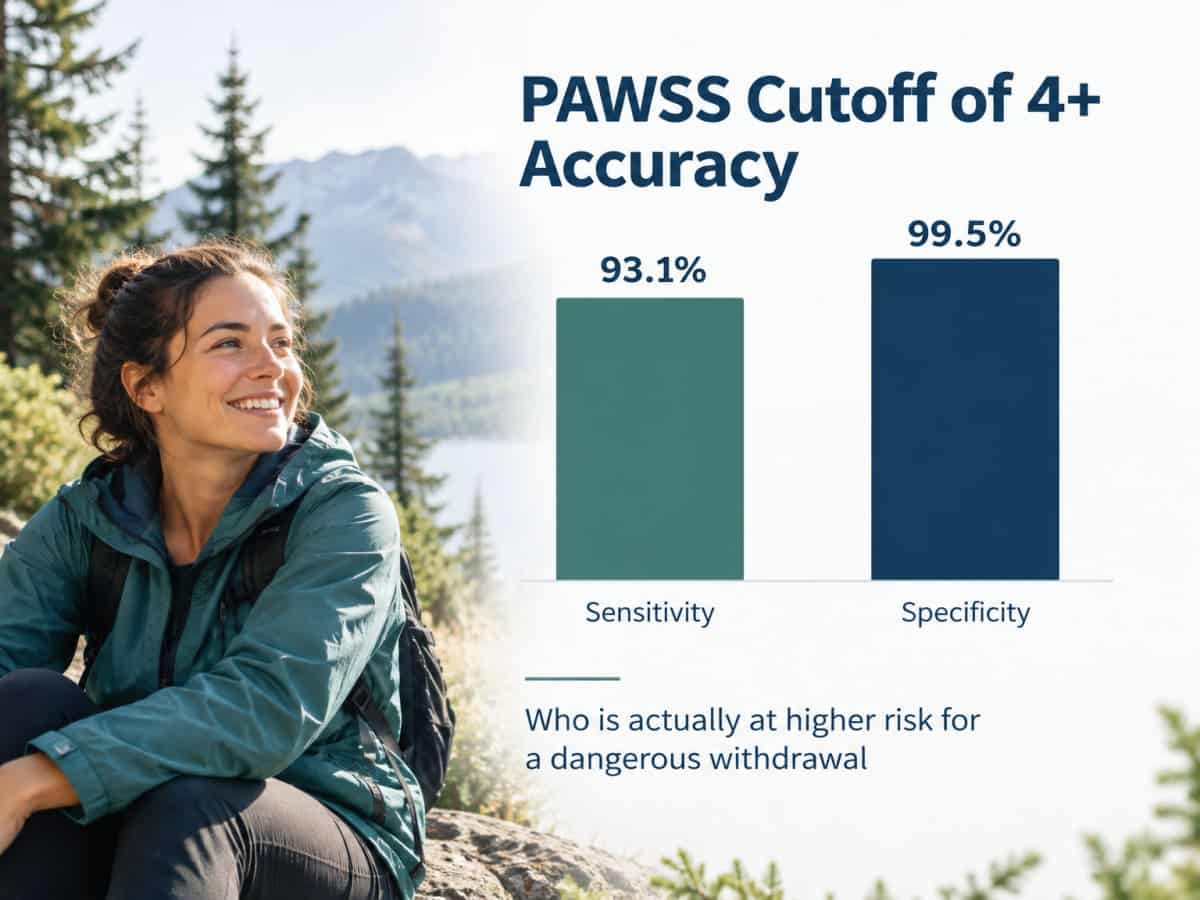
Clinicians also use structured tools instead of eyeballing it. One of them is the Prediction of Alcohol Withdrawal Severity Scale, or PAWSS. In a prospective validation study of medically ill inpatients, a PAWSS score of 4 or higher caught complicated withdrawal with 93.1% sensitivity and 99.5% specificity.6 In plain English: when the tool said someone was high risk, it was almost always right, and it rarely missed people who truly were. That is why a 10-minute conversation with a nurse or provider is worth more than any article you can read on your phone.
Beyond those specifics, risk climbs when you have been drinking daily for months or years, when you drink first thing in the morning to stop the shakes, when you have liver disease, heart problems, uncontrolled diabetes, or a seizure disorder, or when you are older. Mixing alcohol with benzodiazepines like Xanax, Ativan, or Klonopin is another situation clinicians weigh carefully. Pregnancy and being alone in the house also change the picture, because no one is there to notice if something turns.
None of this means you are doomed. It means the honest answer to “how risky is this for me?” is not something you can Google. It is something a clinician figures out with you, usually in one conversation, before anyone decides whether home-based care is even on the table.
Why so few people get help for alcohol use disorder
If part of you is reading this and thinking “I should probably just handle this myself,” you are not alone, and the national numbers show how common that thought is. In 2024, only 7.6% of people aged 12 and older with past-year alcohol use disorder received any alcohol treatment, according to NIAAA’s analysis of the National Survey on Drug Use and Health.13 That leaves roughly 92 out of every 100 people with AUD doing something other than getting help. Medication is used even less: just 2.5% received one of the FDA-approved medications for AUD in the same year.13
The reasons are not mysterious. Shame is a big one. So is fear of losing a job, custody, or standing in a community that still treats drinking as a character issue. Cost and time off work are real. For a lot of people, searching “alcohol treatment at home” is the first quiet step, taken at midnight on a phone, because walking into a building feels like admitting something you are not ready to admit out loud yet.
Here is the kinder way to read that 7.6%: most people with AUD are not refusing help. They are stuck between a problem that scares them and a system that feels bigger and more public than they can handle today. A home-like setting with people who have been there themselves is often the bridge that makes the first call possible.
What a safer path actually looks like
Between “ride it out alone” and “check into a hospital,” there are two real options most people don’t know about: supervised ambulatory care with a clinician checking in on you, and non-hospital residential detox that looks and feels more like a house than a ward. Both are legitimate paths. Neither is the same thing as detoxing by yourself. Here’s what each one actually involves, and when a hospital is still the right call.3, 4
Ambulatory and telemedicine withdrawal management
Ambulatory withdrawal management means a clinician manages your detox while you sleep at home, usually with daily visits, check-ins, and a prescribed medication plan. ASAM’s guideline treats this as a real option for carefully selected people with mild to moderate symptoms, no complicating medical conditions, a sober support person in the house, and a plan to escalate to a higher level of care fast if things turn.3, 4 The key word is selected. A clinician decides, not you and not a website.
Telemedicine has pushed this further. A 2025 single-arm study of clinician-delivered symptom-triggered withdrawal management by video looked at 30 adults over three days. 93.3% completed all three days, and none needed transfer to a higher level of care.10 A separate 2025 qualitative study found participants valued the comfort, privacy, and flexibility of being at home during withdrawal.9 Those are encouraging signals.
They are also narrow signals. Thirty people is small. Participants were pre-screened for lower-risk profiles, had a structured protocol, and had a clinician actively monitoring them. That is a very different thing from someone searching “alcohol detox protocol at home” at 2 a.m. and trying to piece together a plan. If you have a history of withdrawal seizures, delirium tremens, serious medical conditions, or no one around to notice if you decline, ambulatory care is likely not the right fit—and a responsible clinician will tell you that in the first conversation.3, 7
Non-hospital residential detox: the home-like middle path
When people type “alcohol treatment at home,” what many of them actually want is privacy, comfort, and dignity—not fluorescent lights, not a hospital gown, not a room with a TV bolted to the wall. At Pacific Crest Trail Detox, non-hospital residential detox is built around exactly that. You sleep in a bed, not on a gurney. Meals are home-cooked. There are groups during the day and quiet in the evening. And nurses are on site 24 hours a day, with providers rounding seven days a week, so if your blood pressure spikes at 3 a.m. or your tremor gets worse after dinner, someone is already there.
The clinical backbone is still rigorous. In Oregon, licensed withdrawal management programs are required to document your substance-use history on admission, use a validated withdrawal measure like CIWA-Ar or COWS to track symptoms, place you using ASAM criteria, keep medical staffing in place, and have the ability to transfer you to a higher level of care if your course changes.14, 15 That is the regulatory floor. A good program lives well above it.
What that looks like in practice: medication to help prevent seizures and delirium tremens is available and monitored, not improvised. Vitals are checked on a schedule, not when you remember. If something turns, the next step is already arranged, not a frantic 911 call from a bathroom floor. And because detox is only step one, continuing care—outpatient groups, medication for AUD, counseling, alumni support—is lined up before you leave.2, 11
For most people searching for a safer at-home option, this is the honest answer: a home-like setting with medical eyes on you. It gives you most of what you were hoping “at home” would mean, without the part that can kill you.
Hospital-based detox and when it’s the right call
Sometimes the hospital is the right place, and no one should feel ashamed about ending up there. If you have had delirium tremens or withdrawal seizures before, if your resting systolic blood pressure is 140 mm Hg or higher, if you have unstable heart disease, advanced liver disease, uncontrolled diabetes, a seizure disorder, or active suicidal thoughts, an intensive inpatient setting is designed for exactly that level of risk.2, 7 The same is often true if you have been mixing alcohol with benzodiazepines, if you are pregnant, or if you are already in withdrawal and symptoms are escalating.
A good residential program will tell you honestly when a hospital is the safer first stop and help coordinate the handoff. The goal isn’t to keep you in one setting. It’s to get you through withdrawal alive and into real treatment.3
What to expect in medically supervised detox, day by day
Walking into a detox facility is scarier in your head than it is in person. Here’s what the first week actually looks like when you’re being cared for in a home-like residential setting, so the unknown feels a little less unknown.
Day 1 (admission): A nurse sits down with you and goes through your drinking history, medical conditions, medications, and what the last 24 hours looked like. You’ll have your blood pressure, heart rate, and temperature checked, and someone will run through a validated withdrawal scale like CIWA-Ar to score your symptoms honestly. That score drives the medication plan, not a guess.15 You unpack. You eat. You sleep in a bed.
Days 2–3 (the hardest window): This is when symptoms usually peak and when seizures or delirium tremens are most likely if they’re going to show up.9 Vitals and withdrawal scores are checked on a schedule through the day and overnight. Medication is given to help prevent complications and ease the shaking, sweating, and anxiety. Nurses are there at 3 a.m. the same way they are at 3 p.m. If something turns, the plan to escalate care is already in place.
Days 4–7 (settling): Symptoms start to loosen their grip. You’ll begin eating regular meals, sleeping in longer stretches, and sitting in on groups with other people doing the same work. Providers round through the week to check in on how your body is responding.
Days 8–10 (transition): At Pacific Crest Trail Detox, detox typically wraps up in this window, and the next step is already lined up—outpatient groups, medication for AUD if it fits, counseling, a continuing-care plan.2 You don’t leave with a pamphlet and a prayer. You leave with a schedule.
Detox is step one, not the whole answer
Here’s the part a lot of articles about alcohol treatment skip: detox is where you stop drinking safely, not where you learn how to stay stopped. National clinical guidance is explicit that detox is a starting point, and that treatment and continuing care for alcohol use disorder are measured in months and sometimes years, not the few days most people spend in withdrawal management.2 If you only do the first part, the odds of being back where you started climb fast.
The good news is that the evidence on what helps next is clear and practical. NIAAA points to three things that work, often in combination: counseling (individual, group, and family), mutual-support groups, and the three FDA-approved medications for alcohol use disorder—naltrexone, acamprosate, and disulfiram.11, 12 Medication for AUD is wildly underused. Only 2.5% of people with past-year AUD received one of these medications in 2024, which means a lot of people are trying to do this on willpower alone when a prescription could take the edge off cravings.13
What continuing care actually looks like in real life: a few hours a day in a partial hospitalization program when you first leave detox, stepping down to intensive outpatient a few evenings a week, then standard outpatient and alumni groups as life settles. Medication can run alongside any of it. The point isn’t to live in treatment forever. It’s to have real support in place for the months when your brain is still learning how to run without alcohol.
Finding care in Oregon, SW Washington, and beyond
If you’re in the Portland metro, finding licensed withdrawal care close to home is more straightforward than it feels at midnight on your phone. Oregon licenses and oversees residential detox and withdrawal-management programs through the Oregon Health Authority, with service rules under OAR Chapter 415, Division 50. Those rules require admission documentation, a validated withdrawal measure like CIWA-Ar or COWS, ASAM-based placement, medical staffing, and the ability to transfer you to a higher level of care if your course changes.14, 15 That is the floor every licensed Oregon program has to meet before you ever walk through the door.
From Milwaukie, a home-like residential detox is a short drive for most readers in Portland, Gresham, Beaverton, Lake Oswego, Oregon City, Tigard, and Salem. For people in Vancouver, WA and the rest of SW Washington, crossing the river for medical detox is common and often faster than finding comparable care locally. Out-of-state readers travel in from across the Pacific Northwest and beyond too, usually because they want privacy, a home-like setting, and a program that will line up continuing care before they leave.2
When to call now and what the first call sounds like
Some things shouldn’t wait for Monday. If you’re already shaking in the morning, sweating through a shirt, seeing or hearing things that aren’t there, feeling your heart race, or you’ve had a withdrawal seizure or delirium tremens before, that’s a call-today situation—not a research-another-article one.1, 7 If you’ve been drinking heavily every day for months, mixing alcohol with Xanax, Ativan, or Klonopin, or you’re alone in the house with no one to notice if things turn, pick up the phone.
Here’s what the first call actually sounds like, so it feels less like a cliff. A real person answers—often someone who has been through recovery themselves. They ask about your drinking, your health, what medications you take, and how you’re feeling right now. They walk you through verifying your insurance and talk through what admission looks like, usually within a day. No lecture. No sales pitch. If a hospital is the safer first stop, they’ll tell you that honestly.
Calls to Pacific Crest Trail Detox in Milwaukie are confidential and HIPAA-protected. Portland metro, Salem, Vancouver, and out-of-state readers are all welcome. We want to be your last treatment experience, whether we’re your first detox or your fifth.
Check Coverage Before Detoxing at Home
Find out whether your plan may cover medically supervised alcohol detox and continued care.
Frequently Asked Questions
Is it safe to detox from alcohol at home by myself?
No. If you’ve been drinking heavily every day, stopping on your own can trigger seizures or delirium tremens, which are life-threatening.1, 5Supervised outpatient detox exists, but a clinician has to decide you’re low risk first and set up monitoring.3Searching for a home protocol at 2 a.m. is not the same thing as being medically cleared for one.
How long does alcohol withdrawal last?
Early symptoms usually start within hours of your last drink. The hardest window typically falls in the first few days, when seizures and delirium tremens are most likely; delirium tremens usually emerges around days two or three, occasionally as late as day five.9Most physical symptoms settle within a week, though sleep problems, anxiety, and cravings can stretch out for weeks. At Pacific Crest Trail Detox, medically supervised detox typically runs 8 to 10 days, with care handing off into continuing treatment.
What’s the difference between non-hospital residential detox and a hospital stay?
A hospital is built for the sickest patients: ICU access, procedures, high-acuity monitoring. Non-hospital residential detox is licensed medical care that in Oregon must meet admission documentation, validated withdrawal measurement, ASAM placement, medical staffing, and transfer-capability requirements.14, 15At Pacific Crest Trail Detox, that regulatory floor is paired with a house-like setting, nurses on site 24/7, providers rounding through the week, home-cooked meals, and medication managed to help prevent complications. You get real clinical oversight without the gown, the bolted-down TV, or the fluorescent lights. If risk is very high, a hospital remains the right first stop.2
How do I know if I’m at high risk for seizures or delirium tremens?
Red flags include a history of delirium tremens or withdrawal seizures and a resting systolic blood pressure of 140 mm Hg or higher.7Clinicians also look at serious medical conditions, daily morning drinking to stop the shakes, and mixing alcohol with benzodiazepines like Xanax or Klonopin. Structured tools like PAWSS help catch complicated withdrawal early.6A 10-minute phone assessment with a nurse will tell you more than any self-test online.
What happens after detox ends?
Detox is step one, not the whole answer. Continuing care usually means a partial hospitalization program, then intensive outpatient, standard outpatient, counseling, and alumni support over months.2FDA-approved medications for alcohol use disorder—naltrexone, acamprosate, and disulfiram—can run alongside any of it to take the edge off cravings.11, 12A good detox program lines the next step up before you leave, so you don’t walk out with just a pamphlet.
Can I come to Pacific Crest Trail Detox if I live outside Oregon?
Yes. People travel to Milwaukie from across Oregon—Portland, Gresham, Beaverton, Salem—and from Vancouver, WA and the broader Pacific Northwest, plus out of state. The home-like setting, privacy, and lived-recovery staff are often the reasons people choose to travel. Call for a confidential, HIPAA-protected assessment and we’ll walk you through verifying insurance and what admission looks like, usually within a day.
References
- Understanding Alcohol Use Disorder. https://www.niaaa.nih.gov/publications/brochures-and-fact-sheets/understanding-alcohol-use-disorder
- Alcohol Use Disorder: From Risk to Diagnosis to Recovery. https://www.niaaa.nih.gov/health-professionals-communities/core-resource-on-alcohol/alcohol-use-disorder-risk-diagnosis-recovery
- The ASAM Clinical Practice Guideline on Alcohol Withdrawal Management. https://www.samhsa.gov/resource/ebp/asam-clinical-practice-guideline-alcohol-withdrawal-management
- The ASAM Clinical Practice Guideline on Alcohol Withdrawal Management: Pocket Guide. https://www.samhsa.gov/resource/ebp/asam-clinical-practice-guideline-alcohol-withdrawal-management-pocket-guide
- Screen and Assess: Use Quick, Effective Methods. https://www.niaaa.nih.gov/health-professionals-communities/core-resource-on-alcohol/screen-and-assess-use-quick-effective-methods
- Prospective Validation Study of the Prediction of Alcohol Withdrawal Severity Scale (PAWSS) in Medically Ill Inpatients: A New Scale for the Prediction of Complicated Alcohol Withdrawal Syndrome. https://pubmed.ncbi.nlm.nih.gov/25999438/
- Will This Hospitalized Patient Develop Severe Alcohol Withdrawal Syndrome?: The Rational Clinical Examination Systematic Review. https://pubmed.ncbi.nlm.nih.gov/30167704/
- Symptom-Triggered Therapy for Alcohol Withdrawal Syndrome: a Systematic Review and Meta-analysis of Randomized Controlled Trials. https://pmc.ncbi.nlm.nih.gov/articles/PMC6544709/
- “It beats the hell out of going to a hospital”: service user experiences of telemedicine-based symptom-triggered alcohol withdrawal management. https://pubmed.ncbi.nlm.nih.gov/40804689/
- Symptom-Triggered Alcohol Withdrawal Management Delivered Over Telemedicine. https://pubmed.ncbi.nlm.nih.gov/40310714/
- Recommend Evidence-Based Treatment: Know the Options. https://www.niaaa.nih.gov/health-professionals-communities/core-resource-on-alcohol/recommend-evidence-based-treatment-know-options
- Treatment for Alcohol Problems: Finding and Getting Help. https://www.niaaa.nih.gov/publications/brochures-and-fact-sheets/treatment-alcohol-problems-finding-and-getting-help
- Alcohol Treatment in the United States. https://www.niaaa.nih.gov/alcohols-effects-health/alcohol-topics-z/alcohol-facts-and-statistics/alcohol-treatment-united-states
- Oregon Health Authority: Residential Treatment Facilities. https://www.oregon.gov/oha/HSD/AMH-LC/Pages/RT.aspx/1000
- Health Systems Division: Addiction Services – Chapter 415, Division 50. https://www.oregon.gov/oha/HSD/Medicaid-Policy/SUDWaiver/415-050-Highlighted-040723.pdf