
Key Takeaways
- Pacific Crest Trail Detox in Milwaukie staffs many roles with people in long-term recovery, pairing lived understanding with medical care for alcohol, opioid, and benzodiazepine withdrawal.
- Oregon requires certified Peer Support Specialists to have lived recovery or consumer experience plus state-approved training, and has funded expansion of the peer workforce 7, 10.
- A 2025 systematic review of 28 studies and 12,601 participants found peer support most consistently improves treatment engagement and retention, while long-term substance use effects remain mixed 12.
- When comparing detox options, weigh medical supervision, home-like versus hospital setting, credentialed peer involvement, and a clear step-down path through day programs, evening groups, and alumni community.
The First 72 Hours: What Nobody Tells You About Walking In
You probably didn’t sleep much last night. Maybe you’ve been counting hours until your next drink, or watching the clock and dreading what your body will do when the pills run out. Maybe someone who loves you is sitting on the other side of the door, waiting to see what you decide. If any of that sounds familiar, take a breath. You’re already doing the hardest part.
The first 72 hours of detox are physical, but they’re also deeply emotional. Your hands might shake. Your stomach might turn. You might feel a wave of shame so heavy it makes the idea of walking through a treatment center door feel impossible. Nobody hands you a brochure about that part. The pamphlets talk about protocols and medications and levels of care. They don’t talk about what it feels like to sit in an intake chair convinced that everyone in the room is silently judging the worst version of you.
Here’s what nobody tells you: the people who work in a good detox already know. Not from a textbook. From their own lives. At Pacific Crest Trail Detox in Milwaukie, many of the staff and owners are in long-term recovery themselves. The person handing you a warm blanket, the counselor asking about your history, the voice on the phone at 2 a.m. — some of them have sat in the exact chair you’re sitting in. That shared understanding is exactly what federal guidance points to when it describes peer support workers as people who have been successful in recovery helping others in similar situations 1.
You don’t have to arrive brave. You don’t have to arrive clean. You just have to arrive. The next three days will be uncomfortable, and they’ll also be safer than another night alone with this. Picking up the phone counts. Reading this counts. You’re already moving.
The Person Checking You In May Have Sat in That Same Chair
Picture the front desk. You’re clammy, maybe a little unsteady, rehearsing what to say so you don’t cry before you finish a sentence. The person on the other side smiles, hands you a clipboard, and asks how you’re doing. You brace for the polite, distant answer you’ve gotten in emergency rooms before. Instead, they look at you like they actually know.
That’s not an accident. At Pacific Crest Trail Detox, many of the owners, counselors, and support staff have their own recovery stories. Some have been in withdrawal. Some have handed over car keys and cell phones on their own intake day. When they ask how you’re doing, they’re not reading off a script. They’re remembering.
This is the pairing that quietly does the heavy lifting in a good detox: real medical care on one side, real lived experience on the other. The clinical side keeps your body safe — nurses checking your vitals, doctors managing medications that ease withdrawal, protocols for alcohol and benzodiazepine detox where things can turn dangerous fast. The lived-experience side keeps you in the chair long enough for the medical side to work. Oregon’s own definition goes a step further, describing a Peer Support Specialist as someone who uses lived experience to help you access services, work around barriers, and push back against the shame and stigma that make asking for help so hard in the first place 8.
You may not have words yet for what you’re feeling. That’s okay. Someone in that room probably had the same trouble finding words on their first day, too. They can wait with you while you find yours. They can also tell you, honestly, that the fog you’re in right now will lift. Not because it’s a nice thing to say, but because they watched it lift for themselves.
Being met that way — with medical competence and human recognition in the same breath — is what people mean when they say a detox feels different. Not softer. Not less serious. Just more honest about who you are and what you’re walking through.
What the Research Actually Says (And What It Doesn’t)
You deserve honesty, not a sales pitch. So here’s what the research on peer support actually shows — the strong parts and the parts still being figured out.
The most current summary comes from a 2025 systematic review that pulled together 28 multi-group studies and 12,601 participants across substance use disorder programs. Its clearest finding: peer recovery support and recovery coaching most consistently improve treatment engagement and retention. In plain English, people who work with peers tend to show up, stay longer, and stick with the plan. The same review is careful to say that the evidence on direct substance-use outcomes — how much people drink or use down the road — is more mixed and still developing 12. That’s an important line to sit with. Peer support is not a magic switch that turns off addiction. It’s a bridge that keeps you on the path long enough for the medical care, the therapy, and your own hard work to add up.
Other reviews line up with that picture. A large review of peer support groups in addiction treatment found benefits across substance use, treatment engagement, and behaviors closely tied to relapse risk — including craving and self-efficacy, which is a fancy way of saying “the belief that you can actually do this” 14. A peer-reviewed article on peer support inside broader systems of care describes the same pattern: peers help people stay connected to treatment and to hope 13.
Here’s why that matters for you, right now. If the hardest thing about detox is not the first day but the fourth, or the second week, or the Tuesday afternoon three months in when your brain talks you into leaving — engagement and retention are exactly the outcomes you need. Staying in the room is how the medicine works. Staying in the room is how the therapy takes hold. Staying in the room is how a life gets rebuilt, one appointment at a time.
So no, we’re not going to tell you peer support cures addiction. Nobody honest will. What we will tell you, based on the best current evidence, is that being met by someone who has lived it makes you more likely to keep going. And in early recovery, keeping going is almost everything.
Why Oregon Peer Support Isn’t Just a Vibe
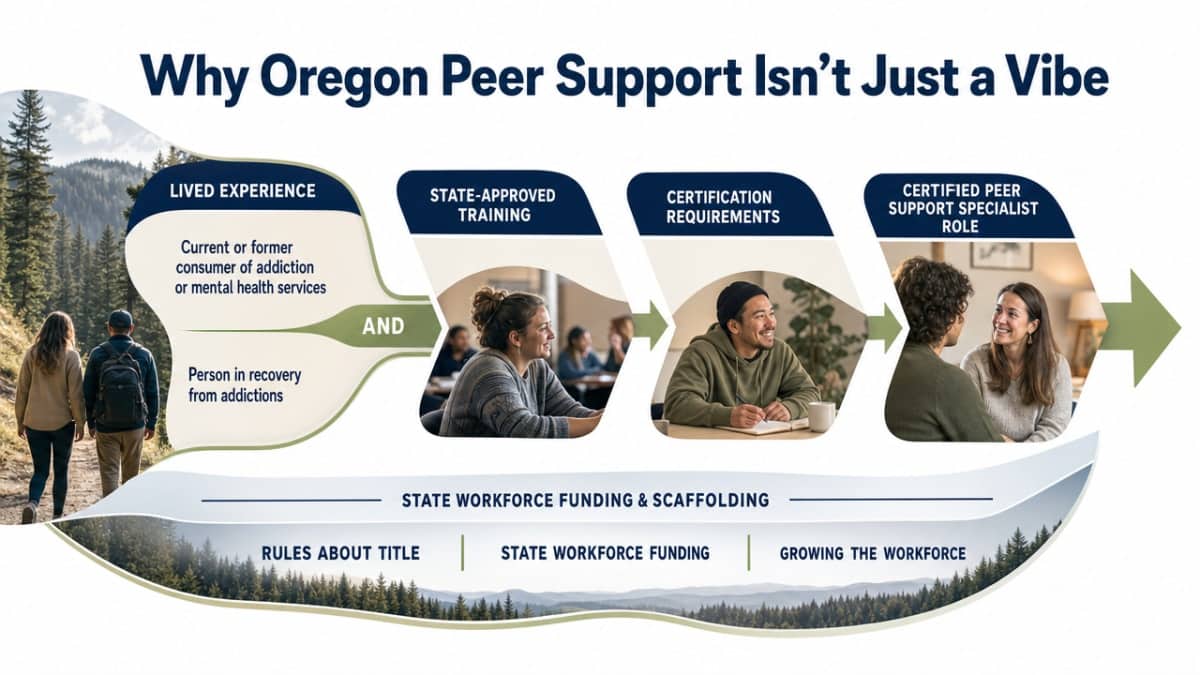
It would be easy to dismiss “lived experience” as a soft phrase — a nice idea a marketing team dreamed up to warm up a cold industry. In Oregon, it isn’t. The state has built actual scaffolding under it: rules about who can hold the title, what training they have to complete, and how much money should flow into growing that workforce.
Start with the credential itself. To work as a certified Peer Support Specialist in Oregon, an applicant has to identify as a current or former consumer of addiction or mental health services, or as a person in recovery from addictions. That’s the lived-experience part. Then they have to complete state-approved training and meet certification requirements before they can hold the role 7. So when someone in that role sits down with you, two things are true at once: they’ve been through something like what you’re going through, and they’ve done the coursework the state requires to sit in that chair on purpose.
The state also defines what the job actually is. Oregon describes a Peer Support Specialist as someone who uses lived experience to help people access services, work around barriers, and push back against the stigma that keeps folks away from care in the first place 8. That’s a job description with teeth. It’s not “be encouraging.” It’s “help this person find a bed, understand their insurance, make it to the next appointment, and not walk out of the room when shame flares up.”
And Oregon is putting money behind it. In 2023, the state’s Behavioral Health Workforce Initiative directed funding specifically to grow Peer Delivered Services capacity and support the existing peer workforce across the state 10. That’s a policy signal, not a slogan. When a state writes checks to expand a role, it’s saying the role does something the system needs.
For you, walking into a Milwaukie detox room, this matters in a very ordinary way. The person offering you water and asking how you slept isn’t just a kind stranger. They’ve likely been where you are, they’ve been trained to help you stay, and they’re part of a workforce Oregon has deliberately chosen to build. Warmth and structure, in the same person. That’s what you’re walking into.
A Home in Milwaukie, Not a Hospital Ward
Close your eyes and picture a hospital detox. Fluorescent lights that never quite turn off. A vinyl chair by the bed. A blood pressure cuff every few hours from someone new each time. Now picture a house on a quiet street in Milwaukie, about fifteen minutes south of downtown Portland. A couch you can actually sink into. A kitchen where somebody is making coffee. A window with a view of Douglas firs instead of a parking garage.
Both places can keep your body safe. They don’t feel the same.
Pacific Crest Trail Detox is a non-hospital medical detox, which is a fancy way of saying you get real medical supervision — nurses, doctors, medications that ease withdrawal from alcohol, opioids, or benzodiazepines — in a setting that looks and feels like a home. Your vitals still get checked. Your medications still get managed carefully, especially for alcohol and benzo withdrawal, which can turn dangerous without watchful care. What’s different is what surrounds all of that: warm rooms, shared meals, and people on staff who have been through their own recovery and are trained to help you through yours.
You still get the medical safety. You just don’t have to trade your dignity for it.
What the First Phone Call Actually Sounds Like
You might be holding your phone right now, thumb hovering. That pause is normal. Most people rehearse the call three or four times before they actually make it. Here’s what usually happens when you dial.
Someone picks up. Not an automated menu with seven options — a real person. They’ll ask your first name and how you’re doing today, and they’ll mean it. If you cry, they’ve heard crying before. If your voice shakes, they’ve heard that too. If you’re calling for someone you love and they don’t know you’re calling, that’s okay to say out loud.
The questions are simple at first:
- What are you using, and how much?
- When was your last drink or dose?
- Any other health conditions we should know about?
- Are you safe right now?
None of it is a test. They’re figuring out whether withdrawal could be dangerous — alcohol and benzodiazepines especially need close medical care — and how quickly to get you in.
They’ll walk you through insurance, what to bring, who can drive you. If money or logistics feel like a wall, say so. That’s part of the peer role Oregon defines: helping you get past the barriers that keep people out of care 8.
You don’t have to be ready. You just have to call. That’s the whole first step.
From Detox to Day Program to Evening Groups: The Handoff That Keeps You in the Room
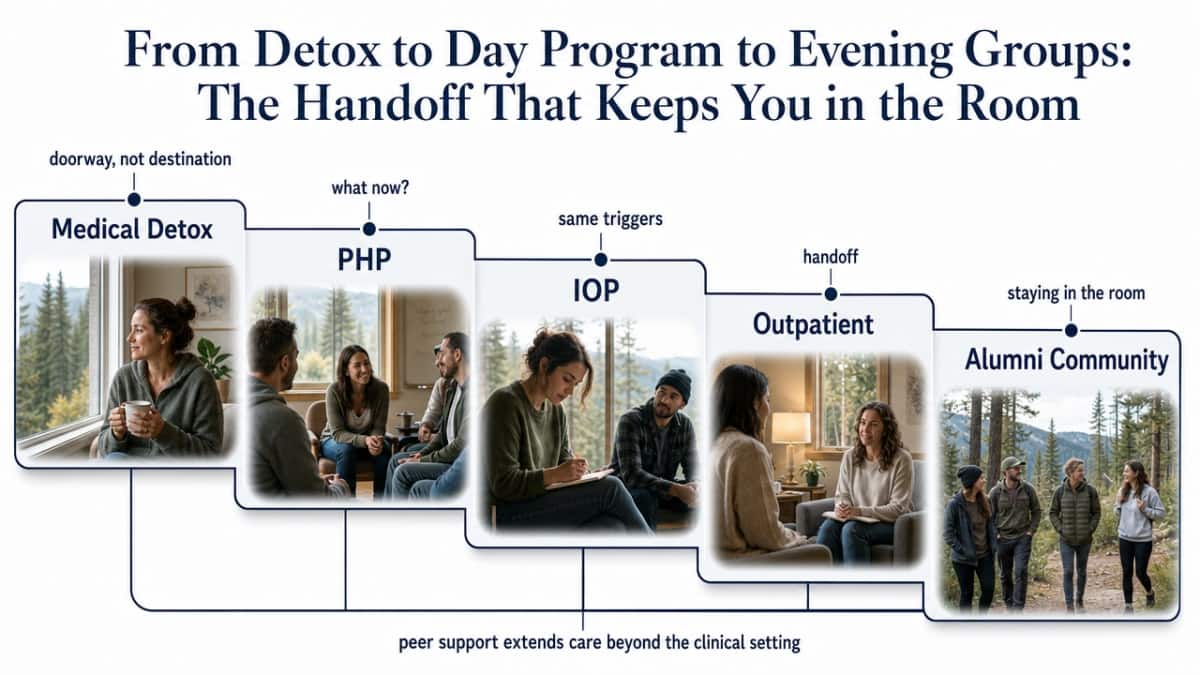
Detox is the doorway, not the destination. That’s one of the quietly important things people learn once they’re a few days in and the shakes have eased. Your body is calmer. Your head is clearer than it’s been in a long time. And then a new question shows up: what now?
This is where a lot of people fall through the cracks. Someone finishes medical detox feeling proud and a little stunned, goes home to the same couch and the same phone and the same triggers, and within a week or two the old life pulls them back. The handoff between detox and what comes next is exactly the moment where staying in the room matters most — and where peer support tends to earn its keep. A SAMHSA brief on peer recovery workers in opioid treatment describes them as people who help extend the reach of care beyond the clinical setting, so recovery doesn’t stop the moment you walk out the door 15.
At Pacific Crest Trail Detox, the plan doesn’t end at discharge. There’s a step-down path built into the program:
- A partial hospitalization program — think of it as a structured day program where you spend most of the day in therapy and groups, then sleep at home or in supportive housing.
- An intensive outpatient program — an evening or part-day group schedule that lets you keep a job or care for kids while still getting real clinical support.
- Standard outpatient after that, tapering as you get steadier.
- Individual therapy, group therapy, family sessions when they help.
Somewhere in that mix, a counselor or peer who knows your name is checking in. Not because it’s on a form. Because they’ve watched this stretch trip people up before, sometimes in their own lives. They know week three is harder than week one. They know the Tuesday afternoon crash is a real thing. And they’re there when it hits.
After Detox: Where Cravings Meet Community
A craving doesn’t announce itself politely. It shows up on a Wednesday when a song you haven’t heard in years comes on in the grocery store, or when a coworker offers to grab a beer after work, or when the sun sets earlier than you expected and the quiet in your apartment gets loud. In those moments, protocols and paperwork are useless. What helps is knowing there’s a phone number in your pocket that goes to someone who understands what just happened in your chest.
That’s the community piece, and it’s not decoration. A review of peer support groups in addiction treatment found benefits across craving and self-efficacy — the quiet, internal belief that you can actually ride this wave without picking up 14. Those two things, together, are what make a random Wednesday survivable. The craving passes. The belief that you can outlast it grows a little each time you do.
Pacific Crest Trail Detox’s aftercare and alumni program is built around exactly this stretch of the road. Group meetings where people know your name and your story. Check-ins with counselors and peers who remember what week four felt like for them. A community of people, some six months out and some six years out, who show up because they were once where you are and someone showed up for them. Peer support in these systems has been tied to hope, belonging, and staying connected to care 13.
You won’t do this alone. That’s the point.
Honest Limits: What Peer Support Can and Can’t Do
It’s also worth naming what the evidence doesn’t promise. Peer support most reliably improves engagement and retention. Its effect on long-term substance use is more mixed and still being studied 12. That means peers help you stay, and staying is where the medical care, therapy, and daily choices you make actually add up to a life.
You deserve both sides. Real medicine for your body. Real understanding for the rest of you. That’s the pairing that gives you a fair shot.
Treated By People Who’ve Been Where You Are
If you’ve read this far, something in you is already moving. That matters. You don’t have to feel ready. You don’t have to have the right words when you call. You just have to let the next person in the room be someone who understands why this is so hard.
At Pacific Crest Trail Detox in Milwaukie, that’s who’s waiting. Owners, counselors, and staff in long-term recovery, working alongside nurses and doctors who keep your body safe through withdrawal from alcohol, opioids, or benzodiazepines. A home-like house instead of a hospital ward. A step-down path — day program, evening groups, aftercare, alumni — so you’re not handed a discharge sheet and left alone with a Tuesday afternoon.
Treated by people who’ve been where you are — that’s Pacific Crest Trail Detox. When you’re ready, or even when you’re not quite ready, pick up the phone. Someone who gets it will answer.
Find Out If Your Care Is Covered Today
See if your insurance covers detox with staff who understand recovery firsthand.
Frequently Asked Questions
What does it mean for detox staff to have lived recovery experience?
It means the person sitting across from you has personally been through addiction and come out the other side. At Pacific Crest Trail Detox, many owners, counselors, and support staff are in long-term recovery themselves. They know the shame, the shakes, and the fear firsthand — and they pair that understanding with training to help you stay engaged in care 1.
Does peer support actually improve detox outcomes?
The strongest current evidence — a 2025 systematic review of 28 studies and 12,601 participants — found peer recovery support most consistently improves treatment engagement and retention. Effects on long-term substance use are more mixed and still being studied 12. In plain terms, peer support helps you stay in treatment, and staying is what gives the medical care, therapy, and daily choices a real chance to add up.
Are Oregon peer support specialists trained and certified?
Yes. To hold the title in Oregon, an applicant must identify as a current or former consumer of addiction or mental health services, or as a person in recovery, and then complete state-approved training and certification 7. So the person supporting you brings both lived experience and coursework the state requires — warmth and structure in the same role, not just good intentions.
Does peer support replace medical care during detox?
No, and it shouldn’t. Federal treatment guidance is clear that peers work alongside clinicians as part of the care team, not in place of them 2. Alcohol and benzodiazepine withdrawal can be dangerous without medical supervision. At Pacific Crest Trail Detox, nurses and doctors handle the medical side while peer-informed staff help you feel understood — both matter, and neither works as well alone.
How is a home-like detox setting different from a hospital detox?
You still get real medical supervision — vital checks, medications that ease withdrawal, careful care for alcohol and benzo detox. The difference is the container. Instead of fluorescent lights and a vinyl chair, you’re in a house in Milwaukie with couches, shared meals, and a window facing trees. Peer support belongs in that kind of setting, where you can feel like a person, not a chart 8.
What happens after detox ends?
Detox is the doorway. From there, you can step into a day program, evening groups a few nights a week, standard outpatient, and an alumni community — with counselors and peers checking in along the way. A SAMHSA brief describes peer workers as people who extend treatment beyond the clinic so recovery keeps going after discharge 15. You won’t be handed a discharge sheet and left alone.
References
- Peer Support Workers for Those in Recovery – SAMHSA. https://www.samhsa.gov/substance-use/recovery/peer-support-workers
- TIP 64: Incorporating Peer Support Into Substance Use Disorder Treatment Services. https://www.samhsa.gov/resource/ebp/tip-64-incorporating-peer-support-substance-use-disorder-treatment-services
- Financing Peer Recovery Support: Opportunities to Enhance the Substance Use Disorder Workforce. https://library.samhsa.gov/product/financing-peer-recovery-support-opportunities-enhance-substance-use-disorder-workforce/pep23-06-07-003
- Opportunities to Enhance the Substance Use Disorder Peer Workforce. https://library.samhsa.gov/sites/default/files/financing-peer-recovery-report-pep23-06-07-003.pdf
- Peers Supporting Recovery from Substance Use Disorders. https://www.samhsa.gov/sites/default/files/programs_campaigns/brss_tacs/peers-supporting-recovery-substance-use-disorders-2017.pdf
- How Can a Peer Specialist Support My Recovery From Problematic Substance Use?. https://library.samhsa.gov/sites/default/files/peer-specialist-support-my-recovery-pep23-02-01-004.pdf
- Training and Certification : Peer Delivered Services. https://www.oregon.gov/oha/hsd/amh-pd/pages/training-certification.aspx
- Peer Support Specialist (PSS). https://www.oregon.gov/oha/EI/Pages/THW-PSS.aspx
- Office of Recovery and Resilience. https://www.oregon.gov/oha/HSD/BHP/Pages/OCA.aspx
- DATE: January 10th, 2023 To: Oregon Peer-Run Organizations … Behavioral Health Workforce Initiative. https://www.oregon.gov/oha/HSD/AMH/docs/PDS-Workforce-Funding0123.pdf
- Lived Experience in New Models of Care for Substance Use …. https://pmc.ncbi.nlm.nih.gov/articles/PMC6585590/
- Peer Recovery Support Services and Recovery Coaching for Substance Use Disorder: A Systematic Review. https://pubmed.ncbi.nlm.nih.gov/41551498/
- Voices of Hope: Substance Use Peer Support in a System of Care. https://pmc.ncbi.nlm.nih.gov/articles/PMC8524681/
- Benefits of peer support groups in the treatment of addiction. https://pmc.ncbi.nlm.nih.gov/articles/PMC5047716/
- Research Data Brief. https://www.samhsa.gov/data/sites/default/files/reports/rpt42708/Opioid%20STR_PeerSupportSvcs%20Brief.pdf