
Key Takeaways
- Private pay is a legitimate third lane alongside Medicaid and commercial insurance in Oregon, letting people access licensed detox without filing claims or waiting on authorizations.
- Oregon licensure and Medicaid enrollment are separate approvals, so a non-hospital detox meets the same ASAM standards, nursing coverage, and physician oversight regardless of how the stay is paid for 6.
- Alcohol and benzodiazepine withdrawal can be medically dangerous, and with Oregon holding the 8th-highest adult alcohol use disorder rate at 11.7%, medically monitored detox is the appropriate setting for most people 8.
- When calling an Oregon program, ask for the daily rate, length of stay, what medications are included, refund terms, and the step-down plan after detox before committing.
Standing at the Edge of Withdrawal in Oregon
If you’re reading this at 2 a.m. with shaking hands, or from a spare bedroom while someone you love sleeps off another rough night, take a breath. You are not late. You are not too far gone. You are looking, and that counts.
Withdrawal from alcohol, benzodiazepines, or opioids is a medical event, not a test of willpower. Alcohol and benzo withdrawal in particular can turn dangerous fast — seizures, blood pressure spikes, delirium. That’s not a scare tactic. It’s the reason detox exists as its own level of care, staffed around the clock, before any longer-term treatment even begins.
You’re also not alone in this. More than one in five Oregonians lived with a substance use disorder in 2023, and the state lost 1,833 people to overdose that same year 11. Behind those numbers are neighbors, coworkers, parents at school pickup — and people exactly like you, sitting up late, wondering what to do next.
Here’s the piece nobody says out loud: the money question is often what freezes people at the door. Maybe your insurance is out-of-network. Maybe you don’t want a claim tied to your name at work. Maybe you’re uninsured and terrified of the bill.
This guide is here to walk you through what private-pay detox in Oregon actually looks like, in plain language, so the cost conversation feels like relief instead of a wall.
Why Private Pay Exists as a Real Path in Oregon
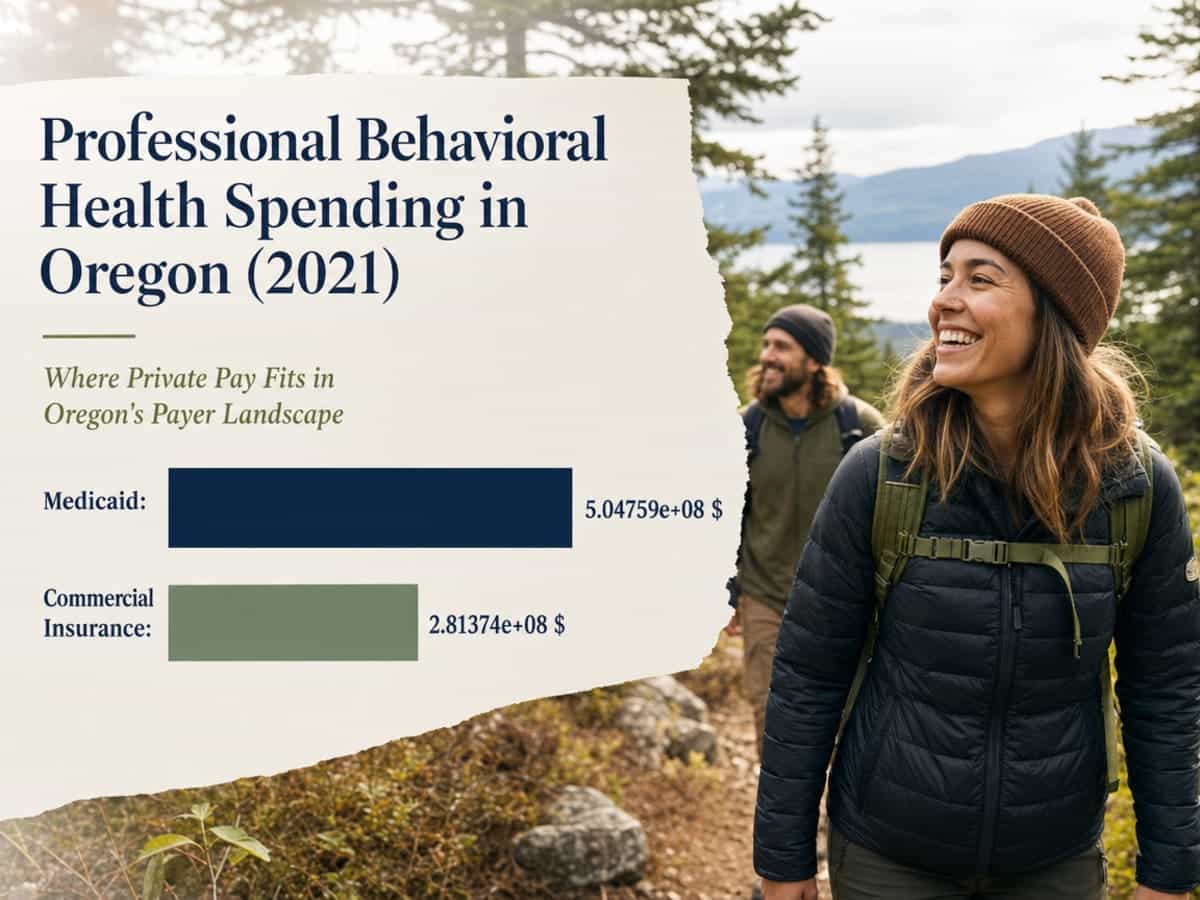
Where Private Pay Fits in Oregon’s Payer Landscape
When people picture paying for detox in Oregon, they usually picture two doors: Medicaid on one side, commercial insurance on the other. Private pay is a third door, and it’s been there the whole time.
Here’s the shape of it. In 2021, Oregon spent about $504.7 million on professional behavioral health services through Medicaid, and roughly $281.4 million through commercial insurance 1. That’s the money moving through the system on your behalf every time a claim gets filed. Private pay — cash, savings, a family loan, a HELOC, a card — sits outside those two rails. It’s smaller than either. It’s also real, and it’s been part of how Oregonians access addiction care for as long as the state has had licensed programs.
Why does that matter to you tonight? Because knowing private pay is a legitimate lane, not a back alley, changes how the phone call goes. You’re not asking a program to bend a rule. You’re asking about a payment path they already understand.
Programs like Pacific Crest Trail Detox in Milwaukie see private-pay admissions alongside commercially insured admissions every week. Some callers have coverage but choose not to use it. Some have a high-deductible plan and would rather pay the deductible directly to the facility. Some are between jobs. Each of those is a normal conversation, not a special case. The money question doesn’t disqualify you. It’s just the first practical thing to sort out so the medical part can start.
Why Publicly Funded Beds Have Waitlists
If you’ve ever called around for a Medicaid-covered detox bed and been told to try back tomorrow, you already know this part in your bones. The waitlist isn’t personal. It’s arithmetic.
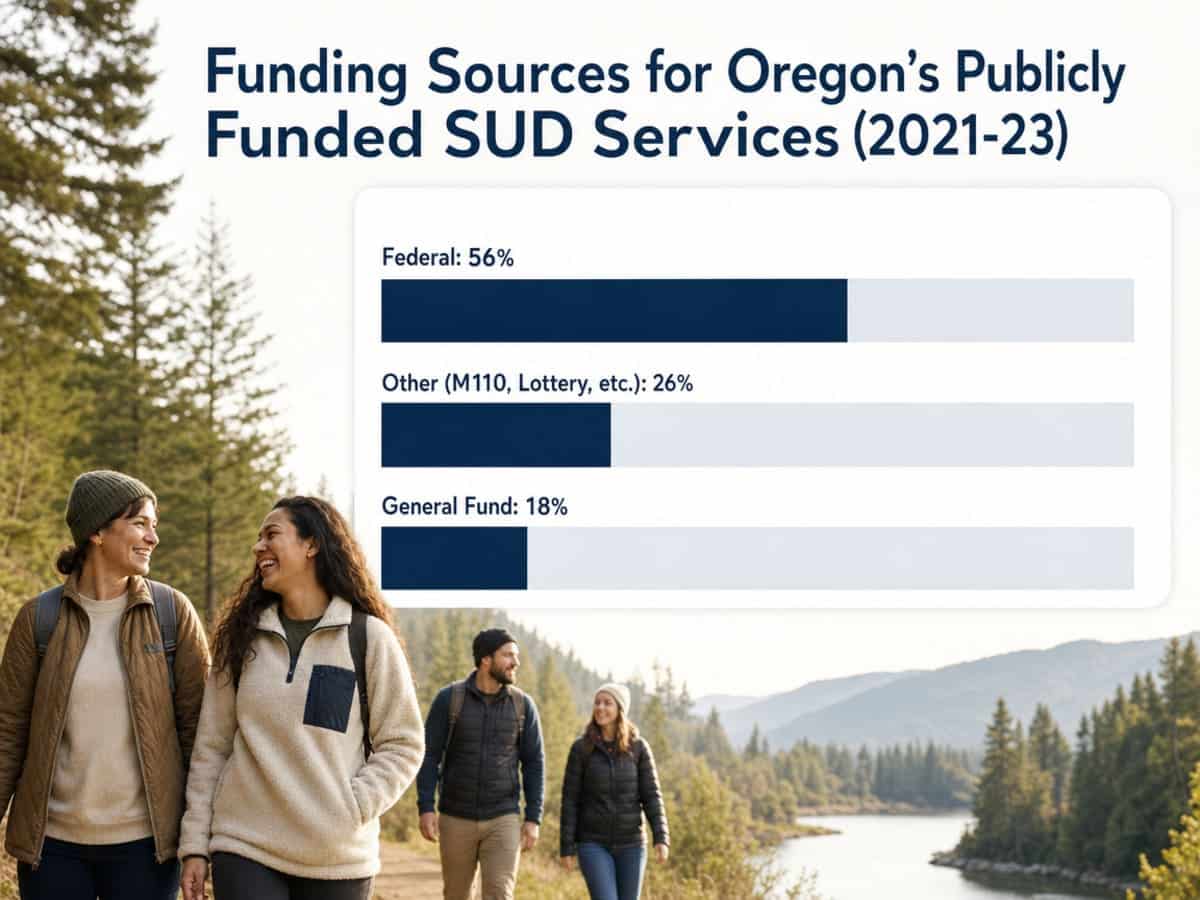
Oregon spent roughly $1 billion on publicly funded substance use services during the 2021–23 biennium. Of that, 56% came from federal dollars, 26% from other sources like Measure 110 and lottery revenue, and 18% from the state General Fund 4. That’s a serious investment. But every one of those dollars comes with strings — federal match rules, contract cycles with coordinated care organizations, program eligibility, prior authorizations, and rate structures that determine which facilities can afford to take Medicaid patients at all.
The result is a system that is genuinely trying to expand access while still rationing beds in real time. A publicly funded detox bed in Portland or Salem or Bend may open at 9 a.m. and be gone by 11. If you’re in early alcohol withdrawal on a Wednesday afternoon, waiting until Friday morning isn’t a scheduling inconvenience — it can be a medical emergency.
Private pay exists partly to give people a way around that clock. A licensed non-hospital program that admits privately doesn’t have to wait for a Medicaid authorization or a CCO referral. When you call and there’s a bed, there’s a bed. That speed isn’t a luxury feature. For someone whose blood pressure is climbing or whose last drink was fourteen hours ago, it’s the difference between starting care today and hoping tomorrow works out.
The Quiet Reasons People Choose Not to Use Insurance
Some people pay privately because they have to. Others pay privately because they’ve thought it through and decided it’s the version of this that lets them sleep at night. Both are okay.
The reasons are usually quiet ones. A nurse with a license to protect who doesn’t want a substance use claim in her employer’s health record. A dad in the middle of a custody negotiation who’s been advised, fairly or not, that a paper trail could be used against him. A pilot, a therapist, a real estate agent, a defense contractor with a clearance — anyone whose job sits on top of a background check or a licensing board. A small business owner on a spouse’s plan who doesn’t want the explanation of benefits landing in the family mailbox. Someone who simply values privacy and doesn’t want to explain their withdrawal to a claims adjuster.
None of that is running from responsibility. It’s the opposite. It’s trying to get care without setting fire to the rest of your life while you do it.
A good Oregon detox program won’t ask you to justify any of this. Pacific Crest Trail Detox and other licensed non-hospital programs handle private-pay admissions with the same clinical care as any other admission — same nursing coverage, same withdrawal protocols, same discharge planning. Your reason for choosing this path is yours. What matters next is that you actually take it.
What a Licensed Non-Hospital Detox Actually Is
Three Kinds of Detox, in Plain Language
The word “detox” gets used for very different things, and that’s part of what makes the phone-tree so confusing when you’re already exhausted. It helps to know that in Oregon, detox generally lives on one of three rungs, each meant for a different level of medical risk.
The top rung is hospital detox. This is a hospital bed with an IV pole, in a wing of a medical center, for people who are actively seizing, in DTs, mixing multiple substances at dangerous levels, or dealing with a serious co-occurring medical crisis like heart or liver failure. It’s the right call when withdrawal is already an emergency. It’s also loud, bright, and expensive, and most people don’t need it.
The middle rung is medically monitored non-hospital detox. Under Oregon’s Section 1115 SUD waiver, this level is defined as 24-hour medically supervised evaluation and withdrawal management in a permanent facility with inpatient beds
for people whose symptoms are serious enough to need constant medical eyes on them but not severe enough to require acute hospital care 9. This is where a program like Pacific Crest Trail Detox sits. Think of it as a residential home with nurses, a medical provider, medications to ease withdrawal, and a bed you can actually sleep in — designed around the person, not the paperwork.
The bottom rung is clinically managed or social detox. There’s a nursing check-in, a safe place to be, peer support, and referrals — but no round-the-clock medical staff and, usually, no medications for withdrawal. It works for lower-risk substances and lower-risk people. It is not the right setting for alcohol or benzodiazepines.
Knowing which rung you need is half the battle. When you call any Oregon program, it’s fair to ask straight out: “What ASAM level of withdrawal management are you licensed for?” 6A clear answer means you’re talking to a program that knows exactly what it is.
Licensure Is Not a Medicaid-Only Standard
There’s a myth worth putting down early: that a program which doesn’t take Medicaid must somehow be less regulated. That’s not how Oregon works.
The Oregon Health Authority is clear on this. Licensure and Medicaid enrollment are two separate things. As OHA puts it, Licensing or certification as a behavioral health program does not guarantee eligibility to participate as an Oregon Health Plan (OHP/Medicaid) provider
6. The federal summary of Oregon’s system says the same in the other direction: state licensure and rule compliance are required before a program can even apply to enroll in Medicaid 7. Licensure is the floor. Medicaid billing is a separate door on top of it.
What that means in practice: a fully licensed non-hospital detox in Oregon meets the same Oregon Administrative Rules, the same ASAM withdrawal management standards, and the same staffing and safety expectations whether the person in the bed is paying cash, using commercial insurance, or covered by Medicaid 6. The nurse’s training doesn’t change. The withdrawal protocol doesn’t change. The physician oversight doesn’t change.
So when you’re comparing programs, don’t lean on “they take Medicaid” as a stand-in for quality. Ask about licensure, ASAM level, medical director, and nursing coverage. Those are the answers that tell you whether you’re safe.
Why Alcohol and Benzo Withdrawal Deserve Medical Supervision
If the substance you’re coming off is alcohol or a benzodiazepine — Xanax, Klonopin, Ativan, Valium — please read this part twice.
Alcohol use disorder is not a rare situation in this state. Oregon has the 8th-highest alcohol use disorder rate in the country, at 11.7% of the adult population 8. That’s a lot of Oregonians for whom “just quit” is a medically unsafe instruction.
Medically monitored detox exists exactly for this. Twenty-four-hour nursing means your vitals get checked while you sleep. A physician or nurse practitioner can order medications — long-acting benzos on a taper, anti-seizure meds, blood pressure support, sleep help — that keep your body from tipping into crisis while it clears. You don’t have to be brave. You have to be somewhere safe. If alcohol or benzos are part of your picture, tapering under medical eyes isn’t optional care. It’s the care.
What You’re Actually Paying For
The Anatomy of a Private-Pay Detox Stay
When you pay privately, you’re not buying a hotel room with a nurse in it. You’re paying for a small team of people to keep your body safe while it does something hard.
Here’s what actually sits inside a stay at a licensed non-hospital medical detox like Pacific Crest Trail Detox:
- There’s 24/7 nursing — someone checking your blood pressure, pulse, and withdrawal symptoms around the clock, including while you sleep.
- There’s a medical provider (physician or nurse practitioner) who reviews your history, orders your taper, and adjusts medications as your body changes hour by hour.
- There’s medication to ease withdrawal when it’s clinically indicated — long-acting benzodiazepines on a taper for alcohol, buprenorphine or comfort medications for opioids, anti-nausea and sleep support so the nights don’t break you.
- Then there’s the part people forget to price in: room and board in a home-like setting. Real food, a real bed, a common room with other people going through the same thing.
- A clinical assessment in the first day or two to figure out what’s really going on underneath the substance — trauma, anxiety, depression, chronic pain, a co-occurring disorder that’s been driving this for years.
- And a discharge plan before you leave, because leaving a detox with no plan is one of the fastest routes back to using.
Under Oregon’s rules, this level of care is defined as around-the-clock medically supervised withdrawal management in a facility with inpatient beds 9. That definition is the floor, whether Medicaid or a private check is paying the bill. When you ask a program for a private-pay quote, you’re asking what it costs to staff all of that for the length of stay your body needs — usually five to ten days, sometimes longer for benzos. Ask for the daily rate, the expected length, and what’s included. A program that answers plainly is one that’s done this conversation before.
How Detox Connects to What Comes Next
Detox is the doorway. It is not the house.
Coming off a substance safely is a real medical accomplishment, and it deserves to be honored. But the days right after detox are also when relapse risk is highest, because the physical craving fades faster than the emotional weight of why you were using in the first place. That’s why Oregon’s own strategic plan puts “rapid access to treatment” and “expanded recovery support services” side by side as goals — one without the other doesn’t hold 13.
A good private-pay conversation includes what happens on day six, or day ten, when you walk out the door. At Pacific Crest Trail Detox, that path usually looks like a supportive step-down: detox first, then a day program (five days a week of therapy and groups while you sleep at home or in sober living), then an evening group program a few nights a week as you rebuild a work and family rhythm, then standard outpatient check-ins, and ongoing alumni support — people who’ve been where you are, checking in on you months after you finish.
When you ask about private-pay cost, ask about this whole arc, not just the detox week. Some programs bundle. Some price each level separately. Some help you use insurance for the outpatient phase even if you paid privately for detox. Any honest answer is fine. A program that can’t sketch the road past detox is one to keep looking past.
The First Call: Questions That Get You Real Answers
Scripts for the Money Conversation
The first call is the hardest one. You already know that. Your throat is dry, your hands might be shaking, and the person on the other end sounds calm in a way that feels like another language. Here’s the trick: you don’t have to improvise. You can read from a page.
Write these down before you dial. Ask them in whatever order feels natural.
- “I’m planning to pay privately. What is your daily rate for medical detox, and what’s included in that number?”
- “What’s the typical length of stay for someone coming off [alcohol / benzos / opioids]? What would push that longer or shorter?”
- “Is medication to ease withdrawal included in the daily rate, or billed separately?”
- “What do you need up front? Is it the full estimated stay, a deposit, or day by day?”
- “If I leave earlier than expected, how do refunds work? If I need to stay longer, how is that handled?”
- “What happens after detox? Do you have a day program, an evening group program, or outpatient care I could step into, and how is that priced?”
- “Can any part of my care be billed to insurance later, even if I pay privately for detox?”
- “Who exactly will I owe money to — the facility, a separate medical group, a lab?”
You’re not being difficult. You’re being a good historian for your own care. Any program that has done this work for a while, including Pacific Crest Trail Detox, has answered these questions a thousand times. The tone on the other end of the line tells you as much as the numbers do.
What a Good Answer Sounds Like
A good answer is specific. It has actual numbers in it, or an honest reason it can’t yet. “Our daily rate is X, our typical alcohol detox is five to seven days, medications are included, and we ask for the estimated stay up front with a refund for any unused days” is a good answer. “It depends, we’ll talk about it when you get here” is not.
A good answer also acknowledges the thing behind the thing. Someone should say, in some form, “We know this is a scary conversation. Let’s make it simple.” You should hear licensure mentioned without you having to pry — the program should know its ASAM withdrawal management level and say so 6. You should hear who the medical provider is. You should hear a plan for after detox, not a shrug.
No Insurance? Talk to Pacific Crest Trail Detox
If you’ve read this far, you already know more than most people who call for the first time. You know what a licensed non-hospital detox is. You know what questions to ask. You know that private pay is a real, respected path in Oregon, not a workaround.
Here’s the one line worth writing on a sticky note: No insurance? No problem — ask Pacific Crest Trail Detox about your options. Whether you’re uninsured, out-of-network, on a high-deductible plan, or simply choosing privacy, the team in Milwaukie will talk through cost, length of stay, medications, and what comes after — without pressure, without a script that pretends to be one.
Pick up the phone when you’re ready. Even a first conversation, with no commitment, is a step your future self will thank you for.
Check Your Detox Coverage in Just Minutes
Quickly find out if your detox costs are covered before you take your next step.
Frequently Asked Questions
What does private pay detox in Oregon actually mean?
It means paying directly for your detox stay — with cash, savings, a card, or a family loan — instead of running it through Medicaid or commercial insurance. The program is still licensed by the state and still follows the same ASAM withdrawal management standards 6. You’re just skipping the claims paperwork.
Is a private-pay detox held to the same safety standards as an insurance- or Medicaid-covered program?
Yes. In Oregon, licensure and Medicaid enrollment are two separate approvals 7. A licensed non-hospital detox meets the same Oregon Administrative Rules, the same ASAM withdrawal management level, and the same staffing and medical oversight requirements no matter who is paying 6. The nurse’s training, the withdrawal protocols, and the physician oversight do not change based on your payment method.
Why would someone choose private pay instead of using their insurance?
Reasons vary and all of them are valid. Some people are uninsured or out-of-network. Some have a high-deductible plan and would rather pay the facility directly. Others protect their privacy because of a professional license, a security clearance, a custody situation, or a job that runs background checks. And some simply don’t want an explanation of benefits landing in the family mailbox. You don’t owe anyone an explanation.
How quickly can I get into a private-pay detox compared to a publicly funded bed?
Usually much faster. Publicly funded beds are rationed against a $1 billion biennial budget with federal match rules, coordinated care organization referrals, and prior authorizations attached 4. A private-pay admission at a licensed non-hospital program doesn’t wait on any of that. If there’s an open bed when you call, you can often be admitted the same day — which matters when alcohol or benzo withdrawal is already underway.
What questions should I ask on the first call about cost?
Ask for the daily rate and what it includes. Ask the typical length of stay for your substance. Ask whether withdrawal medications are bundled or billed separately. Ask what’s needed up front and how refunds work if you leave early. Ask what happens after detox — is there a day program, evening group, or outpatient care you can step into, and how is that priced? A good program answers plainly, in writing.
What happens after detox ends?
Detox is the doorway, not the whole path. Oregon’s own strategy pairs rapid access to treatment with expanded recovery support for a reason — one without the other rarely holds 13. At Pacific Crest Trail Detox, that usually looks like a step-down: a day program, then an evening group program a few nights a week, then standard outpatient check-ins, and ongoing alumni support so you’re not walking it alone.
References
- Substance Use Disorder Financial Analysis Report. https://www.oregon.gov/adpc/MeetingDocuments/SUD-Financial-Analysis-Report-0424.pdf
- July 2024 Alcohol and Drug Policy Commission Progress Report. https://www.oregon.gov/adpc/Documents/July%202024%20ADPC%20Progress%20Report.pdf
- Oregon Behavioral Health Residential+ Facility Study – Final Report (June 2024). https://www.oregon.gov/oha/BH/Reports/Behavioral-Health-Residential-Facility-Study-June-2024.pdf
- Summary of Oregon SUD System Assessments and Gaps Analyses 2020–25. https://www.oregon.gov/adpc/Committee%20Resources/Summary%20of%20Assessments%20and%20Gaps%20Analyses%202020-25.pdf
- Oregon Health Plan 2021–2026 Substance Use Disorder Monitoring, Performance, and Accountability Report. https://www.oregon.gov/oha/OHP/Policy/Shared%20Documents/2021-2026MPA-Report-0524.pdf
- Oregon Health Authority: Licensing and Certification – Behavioral Health Providers. https://www.oregon.gov/oha/BH/Providers/Pages/Licensing-Certification.aspx
- Oregon Summary – State Residential Treatment for Behavioral Health Conditions. https://aspe.hhs.gov/sites/default/files/2021-08/StateBHCond-Oregon.pdf
- Substance Use Disorder Integration Report. https://www.oregon.gov/oha/HSD/AMH/DataReports/SUD-Integration-Report.pdf
- Oregon Substance Use Disorder 1115 Demonstration Waiver. https://www.medicaid.gov/CHIP/Downloads/OR-20-0132.pdf
- July 2024 Report – Alcohol and Drug Policy Commission. https://www.oregon.gov/adpc/Documents/July%202024%20Report%20FINAL%20-%20Updated%20September%202024.pdf
- The 2026–2030 Comprehensive Plan. https://www.oregon.gov/adpc/pages/plan.aspx
- Behavioral Health Services Rules – Oregon Health Plan. https://www.oregon.gov/oha/HSD/OHP/Pages/Policy-BHS.aspx
- Oregon Statewide Strategic Plan (Alcohol and Drug Policy Commission). https://www.oregon.gov/oha/HSD/AMH/OACDocuments/ADPC-Statewide-Strategic-Plan.pdf
- Alcohol, Cannabis and Tobacco Use Data – Oregon Health Authority. https://www.oregon.gov/oha/ph/diseasesconditions/chronicdisease/datareports/pages/substance-use.aspx