


Key Takeaways
- Portland offers state-licensed non-hospital detox in real houses, providing 24-hour clinical monitoring in a residential setting rather than a fluorescent-lit hospital ward 3.
- A home-like environment can reduce stigma and support dignity during withdrawal 7, while trauma-informed staff who knock, protect sleep, and serve real meals help the body settle enough for medication to work.
- Oregon Medicaid data shows people who started opioid use disorder care in residential settings had 1.71 times the odds of still being in treatment at six months compared to outpatient starts 1.
- Before choosing, compare licensing under Oregon’s residential detox rules, withdrawal medication protocols, insurance coverage (Pacific Crest accepts most commercial plans but not OHP), and the aftercare continuum available at discharge.
If Another Hospital Detox Feels Impossible, Read This First
If the thought of another fluorescent-lit hospital room is the reason you keep putting this off, you are not the problem. A lot of people in Portland have been through a rushed ER detox or a clinical ward that felt more like a holding pen than health care. Wanting something quieter, warmer, and more private is not weakness. It is often the reason someone finally says yes to treatment.
Here is what you may not know: medical detox does not have to happen in a hospital to be safe. Oregon licenses non-hospital residential detox facilities that provide 24-hour clinical evaluation, observation, and support in real houses, with peer and social support built into the day 3. The medicine is the same. The lighting is not.
This guide walks you through what a home-like detox in Portland actually looks like — the kitchen, the bedroom, the nurse who knocks before opening the door — and how that setting can meet the same medical standards as a hospital while feeling like somewhere you could actually rest 7. You will also see what happens after the first week, how insurance usually works, and what to say when you call.
Reading this is already a step. Take it slowly.
What a Home-Like Detox in Portland Actually Looks Like
The House Itself: Kitchen, Couch, Back Porch
Picture the last hospital you were in. Now forget it.
A home-like detox in the Portland area is, quite literally, a house. There is a front door with a mat. There is a kitchen where someone is usually making coffee. There is a couch with pillows that do not crinkle when you sit on them, a back porch you can step onto in socks, and bedrooms with real bedding instead of a thin sheet over vinyl. The lighting is lamps, not overhead fluorescents that hum at a pitch your teeth can feel.
This is not decoration for its own sake. Researchers who study treatment environments have found that a non-institutional, homelike setting can enhance feelings of dignity and reduce perceived stigma among people in early recovery 7. When your body is already in revolt and your nervous system is scanning every corner for threat, the difference between a hospital ward and a living room is not cosmetic. It is clinical.
At Pacific Crest Trail Detox in Milwaukie, the space was chosen to feel like a home you might visit, not a facility you were sent to. You will find a shared kitchen, common rooms with soft seating, a yard with trees, and bedrooms that feel like bedrooms. The medical equipment is present, but it is not the first thing you see. The first thing you see is the couch.
A Nurse Who Knocks: How 24-Hour Medical Care Feels Different Here
Here is one of the most important things to understand: the medical care does not disappear because the setting is softer. It just arrives differently.
Oregon requires non-hospital detox programs to provide 24-hour professionally directed evaluation, observation, and support, with peer and social support built into the day 3. Translation: a clinician is awake and watching over you around the clock. Your vitals get checked. Your withdrawal symptoms get scored. Medications get adjusted. If something changes at 2 a.m., someone is there.
What changes is the tone. In a hospital, you are often a room number, and staff come and go without warning. In a home-like detox, a nurse knocks before opening your bedroom door. She might ask how you slept, take your blood pressure at the little table by the window, and hand you your medication with a glass of water instead of a paper cup. If you want to talk, she has a minute. If you want to be left alone with the curtains drawn, that is fine too.
That kind of respect is not a nice extra. It is trauma-informed care, and it is a core part of how good addiction treatment is supposed to work now — creating safe, welcoming environments where trust can start to grow again 10. When the person taking your vitals treats you like a guest instead of a patient in a bed, your shoulders drop. That matters more than you would think.
Meals, Sleep, and the Small Things That Matter at 3 A.M.
Withdrawal has a way of shrinking the world down to the next hour. What you eat, whether you can sleep, whether the room is too cold — these become the whole story.
A home-like detox pays attention to those small things because they are not small at all. Meals are cooked in the kitchen and eaten at a table, not slid through a slot on a tray. You get real food, warm, on an actual plate. If soup is the only thing that sounds bearable on night two, someone can heat you up soup.
Sleep is protected. The bedrooms are quiet. There is no roommate on a monitor beeping through the night, no cart wheels in the hallway at 4 a.m. Blankets are the kind you would have at home. If you wake up shaking at 3 a.m. and cannot get back down, you can pad out to the common room and find a staff member who will sit with you, get you medication if you need it, and not make you feel like a burden.
Patient-centered care means respecting what you prefer, involving you in the plan, and treating you like a person who still gets a say 8. In practice, that looks like a warm blanket and a quiet kitchen at 3 a.m. — and someone awake who is glad you came out for company.
Yes, This Is Real Medical Care — Not a Wellness Retreat
Oregon’s Rules for Non-Hospital Detox
A home-like detox is not a loophole. It is a licensed category of care with its own state rulebook.
Oregon Revised Statutes Chapter 443 defines residential treatment homes as facilities serving five or fewer people, and residential treatment facilities as serving six or more, both licensed to care for individuals with alcohol or drug dependence 4. That is the legal reason a detox program can live inside an actual house on an actual street instead of a hospital campus. The size is the point. Smaller means quieter, more personal, and closer to how a home feels.
The clinical standards do not soften because the walls are painted a warmer color. Oregon’s rules for alcohol detoxification centers require a planned, structured regimen of 24-hour professionally directed evaluation, observation, and support, delivered in a residential setting with peer and social support built in 3. Withdrawal management programs also have to meet the broader residential behavioral health standards under OAR Chapter 309, Division 018, which cover staffing, safety, and service delivery 16. And when you are discharged, Oregon law now requires the program to send you home with naloxone or another opioid overdose reversal medication 4. That is not a spa amenity. That is a public health rule.
Pacific Crest Trail Detox operates inside all of that. The house in Milwaukie is a licensed medical detox facility, not a sober living home and not a retreat. The comfort is real, and so is the paperwork behind it.
Managing Alcohol and Opioid Withdrawal Outside a Hospital Ward
The fear most people bring to this decision sounds like a question: if my withdrawal gets bad, will I actually be safe here?
The honest answer is that alcohol and opioid withdrawal can be dangerous, and they need real clinical management. Alcohol withdrawal in particular can escalate into seizures or delirium tremens, which is why the American Society of Addiction Medicine publishes a clinical practice guideline that walks providers through how to assess severity, choose medications, and monitor patients through the worst of it 12. That guideline does not require a hospital ward. It requires the right level of monitoring, the right medications, and clinicians who know what they are watching for.
In a home-like detox, that translates into regular vital sign checks, symptom scoring throughout the day and night, and medications given on a schedule that matches how your body is actually responding. For opioid withdrawal, that can include buprenorphine or other medications to take the edge off the sickness so you are not white-knuckling day three on a bathroom floor. For alcohol, it usually means a tapered benzodiazepine protocol and careful observation of the tremor, blood pressure, and sleep patterns that tell the clinical team where you are on the curve.
The medicine travels with you into the living room. The ward stays behind.
The Setting Is Part of the Treatment
Why Feeling Safe Changes What Your Body Can Do
Your nervous system does not know the difference between a lecture and a threat. It only knows what the room feels like.
When you walk into a place that looks like a hospital ward — hard floors, bright ceiling lights, a stranger in scrubs asking questions through a plexiglass window — your body braces. Heart rate climbs. Muscles tighten. In early withdrawal, when your system is already flooded and raw, that bracing costs you. You sleep worse. You eat less. You are more likely to say you are fine and walk out the door.
A home-like setting works in the opposite direction. Researchers who study addiction treatment environments have found that a non-institutional, homelike environment can enhance feelings of dignity and reduce perceived stigma among clients 7. Less shame in the room means more honesty with the nurse. More honesty means better symptom scoring, better medication timing, and better care.
Where Home-Like Design Helps and Where Structure Still Matters
A warm room is not the whole treatment. It is the container for it.
There is honest research showing that comfort without structure can actually work against you. One study of residential substance use programs found that as the number of non-clinical services stacked up, residents were less likely to complete treatment, while programs that gave residents a real voice in the community and used fewer rigid contingencies saw better outcomes 2. Translation: cozy is not enough on its own, and neither is a long list of extras. What helps is a home that also has a clear rhythm — meals at set times, medication rounds you can count on, group check-ins, and staff who hold the frame with warmth instead of a clipboard.
At Pacific Crest Trail Detox, that balance shows up in ordinary ways. Breakfast happens. Vitals get taken. There is a schedule for therapy and a schedule for rest. You have a say in your care plan, but the clinical team still leads the medical piece. The couch is real, and so is the accountability that goes with it. Both are part of why you stay long enough to feel the ground come back under your feet.
What the Oregon Data Says About Staying in Care
Here is the question that matters more than any brochure: does the setting actually help you stay in treatment long enough for it to work?
There is one Oregon study worth knowing about. Researchers followed Oregon Medicaid beneficiaries with opioid use disorder and compared what happened to people who started treatment in a residential setting versus those who started in outpatient care. The people who started in residential care had 1.71 times the odds of still being in treatment six months later (adjusted odds ratio 1.71; 95% CI 1.32–2.21) 1. That is a meaningful gap. Staying in care at six months is not the whole story of recovery, but it is one of the strongest predictors we have that the next steps will actually happen.
A few things to hold alongside that number. This study looked specifically at Oregon Medicaid patients with opioid use disorder — not every person in every kind of detox. The same study did not find that residential care reduced overdoses or hospitalizations compared with outpatient, and the retention advantage faded by the one-year mark 1. The researchers were clear that what you do inside the setting — especially whether you receive medications for opioid use disorder — matters as much as the setting itself.
What that means for you: a home-like residential detox in Portland can give you a real head start on staying engaged. It is not a guarantee. It is a better starting line, and what happens after — the follow-up care, the medication, the people you keep showing up for — is what turns that head start into something lasting.
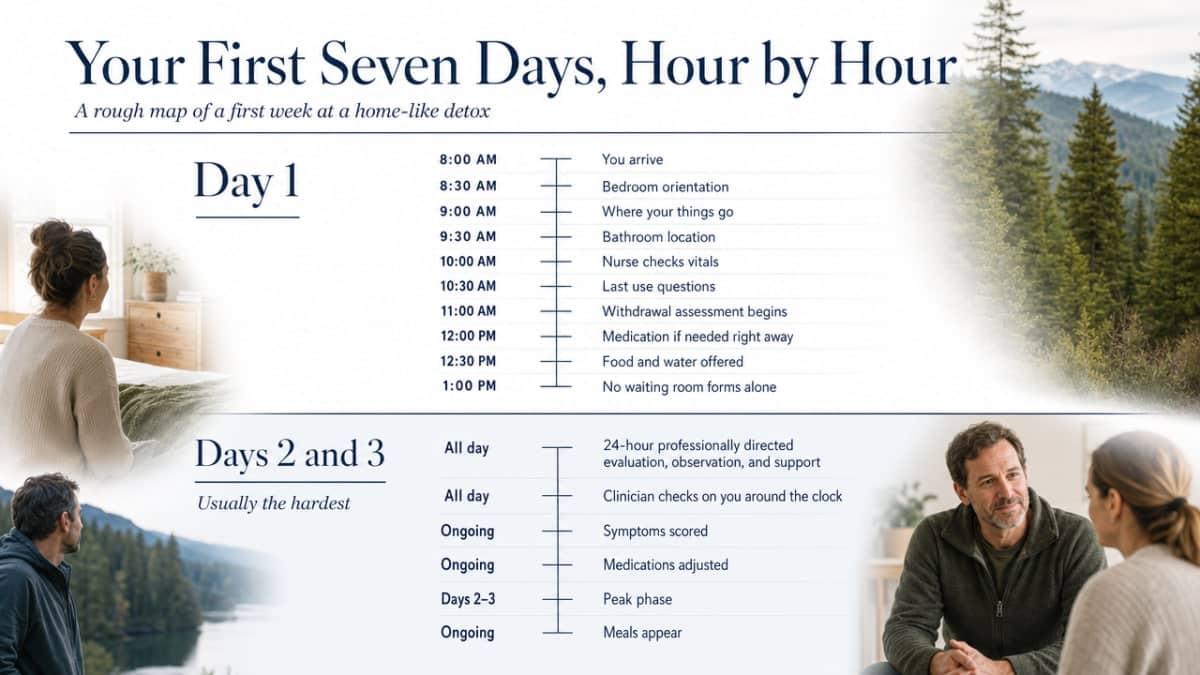
Your First Seven Days, Hour by Hour
Not knowing what will happen is often scarier than the withdrawal itself. Here is a rough map of what a first week at a home-like detox in the Portland area actually looks like, so the unknown gets a little smaller.
- Day 1.
- You arrive. Someone shows you your bedroom, where your things go, and where the bathroom is. A nurse takes your vitals, asks about your last use, and starts a withdrawal assessment. If you need medication right away, you get it. Someone offers you food and water. You are not asked to fill out a stack of forms alone in a waiting room.
- Days 2 and 3.
- These are usually the hardest. Oregon requires 24-hour professionally directed evaluation, observation, and support in residential detox, so a clinician is checking on you around the clock, scoring symptoms and adjusting medications as your body moves through the peak 3. Meals appear at regular times. You do not have to be hungry to eat something small. Sleep is protected as much as possible.
- Days 4 and 5.
- The worst of the physical symptoms usually starts to loosen. You might sit at the kitchen table for a full meal. Light therapy sessions and group check-ins begin. Staff start talking with you about what comes next — not to rush you out, but so you have a plan.
- Days 6 and 7.
- Aftercare planning becomes real. A counselor helps you line up follow-up care, whether that is a partial hospitalization program, outpatient groups, or medication continuation. Before you leave, you go home with naloxone or another opioid overdose reversal medication, which Oregon law now requires residential programs to provide at discharge 4.
Seven days is not a cure. It is the ground under your feet.
What Happens After Detox: The Bridge to Real Life
Detox alone is a beginning, not a finish line. The days right after your body clears are when the ground can feel shakiest — and when the plan you leave with matters most.
Research on continuing care is clear: extended, flexible support after an initial treatment episode is what shifts outcomes from short-term stabilization to something that actually lasts 9. That is why a good home-like detox does not just walk you to the door on day seven and wish you luck. It hands you off to the next thing.
At Pacific Crest Trail Detox, the next thing lives on the same continuum. A partial hospitalization program gives you structured days of therapy while you sleep somewhere safe. An intensive outpatient program steps it down further, so you can start rebuilding a work schedule and family life while still checking in several times a week. Standard outpatient and medication continuation keep the clinical thread going for as long as you need it. Alumni services and aftercare groups give you people who remember your name.
The setting that helped you get through withdrawal — the kitchen, the couch, the nurse who knocked — is not the whole cure. It is the soft place where you built enough trust to say yes to what comes next. That yes is what you carry out the door.
Insurance, Cost, and the Call You’re Putting Off
Money is often the reason people wait one more day. Then another. Then a week.
Here is the short version so you can stop guessing. Pacific Crest Trail Detox accepts most commercial insurance plans. The main exception is the Oregon Health Plan (OHP). If you have insurance through your job, your spouse, or the marketplace, there is a good chance a large portion of detox is covered — often more than you expect.
You do not have to figure this out alone at the kitchen table with a stack of paperwork. One phone call to the admissions team can verify your benefits, tell you what your out-of-pocket share looks like, and walk you through what a stay would actually cost you. No commitment. No lecture. If the plan does not work, they can help you think about next steps.
The call is the hardest part. Everything after it gets a little easier.
Take the Next Small Step
You do not have to be ready for the whole road. You just have to be ready for the next call.
If a hospital detox is the reason you have been putting this off, there is another kind of place waiting — a real house in Milwaukie, with a kitchen and a couch and a nurse who knocks. Medical care that meets you where you are, without the fluorescent lights.
See what detox looks like when it doesn’t feel like a hospital — tour Pacific Crest Trail Detox. One conversation. No pressure. Just a person on the other end who has heard this story before and is glad you picked up the phone.
Check if your insurance covers home-like detox
Find out in minutes if your plan covers a safe, supportive detox experience in Portland.
Frequently Asked Questions
Is a home-like detox in Portland as safe as a hospital detox?
Yes, when the program is licensed. Oregon requires non-hospital detox facilities to provide 24-hour professionally directed evaluation, observation, and support in a residential setting 3. A clinician is awake and watching your vitals through the night. The medicine and monitoring are the same. What changes is the noise, the lighting, and how close the care feels.
Who is a home-like detox facility a good fit for?
Adults who need medical withdrawal management but do not require hospital-level intensive care. That includes people detoxing from alcohol, opioids, or benzodiazepines who want a quieter setting, and people whose last hospital detox felt so cold they walked out early. Care works best when it respects your preferences and involves you in the plan 8. If you are unsure, a phone screening can help sort it out.
How long does detox at a home-like facility usually take?
Most stays run about five to seven days, though it depends on what you used, how long, and how your body responds. Alcohol and benzodiazepine tapers can take longer because they need slow, careful adjustment. Opioid detox may be shorter but often transitions into medication continuation. Your clinical team scores your symptoms each day and adjusts the timeline based on how you are actually doing.
Can I use medication to help with alcohol or opioid withdrawal here?
Yes. Medication is a standard part of care. For alcohol, that usually means a tapered benzodiazepine protocol guided by clinical practice standards for withdrawal management 12. For opioids, that often includes buprenorphine or similar medications to take the edge off the sickness. You are not expected to white-knuckle it. Ask about your options during the intake call — a nurse can walk you through what would likely be used.
What happens after the acute detox week ends?
You step down, not off. A counselor helps you line up follow-up care before you leave — often a partial hospitalization program, an intensive outpatient program, or standard outpatient with medication continuation and alumni support. Extended, flexible care after the initial stay is what most improves long-term outcomes 9. You will also go home with naloxone if opioids were part of your story, as Oregon law requires 4.
What if I’ve tried detox before and it didn’t stick?
You are in good company, and it does not mean you failed. Most people who reach lasting recovery try more than once. What often changes the outcome is not willpower — it is the setting and what comes after. A softer environment can lower the shame that makes people leave early 7, and a real plan for follow-up care gives the next attempt somewhere to land. Try again.
References
- Association between treatment setting and outcomes among Oregon Medicaid beneficiaries with opioid use disorder. https://pmc.ncbi.nlm.nih.gov/articles/PMC9389731/
- Association of facility characteristics and substance use disorder treatment completion and employment. https://pmc.ncbi.nlm.nih.gov/articles/PMC8940653/
- Health Systems Division: Addiction Services – Chapter 415-050 Standards for Alcohol Detoxification Centers (highlighted version). https://www.oregon.gov/oha/HSD/Medicaid-Policy/SUDWaiver/415-050-Highlighted-040723.pdf
- Oregon Revised Statutes Chapter 443 – Residential Care and Treatment Facilities. https://www.oregonlegislature.gov/bills_laws/ors/ors443.html
- Therapeutic communities for addictions: A review of their effectiveness from a recovery-oriented perspective. https://pmc.ncbi.nlm.nih.gov/articles/PMC3562581/
- Residential Treatment for Individuals with Substance Use Disorders: A Critical Review. https://pmc.ncbi.nlm.nih.gov/articles/PMC3123266/
- The Role of the Physical Environment in Substance Use Disorder Treatment. https://pmc.ncbi.nlm.nih.gov/articles/PMC6220597/
- Patient-Centered Care in Substance Use Disorder Treatment. https://pmc.ncbi.nlm.nih.gov/articles/PMC6338348/
- Continuing care in the treatment of substance use disorders: Insights from research. https://pmc.ncbi.nlm.nih.gov/articles/PMC6561407/
- Trauma-Informed Care for People With Substance Use Disorders. https://pmc.ncbi.nlm.nih.gov/articles/PMC7263564/
- The effectiveness of residential treatment services for individuals with substance use disorders: A systematic review. https://pubmed.ncbi.nlm.nih.gov/31254749/
- The ASAM Clinical Practice Guideline on Alcohol Withdrawal Management Pocket Guide. https://www.samhsa.gov/resource/ebp/asam-clinical-practice-guideline-alcohol-withdrawal-management-pocket-guide
- Multnomah County Behavioral Health Profile (OHA). https://www.oregon.gov/oha/HSD/AMH/BH%20Mapping%20Profiles/Multnomah%20County%20BH%20Profle.pdf
- Prescribing and Overdose Data for Oregon. https://www.oregon.gov/oha/ph/preventionwellness/substanceuse/opioids/pages/data.aspx
- Tri-County Overdose Data Brief Spring 2023. https://www.washingtoncountyor.gov/hhs/documents/tri-county-overdose-data-brief-spring-2023/download?inline
- Health Systems Division: Behavioral Health Services – OAR Chapter 309, Division 018. https://www.oregon.gov/oha/HSD/RAC/309-018.pdf