

Key Takeaways
- Mental withdrawal covers the anxiety, flat mood, insomnia, cravings, and brain fog that linger after physical symptoms fade, because the brain keeps rebalancing for weeks or months.4, 7
- Timelines vary by substance: alcohol runs about 5-7 days acute, short-acting opioids 4-10 days, and benzodiazepines 1-4 weeks, with post-acute symptoms stretching 4-6 months or longer.4, 7
- Alcohol and benzodiazepine withdrawal can be life-threatening, and rapid opioid tapering can trigger suicidal thoughts or fatal overdose when tolerance drops, so medical supervision should decide the setting.12
- Detox is the setup, not the finish line; continuing care through PHP, IOP, outpatient, medication, and treatment for co-occurring conditions is where mental symptoms actually settle.5, 13
When the Shaking Stops But Your Mind Won’t Settle
Mental withdrawal is the emotional, cognitive, and behavioral part of stopping a substance. You feel it as anxiety that won’t quiet down, a mood that stays flat, sleep that won’t come, cravings that catch you off guard, and a brain that feels foggy or slow. Physical symptoms often ease within days. The mental symptoms can last weeks or months because your brain is still rebalancing after regular substance use.4, 7
If you stopped drinking or using and expected to feel like yourself once the sweating and nausea passed, you’re not doing recovery wrong. This is a predictable stage, not a personal failure.
This guide walks you through what mental withdrawal looks like, how long it tends to last by substance, when it becomes a medical emergency, and what actually helps your brain finish healing. Alcohol and benzodiazepine withdrawal can be life-threatening and should be managed under medical supervision.2
What Mental Withdrawal Actually Is
The Difference Between Physical and Psychological Withdrawal
Physical withdrawal is what you can see and measure: shaking hands, sweating, a racing pulse, nausea, chills, a pounding headache. For alcohol, these show up within hours of your last drink and usually peak within a day or two.2 For opioids, you feel the aching body, the runny nose, the stomach that won’t settle.
Mental withdrawal is quieter and often lasts longer. It’s the anxiety that hums under everything, the irritability that makes small requests feel huge, the trouble focusing on a conversation, the memory that keeps slipping, the sleep that won’t come even when your body is exhausted.1 It’s craving that arrives out of nowhere and a flatness where enjoyment used to live.
Both kinds of withdrawal are part of the same process, but they don’t move on the same clock. Your body can look stable while your mind still feels raw. That gap is where a lot of people start to doubt themselves, and it’s one of the main reasons care doesn’t end when the physical symptoms do.
Why Your Brain Reacts This Way After You Stop
When you use a substance regularly, your brain adapts. It turns down its own natural chemistry to balance out what you’re putting in. Alcohol, opioids, and benzodiazepines all push the brain toward calm, so the brain pushes back by staying more alert, more wound up, more ready to react. Stimulants do the opposite, so the brain quiets its own reward signals to compensate.
When you stop, the substance is gone but those adaptations don’t vanish overnight. Your brain is now too alert, or too flat, or both at different hours of the day. That’s why anxiety can feel sharper after you quit than it did while you were using, and why sleep goes sideways even when you’re worn out. For people coming off alcohol, researchers describe this as persistent anxiety, irritability, mood instability, insomnia, and craving that outlast the obvious symptoms.6
Rebalancing takes time—days for some systems, weeks or months for others.4 You aren’t broken. Your brain is doing exactly what brains do when the chemistry it got used to suddenly isn’t there anymore.
The Mental Symptoms People Describe Most Often
Anxiety, Irritability, and the Feeling That Something Is Wrong
Anxiety is usually the loudest symptom. It can feel like a buzz under your skin that doesn’t match what’s happening in the room. Your heart picks up when the phone rings. A text from your sister feels like bad news before you open it. You snap at someone you love and can’t tell why.
You’re not imagining it, and you’re not alone in it. In a 2023 study of people going through opioid withdrawal, 73.4% said anxiety was one of their symptoms, with the hardest stretch landing around day five or six.8 That number comes from self-reports and showed a lot of individual variation, but the pattern is consistent with what SAMHSA lists for alcohol withdrawal too: restlessness, irritability, agitation, and anxiety alongside the physical signs.1
Irritability is often the piece families notice first. Small things feel enormous. A dish in the sink, a question about dinner, a slow driver. That short fuse is part of the same wiring, not a character flaw.
Low Mood, Flat Feelings, and Loss of Pleasure
If anxiety is the loud symptom, flatness is the quiet one. Food tastes like nothing. A song you used to love plays in the background and barely registers. You go through the motions of a decent day and feel almost nothing when it ends.
Clinicians call this anhedonia, a reduced ability to feel pleasure. In a systematic review of 27 studies on post-acute alcohol withdrawal, researchers found anhedonia, dysphoria, and persistent low mood among the most commonly reported symptoms, sometimes stretching four to six months or longer after the last drink.7
It’s easy to read this flatness as proof that sobriety isn’t working, or that something is broken that won’t come back. Neither is true. Your brain’s reward system got used to a strong outside signal, and it takes time for your own signals to feel strong again. Small moments start to land first. A hot shower that actually feels good. A laugh that catches you off guard. That’s your brain coming back online.
Sleep Problems, Cravings, and Brain Fog
Sleep tends to be the symptom people underestimate until they’re living inside it. You lie down exhausted and your mind won’t shut off. You fall asleep at midnight and wake at 3 a.m. staring at the ceiling. Dreams get vivid, sometimes about using. Research on post-acute alcohol withdrawal consistently shows sleep disturbance as one of the longest-lasting symptoms, often tied to the anxiety and low mood that come with it.7
Cravings don’t always arrive as a dramatic urge. Sometimes they show up as a stray thought when you drive past an old spot, or a sudden conviction that one drink would take the edge off. Protracted alcohol withdrawal research describes craving as persistent and tied to mood instability, which is why it tends to spike on the hard days.6
Brain fog is the third piece. Trouble focusing, missing words mid-sentence, forgetting why you walked into a room. SAMHSA notes poor concentration and impaired memory as part of the standard withdrawal picture.1 It lifts, slowly. Keep notes, lower the stakes on the first few weeks, and give yourself permission to work at half speed.
How Long Mental Withdrawal Lasts by Substance
Acute Timelines You Can Expect
No two people run the same clock, but there are patterns. For alcohol, the acute withdrawal window typically runs about 5 to 7 days, with the sharpest symptoms in the first 72 hours.4 The physical signs often ease first. The anxiety and sleep problems can still be loud at the end of that week.
For short-acting opioids like heroin or oxycodone, acute withdrawal usually lasts 4 to 10 days.4 A 2023 study of people going through opioid withdrawal found the typical length was about 6.5 days, with the hardest point around day 5 or 6, though individual experiences varied widely.8 Methadone sits in a different range entirely, with withdrawal potentially stretching 14 to 21 days because it leaves the body more slowly.4
Benzodiazepines like Xanax, Ativan, and Klonopin are the longest and most unpredictable of the common substances. Acute withdrawal can run 1 to 4 weeks, depending on the specific drug, the dose, and how long you’ve been taking it.4 This is one reason benzodiazepine withdrawal needs medical supervision from the start, not a willpower plan.
Post-Acute Withdrawal: Weeks and Months, Not Days
Once the acute window closes, a second phase often begins. Clinicians call it post-acute or protracted withdrawal. The physical storm has passed, but anxiety, low mood, sleep disruption, cravings, and trouble concentrating keep showing up in waves.
For alcohol, a systematic review of 27 studies found that post-acute symptoms—anxiety, dysphoria, anhedonia, sleep disturbance, cognitive impairment, cravings, and irritability—can last 4 to 6 months or longer after the last drink.7 The symptoms aren’t constant. They move. A good week, then a hard three days. A clear morning, then a flat afternoon.
For opioids, SAMHSA notes that anxiety, depression, and sleep disturbance can persist for weeks or months after the acute phase is over.4 For benzodiazepines, the slow taper and the long tail of symptoms can feel like one blurred stretch rather than two separate phases.
Protracted withdrawal is still underrecognized, which is part of why so many people blame themselves when they don’t feel like themselves at week six.6 You’re not stalled. Your brain is still rebalancing on a longer timeline than the one most people warned you about.
What Mental Withdrawal Looks Like From the Outside
If you’re the spouse, parent, or adult child reading this, the person you love probably looks fine on paper. The shaking stopped. They’re eating again. The crisis you were bracing for didn’t happen the way you expected. And now they’re short with you, up at 3 a.m., staring at their phone, picking fights about nothing, or sitting on the couch like someone turned the volume down on them.
That’s mental withdrawal, and it’s one of the hardest stretches for families because it doesn’t look like a medical problem. It looks like a mood problem, or a relationship problem, or a person who seems ungrateful for the work everyone put in to get them through detox. Anxiety, irritability, flat mood, poor sleep, and trouble concentrating are documented parts of the picture, sometimes lasting weeks or months after the acute phase.4, 7
When Mental Symptoms Become a Medical Emergency
Suicidal Thoughts, Opioid Tapering, and Overdose Risk After Abstinence
Most mental withdrawal symptoms are miserable without being dangerous. Some are both. If you’re coming off opioids, especially after a long prescription or a rapid cut in dose, the psychological distress can get sharp enough to include thoughts of suicide. Federal clinical guidance warns that rapid tapering or sudden discontinuation of long-term opioids can cause significant withdrawal, serious psychological distress, and suicidal thoughts.12 If that’s where you are right now, please tell someone today. Call 988, call your prescriber, or get to an emergency department.
There’s a second danger that doesn’t feel like an emergency until it is. After a period off opioids, your tolerance drops fast. A dose that felt routine a few weeks ago can cause an overdose now. The same federal guide names this directly: returning to a previously tolerated dose after abstinence can be fatal.12 If a craving starts winning the argument, that’s the moment to call your treatment team, not to test what your body can handle.
Alcohol and Benzodiazepine Withdrawal Can Be Life-Threatening
If you’ve been drinking heavily or taking benzodiazepines like Xanax, Ativan, or Klonopin regularly, stopping on your own is not a safe plan. NIAAA is direct about this: suddenly stopping heavy drinking can cause a painful or potentially life-threatening withdrawal, and medical help is needed to plan a safe process.2, 3 Seizures, delirium, and dangerous changes in heart rate and blood pressure are part of the picture, not just the sweating and anxiety.1
Benzodiazepine withdrawal carries the same seizure risk and often runs longer, 1 to 4 weeks of acute symptoms depending on the drug and dose.4 Severity should decide the setting, not willpower.2 If you’re in Milwaukie, Portland, or anywhere in the Pacific Northwest, a medically supervised detox is the right first call.
What Actually Helps the Brain Finish Healing
Medical Detox: Where the Acute Phase Belongs
The first stretch of withdrawal belongs under medical eyes, especially for alcohol, benzodiazepines, and opioids. SAMHSA defines detox as three jobs done together:
- evaluating what’s actually in your system and what your history is,
- stabilizing you through the worst of the symptoms, and
- getting you ready for the care that comes next.5
Those three pieces matter because detox on its own isn’t addiction treatment. It’s the setup.
In practice, that means a nurse checking your vitals through the night when alcohol withdrawal is at its loudest, a provider adjusting medication when the anxiety or nausea spikes, and someone sitting with you at 2 a.m. when sleep won’t come. Oregon’s rules for detox programs require written admission criteria, documented observation for withdrawal symptoms, and physician medication orders for a reason.14 This is medical care, not a quiet room.
A good detox also starts building the bridge to what comes after. If you leave with no plan for the weeks when your brain is still rebalancing, the hardest part of mental withdrawal is going to find you alone.
Continuing Care: PHP, IOP, Outpatient, and Aftercare
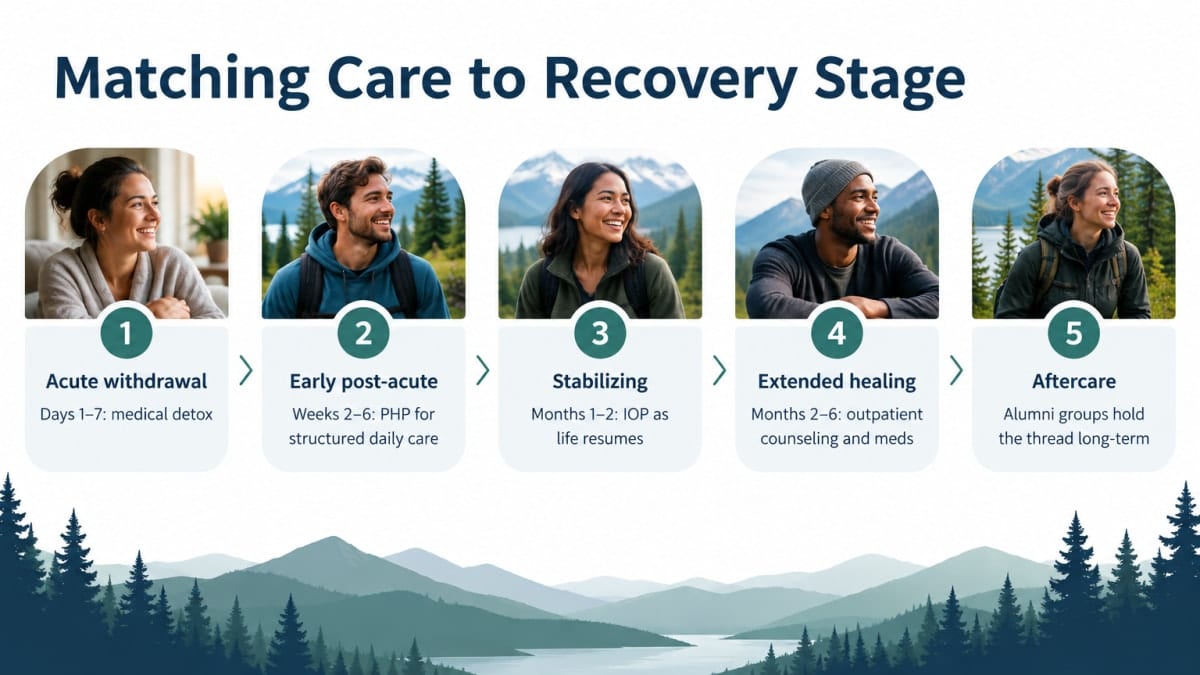
Continuing care is the treatment stage that matches the symptoms you’re actually living with after detox ends. Think of recovery in three overlapping stretches:
- Acute withdrawal runs days, mostly in a medical detox setting, with the shaking, the sweating, and the sharpest anxiety.
- Early post-acute runs roughly weeks two through six, where mood swings, insomnia, cravings, and irritability take over as the physical signs fade.4
- Extended healing covers months two through six and beyond, where flat mood, sleep that still won’t settle, and cognitive fog slowly lift.7
Each stretch has a care setting built for it. A partial hospitalization program (PHP) gives you structured days of therapy and medical check-ins while you sleep at home or in supportive housing, which fits the first weeks after detox when symptoms are still loud. An intensive outpatient program (IOP) steps the hours down so you can start putting work, family, and school back in the picture while still getting several groups a week. Standard outpatient keeps you connected to a counselor and a prescriber as the months stretch out. Aftercare and alumni groups hold the thread when the structure thins.
This is the part detox cannot finish on its own. Your brain is still rebalancing on a longer clock than your body, and continuing care is where that work happens.
Medication, Co-Occurring Mental Health Care, and Daily Habits
Medication can take some of the weight off while your brain rebalances. For alcohol-use disorder, NIAAA names naltrexone, acamprosate, and disulfiram as FDA-approved options that are often combined with counseling or mutual-support groups.13 For opioid-use disorder, medication-assisted treatment with buprenorphine or naltrexone is standard care. These aren’t crutches. They lower craving and quiet the background noise so therapy can actually land.
If anxiety, depression, trauma symptoms, or old sleep problems are still loud after a few weeks sober, that’s worth saying out loud to your treatment team. SAMHSA recommends screening for mental-health and substance-use conditions together, using a “no wrong door” approach so you aren’t bounced between systems that don’t talk to each other.10 Integrated, concurrent treatment for co-occurring conditions is the federal standard of care.11 Some symptoms will ease as your brain settles. Others were there before the substance and need their own care. Both are worth treating.
The daily pieces matter too. Protect your sleep window, even when it fights you. Eat on a schedule. Move your body outside when you can, which is easier in the Pacific Northwest than people think. Keep one or two people in the loop who can hear “today was hard” without flinching.
Getting Care in the Portland Metro and Pacific Northwest
If you’re reading this from Milwaukie, Portland, Gresham, Beaverton, Salem, or across the river in Vancouver, Washington, the practical question is where to start. For alcohol or benzodiazepine withdrawal, that call needs to come before you try to stop on your own, because the risk is real and the symptoms can escalate fast.2, 3 For opioids, a medically supervised start lowers the odds that the anxiety, insomnia, and cravings of the first week push you back toward a dose your body can no longer handle safely.12
A well-run detox in Oregon isn’t a quiet room with a cot. State rules require written admission criteria, documented observation for withdrawal symptoms, and physician medication orders, so you should expect those pieces to be in place from day one.14 Ask what the discharge plan looks like before you ever walk in. Detox is the setup; the continuing care that follows is where the mental symptoms actually settle.5
Pacific Crest Trail Detox sits in Milwaukie and serves the broader Pacific Northwest, including out-of-state readers who want to step away from their usual surroundings to start. Many of our team have been where you are, which shapes how the home-like setting feels at 3 a.m. when sleep won’t come. Verifying insurance is a short, confidential conversation, and it’s a reasonable first step whether we end up being your care team or not. We want to be your last treatment experience, whether we’re your first detox or your fifth.
Get Support for Mental Withdrawal
Check your coverage for medically supervised detox and take a supported first step toward care.
Frequently Asked Questions
Is it normal for anxiety and depression to get worse after the physical withdrawal symptoms stop?
Yes, and this catches a lot of people off guard. The physical symptoms often settle in days, while anxiety, low mood, and sleep problems can get louder for a stretch because your brain is still rebalancing. Research on post-acute alcohol withdrawal describes exactly this pattern, with symptoms that can last weeks to months.7 You’re not sliding backward.
How long does mental withdrawal last?
It depends on the substance and your history. Acute withdrawal usually runs about 5 to 7 days for alcohol, 4 to 10 days for short-acting opioids, and 1 to 4 weeks for benzodiazepines.4 Post-acute symptoms like anxiety, flat mood, and sleep problems can continue for months, often easing in waves rather than disappearing on a set date.7
Can I go through alcohol or benzodiazepine withdrawal at home if the symptoms feel mostly mental?
No. Even when the symptoms feel mostly emotional, alcohol and benzodiazepine withdrawal can turn dangerous quickly, including seizures and delirium.1 NIAAA warns that stopping heavy drinking suddenly can be life-threatening, and the severity of withdrawal should decide the level of medical care.2, 3 A medically supervised start keeps you safer and gives the mental symptoms a chance to settle.
What helps the brain recover after detox is over?
Continuing care does most of this work. Structured programs like PHP, IOP, and standard outpatient give you therapy, medical check-ins, and group support through the weeks when symptoms are loudest. Medications like naltrexone, acamprosate, or disulfiram can lower craving when alcohol is the drug, usually alongside counseling.13 Protecting sleep, eating regularly, and treating co-occurring anxiety or depression also help.10
How do I support a loved one who seems emotionally off weeks after they stopped using?
Keep the house predictable and your expectations low for the first several weeks. Irritability, flat mood, and poor sleep are documented parts of post-acute withdrawal, not a sign they stopped trying.4, 7 Don’t match the irritability. If they mention suicidal thoughts, hopelessness, or a plan to use again, call their treatment team the same day instead of trying to talk them through it alone.
Does Pacific Crest Trail Detox work with people outside the Portland metro?
Yes. Pacific Crest Trail Detox is based in Milwaukie, Oregon, and serves readers across the Portland metro, including Gresham, Beaverton, Salem, and Vancouver, Washington, plus out-of-state clients who want to step away from their usual surroundings to start. Verifying insurance is a short, confidential conversation, and calls are HIPAA-protected whether we end up being your care team or not.
References
- Medication for the Treatment of Alcohol Use Disorder: A Brief Guide. https://www.samhsa.gov/sites/default/files/sma15-4907.pdf
- Alcohol Use Disorder: From Risk to Diagnosis to Recovery. https://www.niaaa.nih.gov/health-professionals-communities/core-resource-on-alcohol/alcohol-use-disorder-risk-diagnosis-recovery
- Treatment for Alcohol Problems: Finding and Getting Help. https://www.niaaa.nih.gov/publications/brochures-and-fact-sheets/treatment-alcohol-problems-finding-and-getting-help
- Protracted Withdrawal. https://library.samhsa.gov/sites/default/files/sma10-4554.pdf
- Quick Guide For Clinicians Based on TIP 45—Detoxification and Substance Abuse Treatment. https://nida.nih.gov/sites/default/files/samhsa_detoxification_and_substance_abuse_treatment.pdf
- The recognition and management of protracted alcohol withdrawal may improve and modulate the pharmacological treatment of alcohol use disorder. https://pubmed.ncbi.nlm.nih.gov/32648800/
- Neurobiology and Symptomatology of Post-Acute Alcohol Withdrawal: A Mixed-Studies Systematic Review. https://pubmed.ncbi.nlm.nih.gov/35838422/
- Clinically meaningful individual differences in opioid withdrawal expression. https://pubmed.ncbi.nlm.nih.gov/37166910/
- Should protracted withdrawal from drugs be included in DSM-IV?. https://pubmed.ncbi.nlm.nih.gov/8097618/
- Managing Life with Co-Occurring Disorders. https://www.samhsa.gov/mental-health/serious-mental-illness/co-occurring-disorders
- Substance Use Disorder Treatment for People with Co-Occurring Disorders. https://library.samhsa.gov/sites/default/files/pep20-06-04-006.pdf
- HHS Guide for Clinicians on the Appropriate Dosage Reduction or Discontinuation of Long-Term Opioid Analgesics. https://www.cdc.gov/overdose-prevention/media/pdfs/2024/03/Guide-for-Clinicians-on-the-Appropriate-Dosage-Reduction-Opioid-Analgesics.pdf
- Understanding Alcohol Use Disorder. https://www.niaaa.nih.gov/publications/brochures-and-fact-sheets/understanding-alcohol-use-disorder
- OFFICE OF THE SECRETARY OF STATE. https://www.oregon.gov/oha/HSD/HSDRules/415-050-01202023.pdf