
Key Takeaways
- Oregon licenses residential withdrawal management under OHA at two ASAM levels — 3.2-WM and 3.7-WM — and the right fit depends on substance, history, and medical risk 12.
- Veterans in Oregon have four main access points: VA Portland SATP, Roseburg VA, White City (SORCC), and OHA-licensed community detox programs, each with different eligibility and setting 5, 4, 10.
- Care is spread across 26 VHA facilities plus community providers, and fragmented handoffs, transportation, and stigma remain documented barriers between systems 6, 7.
- If in crisis, dial 988 and press 1 for the Veterans Crisis Line; otherwise call a VA SUD program or an OHA-licensed detox and ask an intake nurse to help triage 13, 4.
If you’re reading this at 2 a.m.
If you’re reading this at 2 a.m., you’re not alone. Maybe your hands are shaking. Maybe you’re waiting for a spouse to come home, or you’re the spouse who already knows what you’ll find. Maybe you served, came back, and something followed you home that you can’t put down.
Take a breath. You already did the hardest thing tonight, which was to look. Reading this page counts. It’s a small step, and small steps are how people get out.
Here’s what you’ll find below: a plain-language map of veteran detox options in Oregon, what medically supervised withdrawal actually looks like hour by hour, how the VA in Portland, Roseburg, and White City fits alongside licensed community detox programs, and how to pay for care. Veterans face real barriers when reaching out for substance use treatment, including stigma, logistics, and simply not knowing what’s available 7. This page exists to shrink that last one.
If you’re in immediate danger, the next section tells you exactly who to call before you read anything else.
Call 988 and Press 1 Before Anything Else
If you’re seeing seizures, chest pain, confusion, or your loved one can’t stay awake, call 911. Alcohol and benzodiazepine withdrawal can turn dangerous fast, and hospital stabilization comes first. Detox planning comes after you’re safe.
Not in crisis, but close to it? Keep 988 → Press 1 in your phone anyway. Calling isn’t weakness. It’s the same instinct that kept you and your unit alive: assess, act, ask for backup.
What Medically Supervised Detox Actually Looks Like
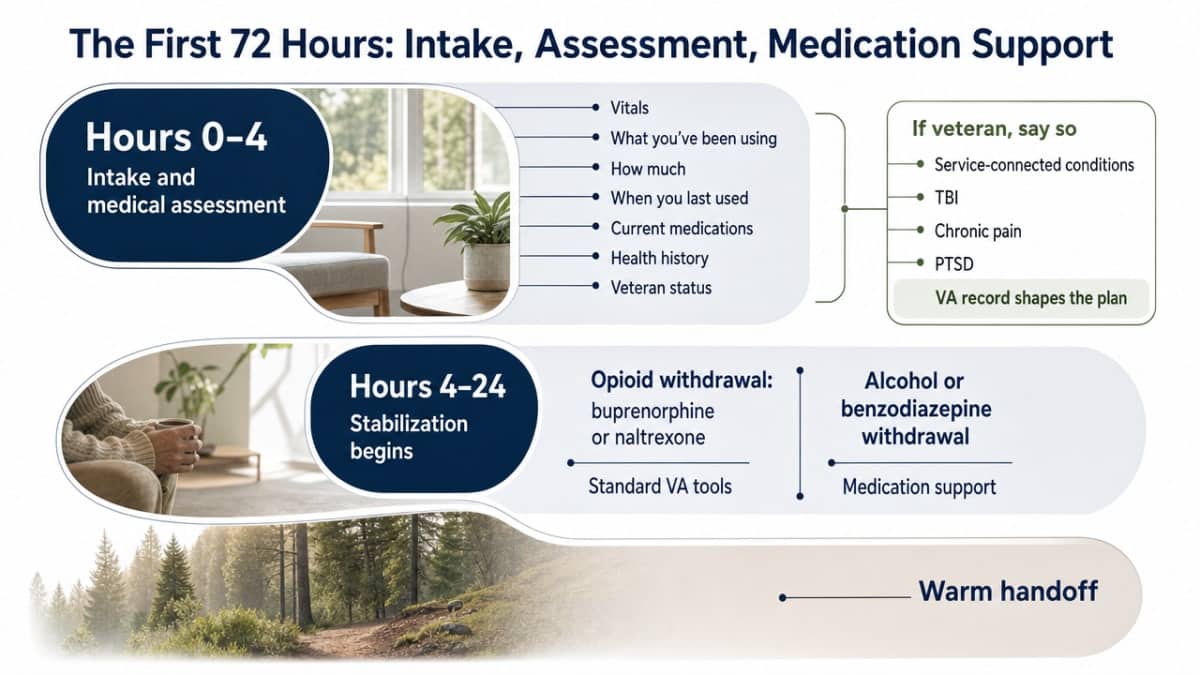
The First 72 Hours: Intake, Assessment, Medication Support
The first three days are the ones people fear the most, and honestly, they should be respected. But they don’t have to be a mystery. Here’s how a good medically supervised detox actually moves, hour by hour.
Hours 0–4: Intake and medical assessment. When you walk in, a nurse or medical provider takes vitals, asks what you’ve been using and how much, when you last used, what medications you already take, and what your health history looks like. If you’re a veteran, this is the moment to say so — service-connected conditions, TBI, chronic pain, PTSD, anything on your VA record. All of it shapes the plan.
Hours 4–24: Stabilization begins. For opioid withdrawal, medication support often means buprenorphine or naltrexone, both of which are standard tools the VA uses too 1. For alcohol or benzodiazepine withdrawal, you’ll usually get a tapering protocol with comfort medications to keep your blood pressure, heart rate, and nervous system out of dangerous territory. SAMHSA is direct about this: medication-assisted treatment sustains recovery and lowers overdose risk for opioid use disorder 14.
Hours 24–72: Round-the-clock monitoring. Staff check vitals on a schedule, adjust medications, and watch for the symptoms that turn dangerous — seizures, delirium tremens, cardiac stress. You eat when you can, sleep when your body lets you, and start meeting the clinical team who’ll help you decide what comes after detox.
Day 3 forward: Warm handoff. Detox isn’t the finish line. A good program is already planning your next level of care — residential, PHP, IOP, or outpatient — before you walk out the door.
ASAM 3.2-WM vs 3.7-WM: What ‘Medically Monitored’ Means in Oregon
When you call an Oregon detox facility, you’re going to hear two numbers a lot: 3.2-WM and 3.7-WM. They’re the two withdrawal management levels the Oregon Health Authority licenses residential and inpatient programs to provide, and knowing the difference helps you ask the right question on the first call 12.
- ASAM 3.2-WM — Adult Clinically Managed Residential Withdrawal Management.
- Think of this as a structured home-like setting with 24-hour support from trained staff and access to medical oversight, but not intensive hospital-level monitoring. It’s the right fit for many people withdrawing from opioids or milder alcohol dependence — situations where the risk is real, but not the kind that needs an ICU nearby 12.
- ASAM 3.7-WM — Adult Medically Monitored Inpatient Withdrawal Management.
- This is a step up. Nursing coverage is heavier, physician involvement is closer, and monitoring is more frequent. It’s appropriate for heavier alcohol dependence, benzodiazepine withdrawal, or anyone whose vitals, seizure history, or co-occurring conditions raise the risk of a dangerous course 12.
Both are recognized under Oregon’s licensing framework. Neither is “better” in the abstract — the right level depends on you: how much, how long, what else is going on medically, and what your withdrawal history has looked like before.
So when you call, ask three questions. First: What ASAM withdrawal management level are you licensed for? Second: Given what I’m withdrawing from, is that the right level for me — or should I be somewhere with more medical coverage? Third: If I need a higher level partway through, what happens? A trustworthy program will answer plainly and, if needed, refer you up. That’s not a weakness. That’s the system working the way it should.
Why Non-Hospital Detox Can Be Safe When It’s Done Right
There’s a fair question hiding underneath a lot of these searches: Isn’t detox supposed to happen in a hospital? Not always. Peer-reviewed research on nonhospital detoxification is clear that it can be safe and effective when appropriate medical oversight and protocols are in place 9. The word doing the heavy lifting there is appropriate.
What “done right” looks like in practice: a licensed program operating under Oregon’s OHA rules, on-site or on-call medical staff, standardized withdrawal protocols (like CIWA for alcohol or COWS for opioids), medication support when it’s indicated, and a clear plan to transfer to a higher level of care if your withdrawal takes a turn 21112.
A non-hospital residential setting has real advantages for people who qualify for that level. It’s quieter. It feels more like a house than a ward. You sleep in a bed, not on a gurney. For many veterans, that difference matters — hospitals carry their own weight of memory and association.
The judgment call isn’t hospital vs. home-like. It’s what does your body and history actually need right now? A good intake conversation gets you to the honest answer, even if the answer is “start somewhere with more medical coverage first.”
The Real Map of Veteran Detox Access in Oregon
VA Portland Health Care System (SATP)
The VA Portland Health Care System runs the Substance Abuse Treatment Program (SATP), which is the biggest veteran-specific SUD hub in the northern half of the state. SATP offers veterans inpatient assessment and stabilization, outpatient treatment, a dual disorders program, and a geriatric program 5. In plain terms: they can help you get through the acute withdrawal window, then move you into ongoing care without you having to start over with a new team.
If you’re already enrolled in VA health care, call your primary care team or the SATP intake line and say the word detox. If you’re not enrolled, you can still contact VA Portland directly — they’ll walk you through eligibility while you’re on the phone. VA-wide, the treatment menu includes medically managed detoxification, counseling, and medications like buprenorphine and naltrexone for opioid or alcohol use disorder 1.
Roseburg VA and White City (Southern Oregon Rehabilitation Center)
If you live south of Eugene, driving three hours to Portland isn’t realistic when you’re in withdrawal. That’s what the Roseburg VA Health Care System and the VA Southern Oregon Rehabilitation Center & Clinics in White City are for. Both are on the VA’s official Oregon SUD program directory, with contact numbers for admissions and SUD coordination 4.
White City in particular has a long history as a residential rehabilitation site for veterans and can be a landing spot for longer-term recovery after the initial withdrawal window is handled. If you call a VA medical center that doesn’t have a named SUD program, the VA’s own guidance is direct:“Contact your local VA Medical Center and ask for the Mental Health clinic” 4. That’s the door. Ask for it by name.
OHA-Licensed Non-Hospital Residential Detox
Outside the VA, Oregon has a network of community detox facilities licensed by the Oregon Health Authority. These are not hospitals, and they’re not unregulated either. Every residential SUD program has to be licensed by OHA under OAR 415-012, licenses run for two years, and OHA can renew, condition, suspend, or revoke them based on inspection 211. The Behavioral Health Division specifically oversees residential withdrawal management programs 3.
Certified providers show up in the state’s public provider directory with “Detoxification Services” listed next to their name 10. That directory is worth pulling up. For a veteran, the practical advantage of a community licensed detox is speed and setting — you can often get in quickly, and the environment feels more like a house than a ward. You don’t need a VA referral to walk through the door. Many programs accept most commercial insurance plans, and some coordinate with VA Community Care when a veteran can’t get timely care inside the VA.
Side-by-Side: Where Oregon Veterans Actually Go for Detox
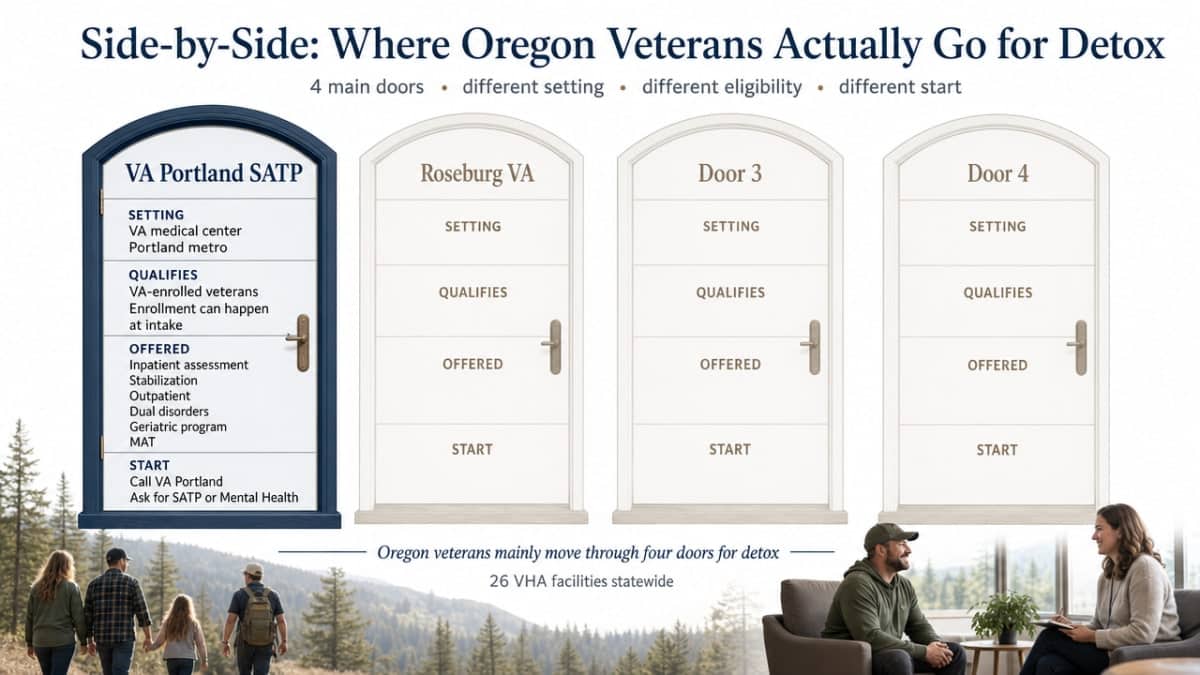
Here’s the honest map. Oregon veterans mainly move through four doors for detox, and each one has a different setting, a different eligibility rule, and a different way to start. The VHA provides behavioral health services to Oregon veterans through 26 VHA facilities across the state, with SUD services that include pharmacotherapy, individual and group counseling, and short- or long-term inpatient residential treatment 6. That’s a lot of front doors, and part of why families feel lost.
| Access Point | Setting | Who Qualifies | What’s Offered | How to Start |
|---|---|---|---|---|
| VA Portland SATP | VA medical center, Portland metro | VA-enrolled veterans (enrollment can happen at intake) | Inpatient assessment and stabilization, outpatient, dual disorders, geriatric program, MAT 51 | Call VA Portland; ask for SATP or Mental Health |
| Roseburg VA | VA medical center, southern Oregon | VA-enrolled veterans in the Roseburg catchment | SUD program with medically managed detox, counseling, MAT 41 | Use the VA Oregon SUD directory contact line 4 |
| White City (VA SORCC) | Residential VA campus, Jackson County | VA-enrolled veterans, often after acute stabilization | Residential rehabilitation, SUD services, longer-term recovery 4 | Ask your VA team for a SORCC referral, or call directly 4 |
| OHA-licensed non-hospital detox | Home-like residential, community setting | Any adult meeting medical criteria — no VA enrollment required | ASAM-level withdrawal management, MAT where indicated, warm handoff 101214 | Call the program directly; verify OHA licensure 211 |
None of these doors is the wrong door. If one has a wait, try another. If you’re not sure which fits, call whichever number you have and ask them to help you triage — a good intake nurse, VA or community, will tell you plainly whether you’re in the right place or should go somewhere with more medical coverage.
The Coordination Gap Between VA and Community Providers
Here’s something the Oregon Health Authority’s own veterans behavioral health report says out loud: care for veterans in this state is spread across 26 VHA facilities, plus community providers, plus crisis lines — and the seams between them show. The report names fragmented care, transportation challenges, and limited awareness of available services as real barriers keeping veterans from getting to treatment 6. RAND found the same pattern nationally: stigma, logistics, and not knowing what’s out there keep veterans from starting 7.
What that looks like on the ground: you call the VA and there’s a wait for a bed. You call a community detox and they don’t know how to loop in your VA primary care team. You get through withdrawal somewhere, then the handoff to ongoing counseling drops because two systems don’t share a chart. None of that is your fault. It’s the gap.
A few things help you close it yourself. Ask every provider — VA or community — to send records to your VA primary care team and to whatever program picks up after detox. Keep a short list on your phone: your VA facility, your SATP or Mental Health clinic number, your VSO, and whichever community detox you’re considering. If a community program is worth its license, they’ll help coordinate the handoff instead of leaving you to run relay between systems.
PTSD, Chronic Pain, and Moral Injury Change How Detox Should Work
Detox for a veteran is rarely just about one substance. It’s about what the drinking or the pills were doing for you in the first place. Peer-reviewed data is blunt: veterans carry higher rates of substance use disorders than the general population, and those disorders often ride alongside PTSD and depression 8. The VA says the same thing in plainer language — SUD in veterans commonly co-occurs with PTSD and other mental health conditions tied to service 15.
That changes what a good detox looks like. A few practical things to watch for:
- Sleep and hypervigilance. If you’ve been using alcohol or benzos to sleep through nightmares, taking that away without a plan lands you back in the same place that started the cycle. A capable intake team asks about this on day one.
- Chronic pain. If opioids were prescribed for a back, a knee, a blast injury, detox has to include a real conversation about what happens to the pain when the medication stops. MAT — buprenorphine or naltrexone — is one of the tools, and the evidence for it in opioid use disorder is strong 14.
- Moral injury. This one doesn’t show up on a lab panel. It’s the weight of what you saw, did, or couldn’t stop. A detox program that can name it, and hand you off to a trauma-informed clinician after stabilization, is doing the work.
The takeaway: when you call a program, ask whether they treat co-occurring PTSD and pain, and how. “Yes” isn’t enough. You want to hear who does it, when it starts, and what happens after detox ends.
Why a Veteran-Owned Detox Feels Different
The person who founded Pacific Crest Trail Detox served in the Gulf War. That’s a fact, not a marketing hook. It matters because of what it changes about the daily texture of the place — the way people talk to you, the way structure shows up in the schedule, the way nobody flinches when you say something that would land funny in a civilian room.
Veterans often describe a specific kind of loneliness in treatment settings: being the only one in the group who’s held a rifle, lost someone in uniform, or come home carrying something the discharge paperwork didn’t cover. RAND’s research on veteran SUD care names stigma and a sense of not being understood as real reasons people delay treatment or drop out early 7. A room where the founder has been where you’ve been shrinks that gap on day one.
What that looks like in practice is small and concrete. Wake-up times that feel familiar. Direct language instead of clinical hedging. Staff who understand why a locked door or a certain smell can spike your heart rate. And an honest read on co-occurring PTSD and chronic pain — the things the VA fact sheet flags as common companions to substance use in veterans 15 — instead of treating them like extra paperwork.
Veteran-owned, veteran-understood. That’s the whole idea.
Paying for Detox: Insurance, VA Coverage, and What to Ask
Money worry is a real part of why people wait. Here’s the short version of how paying for detox actually works in Oregon.
If you’re VA-enrolled: VA substance use treatment — including medically managed detox, counseling, and medications like buprenorphine and naltrexone — is part of your VA health benefits 1. Start with your VA facility. If they can’t take you in the window you need, ask specifically about VA Community Care so a licensed community detox can bill the VA directly.
If you have commercial insurance: Most private plans cover medically necessary detox at a licensed Oregon facility. Ask the program three things: Are you in-network with my plan? What will my out-of-pocket look like? Do you handle the prior authorization, or do I? A good intake team runs the benefits check while you’re on the phone.
A note on Oregon Health Plan: Not every private detox accepts OHP. If OHP is your coverage, the OHA provider directory and your VA facility are the fastest routes to a program that can bill it 10.
How to Take the Next Step Today
You’ve read a lot. That counts. Here’s what to do in the next hour, not the next month.
If you’re in crisis: dial 988 and press 1 for the Veterans Crisis Line 13. If withdrawal symptoms are severe — seizures, chest pain, confusion — call 911 first.
If you’re VA-enrolled: call VA Portland, Roseburg, or White City and ask for SUD or Mental Health by name 4.
If you want a home-like, non-hospital option run by someone who served: Pacific Crest Trail Detox is in Milwaukie, Oregon. The founder is a Gulf War veteran. Call and say what you’re withdrawing from — an intake nurse will help you triage, verify benefits, and coordinate with your VA team if that’s the right fit.
Veteran-owned, veteran-understood. One phone call is the next step. That’s it.
Check Your Coverage for Veteran Detox Support
Find out if your insurance covers immediate, medically supervised detox care designed for veterans.
Frequently Asked Questions
Can I go straight to the VA in Oregon for detox, or do I need a referral?
You can go straight to the VA. Call VA Portland, Roseburg, or the White City campus and ask for the SUD program or the Mental Health clinic by name — the VA’s own guidance points people there when a facility doesn’t have a named SUD program 4. If you’re not yet enrolled in VA health care, they can start enrollment during intake 1.
What’s the difference between VA detox and a private licensed detox in Oregon?
Both can be safe and evidence-based. The VA offers medically managed detox, counseling, and medications like buprenorphine and naltrexone across 26 VHA facilities in Oregon, tied into your VA record 16. A private OHA-licensed detox operates under state rules and inspection 211, often in a home-like setting with faster admission and no VA enrollment required. Neither is automatically better — it depends on your situation and timing.
Is it safe to detox from alcohol or benzodiazepines outside of a hospital?
Sometimes, yes — and sometimes, no. Peer-reviewed research shows nonhospital detox can be safe and effective when appropriate medical oversight and protocols are in place 9. Heavier alcohol dependence, a seizure history, or benzodiazepine withdrawal usually calls for the higher ASAM 3.7-WM medically monitored level 12. Ask any program to assess you honestly and refer up if your case needs more medical coverage.
Will my insurance or VA benefits cover detox in Oregon?
If you’re VA-enrolled, medically managed detox, counseling, and medications like buprenorphine and naltrexone are part of your VA benefits 1. If the VA can’t take you in time, ask about VA Community Care. Most commercial plans cover medically necessary detox at a licensed Oregon facility — ask the program to verify benefits during your first call. Oregon Health Plan coverage varies; the OHA provider directory can help 10.
What should I do right now if a veteran I love is in withdrawal?
If they’re showing seizures, chest pain, confusion, or can’t stay awake, call 911. Otherwise, dial 988 and press 1 for the Veterans Crisis Line — you don’t have to be the veteran to call 13. Then call a VA SUD program 4 or an OHA-licensed detox and describe what they’ve been using and for how long. An intake nurse will help you triage the next step.
Does a veteran-owned detox actually treat withdrawal differently?
The medical protocols are the same evidence-based standards any licensed Oregon program follows 1214. What changes is the room. RAND found stigma and feeling misunderstood keep many veterans from starting or staying in SUD treatment 7. When the founder served — Pacific Crest Trail Detox’s founder is a Gulf War veteran — the language, structure, and read on co-occurring PTSD or pain 15 tend to land differently on day one.
References
- Substance Use Treatment For Veterans. https://www.va.gov/health-care/health-needs-conditions/substance-use-problems/
- Oregon Summary – State Residential Treatment for Behavioral Health Conditions. https://aspe.hhs.gov/sites/default/files/2021-08/StateBHCond-Oregon.pdf
- Oregon Health Authority : Licensing and Certification. https://www.oregon.gov/oha/hsd/amh-lc/pages/index.aspx
- Oregon – VA Substance Use Disorder Program Locations. https://www.va.gov/directory/guide/state_SUD.cfm?STATE=OR
- Treatment Resources for Alcohol and Drug Abuse. https://www.ohsu.edu/portland-alcohol-research-center/treatment-resources-alcohol-and-drug-abuse
- Veterans Behavioral Health Services Improvement Study Report. https://www.oregon.gov/oha/HSD/AMH/Documents/Veterans%20Behavioral%20Health%20Services%20Improvement%20Study%20Report.pdf
- Veterans’ Experiences with Substance Use Disorder Treatment. https://www.rand.org/pubs/research_reports/RR3220.html
- Substance Use Disorders in Military Veterans: Prevalence and Treatment Considerations. https://www.ncbi.nlm.nih.gov/pmc/articles/PMC6235622/
- Detoxification and Substance Abuse Treatment in Nonhospital Settings. https://pubmed.ncbi.nlm.nih.gov/30752563/
- Oregon Substance Use Disorders Treatment Provider Directory. https://www.oregon.gov/oha/HSD/AMH/docs/provider-directory.pdf
- Residential Substance Use Disorders Treatment and Recovery Services Programs (OAR 309-018). https://www.oregon.gov/oha/HSD/Medicaid-Policy/SUDWaiver/309-018-Highlighted-040723.pdf
- Oregon Health Authority : Licensing and Certification : Providers. https://www.oregon.gov/oha/BH/Providers/Pages/Licensing-Certification.aspx
- Behavioral Health Crisis Response System and 988. https://www.oregon.gov/oha/hsd/amh/pages/988.aspx
- Medication-Assisted Treatment (MAT) – SAMHSA. https://www.samhsa.gov/medication-assisted-treatment
- Veterans and Substance Use Disorders Fact Sheet – VA. https://www.va.gov/vetsinworkplace/docs/em_SUD_Factsheet.pdf