

Key Takeaways
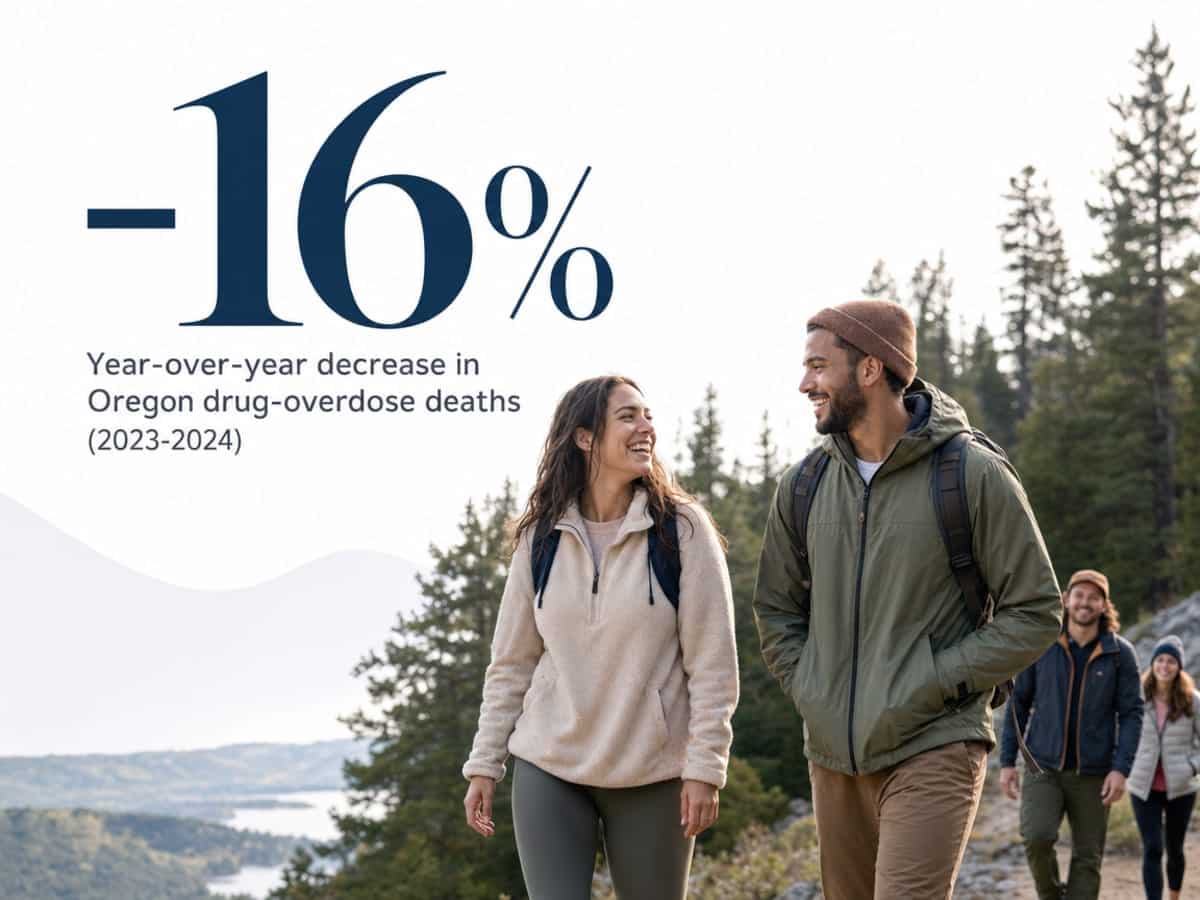
- Oregon saw a 16% drop in overdose deaths from 2023 to 2024, yet 1,544 people still died, and bed shortages mean waiting carries real risk 5, 6.
- More than 90% of Oregon’s 2024 overdose deaths involved fentanyl, meth, or both, and 62.2% involved multiple substances, making unsupervised withdrawal far riskier than in past years 5.
- A legitimate Oregon detox is licensed by OHA for withdrawal management under Chapter 415, Division 50, with 24-hour medical staff and written clinical policies 1, 3.
- If the first door doesn’t open, keep dialing: a 24/7 admissions line, 988 for behavioral-health crisis, 1-800-923-4357, or a county Behavioral Health Resource Network for OHP members 4, 7, 8.
What to do in the next ten minutes if withdrawal is getting dangerous
You made it to this page. That counts. If your hands are shaking, your heart is pounding, you’re sweating through your shirt, or you’re thinking in loops you can’t break — read the next few lines slowly. You don’t have to figure everything out tonight. You just have to make one call.
If you’re scared but still able to talk, here’s what to do in the next ten minutes:
- Call a 24/7 detox admissions line. Pacific Crest Trail Detox in Milwaukie answers the phone around the clock. A real person picks up. You don’t need a referral, and you don’t need to have your story together.
- Keep two backup numbers open. 988 is Oregon’s behavioral-health crisis line — call, text, or chat, any hour 8. The Oregon Alcohol and Substance Helpline at 1-800-923-4357 can also help you find care 7.
- Don’t stop drinking alcohol or taking benzos cold turkey while you wait. Both can cause seizures. Tell the person on the phone what you’ve been using and when you last used it, so they can guide you safely until you’re in a bed.
You’re not weak. You’re in withdrawal, and withdrawal is a medical event. When you’re ready, we’re ready — call Pacific Crest Trail Detox any time. The next ten minutes are the hardest part.
Why the clock matters right now in Oregon
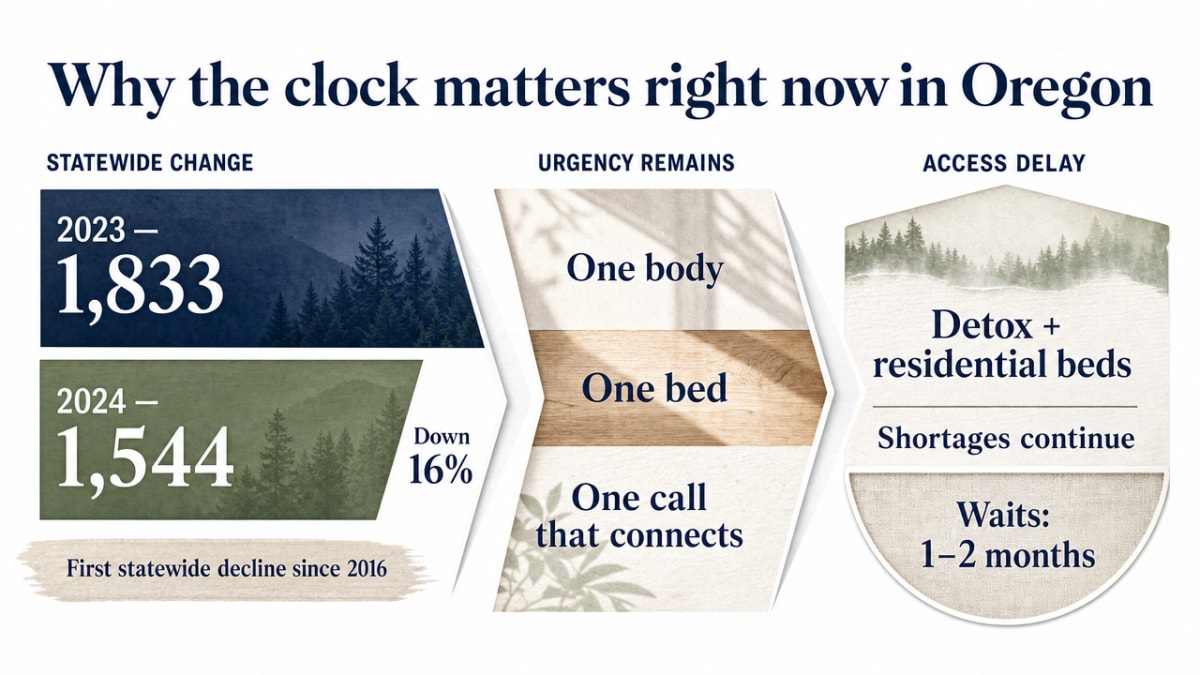
Here’s the hard truth, said gently: Oregon is in a better place than it was a year ago, and the situation is still serious enough that waiting is not neutral. In 2024, 1,544 people in Oregon died from a drug overdose. That number is down 16% from 2023, when 1,833 people died — the first statewide decline since 2016 5. That’s real progress, and it was built on people doing exactly what you’re doing right now: picking up the phone.
But a statewide drop doesn’t change your math tonight. If you’re the person in withdrawal, or the person sitting next to them, the only number that matters is one. One body. One bed. One call that connects.
Access can also be slower than you’d expect. Oregon’s Medicaid monitoring report notes continuing shortages of detox and residential beds for some Oregon Health Plan members, with waits of one to two months for many programs and up to nine months for some youth 6. That’s part of why 24/7 private admissions lines exist — so people with commercial insurance don’t have to sit in that queue while their body is in crisis.
The decline in deaths is a quiet signal that treatment works when people can reach it. Your job tonight is small and specific: reach it. Dial a line that’s open now. If the first call doesn’t land, dial the next one. The clock isn’t your enemy here — it’s just honest. Every hour you shave off the gap between “I can’t do this anymore” and “someone is helping me” is an hour your body isn’t fighting alone.
What makes unsupervised withdrawal riskier in 2024–2025
If you’ve detoxed on your own before and gotten through it, you may be telling yourself you can do it again. That instinct made sense a few years ago. It doesn’t match what’s in the drug supply right now.
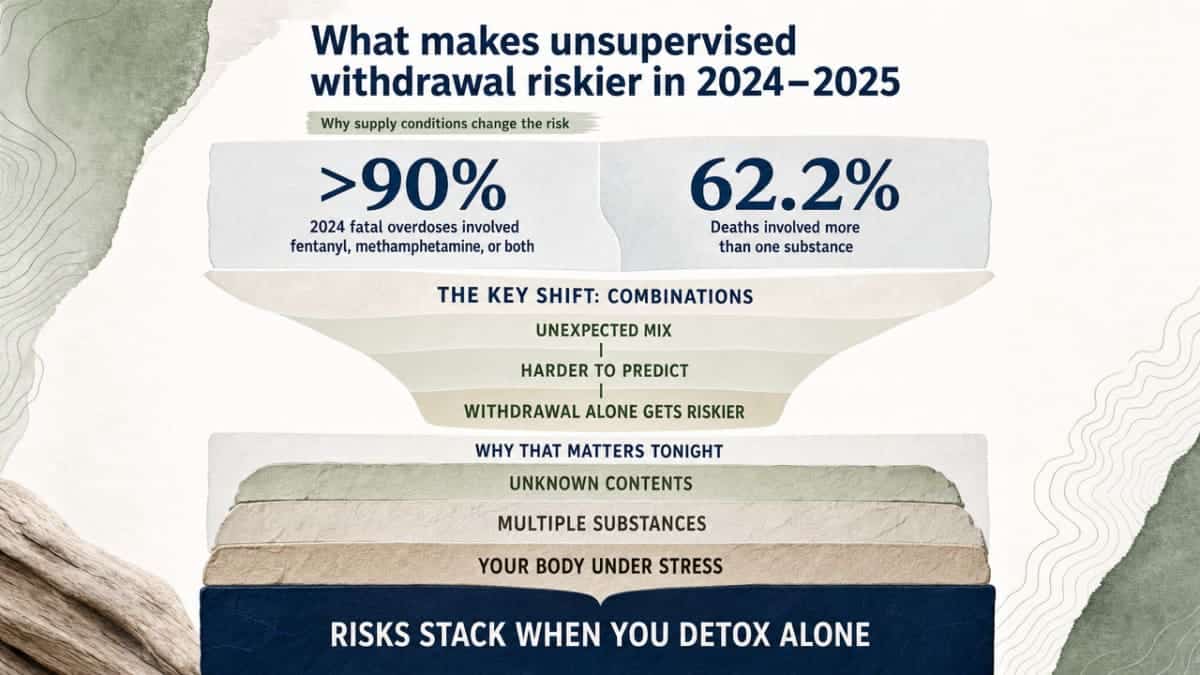
Oregon’s 2025 overdose report found that more than 90% of fatal drug overdoses in the state in 2024 involved fentanyl, methamphetamine, or both. And 62.2% of those deaths involved more than one substance 5. That second number is the one that quietly changes everything. People aren’t just dying from one drug they meant to take. They’re dying from combinations — fentanyl mixed into a pill they thought was Xanax, meth cut with something they can’t see, a drink on top of a benzo on top of an opioid their body hasn’t fully cleared.
Here’s why that matters for you tonight. When you try to ride out withdrawal alone, three things stack up at once. Your tolerance drops fast. Your judgment gets fuzzy from no sleep, dehydration, and panic. And if you reach for “just a little” to take the edge off, the thing you reach for is almost certainly not what it used to be. A dose that felt normal last month can stop your breathing this week.
Alcohol and benzo withdrawal carry their own danger — seizures, delirium, cardiac strain — that no supply issue can soften. Those are medical events that need medicine, not willpower.
None of this is said to scare you. It’s said so you’ll give yourself permission to stop trying to tough it out. The street supply changed. Your options for safe withdrawal didn’t — a licensed detox with people watching your vitals, medicine to ease the symptoms, and a quiet room to sleep in is still right there, one call away. You don’t have to white-knuckle through a drug supply that keeps getting more unpredictable. You just have to let someone else carry the medical piece for a few days.
The first call: what to say when you dial admissions
You don’t need a script. The person on the other end of a real 24/7 admissions line talks to people in withdrawal every single day. They’ve heard every version of “I’m sorry, I don’t know how to do this.” You’re not interrupting them. This is the call they’re staffed for.
Still, if your brain is foggy and you want something to hold onto, here’s what helps them help you faster:
- What you’ve been using, and when you last used it. Alcohol, opioids, benzos, meth, a mix — just say it plain. How much, how often, and the time of your last drink or dose. They are not going to lecture you. That information tells them how urgent your medical risk is and what medicine you may need in the first few hours.
- What withdrawal feels like right now. Shaking, sweating, vomiting, racing heart, seeing things, pain, panic, trouble sleeping. One sentence is enough.
- Any other health stuff. Seizures, heart problems, pregnancy, diabetes, mental-health diagnoses, medications you take. If you don’t remember a name, say what it’s for.
- Your insurance card, if you have one. Pacific Crest Trail Detox accepts most commercial insurance (not Oregon Health Plan). If you don’t have the card in your hand, give them the carrier name and they’ll find the rest. If you have OHP, tell them — they’ll point you to the right Oregon pathway so you don’t lose time 7.
- Where you are and who’s with you. This matters for transport and safety, especially if you’re alone or far from Milwaukie.
A few things the admissions person will likely tell you back: whether a bed looks available tonight, what time to arrive, what to bring, and — critically — what to do between hanging up and walking in. If you’ve been drinking heavily or using benzos regularly, they will usually tell you not to stop on your own while you wait. That’s not permission to use. That’s harm reduction so your body doesn’t have a seizure in the parking lot.
If you start crying, go quiet, or lose the thread, that’s okay. Say “I need a minute.” They’ll wait. If the call drops, they’ll call you back. You are allowed to not have the right words. Picking up the phone was the hard part, and you already did it.
How to tell a real licensed detox from a program that only looks like one
Not every place that calls itself “detox” is actually set up to keep you safe while your body comes off a drug. Some are sober-living houses with good intentions and no nurse. Some are marketing funnels that take your call, then try to fly you across the country. In a crisis, you don’t have time for either. Here’s the plain-English version of what to check.
Oregon’s Health Authority licenses withdrawal-management programs under Chapter 415, Division 50. That’s the rule book. A real detox has to be licensed by the state, keep written policies, and be inspected at least every two years 3. If a facility can’t tell you their license category in one sentence, that’s your answer.
There are really three settings where someone comes off a substance safely in Oregon, and they do different jobs:
- Clinically managed residential withdrawal management. A licensed non-hospital detox with 24-hour staff, medical oversight, and medicine to ease symptoms. Good fit for most adult alcohol, opioid, and benzo withdrawal when you’re medically stable enough to be out of a hospital. This is where Pacific Crest Trail Detox sits — a home-like house in Milwaukie, not a clinical ward 2.
- Medically monitored inpatient withdrawal management. A higher-intensity licensed setting with more nursing and physician coverage on-site. Fits people with heavier medical risk, complicated histories, or co-occurring conditions that need closer watching 2.
- Hospital emergency department. Not detox. This is where you go for a seizure, chest pain, overdose, or any immediate threat to life. The ER stabilizes you, then you move into a licensed detox for the actual withdrawal days.
Three questions to ask on the phone before you commit:
- “Are you licensed by Oregon Health Authority for withdrawal management under Chapter 415?” The answer should be yes, without a pause 1.
- “Will there be medical staff watching my vitals and giving me medicine for symptoms?” If the honest answer is “we’re a sober-living home,” that’s not detox — hang up kindly and dial the next number.
- “What’s your plan if my withdrawal gets worse than expected?” A real program has transfer agreements and a straight answer.
You’re not being picky by asking. You’re being careful with your own body, which is exactly the muscle recovery asks you to build.
The first 24 hours after you arrive at a non-hospital detox
You walked in. That’s the biggest thing that will happen today. Everything from here is somebody else carrying the weight for a while.
Here’s roughly what the first day looks like at a licensed non-hospital detox like Pacific Crest Trail Detox, so your brain has a map to hold onto when you’re too tired to think.
The first hour or two: intake and medical check. A nurse or clinician sits down with you in a quiet room and asks the same questions you answered on the phone, plus a few more. Blood pressure, pulse, temperature, oxygen. A urine screen. A conversation about your last drink or last dose, your health history, what medications you take, whether you’ve had seizures or hallucinations before. If you’ve been drinking heavily or using benzos, they’re specifically watching for signs of serious withdrawal so they can get medicine into you before symptoms peak. Oregon rules require licensed withdrawal-management programs to follow written clinical policies for exactly this kind of assessment 3.
The next few hours: medicine, fluids, and a bed. Based on what the assessment shows, you’ll get medicine to ease the symptoms — something for the shaking, something for the nausea, something to help your nervous system settle. If you’re coming off opioids, this is usually where a conversation about buprenorphine or another FDA-approved medication starts 11. You’ll be shown your room. Someone will offer you water, a snack, a shower, clean clothes. You can sleep. People will keep checking on you.
The rest of the first 24 hours: monitoring. Vitals every few hours. Someone close by if symptoms spike. In a clinically managed residential setting, that watching happens around the clock, which is the whole point of being there instead of white-knuckling it at home 2. You don’t have to be “on” for anyone. No groups the first day. No lectures. Just rest, fluids, medicine, and people who’ve seen this a hundred times and aren’t rattled by any of it.
If something gets worse than the setting can safely handle, a licensed program has a plan to move you to a higher level of care. You won’t be stuck.
By tomorrow morning, you’ll still feel rough — detox isn’t magic — but the sharpest edge will usually be off. That’s when the next conversation starts: what continuing care looks like, so this stretch of hard work doesn’t have to be the last word.
Alcohol, opioids, benzos: what urgent looks like for each
Not every withdrawal is the same shape of dangerous. Here’s a plain breakdown of what counts as urgent for the three substances that most often send people to a 24/7 detox line in Oregon — so you can tell the person on the phone what’s actually happening in your body.
Alcohol. If you’ve been drinking heavily every day for weeks or longer, stopping on your own is the one you shouldn’t try. Alcohol withdrawal can be life-threatening after chronic heavy drinking and is tied to roughly 260,000 emergency-department visits and 850 deaths in the U.S. each year 10. Urgent signs to say out loud when you call: shaking that won’t settle, sweating, a racing heart, vomiting, confusion, seeing or hearing things that aren’t there, or any seizure history. The first 24 to 72 hours are the window where symptoms peak. Keep sipping water. Don’t quit cold while you wait — ask the admissions nurse what’s safe until you arrive.
Opioids (fentanyl, heroin, oxycodone, hydrocodone, methadone, tramadol). Opioid withdrawal is rarely deadly on its own, but it is brutal — bone-deep aches, chills, cramps, diarrhea, vomiting, insomnia, panic — and the real danger comes after. Your tolerance drops within days, so if you use “a normal amount” to stop the misery, that amount can stop your breathing. That’s why CDC guidance is clear: detox alone is not recommended for opioid use disorder, and medicine like buprenorphine or methadone should be offered to lower overdose and death risk 9. On the phone, mention what you’ve been using, your last dose, and whether you want to start medication during detox.
Benzodiazepines (Xanax, Klonopin, Ativan, Valium). Benzo withdrawal belongs in the same “don’t stop alone” category as alcohol. Seizures, severe anxiety, and dangerous blood-pressure swings are real risks, especially if you’ve been on a daily dose for months. Tapering has to be medically guided. Tell the admissions line the exact medication, dose, and how long you’ve been taking it.
Whichever substance is driving this — or whichever combination — you don’t have to rank your own emergency. Say what you’ve used and when. Let the clinician decide the urgency. That’s their job, and it’s one less thing you have to carry tonight.
What happens after detox — and why that question matters before you admit
Ask this on the admissions call, even if your voice is shaking: “What happens when I leave?” The answer tells you whether you’re walking into a safe landing or a cliff.
Detox is the first few days. It gets the substance out and your body stable. On its own, it is not treatment for the reason you started using in the first place. Federal guidance is blunt about this for opioids: the CDC states that detoxification alone is not recommended because it raises the risk of resumed use, overdose, and overdose death 9. The medicine that lowers that risk — buprenorphine, methadone, or naltrexone — works best when it starts during detox and continues after you leave. People treated with methadone or buprenorphine are less likely to die or overdose than people who get no medication 11.
A real detox will talk about continuing care before you ever walk in. At Pacific Crest Trail Detox, that means a step-down into partial hospitalization, intensive outpatient, or standard outpatient, plus alumni support — all housed under the same roof, so you aren’t handed a stack of phone numbers on your way out the door. If medication-assisted treatment is right for you, it starts here and keeps going.
So ask the question. A program that can answer it clearly is a program that plans to still know your name next month.
If the first door doesn’t open: Oregon’s parallel help pathways
Sometimes the first number you dial is busy. Sometimes the bed you were hoping for isn’t available tonight. That doesn’t mean you’re out of options — it means you keep dialing. Oregon has more than one door, and every one of them is open right now.
Save these three numbers in your phone before you do anything else:
- Pacific Crest Trail Detox admissions line — answered around the clock in Milwaukie. Real person, no referral needed.
- 988 — Oregon’s behavioral-health crisis line. Call, text, or chat, 24/7. Trained counselors can help you find resources, connect you with community support, or send mobile crisis help if you need it 8. 988 isn’t a bed-booking service, but it is a human voice that will stay on the line with you while you figure out the next step.
- 1-800-923-4357 — Oregon’s Alcohol and Substance Helpline, listed on the state’s “Need Help Now” page alongside 988 and the official provider directory 7.
If you have Oregon Health Plan coverage, your path looks a little different. Pacific Crest Trail Detox doesn’t accept OHP, and state reports have documented real wait times for some OHP residential beds 6. The faster route for OHP members usually runs through one of Oregon’s 42 Behavioral Health Resource Networks, which provide free, low-barrier treatment and support in every county 4, plus the OHA provider directory linked from the Need Help Now page 7.
Keep dialing until a human picks up. That’s the whole plan tonight.
Pacific Crest Trail Detox in Milwaukie: what a 24/7 admissions call sounds like here
If you dial Pacific Crest Trail Detox at two in the afternoon or two in the morning, the same thing happens: a person picks up. Not a menu tree. Not a next-business-day callback. Someone who knows what withdrawal sounds like on the other end of a shaky voice.
The call usually runs fifteen to twenty minutes. They’ll ask what you’ve been using, when you last used, your health history, and whether you have insurance. Pacific Crest Trail Detox accepts most commercial insurance but does not accept Oregon Health Plan. If you have OHP, they’ll point you toward the state’s provider directory and the Behavioral Health Resource Network in your county so you don’t lose the night 7, 4. If your coverage works, they’ll talk through what time to arrive, who’s driving, and what to do with your body in the meantime.
The house itself sits in Milwaukie, just south of Portland. It looks like a house, because it is one — not a hospital wing, not a clinical ward. Oregon licenses it as a non-hospital withdrawal-management program under Chapter 415, Division 50, with 24-hour staff, medical oversight, and medicine to ease symptoms 2, 3. Many of the people working there have been through recovery themselves. They are not startled by your worst day.
When you’re ready, we’re ready — call Pacific Crest Trail Detox any time.
Check Your Coverage for Immediate Detox Admission
Find out right now if your insurance covers medical detox and stabilization in Oregon.
Frequently Asked Questions
Does a 24/7 admissions line mean I can get a bed tonight?
Often, yes — but no honest program will promise it before they’ve talked to you. A 24/7 line means a real person answers any hour and starts your screening right away. If a bed is open and your situation fits, you can usually arrive the same day. If not, they’ll help you find the next safe step rather than leave you alone with it.
What should I bring with me when I come in for detox?
Keep it simple: a photo ID, your insurance card if you have one, a list of medications you take (bottles are fine), comfortable clothes for a few days, basic toiletries, and a phone charger. Leave alcohol, substances, weapons, and valuables at home. If you forget something, staff will help you work around it. Showing up matters more than packing perfectly.
Is a non-hospital medical detox safe for alcohol or benzo withdrawal?
Yes, when the program is licensed and medically staffed. Oregon licenses non-hospital withdrawal management under Chapter 415, Division 50, with required written policies and routine inspections 3. Clinically managed residential withdrawal management covers most adult alcohol and benzo cases that are medically stable 2. If your risk looks higher during screening, staff refer you to a hospital or medically monitored setting instead.
What if I have Oregon Health Plan (OHP) coverage?
Pacific Crest Trail Detox doesn’t accept OHP, so your fastest route runs through state pathways. Start with the Oregon Alcohol and Substance Helpline at 1-800-923-4357 or the provider directory linked from OHA’s Need Help Now page 7. Every Oregon county has a Behavioral Health Resource Network offering free, low-barrier treatment and support 4. If you’re in crisis while you wait, call 988 8.
Should I call 988, 911, or an admissions line first?
Call 911 if there’s a seizure, chest pain, trouble breathing, overdose, or thoughts of hurting yourself — anything that needs an ambulance now. Call 988 for a behavioral-health or substance-use crisis when you need a human voice and help finding resources, any hour 8. Call a detox admissions line when you’re ready to come in. If you’re unsure, dial 988 — they’ll help you sort it.
How do I know a detox facility is actually licensed in Oregon?
Ask one question on the phone: “Are you licensed by Oregon Health Authority for withdrawal management under Chapter 415?” A real program answers yes without hesitating 1. You can also check OHA’s provider directory and licensing pages, which list approved residential and withdrawal-management programs 2. Licensed facilities keep written clinical policies and are inspected at least every two years 3. If something feels off, keep dialing.
References
- Residential Treatment Facilities : Licensing and Certification. https://www.oregon.gov/oha/HSD/AMH-LC/Pages/RT.aspx
- Oregon Health Authority : Licensing and Certification : Providers. https://www.oregon.gov/oha/bh/providers/pages/licensing-certification.aspx
- Health Systems Division: Addiction Services – Chapter 415. https://www.oregon.gov/oha/HSD/Medicaid-Policy/SUDWaiver/415-050-Highlighted-040723.pdf
- Substance Use Disorder Integration Report. https://www.oregon.gov/oha/HSD/AMH/DataReports/SUD-Integration-Report.pdf
- 2025 – Opioids and the Ongoing Drug Overdose Crisis in Oregon. https://www.oregon.gov/oha/PH/PREVENTIONWELLNESS/SUBSTANCEUSE/OPIOIDS/SiteAssets/Lists/feature/EditForm/2025%20Oregon%20Opioid%20Overdose%20Report.pdf
- Oregon Health Plan 2021-2026. https://www.oregon.gov/oha/HSD/Medicaid-Policy/SUDWaiver/MPA-Report-0524.pdf
- Need Help Now?/¿Necesita Ayuda?. https://www.oregon.gov/oha/bh/lifespan/pages/get-help.aspx
- About the 988 Suicide & Crisis Lifeline. https://www.oregon.gov/oha/BH/Lifespan/Pages/About-988.aspx
- Opioid Use Disorder: Treating | Overdose Prevention | CDC. https://www.cdc.gov/overdose-prevention/hcp/clinical-care/opioid-use-disorder-treating.html
- Alcohol Use Disorder: From Risk to Diagnosis to Recovery. https://www.niaaa.nih.gov/health-professionals-communities/core-resource-on-alcohol/alcohol-use-disorder-risk-diagnosis-recovery
- Medications for Opioid Use Disorder. https://nida.nih.gov/research-topics/medications-opioid-use-disorder