


Key Takeaways
- Quitting alcohol or benzodiazepines cold turkey after heavy holiday use can trigger seizures and delirium tremens, which is why a professional assessment should come before you stop 4.
- Opioid detox alone is not recommended because tolerance drops within days and relapse at old doses drives overdose deaths; staying on buprenorphine, methadone, or naltrexone is safer 1, 14.
- A medically supervised week combines a day-one assessment, FDA-approved medications matched to your substance, and a planned handoff into continuing care rather than discharge with a phone number 5, 7.
- Oregon residents with commercial insurance can often start at Pacific Crest Trail Detox within 24 to 48 hours; those on OHP should call 988 or 211 for a Behavioral Health Resource Network 13.
The January pattern no one warns you about
You already know how this story goes, because you lived it last year. The holidays hand you permission. Office parties, in-laws, a bottle of something nice on the counter from Thanksgiving through New Year’s Eve. By December 28th you’re not really drinking for fun anymore. You’re drinking because stopping feels worse than continuing. Then midnight hits, the ball drops, and you make a quiet promise to yourself: January 1st, done.
Here’s the pattern that plays out in Oregon emergency rooms every year. January 1st, you pour the last of it down the sink. January 2nd, your hands shake and you can’t sleep. January 3rd, your heart is pounding and you feel like you’re coming out of your skin. By January 4th, you’re either back where you started, telling yourself you’ll try again next week, or you’re in an ER being told that quitting the way you did was more dangerous than the drinking.
If you’re reading this at 2 a.m. with a hangover and a knot in your chest, you’re not weak and you’re not alone. You’re on a schedule millions of people share, and willpower was never going to be enough on its own. Alcohol withdrawal after months of heavy drinking can turn medical fast, which is why clinicians recommend professional assessment before you stop 3.
A New Year sobriety detox program isn’t a resolution. It’s a medically supervised first week, with people watching your vitals and a plan for what happens on day eight. That’s the version that actually works, and the rest of this guide walks you through what it looks like.
Why quitting cold turkey at home can be dangerous
Alcohol withdrawal: seizures, DTs, and the second-day crash
Here’s what nobody told you when you poured the wine down the sink: your body has been working around the alcohol for weeks. If you’ve been drinking heavily through the holidays — most nights, several drinks, maybe starting earlier in the day than you want to admit — your nervous system has adjusted. Take the alcohol away suddenly, and that adjustment becomes the problem.
Alcohol withdrawal after prolonged heavy drinking can include nausea, a racing heart, tremors, sweating, elevated blood pressure, seizures, and a condition called delirium tremens that can be life-threatening when someone who chronically drinks heavily stops suddenly without medical help 4. That’s not a scare line from a rehab brochure. That’s the National Institute on Alcohol Abuse and Alcoholism, in plain clinical language.
The timing is cruel. You feel the worst of it around 24 to 72 hours after your last drink — right when you thought you were through the hard part. Day one you feel shaky but proud. Day two your hands won’t stop and you can’t sleep. Day three your heart is pounding and you’re genuinely scared, and that’s the moment people either call for help or reach for the bottle to make it stop.
You don’t have to guess which category you fall into. A professional assessment — a phone call, really — can tell you whether you can taper safely at home or need a medical setting where someone is watching 3.
Opioids and the overdose window after your tolerance drops
Opioid withdrawal usually won’t kill you the way alcohol withdrawal can. What comes after can.
When you stop using opioids — pills, heroin, fentanyl, anything in that family — your tolerance drops within days. The dose that got you through yesterday is not the dose your body can handle next week. If you relapse at your old amount after a stretch of abstinence, you can overdose on what used to feel normal 6. This is the quiet math behind most of the January opioid deaths that don’t make the news.
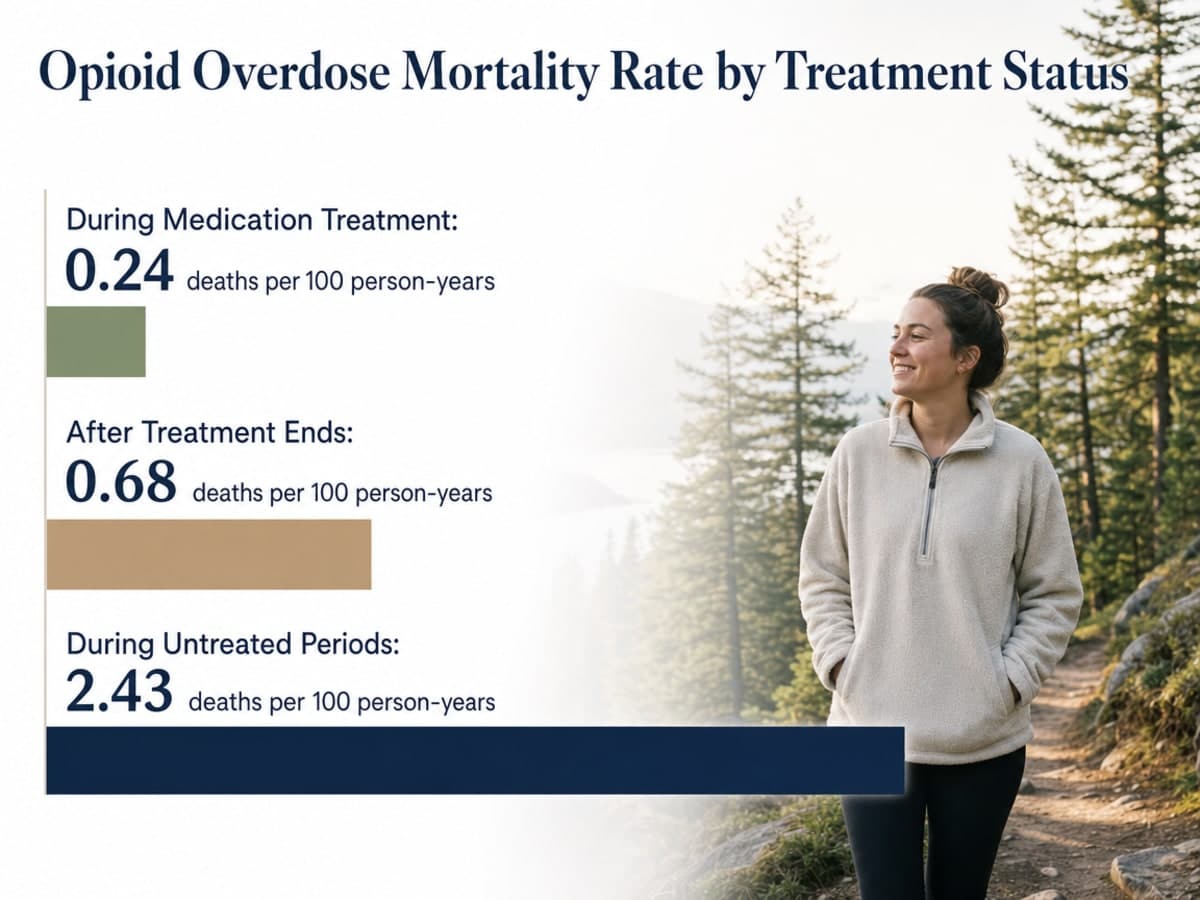
The numbers are stark. A systematic review of 30 cohort studies covering 370,611 participants found pooled overdose mortality of 0.24 deaths per 100 person-years during medication-assisted treatment, 0.68 after treatment ended, and 2.43 during untreated periods 14. In other words: being on buprenorphine or methadone is dramatically safer than being off it, and the period right after you stop treatment is where the risk spikes. These are observational studies with the limits that come with that design, but the pattern is consistent and large.
Benzodiazepines: the quiet third risk
If Xanax, Klonopin, Ativan, or any benzodiazepine has been part of your daily routine — prescribed or not — the quitting rules change again. Benzos act on the same brain system as alcohol, which means stopping them abruptly after long-term use carries the same category of risk: seizures, severe autonomic symptoms, and a withdrawal syndrome that can stretch for weeks instead of days.
This is not a willpower situation. Benzo withdrawal almost always needs a medically supervised taper, often slower than people expect, sometimes alongside other medications to keep you safe. If you’ve been mixing benzos with alcohol or opioids — which is common and which you don’t need to feel ashamed about — that combination raises the stakes further and makes a professional assessment non-optional before you stop anything.
What a medical detox program actually does
The assessment on day one
The first thing that happens isn’t a lecture or a locked door. It’s a conversation. Someone sits down with you and asks what you’ve been using, how much, how often, and for how long. They ask when your last drink or dose was, what medications you’re on, whether you’ve had seizures before, whether you’ve tried to quit before and what happened. None of this is to judge you. It’s to figure out how your body is likely to respond when the substance leaves it.
Clinicians use that information to decide what level of care you actually need. Someone with mild symptoms and strong support at home may do fine with outpatient monitoring. Someone with a long drinking history, past withdrawal seizures, or a mixed benzo-and-alcohol pattern needs a setting where staff can intervene quickly 4. The assessment also covers mental health, physical health, housing, and family — because the plan that comes next has to fit the life you’re actually going back to 16.
Medications that take the edge off withdrawal
There are real medications for this. You don’t have to white-knuckle your way through it, and you shouldn’t try.
For alcohol, the FDA has approved three medications that clinicians consider as part of treatment: naltrexone, available as a daily pill or a monthly injection; acamprosate, which supports staying abstinent; and disulfiram, which causes unpleasant effects if you drink while taking it 5. During the acute withdrawal days themselves, medical teams typically use other medications to calm the nervous system, prevent seizures, and bring down the racing heart and blood pressure. Which medications, in what doses, depends on your assessment — this part is not one-size-fits-all.
For opioids, the picture is similar but with different tools. Buprenorphine, methadone, and naltrexone are the three FDA-approved medications for opioid-use disorder, and lofexidine can help specifically with the acute withdrawal symptoms — the sweating, the restlessness, the gut cramps that make day two feel unlivable 7. Buprenorphine in particular can turn the worst 48 hours into something a human being can get through.
Here’s the part worth saying plainly: medication isn’t a shortcut or a crutch. For opioids, staying on medication after detox is strongly associated with lower mortality compared to being off it, and the CDC explicitly recommends against detox alone without a medication plan 1. The medications aren’t just for comfort during the first week. They’re part of what keeps you alive during the second month.
Your first seven days, hour by hour
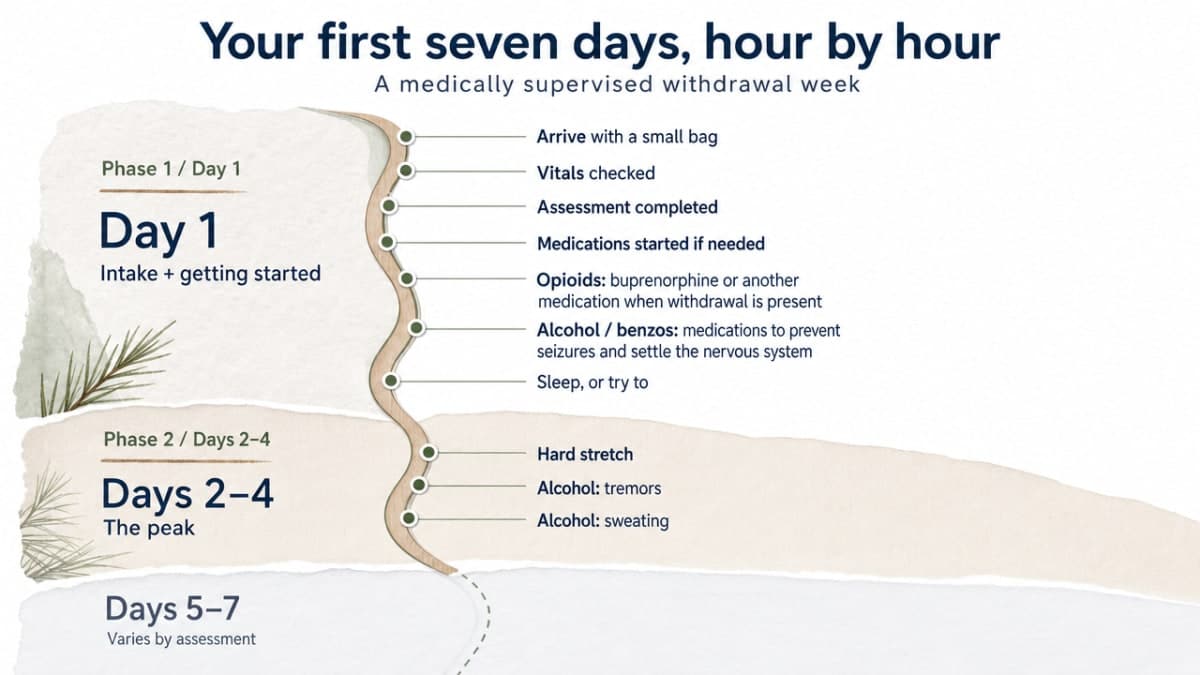
You don’t need a philosophy. You need to know what tomorrow is going to feel like. Here is a conservative sketch of what a medically supervised week typically looks like, based on how clinicians describe the alcohol- and opioid-withdrawal arc. Your own timeline will differ, and that’s what the assessment is for.
Day 1 — intake and getting started. You arrive, usually with a small bag. Staff checks your vitals, finishes the assessment, and starts medications if you need them. If you’re coming off opioids, this is typically when buprenorphine or another medication is introduced, timed to when withdrawal symptoms are present. If you’re coming off alcohol or benzos, medications to prevent seizures and settle your nervous system start now. You sleep, or try to.
Days 2–4 — the peak. This is the hard stretch. For alcohol, symptoms can include tremors, sweating, elevated pulse and blood pressure, and in more severe cases seizures or delirium tremens — which is exactly why you’re not doing this alone 4. Medical staff adjusts medication through the day based on what your body is doing. You will probably feel bad. You will probably sleep poorly. You will not be in danger of the thing you were most afraid of, because someone is watching.
Days 5–7 — stabilization and the plan. Symptoms ease. You start eating again. Sleep begins to return. This is when the real work of the week happens: sitting down with a counselor and figuring out what Monday looks like. For alcohol, that may mean continuing naltrexone, acamprosate, or disulfiram and connecting with outpatient counseling 5. For opioids, it means staying on buprenorphine, methadone, or naltrexone and moving into ongoing care 7. Discharge isn’t a graduation. It’s a handoff.
If you remember nothing else about this timeline, remember that the worst part has an end date, and you don’t have to face it alone to get there.
Hospital detox vs. a home-like residential setting
If you’ve only ever pictured detox as a hospital hallway — fluorescent lights, a shared ward, a plastic bracelet, a stranger in the next bed — you’re picturing one option, not the only one. Oregon actually licenses two different approved levels for inpatient withdrawal management: clinically managed residential withdrawal management, and medically monitored inpatient withdrawal management 10. They sit at different points on the intensity scale, and they feel very different to live through.
A hospital emergency department is where you want to be if you’re actively seizing, if your vitals are dangerous, or if you have medical complications that need a full hospital team. That’s real and sometimes necessary. What hospitals usually aren’t built for is the next five days — the slow stretch where the acute danger has passed but your sleep is wrecked, your appetite is gone, and you need somewhere human to sit with what you’ve done and what comes next. Hospital discharge often happens fast, with a referral in your hand and no clear bridge to it.
A home-like residential detox fills that middle ground. At Pacific Crest Trail Detox in Milwaukie, that means your own bed instead of a ward, a kitchen instead of a cafeteria tray, and a medical team on-site watching your vitals and adjusting medications through the week. No hallway noise at 3 a.m. No fluorescent buzz. If your assessment shows you need a higher level of medical monitoring than a non-hospital setting provides, staff will say so — that’s what the licensing distinction is for 10.
The practical difference matters because the first week sets up the second month. A warm handoff from the same team into outpatient counseling and medication management is a very different experience than being discharged from an ER with a phone number. You still have to make the call. You just don’t have to make the next ten alone.
How to start this week in Oregon
If you have commercial insurance
If you carry a commercial plan — through your job, your spouse’s job, a marketplace plan, Medicare with a supplement — the path this week is shorter than you probably think. Pacific Crest Trail Detox in Milwaukie accepts most commercial insurance, and the intake call does the hard part for you. You give them your insurance card number, the last substance you used, and roughly when. They run the benefits check while you’re still on the phone.
You don’t need a referral from your primary care doctor. You don’t need to file paperwork first. You don’t need to wait until Monday if it’s a Saturday night. Admission can often happen within 24 to 48 hours of that first call, sometimes same-day depending on your assessment and what bed is open.
Have your insurance card nearby, a list of what you’ve been taking and when, and a quiet five minutes. If you want someone else to make the call for you — a spouse, a sibling, a friend — that’s allowed, and it’s often how this actually happens.
If you have the Oregon Health Plan
Here’s the honest part: Pacific Crest Trail Detox doesn’t accept the Oregon Health Plan. That’s a real limit, and if OHP is your coverage, you need a different front door — not a worse one, just a different one.
OHP covers detoxification, medication-assisted treatment, residential care, and individual, group, and family counseling, and you do not need a referral from a primary care doctor to get help for alcohol or drug problems 9. That means you can start the process directly. The place to start is one of Oregon’s Behavioral Health Resource Networks, which are set up in every county and Tribe to provide free, low-barrier access to substance-use treatment and supports 13. They can connect you to a detox bed that takes OHP, help with transportation, and keep walking with you after the first week.
Call 988 or your county’s Behavioral Health Resource Network to get started today. If you’re not sure which network serves your county, call 211 and they will route you. You are not stuck.
What the state pays for different intensities of care
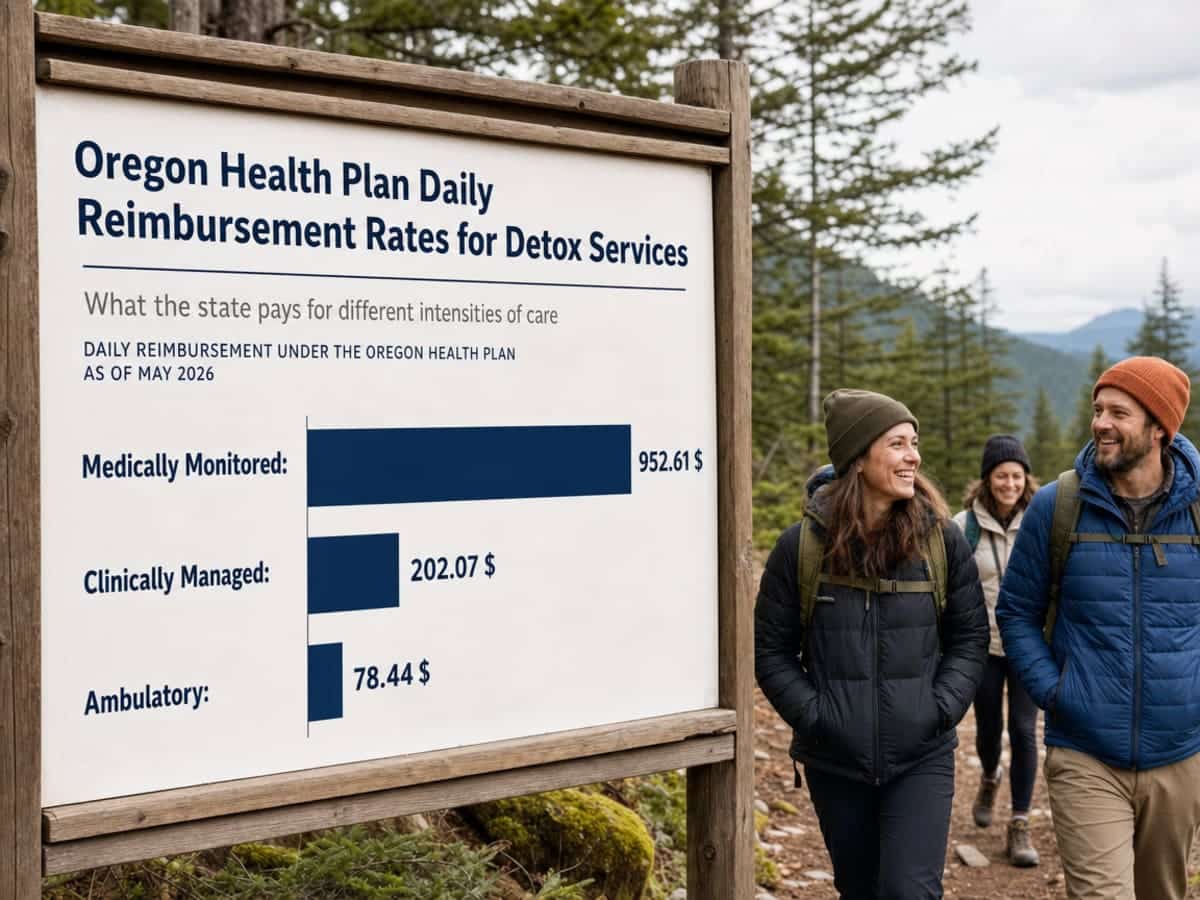
If you’re a family member trying to make sense of what detox costs and why one program quotes a different number than another, it helps to see what Oregon itself pays for different intensities of care. These are reimbursement rates from the state’s behavioral-health fee schedule — what the Oregon Health Plan pays providers per day. They are not what a commercial-insurance patient pays out of pocket, and they are not what a self-pay family pays. They are a useful anchor for the question, “How much more intensive is one level than another?”
Oregon’s fee schedule lists roughly:
- $952.61 per day for medically monitored detoxification
- $202.07 per day for clinically managed detoxification
- $78.44 per day for ambulatory (outpatient) detoxification 11
The spread tells the story: medically monitored care involves 24-hour nursing, more frequent medication adjustments, and the ability to respond quickly if alcohol or benzo withdrawal gets dangerous. Clinically managed residential care is a lower-intensity residential setting. Ambulatory detox is day-program care where you sleep at home.
Which level fits you is a clinical question, not a budget question — your assessment decides that. But if someone is comparing programs and the prices look wildly different, this is usually why. More medical staffing, more cost. For a commercial-insurance patient, the day-to-day price you see on an explanation of benefits will differ from these numbers; call the program and ask them to run your specific plan.
What has to happen after detox ends
Day seven is not the finish line. It’s the handoff. The sickest days are behind you, your sleep is coming back, and the real question starts: what fills the hours that used to be filled by drinking or using? If nothing does, the body you just worked so hard to clear becomes a body with less tolerance and more risk.
That risk isn’t theoretical for opioids. A systematic review of methadone and buprenorphine treatment found that all-cause and overdose mortality were substantially higher out of treatment than in it, with the induction period and the weeks right after someone leaves treatment flagged as the two most dangerous windows 15. The CDC guidance says it in plainer terms: a detox-only plan, without continuing medication and support, is not what good care looks like 2. If you came off opioids, staying on buprenorphine, methadone, or naltrexone after discharge is part of the plan, not an optional add-on.
For alcohol, continuing care usually means some mix of naltrexone, acamprosate, or disulfiram alongside counseling 5. For both, it means addressing the stuff detox doesn’t touch — the mental health piece, the housing piece, the family piece, the job you may or may not still have. Oregon’s residential treatment rules require programs to assess and coordinate those exact supports, because recovery that ignores them doesn’t hold 12. Effective treatment attends to multiple needs and gets adjusted as those needs change 16.
At Pacific Crest Trail Detox, that transition happens with the same team you already know — a step down into partial hospitalization or intensive outpatient, continued medication management, counseling, and an alumni community that doesn’t disappear on day eight. You already did the hardest week. The next one gets easier when you’re not doing it alone.
Making the call before the resolution fades
Resolutions have a half-life. The version of you reading this at 2 a.m. — scared enough to be honest — is the version that makes the call. By Thursday afternoon, when the shakes ease a little and the shame talks you into one more week, that version gets quieter. January gets away from people that way.
You don’t have to have the whole plan figured out. You need a phone, an insurance card if you have one, and five minutes. Pacific Crest Trail Detox in Milwaukie is a home-like place where a medical team watches over you while you come off alcohol, opioids, or benzos safely, then helps you plan what comes next. If you have the Oregon Health Plan, call 988 or 211 and ask for your county’s Behavioral Health Resource Network 13. Picking up the phone is the hard part. The rest, we help with.
Start Your Year Safe—Check Detox Coverage Now
Find out if your insurance supports a safe, medically-supervised start to sobriety this January.
Frequently Asked Questions
Is it dangerous to quit drinking on my own after the holidays?
It can be, and it depends on how much you’ve been drinking and for how long. After prolonged heavy drinking, stopping suddenly can bring on tremors, a racing heart, elevated blood pressure, seizures, and delirium tremens — which can be life-threatening without medical help 4. A quick phone assessment can tell you whether you can taper safely or need a monitored setting.
How fast can I actually start a detox program in Oregon?
Faster than you probably think. If you have commercial insurance, Pacific Crest Trail Detox in Milwaukie can often verify benefits during your first call and admit within 24 to 48 hours, sometimes same-day. You don’t need a referral from your primary doctor. If you have the Oregon Health Plan, call 988 or 211 for your county’s Behavioral Health Resource Network, which offers low-barrier access 13.
What happens during the first day of medical detox?
Day one is mostly a conversation and a careful start. Staff checks your vitals and asks what you’ve used, how much, and when your last drink or dose was. If you’re coming off opioids, medication like buprenorphine is typically started once withdrawal symptoms appear 7. For alcohol or benzos, medications that calm the nervous system and prevent seizures begin now. Then you rest.
Will I be given medication to help with withdrawal symptoms?
Yes, if your assessment calls for it. For alcohol, FDA-approved options include naltrexone, acamprosate, and disulfiram, along with medications during acute withdrawal to prevent seizures 5. For opioids, buprenorphine, methadone, and naltrexone are the three FDA-approved medications, and lofexidine can ease acute symptoms like sweating and restlessness 7. You should not have to white-knuckle through it, and good care doesn’t ask you to.
What if I have the Oregon Health Plan instead of commercial insurance?
Pacific Crest Trail Detox doesn’t accept OHP, so you’ll need a different front door. OHP does cover detox, medication-assisted treatment, residential care, and counseling, and you don’t need a primary care referral 9. Call 988 or 211 to reach your county’s Behavioral Health Resource Network, which provides free, low-barrier access to treatment and can connect you to a bed 13.
What happens after the first week of detox is over?
Day seven is a handoff, not a finish line. For opioids, staying on buprenorphine, methadone, or naltrexone after discharge is linked to substantially lower mortality than being off medication 15. For alcohol, continuing care usually combines medication with counseling 5. At PCTD, that means stepping down into partial hospitalization or intensive outpatient with the same team, plus alumni support.
References
- Opioid Use Disorder: Treating | Overdose Prevention | CDC. https://www.cdc.gov/overdose-prevention/hcp/clinical-care/opioid-use-disorder-treating.html
- Guideline Recommendations and Guiding Principles – CDC. https://www.cdc.gov/overdose-prevention/hcp/clinical-guidance/recommendations-and-principles.html
- Treatment for Alcohol Problems: Finding and Getting Help. https://www.niaaa.nih.gov/publications/brochures-and-fact-sheets/treatment-alcohol-problems-finding-and-getting-help
- Alcohol Use Disorder: From Risk to Diagnosis to Recovery. https://www.niaaa.nih.gov/health-professionals-communities/core-resource-on-alcohol/alcohol-use-disorder-risk-diagnosis-recovery
- Recommend Evidence-Based Treatment. https://www.niaaa.nih.gov/health-professionals-communities/core-resource-on-alcohol/recommend-evidence-based-treatment-know-options
- Treatment and Recovery. https://nida.nih.gov/publications/drugs-brains-behavior-science-addiction/treatment-recovery
- Medications for Opioid Use Disorder. https://nida.nih.gov/research-topics/medications-opioid-use-disorder
- Provisional Drug Overdose Death Counts. https://www.cdc.gov/nchs/nvss/vsrr/drug-overdose-data.htm
- Oregon Health Plan (OHP) Behavioral Health Coverage. https://www.oregon.gov/oha/hsd/ohp/pages/behavioral-health.aspx
- Oregon Health Authority : Licensing and Certification : Providers. https://www.oregon.gov/oha/bh/providers/pages/licensing-certification.aspx
- Substance Use Disorder. https://www.oregon.gov/oha/HSD/RAC/309-018.pdf
- Behavioral Health Services – Chapter 309. https://www.oregon.gov/oha/HSD/COMPASS/resources/ROADS%20BH%20+%20Addiction%20Reference%20Manual_v1.1.pdf
- Substance Use Disorder Integration Report. https://www.oregon.gov/oha/HSD/AMH/DataReports/SUD-Integration-Report.pdf
- Effects of medication-assisted treatment on mortality among opioids users: A systematic review and meta-analysis. https://pubmed.ncbi.nlm.nih.gov/29934549/
- Mortality risk during and after opioid substitution treatment. https://pubmed.ncbi.nlm.nih.gov/28446428/
- Principles of Drug Addiction Treatment: A Research-Based Guide. https://nida.nih.gov/sites/default/files/podat-3rdEd-508.pdf