


Key Takeaways
- An intake specialist answers, not a scripted receptionist, and runs a calm conversation shaped by lived experience rather than judgment or pressure.
- The 15-minute call moves through a privacy promise, substance use questions, medical and mental health history, insurance and logistics, and a next-step plan you control.
- Federal rule 42 CFR Part 2 blocks disclosure to employers, family, or other providers without your written consent, so honesty on the call stays protected 9.
- Detailed questions about doses, last use, and prior seizures feed a validated withdrawal screening that shapes your safety plan, not a case against you 8.
- The screening follows SBIRT, the standard workflow used by nearly all Oregon and national substance use programs to match callers to the right level of care 4, 10, 11.
- Having your ID, insurance card, a rough use timeline, prescription bottles, and a quiet space nearby makes the call smoother, especially if withdrawal has already started.
- Family members can call for information, but admission requires the person using to agree, so the process often becomes two calls rather than one.
- After admission, nurses repeat the screening in person, medication-assisted treatment can begin, and the team maps aftercare like PHP, IOP, or outpatient before discharge 8, 6.
If You’ve Picked Up the Phone Three Times Today
If you’ve picked up your phone three times today and put it back down, you’re not the only one. That pause before dialing a detox center is one of the hardest moments in the whole recovery process, and it has almost nothing to do with wanting help. You already want help. What you don’t know is what the next twenty minutes will sound like once someone answers.
Here’s the short version: it’s a conversation, not an interrogation. The person on the other end has taken this call thousands of times. They’ve heard whatever you’re afraid to say out loud. They aren’t going to ask you to explain how you got here, and they aren’t going to make you promise anything before you hang up.
This guide walks you through the call minute by minute — who answers, what they ask, what they’re legally not allowed to share, what happens if you say “I’m not ready today,” and what happens if you say yes. Read it once. Then, when you’re ready, dial. Pacific Crest Trail Detox in Milwaukie, Oregon takes calls from people who feel exactly the way you feel right now.
Who Actually Answers When You Call
The person who answers is an intake specialist. Not a doctor, not a receptionist reading from a script, and not a salesperson. At Pacific Crest Trail Detox, it’s someone who has spent their career doing this specific job: taking calls from people who are scared, or hurting, or calling on behalf of someone they love. Many intake staff at detox programs have their own lived recovery experience. They know what the pause before dialing feels like.
Here’s what that means in practice. They aren’t surprised by anything you say. If you tell them you drank a fifth of vodka this morning, they’ll ask when your last drink was and whether you’re shaking — not whether you’re ashamed. If you tell them you’ve been mixing Xanax and alcohol for two years, they’ll want to know your dose and how long since your last pill, because that combination can be medically dangerous to stop cold and they need to plan for it.
They’re trained to run a brief, structured screening and match you with the right level of care, which is the standard workflow used across substance use treatment 4. But the tone is a conversation, not a form. You can ask them to slow down. You can ask them to repeat a question. You can cry. None of it is a problem.
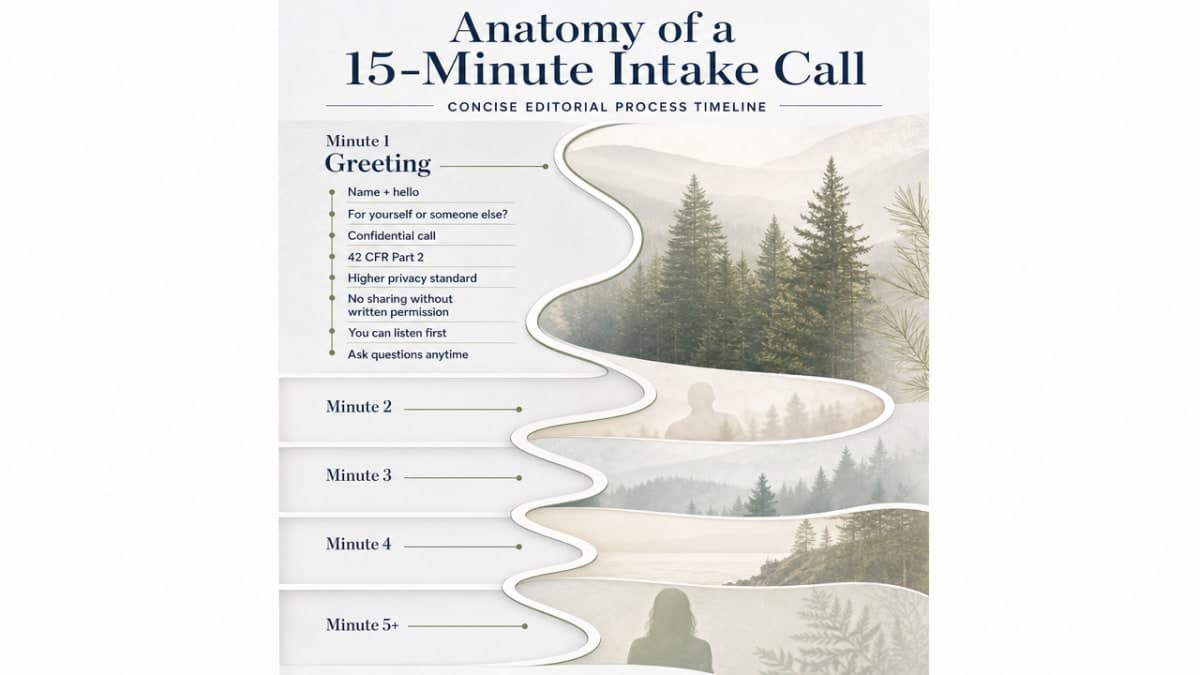
Anatomy of a 15-Minute Intake Call
Minute 1: The Greeting and the Privacy Promise
The first thing you’ll hear is a name and a hello. Something close to: “Thanks for calling Pacific Crest Trail Detox, this is [name] — are you calling for yourself or for someone else?” That’s it. No script about how brave you are. No pitch.
Within the first thirty seconds or so, the intake specialist will tell you that the call is confidential. That’s not a courtesy line. Federal law — specifically 42 CFR Part 2 — protects substance use disorder records at a higher standard than regular medical records, and it applies from the moment you start giving details about your use 9. Nothing you say gets shared with your employer, your family, your doctor, or anyone else without your written permission.
You can also just listen at first. If you need a minute before you talk, say so. If you want to ask questions before you answer any, that’s fine too. This first minute is designed to slow your heart rate down, not speed it up.
Minutes 2–5: What You’re Using and When You Last Used
Once you’re ready, the questions get specific — but not in a way that’s meant to corner you. The intake specialist needs to know what’s in your body, how much, and when you last used. That’s because withdrawal from alcohol and benzodiazepines like Xanax, Ativan, or Klonopin can become medically dangerous within hours, and the timing of your last dose changes what happens next 8.
Expect something like: What are you using? How much on a typical day? When was your last drink or last pill? Are you feeling shaky, sweaty, nauseous, anxious, or having trouble sleeping? Have you ever had a seizure coming off alcohol or benzos? Have you ever been through detox before?
These aren’t test questions. They map to a validated withdrawal-risk screening that detox programs use to decide how urgently you need to be seen and what medications you might need on arrival 8. If you don’t know an exact number — how many drinks, how many milligrams — say roughly. “About a fifth a day for the last year” is enough. “A handful of blue ones, I’m not sure the dose” is enough. They’ll work with what you have.
If you’re using more than one substance — say alcohol plus opioids, or benzos plus stimulants — tell them all of it. Mixing changes the medical picture, and the person on the phone has heard every combination. They’re not scoring you. They’re building a safety plan.
Minutes 6–10: Medical History, Mental Health, and Home Environment
The middle stretch of the call widens out. The intake specialist is working through a clinical framework called the ASAM six dimensions — the standard placement tool used across addiction medicine to figure out which level of care fits you safely 7. In plain language, they’re asking about six things: how your body is handling withdrawal, what other medical issues you have, what’s going on with your mental health, how you feel about treatment, whether you’ve relapsed before, and what your home life looks like right now.
So expect questions like: Do you have any medical conditions — heart problems, liver issues, seizures, diabetes, pregnancy? What prescription medications are you on? Have you ever been diagnosed with depression, anxiety, bipolar disorder, PTSD? Are you having any thoughts of hurting yourself? Is there anyone at home who’s also using, or anyone who’s unsafe to be around?
That last one matters more than most people expect. If you’re trying to detox and your roommate is drinking in the next room, that’s important information — not a reason to be judged. Pacific Crest Trail Detox is a home-like residential setting in Milwaukie specifically because so many people don’t have a safe, quiet place to withdraw. Naming what’s happening at home helps the intake specialist explain why coming in might make sense for you.
Minutes 11–13: Insurance, Logistics, and Getting to Milwaukie
This is the part most people brace for, and it’s usually the easiest. The intake specialist will ask for the name of your insurance carrier and the member ID off your card. Pacific Crest Trail Detox accepts most commercial insurance plans (the one exception is Oregon Health Plan). They’ll run a benefits check — often while you’re still on the line, sometimes with a callback in an hour or two — and tell you in plain numbers what your plan covers.
No one is going to quote you a bill on this call without your insurance information in front of them. If you don’t have your card, they’ll still talk to you; you can text a photo of it later.
Then come the practical questions. Where are you now? Do you have a way to get to Milwaukie, or do you need help figuring out a ride? Is there anyone who can drive you? Do you have kids, pets, or a job situation that needs a plan before you leave the house? None of these are dealbreakers. They’re logistics, and the intake specialist has helped people work through every version of them.
Minutes 14–15: What Happens Next (or What Happens If You Say ‘Not Today’)
By the end of the call, one of three things happens. If you’re ready and there’s a bed available, the intake specialist will walk you through when to arrive, what to bring, and what the first twenty-four hours will look like. If you’re ready but a bed opens up tomorrow instead of tonight, they’ll hold your spot and give you a safety plan for the hours in between.
And if you say, “I don’t think I can do this today” — they’ll say okay. No pressure, no guilt trip, no callback loop you can’t opt out of. They may ask if it’s alright to check in with you in a few days. You can say yes or no. Your file, if one gets started at all, stays protected under the same federal privacy rules from minute one 9.
What the Person on the Phone Will Never Do
Most of the fear that keeps people from dialing isn’t fear of the questions. It’s fear of what happens to the answers. So it’s worth being direct about the things intake will not do — because federal law and program policy already draw those lines for you.
- They will not call your employer. Not to verify anything, not to explain why you might miss work, not for any reason. If you need documentation for FMLA or a leave request later, that only happens with your written permission and only in the form you approve.
- They will not notify your family. If your spouse, parent, or adult child doesn’t know you’re calling, they won’t know from Pacific Crest Trail Detox. Under federal rule 42 CFR Part 2, substance use disorder records get a stronger layer of protection than regular medical records — the program cannot share information that would identify you as someone with a substance use disorder without your written consent, with only narrow exceptions like a medical emergency 9.
- They will not share your records with your primary care doctor, your therapist, your insurance company beyond a benefits check, or any other provider unless you sign a specific release naming that person and what can be shared 9.
- They will not report you to police or immigration. A call about your own substance use is not a crime being reported.
- They will not require you to commit to admission on this call. You can gather information, ask about the house in Milwaukie, ask what the first night looks like, and hang up to think. Calling is a step. It’s not a signature.
Why the Screening Exists (and Why It’s Not an Interrogation)
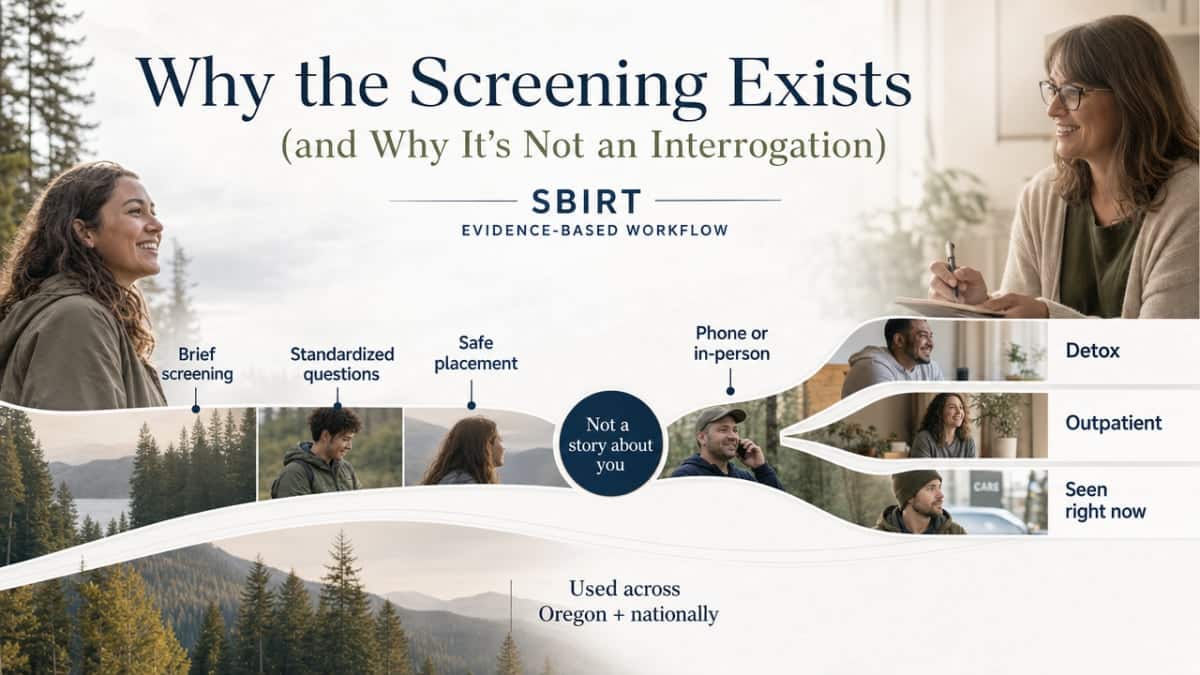
It can feel like a lot of questions in a short amount of time. Substances, doses, seizures, medications, mental health history, who’s at home. If you’re already tired or in early withdrawal, that stretch of the call can feel like too much. So here’s what’s happening on the other side of the phone: the intake specialist isn’t collecting a story about you. They’re running a short, standardized screening that almost every legitimate treatment program uses to figure out where you belong safely.
Brief phone or in-person screening followed by referral to the right level of care is the accepted evidence-based workflow across the field — it has a name, SBIRT, and it’s how substance use programs across the country decide who needs detox, who needs outpatient care, and who needs to be seen right now 4, 5. Pacific Crest Trail Detox didn’t design this to make you uncomfortable. It’s the same framework used in emergency rooms, primary care clinics, and community health centers.
And it is nearly universal. In Oregon, 94.0% of substance use treatment facilities offer pre-treatment screening for substance use 10. Nationally, that number is 97.2% 11. If it feels like every program asks similar questions, that’s because they do — and it’s a sign the process is working the way it’s supposed to.
So when the person on the phone asks whether you’ve had a seizure before, or what your last drink was, or whether anyone else at home is using, they’re not building a case. They’re building a safety plan for you.
Before You Dial: A Short List of What to Have Nearby
You don’t need to prepare for this call the way you’d prepare for a job interview. But a few things within arm’s reach will make the twenty minutes go smoother, especially if you’re tired or already feeling shaky.
- Your ID and your insurance card, if you have them. A photo on your phone works. If you can’t find either, call anyway — the intake specialist can still talk with you and sort documents later.
- A rough list of what you’ve been using and when you last used. Not exact milligrams or a confession. Just something like: “Vodka, about a fifth a day, last drink two hours ago,” or “Xanax and alcohol, most days, last dose last night.” If you’re on prescription medications, have those bottles nearby too.
- A phone charger. These calls can run longer if a benefits check happens on the line.
- A quiet room, if that’s possible. A car in the driveway counts. A bathroom with the door shut counts.
And if there’s one person who knows you’re making this call and can sit with you afterward — a sibling, a friend, a sponsor — having them nearby helps. It’s not required. Plenty of people call alone. Either is okay.
If You’re Calling for Someone Else
A lot of the calls that come into Pacific Crest Trail Detox aren’t from the person who’s using. They’re from a wife who found empty bottles under the sink. A dad whose adult son just nodded off at the dinner table. A sister who’s been getting scared texts for weeks. If that’s you right now, the call still works — with a few things worth knowing before you dial.
You can call for information without your person knowing. The intake specialist can walk you through how detox in Milwaukie works, what withdrawal from your loved one’s specific substances looks like medically, what insurance is likely to cover, and how admission would actually happen. That conversation is yours to have.
What the intake specialist can’t do is admit someone who hasn’t agreed to come. Detox is voluntary. Even in a medical emergency, the person themselves has to say yes at some point. So the call often becomes two calls: one where you gather information and think through options, and a later one — sometimes days later, sometimes an hour later — where your person picks up the phone themselves, or where you dial together with them in the room.
Bring what you know. Substances, rough amounts, last use, any medical conditions, whether they’ve had a seizure or hallucinations coming off before. The intake specialist will also ask what you’re seeing at home. That helps them coach you on what to watch for and when to call 911 instead.
And hear this clearly: making this call is not going behind their back. It’s doing homework so that when the moment comes, you already know where to go.
What Happens After the Call: Admission, Detox, and What Comes Next
If the call ends with a plan to come in, the next few hours are more manageable than they sound. You’ll get an arrival time, a short packing list (comfortable clothes, toiletries without alcohol, any current prescription bottles, a phone charger), and directions to the house in Milwaukie. If you need a ride, the intake specialist will help you sort that out before you hang up. Many detox and treatment programs now use phone and video intake as a normal front door to care, not a workaround 6.
When you arrive, a nurse and clinician repeat and expand the screening you started on the phone — because in-person assessment catches things a call can’t, and validated withdrawal scales guide what medications you get and when 8. If you’re detoxing from alcohol or benzodiazepines, medication-assisted treatment can start right away to keep withdrawal from becoming dangerous. If it’s opioids, there are medications for that too. You get your own bed. It’s a house, not a hospital ward.
The first 24 to 72 hours are the medically supervised part — vitals checked regularly, medications adjusted, meals, sleep, and quiet. Most alcohol and opioid detox stays run several days to a week, depending on what your body is working through.
Detox is the beginning, not the whole thing. Before you leave, the team maps out what comes next: a partial hospitalization program (structured days, evenings home), an intensive outpatient program (a few sessions a week), standard outpatient counseling, or alumni support once you’re further along. You don’t have to figure that out on the phone. You just have to make the call that gets you to the front door.
If Pacific Crest Trail Detox Isn’t the Right Fit
Maybe you live too far from Milwaukie. Maybe your insurance is Oregon Health Plan, which Pacific Crest Trail Detox doesn’t accept. Maybe after the call you decide the home-like residential setting isn’t what you need right now, or you’d rather try an ambulatory option closer to home. That’s a valid outcome of the call, not a failure of it.
The intake specialist can point you toward other programs. You can also call SAMHSA’s National Helpline directly at 1-800-662-HELP (4357) — it’s free, confidential, available 24/7, and staffed to give you referrals to local treatment facilities, support groups, and community-based organizations 1. You can text your ZIP code to 435748 for the same kind of referral if a call feels like too much right now 2.
The goal is getting you somewhere safe. It doesn’t have to be here.
See if your insurance covers safe detox care
Quickly find out if your insurance helps with detox and recovery support.
Frequently Asked Questions
Is my call to a detox center really confidential?
Yes. Substance use disorder records are protected by a federal rule called 42 CFR Part 2, which is stricter than regular medical privacy law. What you share on the call cannot be disclosed to your employer, family, other providers, or insurance beyond a benefits check without your written consent, with only narrow exceptions like a medical emergency 9. That protection kicks in the moment you start giving details.
Do I have to commit to going to detox during the call?
No. Calling is not committing. You can ask every question you have, hear what admission would look like, and hang up to think. Many people call once to gather information and call back hours or days later when they’re ready. The intake specialist won’t pressure you or lock you into anything on the phone.
What if I don’t have insurance or can’t afford treatment?
Call anyway. The intake specialist can talk through options and, if Pacific Crest Trail Detox isn’t a fit for your situation, point you elsewhere. You can also reach SAMHSA’s National Helpline at 1-800-662-HELP (4357), which is free, confidential, and available 24/7 for referrals to local treatment programs, sliding-scale providers, and community-based support 1. Not having a card is not a reason to stay silent.
Can I call for my spouse, parent, or adult child instead of them?
Yes, and a lot of calls come in that way. You can ask what detox in Milwaukie looks like, what withdrawal from their specific substances involves, and what insurance is likely to cover. What the intake specialist can’t do is admit someone who hasn’t agreed to come — detox is voluntary. Bring what you know about their use, and expect the process to become a two-call conversation.
What if I’m already in withdrawal when I call?
Tell the person on the phone right away. Symptoms like shaking, sweating, nausea, or confusion — especially coming off alcohol or benzodiazepines — change the urgency of the call, and staff use validated withdrawal scales to gauge risk quickly 8. If you’ve had a seizure or hallucinations before, say so. If your symptoms sound dangerous, they’ll help you decide whether to come in now or call 911.
Will the person on the phone judge me for what I’ve been using?
No. Intake specialists take these calls every day and have heard every substance, every combination, and every amount. Their job is to figure out what you need medically, not to react to what you disclose. Whether it’s a fifth of vodka this morning, months of daily Xanax, or a fentanyl relapse last night, the tone stays the same: what’s in your body, when, and what happens next.
References
- National Helpline for Mental Health, Drug, Alcohol Issues. https://www.samhsa.gov/find-help/helplines/national-helpline
- Find Substance Use Disorder Treatment. https://www.samhsa.gov/substance-use/treatment/find-treatment
- Screening and Treatment of Substance Use Disorders among Adolescents. https://library.samhsa.gov/sites/default/files/pep20-06-04-008.pdf
- Screening, Brief Intervention, and Referral to Treatment (SBIRT). https://www.samhsa.gov/substance-use/treatment/sbirt
- TAP 33: Systems-Level Implementation of Screening, Brief Intervention, and Referral to Treatment. https://library.samhsa.gov/product/tap-33-systems-level-implementation-screening-brief-intervention-and-referral-treatment
- Telehealth for the Treatment of Serious Mental Illness and Substance Use Disorders. https://www.samhsa.gov/resource/ebp/telehealth-treatment-serious-mental-illness-substance-use-disorders
- 2 Settings, Levels of Care, and Patient Placement (NCBI/NIH, TIP). https://www.ncbi.nlm.nih.gov/books/NBK64109/
- Withdrawal Management Guidance (Minnesota DHS, 2025). https://mn.gov/dhs/assets/WDM%20Guidance_9.8.2025_tcm1053-706303.pdf
- Understanding Confidentiality of Substance Use Disorder Patient Records (HHS, Part 2). https://www.hhs.gov/hipaa/part-2/index.html
- National Survey of Substance Abuse Treatment Services (N-SSATS), Oregon Profile. https://www.samhsa.gov/data/sites/default/files/quick_statistics/state_profiles/NSSATS-OR19.pdf
- National Substance Use and Mental Health Services Survey State Profiles 2022. https://www.samhsa.gov/data/sites/default/files/reports/rpt42713/NSUMHSS-State-Profile-22.pdf
- 2022 National Survey on Drug Use and Health, Oregon State Tables. https://www.samhsa.gov/data/sites/default/files/reports/rpt44486/2022-nsduh-sae-state-tables/NSDUHsaeOregon2022.pdf
- 2023 NSDUH Oregon State Tables. https://www.samhsa.gov/data/sites/default/files/reports/rpt56188/2023-nsduh-sae-state-tables_0/2023-nsduh-sae-state-tabs-oregon.pdf