


Key Takeaways
- A tapering doctor who skips a full medication and substance history before adjusting your dose is giving you a refill, not a plan; expect questions about alcohol, opioids, seizures, and mental health at the first visit 1.
- Verbal instructions and ‘we’ll figure it out’ are not tapering care; you should leave the appointment with a written, gradual schedule and clear instructions for what to do if a step feels too hard 6.
- Withdrawal happens between visits, so a qualified prescriber gives you a real way to reach them with same-day response, not voicemail that gets returned next week 5.
- A doctor who pushes you forward on schedule no matter what you report is the wrong doctor; competent tapering means slowing down, holding, or stepping back up when symptoms demand it 3.
The Difference Between a Prescriber and a Tapering Doctor
Any licensed clinician with a DEA number can write you a prescription for Xanax, Klonopin, Ativan, or Valium. Far fewer know how to get you safely off one. That gap is the whole reason you’re reading this.
A prescriber keeps the medication coming. A benzodiazepine tapering doctor builds a plan to lower your dose over weeks or months, watches how your body responds, and adjusts when things get hard. The job is less about the pad and more about what happens between visits.
You don’t need a doctor with a specific title. You need one who treats dependence as a medical reality, not a willpower problem. The FDA has told clinicians plainly that no single taper schedule fits every patient and that stopping too fast can cause serious withdrawal, including seizures 1. A good tapering doctor already works that way: individualized plan, gradual reductions, clear communication, and a path to a higher level of care if your situation calls for it.
The rest of this guide shows you how to spot that doctor in a single conversation.
Why Benzodiazepines Are Hard to Stop Without the Right Help
What Physical Dependence Actually Means After Months or Years of Use
If you’ve been taking a benzodiazepine daily for more than a few weeks, your brain has already adjusted. These medications quiet the nervous system by boosting a calming chemical called GABA. Over time, your brain compensates by dialing down its own GABA activity and dialing up the opposite signal. The pill isn’t just helping anymore. It’s holding a new baseline in place.
That’s physical dependence, and it is not the same as addiction. You can take your medication exactly as prescribed and still be dependent on it. It means your body now expects the dose. When the dose drops suddenly, the brakes come off a nervous system that no longer knows how to brake on its own.
This is why anxiety, insomnia, muscle tension, and racing thoughts often come roaring back the moment you miss a dose. You’re not weak. You’re not imagining it. You’re experiencing a predictable medical response that a good tapering doctor will name out loud at your first visit.
Why ‘Just Stop’ and Cold-Turkey Advice Is Dangerous
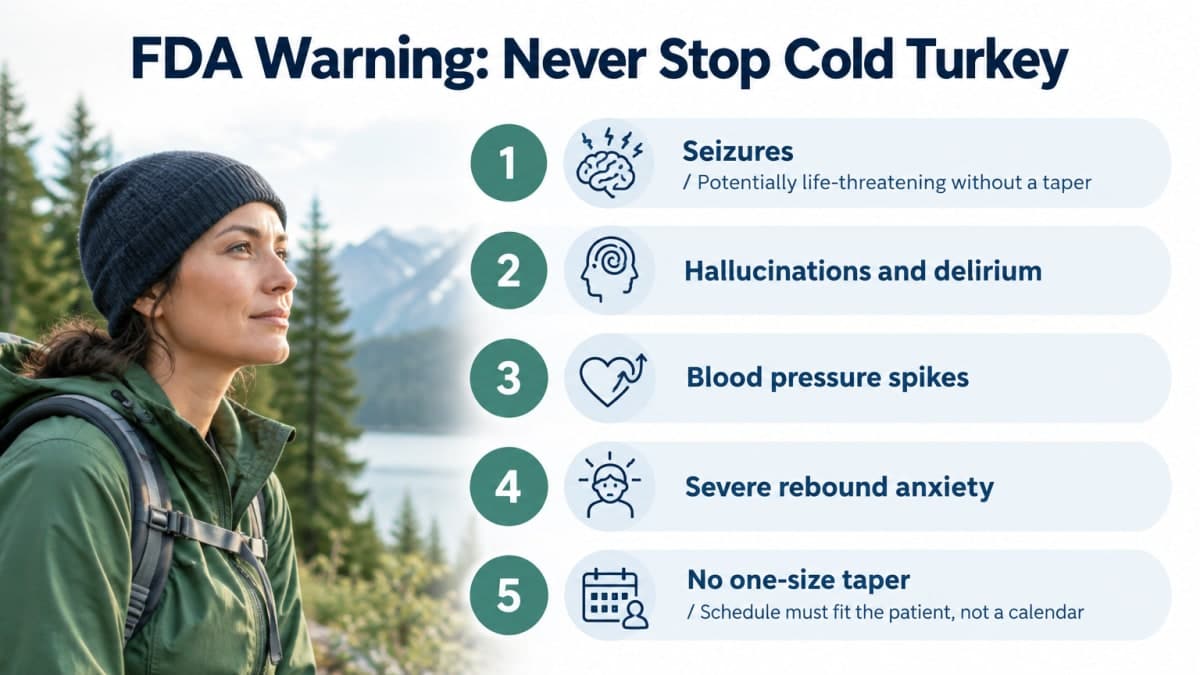
Cold-turkey withdrawal from a benzodiazepine can also include hallucinations, delirium, dangerous spikes in blood pressure, and rebound anxiety that feels worse than anything you felt before you started the medication. The VA/DoD clinical guideline flatly tells clinicians to avoid abrupt discontinuation and to taper gradually with close attention to how you are tolerating each step 3.
So when a well-meaning doctor says “just stop,” or a new prescriber says “cut it in half next week and we’ll see,” they are not giving you a plan. They are handing you a risk. A doctor who understands this medication class will tell you that coming off takes weeks or months, not days, and that the schedule belongs to your body, not to a calendar.
Which Specialties Commonly Manage Benzodiazepine Tapers
There is no single “benzodiazepine tapering doctor” board certification. Several specialties see this work regularly, and any of them can be the right fit depending on your situation.
Addiction medicine physicians are often the most experienced with higher-dose, longer-duration, or multi-substance cases. They expect dependence, they expect withdrawal, and they are used to writing taper plans that stretch over months.
Primary care doctors manage many tapers, especially when the medication was prescribed in their office to begin with. A primary care doctor who already knows your history and is willing to go slowly can be an excellent choice for lower-dose, straightforward cases.
Psychiatrists and psychiatric nurse practitioners often lead tapers when the benzodiazepine was prescribed for anxiety, panic, or insomnia and the underlying condition still needs treatment.
Neurologists may manage tapers tied to seizure history or chronic conditions like restless legs. Geriatricians handle deprescribing in older adults, where falls and memory problems raise the stakes.
And medically supervised detox programs staffed by physicians and 24/7 nurses handle the cases where tapering at home is not safe to begin with 3.
The title on the door matters less than whether the clinician works the way the next section describes.
Behaviors That Signal a Qualified Tapering Doctor
They Take a Full Medication and Substance History Before Writing Anything
A qualified tapering doctor spends the first appointment asking, not prescribing. Before they touch your dose, they want the whole picture: every prescription you take, how much alcohol you drink in an average week, any opioid pain medication, sleep aids, muscle relaxers, cannabis, and anything you’ve used that wasn’t prescribed to you. The FDA has pushed clinicians to screen exactly this way because other sedatives, alcohol, and opioids all change how your body will handle a benzodiazepine coming down 1.
If your first visit is ten minutes and the only question is “how much are you taking,” that’s not a history. That’s a refill.
Expect questions about seizure history, past withdrawal attempts, mental-health conditions, and what’s going on at home. A doctor who understands dependence treats your context as part of the medicine. The more honestly you answer, the safer your plan can be.
They Give You a Written, Gradual, Flexible Schedule
You should leave the appointment holding paper. Not a verbal “we’ll figure it out,” not a note scribbled on the back of a card. A real plan, written down, that tells you what dose you take on which day, when the next reduction happens, and what to do if the step feels too hard.
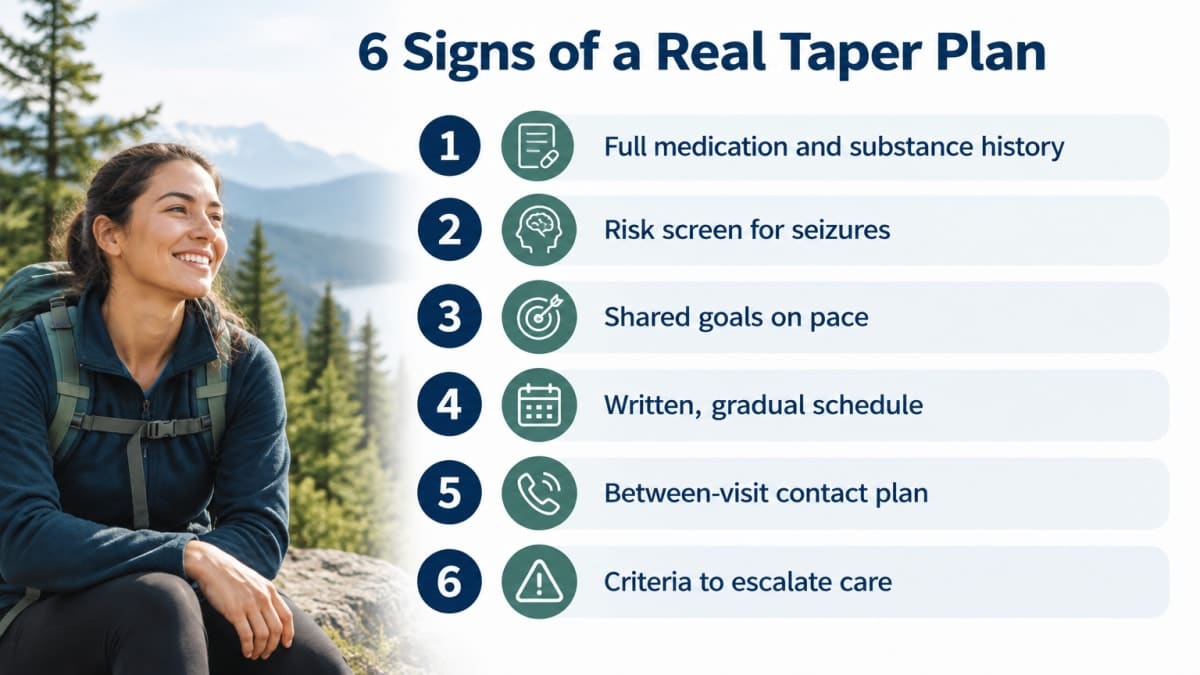
The VA clinician toolkit describes what a competent first appointment looks like:
- a full medication and substance history,
- a risk screen for seizures and other complications,
- shared goal-setting with you about pace and priorities,
- a written gradual schedule,
- a plan for how to reach the practice between visits, and
- clear criteria for moving to a higher level of care if outpatient tapering stops being safe 6.
Those six steps are your checklist. If your doctor skips three of them, you have your answer.
Flexibility matters as much as the schedule itself. A good tapering doctor expects to slow down. They build that permission into the plan from day one.
They Stay Reachable Between Visits and Expect You to Call
Tapering doesn’t happen in the exam room. It happens in your kitchen at 2 a.m. when sleep won’t come, or on day four of a reduction when your hands won’t stop shaking. The doctor who wrote your plan needs to be reachable when that happens.
Ask directly at the first visit: when symptoms get rough between appointments, how do I reach you, and how fast will someone call me back? The FDA’s patient-facing guidance tells people on benzodiazepines to talk to their prescriber about a gradual plan and to seek emergency help for serious symptoms like trouble breathing or seizures 5. That only works if your prescriber actually answers the phone. A nurse line, a patient portal with a same-day response, or a direct number is the baseline. Voicemail that gets returned next week is not.
They Know When to Slow the Taper or Pause It Entirely
A good tapering doctor treats your symptoms as data, not as complaints. When a step hits harder than expected, they slow the next reduction, hold at your current dose for a few extra weeks, or sometimes step back up briefly to stabilize you. None of that is failure. It’s the plan working the way the plan should work.
The VA/DoD clinical guideline tells clinicians to taper gradually with close attention to patient symptoms and tolerability, and to avoid abrupt discontinuation when withdrawal could involve seizures, hallucinations, or delirium 3. Translated into plain language: your doctor should ask how you’re doing and change course when you tell them.
If your prescriber pushes you forward on schedule no matter what you report, or treats a request to slow down as drug-seeking, that’s not caution. That’s the wrong doctor. The one you want will say, out loud, that your body sets the pace.
Red Flags to Walk Away From
Some things you hear in a first appointment should end the appointment. Not because the doctor is a bad person, but because they are not the right doctor for this specific job.
Walk away, or at least get a second opinion, if you hear any of these:
- “Just stop taking it.” The FDA has told clinicians directly that abrupt discontinuation can cause life-threatening withdrawal and that no standard schedule fits every patient 1.
- “Cut your dose in half next week and we’ll see how it goes.” That is a guess, not a taper.
- They refuse to put the schedule in writing. A plan you can’t hold in your hand isn’t a plan.
- They won’t tell you how to reach them between visits. Withdrawal doesn’t keep office hours.
- They treat your request to slow down as drug-seeking. Flexibility is a feature of competent tapering care, not a loophole.
- They never ask about alcohol, opioids, or other sedatives. That history changes everything about what a safe taper looks like.
Trusting your gut here is not an overreaction. It’s part of the medicine.
Questions to Ask at the First Appointment
Walk in with a short list. You don’t need to interrogate anyone. You just need to hear how they answer.
Try these, in roughly this order:
- “How do you usually approach a taper for someone who has been on this medication for [length of time] at [general dose level]?” A qualified doctor will talk about weeks or months, not days, and will say the plan depends on how your body responds 3.
- “Will you write the schedule down and give me a copy?” The answer should be yes, without hesitation 6.
- “What do I do if a step feels too hard?” Listen for a specific plan: slow the next reduction, hold the current dose, or step back briefly. Not “push through.”
- “How do I reach you between visits, and how fast will someone call me back?” You want a real answer, not a brochure 5.
- “At what point would you recommend I move to medically supervised detox instead of tapering at home?” A doctor who knows this medication class will have clear criteria ready.
- “How will you coordinate with my other prescribers?” Especially if you take opioids, sleep aids, or treatment for alcohol use.
You’re not being difficult. You’re being the kind of patient a good tapering doctor actually wants.
Outpatient Taper vs. Medically Supervised Withdrawal: How to Tell Which One Fits
Most people on benzodiazepines can come off safely at home with the right doctor and the right schedule. Some can’t. Knowing which group you’re in is one of the most important conversations you’ll have at that first appointment.
Outpatient tapering tends to be a reasonable starting point when your dose is on the lower end, you’ve been on the medication for a shorter stretch, you don’t have a history of withdrawal seizures or delirium, you aren’t drinking heavily, you aren’t combining the benzodiazepine with opioids or other sedatives in ways your prescribers haven’t coordinated, and you have a stable place to sleep with someone who can notice if something goes wrong.
Medically supervised withdrawal, done inside a detox facility with 24/7 nursing and daily provider rounds, is the safer starting point when any of the following are in the picture: a high daily dose, years of continuous use, a prior seizure or hallucination during a past taper attempt, active heavy alcohol use, concurrent opioid use that hasn’t been stabilized, or housing that isn’t safe enough to ride out hard days. The VA/DoD guideline is direct that abrupt discontinuation should be avoided and that tapering should be gradual, with particular caution when withdrawal could involve seizures, hallucinations, or delirium 3. The FDA has made the same point in plainer language: no single schedule fits every patient, and some situations are not safe to manage at home 1.
A qualified tapering doctor will walk through these factors with you out loud, not in their head. If your situation lands in the harder category, the right move isn’t a slower outpatient taper. It’s starting inside a program that can watch you around the clock, then stepping down to outpatient care once you’re stable.
Special Situations That Change Who Should Manage Your Taper
When You’re Also on Opioids or in Treatment for Opioid Use Disorder
If you take a prescription opioid for pain, or if you’re on buprenorphine or methadone for opioid use disorder, your benzodiazepine taper is not a solo project. These medications all slow breathing. Combined, they raise the risk of overdose. That’s why the CDC tells clinicians to be especially cautious when opioids and benzodiazepines are prescribed together and to weigh benefits against real risks 4.
The move you want is coordination, not reflex. SAMHSA is clear that treatment for opioid use disorder should not be automatically stopped just because a benzodiazepine is in the picture, and that some people in this situation need medically supervised withdrawal rather than a home taper 2. A qualified tapering doctor will call your opioid prescriber or your MOUD provider, agree on who’s steering what, and build a plan that lowers one risk without creating another. If no one is picking up the phone, that’s your signal to find a team that will.
When Alcohol, Chronic Pain, PTSD, or Insomnia Are in the Picture
Benzodiazepines rarely show up alone. Many people on them are also drinking more than they’d like, living with chronic pain, carrying PTSD, or losing sleep night after night. Each of those changes the math.
Heavy alcohol use is the one that most often moves a taper out of the outpatient column. Alcohol and benzodiazepines withdraw through the same nervous-system pathway, and the VA/DoD guideline specifically warns against abrupt discontinuation when seizures, hallucinations, or delirium are possible 3. If you’re drinking daily, say so out loud at the first visit. It changes the plan, not the welcome.
PTSD, chronic pain, and insomnia don’t disqualify you from tapering, but they do mean the doctor you want is one who treats the underlying condition as the medication comes down, not one who shrugs and hopes it holds.
When Your Current Doctor Retires, Moves, or Refuses to Keep Prescribing
This is one of the most common ways people end up searching for a tapering doctor in the first place. A long-time prescriber retires. A clinic drops the medication from its formulary. A new provider takes over the practice and says they won’t refill what the last one wrote.
Whatever the reason, you are suddenly facing a cliff that your body is not ready for. The FDA has told clinicians directly that patients should not stop benzodiazepines suddenly and should have a gradual plan worked out with a prescriber 5. That guidance exists precisely because this situation happens often.
You have options. Call an addiction-medicine practice, a primary-care clinic that advertises deprescribing, or a medical detox program and explain exactly what happened. Bring your bottle. Ask for a bridge plan while you find longer-term care. Nobody competent will tell you to white-knuckle it.
What a Modern Team-Based Taper Can Look Like
The best tapering care rarely rests on one person. A doctor writes the plan, but a pharmacist double-checks the medication list, a therapist or counselor helps you manage the anxiety and sleep problems that surface as the dose drops, and a nurse or care coordinator keeps the lines open between visits.
One primary-care program built around this idea paired pharmacists with prescribers to run education, medication-history review, patient-driven taper design, and telephone or video follow-up. When patients hit lower doses or ran into trouble, the schedule slowed to roughly 5% reductions every two to four weeks instead of pushing forward on the original pace 7.
You don’t need that exact structure. You need a practice that works that way: more than one set of eyes, honest check-ins, and a plan that answers your body instead of the calendar.
Finding a Benzodiazepine Tapering Doctor in the Portland Metro and SW Washington
Start closer to home than you think. In Milwaukie, Portland, Gresham, Beaverton, Salem, and across the river in Vancouver, Washington, three kinds of practices tend to handle tapers well: addiction-medicine clinics, primary-care offices that specifically advertise deprescribing or medication review, and medical detox programs that keep a prescriber available to the community.
When you call, be specific. Say you’ve been on a benzodiazepine for months or years, name the medication, and ask whether the practice writes gradual, individualized taper plans and coordinates with other prescribers. A clinic that handles this work regularly will answer in minutes, not transfer you three times.
If you live outside the metro, or outside Oregon entirely, travel is a reasonable option for the detox step. People come from the coast, central Oregon, SW Washington, and farther to start inside a program and then step down to outpatient care near home. The FDA’s own guidance is that patients should not stop benzodiazepines suddenly and should have a gradual plan worked out with a prescriber 5. Finding the right one is worth the drive.
If You’re Not Safe to Taper at Home: Starting with Medical Detox
Some situations call for a different starting line. If your dose is high, you’ve been on the medication for years, you’ve had a seizure or hallucination during a past attempt to come off, or you’re drinking heavily on top of it, trying to taper in your living room is not caution. It’s a gamble your body may not win.
Medical detox is a short stay inside a facility with nurses on site around the clock and providers rounding daily. The point isn’t to rush you off. It’s to stabilize you in a place where someone can watch for seizures, treat rebound anxiety and insomnia as they surface, and adjust the plan hour by hour if your body needs that. SAMHSA notes that people at risk for serious withdrawal, including seizures or delirium, may need inpatient medically supervised withdrawal rather than an outpatient taper 2.
Starting inside a program also makes the handoff cleaner. Once you’re stable, you step down to outpatient care with a written plan, a prescriber who knows your history, and a team you’ve already met.
Talk With Someone Who Does This Every Day
If you’re reading this because you want off a benzodiazepine and don’t know where to start, you’ve already done the hardest part. The next step is a phone call.
Pacific Crest Trail Detox has handled benzodiazepine withdrawal in Milwaukie, Oregon since 2017, with 24/7 nursing, providers rounding seven days a week, and a home-like setting that doesn’t feel like a hospital. Call for a confidential, HIPAA-protected assessment, or verify your insurance online. We want to be your last treatment experience, whether we’re your first detox or your fifth.
Find Medically Supported Benzo Tapering Care
Check whether your plan may cover medically supervised withdrawal support and the next step in care.
Frequently Asked Questions
What kind of doctor can help me taper off a benzodiazepine like Xanax, Klonopin, Ativan, or Valium?
Addiction-medicine physicians, primary-care doctors, psychiatrists, psychiatric nurse practitioners, neurologists, and geriatricians all manage tapers. The title matters less than whether they take a full history, write a gradual schedule, and stay reachable between visits 6.
How long does a safe benzodiazepine taper usually take?
Weeks to many months, depending on your dose, how long you’ve been on the medication, and how your body responds at each step. The FDA has stated plainly that no single schedule fits every patient, and the pace should answer your symptoms, not a calendar 1.
What should I do if my current doctor tells me to just stop or cut my dose in half?
Don’t follow that advice without a second opinion. The FDA warns patients not to stop benzodiazepines suddenly and to work out a gradual plan with a prescriber 5. Call an addiction-medicine practice, a deprescribing-focused primary-care office, or a medical detox program and explain what happened.
How do I know if I should taper as an outpatient or start with medically supervised detox?
A high dose, years of use, a past seizure or hallucination during withdrawal, heavy drinking, uncoordinated opioid use, or unstable housing push you toward inpatient care. The VA/DoD guideline is direct that abrupt reductions should be avoided when seizures, hallucinations, or delirium are possible 3.
What if I’m also taking opioids or being treated for opioid use disorder?
Your tapering doctor should coordinate directly with your opioid prescriber or MOUD provider. CDC urges particular caution when both are prescribed together 4, and SAMHSA notes that opioid-use-disorder treatment should not be automatically stopped and that some people need medically supervised withdrawal 2.
Can I come to Pacific Crest Trail Detox from outside the Portland metro or SW Washington?
Yes. People travel from the Oregon coast, central Oregon, Vancouver WA, and out of state to start inside the program in Milwaukie, then step down to outpatient care closer to home. Call for a confidential, HIPAA-protected assessment or verify your insurance online.
References
- FDA requiring Boxed Warning updated to improve safe use of benzodiazepine drug class. https://www.fda.gov/media/142368/download
- Medications for Opioid Use Disorder: For Healthcare and Addiction Professionals, Policymakers, Patients, and Families. https://www.samhsa.gov/sites/default/files/pep21-02-01-002.pdf
- VA/DoD Clinical Practice Guideline for the Management of Substance Use Disorders. https://healthquality.va.gov/HEALTHQUALITY/guidelines/MH/sud/VA-DoD-SUD-CPG_Final_for-508_v3.pdf
- Guideline Recommendations and Guiding Principles. https://www.cdc.gov/overdose-prevention/hcp/clinical-guidance/recommendations-and-principles.html
- Benzodiazepine Drug Class: Drug Safety Communication. https://www.fda.gov/safety/medical-product-safety-information/benzodiazepine-drug-class-drug-safety-communication-boxed-warning-updated-improve-safe-use
- Helping Patients Taper from Benzodiazepines. https://www.va.gov/painmanagement/docs/OSI_6_Toolkit_Taper_Benzodiazepines_Clinicians.pdf
- Design, Implementation, and Evaluation of a Pharmacist-Led Benzodiazepine Tapering Program in Primary Care. https://pmc.ncbi.nlm.nih.gov/articles/PMC9945842/