


Key Takeaways
- Physical dependence and addiction are not the same; the FDA states abuse and addiction are distinct from tolerance and physical dependence, which can develop even at prescribed doses 3, 16.
- Warning signs include dose creep, hidden stashes, early refills, mixing with alcohol or sedatives, and panic when the bottle runs low, especially after long-term nightly use.
- Stopping Ambien abruptly after regular or escalated use can trigger withdrawal ranging from rebound insomnia to tremors, convulsions, and delirium, so a medically supervised taper is the standard of care 1, 16.
- A confidential assessment with a clinician or medical detox program is the safer next step than quitting alone, with detox at Pacific Crest Trail Detox typically running 8 to 10 days before continued outpatient care.
The quiet problem with a pill marketed as safer
If you’re reading this at 2 a.m. with an Ambien bottle on the nightstand, you’re not alone, and you’re not overreacting. Ambien (zolpidem) can lead to physical dependence and, for some people, a sedative use disorder, even when it started as a prescription you took exactly as directed. The FDA’s own labeling warns that dependence risk rises with higher doses and longer use, and that stopping suddenly can trigger withdrawal that ranges from rebound insomnia to tremors, convulsions, and delirium 1, 16.
Ambien was introduced as a gentler option than older sleeping pills, and that reputation stuck. It made the drug feel almost casual, something you refill without thinking much about it. But the research tells a quieter, more complicated story, especially for people who’ve been taking it for months or years, who’ve started needing more to sleep, or who feel a knot of panic when the bottle runs low.
This guide walks you through what Ambien addiction actually looks like, how it differs from physical dependence, when withdrawal becomes a medical concern, and what help looks like if you or someone you love is ready to stop.
Is Ambien addictive, or just habit forming?
What the FDA label actually says about dependence and addiction
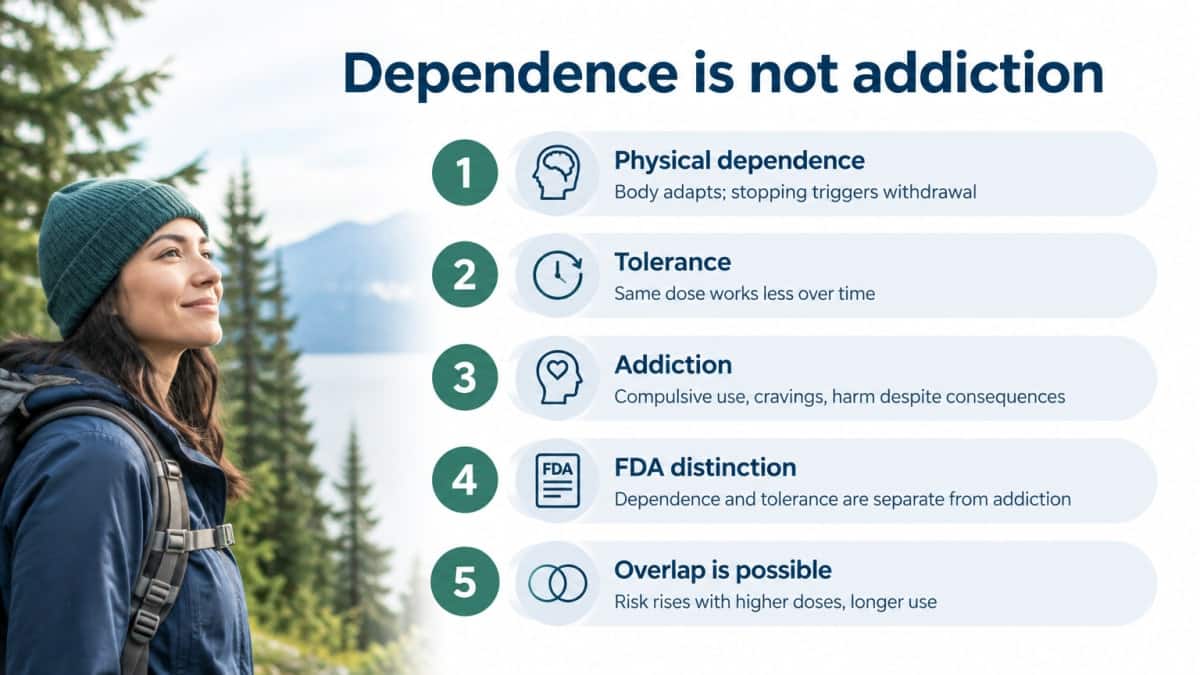
Here is the piece most articles skip: dependence and addiction are not the same thing, and the FDA says so plainly. The Zolpimist labeling spells it out:“Abuse and addiction are separate and distinct from physical dependence and tolerance” 3.That one sentence can take a lot of weight off your shoulders if you’ve been quietly worried that needing your pill means you’re an addict.
Physical dependence is your body adapting to a drug you’ve taken regularly. If you stop suddenly, you feel it. The Ambien label describes withdrawal symptoms that can range from rebound insomnia and anxiety to sweating, tremors, vomiting, convulsions, and delirium after rapid dose reduction or abrupt discontinuation 16. Tolerance is a cousin of dependence: the same dose stops working as well, so sleep gets thinner even though nothing else has changed.
Addiction is a different pattern. It involves compulsive use, cravings, loss of control, and continuing to use the drug even when it’s clearly causing harm. You can have physical dependence without addiction, which is why many people on long-term prescriptions need a medically supervised taper even when they’ve never misused a single pill 1, 16. You can also have both. The FDA label notes that dependence risk rises with higher doses and longer treatment, and that risk is greater in people with a history of alcohol or drug problems 2, 16. Knowing which pattern you’re in changes what kind of help you need, not whether you deserve help.
Why ‘just a sleep pill’ is a misleading reassurance
When Ambien hit the market, it was pitched as the softer cousin of older sleeping pills. That framing stuck, and it still shapes how people talk about zolpidem at kitchen tables and in doctor’s offices. The problem is that the research didn’t stay there.
MedlinePlus, written for patients, says plainly that zolpidem may be habit forming and that stopping it suddenly can cause shakiness, anxiety, sweating, rebound insomnia, and, rarely, seizures 4. A 2024 case report and literature review goes further, describing published cases of zolpidem-related euphoria, escalating use, craving, and withdrawal, and warns that dependence can develop even though the drug has a reputation for lower abuse potential than benzodiazepines 18.
So “it’s just a sleep pill” isn’t quite true, and it isn’t quite false either. Most people who take Ambien for a short course don’t develop a problem. But the drug can produce real physical dependence, and for some people it goes further than that. If you’ve found yourself taking more than prescribed, hiding how much you take, or feeling scared about an empty bottle, that reassuring phrase has stopped being accurate for you. That doesn’t make you weak. It means your body and brain have responded in ways the label openly describes, and it’s a signal to get a clinician involved rather than tough it out alone.
How Ambien dependence actually develops
Tolerance, dose creep, and the slow slide
Dependence rarely announces itself. It usually starts with a few nights of good sleep on a 5 or 10 mg dose, then a stretch of nights where the same pill doesn’t quite work the way it used to. You lie there, waiting for it to kick in. Maybe you take a second half. Maybe your prescriber bumps the dose. The FDA label is upfront that dependence risk goes up with higher doses and longer treatment, and that tolerance can develop so the medication becomes less effective over time 1, 16.
That’s the slow slide. For most people on a short course, it never happens. For others, especially those who’ve been on nightly zolpidem for months or years, the body adapts. You need the pill not just to sleep well, but to avoid the shakiness, anxiety, and rebound insomnia that show up when you skip a night 4. At that point, the drug has become part of how your nervous system regulates itself.
How far this can go is sobering. One published case describes a patient who climbed from 5 mg to roughly 100 to 150 mg a night and had a generalized seizure about 16 hours after her last dose 10. That’s one person, not a prediction for anyone on a normal prescription. But it shows the trajectory is real, and it’s why dose creep is worth taking seriously the first time you notice it.
Who is at higher risk
Ambien doesn’t affect everyone the same way, and the FDA labeling is specific about who tends to run into trouble. Risk is greater in people with a current or past history of alcohol or drug problems, including people who’ve struggled with other sedatives or opioids in the past 2, 16. A pharmacovigilance survey of reported zolpidem cases found that prior substance use or psychiatric conditions showed up repeatedly in the people who developed abuse or dependence 12. An older review of published cases pointed in the same direction: most severe dependence stories involved a background of alcohol or drug misuse, psychiatric history, or both 11.
Dose and duration matter too. The longer you’ve been taking Ambien and the higher the dose, the more your body has had time to adapt 1. The FDA lowered recommended starting doses for women to 5 mg for immediate-release and 6.25 mg for extended-release products 6. If any of these fit you, it doesn’t mean you’re destined for a problem. It means a conversation with a clinician before you try to stop is the smarter play.
Signs you may be addicted to Ambien
Most people don’t wake up one day and decide they have a problem with a sleep pill. The signs show up quietly, in the small negotiations you start having with the bottle. If several of these feel familiar, it’s worth paying attention.
- You’re taking more than prescribed, or taking it earlier in the evening to get ahead of a bad night.
- You’ve asked for early refills, or you’ve gone to a second prescriber to make sure you don’t run out.
- You keep a hidden stash in a drawer, a bag, or the car, because the thought of being without it makes you anxious.
- You crush, chew, or combine your dose with alcohol or another sedative to get a stronger effect, something the FDA label warns about given the greater dependence risk among people with a history of alcohol or drug use 2, 16.
There are emotional signs too. You feel irritable or panicky when the bottle runs low. You’ve tried to cut back and couldn’t. You’ve had next-morning fog, missed work, or near-misses behind the wheel and kept taking the same dose anyway 6. You’ve skipped social plans or lied to people you love about how much you take.
None of this makes you a bad person. It fits the pattern the FDA label describes, where compulsive use and continued use despite harm separate addiction from simple physical dependence 3, 16. If you recognize yourself here, that recognition is the opening. The next step is a confidential conversation with a clinician, not a solo attempt to quit.
What complex sleep behaviors look like, and why the FDA calls them serious
In 2019, the FDA added a boxed warning, its strongest safety label, to Ambien, Ambien CR, Edluar, Intermezzo, and Zolpimist because people were doing things in their sleep they had no memory of the next morning, and some of them were getting hurt or killed 17. That is not a footnote. It is the agency’s highest-level flag on a drug a lot of people still think of as mild.
The behaviors are more specific than regular sleepwalking. People have driven cars, cooked food on a hot stove, eaten strange combinations, made phone calls, and had conversations while not fully awake, then woken up with no memory of any of it 17. The FDA warning describes serious injuries and deaths resulting from sleepwalking, sleep-driving, and other activities performed while not fully awake 17.
Who ends up in the ER on Ambien
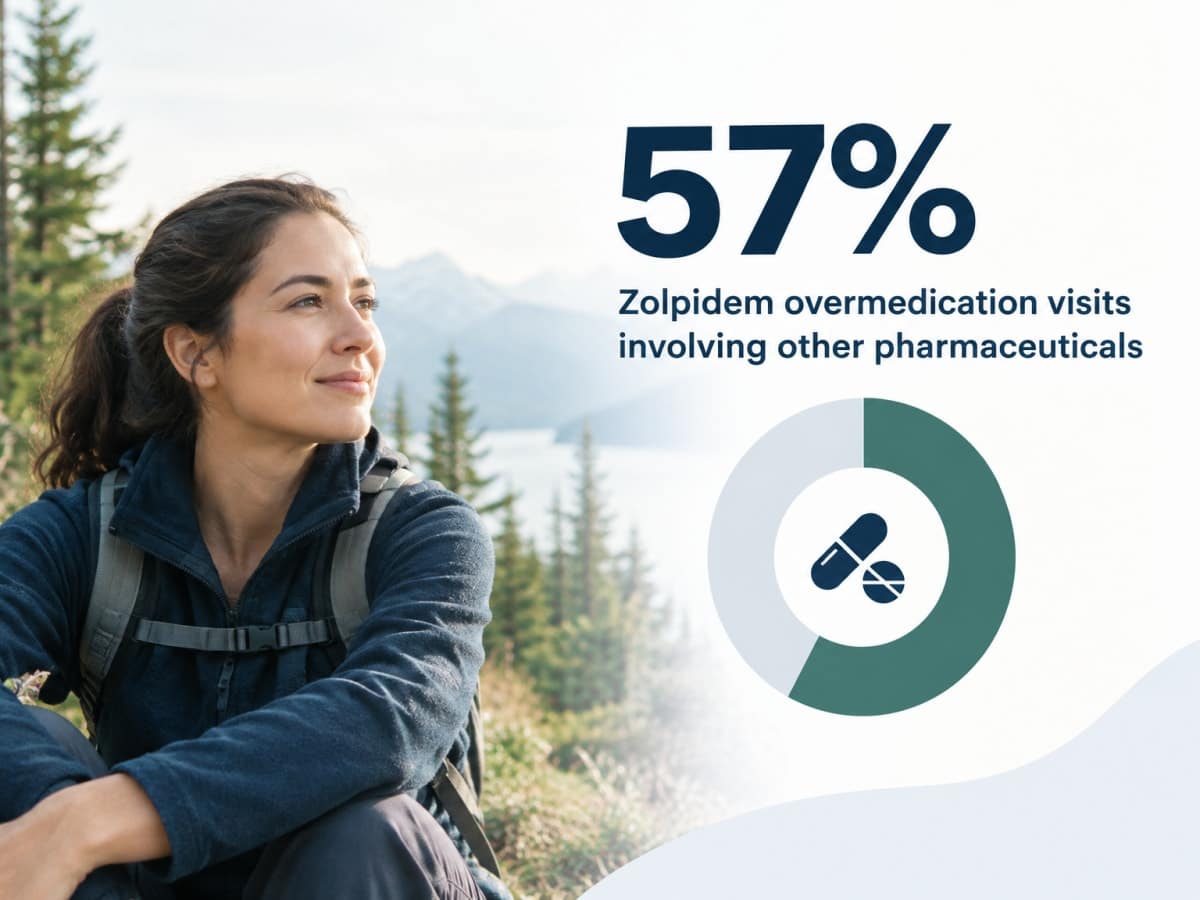
The clearest picture of who gets hurt on zolpidem comes from a SAMHSA Drug Abuse Warning Network report on emergency department visits caused by taking too much of the medication. In the most recent federal DAWN snapshot available, from 2010:
- Women accounted for 68% of these zolpidem-related overmedication visits
- 57% involved other pharmaceuticals
- 14% involved alcohol
- 47% ended in a hospital admission or transfer to another facility 5
Those four numbers tell a story worth sitting with, even as historical surveillance rather than current prevalence.
Women show up more often, and the FDA eventually lowered recommended starting doses for women 6. The co-use pattern is just as telling. More than half of these ER visits involved another prescription medication, and roughly one in seven involved alcohol 5. Mixing Ambien with anything else that slows breathing or blunts the central nervous system is where a bad night turns into a hospital night.
The admission rate is the piece that often surprises people. Nearly half of these visits were serious enough that the person could not simply be discharged home 5. That is not a mild sleep aid profile. If you’ve been pairing your pill with a glass of wine, a muscle relaxer, or anything your prescriber doesn’t know about, the ER data is a quiet warning worth heeding before the next refill.
What Ambien withdrawal feels like, and why stopping cold is risky
If you’ve ever skipped a dose and lain awake all night, heart racing, skin damp, mind looping, you’ve already met a mild version of zolpidem withdrawal. The full picture can get much bigger. MedlinePlus warns in plain language that stopping zolpidem suddenly can cause shakiness, anxiety, sweating, rebound insomnia, and, rarely, seizures, which is why it tells patients not to stop without talking to a clinician first 4.
The FDA Ambien label is even more specific. Withdrawal signs and symptoms after rapid dose reduction or abrupt discontinuation can range from mild rebound insomnia and dysphoria to vomiting, sweating, abdominal cramps, tremors, convulsions, and delirium 1, 16. Not everyone will experience the severe end. But the range exists, which is the point.
How often does it actually happen? Among reported zolpidem misuse cases in a 2007 French CEIP pharmacovigilance survey, 81% developed withdrawal symptoms after stopping 12. That number sounds enormous, and it needs its scope stated clearly: those were reported cases flagged to a national monitoring network, not a cross-section of everyone who’s ever filled an Ambien prescription. Most people on a short course won’t look like that sample. But if you’ve been taking zolpidem nightly for a long stretch, or you’ve been taking more than prescribed, you have more in common with that group than with someone who used it for a week of jet lag.
The case literature shows why abrupt stopping is where things get dangerous. One patient who had escalated from 5 mg to roughly 100 to 150 mg a night had a generalized seizure about 16 hours after her last dose 10. Another case describes seizures after withdrawal from 300 mg a day 7. A third report tracks a chronological sequence after abrupt cessation of overdose-level use: anxiety, craving, paresthesia, flu-like symptoms, then seizures and hallucinations 9. These are not everyone’s story. They are what the ceiling looks like, and they explain why clinicians plan a controlled taper instead of a cold stop.
What the numbers do and do not say about Ambien addiction
If you’ve gone looking for a clean national statistic on Ambien addiction, you’ve probably noticed something frustrating: no one quotes the same number, and most of them don’t quite match the question. There’s a reason for that, and it’s worth knowing before you let a scary figure or a reassuring one shape your decision.
SAMHSA, the federal agency that tracks substance use in the United States, groups prescription sedatives into one category that includes zolpidem, eszopiclone, zaleplon, benzodiazepine sedatives, and barbiturates 15. So when you see a national rate of prescription sedative misuse, you’re seeing Ambien bundled with several other medications, not a zolpidem-specific number. A recent analysis of 2021 to 2023 survey data estimated that about 0.27% of U.S. adults, roughly 681,000 people, misused prescription sedatives specifically for sleep, but that figure covers the whole sedative category, not Ambien alone 14. An older study using 2015 to 2016 data found past-year sedative or tranquilizer misuse was highest among young adults at 5.8%, again across the broader category 13.
The pharmacovigilance data from France is more Ambien-specific but comes with its own scope: among reported cases flagged to the national monitoring network, 62% met the study’s dependence criteria 12. That’s a snapshot of people already in trouble enough to be reported, not a cross-section of everyone with a prescription. The FDA’s Ambien label is honest about this gap, noting that available data cannot reliably estimate how often dependence develops at recommended doses 16. So if a number feels either too alarming or too reassuring, check what it actually measured. Your own pattern with the pill tells you more than any national rate can.
For families: what to watch for and how to talk about it
If you’re the spouse, adult child, parent, or close friend reading this, your instincts probably brought you here for a reason. You’ve noticed something and the person you love has waved it off as just a sleep thing. Trust what you’re seeing.
Behavioral signs often show up before anyone names them. You might find bottles tucked in a sock drawer, a car console, or a travel bag. Refills come earlier than they should, sometimes from a second prescriber. Pills get counted, hidden, or quietly replaced. Conversations about sleep turn defensive fast. There may be mornings they don’t remember texts they sent, food they ate, or a short drive they took the night before, which the FDA flags as a serious safety concern worth stopping the medication over 17. You may notice next-day fog, slurred evening speech, or a glass of wine paired with the pill, a combination that shows up in roughly one in seven zolpidem-related ER visits 5.
When you talk, pick a sober morning, not a groggy night. Lead with what you’ve seen, not what you’ve concluded. Say the specific thing: the hidden bottle, the missed meeting, the drive they don’t remember. Ask what stopping feels like for them, because the fear of withdrawal is often what keeps the pill in the drawer 4. Offer to sit with them while they call a clinician or a medical detox program. You don’t have to have the answers. You just have to not look away.
What medically supervised detox for Ambien actually looks like
Inside a non-hospital medical detox
Picture something closer to a quiet house than a hospital floor. That is the setting a non-hospital medical detox is built around, and for sedative withdrawal it tends to be the right fit. You arrive, you talk with a nurse and a provider, and someone takes the time to understand what you’ve actually been taking, for how long, and at what dose. From there, a controlled taper gets planned. The pill does not come out of your life overnight.
Day to day, you have RNs on site around the clock and providers rounding during the week to adjust the taper based on how your body is responding. Vital signs get checked, sleep gets tracked, and symptoms get treated as they come up, which matters because the FDA label describes a withdrawal range that can include rebound insomnia, anxiety, sweating, tremors, and, at the severe end, convulsions and delirium 1, 16. Having clinicians nearby when any of that shows up is the whole point.
The rest of the day looks pretty human. Home-cooked meals, a bed that isn’t under fluorescent lights, daily groups where you sit with other people who get it, and time to rest. At Pacific Crest Trail Detox, medical detox typically runs about 8 to 10 days, long enough to let the taper do its work without rushing your nervous system.
From detox to continued care in Oregon and SW Washington
Detox is step one, not the finish line. The sleep problem that sent you to Ambien in the first place, the anxiety underneath it, the habits that grew up around the bottle, none of those get solved in 8 days. That is why the handoff matters.
A good program moves you from detox into partial hospitalization (PHP), intensive outpatient (IOP), or standard outpatient care without a gap, with aftercare and alumni support waiting on the other side. If you live in the Portland metro, Milwaukie, Gresham, Beaverton, Salem, or across the river in Vancouver, Washington, that continuum can happen close to home. Out-of-state readers are welcome too; many people travel for detox and plan continued care back home.
Pacific Crest Trail Detox was built around this handoff. We want to be your last treatment experience, whether we’re your first detox or your fifth.
If you’re ready to talk to someone
You don’t have to be sure you have an addiction to make the call. Most people reach out when they’re tired of the bargaining, the hidden bottle, the 3 a.m. math about how many pills are left. That’s enough reason.
A confidential, HIPAA-protected assessment with Pacific Crest Trail Detox in Milwaukie takes about twenty minutes. We’ll talk through your dose, how long you’ve been on Ambien, what you’ve tried, and what’s getting in the way. If medical detox is the right next step, we’ll walk you through what admission looks like and help verify your insurance benefits before you commit to anything. We want to be your last treatment experience, whether we’re your first detox or your fifth.
Check Coverage for Ambien Detox Care
See what your plan may cover for medically supervised help with Ambien withdrawal and next steps.
Frequently Asked Questions
Can you get addicted to Ambien if you only take the prescribed dose?
Most people on a short, prescribed course do not develop addiction, but physical dependence can still show up with regular nightly use. The FDA label is clear that dependence risk rises with higher doses and longer treatment, and that risk is greater if you have a history of alcohol or drug problems 2, 16. Addiction, which involves compulsive use and loss of control, is less common at prescribed doses but not impossible 3.
What is the difference between Ambien dependence and Ambien addiction?
Dependence is your body adapting to the drug, so stopping suddenly causes withdrawal symptoms like shakiness, anxiety, and rebound insomnia 4. Addiction is a behavioral pattern: compulsive use, cravings, taking more than intended, and continuing despite harm. The FDA puts it plainly, saying abuse and addiction are separate and distinct from physical dependence and tolerance 3. You can have one without the other, or both at once.
Is it dangerous to stop taking Ambien suddenly?
It can be, especially after regular or escalated use. MedlinePlus warns that abrupt discontinuation can cause shakiness, anxiety, sweating, rebound insomnia, and, rarely, seizures 4. The Ambien label describes a wider range after rapid dose reduction, from dysphoria and tremors to convulsions and delirium 1, 16. Call your prescriber or a medical detox program before you stop. A supervised taper is the standard of care.
How long does Ambien withdrawal usually last?
Timing varies with your dose, how long you’ve been taking it, and your overall health. Published case reports show seizures occurring within 16 hours of a last dose after high-dose use 10, which is why timing should be clinically monitored, not guessed at.
Does insurance cover medical detox for Ambien at Pacific Crest Trail Detox?
Pacific Crest Trail Detox accepts most commercial insurance plans, and benefits vary by carrier and policy. The fastest way to get a real answer is a confidential insurance verification, which the admissions team can complete over the phone or through a short online form. There is no cost or commitment to verify. You’ll find out what your plan covers for medical detox and continued care before you make any decisions.
What should I do if a family member is misusing Ambien?
Start with what you’ve actually seen: hidden bottles, early refills, next-morning fog, or nights they don’t remember. Pick a calm, sober morning to talk, and ask what stopping feels like, since fear of withdrawal often keeps the pill in the drawer 4. Offer to sit with them while they call a clinician or medical detox program. You don’t need the answers, just the willingness to stay in the conversation.
References
- [XML] 3ea49e15-b738-4851-a865-f39b71b36dcb.xml – accessdata.fda.gov. https://www.accessdata.fda.gov/spl/data/3ea49e15-b738-4851-a865-f39b71b36dcb/3ea49e15-b738-4851-a865-f39b71b36dcb.xml
- [XML] c4e9a658-250e-4e77-968d-d214bc665e61.xml – accessdata.fda.gov. https://www.accessdata.fda.gov/spl/data/c4e9a658-250e-4e77-968d-d214bc665e61/c4e9a658-250e-4e77-968d-d214bc665e61.xml
- Zolpimist (zolpidem tartrate) Oral Spray – FDA. https://www.fda.gov/media/138781/download
- Zolpidem: MedlinePlus Drug Information. https://medlineplus.gov/druginfo/meds/a693025.html
- Emergency Department Visits Attributed to Overmedication That Involved the Insomnia Medication Zolpidem. https://www.samhsa.gov/data/sites/default/files/DAWN-SR150-Zolpidem-2014/DAWN-SR150-Zolpidem-2014.htm
- Questions and Answers: Risk of next-morning impairment after use of insomnia drugs; FDA requires lower recommended doses for certain drugs containing zolpidem. https://www.fda.gov/drugs/drug-safety-and-availability/questions-and-answers-risk-next-morning-impairment-after-use-insomnia-drugs-fda-requires-lower
- Zolpidem dependence and withdrawal. A case report of generalized seizures. https://pubmed.ncbi.nlm.nih.gov/37863763/
- Severe chronic abuse of zolpidem for over 10 years: a case report and review of similar cases. https://pubmed.ncbi.nlm.nih.gov/37829761/
- Case report: Chronological symptom profile after cessation of overdose zolpidem in a patient with comorbid bipolar disorder-from anxiety, craving, paresthesia and influenza-like symptoms to seizures and hallucinations. https://pubmed.ncbi.nlm.nih.gov/36061292/
- Zolpidem Dependency and Withdrawal Seizure. https://pmc.ncbi.nlm.nih.gov/articles/PMC4329938/
- Abuse and dependence potential for the non-benzodiazepine hypnotics zolpidem and zopiclone: a review of case reports and epidemiological data. https://pubmed.ncbi.nlm.nih.gov/14519173/
- Evidence of zolpidem abuse and dependence: results of the French Centre for Evaluation and Information on Pharmacodependence (CEIP) network survey. https://pmc.ncbi.nlm.nih.gov/articles/PMC2000636/
- PRESCRIPTION TRANQUILIZER/SEDATIVE MISUSE ACROSS AGE GROUPS IN THE UNITED STATES. https://pmc.ncbi.nlm.nih.gov/articles/PMC6527336/
- Who Misuses Sedatives for Sleep? Evidence from a Nationally Representative US Sample. https://pmc.ncbi.nlm.nih.gov/articles/PMC13055149/
- Results from the 2025 National Survey on Drug Use and Health. https://www.samhsa.gov/data/sites/default/files/reports/rpt57150/2025-nsduh-annual-national-html/2025-nsduh-annual-national.htm
- Ambien Label – Food and Drug Administration. https://www.accessdata.fda.gov/drugsatfda_docs/label/2016/019908s037lbl.pdf
- Certain Prescription Insomnia Medicines: New Boxed Warning – Due to Risk of Serious Injuries Caused by Sleepwalking, Sleep Driving and Engaging in Other Activities While Not Fully Awake. https://www.fda.gov/safety/medical-product-safety-information/certain-prescription-insomnia-medicines-new-boxed-warning-due-risk-serious-injuries-caused
- Zolpidem-related euphoria, addiction and detoxification: A case report and review of the literature. https://pmc.ncbi.nlm.nih.gov/articles/PMC11537603/