Key Takeaways
- Oregon’s culturally grounded recovery is a coordinated system, with all nine federally recognized tribes and the Urban Indian Health Program running medication-assisted treatment alongside ceremony, elders, and peer support 3.
- Location shapes access: enrolled members can start at a tribal health clinic, Portland-area residents can reach NARA Northwest, and every county has a Behavioral Health Resource Network on-ramp 3.
- Medical detox in Milwaukie fills the gap tribal outpatient programs generally can’t cover, stabilizing alcohol or benzodiazepine withdrawal and then handing patients off warmly to culturally specific aftercare 7.
- For immediate next steps, Oregonians can call the free 24/7 Recovery Center Hotline, a tribal clinic, NARA Northwest, or a county BHRN, with funding available for the uninsured 10.
What Culturally Grounded Recovery Actually Looks Like in Oregon
If you’re reading this at 2 a.m. because someone you love is shaking on the couch, or because you’re the one shaking, start here: culturally grounded recovery in Oregon isn’t a mood. It’s a real system of care, built by tribes, urban Indian programs, and state partners, that treats your identity as part of the medicine — not as a decoration.
The reason it exists is not gentle. The CDC reports that American Indian and Alaska Native people have higher rates of alcohol-related deaths and drug-induced mortality than other racial and ethnic groups in the United States 15. That gap didn’t appear on its own. It was built by generations of removal, boarding schools, and health systems that treated Native patients as problems to be managed. Culturally grounded care is the response to that history, not a marketing add-on.
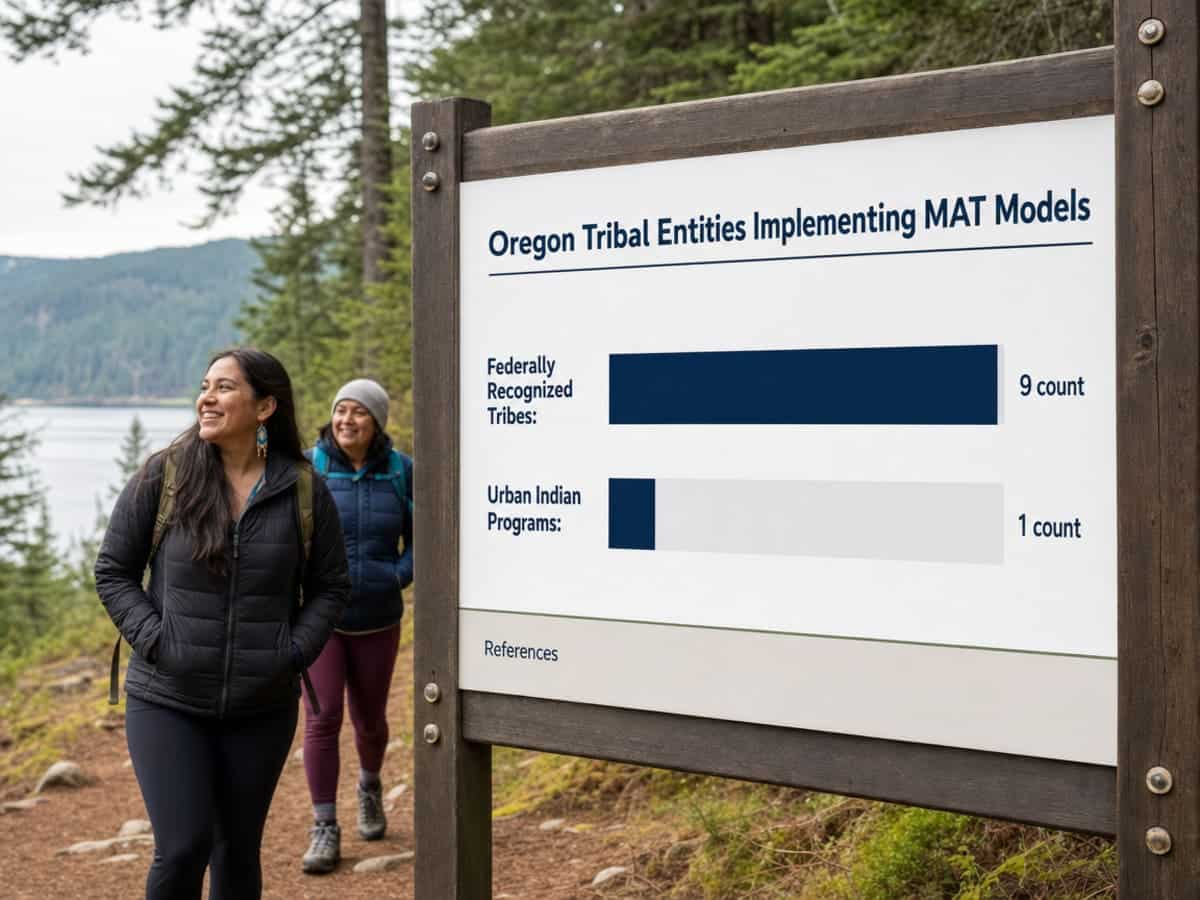
In Oregon, that response has a specific shape. It includes elder wisdom and lived-experience peers, ceremony and language, family involvement, and trauma-informed practice — with an explicit warning against cultural appropriation by providers who haven’t earned the right to hold those practices 1. It also includes medicine. All nine federally recognized tribes in Oregon, along with the Urban Indian Health Program, now run medication-assisted treatment models alongside traditional healing 3.
So when you hear “culturally grounded,” hear this: a licensed clinician who knows how to keep you alive through withdrawal, a peer who’s walked the road, an elder who prays over you, and a family that gets to stay in the room. That’s the standard. The rest of this guide shows you where to find it, and how a detox in Milwaukie fits into that picture without pretending to be something it isn’t.
Why This Detox Is Building a Native Track
Here is the plain fact behind this section: the owner of Pacific Crest Trail Detox got sober through a Native American recovery program. That’s where his own life turned around, and that’s why PCTD is now working to build a track that serves Native people well. It isn’t a campaign. It’s a debt being paid forward.
What that means in practice is a facility trying to grow in the right direction — slowly, and with input from people who actually carry these traditions. PCTD is a non-hospital medical detox in Milwaukie. It is not a tribal program, and it will not claim to be one. What it can do is keep you safe through alcohol or benzodiazepine withdrawal that can turn deadly, start you on medicine like methadone or buprenorphine if that fits your plan, and then hand you off to the tribal clinic, NARA Northwest, or urban Indian program that will hold the longer road of recovery with you 1.
You should expect a detox partner to be honest about what it is and what it isn’t. That honesty is the beginning of respect. If you’re the family member making this call at midnight, know that you’re not being asked to trade tradition for medicine. You’re being met halfway.
The Oregon Landscape: Who Provides Native Recovery Care
Tribal Health Clinics and the Nine Federally Recognized Tribes
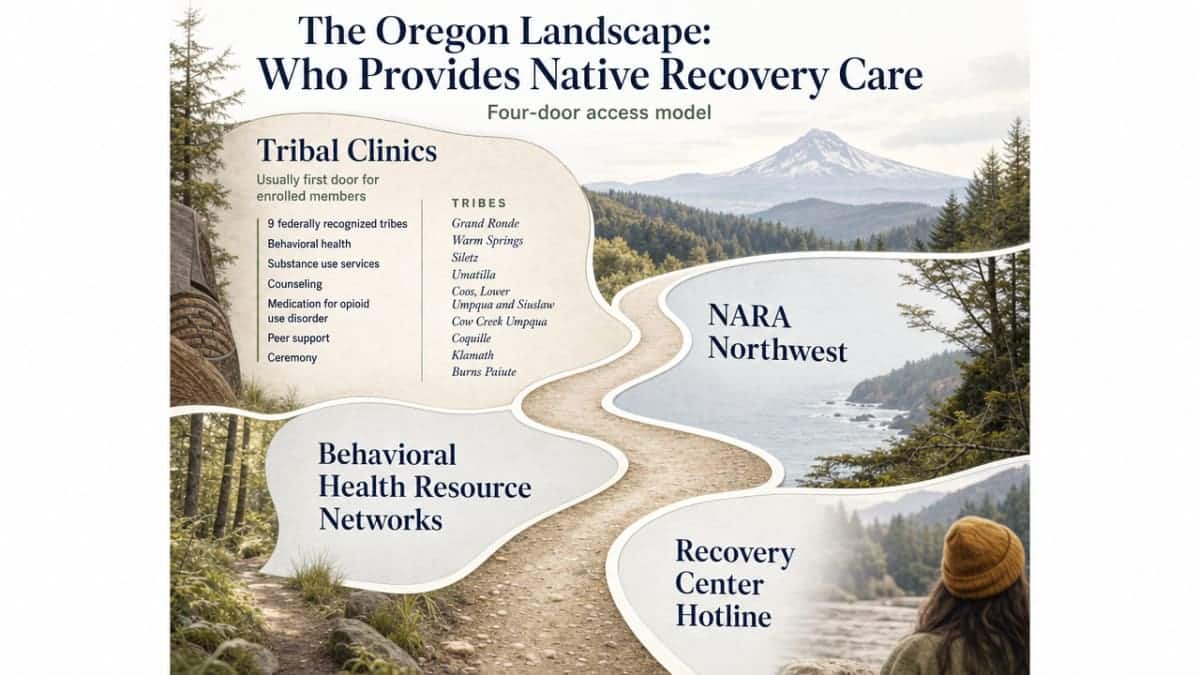
Oregon has nine federally recognized tribes, and each one runs its own health system with its own history, geography, and way of doing things. The Confederated Tribes of Grand Ronde, the Confederated Tribes of Warm Springs, the Confederated Tribes of Siletz Indians, the Confederated Tribes of the Umatilla Indian Reservation, the Confederated Tribes of Coos, Lower Umpqua and Siuslaw Indians, the Cow Creek Band of Umpqua Tribe, the Coquille Indian Tribe, the Klamath Tribes, and the Burns Paiute Tribe all operate or contract for behavioral health and substance use services for their members.
If you’re enrolled in one of these tribes, your tribal clinic is usually the first door to knock on. Many offer counseling, medication for opioid use disorder, peer support, and ceremony together in one place, with staff who know your family and your community. The Oregon Native American Behavioral Health Collaborative — which includes all nine tribes along with NARA, the Oregon Health Authority, the ODHS Office of Tribal Affairs, and the Northwest Portland Area Indian Health Board — wrote the state’s Tribal Behavioral Health Strategic Plan together, which tells you how tightly these systems are wired to one another 4.
You don’t have to live on tribal land to use tribal services, but eligibility varies. Call your clinic and ask what’s available to you today, not next week.
NARA Northwest and the Urban Indian Program
Most Native people in Oregon don’t live on a reservation. If you’re in Portland, Gresham, Beaverton, or anywhere in the metro, the Native American Rehabilitation Association of the Northwest — NARA — is likely the closest culturally specific door. NARA has been serving urban Native people in this region for decades, and Oregon’s Tribal Behavioral Health Strategic Plan names it directly as a key partner receiving state grant support for substance misuse prevention, treatment, and recovery for uninsured and underinsured people 4.
NARA offers outpatient treatment, residential care, medication for opioid use disorder, mental health services, primary care, and youth and family programs. You do not have to be enrolled in a specific tribe to be seen there. Descendancy is honored, and the intake staff are used to answering questions about eligibility without making you feel small for asking.
The Urban Indian Health Program is the broader federal category NARA sits within, and Oregon funds it alongside the nine tribes so that Native people in cities are not left out of the state’s substance use response 3.
Behavioral Health Resource Networks and the Recovery Center Hotline
Even with tribal clinics and NARA in the picture, there are nights when you need a number to call right now, from wherever you are, and someone who will pick up. Oregon built two things for exactly that moment.
The first is the Recovery Center Hotline. It’s free, confidential, and answered 24 hours a day, seven days a week, and it can connect you to licensed and certified treatment centers across the state — including a screening pathway created under Oregon’s Drug Addiction Treatment and Recovery Act 10. You don’t need insurance to call. You don’t need to know what kind of treatment you want. You just need to pick up the phone.
The second is the Behavioral Health Resource Network, or BHRN. These are regional networks funded through Oregon’s substance use disorder integration work to make sure every county has an on-ramp to prevention, harm reduction, treatment, recovery housing, and peer support — with specific dollars earmarked for tribes and the Urban Indian Program so that Native people are not routed into a generic pipeline 3.
Between the hotline, a BHRN, a tribal clinic, and NARA, you have four different doors. Any one of them is a real start.
Braiding Medicine and Tradition: How Oregon Tribes Handle MAT
There’s a real tension in Native recovery that no honest guide should skip. Many traditional teachings hold sobriety as a whole-body, whole-spirit path — no substances, period. Methadone and buprenorphine are substances. For some elders and community members, that’s a hard line, and pushing past it without care can feel disrespectful 1. If you’ve ever felt torn between what your community teaches and what a doctor is offering, you are not alone, and you are not wrong for feeling it.
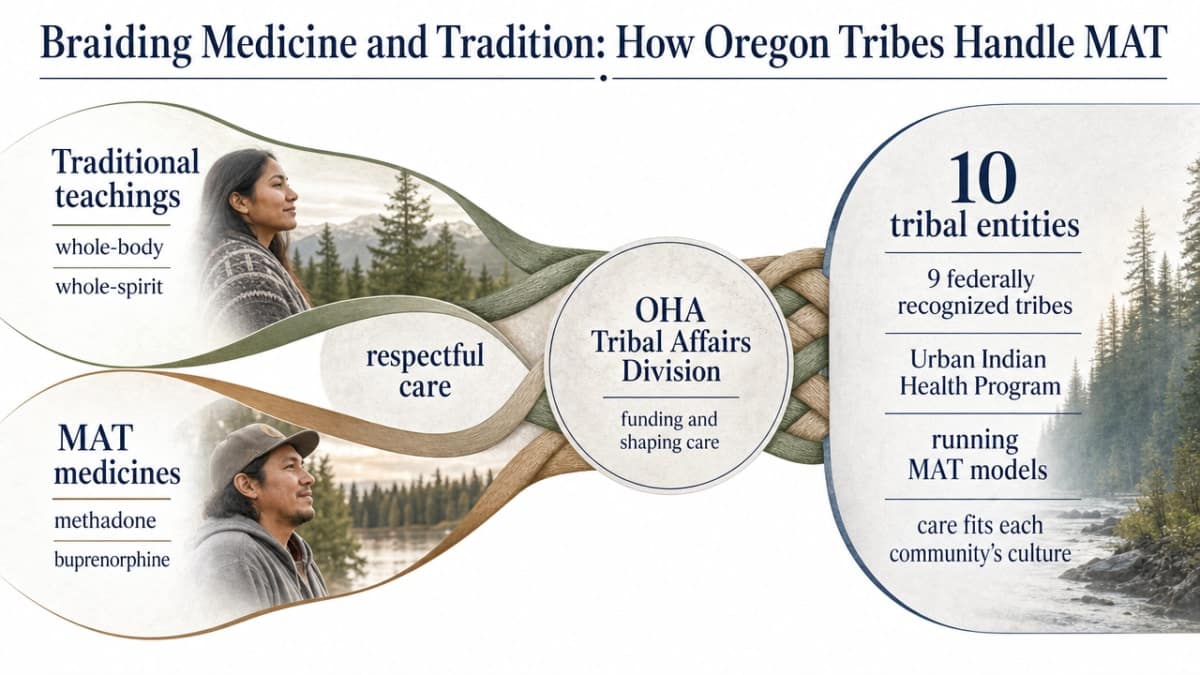
Here’s what’s changed in Oregon. Every one of the state’s nine federally recognized tribes, plus the Urban Indian Health Program, is now running some form of medication-assisted treatment — ten tribal entities in total, working through the Oregon Health Authority’s Tribal Affairs Division to fund and shape care that fits each community’s cultural needs 3. Ten out of ten. That’s not a pilot. That’s a statewide answer to a statewide crisis.
What tribes are doing is braiding, not replacing. Medicine like methadone or buprenorphine steadies your body so the cravings quiet down and your brain has room to heal. Ceremony, elders, peer support, and language work on the parts medicine can’t touch — the grief, the shame, the disconnection from who you are. Neither strand alone is enough for most people. Together, they hold.
You should know that not every tribal member will feel the same about MAT, and not every program frames it the same way. Some sites keep medication conversations quiet out of respect for elders who prefer abstinence-only recovery. Others talk about it openly as a tool. Both are valid. What matters is that in Oregon, the option is there — inside tribal systems, not outside them — so you don’t have to leave your community to get medicine, and you don’t have to give up medicine to stay in your community.
If you’re in early withdrawal right now, this matters in a very practical way. Starting buprenorphine or methadone safely usually means medical supervision first, then a handoff to a program that will keep you on it long-term. That handoff is where a detox partner like Pacific Crest Trail Detox can help — stabilizing you medically, then walking you to the tribal or urban Indian program that will carry the rest of the road with you.
The Grand Ronde Mobile Medication Unit as a Living Example
If you want to see what braiding actually looks like on the ground, look about an hour southwest of Portland. In 2022, the Confederated Tribes of Grand Ronde launched what a peer-reviewed study calls the first Tribally operated opioid treatment program mobile medication unit known in the nation — a van, essentially, that brings methadone and buprenorphine directly to community members who would otherwise face long drives, weather, and stigma to get a daily dose 2.
That last word matters. In rural areas, everyone knows whose car is parked at the clinic. For a lot of people, the shame of being seen walking through those doors was enough to keep them using. The mobile unit changed the math. Care came to them, on tribal land, under tribal approval, with staff who understood why an elder might be uneasy about methadone and why a young father might still choose it.
The study describes real friction, too — federal daily-dosing rules, state regulation, and the ongoing work of holding medication treatment alongside traditional healing views without either one getting flattened 2. Nobody pretended it was simple. They built it anyway.
You don’t have to be a Grand Ronde member for this example to mean something. It shows that in Oregon, tribes are not waiting for permission to design care that fits their people. And it sets a bar for what respectful partnership looks like when a non-tribal facility, like a detox in Milwaukie, offers to help.
What Culturally Grounded Care Actually Includes
When you’re vetting a program for yourself or someone you love, you need a short list of what to actually look for — not a vibe, not a logo, not a poster on the wall. Here’s what the research and Oregon’s own Native peer standards say culturally grounded care includes.
- Elders and lived-experience peers.
- Oregon’s Native SUD Peer Best Practices document names elder wisdom and lived experience as central to how Native people heal from substance use. Peers who have walked the road themselves carry a kind of authority no textbook grants 1.
- Ceremony and language.
- A systematic review of 19 studies covering 5,949 Native treatment clients found that culturally adapted programs commonly incorporate traditional ceremonies, elders, Native languages, and community-based delivery — and that these elements are tied to stronger engagement and retention than generic care 5. Ceremony isn’t garnish. It’s clinical.
- Family involvement.
- Native recovery is rarely a solo project. Aunties, cousins, grandparents, and children often belong in the room, and Oregon’s family-centered behavioral health work with tribes reflects that 11. A program that treats your family as a distraction is missing the point.
- Trauma-informed practice.
- Historical trauma — boarding schools, removal, forced assimilation — isn’t ancient history. Culturally grounded care assumes that story is in the room and works with it, not around it 1.
- An honest line against appropriation.
- This is the one most easily faked. Oregon’s peer best practices document warns explicitly against non-Native providers borrowing sacred practices they haven’t been given the right to hold 1. A respectful program either partners with tribal or urban Indian providers for those pieces, or it stays in its lane and refers out. If a facility is passing around smudge sticks with no tribal relationship behind it, that’s a red flag, not a feature.
Use this list as your checklist. If a program can name how it does each of these five things — and who it partners with when it can’t — you’re talking to someone worth trusting.
Where Medical Detox Fits: The Warm Handoff Model
That’s the gap a facility like Pacific Crest Trail Detox is built for. PCTD is a non-hospital medical detox in Milwaukie with 24/7 monitoring, medication management, and a home-like setting rather than a hospital ward. Nurses watch your vitals. Doctors adjust your medications. If methadone or buprenorphine is part of your plan, they can get you started safely so your body has something steady to stand on 7.
Then comes the handoff. The word to hold onto is warm. A warm handoff means PCTD doesn’t just discharge you with a folder of phone numbers and wish you luck. It means the team calls ahead to your tribal clinic, your NARA case manager, or the Behavioral Health Resource Network in your county, confirms the appointment, and makes sure someone is expecting you on the other side 3. Your medication continues. Your story doesn’t have to be told from scratch.
Picture two columns. On one side: medical detox — IV fluids, comfort medications, sleep, blood pressure checks, a bed that isn’t the floor. On the other side: elders, ceremony, peer support, family, the tribal clinic that knows your last name. The arrow between them is the handoff. Neither column is trying to be the other. That’s the whole point.
If you’re the person calling at midnight, ask the detox one direct question: who do you already work with on the tribal or urban Indian side, and what does the handoff look like? A straight answer is what respect sounds like.
Family, Youth, and Community in Native Recovery
If you’re the auntie making the calls, or the grandmother watching a grandchild come apart, know that your role isn’t a complication in this process. It’s part of the treatment. Oregon’s own child and family behavioral health work was shaped alongside the nine federally recognized tribes, NARA, and the Northwest Portland Area Indian Health Board, and it treats family and community as central to how Native young people heal 11.
What that looks like on the ground: family sessions that include more than one household, youth programs that pair clinical care with cultural teaching, and case managers who understand that a cousin dropping someone off for treatment is a support system, not a red flag. Tribal supports are available to Native youth as needed, with families routed through county mental health programs and tribal contacts rather than left to figure it out alone 14.
For adults in detox, this matters too. Bring the people who matter to your intake conversation. Ask how the program includes them. A door that only opens for one person at a time isn’t built for how Native recovery actually works.
Funding, Deflection, and Real Phone Numbers
You should know that Oregon is putting money behind this work, not just words. Under HB 4002, the state’s Behavioral Health Deflection Program routes formula funding directly to tribal governments, with a minimum base allocation of $150,000 per tribal applicant for the 2023-25 cycle 13. That money supports the kind of outreach and diversion that keeps a Native person out of jail and into treatment when a police contact could have gone either way. If you or someone you love is facing charges tied to substance use, ask whether deflection is on the table before you accept the first offer the court hands you.
Beyond deflection, the Tribal Affairs Division at the Oregon Health Authority channels grant dollars to the nine federally recognized tribes and NARA Northwest specifically for uninsured and underinsured people who need substance use care 4. Translation: if you don’t have insurance, that alone is not a reason to hang up.
Here are the numbers to keep on the fridge:
- The Oregon Recovery Center Hotline is free, confidential, and answered 24/7, and it can screen you and connect you to licensed treatment across the state 10.
- Your tribal health clinic, if you’re enrolled, is the second call.
- NARA Northwest in Portland is the third if you’re in the metro.
- The Behavioral Health Resource Network in your county is the fourth 3.
Four numbers. Any one of them, tonight, is enough to start.
Making the First Call
If you’ve read this far, you already know more than most people who dial a detox line for the first time. You know that safe withdrawal from alcohol or benzos is a medical event, not a willpower test. You know that Native recovery in Oregon is being built by tribes, NARA Northwest, and urban Indian programs — with medicine and tradition held together, not pulled apart 3. You know that a respectful detox partner will name what it is, keep you alive through the hard days, and walk you to the community that will carry the rest.
Pacific Crest Trail Detox is building a Native track because the owner’s own sobriety came through a Native American program. That story is the reason for the work, not the pitch. What PCTD offers now is medical detox in a home-like setting in Milwaukie, and warm handoffs to the tribal clinic, NARA, or Behavioral Health Resource Network that fits your life.
Making this call is already a step. Pacific Crest Trail Detox is building a program rooted in respect for Native recovery traditions — reach out to learn more.
Check your coverage for Native-focused detox care
Find out if your insurance supports respectful, culturally rooted addiction treatment in Oregon.
Frequently Asked Questions
Is Pacific Crest Trail Detox a tribal or Native-run treatment program?
No. PCTD is a non-hospital medical detox in Milwaukie, Oregon. It is not a tribal program and will not claim to be one. The owner’s own sobriety came through a Native American recovery program, and PCTD is building a Native track that works alongside tribal clinics, NARA Northwest, and urban Indian providers — not in place of them.
Can I use medication like methadone or buprenorphine and still honor Native recovery traditions?
Yes. All nine federally recognized tribes in Oregon and the Urban Indian Health Program now run medication-assisted treatment models alongside traditional healing 3. Some communities talk about medicine openly; others hold it quietly out of respect for elders who prefer abstinence-only paths 1. Both are valid. You should not have to choose between medicine and your community.
What does culturally grounded addiction care actually include?
Five concrete things: elders and lived-experience peers, ceremony and language, family involvement, trauma-informed practice, and an honest line against cultural appropriation by providers who have not earned the right to hold sacred practices 1. A systematic review of 19 studies covering 5,949 Native treatment clients found that programs built around ceremonies, elders, Native languages, and community-based delivery were more acceptable and better retained clients than generic care 5.
Who provides Native-specific addiction treatment in Oregon besides tribal clinics?
NARA Northwest is the largest urban Indian provider in the Portland metro, offering outpatient and residential treatment, medication for opioid use disorder, mental health services, and primary care. Oregon’s Tribal Behavioral Health Strategic Plan names NARA as a key partner receiving state grant funding for uninsured and underinsured Native people 4. Descendancy is honored, so you do not have to be enrolled in a specific tribe to be seen.
How does medical detox connect to tribal or culturally specific aftercare?
Through a warm handoff. A detox partner stabilizes you medically — 24/7 monitoring, medication management, safe withdrawal from alcohol or benzodiazepines — then calls ahead to your tribal clinic, NARA case manager, or the Behavioral Health Resource Network in your county to confirm the appointment and continue your medication 3. You do not get discharged with a folder and a wish. Someone is expecting you on the other side.
What phone numbers should a family member call first?
Keep four numbers close. The Oregon Recovery Center Hotline is free, confidential, and answered 24/7, and it can screen and connect anyone to licensed treatment statewide 10. Your tribal health clinic is the second call if you are enrolled. NARA Northwest is the third if you are in the Portland metro. The Behavioral Health Resource Network in your county is the fourth 3. Any one of them, tonight, is enough.
References
- Native American SUD Peer Best Practices. https://www.oregon.gov/oha/HSD/AMH-PD/Documents/NA-SUD-Peer-Best-Practices.pdf
- Engaging the great circle: a qualitative study of the confederated tribes of grand Ronde’s mobile medication unit. https://pmc.ncbi.nlm.nih.gov/articles/PMC10812851/
- Substance Use Disorder Integration Report. https://www.oregon.gov/oha/HSD/AMH/DataReports/SUD-Integration-Report.pdf
- Tribal Behavioral Health Strategic Plan – 2019 to 2024. https://www.oregon.gov/oha/HSD/AMH/docs/Tribal-BH-Strategic-Plan-2019-2024.pdf
- Culturally adapted substance use interventions for Native American communities: A systematic review. https://pmc.ncbi.nlm.nih.gov/articles/PMC6761925/
- Culturally tailored substance use interventions for Indigenous people of North America: a systematic review. https://pubmed.ncbi.nlm.nih.gov/37292247/
- Trending the evidence on opioid use disorder continuum of care among rural American Indian/Alaska Native tribes: A systematic scoping review. https://pubmed.ncbi.nlm.nih.gov/33359980/
- A Scoping Review of American Indian and Alaska Native Substance Use Disorder Treatment Research. https://pmc.ncbi.nlm.nih.gov/articles/PMC10529616/
- Substance and Behavioral Addictions among American Indian and Alaska Native People. https://pmc.ncbi.nlm.nih.gov/articles/PMC8910676/
- Recovery Center HOtline. https://www.oregon.gov/oha/HSD/AMH/Docs/lfl-hotline-en.pdf
- Implementing the Child and Family Behavioral Health Roadmap 2020-2024. https://www.oregon.gov/oha/HSD/BH-Child-Family/Documents/Child%20and%20Family%20BH%20Roadmap%202020-2024.pdf
- OHA Behavioral Health Collaborative Report. https://www.oregon.gov/oha/hsd/bhp/Documents/Behavioral-Health-Collaborative-Report.pdf
- 2023-25 Oregon Behavioral Health Deflection Program. https://www.oregon.gov/cjc/bhd/Documents/2023-2025_Tribal_Formula_Funding_Table.pdf
- OHA 8.5 x 11 Basic Publication Template. https://www.oregon.gov/oha/HSD/BH-Child-Family/Documents/CFBH%20Summary%20for%20Tribes.pdf
- American Indian and Alaska Native Substance Use: Facts and Figures. https://www.cdc.gov/pcd/issues/2018/17_0434.htm
- Culturally Adapted Substance Use Interventions for Native American Communities: A Systematic Review. https://www.ncbi.nlm.nih.gov/pmc/articles/PMC6761925/