
Key Takeaways
- Opioid dependency was treated as a moral failing for over a century until Dole and Nyswander’s 1960s methadone research reframed it as a treatable medical condition responsive to steady, long-term care.
- Agonist medications like methadone and buprenorphine cut mortality risk roughly in half for people with opioid use disorder, which shifted the debate from cultural preference to lifesaving treatment.1
- Methadone, buprenorphine, and naltrexone each work differently, so the right fit depends on your history and life, not on which medication sounds most like traditional recovery.6
- The 2023 removal of the DATA waiver and updated federal rules mean regular doctors can now prescribe buprenorphine, and home-like settings with counseling are increasingly available.7,8
Why the Story of MAT Matters to You Right Now
If you’re reading this, something brought you here. Maybe a scare. Maybe a quiet moment after a rough week. Perhaps you’ve tried to stop using opioids on your own more times than you can count, and you’re tired of the shame that comes with each attempt. Understanding the history of medication-assisted treatment can be a first step toward finding answers and exploring your options. That takes courage, and it matters. Looking things up in the middle of the night is not weakness. It’s you doing the work of figuring out what’s real.
Here’s what the history of medication-assisted treatment can give you that a pamphlet can’t: context. The reason you may have heard mixed things about methadone, or wondered whether taking buprenorphine is “really” recovery, is that this kind of care has spent sixty years fighting stigma that had nothing to do with the science. The medicine has been quietly working the whole time. The world just took a while to catch up.
Today, methadone, buprenorphine, and naltrexone are the three medications the FDA has approved to treat opioid use disorder, and each one has a job you can understand in plain language. Knowing how they got here, and why access is finally easier than it was even a few years ago, can help you decide what to try next without carrying anyone else’s judgment into the room with you.6
Before There Was a Name for It: Opioid Dependency Before the 1960s
For most of American history, if you were dependent on opioids, there was no real treatment. There was only judgment, jail, or the quiet suffering of trying to stop and failing again and again. If any part of that sentence makes your chest tighten with recognition, take a breath. You are not the first person to feel trapped by something your body kept demanding, and you are not the last person to wonder if there is a better way.
Opioids themselves are ancient. Morphine was isolated in the early 1800s and used freely by doctors during the Civil War. Heroin was sold over the counter in the late 1800s as a cough remedy. Nobody called what happened next “opioid use disorder.” They called it a weakness of character. When the Harrison Narcotics Act passed in 1914, dependency shifted almost overnight from a medical concern to a criminal one. Doctors who tried to help patients taper were prosecuted. People who could not stop were labeled deviants.
By the 1920s and into the 1950s, the standard “treatment” was forced abstinence, often in locked facilities, sometimes in prisons. Relapse rates were staggering, though nobody used that language either. The people running these programs assumed that if you started using again, you simply had not wanted sobriety badly enough.
You may have inherited that assumption without realizing it. A lot of us did. The reason you have felt shame about needing help is not because shame belongs to you. It is because for roughly a century, that is what the culture handed out instead of care. Holding that fact gently is the first step toward setting it down.
The Methadone Breakthrough and the Question It Answered
Dole, Nyswander, and the Idea That Changed Everything
In the mid-1960s, two researchers in New York started asking a question almost no one else was asking. Vincent Dole was an expert in metabolism. Marie Nyswander was a psychiatrist who had spent years treating people with heroin dependency and watching them relapse over and over. They noticed something the culture had missed: the people coming back to heroin were not lazy or immoral. Their bodies were doing something they could not turn off with willpower.
So Dole and Nyswander tried something new. They gave a small group of patients a long-acting oral medication called methadone, one dose a day, at a steady level. What happened surprised almost everyone but them. The cravings quieted. People stopped chasing heroin. They went back to work. They reconnected with families. They looked, in the researchers’ notes, like people again.
What Dole and Nyswander proved, quietly and against a lot of resistance, is that opioid dependency looks less like a failure of character and more like a long-term medical condition that responds to long-term medical care. If you have ever been told to “just want it more,” this is the science that says the people telling you that were wrong. Your brain is not broken because you are weak. It is asking for something it can be helped to stop asking for.
Why People Called It ‘Trading One Drug for Another’
Almost as soon as methadone worked, the backlash started. You have probably heard some version of it:
“That’s not really recovery.” “You’re just swapping one addiction for another.” “Real sobriety means nothing in your system.”
If those sentences have ever made you flinch, or made you put off asking a doctor for help, you are not imagining the sting. That message has been in the air for sixty years.
Here is what was actually happening. Methadone at a proper dose does not get you high. It does not cloud your thinking. Research has shown that when the dose is right, these medications have no negative effect on your intelligence, your ability to work, or how you function day to day. What it does is fill the receptors your brain has been begging to have filled, so you can stop chasing that feeling and start living around it.3
The “trading one drug for another” line was never really about pharmacology. It was about a culture that wanted people with dependency to suffer as proof they deserved to recover. You do not have to carry that idea with you anymore. Needing a daily medication to steady a brain that has been through a lot is not cheating. It is treatment, the same way insulin is treatment. That is not a slogan. That is what the science has been showing since Dole and Nyswander’s first patients walked back into their own lives.
The Evidence That Quietly Ended the Debate
For decades, the argument about methadone and later buprenorphine was mostly cultural. People argued about what recovery should look like instead of what actually kept people alive. Then the numbers started piling up, and the debate ran out of room to stand.
Sit with that for a second, because it is heavy. If you have lost someone, or come close to being lost yourself, that number is not abstract. It is the difference between a funeral and a phone call on a Tuesday afternoon.
The evidence did not stop at mortality. Peer-reviewed reviews of MAT show it reduces heroin and other opioid use, lowers risky injection practices, and helps people stay in treatment long enough for counseling and support to actually take root. Federal health agencies have been consistent on the same point: when combined with counseling, these medications are effective, and they belong in the standard toolkit for opioid use disorder, not on its edges.2,4
That is the quiet part the debate never quite figured out how to argue with. You are allowed to let it settle the question for you, too.

2002: Buprenorphine Moves Treatment Out of the Clinic Window
For almost forty years after Dole and Nyswander’s breakthrough, if you wanted methadone, you had to go get it. Every day. At a licensed clinic. Sometimes across town, sometimes before work, sometimes standing in a line that felt designed to make you feel small. If that image lands hard, it’s because it was hard. A lot of people who needed help either didn’t start or didn’t stay because their life could not bend around the dispensing window.
Then in 2002, the FDA approved buprenorphine for treating opioid use disorder, and something quietly changed. This medication could be prescribed in a regular doctor’s office and filled at a regular pharmacy. You did not have to show up at dawn. You did not have to explain yourself to a receptionist who knew why you were there. You could take it at your kitchen table, with your coffee, like any other prescription.6
What that shift meant in practice was that treatment stopped being something that only happened in one kind of building. Buprenorphine works a little differently than methadone. It’s a partial agonist, which is a technical way of saying it soothes the same receptors but with a built-in ceiling, so it tends to be gentler and carries a lower overdose risk when used as prescribed. Combined with counseling and support, it has been shown to reduce opioid use and help people stay in care.2,7
If you have ever put off asking for help because the picture in your head was a clinic line, this is the moment that picture stopped being the only option. Treatment came home.
The Three Medications, in Plain Language
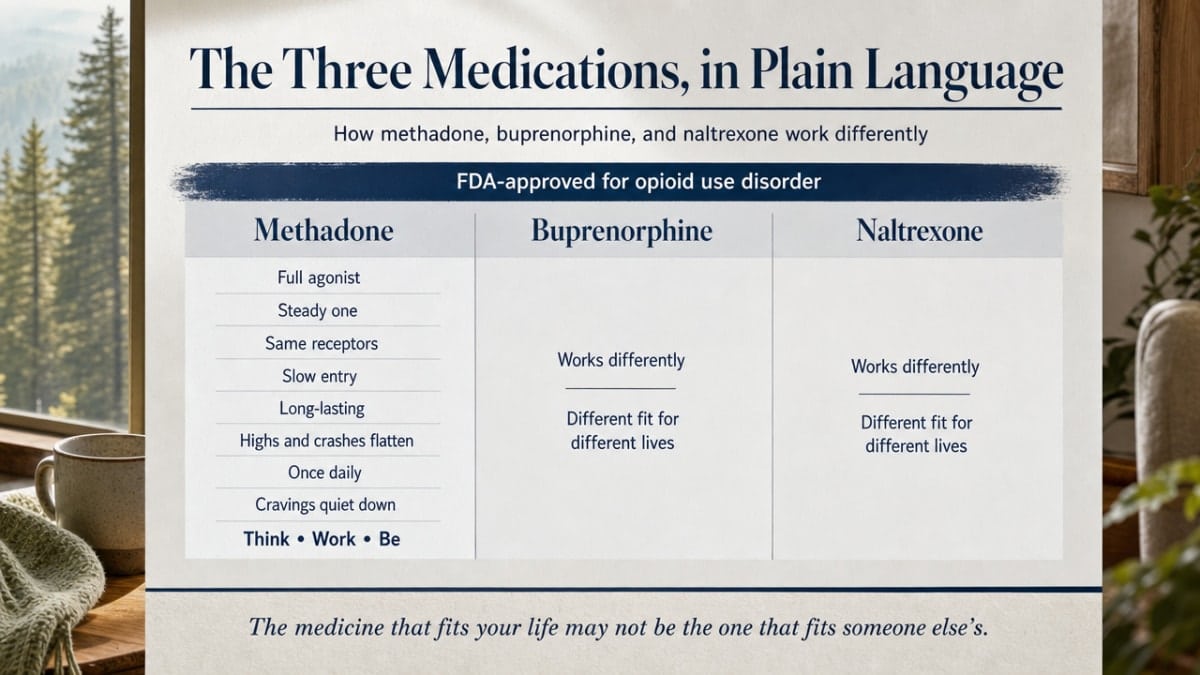
You do not need a pharmacology class to understand what these medicines do. You just need someone to say it in words that make sense at your kitchen table. The FDA has approved three medications to treat opioid use disorder: methadone, buprenorphine, and naltrexone. Each one works differently, and that difference is the whole point. Because you are not the same as anyone else who has ever tried to stop, and the medicine that fits your life may not be the medicine that fits your neighbor’s.6,7
Medication | Description |
|---|---|
Methadone | It is what doctors call a full agonist. In plain language, it is the steady one. It settles fully into the same brain receptors that opioids have been hitting, but it does it slowly and stays a long time, so the highs and crashes flatten out. Take it once a day at the right dose and the cravings quiet down. You can think, you can work, you can be present with the people you love. It has been used the longest of the three, and for people whose dependency has been long or heavy, it is often the one that holds. |
Buprenorphine | It is a partial agonist. It touches the same receptors, but only partway, with a built-in ceiling that makes overdose less likely at prescribed doses. In everyday terms, it is the gentler cousin of methadone. It can be prescribed at a regular doctor’s office and picked up at a regular pharmacy, which is why so many people today start here. |
Naltrexone | It is the opposite kind of tool. It is an antagonist, which means it blocks the receptors instead of soothing them. If you use an opioid while naltrexone is in your system, you will not feel the effect. It is not for everyone, and it usually requires being fully through withdrawal before you start, but for some people the block itself is the peace they have been looking for. |
Three medicines. Three different ways in. One shared purpose: to give your brain enough steady ground to let the rest of you do the harder, slower work of building a life you want to be awake for.
2023: The Waiver Falls and Access Finally Widens
For twenty years after buprenorphine was approved, there was still a catch. If your family doctor wanted to prescribe it to you, they could not just write the prescription the way they would for blood pressure medication. They had to apply for something called a DATA waiver, take special training, and agree to a patient cap. Most doctors never bothered. If you have ever called around looking for someone who would help and hit voicemail after voicemail, that is the reason.
Think about what that meant in practice. A doctor could prescribe a bottle of oxycodone in five minutes but needed a federal certification to prescribe the medication that treats what oxycodone had done. It was a strange gap in the system, and it kept a lot of people stuck.
Then, at the end of 2022, Congress passed the MAT Act, and in 2023 the DATA waiver requirement went away. Practitioners no longer need special certification to prescribe buprenorphine for opioid use disorder 8. A regular doctor, in a regular office, can now help you the same way they would help someone with any other chronic condition. Federal rules for opioid treatment programs have also been updated to give more flexibility in how methadone and buprenorphine are delivered, so care can bend around your life instead of the other way around.7
If you tried to get help three or five years ago and could not find a prescriber, that was not your failure. The door was mostly closed. It is a lot more open now, and you are allowed to try again.
Why Access Still Lags the Evidence
If the medicine works this well, and the door is finally more open, you might be wondering why so many people you know are still stuck. It is a fair question, and the answer is honest: the system is catching up, but it has not caught up yet.
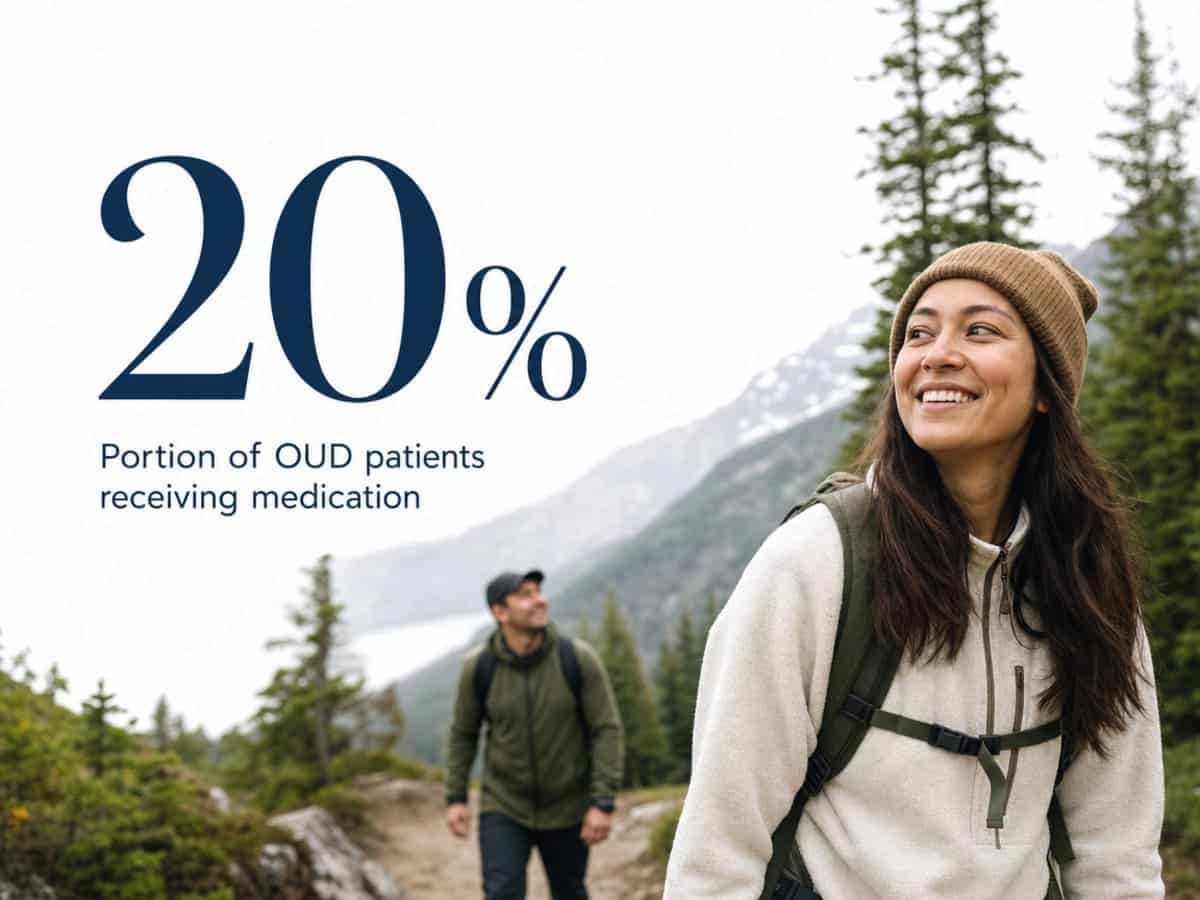
Here is the number that names the gap. Fewer than 1 in 5 people with opioid use disorder receive any of the FDA-approved medications that are known to help. That is not a reflection of how many people want help. It is a reflection of how many can find a prescriber, get to an appointment, afford the visit, or feel safe walking through the door after everything they have already been told about themselves.5
The reasons stack up in ways that are not your fault:8
- Some rural counties still do not have a single prescriber.
- Insurance can be a maze.
- Waitlists exist.
- Stigma at the front desk exists.
- Old rules about who could prescribe what shaped a whole generation of clinicians, and habits change slower than policy.
- Even well-meaning family members sometimes push back, echoing the “trading one drug for another” line without knowing where it came from.
If you have tried to get help and hit a wall, that wall is real. It is also not the final word. Programs that combine medication with counseling and a warm, human setting are growing, and community prescribers are more available now than they were even three years ago. The evidence is on your side. The system is slowly turning to meet it. Your job is not to fix the system. Your job is to keep asking, one call at a time, until you find the door that opens.
The Quiet Shift: From Dispensing Windows to Home-Like Care
Picture the two rooms side by side. On the left, a fluorescent-lit clinic with a plexiglass window, a paper cup, and a line of people who would rather be almost anywhere else. On the right, a kitchen with a coffee pot, a couch that has seen a lot of hard conversations, and a nurse who knows your name. Both rooms can deliver the same medication. Only one of them treats you like a person while it happens.
That shift, from the dispensing window to something that looks more like a home, is the newest chapter in this story. It did not happen because anyone stopped caring about safety. It happened because the evidence kept saying the same thing: people do better when the setting supports them. Federal rules for opioid treatment programs were updated in 2024 to give more flexibility in how methadone and buprenorphine can be delivered, which opens the door for care that fits around a person’s life instead of the other way around. Guidance from federal health agencies has also been consistent that these medications work best when paired with counseling and behavioral support, not when handed over in isolation.2,7
What that looks like in practice is quieter than the old picture. It looks like a small residential place with medical supervision on-site, group therapy in a living room instead of a waiting area, and a treatment plan built around the three phases most guidance now recommends:3
- getting stable,
- moving through withdrawal safely, and
- then staying on medication long enough for the rest of your life to catch up.
It looks like people eating dinner together. It looks like sleep.
If the word “detox” has always sounded cold to you, this is the version worth knowing exists. A home-like setting with medical staff, group support, and MAT built in is not a fantasy anymore. It is where a lot of this history has been pointing all along.
What the History Gives You Permission to Do Next
Sixty years is a long time for a science to spend proving itself against a culture that did not want to listen. If you have made it this far in the story, you already know more about your options than most people who quietly wonder if they are worth saving. That knowing is not nothing. Hold onto it.
Here is what the arc has been building toward, in case no one has said it to you plainly:
- You are allowed to ask a doctor about medication for opioid use disorder without apologizing for the question.
- You are allowed to try one medicine and switch to another if the first one does not fit your life.
- You are allowed to want counseling alongside your prescription, because the evidence has been clear for a long time that medicine and support work better together than either one alone.2
- You are allowed to look for a place that feels more like a home than a hospital, with medical staff nearby and people who will sit with you through the hard nights.
The next step is not a leap. It is a phone call, or a conversation with a doctor you already see, or a quiet Google search that turns into a real appointment. If a warm, home-like detox with medication support and group therapy sounds like the setting where you could finally take a breath, places like Pacific Crest Trail Detox exist because the history in this article kept pushing the door open. Walk through it when you are ready. The people on the other side have been waiting.
Check Your Coverage for MAT and Support
See if your insurance covers medically assisted detox and care, so you can take your next step forward.
Frequently Asked Questions
Is medication-assisted treatment just trading one drug for another?
No, and that line has done a lot of quiet damage. At the proper dose, these medications do not get you high or cloud your thinking, and research has shown they have no negative effect on your intelligence, physical functioning, or ability to hold a job. What they do is steady the receptors your brain has been asking to have filled, so you can stop chasing that feeling and start living around it.3
What are the three FDA-approved medications used in MAT?
The FDA has approved methadone, buprenorphine, and naltrexone for treating opioid use disorder. Methadone settles fully into the same brain receptors opioids have been hitting, but slowly and steadily. Buprenorphine touches those receptors only partway, with a built-in ceiling that lowers overdose risk. Naltrexone blocks them entirely, so opioids do not produce an effect. Three different tools, one shared purpose: giving your brain steady ground while the rest of your life catches up.6
How long do people usually stay on MAT?
There is no single right answer, and that is on purpose. Federal guidance describes three phases: getting stable, moving through withdrawal safely, and then a maintenance phase that can last months or years depending on your life. Some people stay on medication for a year. Some stay much longer. Longer time in treatment is linked to better outcomes, so the honest answer is: as long as you and your doctor agree it is helping.3
Do I still need counseling if I’m taking medication for opioid use disorder?
You don’t strictly have to, but the evidence is pretty clear that pairing the two works better than either alone. Peer-reviewed reviews of MAT show that combining these medications with counseling and behavioral support reduces opioid use, lowers risky injection practices, and helps people stay in care longer. The medicine steadies your body. The counseling helps you rebuild what dependency wore down. You deserve both, not just one.2
Why is it easier to get MAT today than it was a few years ago?
The biggest change happened in 2023, when the MAT Act eliminated the DATA waiver requirement for prescribing buprenorphine. Before that, doctors had to apply for special federal certification and accept patient caps, which meant most never bothered. Now any prescriber can help you the same way they would with any other chronic condition. Updated federal rules for opioid treatment programs have also added flexibility in how methadone is delivered.7,8
Can MAT be done in a home-like setting instead of a clinic?
Yes, and that is one of the newer chapters in this story. Updated federal rules give more flexibility in how methadone and buprenorphine can be delivered, which opens the door for smaller residential settings with on-site medical staff rather than only large clinics. Guidance from federal health agencies has been consistent that these medications work best when paired with counseling in a supportive environment. A kitchen table can be part of treatment now.2,7
References
- The Effectiveness of Medication-Based Treatment for Opioid Use Disorder. https://www.ncbi.nlm.nih.gov/books/NBK541393/
- Medication Assisted Treatment for Opioid Use Disorder. https://pmc.ncbi.nlm.nih.gov/articles/PMC8389722/
- Medication-Assisted Treatment for Opioid Use Disorder. https://stacks.cdc.gov/view/cdc/78827/cdc_78827_DS1.pdf
- Medication-Assisted Treatment for Opioid Use Disorder | Overdose Resource Exchange. https://www.cdc.gov/overdose-resources/search/pages/2019-133.html
- Medications for Opioid Use Disorder. https://nida.nih.gov/research-topics/medications-opioid-use-disorder
- Information about Medications for Opioid Use Disorder (MOUD). https://www.fda.gov/drugs/food-and-drug-administration-overdose-prevention-framework/information-about-medications-opioid-use-disorder-moud
- Medications for the Treatment of Opioid Use Disorder. https://www.federalregister.gov/documents/2024/02/02/2024-01693/medications-for-the-treatment-of-opioid-use-disorder
- Waiver Elimination (MAT Act). https://www.samhsa.gov/substance-use/treatment/resources/mat-act
- Review of Medication-Assisted Treatment Guidelines and Measures for Opioid and Alcohol Use Disorders. https://aspe.hhs.gov/reports/review-medication-assisted-treatment-guidelines-measures-opioid-alcohol-use-0
- Medication Assisted Treatment for Opioid Use Disorder (Clinical Guidance, Federal Bureau of Prisons). https://www.bop.gov/resources/pdfs/opioid_use_disorder_cg.pdf