
Key Takeaways
- Fentanyl’s core danger is respiratory depression: it slows the brainstem’s breathing signal until breaths get shallow, far apart, then stop, which drives every other serious effect.6, 5
- Prescribed fentanyl carries real but monitored risk, while street fentanyl in counterfeit pills and powders has no reliable dose, with roughly 29% of tested counterfeit pills holding a potentially deadly amount.13
- Recognize overdose by the cluster: pinpoint pupils, limp body, blue or gray lips, slow or absent breathing, gurgling, and cold clammy skin. Call 911, give naloxone, support breathing, and stay with the person.2, 18
- Detox clears the drug but doesn’t rebuild the life around it, so medically supervised withdrawal should hand off to PHP, IOP, outpatient, and ongoing support rather than stand alone.19
Why Fentanyl Is So Dangerous Starts With One Word: Breathing
If you’re trying to understand the effects of fentanyl, start here: the drug’s real danger isn’t its strength on paper. It’s what it does to your breathing. Fentanyl binds tightly to opioid receptors in the brainstem, the part of you that tells your lungs to pull in air without you thinking about it. When that signal slows down, so does everything else.
Doctors call this respiratory depression. In plain language, your breaths get shallow, then far apart, then stop. The FDA warns that serious, life-threatening, or fatal respiratory depression can happen with prescribed fentanyl, especially when a dose starts or goes up.6 NIOSH describes the same mechanism in severe toxicity: low oxygen, low blood pressure, slowed heart rate, coma, and death all follow from breathing that quits working.5
Every other short-term effect of fentanyl, the drowsiness, the pinpoint pupils, the quiet, is a clue pointing back at that one thing. Keep that in mind as you read the rest. It will make the overdose signs, the side effects, and the reason supervised detox exists all click into place.
Prescribed Fentanyl vs. Street Fentanyl: Why the Difference Matters
When you hear “fentanyl,” two very different things get lumped together, and the confusion makes it harder to understand what you or your loved one is actually dealing with.
Prescribed fentanyl is a legitimate medication used for severe pain, often during surgery, for cancer pain, or for people who’ve built a tolerance to other opioids. It comes as a skin patch, an injection, a lozenge, or a lollipop-style tablet. Doses are measured in micrograms, prescribed by a clinician, and tracked by a pharmacy. Even then, the FDA warns that serious breathing problems can happen, especially in the first 24 to 72 hours of a patch or after a dose increase.9 That’s why pain patients get checked carefully at the start of treatment.
Street fentanyl is a different animal. It’s made in unregulated labs and pressed into counterfeit pills meant to look like Percocet, Oxycodone, or Xanax, or mixed into powder sold as heroin, cocaine, or methamphetamine. There’s no label, no dose, no quality control. Two pills from the same bag can contain wildly different amounts.
If you’re a pain patient taking fentanyl as prescribed, your risks are real but managed. If you took something off-label from a friend or the street, you’re in a different situation, and the rest of this article speaks directly to that.
What Fentanyl Does in the First Hour: Short-Term Effects
What You Feel in Your Body and Mind
If you’ve just taken fentanyl, prescribed or not, here’s what tends to show up first. A warm, heavy wave of relaxation. Pain quiets down. Some people feel a short lift of euphoria, then a soft, pulled-under drowsiness that’s hard to fight. Your eyelids get weighty. Your thoughts slow. The room feels further away than it did a minute ago.
Your body gives you other clues. Nausea is common, sometimes vomiting. You might feel dizzy or lightheaded when you stand up. Your mouth goes dry. You may feel cold even in a warm room. A dull headache can settle in. If you’ve used fentanyl before, you probably know the constipation that follows.7, 8
Then there’s the breathing. You may not notice it at all, which is part of the danger. Your breaths get shallower and farther apart without any sense of struggle. If someone asks a question and it takes you a long beat to answer, or if you catch yourself nodding off mid-sentence, that’s your nervous system telling you the dose is doing more than you planned.6
What Other People Notice From the Outside
From across the room, the signs are different, and often easier to see than to feel. The person’s pupils shrink to tiny black dots, even in dim light. Their eyelids droop. Their head nods forward and jerks back up, over and over, what some people call being “on the nod.” Speech slurs or trails off. They may scratch at their face or arms.
Skin can look pale or flushed, and feel cool or clammy to the touch. Breathing gets quiet, slow, sometimes with long pauses or an odd, snore-like sound you haven’t heard from them before.9 If you’re a parent, partner, or friend watching this, trust what you’re seeing. You don’t need to diagnose anything. If you can’t rouse them with a firm shake and a loud voice, you’ve crossed from side effects into something that needs a 911 call and naloxone right now.2
Common Side Effects of Fentanyl Use
Even when fentanyl is doing exactly what it’s supposed to do, your body pushes back. The side effects aren’t a sign something went wrong; they’re the predictable cost of a drug this strong binding to receptors spread across your gut, brain, skin, and heart.
The most common ones show up on nearly every FDA label and patient resource:
- Nausea and vomiting
- Sleepiness that feels heavier than normal tiredness
- Dizziness, especially standing up fast
- Constipation that doesn’t resolve on its own
- Headache, fatigue, and feeling cold even when the room isn’t7
MedlinePlus adds weakness, extreme drowsiness, and noticeable changes in heartbeat to that list.8
Some side effects are quieter and worth naming. Dry mouth. Itchy skin, sometimes with a rash where a patch sits. Trouble peeing. A foggy, slowed-down feeling that makes work, driving, or caring for kids genuinely unsafe.
Serious reactions can show up at any dose. The FDA flags life-threatening respiratory depression as the one that doesn’t wait politely for a warning sign.6 If breathing changes, if someone is hard to wake, if lips or fingertips look dusky, that stopped being a side effect. That’s an emergency, and the next section tells you exactly what to look for.
Overdose Warning Signs: What You’d Actually See
The Six Signs That Mean Call 911 Now
You don’t need medical training to recognize a fentanyl overdose. You need to know what six things look like together, and you need to trust yourself when you see them.
The CDC lists six warning signs that, taken together, mean an opioid overdose is happening and emergency help is needed right now:
- Pinpoint pupils
- A limp body
- Blue or gray lips and fingertips
- Slow or absent breathing
- Choking or gurgling sounds
- Cold, clammy, or discolored skin2
SAMHSA names the same picture in slightly different words: pale or clammy, limp, blue or purple around the lips or nails, gurgling, vomiting, or unable to wake.17
Here’s the thing about this list. You rarely see one sign on its own. You see a cluster. A person who’s slumped and quiet is one thing. A person who’s slumped, breathing in long slow gaps, with gray lips and skin that’s cool to the touch, is something else entirely.
What an Overdose Looks Like in Real Settings
Overdoses rarely look like what people picture. There’s often no dramatic collapse. More often it’s quiet, and the quiet is what fools people.
In a bedroom, it might look like your son is asleep in an odd position, half-sitting against the headboard, chin dropped to his chest. The room is dim. You hear a slow, uneven snoring sound you’ve never heard from him before, with long pauses between breaths.9 His lips look darker than usual in the lamplight.
In a bathroom, it might be your partner on the floor between the toilet and the tub, phone still in one hand. The door was locked for twenty minutes. When you finally get in, their skin is cool. Their pupils, when you lift an eyelid, are tiny.
In a car, it might be a passenger who went quiet on the drive home and now won’t answer. Their head is tipped back. Their breathing is so shallow you have to put a hand on their chest to feel it move.
If any of this is what you’re seeing right now, stop reading. Call 911. Then come back for what to do while you wait.
How to Respond: A Non-Shaming Overdose Script
If you’re standing over someone right now and you think they’re overdosing, you don’t need to be calm. You need to move. Here is what to do, in order.
Call 911 first. Say the words “possible opioid overdose” and give the address. You will not get your loved one in trouble by calling. You might save their life.
Give naloxone if you have it. Spray one dose into one nostril. If they don’t start breathing or wake up within 2 to 3 minutes, give a second dose in the other nostril. Fentanyl is strong enough that more than one dose is often needed.3, 18 Naloxone can restore normal breathing within a few minutes.4
Support their breathing. Tilt their head back slightly to open the airway. If they’re not breathing at all, SAMHSA guidance supports starting rescue breaths or CPR until help arrives.17 If they are breathing but unconscious, roll them onto their side so they don’t choke if they vomit.
Stay with them. Naloxone can wear off before fentanyl does, so a person can slip back into overdose even after they’ve woken up and feel fine.1 When they come to, they may be confused, nauseous, or feel sick from sudden withdrawal.1 That’s expected. Keep them with you until paramedics arrive.
You did the right thing by calling. Nothing about this moment is a judgment on you or them.
The Counterfeit Pill Problem: Why You Can’t Tell by Looking
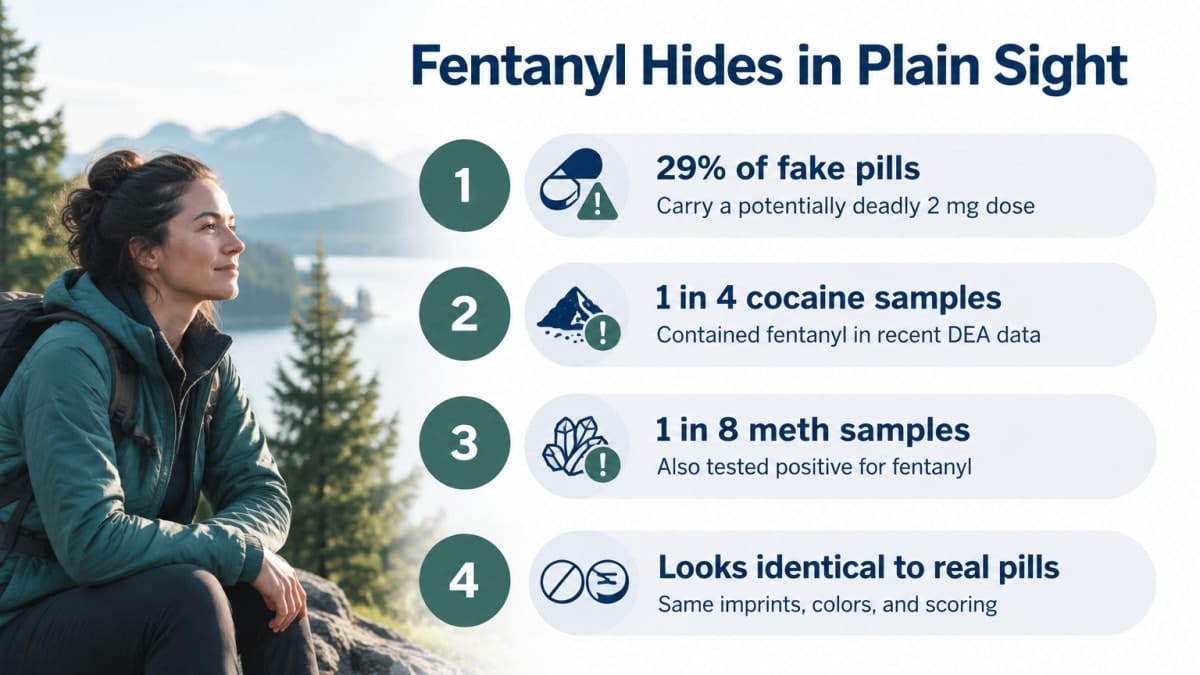
Here’s what makes street fentanyl so hard to protect yourself from: the pill in your hand looks exactly like the real thing. Counterfeits are pressed with the same imprints, the same colors, the same scoring as pharmacy Percocet, Oxycodone, Adderall, or Xanax. Your eyes cannot tell you what’s inside.
DEA lab analysis found that roughly 29% of fentanyl-containing counterfeit pills tested in fiscal year 2025 held a potentially deadly dose of about 2 mg, with the average analyzed pill containing 1.58 mg.13 That’s a laboratory sample of seized pills, not every pill in circulation, so don’t read it as a fixed probability for any one tablet. Read it as a warning that the risk is real and the dose varies wildly from pill to pill, even within the same batch.
Fentanyl isn’t only in fake pills, either. DEA’s 2025 National Drug Threat Assessment reported that roughly one in four cocaine submissions and one in eight methamphetamine submissions in recent forensic data also contained fentanyl.14 Someone who has never knowingly touched an opioid can still overdose from a line of cocaine or a point of meth.
If you’re going to use something you didn’t get from a pharmacy, fentanyl test strips, never using alone, and keeping naloxone within arm’s reach are the harm-reduction basics worth knowing.18
Dependence and Withdrawal: Your Nervous System Adapted, That’s Not a Character Flaw
If you’ve been using fentanyl for more than a few weeks and you’re starting to feel sick when a dose wears off, that isn’t weakness. It’s biology doing what biology does. Your brain and nervous system noticed a strong signal arriving regularly and adjusted the volume knobs on everything else to compensate. That adjustment is called dependence, and it can happen with prescribed fentanyl taken exactly as directed, not just with street use.
Here’s what the adaptation looks like when the drug leaves. Within hours of a missed dose, you may feel anxious and restless. Your nose runs. You yawn constantly. Sweating and chills trade places. Muscle aches settle into your back and legs. Then the gut turns on you: stomach cramps, nausea, vomiting, diarrhea. Your heart beats fast. Sleep won’t come, and cravings get loud.8 CDC guidance describes the same cluster, with naloxone sometimes triggering a sudden version of it in people who are opioid-dependent.1
None of that is a verdict on your character. It’s the opposite. It’s evidence that your body took the drug seriously and reorganized around it, which is exactly what a nervous system is supposed to do. The problem is that reorganizing back takes more than willpower and a quiet weekend. That’s why medical support exists, and why the next section walks through what it actually looks like.
Fentanyl in Oregon: What the Numbers Say About Where You Live
If you’re reading this from Portland, Milwaukie, Gresham, Beaverton, Salem, or across the river in Vancouver, the fentanyl problem isn’t an abstraction happening somewhere else. It’s shaping what paramedics see on shift, what parents find in bedrooms, and what friends carry in their bags.
The Oregon Health Authority counted 1,544 overdose deaths in the state in 2024, down about 16% from the year before.15 That drop is real, and it matters. It also doesn’t mean the water is safe. Fentanyl was involved in 68% of fatal overdoses in Oregon in 2024, which means roughly two out of three people who died had this one drug in their system.16
Two more numbers worth sitting with. In 2024, 62.2% of Oregon overdose deaths involved more than one substance, so the person who died often didn’t know everything they’d taken.15 And 34% of the people who died in 2024 had been given naloxone before they were pronounced, up from 10% in 2020.15 Bystanders are reaching for the spray. Sometimes it isn’t enough, which is the strongest argument for calling 911 the second you reach for it.
Why Stopping Alone Is Harder Than It Sounds, and What Supervised Detox Actually Does
You may have tried to stop on your own. Maybe more than once. The first few hours feel manageable. Then the sweating starts, the muscle aches dig in, your gut rebels, you can’t sleep, and the cravings turn into a voice that sounds reasonable. By hour 36, using again feels less like a choice and more like turning off a fire alarm. That isn’t a failure of character. It’s your nervous system doing exactly what it adapted to do.
Supervised medical detox changes the math. In a non-hospital residential setting, nurses are on site around the clock to watch your vitals, manage nausea and pain, help you actually sleep, and keep you safe if breathing or heart rate drift in the wrong direction. Fentanyl withdrawal rarely kills on its own, but it is miserable enough that most people stop trying before the worst passes. Medical support is what lets you get to the other side.
What Comes After Detox: Continued Care That Holds
Detox is where the drug leaves your body. The life you’re walking back into is still the same one you left, which is why what comes next matters as much as the eight to ten days of medical care that start the process.
A real continuum usually looks like this. Detox hands off to a partial hospitalization program (PHP), where you spend most of the day in structured therapy but sleep somewhere stable at night. PHP steps down to an intensive outpatient program (IOP), which pulls back to a few sessions a week so you can start working, parenting, or going to school again. Outpatient care and alumni groups keep you connected after that, often for a year or more.
Each step exists because recovery is a nervous-system rebuild, not a moment. SAMHSA’s federal guidelines are blunt about why that progression matters: short-term withdrawal management on its own carries a high rate of return to opioid use.19 Detox clears the path. The weeks and months after are what let you actually walk it.
A Confidential Next Step
If you’ve read this far, something is pulling at you. Maybe you’re the one using. Maybe you’re the one watching. Either way, calling for help isn’t admitting defeat. It’s the single thing most likely to change what tomorrow looks like.
Pacific Crest Trail Detox is a non-hospital medical detox in Milwaukie, Oregon, serving Portland, Gresham, Beaverton, Salem, Vancouver, and clients from out of state. You’d stay in a home-like setting with RNs on site around the clock, home-cooked meals, daily groups, and providers who round seven days a week. Many of the staff are in recovery themselves. Detox typically runs eight to ten days and hands off directly to PHP, IOP, outpatient, and alumni support, so you aren’t dropped back into the same life with no scaffolding.
We want to be your last treatment experience, whether we’re your first detox or your fifth. Calls are confidential and HIPAA-protected. Reach out to verify your insurance or ask a question. No pressure, no judgment.
Check Coverage for Fentanyl Detox
See whether your plan may help cover medically supervised fentanyl detox and next-step care.
Frequently Asked Questions
How long do the effects of fentanyl last?
It depends on how fentanyl entered your body. A transdermal patch releases fentanyl steadily for up to 72 hours, which is also why the FDA flags that first 24 to 72 hours as the highest-risk window for serious breathing problems.9
Can you overdose on prescribed fentanyl, or only on street fentanyl?
Yes, you can overdose on prescribed fentanyl. The FDA warns that serious, life-threatening, or fatal respiratory depression can occur with medical fentanyl, especially when treatment starts or a dose goes up.6 Prescribed fentanyl is safer because the dose is known and monitored, but it isn’t risk-free. Mixing it with alcohol, benzodiazepines, or sleep medications sharply raises the chance of breathing stopping. Street fentanyl adds the unknown-dose problem on top.
What should I do if I think someone is overdosing on fentanyl?
Call 911 first and say “possible opioid overdose.” Give naloxone if you have it, one spray in one nostril, and repeat in the other nostril after 2 to 3 minutes if they don’t wake or start breathing.18 Support their breathing, roll them onto their side if they’re breathing but unconscious, and stay with them until paramedics arrive. Naloxone can wear off before the fentanyl does, so a second overdose is possible.1
How can I tell if a pill contains fentanyl?
You can’t tell by looking. Counterfeit pills are pressed to match the imprint, color, and shape of real pharmacy medications, and DEA lab testing found that roughly 29% of fentanyl-containing counterfeit pills analyzed in fiscal year 2025 held a potentially deadly dose.13 SAMHSA notes that fentanyl test strips are among the harm-reduction tools used to help identify fentanyl in a substance, though they cannot guarantee a substance is free of fentanyl or other dangerous adulterants.18
Is fentanyl withdrawal dangerous, and how long does it last?
Fentanyl withdrawal is rarely life-threatening on its own, unlike alcohol or benzodiazepine withdrawal, which can be. But it is intensely uncomfortable: anxiety, sweating, chills, muscle aches, stomach cramps, vomiting, diarrhea, fast heartbeat, insomnia, and strong cravings.8 Medical supervision keeps you safe, hydrated, and far more likely to finish.
Do I have to live in Oregon to get help at Pacific Crest Trail Detox?
No. Pacific Crest Trail Detox is in Milwaukie, Oregon, and serves the Portland metro, Salem, and Vancouver, Washington, but out-of-state clients are welcome too. Many people travel in from across the Pacific Northwest and beyond because stepping away from the environment tied to use helps. Call to verify insurance and talk through logistics. It’s confidential and HIPAA-protected.
References
- How and When to Use Naloxone for an Opioid Overdose. https://www.cdc.gov/overdose-prevention/media/pdfs/2024/04/Naloxone-Fact-Sheet_FamilyandCaregivers_HowandWhen_4_11_2024.pdf
- THE FACTS ABOUT FENTANYL. https://www.cdc.gov/overdose-resources/pdf/CDC_Fentanyl-Fact-Sheet_General_508.pdf
- Signs of Opioid Misuse, Opioid Use Disorder, and Overdose. https://www.cdc.gov/overdose-prevention/media/pdfs/Signs-of-Opioid-Misuse-Opioid-Use-Order-and-Overdose_508compliant.pdf
- 5 Things to Know About Naloxone | Overdose Prevention. https://www.cdc.gov/overdose-prevention/reversing-overdose/about-naloxone.html
- Fentanyl: Incapacitating Agent. https://www.cdc.gov/niosh/ershdb/emergencyresponsecard_29750022.html
- Fentanyl Citrate Injection: Prescribing Information. https://www.accessdata.fda.gov/drugsatfda_docs/label/2025/019115s048lbl.pdf
- Fentanyl Transdermal System Prescribing Information. https://www.accessdata.fda.gov/spl/data/87f6e135-d908-4279-b38c-d05597f3e882/87f6e135-d908-4279-b38c-d05597f3e882.xml
- Fentanyl: MedlinePlus Drug Information. https://medlineplus.gov/druginfo/meds/a605043.html
- Fentanyl Transdermal Patch: MedlinePlus Drug Information. https://medlineplus.gov/druginfo/meds/a601202.html
- Fentanyl. https://www.cdc.gov/overdose-prevention/about/fentanyl.html
- Drug Overdose Deaths in the United States, 2003–2023. https://www.cdc.gov/nchs/data/databriefs/db522.pdf
- U.S. Overdose Deaths Decrease for Third Consecutive Year in 2025. https://www.cdc.gov/nchs/pressroom/releases/20260513.html
- The United States: 2024-2025 Counterfeit Pill Data. https://www.dea.gov/sites/default/files/2026-10/US-2024-2025%20Counterfeit%20Pill%20Data.pdf
- DEA Releases 2025 National Drug Threat Assessment. https://www.dea.gov/press-releases/2025/05/15/dea-releases-2025-national-drug-threat-assessment
- 2025 Opioids and the Ongoing Drug Overdose Crisis in Oregon: Report to the Legislature. https://www.oregon.gov/oha/PH/PREVENTIONWELLNESS/SUBSTANCEUSE/OPIOIDS/SiteAssets/Lists/feature/EditForm/2025%20Oregon%20Opioid%20Overdose%20Report.pdf
- Fentanyl: Opioid Overdose and Misuse Prevention | Oregon Health Authority. https://www.oregon.gov/oha/PH/PREVENTIONWELLNESS/SUBSTANCEUSE/OPIOIDS/Pages/FentanylFacts.aspx
- Opioid Overdose Prevention and Reversal. https://www.samhsa.gov/substance-use/treatment/overdose-prevention
- SAMHSA Overdose Prevention and Response Toolkit. https://library.samhsa.gov/sites/default/files/overdose-prevention-response-kit-pep23-03-00-001.pdf
- Federal Guidelines for Opioid Treatment Programs. https://library.samhsa.gov/sites/default/files/federal-guidelines-opioid-treatment-pep24-02-011.pdf