Key Takeaways
- A detox center is a licensed medical setting where staff monitor vitals, manage withdrawal with medication, and keep someone safe while alcohol or drugs leave the body. At Pacific Crest Trail Detox, stays typically run 8 to 10 days.
- Detox clears the body but does not treat the underlying substance use disorder, which is why NIDA frames it as a starting point that should connect to ongoing care 1.
- Alcohol and benzodiazepine withdrawal can be life-threatening, and opioid detox without continuing medication raises overdose risk once tolerance drops 2, 3.
- A quality detox center pairs 24-hour nursing, daily provider rounds, and verifiable accreditation with a written continuing-care plan into PHP, IOP, outpatient, or MAT before discharge.
What People Actually Mean When They Say “Detox Center”
A detox center is a healthcare setting where your body safely clears alcohol or drugs under medical supervision. Nurses monitor your vitals, providers manage withdrawal symptoms with medication when needed, and staff keep you comfortable and safe through the hardest first days. That’s the detox center meaning in plain terms.
What a detox center is not: a cure, a rehab, or a place that fixes the reasons you started using in the first place. Detox handles the acute, physical part of stopping. The deeper work of recovery, cravings, mental health, relationships, happens in the care that follows 1.
If you’re reading this because you’re scared for yourself or someone you love, you’re already doing something right. The rest of this article walks you through what actually happens inside a detox center, who needs one, what the days look like, which medications help, and what comes next, so you can make the next call with your eyes open.
What Is a Detox Center, in Plain Language?
The honest definition: a medically supervised place to get through withdrawal
A detox center is a licensed healthcare setting where trained staff help your body get through withdrawal safely. Think of it as a short-stay medical environment with one job: keep you stable, comfortable, and alive while alcohol or drugs leave your system.
At Pacific Crest Trail Detox, stays typically run 8 to 10 days for alcohol and opioids. During that time, nurses check your blood pressure, heart rate, temperature, and symptoms around the clock. A provider decides whether you need medication to prevent seizures, calm nausea, lower blood pressure, or quiet opioid cravings. You sleep, eat, hydrate, and start to feel human again.
Here’s the honest part: detox clears your body. It does not treat the reasons you drank or used. That’s not a failure of detox, it’s the design. Managing withdrawal and treating a substance use disorder are two different jobs, and detox is only the first one 1.
Detox vs. rehab vs. treatment: why the words get confused
These three words get used like they mean the same thing. They don’t.
- Detox
- is the medical piece. Days, not months. The goal is a safe exit from physical dependence.
- Rehab
- is an older, catch-all word people use for residential programs where someone lives on-site and gets therapy, groups, and structure, usually for a few weeks.
- Treatment
- is the bigger umbrella. It covers everything that actually addresses the substance use disorder itself: individual counseling, group therapy, medication for opioid or alcohol use disorder, family work, help with co-occurring anxiety or depression, and the slow rebuilding of a life. Treatment usually runs in levels, partial hospitalization, intensive outpatient, standard outpatient, and continues for months.
NIDA puts it plainly: detoxification is not the same as treatment, and detox on its own usually leads back to use 1. That’s not a scare line. It’s why a good detox center spends part of your stay planning what comes after you walk out the door.
Who a Detox Center Is For
When alcohol withdrawal becomes a medical emergency
If you’ve been drinking heavily every day for weeks, months, or years, stopping on your own is not just hard. It can kill you.
Alcohol withdrawal after chronic heavy drinking can trigger seizures and a condition called delirium tremens, where a person becomes confused, agitated, and physically unstable. NIAAA is direct about this: alcohol withdrawal can be life-threatening when someone who drinks heavily stops suddenly without medical support 2.
Signs that withdrawal is heading somewhere serious include:
- shaking hands
- sweating
- nausea that won’t quit
- racing heart
- hallucinations
- a seizure
If any of these show up after you cut back or stop, that’s a medical situation, not something to tough out.
This is exactly what a detox center is built for. Nurses watch your vitals around the clock, and providers can start medication early to prevent the worst outcomes before they begin. If you’re drinking daily and thinking about stopping, don’t white-knuckle it at home. Get assessed first.
Opioids, benzodiazepines, and other drugs that need supervised care
Opioid withdrawal, think heroin, fentanyl, oxycodone, hydrocodone, methadone, usually isn’t fatal on its own, but it’s brutal. Bone-deep aches, vomiting, diarrhea, insomnia, and a crushing anxiety that makes most people use again just to make it stop. A detox center can quiet those symptoms with medication and start you on treatment that actually lowers your overdose risk going forward. CDC is clear that detox without medication for opioid use disorder is not recommended, because the risk of returning to use, and overdosing on a lower tolerance, goes up 3.
Benzodiazepines, Xanax, Klonopin, Ativan, Valium, are the other group that needs medical supervision, full stop. Stopping suddenly after regular use can cause seizures, similar to alcohol. A supervised taper is the safe path.
Stimulants like meth and cocaine don’t typically cause medical-emergency withdrawal, but the crash, deep depression, exhaustion, cravings, often lands people back in use within days without structured support.
If you’re reading this for someone you love
You’re probably exhausted. Maybe you’ve been through a few bad nights, a scary text, a bottle hidden somewhere it shouldn’t be. You want to help, and you don’t want to make it worse.
Here’s what helps: knowing that detox is a real medical service, not a punishment and not a last resort. You don’t have to wait for rock bottom. You don’t have to force a decision today. You can call a detox center yourself and ask questions, before your person is ready, so you know what to say when they are.
Confidential assessments are usually free. Admissions staff talk to family members every day. You are not overreacting by picking up the phone.
Inside a Detox Center: What 8 to 10 Days Actually Looks Like
Intake, assessment, and the first 24 hours
You arrive, usually with a small bag and a lot of nerves. Someone meets you at the door, not a clipboard-first stranger. Intake is a conversation: what you’ve been using, how much, how often, when your last drink or dose was, what medications you take, what medical conditions you live with, and what’s happened in past detox attempts if there were any.
A nurse checks your vitals and draws labs. A provider reviews everything and decides what your body is likely to do over the next 72 hours. If you drink daily or use opioids heavily, medication usually starts within the first few hours to get ahead of withdrawal, not chase it.
The first 24 hours are the loudest. You’ll be checked often, offered fluids and food when you can hold it down, and settled into a room. Most people sleep in pieces. That’s expected. You’re not failing, your nervous system is resetting.
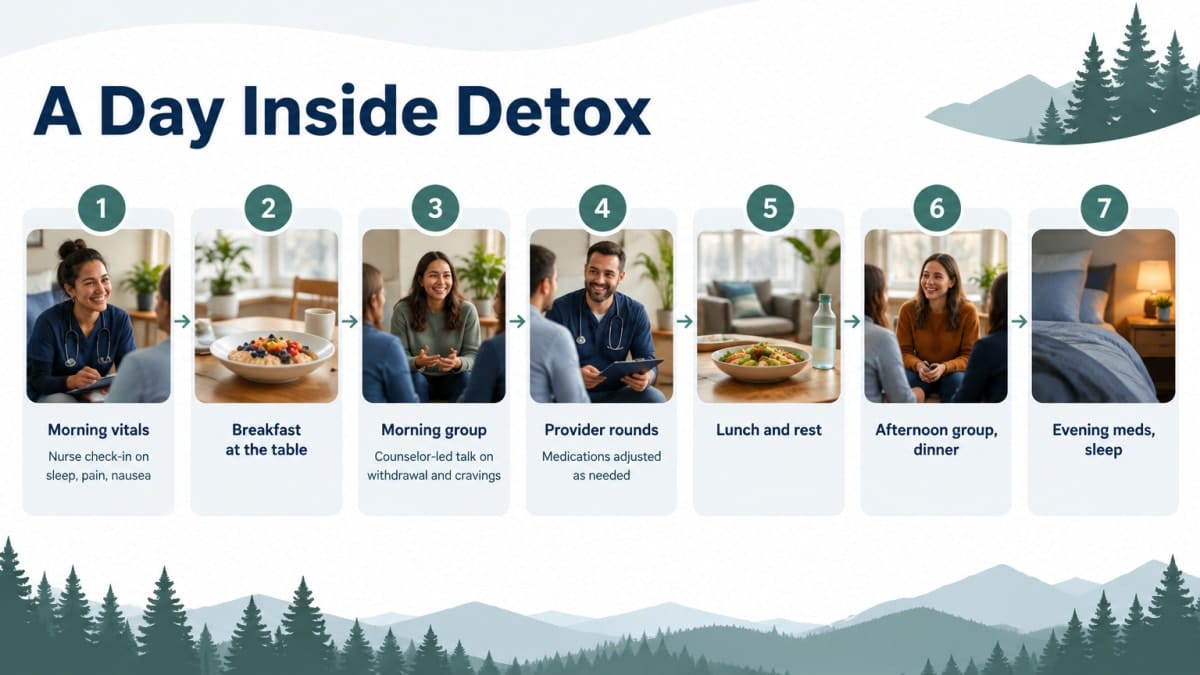
A real day: vitals, meals, groups, provider rounds, sleep
By day two or three, there’s a rhythm. It’s quieter than a hospital and more structured than home.
Mornings start with vitals and a check-in with a nurse. How did you sleep? Pain level? Nausea? Anxiety? Medications get adjusted based on what you report and what the numbers say. Breakfast is a real meal, eggs, oatmeal, fruit, coffee, eaten at a table, not off a tray. Appetite usually comes back in waves. Nobody pushes.
Mid-morning is often a group: a short, grounded conversation led by a counselor. Topics stay practical, what withdrawal does to the brain, what cravings actually are, what the next level of care looks like. You listen as much as you talk. Many of the people leading groups have been through this themselves, which tends to lower the walls faster than any credential.
Providers round through the day, checking in on how medication is working and whether anything needs to change. Lunch, rest, maybe a walk outside if you’re steady on your feet. Afternoon group. Dinner. Evening meds. Sleep, which gets easier as the days pass.
NIDA frames detox as the acute-withdrawal management phase that should connect to ongoing treatment, not a stand-alone fix 1. The daily structure inside a good detox center is built around that reality: stabilize the body, start building trust, and prepare you for what comes next.
Discharge planning and the warm handoff to what comes next
Discharge planning doesn’t start on day 10. It starts around day three, as soon as your head clears enough to think past the next hour.
A case manager sits with you to map out what’s next: partial hospitalization, intensive outpatient, standard outpatient, sober living, medication for opioid or alcohol use disorder, or a combination. Appointments get scheduled before you leave, not after. If you’re coming from Portland, Milwaukie, Gresham, Beaverton, Salem, or Vancouver WA, local handoffs are easier. Out-of-state readers get help lining up care back home or stepping into continuing care here.
The goal is simple: you shouldn’t walk out the door with a bag of belongings and a phone number scribbled on paper. You should walk out with a plan, a start date, and someone expecting you.
Medications Used in Detox, Explained Without the Alphabet Soup
For alcohol withdrawal: calming the nervous system safely
When you’ve been drinking heavily and suddenly stop, your nervous system goes into overdrive. It’s been pushing against alcohol’s sedating effect for so long that, without it, everything revs: heart rate, blood pressure, anxiety, tremors. Left alone, that revving can turn into seizures or delirium tremens.
The standard medication for medically managed alcohol withdrawal is a class of drugs called benzodiazepines, used short-term and in a controlled setting to prevent seizures and keep the nervous system from boiling over 5. A nurse or provider doses them based on your symptoms and vitals, not a flat schedule, so you get what you need and no more. Doses taper down as your body stabilizes.
A separate set of medications, acamprosate, naltrexone, and disulfiram, exists to support longer-term alcohol use disorder treatment after detox is over. Those are different tools for a different job 5.
For opioid withdrawal: buprenorphine, methadone, naltrexone, and lofexidine
Opioid withdrawal medications split into two camps: ones that get you through the acute days, and ones that treat opioid use disorder going forward. Good detox centers use both, and they explain the difference so you know what you’re taking and why.
- Buprenorphine (often known by the brand name Suboxone when combined with naloxone) is an FDA-approved medication for opioid use disorder used to ease withdrawal and reduce cravings, and most people continue it after discharge as ongoing treatment 4, 7.
- Methadone is another FDA-approved medication for opioid use disorder. It’s generally dispensed through licensed opioid treatment programs and is a well-established option for people who need more structure 4.
- Naltrexone is different. It’s an FDA-approved medication used after withdrawal to help prevent return to opioid use 4, 7.
- Lofexidine isn’t a treatment for opioid use disorder. It’s a non-opioid medication used specifically to ease the acute symptoms of opioid withdrawal while your body resets 7.
Why Detox Alone Isn’t Enough
What the research says about life after a detox stay
Here’s the piece most people don’t hear until it’s too late: finishing detox is not the finish line. Your body is clearer, your head is quieter, but your tolerance has dropped and your brain is still rewiring. That combination is risky, especially for opioids, because the dose that felt normal two weeks ago can now be the dose that stops your breathing.
A 2007 prospective study followed 470 adults for two years after they left an urban detox unit. Estimated overdose occurred in 16.9% of the full group during follow-up, and 26.7% in the subgroup with opioid problems 6. That’s a single cohort from one city nearly two decades ago, not a current national rate, so don’t read it as your fate. Read it as a reason the days after discharge matter as much as the days inside. People who walk out with a plan, medication when appropriate, and someone expecting them do better than people who walk out with a phone number.

What continuing care looks like: PHP, IOP, outpatient, and aftercare
After detox, care steps down in intensity as you build real-life footing. The levels have clunky names, so here’s what they actually mean day to day.
- Partial hospitalization (PHP)
- is the closest thing to detox-level structure without the overnight stay. You spend most of the day in groups, individual sessions, and medical check-ins, five or six days a week, then go home or to sober living at night.
- Intensive outpatient (IOP)
- drops the hours but keeps the backbone, usually three days a week, three hours at a time. Enough structure to hold you steady while you start working, parenting, or going back to school.
- Standard outpatient
- is weekly therapy, medication management, and occasional groups. It’s where most people land once life feels possible again.
- Aftercare and alumni support
- is the long tail, peer groups, check-ins, and a community that remembers your name a year later.
NIDA frames recovery as a long process that benefits from sustained support rather than a single episode of care 1. The handoff from detox to one of these levels is the whole point of a good stay.
How to Tell a Good Detox Center From a Bad One
Signals of safe, honest care
A good detox center sounds boring on the phone. The person who answers asks about your medical history, how much you’ve been using and for how long, what medications you take, and whether you’ve had seizures or detox attempts before. They don’t promise anything in the first five minutes. That’s a good sign.
Look for a few specific things:
- Nurses on-site 24 hours a day, not just on call.
- A provider, meaning a physician, nurse practitioner, or physician assistant, who rounds regularly, not weekly.
- Clear accreditation, such as The Joint Commission, and state licensure you can verify yourself.
- A written medication plan that matches what the research actually supports, benzodiazepines for alcohol withdrawal under supervision 5, and buprenorphine, methadone, or naltrexone for opioid use disorder with a plan that extends past discharge 4, 7.
Honest centers also talk about what comes after discharge before you’ve even checked in. CDC is clear that detox without a continuing-care plan raises the risk of returning to use 3. A good admissions team knows that and brings it up without being asked.
Red flags that should make you pause
Be careful if a center promises a cure, a guaranteed outcome, or a quick fix. Nobody in legitimate addiction medicine talks that way. Recovery is a process, and anyone claiming otherwise is selling.
Other things that should make you slow down:
- pressure to commit before you’ve asked questions
- vague answers about medical staffing or who’s on-site overnight
- no accreditation or license information on the website
- aggressive upselling the moment they confirm you have insurance
- no clear plan for care after discharge
NIDA is direct that detoxification by itself usually leads back to use 1, so a center that treats detox as the whole product, rather than the first step, is missing the point of why you called.
Trust your gut. If the conversation feels like a sales pitch instead of a medical intake, hang up and call somewhere else.
The Bigger Picture: Overdose Deaths Are Falling, but Risk Is Still Real
You’re making this decision in a moment that’s actually trending in the right direction. CDC provisionally estimated 69,973 U.S. drug-overdose deaths in 2025, down from an estimated 81,313 in 2024, with opioid-involved deaths falling from an estimated 55,296 to 44,564 over the same period. Those are provisional figures and may shift as records are finalized, but the direction is real: this is the third year in a row the numbers have come down 8.
That matters for how you think about the next few weeks. Fewer people are dying, which means more people are getting into care, staying on medication, and finding ways to keep going. You are not stepping into a lost cause. You are stepping into a system that is, slowly, learning how to help.
At the same time, risk doesn’t disappear because a national chart ticks down. Tens of thousands of people still died last year, and the days right after a detox stay carry their own danger, especially for opioids, when tolerance drops fast. The hopeful read and the honest read live in the same sentence: things are getting better, and your plan after discharge is still the thing that keeps you alive.
How to Choose a Detox Center in the Portland Metro, SW Washington, or From Out of State
If you’re calling from Portland, Milwaukie, Gresham, Beaverton, Salem, or Vancouver WA, geography actually helps you. A local detox center means a shorter drive on the hardest day, easier family visits, and a smoother handoff to continuing care providers who already know each other. Ask whether the center has established relationships with PHP and IOP programs you could step into within a week of discharge.
Coming from out of state is also common and worth doing when the right fit isn’t close to home. A good admissions team will coordinate travel, confirm medical clearance before you fly or drive, and build a continuing-care plan that works whether you stay in Oregon afterward or head back. Ask directly: how will I get from the airport, what happens if I need medication on arrival, and who helps me line up care when I leave?
Short checklist as you compare centers:
- 24-hour on-site nursing
- a provider who rounds daily
- verifiable accreditation and state licensure
- medications that match current guidance for alcohol or opioid withdrawal 3, 5
- a written continuing-care plan before discharge 1
If a center can’t answer those in one call, keep calling.
Talk to Someone Confidentially About Your Next Step
You don’t have to have it all figured out before you pick up the phone. A confidential call is just a conversation: someone asks what’s going on, listens, and helps you figure out whether medical detox makes sense right now. No commitment, no judgment, no sales pitch.
Pacific Crest Trail Detox, based in Milwaukie just outside Portland, offers free assessments by phone, and admissions staff can walk you through what detox would look like, how insurance verification works, and what continuing care could follow. Calls are HIPAA-protected. Whether you’re local, in Vancouver WA, or calling from out of state, the first step is the same: talk to a real person and see what’s actually possible from here.
See What Detox Care Your Plan May Cover
Check your benefits for medically supervised detox and learn what steps may be available to you.
Frequently Asked Questions
What is the difference between a detox center and a rehab?
A detox center handles the short medical window where your body clears alcohol or drugs. Rehab is a longer stretch of therapy, groups, and structure that treats the substance use disorder itself. Detox keeps you safe through withdrawal. Rehab, or treatment more broadly, does the deeper work that follows 1.
How long does a stay at a detox center usually last?
At Pacific Crest Trail Detox, stays typically run 8 to 10 days for alcohol and opioid withdrawal. The exact length depends on what you’ve been using, how long, your medical history, and how your body responds to medication. Your provider adjusts the plan day by day based on vitals and symptoms, not a flat schedule.
Is medical detox necessary, or can someone stop drinking or using at home?
If you drink heavily every day or use benzodiazepines like Xanax or Klonopin regularly, stopping at home is dangerous. Withdrawal can cause seizures and, in alcohol’s case, be life-threatening 2. Opioid withdrawal usually isn’t fatal, but detox without medication raises overdose risk when use resumes 3. Get a medical assessment before you try to stop on your own.
What happens after you leave a detox center?
You step into continuing care, that’s the whole point. Most people move into partial hospitalization, intensive outpatient, standard outpatient, or medication-based treatment like buprenorphine or naltrexone, often combined with sober living or aftercare groups. NIDA is clear that detox without follow-up usually leads back to use, so a good center schedules your next appointment before you walk out 1.
Can someone from out of state come to a detox center in Oregon?
Yes, and it’s common. Admissions teams in the Portland metro and Milwaukie regularly coordinate travel, medical clearance before you fly or drive, and continuing care plans that work whether you stay in Oregon afterward or head home. Ask directly about airport pickup, day-one medication, and how they’ll help you line up care after discharge.
How do I pay for detox, and are calls really confidential?
Most detox centers accept commercial insurance and can verify your benefits by phone before you commit. Ask what’s covered, what your out-of-pocket cost looks like, and whether continuing care is included in the estimate. Calls to a licensed detox center are HIPAA-protected, meaning your health information stays private. Asking questions does not create a medical record or obligate you to admit.
References
- Treatment and Recovery – National Institute on Drug Abuse (NIDA). https://nida.nih.gov/publications/science-addiction/treatment-recovery
- Alcohol Use Disorder: From Risk to Diagnosis to Recovery. https://www.niaaa.nih.gov/health-professionals-communities/core-resource-on-alcohol/alcohol-use-disorder-risk-diagnosis-recovery
- Opioid Use Disorder: Treating | Overdose Prevention – CDC. https://www.cdc.gov/overdose-prevention/hcp/clinical-care/opioid-use-disorder-treating.html
- Information about Medications for Opioid Use Disorder (MOUD) – FDA. https://www.fda.gov/drugs/food-and-drug-administration-overdose-prevention-framework/information-about-medications-opioid-use-disorder-moud
- Mental Health Issues: Alcohol Use Disorder and Common Co-occurring Conditions. https://www.niaaa.nih.gov/health-professionals-communities/core-resource-on-alcohol/mental-health-issues-alcohol-use-disorder-and-common-co-occurring-conditions
- Overdose after detoxification: a prospective study. https://pubmed.ncbi.nlm.nih.gov/17280803/
- Medications for Opioid Use Disorder | National Institute on Drug Abuse. https://nida.nih.gov/research-topics/medications-opioid-use-disorder
- U.S. Overdose Deaths Decrease for Third Consecutive Year in 2025. https://www.cdc.gov/nchs/pressroom/releases/20260513.html