


Key Takeaways
- Oregon licenses residential detox up to 16 beds, so a program holding at 11 is a deliberate staffing choice, not a regulatory limit 1.
- The state has just 301 withdrawal management beds total, making each medically monitored bed a scarce slot within a strained system 6.
- Vet any small center by confirming Health Systems Division licensing, overnight staff ratios, medically monitored level of care, and the handoff to PHP, IOP, or MAT after day five 4, 5.
- If withdrawal from alcohol or benzodiazepines is underway, call a licensed Oregon program tonight with insurance, use history, and a driver ready — travel from rural counties or southwest Washington is common 11.
What 3 a.m. Looks Like Inside an 11-Bed Unit
If you are reading this at 3 a.m., you already know something most people never have to learn. Withdrawal has its own clock. Your legs will not stay still. Your heart is doing something it did not used to do. You keep checking the time and the time keeps not moving.
Here is what that same hour looks like inside a small detox center in Oregon. A nurse walks into your room without knocking twice, because she already knows you have not slept. She takes your blood pressure, asks how the shaking compares to an hour ago, and writes it down on a chart that has your first name on top, not a room number. If you are coming off alcohol or benzodiazepines, she is watching for specific things she has been trained to catch early, because those two withdrawals can turn dangerous fast 4. There is a med tech in the hallway. A counselor is on call. Ten other people are on the unit, not sixty.
That is the whole argument for a small facility, and it is not a marketing one. In a program built around eleven beds and roughly four clients per staff member, the person checking on you at 3 a.m. has met you, remembers what you said at intake, and notices when something shifts. You are not paged. You are seen.
The rest of this guide walks through what “small” actually means under Oregon’s rules, what to ask before you say yes to any center, and what happens after the worst night is behind you. If you are the family member making the call while someone you love is on the couch shaking, that guide is for you too.
Why ‘Small’ Is a Design Choice in Oregon, Not a Shortfall
The 16-Bed Ceiling and What It Signals
Oregon draws a specific line around residential detox. Under state rules, a Residential Substance Use Disorder Treatment Program is a non-hospital setting that provides 24-hour observation and treatment, and it can serve up to 16 individuals — detox included 1. Sixteen is the ceiling. It is not the target.
That distinction matters when you are trying to make sense of what “small” means in a real building with real staff. A program can legally take sixteen people. It can also choose to hold at eleven. Both are legal. Only one lets a nurse remember what your withdrawal looked like six hours ago without pulling up a chart.
The rules that sit alongside the bed cap are just as telling. Oregon requires every residential behavioral health program to stay inside its approved capacity — “at no time shall the number of individuals served exceed the approved capacity” — and to keep a written emergency plan posted near the staff phone 3. Those are floor-level expectations, not aspirations. What varies is how much room a program leaves between its floor and its ceiling.
When you see a small Oregon detox operating with eleven beds instead of sixteen, read it as a deliberate choice. The building could be fuller. The staff schedule was written so it would not be.
Oregon’s Withdrawal Management Footprint: 301 Beds for a Whole State
Zoom out from a single building and the picture gets thinner fast. Oregon has 301 withdrawal management beds total — 293 medically monitored and 8 clinically managed — which works out to roughly 7.11 beds per 100,000 people 6. That is the entire supply of licensed detox beds for a state of more than four million.
Split those numbers apart and it gets more specific. “Medically monitored” means round-the-clock nursing with a physician available — the level of care you want when you are coming off alcohol, benzodiazepines, or opioids and your body needs someone watching your vitals through the night. “Clinically managed” means a lower-intensity, more home-like setting for milder withdrawal. There are only eight of those beds in the whole state. Eight.
So when a program in Milwaukie holds eleven medically monitored beds, that is not a rounding error inside a giant system. That is roughly 3.7% of Oregon’s entire medically monitored withdrawal capacity sitting in one house. Each bed is a real slot for a real person on a real night.
What that means for you, practically: when you call, you are not shopping a large marketplace. You are asking whether one of a very small number of licensed beds in the state is open for you tonight, and whether the people staffing it can give you the kind of attention your body needs during the worst of it.
The scarcity is not a marketing point. It is the reason small programs matter. If Oregon had thousands of detox beds, size would be a preference. It doesn’t. Size becomes a design decision — how much attention each bed gets — and small programs stake out the end of the spectrum where you are not competing with sixty other people for a nurse’s eyes.
Demand Is Still Enormous, Even as Deaths Drop
There is a piece of good news in the Oregon data, and you deserve to hear it plainly. Overdose deaths in Oregon dropped in 2024 — 1,544 people died, down from 1,833 in 2023 8. That is 289 people who did not die in a year. It matters.
What the same report shows in the next paragraph is why you are still reading this at whatever hour it is. In 2024, Oregon recorded 4,193 inpatient overdose-related hospitalizations and 10,365 overdose-related emergency room visits 8. The dying slowed. The suffering did not. For every person who died, several more were carried into an ER, stabilized, and sent home — often with no bed waiting for them to detox in.
You are somewhere on that same map. Maybe you have already been in an ER this year. Maybe you have been trying to quit on your own and your body is telling you that is not going to work this time. Either way, the numbers behind you are not shrinking.
That is why small programs holding themselves to eleven beds instead of stretching to sixteen is not a boutique flourish. It is a working answer to a question the state has not solved: how do you give the person in front of you the attention their withdrawal actually needs, when the whole system is under pressure? You do it by keeping the room small on purpose.
What a 4:1 Staff Ratio Actually Buys You During Withdrawal
Who Is on Shift at 2 a.m. — and What They Do
A staff-to-client ratio is one of those numbers that sounds like a spec sheet until you are the client. So let’s put it in a room.
At 2 a.m. inside an eleven-bed unit running roughly four clients per staff member, the shift is not a skeleton crew. A nurse is awake and moving between rooms, running the withdrawal assessments Oregon’s rules expect for a medically monitored program 4. A medication technician is nearby, ready to pull the next comfort med when the nurse says it’s time — the Ativan taper for alcohol withdrawal, the clonidine for opioid restlessness, the hydration and electrolytes nobody thinks about until they are cramping. A counselor is on call by phone if someone spirals emotionally at 3 a.m., which happens. A peer support person — someone who has been through their own withdrawal — is often on the overnight rotation too, because the loneliest hour of detox is not always the one where your vitals are worst.
Four to one means the nurse doing your 2 a.m. check just came from checking two other people, not sixteen. She has time to sit on the edge of the bed. She notices you have not touched the water on the nightstand. She writes it down. When the day-shift nurse comes on at 7, that note is the first thing she reads. That handoff is what safety actually looks like, and it is only possible when the math stays small.
Being Recognized, Not Rotated Through
There is a specific fear that shows up when you are considering detox, and it deserves to be named. You are afraid you will be a chart. A room number. A face the night nurse has to squint at because she is on her fourth admission of the shift.
Small changes that math. When a program holds eleven beds instead of stretching to the state’s sixteen-person cap 1, the same handful of nurses, techs, and counselors see you across shifts. By day two, someone knows you take your coffee black and that you get quiet — not calm, quiet — right before your tremors spike. By day four, the counselor walking you to your first group already knows your kid’s name because you mentioned her at intake.
That kind of recognition is not a soft benefit. It is how staff catch the thing that is about to go wrong before it does. And it is the whole point of Pacific Crest Trail Detox holding at eleven — so the person watching you at 2 a.m. is not meeting you for the first time.
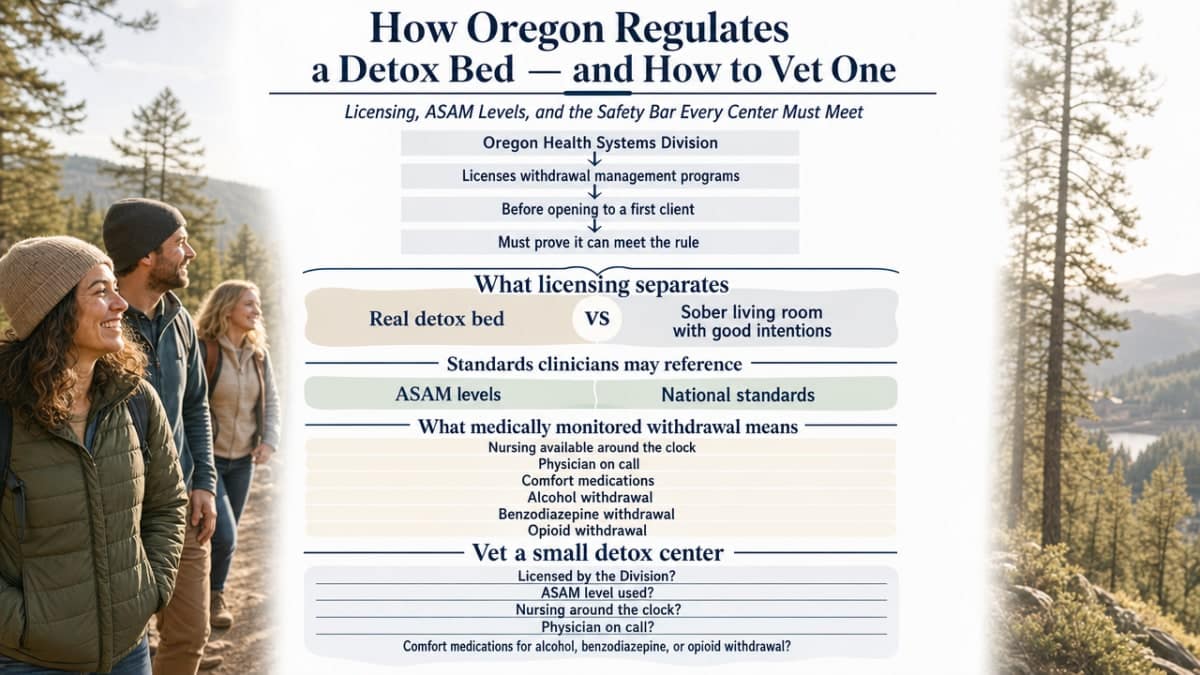
How Oregon Regulates a Detox Bed — and How to Vet One
Licensing, ASAM Levels, and the Safety Bar Every Center Must Meet
Any withdrawal management program operating in Oregon has to be licensed by the state’s Health Systems Division. That is not a formality. The rule that governs detox centers spells out that “withdrawal management programs must be licensed by the Division” and lays out what the program has to prove it can do before it opens the door to a first client 4. Licensing is what separates a real detox bed from a sober living room with good intentions.
The current rules are written to line up with two national standards you may see referenced by clinicians or insurance case managers. The first is what most people call medically monitored withdrawal — nursing available around the clock, a physician on call, comfort medications for alcohol, benzodiazepine, or opioid withdrawal, and protocols for the moments when vitals go the wrong direction. The second is a lower-intensity, more home-like level for milder withdrawal 4. If a center in Oregon is treating you for alcohol or benzo withdrawal, the medically monitored standard is the one you want them held to.
A Short Checklist Before You Say Yes to Any Small Center
You are not going to have hours to research this. So here is a short list you can run through on a phone call, in the parking lot, or from the couch while someone you love is shaking next to you.
- Ask if they are licensed by Oregon’s Health Systems Division for withdrawal management. If the person answering hesitates or says “we’re a wellness program,” that is your answer. Licensed detox centers know they are licensed 4.
- Ask what level of withdrawal management they are approved for. For alcohol, benzodiazepines, or opioids, you want medically monitored — nursing overnight, physician on call, comfort medications on hand.
- Ask about the staff-to-client ratio on the overnight shift specifically. Daytime numbers can look great and hide a thin 2 a.m. crew.
- Ask what happens on day five or seven. A good center has already thought about the handoff to medication-assisted treatment, a partial hospitalization program, or outpatient care 5. If the answer is “we discharge you home,” keep calling.
- Ask about insurance in the first sentence, not the last. Confirm what plans they accept and whether they can verify your benefits today.
None of these questions are rude. Any small center worth admitting yourself to has heard all of them and will answer plainly. You are allowed to be a hard yes.
Detox Is Step One: The Continuum That Makes Small Work Long-Term
Here is the honest part nobody tells you at intake: getting through withdrawal is not the same thing as getting better. National guidance is blunt about it. SAMHSA’s Treatment Improvement Protocol 45 says detoxification “is not in itself treatment” — it is “a first step in the treatment of substance-related disorders” 5. Five to seven days of medically monitored withdrawal clears your body. It does not rewire the part of you that reached for the bottle or the pill in the first place.
That is why the size of a detox program only pays off if the handoff into what comes next is already built. A small unit that stabilizes you beautifully and then hands you a printed list of phone numbers on discharge day is not a small program. It is a bottleneck with nice lighting.
The stages you want lined up before you say yes to any Oregon detox look like this, in plain language:
- Medical detox — the 5-to-7-day stretch with nursing overnight and comfort medications.
- Medication-assisted treatment (MAT) — Suboxone, Vivitrol, or naltrexone if opioids or alcohol are in the picture, so your brain has support while it recalibrates.
- Partial hospitalization (PHP) — day-long clinical programming, usually five days a week, while you sleep in a stable setting.
- Intensive outpatient (IOP) — a step down, typically nine to twelve hours a week, so you can start rebuilding a normal schedule.
- Standard outpatient — weekly therapy and check-ins.
- Alumni and aftercare — the people who knew you at your worst, still checking in a year later.
Oregon’s Medicaid program is designed with that arc in mind. The state’s SUD 1115 demonstration aims for a statewide average residential length of stay of 30 days or less, with medically supervised withdrawal management flowing directly into ongoing treatment 9. Detox is engineered as a doorway, not a destination.
Small programs that run their own PHP, IOP, and alumni tracks — the way Pacific Crest Trail Detox does — collapse the handoff into a single relationship. The counselor who sat with you on day three is still the one you see on week six. That continuity is what makes eleven beds work for the long haul, not just the long night.
Paying for a Small Detox Bed in Oregon
Money is the question people are most afraid to ask when they call, and it should be the first one. A small detox bed in Oregon is not cheaper than a large one — the nursing hours, comfort medications, and physician oversight cost the same whether the building holds eleven people or sixty. What changes is how the bill gets paid, and that changes based on which insurance card is in your wallet.
Most private commercial insurance plans in Oregon cover medically monitored withdrawal management as a medical necessity. That includes the big regional carriers — Regence, Providence, PacificSource, Moda, Kaiser (out of network in most cases), and the national plans like Aetna, Cigna, and United. A small center’s admissions team should be able to run a real-time benefits check while you are still on the phone, tell you what your deductible and coinsurance look like, and give you a plain number before you agree to come in. If they cannot do that in the first call, that is a signal.
The Oregon Health Plan — the state’s Medicaid program — is a different track. Under Oregon’s SUD 1115 demonstration, Medicaid pays for medically supervised withdrawal management and residential treatment, with the state aiming for a statewide average residential length of stay of 30 days or less 9. That coverage is real and it is generous. But not every small center contracts with OHP. Pacific Crest Trail Detox, for example, accepts most commercial insurance but does not accept OHP. If Medicaid is your coverage, ask directly and be ready to be routed to a center that takes it — the state’s SUD 1115 waiver page and your coordinated care organization can help you find one 7.
A few things worth knowing before you commit. Ask whether the quoted number is per day or for the full stay. Ask whether MAT medications and lab work are billed separately. Ask what happens if your withdrawal needs six days instead of five. And ask about a self-pay rate — some small centers publish one, and it is sometimes lower than what a high-deductible plan would leave you owing. None of these questions slow the admission down. They protect you from a bill you did not see coming.
Geography: Why a Milwaukie Bed Serves a Wider Pacific Northwest
Milwaukie sits just south of Portland, which puts a small detox bed there inside easy reach of the metro area — but the catchment is much wider than that. Many rural Oregon counties have no local residential SUD treatment or withdrawal management beds at all, which means people routinely travel to urban centers for a licensed bed 11. If you are calling from Bend, from the coast, from a small town in the Gorge, or from southwest Washington, that travel is not a preference. It is the only way to get to a nurse who can watch you overnight.
The supply pressure behind that travel is real, and it is not going to loosen soon. Oregon currently has 1,374 SUD residential beds statewide, with a state goal to add just 74 more — about 5% growth — by the end of 2026 2. That is the entire planned expansion for a state where overdose hospitalizations still run in the thousands each year. A handful of new beds spread across the map does not change the fact that on the night you decide to go in, the bed you can actually reach may be an hour or two from home.
What that means for you is simple. When a small Milwaukie program picks up the phone, they are often the closest medically monitored option for someone hours away. Coming to a bed you can get to tonight, in a program small enough that the intake nurse remembers your name by morning, is worth the drive.
If You Are the One Making the Call in the Next 24 Hours
You do not need a plan. You need a phone call. Everything else can be figured out from a chair in the intake office.
Before you dial, put three things within reach:
- the insurance card of the person going in,
- a rough list of what they have been using and how much in the last week, and
- the name of the closest person who can drive.
That is enough. A small detox center’s admissions team will walk you through the rest — benefits check, medical questions, whether tonight or tomorrow morning makes more clinical sense given the last drink or last dose.
You are already doing the hard part. Eleven beds means you are never a number — call Pacific Crest Trail Detox.
Find Out If Your Detox Is Covered Today
Quickly check your insurance for small, personalized detox care in Oregon.
Frequently Asked Questions
Is a small detox center in Oregon safe for alcohol or benzodiazepine withdrawal?
Yes, when it is licensed by Oregon’s Health Systems Division for medically monitored withdrawal management 4. That level means nursing overnight, a physician on call, and comfort medications on hand — the standard you want for alcohol or benzo withdrawal, which can turn dangerous fast. Small size does not lower the safety bar. It raises how closely staff can watch you.
What does ‘small’ actually mean under Oregon’s licensing rules?
Oregon caps residential SUD programs, including detox, at 16 individuals 1. That is the legal ceiling. A program that holds at eleven beds is choosing to sit well below it. The choice shows up in staffing math — fewer clients per nurse, more time at each bedside during the worst hours of withdrawal.
How do I vet a small detox center before admitting myself or a loved one?
Ask five things on the first call. Are they licensed by Oregon’s Health Systems Division for withdrawal management 4. What level — medically monitored or clinically managed. What is the staff-to-client ratio on the overnight shift. What is the handoff into ongoing care on day five or seven. What insurance do they accept, and can they verify benefits today. Plain answers mean a real program.
Does a small detox center take insurance in Oregon?
Most take commercial plans — Regence, Providence, PacificSource, Moda, Aetna, Cigna, United. Coverage varies by center. The Oregon Health Plan is a separate track; not every small program contracts with OHP. Pacific Crest Trail Detox accepts most commercial insurance but does not take OHP. Ask directly on the first call and get a real-time benefits check before you agree to come in.
What happens after detox ends?
Detox is a first step, not treatment on its own 5. After the 5-to-7-day withdrawal stretch, the next stages are medication-assisted treatment if opioids or alcohol are in the picture, then partial hospitalization, intensive outpatient, standard outpatient, and alumni support. Small programs that run their own continuum keep the same counselor with you across stages, which is what makes eleven beds hold up long-term.
Can I travel from another part of Oregon or the Pacific Northwest to a small detox bed?
Yes, and many people do. Rural Oregon counties often have no local withdrawal management beds, so traveling to a Portland-area program is standard 11. A Milwaukie bed is reachable from Bend, the coast, the Gorge, and southwest Washington. Call first — admissions can talk you through timing based on your last drink or last dose, and coordinate a ride if needed.
References
- Oregon Health Authority Behavioral Health Residential+ Facility Study (January 2024). https://www.oregon.gov/oha/HSD/AMH/docs/OR-BH-Residential-Facility-Study-January-2024.pdf
- Governor Kotek, Oregon Health Authority Announce 465 Added Treatment Beds by End of 2026. https://apps.oregon.gov/oregon-newsroom/OR/GOV/Posts/Post/governor-kotek-oregon-health-authority-announce-465-added-treatment-beds-by-end-of-2026
- Health Systems Division: Behavioral Health Services – OAR Chapter 309-018. https://www.oregon.gov/oha/HSD/RAC/309-018.pdf
- Health Systems Division: Addiction Services – OAR 415-050 (Highlighted). https://www.oregon.gov/oha/HSD/Medicaid-Policy/SUDWaiver/415-050-Highlighted-040723.pdf
- Detoxification and Substance Abuse Treatment (TIP 45). https://www.ncbi.nlm.nih.gov/books/NBK64115/
- Oregon Behavioral Health Residential+ Facility Study – Final Report (June 2024). https://www.oregon.gov/oha/BH/Reports/Behavioral-Health-Residential-Facility-Study-June-2024.pdf
- Substance Use Disorder 1115 Demonstration Waiver – Oregon Health Plan. https://www.oregon.gov/oha/hsd/medicaid-policy/pages/sud-waiver.aspx
- Oregon overdose deaths declined in 2024. https://www.oregon.gov/oha/erd/pages/oregon-overdose-deaths-declined-in-2024-2025-05.13.2026.aspx
- Oregon Health Plan Substance Use Disorder 1115 Demonstration – Special Terms and Conditions. https://www.oregon.gov/oha/HSD/Medicaid-Policy/SUDWaiver/STCs-040821.pdf
- Oregon SUD System Assessments and Analyses 2020–25. https://www.oregon.gov/adpc/Committee%20Resources/Summary%20of%20Assessments%20and%20Gaps%20Analyses%202020-25.pdf
- Oregon Rural Behavioral Health Access Report 2022. https://www.oregon.gov/oha/BHP/Documents/Rural-Behavioral-Health-Access-Report-2022.pdf