


Key Takeaways
- Heavy daily drinking weakens the brain’s GABA brakes and floors the glutamate gas pedal, so stopping suddenly leaves nothing to slow neurons down and can trigger a seizure 1, 6.
- The highest-risk seizure window falls between 6 and 48 hours after the last drink, while delirium tremens can begin 48 to 72 hours in and turn fatal without treatment 2, 9.
- Each unsupervised withdrawal can sensitize the nervous system through kindling, meaning later attempts to quit at home may be more severe than earlier ones, not easier 3.
- Supervised detox uses benzodiazepines, 24/7 nursing, and replacement of thiamine and electrolytes to steady the brain’s chemistry and prevent the cliff-edge drop that causes seizures 9, 11.
The Brakes-and-Gas Problem in a Brain That’s Been Drinking
If you’ve been drinking heavily for months or years, your brain has been doing something quiet and clever in the background: adapting. Not because you’re weak. Because that’s what brains do when the same chemical shows up in them every single day. Understanding what it’s been adapting to is the first step in understanding why stopping suddenly can be so physically dangerous — and why what happens next is not your fault.
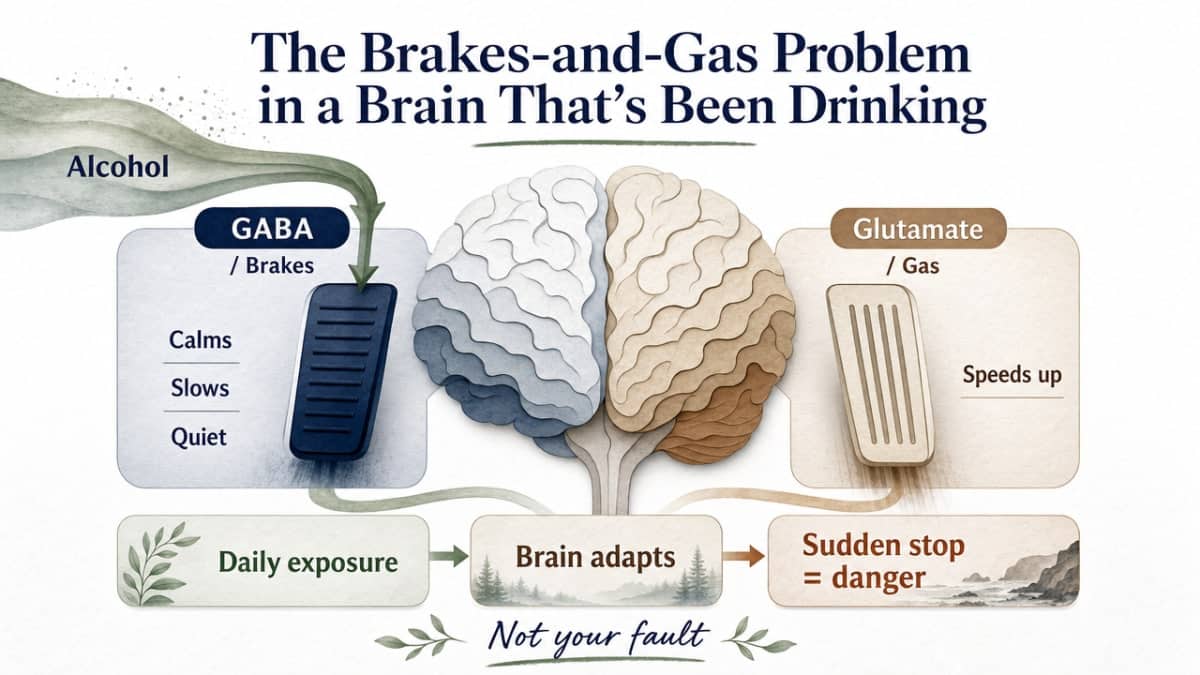
Here’s the picture worth carrying with you. Your brain runs on two big systems that work like the pedals in a car. One is a set of brakes, called GABA, that calms things down. The other is a gas pedal, called glutamate, that speeds things up. Alcohol pushes the brakes. That’s a lot of what people feel when they drink — the slowing, the loosening, the quiet in the head 1.
When alcohol keeps pushing those brakes every day, your brain doesn’t just sit there. It tries to balance the car. It quietly turns down the sensitivity of the GABA brakes and turns up the glutamate gas pedal, so you can still function, work, hold a conversation, drive to the store 5, 6. From the outside, it looks like you’re handling your drinking. On the inside, your nervous system has rewired itself to counter the very substance keeping it steady.
Then the alcohol goes away — even for a night, even because you meant to cut back — and here’s the problem. The brakes are still weakened. The gas is still floored. Nothing is holding the car back. That mismatch is why you feel shaky, sweaty, anxious, or unable to sleep within hours of your last drink, and it’s the same mismatch that can build into a seizure if it isn’t managed 1, 6.
So if you’ve tried to stop and felt like your body turned on you, it wasn’t a lack of willpower. It was chemistry doing exactly what the science predicts. That’s actually good news, because chemistry is something a medical team can steady for you — gently, in a setting that feels more like a home than a hospital — while your brain finds its footing again.
What’s Actually Happening in Your Brain When You Stop Drinking
Let’s slow down and look under the hood, because knowing what your brain is doing when you stop drinking changes everything about how scary this feels. You are not falling apart. You are not being punished for the years of drinking. You are watching a nervous system that adapted to alcohol try to run without it for the first time in a long time — and that transition has a name, a mechanism, and a treatment.
Remember the brakes and the gas from a moment ago? Here is what those pedals are actually called. The brakes are GABA receptors — tiny docking sites on your brain cells that, when activated, calm the whole network down. Alcohol makes those docking sites work harder than they normally would, which is why a drink can feel like the volume knob in your head just turned down 1. The gas pedal is a different system called glutamate, which fires through what are known as NMDA receptors. Glutamate is what wakes you up, keeps you alert, lets you think and react.
After weeks and months of daily heavy drinking, your brain does two things at once to stay balanced. It quiets down the GABA brakes because alcohol is doing that job for it, and it turns up the glutamate gas pedal to compensate for how sedated everything has become 6, 10. Neuroscientists call this downregulation of GABA and upregulation of NMDA-glutamate. In plain terms: your brain has learned to run hot so it can keep up with the alcohol that’s cooling it down.
Now picture what happens the moment the alcohol clears out of your bloodstream. The brakes are worn thin. The gas pedal is floored. There is nothing left to slow the signal down, and your brain cells start firing in a way that is way too loud, way too fast, way too coordinated. Doctors call this state central nervous system hyperexcitability 1, 6. You feel it as a racing heart, jitters, sweat you can’t stop, a sense that your skin is buzzing, sleep that will not come.
When that hyperexcitability crosses a certain threshold, groups of neurons can fire together in a runaway wave — and that wave is a seizure. Most alcohol withdrawal seizures are what’s called generalized tonic-clonic seizures, meaning the whole brain gets pulled into the wave and the body stiffens and shakes 10. It is not a personality defect surfacing. It is not you finally paying for something. It is a specific, mapped, measurable chemical event that happens because your brain has been quietly holding itself together against a daily flood of alcohol, and now the flood is gone.
Here is why that framing matters. If the problem is a mismatch between weakened brakes and a stuck gas pedal, then the solution is to gently re-engage the brakes while your brain rebuilds its own. That is exactly what medically supervised detox does with carefully dosed medication and 24/7 monitoring — it steadies the pedals for you so your nervous system can find neutral again without slamming into a seizure on the way there 1, 10.
The First 72 Hours: A Timeline of What to Watch For
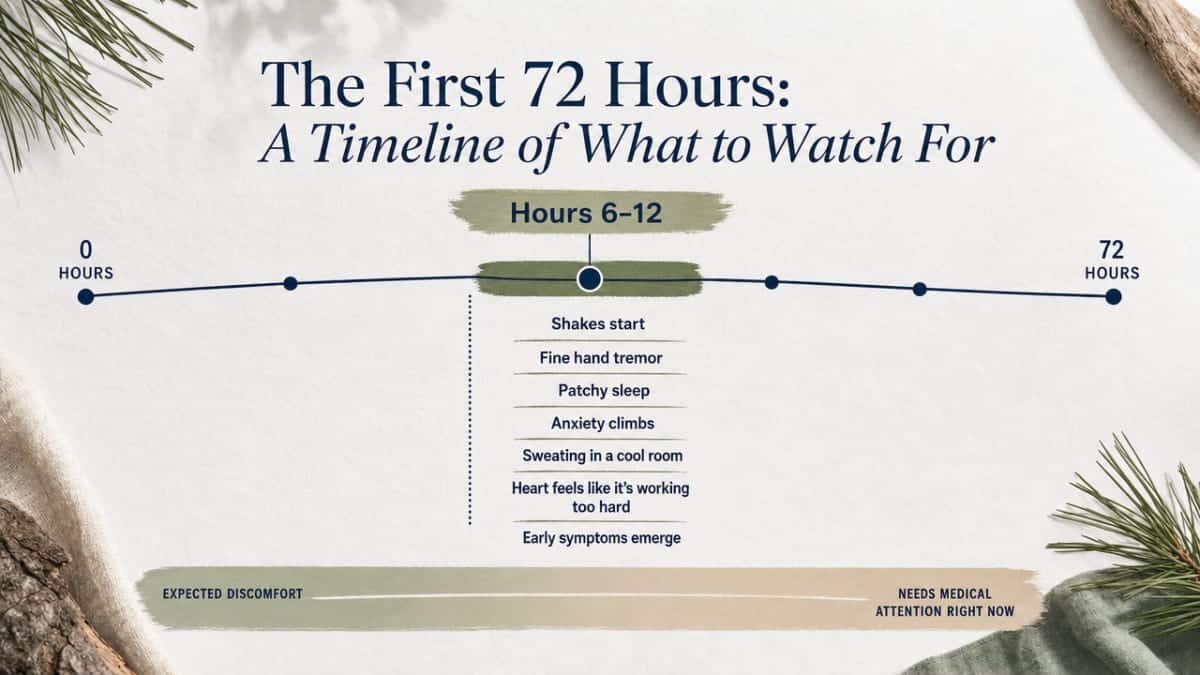
If you or someone you love has just had their last drink, the next three days matter more than any other stretch. Not to scare you — to prepare you. Withdrawal doesn’t unfold randomly. It follows a fairly predictable arc, and knowing what tends to happen when can help you tell the difference between “this is uncomfortable but expected” and “this needs medical attention right now.”
Hours 6 to 12: the shakes start. This is usually the first sign that the brain is missing what it’s been running on. You might notice a fine tremor in your hands, especially when you reach for something. Sleep gets patchy or disappears entirely. Anxiety climbs for no obvious reason, and sweat shows up even in a cool room. Your heart might feel like it’s working too hard just sitting on the couch. These early symptoms typically emerge within the first several hours after the last drink and are the body’s first signal that the nervous system is over-revving 9.
Hours 12 to 24: perception can start to slip. For some people — not everyone — this window brings alcoholic hallucinosis: seeing shadows move, hearing voices or sounds that aren’t there, feeling bugs on the skin. It is deeply unsettling, and it is also, in most cases, a signal that the brain is entering deeper withdrawal without full-blown delirium yet. Awareness usually stays intact, meaning the person can still tell you their name and where they are, which is one of the ways this differs from what comes later 9.
Hours 6 to 48: the seizure window. Acute symptomatic withdrawal seizures — the generalized tonic-clonic kind, where the body stiffens and then jerks — most often appear in this stretch 2. They can happen even in people who have never had a seizure before in their life. They can happen with no dramatic warning. Sometimes there is only one; sometimes they come in clusters. This is the window where being alone at home is the most dangerous, and where medical supervision matters the most.
Hours 48 to 72 and beyond: the delirium tremens window opens. DTs, as they’re often called, are the most serious form of alcohol withdrawal. Confusion becomes profound. The person may not know where they are or who is with them. Heart rate and blood pressure can climb into dangerous territory. Fever, severe agitation, and vivid hallucinations blur together. DTs typically begin 48 to 72 hours after the last drink, and they can stretch on for three to eight days if not treated 9. Untreated DTs can be fatal, which is why this stage belongs in a setting with round-the-clock nursing and medication ready to go.
Here is what to hold onto as you read that timeline: it is a map, not a prophecy. Not everyone experiences every stage. Some people move through the early hours with mild shakes and never progress further. Others go from mild tremor to seizure faster than the textbook suggests. The point of the timeline isn’t to predict exactly what will happen to you — it’s to make clear that the highest-risk hours are the same hours when help is most useful, and that trying to guess your way through them alone is the part worth avoiding 2.
Who Is Most Likely to Have a Withdrawal Seizure
You might be reading this and wondering, quietly, whether you’re the kind of person this actually happens to. That is a fair question, and there are honest answers. Not everyone who stops drinking has a seizure. But researchers have gotten pretty good at spotting the patterns that make one more likely, and if you see yourself in these patterns, that is worth knowing — not to shame you, but so you can make a safer plan than you might have made otherwise.
The biggest single risk factor is a previous complicated withdrawal. If you’ve ever had a seizure while stopping before, or ended up in an ER during a past attempt to quit, or gone through delirium tremens even once, your nervous system has already shown you what it’s capable of. Doctors treat that history as one of the strongest predictors of another severe withdrawal 7.
Heavy, recent daily intake is the next big one. Not “a lot on weekends” — daily or near-daily drinking, at high volumes, sustained over weeks and months. That is what teaches the GABA-and-glutamate system to adapt in the first place, and the more it’s had to adapt, the more it has to unlearn when the alcohol stops 7, 9. If your first drink of the day is close to when you wake up, or if you’ve been drinking to head off shakes, your body is already telling you it’s dependent.
Medical conditions layered on top raise the stakes further. Liver disease, infections, poor nutrition, low magnesium or potassium, a history of head injury, or another seizure disorder can all tip a withdrawal that might have been rough into one that is dangerous 7, 9. Older adults and people who’ve been drinking for many years tend to have a harder time, too, because their systems have less reserve to buffer the shock.
If more than one of those describes you or the person you love, please read this next line slowly: that is not a verdict, that is a reason to have someone else in the room when this happens. A team that can watch vitals, adjust medication, and step in fast is exactly what these risk factors are asking for.
The Kindling Effect: Why Each Home Detox Can Be Worse Than the Last
Here is something almost no one tells you at the kitchen table, and it might be the most important thing in this whole article: withdrawal has a memory. Your brain does not treat the fifth time you stop drinking the same way it treated the first. Every unsupervised withdrawal you have already survived may have quietly made the next one harder — and researchers have a name for that pattern. They call it kindling 3.
Think of it the way you would think of a fire. The first time you try to light damp wood, it takes a lot to get a spark. But once that wood has been dried out by earlier attempts, it catches faster and burns hotter. Your nervous system does something similar. Each time you go through withdrawal — the shakes, the sweating, the racing heart — your brain becomes a little more sensitized, a little more ready to fire hard when the alcohol drops away again. Both clinical studies of people going through repeated detoxes and experimental research point in the same direction: withdrawal symptoms, including seizures, tend to become more severe with each cycle 3.
That reframes a sentence a lot of people say to themselves, sometimes with pride: I’ve quit before, I can do it again. Read compassionately, that sentence is about resilience. Read medically, it is a warning. If the last time was rough, the next unsupervised time is more likely to be rougher, not easier. If the last time included a seizure, the odds of another one go up, not down. Kindling is why someone who muscled through withdrawal in their thirties can end up in an emergency room over the same amount of drinking in their forties, wondering what changed.
A Withdrawal Seizure Is Not Epilepsy
If you’ve already had a withdrawal seizure, or you’ve watched someone you love have one, there’s a fear that tends to show up right after the fear of dying: Do I have epilepsy now? Is this my life from here on out? Take a breath. In most cases, the answer is no.
An alcohol withdrawal seizure is what doctors call an acute symptomatic seizure. Translated out of clinical language, that means it happened because of a specific, temporary chemical event — your brain rebounding hard when the alcohol it had adapted to suddenly disappeared — and not because you have a chronic seizure disorder 8. Epilepsy is different. Epilepsy is a lasting tendency to have unprovoked seizures, meaning they show up without a clear trigger like withdrawal, high fever, or head injury. The two can look almost identical in the moment. They are not the same diagnosis.
The neurobiology backs this up. Withdrawal seizures cluster in a narrow window after the last drink and reflect that short-lived state of rebound hyperexcitability we’ve been walking through — GABA brakes worn thin, glutamate gas floored 10. Once the brain has time to rebalance those systems, usually with medication to steady the process, the specific chemical setup that produced the seizure is no longer there. That is why most people who have a withdrawal seizure and then get sober do not go on to have seizures for the rest of their lives 8.
None of this means a withdrawal seizure is a small thing. It is a serious warning from your nervous system, and it raises the odds of another one if you try to stop unsupervised again. But it is not a permanent label. It is a signal, not a sentence — and with the right care through detox and early recovery, it can be the last one you ever have 10.
What Supervised Detox Actually Does to Lower the Risk
If the danger of alcohol withdrawal comes from a mismatch — brakes worn thin, gas pedal floored — then the whole job of supervised detox is to steady those pedals for you until your brain can steady itself. That is not a vague promise. It is a set of very specific things a medical team does, hour by hour, that changes the outcome.
The first piece is medication. Benzodiazepines are the standard of care for alcohol withdrawal, and the reason is simple: they gently press the same GABA brakes that alcohol has been pressing, so your brain does not experience the cliff-edge drop that triggers seizures and delirium tremens in the first place 11. Instead of your nervous system slamming from full sedation to full hyperexcitability, a clinician eases you down the slope with doses adjusted to what your body is actually showing them — tremor, pulse, blood pressure, sleep. That symptom-triggered approach is what modern protocols use to reduce seizure risk without over-sedating you 9. In some cases, medications like carbamazepine or gabapentin are added on for milder symptoms or mood support, but they are helpers, not replacements 11.
The second piece is 24/7 nursing. Withdrawal changes fast. A person can look okay at 10 p.m. and be seizing at 2 a.m. — that six-to-48-hour seizure window is exactly why someone needs eyes on you overnight, not a family member trying to stay awake in a kitchen chair 2. Nurses watch vital signs, catch early warning signs like rising heart rate or climbing blood pressure, and can give the next dose of medication before things escalate. That constant presence is also why complications like DTs, which can begin in the 48-to-72-hour window, get caught and treated instead of turning fatal 9.
The third piece is everything else your body has been missing. Heavy drinking depletes thiamine (a B vitamin the brain needs), magnesium, potassium, and often just plain calories and water. Supervised detox corrects those quietly in the background with IV or oral supplementation, which lowers seizure risk on its own and helps you feel less wrecked as the days go on 9. Structured medication protocols like these have been shown to reduce the need for higher levels of care and keep more people safe through the hardest hours 4.
The fourth piece is the part that most people do not expect to matter as much as it does: where the care happens. A homelike residential setting — a real bed, a real couch, food that looks like food, staff who talk to you like a person — lets your nervous system come down from years of stress while the medication does its work. Compassionate, evidence-based care in a warm environment is what programs like Pacific Crest Trail Detox are built around, because the calmer your surroundings, the less your already-over-revved brain has to fight. You do not have to earn this kind of help. You just have to accept it.
What to Do Right Now If You’re Scared to Stop
If your hands are a little shaky reading this, or your chest feels tight, that fear is not weakness. It is your nervous system telling you something true — that your body has been carrying alcohol for a long time, and that stopping is a medical event, not a moral test. So let’s talk about what you can actually do in the next hour, not next month.
First, do not stop cold turkey by yourself if you drink heavily every day, if you’ve had shakes when you cut back before, or if you’ve ever had a seizure or been to an ER during a past attempt to quit. That is not a suggestion to keep drinking forever. It is a boundary around the specific 6-to-48-hour window when your brain is most likely to seize 2. Between now and the moment you have support in place, it is safer to keep your intake steady than to slam the door shut on it alone.
Second, tell one person. A partner, an adult child, a friend who has picked up the phone before. You do not have to explain the whole history. “I think I need help stopping drinking safely” is enough. Having someone who knows what’s happening is the difference between a scary night and a dangerous one.
Third, call a medical detox program and ask what an intake looks like. You are allowed to ask questions before you commit. A good program will walk you through what the first day feels like, what medication does, what the room looks like, whether your insurance is accepted. Most do accept insurance, and the person on the phone is not there to judge you — they have heard your story before, from people who are now on the other side of it.
If you are the spouse, parent, or friend reading this because someone you love is in the thick of it: your job is not to convince them of anything philosophical tonight. Your job is to get a phone number on the fridge and be the calm voice in the room. If they are already confused, feverish, seizing, or hallucinating, call 911 — that is an emergency, not a failure.
Reading this far is already a step. Making the call is the next one. You do not have to be brave. You just have to let someone else hold the pedals for a few days while your brain finds its footing again.
Check Your Coverage for Alcohol Detox Support
Find out if your insurance covers safe, supervised alcohol detox for seizure prevention.
Frequently Asked Questions
How long after my last drink could a seizure happen?
For most people, the highest-risk window opens somewhere between 6 and 48 hours after the last drink, which is when acute withdrawal seizures tend to cluster 2. Some folks feel shaky and anxious well before that window; others get through the first day and think they’re in the clear right before something happens. That is exactly why round-the-clock monitoring matters more than trying to predict your own timeline.
Can you die from an alcohol withdrawal seizure?
Yes, though the bigger danger is usually what a seizure signals is coming next. A single withdrawal seizure can cause injury from a fall or lead to a longer, back-to-back seizure that needs emergency care. It also raises the odds of delirium tremens in the following days, which can be fatal if untreated 9. This is not meant to scare you into freezing — it is meant to make one phone call feel worth it.
I’ve quit before without a seizure — am I safe to do it again at home?
Not necessarily, and this is the part most people don’t hear. Research on the kindling effect shows that each unsupervised withdrawal can sensitize your nervous system, so a later attempt may be harder or more dangerous than an earlier one, even at the same drinking level 3. “I got through it before” is a reason to be proud of your resilience — and a reason to have medical support in the room the next time.
Does having a withdrawal seizure mean I have epilepsy now?
In most cases, no. Withdrawal seizures are what doctors call acute symptomatic seizures — they happen because of a short-term chemical rebound when alcohol leaves a brain that adapted to it, not because you have a chronic seizure disorder 8. Once your nervous system rebalances with proper detox support, that specific trigger is gone 10. It’s a serious warning worth listening to, but it is not a diagnosis you carry forever.
What should I do if my spouse or parent is trying to stop drinking and seems shaky or confused?
If they are actively seizing, extremely confused, running a fever, or hallucinating, call 911 — those signs, especially in the 48-to-72-hour range, can point to delirium tremens 9. If they are shaky, sweaty, and anxious but still oriented, that’s the moment to call a medical detox program together and ask about same-day intake. Do not try to help them stop cold turkey at home. Stay with them, keep the room calm, and get professionals involved tonight.
What actually happens in a medically supervised detox?
You get a real bed, an intake conversation, and a nursing team watching your vitals around the clock. Medication — usually benzodiazepines, dosed to what your body is showing — steadies the GABA brakes so your brain doesn’t slam into that hyperexcitable state 11. Fluids, thiamine, and electrolytes get replaced quietly in the background 9. In a homelike setting, therapy and rest happen alongside the medical piece, so the next chapter starts before you leave.
References
- Ethanol, GABA and epilepsy. https://pubmed.ncbi.nlm.nih.gov/10071417/
- Alcohol withdrawal syndrome: mechanisms, manifestations, and management. https://pmc.ncbi.nlm.nih.gov/articles/PMC6084325/
- Kindling in Alcohol Withdrawal. https://pmc.ncbi.nlm.nih.gov/articles/PMC6761822/
- Alcohol Withdrawal Prevention & Treatment. https://med.uth.edu/surgery/alcoholwithdrawl/
- Neurobiology of Alcohol Dependence. https://www.ncbi.nlm.nih.gov/pmc/articles/PMC2951975/
- Pathophysiology of alcohol withdrawal. https://pubmed.ncbi.nlm.nih.gov/12601743/
- Alcohol withdrawal syndrome: mechanisms, manifestations and management. https://pubmed.ncbi.nlm.nih.gov/23146292/
- Update on the neurobiology of alcohol withdrawal seizures. https://pubmed.ncbi.nlm.nih.gov/25747920/
- Alcohol Withdrawal Syndrome – StatPearls – NCBI Bookshelf. https://www.ncbi.nlm.nih.gov/books/NBK441882/
- Update on the Neurobiology of Alcohol Withdrawal Seizures. https://pmc.ncbi.nlm.nih.gov/articles/PMC1312739/
- Anticonvulsants for the Treatment of Alcohol Withdrawal Syndrome and Alcohol Use Disorders. https://pmc.ncbi.nlm.nih.gov/articles/PMC5759952/