

Key Takeaways
- Post-acute withdrawal syndrome is the pattern of lingering symptoms — sleep problems, mood swings, cravings, foggy thinking, and anhedonia — that persist in waves after acute withdrawal clears.1
- PAWS lacks a formal DSM diagnosis, but it is a widely recognized experience that validates why people feel off weeks after detox rather than failing recovery.1
- Timelines differ by substance: alcohol symptoms can run 4-6 months or longer, benzodiazepine symptoms can last months or years, and stimulants bring a slow mood climb after the first few days.1, 10, 8
- Detox alone is not enough; continuing care and medication where appropriate help carry people through the months when PAWS symptoms rise and fall.9, 7
When Detox Ends and the Hard Weeks Begin
Post-acute withdrawal syndrome (PAWS) is the cluster of symptoms some people live with after acute withdrawal has settled — anxiety, poor sleep, mood swings, foggy thinking, and cravings that come and go for weeks or months. It is not a sign you are failing recovery. It is a recognized pattern after stopping heavy or long-term substance use, though researchers still debate its exact definition.1
If you finished detox expecting to feel like yourself by day 15 and you don’t, you are not imagining it. You slept badly again last night. Your mood dipped out of nowhere. A craving showed up on a quiet Tuesday for no reason you can name. That is the experience thousands of people describe in the first weeks after acute withdrawal clears.2
This guide walks you through what PAWS looks like, how long it tends to last for alcohol, opioids, benzodiazepines, and stimulants, and — most importantly — what actually helps you get through it. Detox is step one. The weeks after are where the real recovery work happens, and you don’t have to do them alone.
What Is Post-Acute Withdrawal Syndrome, Really?
A Working Definition Without a Textbook Diagnosis
Here is the honest version: post-acute withdrawal syndrome is not in the DSM. There is no blood test for it, no agreed-upon checklist, and no single timeline that fits every substance or every person. Researchers reviewing the alcohol literature have pointed out plainly that the field lacks a consensus definition of PAWS, which is why you may hear it called protracted withdrawal, prolonged withdrawal, or simply “the long tail” depending on who is talking.1
So what is it, in plain terms? PAWS is the pattern clinicians and people in recovery keep describing: a run of symptoms — anxiety, low mood, sleep problems, cravings, foggy thinking, irritability — that outlasts the fever-pitch days of acute withdrawal and shows up in waves over weeks or months.1 The symptoms are real. They are common enough that researchers keep studying them.2 They just do not have a tidy diagnostic box yet. Knowing that upfront helps you treat your experience as something to work with, not a mystery to decode.
PAWS vs. Acute Withdrawal: Two Different Clinical Pictures
Acute withdrawal is the first wave. For alcohol or benzodiazepines, this is the medically urgent window — tremor, racing heart, possible seizures, and in severe cases, a condition that can be life-threatening without supervision.4 This is why acute alcohol and benzo withdrawal belong in a medical setting with people watching your vitals, not on your living room couch.
PAWS is a different animal. By the time you are in it, the dangerous physiology has usually settled. What is left is a nervous system that is still recalibrating — mood that drops without warning, sleep that fragments, a craving that arrives on a quiet afternoon. Symptoms rise and fall, sometimes for weeks, sometimes longer, and they generally soften over time rather than spike.2 The care you need shifts too. Acute withdrawal calls for medication and monitoring. PAWS calls for continuing care, structure, and support that lasts past day ten.
The Symptoms That Catch People Off Guard
Sleep That Won’t Settle, Moods That Swing, Cravings That Sneak Back
You expected to sleep like a normal person again. Instead, you lie down at 11 p.m., drift off, and wake up at 2:47 a.m. staring at the ceiling. Or you fall asleep hard, dream intensely, and wake exhausted. Sleep disruption is one of the most consistently reported post-acute symptoms across the alcohol recovery literature, right alongside cravings and anxiety.2 It is also one of the most frustrating, because it feeds everything else.
Mood is the next piece. You might feel steady for three days, then wake up on day four irritable at the sound of your own kitchen. Someone cuts you off in traffic and you want to cry. An hour later you feel fine. These swings are not a character flaw. Researchers studying post-acute alcohol withdrawal have repeatedly identified negative mood, anxiety, and irritability as part of the picture, showing up in waves rather than a straight line.1
Cravings behave the same way. They do not politely fade on a schedule. A song, a smell, a hard conversation, a Friday at 5 p.m. — something small flips the switch and the pull is back. The good news from the research: cravings and sleep problems generally soften over months of continued recovery, even if they do not vanish on cue.2
Thinking, Focus, and the Flat Feeling People Call Anhedonia
Then there is the fog. You read the same paragraph three times. You walk into the kitchen and forget why. Names slip. Simple tasks take longer than they should. Cognitive impairment and poor concentration show up as recurring features in studies of post-acute alcohol withdrawal, and they can be unsettling if no one warned you to expect them.1
The flat feeling is harder to describe. Food is less interesting. A hobby you used to love feels like homework. Jokes land, but you don’t laugh from the gut. Clinicians call this anhedonia — a loss of pleasure — and it is one of the symptoms researchers keep flagging after alcohol cessation.1 It eases, but slowly. Naming it helps. Knowing it is temporary helps more.
How Long Does PAWS Last by Substance?
Alcohol: Months, Not Days
If alcohol was your substance, the honest answer is that post-acute symptoms can run on a scale of months, not days. A 2022 systematic review of post-acute alcohol withdrawal found that symptoms can persist for roughly 4 to 6 months, and sometimes longer, in people recovering from heavy or long-term drinking.1 That does not mean you will feel miserable the whole time. It means the sleep problems, mood dips, cravings, and foggy thinking tend to come in waves across that window rather than wrap up in a tidy week.
The second piece of good news comes from a larger review of 102 publications on protracted alcohol withdrawal. Cravings and sleep problems were common past the acute phase, but they generally softened over months of continued recovery.2 The trend line points down, even if the day-to-day line zigzags.
Opioids: Acute Fades, Cravings Linger
Opioid withdrawal has a reputation for being brutal in the short term — the flu-from-hell comparison exists for a reason. The acute phase usually eases over days to a couple of weeks. What tends to stick around longer is the quieter stuff: low energy, poor sleep, flat mood, and cravings that can show up long after your body has physically settled.
Here is the part that matters more than any symptom chart. The CDC is clear that detox alone is not recommended as treatment for opioid use disorder, because stopping without ongoing medication is linked to higher rates of resumed opioid use, overdose, and overdose death — partly because tolerance drops fast once you stop.7 Opioid withdrawal management works best as a doorway into treatment, not a finish line.13
That is why medications like buprenorphine, methadone, and naltrexone exist, along with lofexidine to ease acute symptoms.6 If opioids were your substance, the PAWS conversation is really a continuing-care conversation. You do not have to white-knuckle the cravings alone.
Benzodiazepines: The Longest and Least Predictable Window
Benzodiazepines — Xanax, Klonopin, Ativan, Valium — are the substance class where protracted symptoms are most unpredictable, and where you most need to work with a clinician you trust. The 2025 joint clinical practice guideline on benzodiazepine tapering states plainly that some patients experience symptoms lasting months or in some cases years beyond the time the medication should have left their system.10 This is not a scare tactic. It is a reason to taper slowly, under supervision, and to expect a longer runway on the other side.
How common are those lingering symptoms? A 2025 scoping review looked at this specific question.
Among 46 studies of benzodiazepine cessation, 27 reported signals of symptoms persisting or emerging more than four weeks after people stopped the medication.11 A scoping review flags signals rather than proves cause and effect, so this is not a statement that benzodiazepines definitely cause months of symptoms in everyone — but it is a serious enough pattern that your care team should take it seriously too.
One more thing worth saying: physical dependence on a benzodiazepine is not the same as a substance use disorder, and protracted symptoms can overlap with anxiety, insomnia, or the condition that led to the prescription in the first place.10 Sorting that out is a job for careful follow-up, not guesswork.
Stimulants: Sharp Drop, Slow Climb
Stimulant withdrawal — from methamphetamine or cocaine — follows a different shape. The sharpest discomfort hits early. A clinical review of psychostimulant withdrawal describes symptoms peaking in the first 2 to 3 days after stopping, with the most intense physical and emotional discomfort often easing within about 4 to 7 days.8 That is the fast part.
The slower part is what tends to blindside people. Depressed mood, fatigue, poor concentration, increased appetite, disrupted sleep, and cravings can roll on for weeks into what clinicians call the early protracted phase.8 You feel physically better, but motivation is thin and pleasure is muted. That gap — body recovered, brain still catching up — is where a lot of returns to use happen.
There is also no FDA-approved medication specifically for stimulant use disorder, and a 2026 consensus guideline confirms that evidence for several proposed medications is weak or inconclusive.14 Behavioral treatments — cognitive behavioral therapy, contingency management, community reinforcement — are the primary tools, and they work better when you stay engaged with them past the first few weeks.8
Why Your Brain Still Feels Off Weeks Later
Here is the short version of why you still feel foggy, flat, or wired a month in: your brain spent months or years adjusting to a chemical that is no longer there. It does not snap back on a schedule. Alcohol, opioids, benzodiazepines, and stimulants each push different brain systems — the ones that handle calm, reward, sleep, and stress — in different directions. When the substance leaves, those systems have to find a new baseline, and that takes time your calendar doesn’t respect.
Researchers studying post-acute alcohol withdrawal describe recurring features — negative mood, anxiety, loss of pleasure, sleep problems, cognitive trouble, irritability, cravings — that make more sense once you picture the nervous system still rebalancing after long exposure.1 It is why a good day can be followed by a hard one with no obvious trigger. Nothing is going wrong. Your brain is doing repair work in the background, and that work shows up as symptoms before it shows up as relief.
What Actually Helps During the PAWS Window
Medications: What the Evidence Does and Doesn’t Support
Here is the straight answer about medication for PAWS itself: there is no standard regimen. A scoping review of post-acute alcohol withdrawal treatments found only 16 studies that met inclusion criteria, with low overall strength of evidence. Researchers saw some signals that gabapentin, pregabalin, carbamazepine, or oxcarbazepine might help selected mood or sleep symptoms, but nothing that pulls the whole picture together.3 That is why your clinician will individualize, not hand you a universal protocol.
Medication for the underlying substance use disorder is a different conversation, and the evidence is much stronger there. For opioid use disorder, buprenorphine, methadone, and naltrexone are FDA-approved and reduce cravings and withdrawal in ways that matter for the months after detox.6 For alcohol use disorder, continuing-care medication decisions sit alongside counseling and are made with a clinician who knows your history.5 For stimulants, no medication is FDA-approved, and a 2026 consensus guideline confirms that evidence for proposed options is weak or inconclusive.14
The honest headline: medication can soften specific symptoms and reduce relapse risk for some substances. It is not a cure for the slow nervous-system repair underneath.
Therapy, Peer Support, and the Daily Habits That Carry You
If medication is the lower half of the ladder, this is the upper half. NIDA is direct about it: detoxification alone is not sufficient to help a person recover, because the triggers that pull you back — stress, specific places, certain people, familiar things, and particular moods — do not disappear when your body stops hurting.9 Therapy teaches you what to do with those triggers when they show up on a Thursday night.
Cognitive behavioral therapy, contingency management, and community reinforcement are the behavioral tools with the most consistent evidence, especially for stimulant recovery where medication options are thin.8 Group work adds something therapy one-on-one cannot: other people who recognize the exact flavor of 2 a.m. you are describing. Daily habits — a steady wake-up time, a walk, a meal with protein, one phone call — are not glamorous, but they stack. At a program with staff who have been through recovery themselves, that honesty tends to come built in.
Three Symptoms That Drive Relapse — and What to Do About Each
- Sleep.
- Fragmented sleep feeds every other symptom and shows up repeatedly in the alcohol recovery literature as one of the stickiest post-acute problems.2 A clinician can rule out other causes, consider short-term non-habit-forming options, and build a sleep schedule you can keep. Boring works: same bedtime, no screens in bed, no late caffeine, dim light after dinner. A continuing-care program holds the structure when you can’t.
- Cravings.
- Cravings are not willpower tests you keep failing. They are nervous-system signals attached to triggers like stress, people, places, and moods.9 For opioids, medication such as buprenorphine, methadone, or naltrexone quiets the craving signal itself.6 For stimulants and alcohol, behavioral therapies — CBT, contingency management, community reinforcement — teach you what to do in the ten minutes a craving lasts.8
- Low mood and the flat feeling.
- Anhedonia and negative mood are documented features of post-acute alcohol withdrawal and ease slowly.1 Movement, sunlight, connection with someone who gets it, and regular check-ins with a counselor are the quiet work that moves the needle. Call a clinician if the dip deepens or thoughts of self-harm appear.
Detox Is the Start Line: Building Continuing Care That Lasts
Eight to ten days in a detox bed is a real accomplishment. It is also not the finish. NIDA puts it plainly: detoxification is not sufficient by itself to help a person recover, because stopping the substance does not teach you what to do when stress, specific people, familiar places, and old moods come looking for you.9 For opioids, CDC guidance goes a step further — detox without medication for opioid use disorder is not recommended, because it is linked to higher rates of resumed use, overdose, and overdose death.7
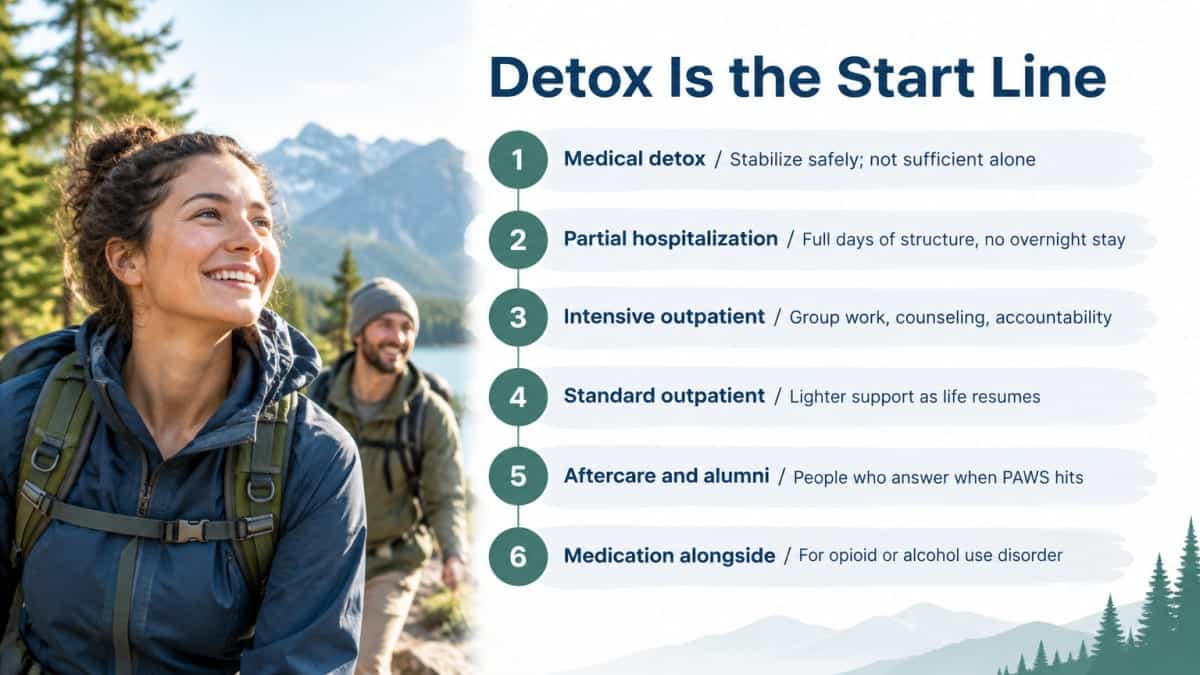
That is why continuing care matters as much as the days you spent getting stable. A workable path usually looks like this: medical detox first, then a step down through more intensive outpatient levels, then lighter outpatient support, then aftercare and alumni connection — with medication for opioid or alcohol use disorder running alongside any stage when it fits.
Partial hospitalization gives you full days of structure without an overnight stay. Intensive outpatient drops the hours but keeps the group work, counseling, and accountability. Standard outpatient and aftercare hold the long tail — the weeks and months when PAWS symptoms rise and fall and you need people who still answer the phone. You are not stepping down from care. You are stepping into the part that lasts.
When to Call a Clinician, Not Wait It Out
Patience with PAWS is reasonable. Silence is not. Some symptoms are expected waves that pass. Others are signals that something else is going on and deserve a professional set of eyes the same week — sometimes the same day.
Call a clinician if your mood drops hard and stays there, if you have thoughts of hurting yourself, or if anxiety ramps up to the point you cannot work, sleep, or eat for days in a row. Call if cravings have moved from occasional pulls to constant pressure, if you have started making plans around using again, or if a slip has already happened. For benzodiazepine recovery specifically, lingering symptoms can overlap with underlying anxiety, insomnia, or the condition that led to the prescription — careful follow-up is how you tell them apart, not guesswork at home.10
If You’re in Oregon or Southwest Washington
If you’re reading this from Portland, Milwaukie, Gresham, Beaverton, Salem, or across the river in Vancouver, Washington, the practical question is where to get medical detox and the continuing care that carries you through the PAWS window. Pacific Crest Trail Detox sits in Milwaukie, a short drive from most of the Portland metro, in a home-like setting rather than a hospital floor — RNs on site around the clock, providers rounding seven days a week, home-cooked meals, and staff who have been through recovery themselves.
Detox typically runs about 8 to 10 days. From there, the step-downs — PHP, IOP, outpatient, aftercare, and medication-assisted treatment where it fits — are built to hold the months when symptoms rise and fall. Out-of-state readers are welcome too; plenty of people travel in. We want to be your last treatment experience, whether we’re your first detox or your fifth.
Check Coverage for Continued Recovery Care
See what your plan may cover for post-acute withdrawal support and care beyond detox.
Frequently Asked Questions
Is post-acute withdrawal syndrome a real medical diagnosis?
PAWS is a widely recognized pattern, but it is not a formal diagnosis in the DSM, and researchers reviewing the literature have been clear that there is no consensus definition or diagnostic test for it.1That does not mean your symptoms are imaginary. It means clinicians treat the symptoms you describe — sleep, mood, cravings, focus — rather than check a box.
How do I know if what I’m feeling is PAWS or something else?
Honest answer: you often cannot sort it out alone. Persistent anxiety, insomnia, or low mood can overlap with underlying conditions or the issue a medication was first prescribed for, so clinicians recommend careful follow-up rather than guessing at home.10If symptoms are intense, persistent, or getting worse, bring them to a provider. That is what assessment is for.
Can PAWS cause a relapse, and how do I protect myself?
PAWS does not force a return to use, but the symptoms it brings — stress, cravings, hard moods, bad sleep — overlap closely with the triggers NIDA identifies as common relapse drivers.9Protection looks like structure: a continuing-care program, counseling, peer support, and medication where appropriate. You are not relying on willpower alone, and you shouldn’t have to.
Is there a medication that treats post-acute withdrawal?
There is no standard medication for PAWS itself. A scoping review found only 16 treatment studies met inclusion criteria, with low overall strength of evidence, and signals — not proof — for options like gabapentin or pregabalin on selected symptoms.3Medications for the underlying use disorder, like buprenorphine or naltrexone for opioids, carry stronger evidence and belong in that conversation.6
How long after detox should I stay in treatment?
Longer than you probably think. NIDA states plainly that detoxification is not sufficient by itself to help a person recover, because the triggers that pull you back do not disappear with the physical symptoms.9A typical path steps down through PHP, IOP, outpatient, and aftercare over months, so support is still around when PAWS symptoms rise and fall.
Can I get help at Pacific Crest Trail Detox if I live outside Oregon?
Yes. Pacific Crest Trail Detox sits in Milwaukie, in the Portland metro, and welcomes out-of-state clients regularly. Admissions can walk you through what travel looks like, verify your benefits, and talk through what comes after the 8–10 day detox stay. Calls are confidential and HIPAA-protected, and the first conversation is just a conversation — no commitment required.
References
- Neurobiology and Symptomatology of Post-Acute Alcohol Withdrawal: A Mixed-Studies Systematic Review (2022). https://pmc.ncbi.nlm.nih.gov/articles/PMC9798382/
- Symptoms of Protracted Alcohol Withdrawal in Patients with Alcohol Use Disorder: A Comprehensive Systematic Review (2023). https://pmc.ncbi.nlm.nih.gov/articles/PMC10190151/
- Management of Post-Acute Alcohol Withdrawal: A Mixed-Studies Scoping Review. https://pmc.ncbi.nlm.nih.gov/articles/PMC9798381/
- Understanding Alcohol Use Disorder. https://www.niaaa.nih.gov/publications/brochures-and-fact-sheets/understanding-alcohol-use-disorder
- Alcohol Use Disorder: From Risk to Diagnosis to Recovery. https://www.niaaa.nih.gov/health-professionals-communities/core-resource-on-alcohol/alcohol-use-disorder-risk-diagnosis-recovery
- Medications for Opioid Use Disorder. https://nida.nih.gov/research-topics/medications-opioid-use-disorder
- Opioid Use Disorder: Treating | Overdose Prevention – CDC. https://www.cdc.gov/overdose-prevention/hcp/clinical-care/opioid-use-disorder-treating.html
- Clinical Management of Psychostimulant Withdrawal. https://pmc.ncbi.nlm.nih.gov/articles/PMC10069411/
- Treatment and Recovery. https://nida.nih.gov/publications/drugs-brains-behavior-science-addiction/treatment-recovery
- Joint Clinical Practice Guideline on Benzodiazepine Tapering (2025). https://pmc.ncbi.nlm.nih.gov/articles/PMC12463801/
- Long-term neurological consequences following benzodiazepine exposure: A scoping review (2025). https://pmc.ncbi.nlm.nih.gov/articles/PMC12393751/
- Toward clarifying ASAM’s inpatient and residential benzodiazepine withdrawal management recommendations (2026). https://pmc.ncbi.nlm.nih.gov/articles/PMC13246659/
- Review article: Effective management of opioid withdrawal symptoms: A gateway to opioid dependence treatment. https://pmc.ncbi.nlm.nih.gov/articles/PMC6590307/
- Evidence-based consensus guidelines for the pharmacological management of stimulant use disorders (2026). https://pmc.ncbi.nlm.nih.gov/articles/PMC13222391/