Key Takeaways
- Medical stabilization comes first at Pacific Crest Trail Detox, with doctors and nurses managing withdrawal risks like seizures before any outdoor activity begins, guided by ASAM clinical standards 3.
- Outdoor time is introduced gradually, from porch sitting to short walks to disc golf, matching SAMHSA guidance that recovery movement should be gentle and enjoyable 1.
- Evidence points in a real but modest direction: 85% of 21 reviewed studies showed positive outcomes for drug dependence with nature-based interventions, though researchers stress more rigorous trials are needed 4.
- Detox is a doorway, so PCTD arranges partial hospitalization, outpatient care, and alumni support before discharge, since regular enjoyable activity is tied to lower relapse rates 2.
What a Tuesday Afternoon Looks Like at a Detox That Gets You Outside
Picture this. It’s Tuesday, a little after two. You slept last night — not perfectly, but you slept, which felt impossible three days ago. A nurse checked your vitals this morning and your hands aren’t shaking the way they were. You ate real food. And now someone on staff is asking if you want to head outside for a slow walk around the property or throw a few discs at the basket out back.
That’s it. That’s the afternoon.
No clipboard interrogation. No fluorescent-lit dayroom with a TV nobody’s watching. Just fresh Oregon air, a couple of other people in recovery who get exactly where you are, and a staff member close enough to help if you feel wobbly. If you’d rather sit on the porch and watch the trees move, that’s fine too. Nobody’s going to make you hike a mountain when your body is still learning how to be still.
This is Pacific Crest Trail Detox. It’s a house in Milwaukie, Oregon — not a hospital wing. You get real medical care from doctors and nurses who handle the scary parts of withdrawal, especially with alcohol and benzodiazepines where things can turn dangerous fast. And when your body is ready, the door opens. Simple as that.
The reason we build it this way isn’t a gimmick. Federal recovery guidance from SAMHSA now names physical activity as a core part of recovery, with a specific note that gentle, enjoyable movement can help take the edge off cravings 1. Walking counts. So does tossing a disc across a grassy fairway with someone who’s twelve days ahead of you on the same road.
You came here to get sober. You’ll also start learning, quietly, what sober can feel like.
Medical Detox First, Fresh Air Second: The Sequence That Keeps You Safe
Why Withdrawal Management Comes Before Any Trail
Let’s be honest about the order of things. Before anyone hands you a disc or points you toward a walking path, a doctor needs to look at you. That’s not a formality. It’s the part that keeps you alive.
Alcohol withdrawal and benzodiazepine withdrawal — think Xanax, Klonopin, Ativan — can turn dangerous quickly. Seizures. Wild swings in blood pressure. In the worst cases, something called delirium tremens. This is why national clinical guidance from ASAM exists in the first place: to give the medical team a clear playbook for symptoms, medications, and monitoring during the risky first days 3. Opioid withdrawal is rarely fatal on its own, but the misery of it — the sweating, the cramping, the panic — is real, and medication makes a genuine difference in whether you stay through the hard part.
So at Pacific Crest Trail Detox, the first days look medical. Nurses check your vitals on a schedule. A doctor decides what medication you need and adjusts it as your body changes. If you slept two hours, someone knows. If you couldn’t keep water down, someone knows.
The Three-Step Path: Stabilize, Step Outside, Practice Sober Fun
Here’s what the sequence actually looks like, in plain terms.
Step one: Stabilize. You arrive. You get assessed. A doctor and nursing team build a plan around what you were using, how much, and how long. Medication starts if you need it. You sleep in a real bedroom, not a curtained bay. Meals show up. Vitals get checked. This is the phase where the ASAM withdrawal guidance runs the show, because getting the medical piece right is what makes everything else possible 3.
Step two: Step outside. As symptoms ease — often a few days in, though every body has its own clock — the outside starts small. Ten minutes on the porch with a cup of coffee. A short walk to the end of the block with a staff member. Sitting on a bench where you can hear birds instead of a TV. SAMHSA’s recovery guidance is explicit that physical activity in recovery should start gradually and be enjoyable, not punishing 1. That’s the whole point of easing in.
Step three: Practice sober fun. Once you’re steadier, the activities open up. A slow hike on a wooded path. A round of disc golf where the only score that matters is that you laughed once. Walking is specifically named in the SUD recovery research as an acceptable, evidence-supported option — you don’t need to be an athlete for it to count 16.
Each step earns the next. Nothing skips. That’s the sequence, and it’s the reason it works.
What Outside Time Actually Does to a Nervous System in Withdrawal
Ten Minutes Under Trees Is Not Nothing
When your body is coming off a substance, your nervous system is basically an alarm that won’t turn off. Heart racing. Skin crawling. Every noise too loud. You’ve felt it, or you’re feeling it right now, and you know exactly what that state costs.
Here’s something worth knowing. A 2025 meta-analysis found that being outside for as little as ten minutes — even in ordinary urban nature, not some pristine forest — can improve adult mental health 11. Ten minutes. That’s shorter than most of the cravings you’re about to ride out.
What does that look like at Pacific Crest Trail Detox? It looks like sitting on the back porch with a blanket around your shoulders. It looks like walking to the mailbox and back with someone next to you. It looks like standing under a tree for a few minutes because the room felt too small.
You don’t have to earn it. You don’t have to feel great first. When a nurse gives you the go-ahead, stepping outside for a few minutes is a real intervention — small, doable, and backed by research. Your nervous system doesn’t need a grand hike to start settling. It just needs a different set of inputs than the ones it’s been drowning in.
Green Space, Lower Anxiety: What the Data Shows
You might be reading all this and thinking, okay, but does a patch of grass actually change anything in my brain, or is this just nice-sounding wellness talk?
Fair question. Here’s what the numbers say.
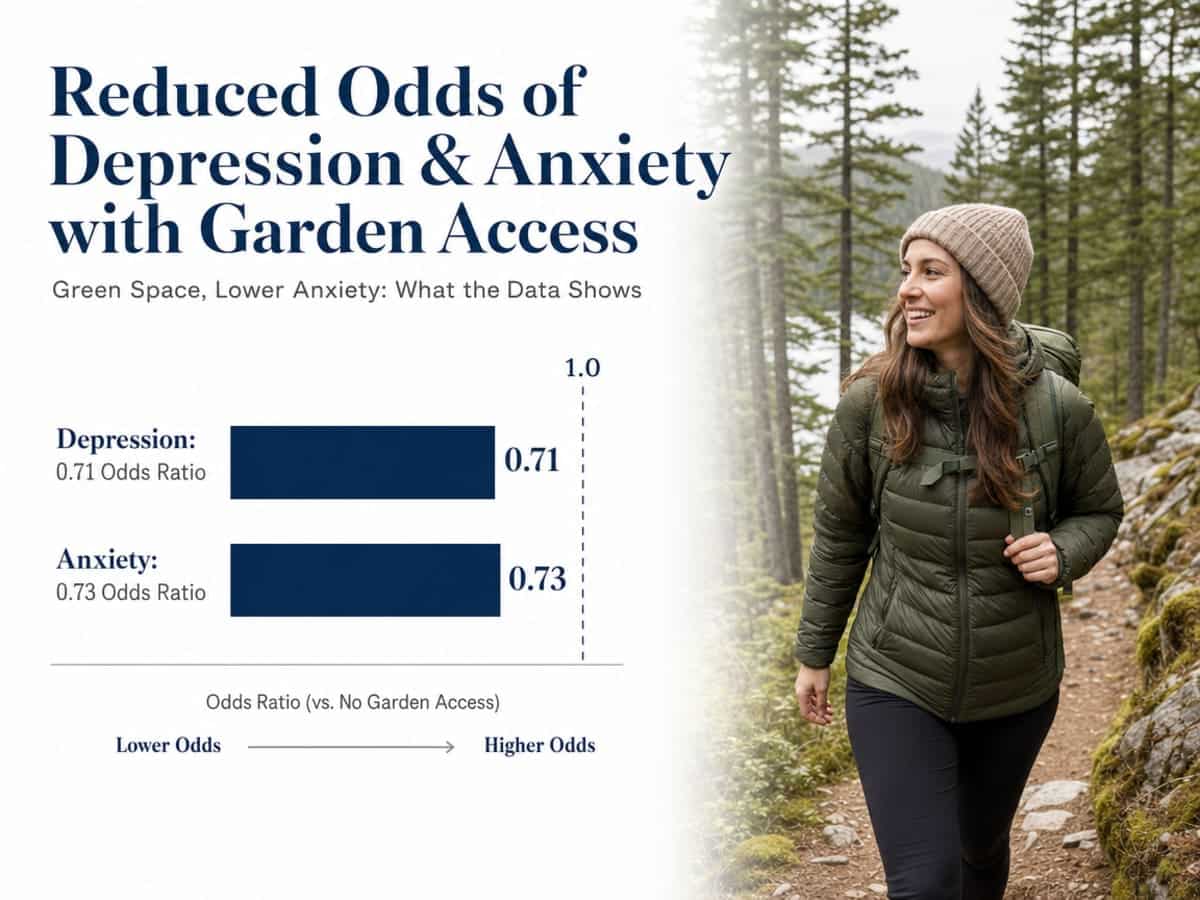
A 2024 systematic review looking at nature exposure and mental health found that people with access to a garden had lower odds of depression (odds ratio 0.71) and lower odds of anxiety (odds ratio 0.73) compared with people who didn’t have that access 10. An odds ratio under 1 means the outcome is less likely — so garden access lined up with roughly a 29% lower chance of depression and a 27% lower chance of anxiety in the studies reviewed.
A quick honest note: the authors rated the overall certainty of this evidence as low, because most of the underlying studies were observational and had some risk of bias 10. So this isn’t a prescription. Nobody is claiming a garden cures anxiety. But when you stack it against the rest of what we know — that walking is an accepted movement option in SUD recovery 16, that short outdoor breaks improve adult mood 11, that federal guidance now names enjoyable physical activity as part of the recovery toolkit 1— a pattern shows up.
Outside time is not window dressing. For a nervous system that’s been screaming at you for days, a bench under a tree is a small, real relief. That’s why PCTD makes room for it as soon as your body is ready.
Disc Golf as Rehearsal: Learning That Sober Can Feel Good
Here’s a hard truth nobody prints on the brochure: one of the biggest reasons people go back to using isn’t withdrawal. It’s boredom. It’s a Saturday afternoon with nothing to do and a brain that used to know exactly how to fill the time. If you’ve been there, you already know.
So when Pacific Crest Trail Detox puts a disc golf basket out back and takes people for walks on wooded paths near Milwaukie, it isn’t about turning you into an athlete. It’s rehearsal. You’re practicing, in a safe place with people who understand, what it feels like to enjoy an hour of your life without a drink or a pill in your hand.
That sounds small. It isn’t.
SAMHSA’s federal recovery guidance is direct about this: physical activity in recovery should be enjoyable, not a punishment, and regular movement has been linked to lower rates of returning to problematic substance use 2. The word enjoyable is doing real work in that sentence. If you hate what you’re doing, you won’t keep doing it. If you laugh once during a round of disc golf — even a bad throw that clangs off a tree — your brain files something new. Sober can feel like this. Not just survivable. Actually okay.
The SUD recovery movement research backs the specific activities up. Walking, low-to-moderate outdoor sports, and light adventure recreation are all named as acceptable, evidence-appropriate options in early recovery 16. You don’t need a gym membership or a running habit. You need a disc, a path, and someone next to you who’s rooting for you.
And the co-occurring trauma angle matters here too. A lot of people coming into detox are also carrying PTSD — from combat, from childhood, from things that happened while they were using. A 2024 review of nature-based activities like hiking and camping as adjunctive treatments for people with co-occurring PTSD and substance use disorder found they show promise for reducing both PTSD symptoms and craving levels 5. The authors are careful to say the research is still developing, so nobody’s promising a hike will heal trauma. But the direction of the evidence is pointing somewhere real.
What this looks like day to day at PCTD is unglamorous, and that’s the point. You throw a disc. You walk to the second basket. You talk to the guy next to you about how his kid’s soccer season is going, or you don’t talk at all. Nobody’s grading you. Nobody’s timing you. You come back to the house, tired in a good way, and eat lunch.
That hour is you, learning your new life. One throw at a time.
The Evidence, Told Honestly
What the Research Says About Nature-Based Interventions for Drug Dependence
You deserve the real picture here, not a marketing version. So here it is.
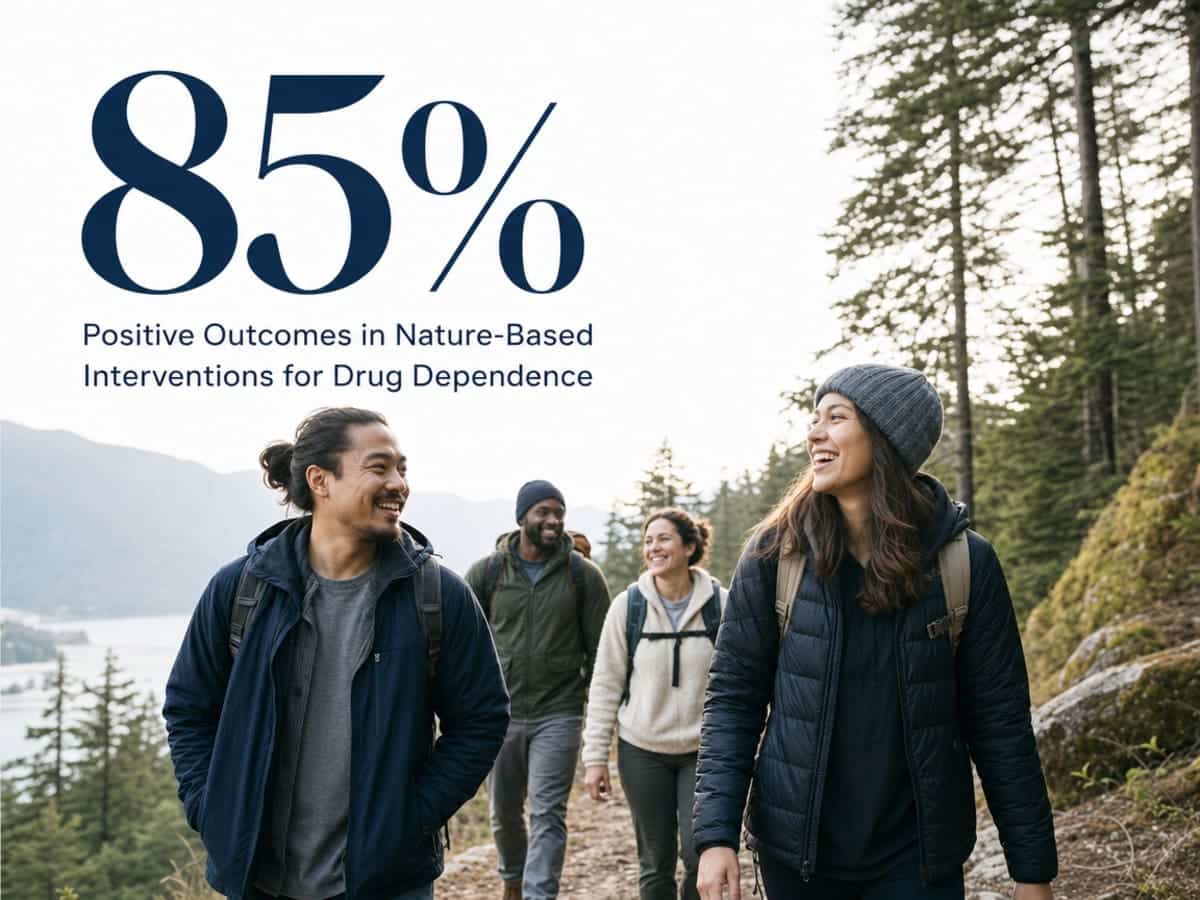
In 2024, researchers screened 8,205 articles on natural interventions in substance abuse treatment and prevention. After applying quality filters, 21 studies made the cut. Of those 21, roughly 85% reported positive outcomes for people dealing with drug dependence 4. That’s a striking number, and it’s worth sitting with for a moment.
But it’s also worth being clear about what that number is and isn’t.
It’s a review of studies that already existed — not a single big trial that proved anything on its own. The 21 studies varied in size, design, and what exactly they measured. Some were strong. Some had real limits. The authors themselves are careful to say the field needs more rigorous research before anyone can hand out firm clinical prescriptions 4.
So what does 85% actually mean for you? It means the direction of the evidence is genuinely encouraging. When researchers looked across everything that had been studied — hiking programs, garden programs, outdoor group work — most of it pointed the same way: people generally did better with nature-based support layered onto their recovery than without it.
That’s not a cure. It’s a pattern. And in a field where families have been sold plenty of overpromises, a pattern grounded in a real review of real studies is worth more than a slogan. At Pacific Crest Trail Detox, we treat outdoor time exactly the way the evidence describes it — as a helpful, honest addition to solid medical care, not as the star of the show.
What It Won’t Do, and Why PCTD Isn’t a Wilderness Program
Now the flip side. Because if we’re going to be honest about what the evidence supports, we also have to be honest about what it doesn’t.
And here’s something else worth saying plainly: Pacific Crest Trail Detox is not a wilderness therapy program. Nobody is sending you into the backcountry with a tarp and a granola bar. Some wilderness programs run 6 to 12 weeks, and the research suggests programs shorter than 6 weeks may be less effective in that specific model 13. That’s a different thing entirely from what we do.
PCTD is a house in Milwaukie, Oregon. A real house, with real bedrooms, real medical staff on-site, and real trails and disc golf nearby that you can access when your body is ready. Outdoor time is the flavor of the day, not the whole meal. The meal is medical detox done right, with therapy, group support, and a clear plan for what comes after — partial hospitalization, outpatient care, alumni support — because detox alone isn’t the finish line.
Honest promises are the only kind worth making when you’re scared. So that’s what you get here.
Is It Safe to Move Around During Detox?
This is the question that keeps most people up at night before they walk through the door. You’re already feeling awful. The idea of doing anything more than lying still sounds unreasonable, maybe even risky. So let’s talk about it plainly.
The short answer is yes — when a medical team clears you and the activity fits where your body actually is. Not before. Not on your own timeline. When the nurse says your vitals look good and a walk to the porch is reasonable, that’s your green light. Not a minute sooner.
There’s actual research on this question, which matters. A 2018 study looked at a structured outdoor adventure activity — sailing — with people in residential substance use disorder treatment. The researchers were specifically checking for harm. What they found: no physical injuries, and no increases in anxiety or negative mood during the activity 15. One study on one activity doesn’t settle every question, but it points somewhere honest. Structured outdoor time, done with support, was tolerated well by people in early recovery.
At Pacific Crest Trail Detox, safety looks unglamorous. A staff member walks with you the first few times. Hydration matters. Nobody’s pushing pace. If you feel shaky, you sit down — on a bench, on the grass, wherever you are. The activity ends the moment your body says enough. That’s not weakness. That’s the whole design.
The risk isn’t movement. The risk is moving too much, too soon, without anyone paying attention. That’s what we don’t do here. When you’re ready, you’ll know, and so will we.
A House, Not a Ward: Why the Setting Matters as Much as the Trail
Close your eyes for a second and picture where you thought detox was going to happen. For most people, the image is the same: a narrow bed with a plastic rail, a wall-mounted TV bolted too high, a corridor that smells like disinfectant, and someone in scrubs walking past every hour without looking in. That picture is real for some medical settings, and for the sickest patients those settings save lives. But it isn’t the only option, and it isn’t the one that fits everyone.
Pacific Crest Trail Detox is a house. Actually a house. Bedrooms with real doors. A kitchen where meals get made and the coffee pot is on. A living room with couches you can sink into. Windows that look out at trees, not a parking lot. When you wake up here, you wake up somewhere that already feels a little like being home — not somewhere you’re trying to get discharged from.
That matters more than it sounds. Your nervous system is reading the room the whole time you’re in withdrawal. Bright fluorescent lights, hard surfaces, and constant beeping keep the alarm system on. Soft light, warm colors, and quiet spaces let it start turning down. Research linking nature and everyday environments to health outcomes points the same direction — surroundings shape mood, sleep, and physical activity in ways that add up over days 8.
The outdoor piece works because the indoor piece works first. If the house didn’t feel safe, no trail in Oregon would make up for it. Because it does feel safe, stepping out the back door for a short walk is just an extension of that same calm — not a break from a place you can’t wait to leave.
Medical care is still fully here. Doctors, nurses, medication when you need it, someone checking on you around the clock. What’s missing is the ward. And you probably won’t miss it.
After Detox: How Outside Time Points Toward the Next Step
Detox is a doorway, not a destination. The medical part — getting you safely through withdrawal — is only the first stretch. What happens next is where the real work of staying sober lives, and this is where those short walks and disc golf rounds start paying off in ways you can feel.
Here’s the honest math on why the next step matters: detox without follow-up care has a very low success rate. That’s why Pacific Crest Trail Detox lines up what comes after before you ever finish the first phase:
- A partial hospitalization program (a structured day program where you go home at night)
- An intensive outpatient program (fewer hours, more independence)
- Regular outpatient therapy
- An alumni community that keeps the door open long after you leave
The outside piece carries forward too. SAMHSA’s recovery guidance points out that regular enjoyable physical activity is linked to lower rates of returning to problematic substance use 2. That habit you started here — a walk after breakfast, a slow round of disc golf on a Saturday — is something you take with you. It’s yours now.
You leave with a plan, a routine, and a small, real answer to the question that scares everyone: what am I going to do with my time?
Ready to Detox Somewhere That Gets You Outside?
You’ve read enough. Here’s what matters now.
If you’re scared, that’s normal. If you’re tired of picturing a hospital bed with a plastic rail, you don’t have to picture that anymore. Pacific Crest Trail Detox is a house in Milwaukie, Oregon, with real doctors and nurses handling the medical part of withdrawal, and real trails and a disc golf basket waiting for the day your body says yes. After detox, we help you line up the next step — day programs, outpatient care, an alumni community — so you’re not walking out alone.
Ready to detox somewhere that gets you outside? Call Pacific Crest Trail Detox today.
See if outdoor detox adventure is covered
Find out if your insurance supports outdoor-based detox and early recovery.
Frequently Asked Questions
Is it safe to go outside during detox withdrawal?
Yes, once your medical team clears you. The first days focus on stabilizing your body with doctors, nurses, and medication if needed. When your vitals are steady, short outdoor time — a few minutes on the porch, a slow walk with a staff member — becomes an option. A study of structured outdoor activity in residential SUD care reported no injuries and no anxiety spikes 15.
How is this different from wilderness therapy?
Pacific Crest Trail Detox is not a wilderness program. Nobody sleeps in a tent or hikes into the backcountry. It’s a house in Milwaukie, Oregon with medical staff on-site. Some wilderness therapy runs 6 to 12 weeks in remote settings, and shorter versions may be less effective in that model 13. What we do is residential medical detox with outdoor recreation woven in.
What kinds of outdoor activities are actually part of the program?
Simple things. Walks around the property. Sitting on the porch with coffee. Slow hikes on wooded paths near Milwaukie once you’re steady. A round of disc golf where nobody’s keeping score. The SUD recovery research specifically names walking, low-to-moderate outdoor sports, and light adventure activities as acceptable options in early recovery 16. No athletic experience required.
Do I still get medical supervision if the program includes hiking and disc golf?
Absolutely. Medical care is the foundation, not an afterthought. Doctors and nurses monitor you around the clock during the risky early days, especially for alcohol and benzodiazepine withdrawal where seizures are possible. National ASAM guidance shapes how the medical team handles symptoms and medication 3. Outdoor time only starts when your body is ready, and staff are with you.
What if I’m not outdoorsy or athletic?
You don’t need to be. If your idea of outside is sitting on a bench and listening to birds, that counts. A 2025 meta-analysis found even ten minutes outdoors can improve adult mental health 11. SAMHSA’s recovery guidance says the point is enjoyable movement, not punishment 1. If disc golf sounds terrible, skip it. A slow walk works. So does the porch.
What happens after detox ends?
Detox is the first step, not the whole plan. Pacific Crest Trail Detox lines up what comes next before you finish — a day program (partial hospitalization), a lighter schedule (intensive outpatient), standard outpatient therapy, and an alumni community. Regular enjoyable movement carries forward too, since it’s linked to lower rates of returning to substance use 2. You leave with support, not a discharge slip.
References
- The Intersection of Physical Activity, Wellness, and Recovery. https://library.samhsa.gov/product/intersection-physical-activity-wellness-and-recovery/pep24-08-006
- The Intersection of Physical Activity, Wellness, and Recovery. https://library.samhsa.gov/sites/default/files/intersection-physical-activity-recovery-pep24-08-006.pdf
- The ASAM Clinical Practice Guideline on Alcohol Withdrawal Management Pocket Guide. https://www.samhsa.gov/resource/ebp/asam-clinical-practice-guideline-alcohol-withdrawal-management-pocket-guide
- a review of natural interventions in substance abuse treatment and prevention. https://pmc.ncbi.nlm.nih.gov/articles/PMC11570648/
- Recovery Horizons: Nature-Based Activities as Adjunctive Treatments for Co-Occurring Post-Traumatic Stress Disorder and Substance Use Disorders. https://pmc.ncbi.nlm.nih.gov/articles/PMC11571177/
- Recovery Horizons: Nature-Based Activities as Adjunctive Treatments for Co-Occurring Post-Traumatic Stress Disorder and Substance Use Disorders. https://pubmed.ncbi.nlm.nih.gov/39563987/
- Nature’s Role in Outdoor Therapies: An Umbrella Review. https://pmc.ncbi.nlm.nih.gov/articles/PMC8150931/
- Associations between Nature Exposure and Health. https://pmc.ncbi.nlm.nih.gov/articles/PMC8125471/
- Urban Green Space and Its Impact on Human Health. https://stacks.cdc.gov/view/cdc/53658/cdc_53658_DS1.pdf
- Nature exposure and mental health during the COVID-19 pandemic: A Navigation Guide systematic review with meta-analysis. https://pmc.ncbi.nlm.nih.gov/articles/PMC38821342/?fc=None&ff=20240602100759&v=2.18.0.post9+e462414
- A Systematic Review and Meta-Analysis on the Effect of Nature …. https://pmc.ncbi.nlm.nih.gov/articles/PMC11851813/
- The effectiveness of nature-based interventions on mental …. https://pubmed.ncbi.nlm.nih.gov/42390719/
- The Interleaving Trails of Lifestyle and Wilderness. https://pmc.ncbi.nlm.nih.gov/articles/PMC10328209/
- Wilderness Therapy Programs: A Systematic Review of Research. https://www.wsipp.wa.gov/ReportFile/1748/Wsipp_Wilderness-Therapy-Programs-A-Systematic-Review-of-Research_Report.pdf
- Safety and psychological impact of sailing adventure therapy among a residential substance use disorder population. https://pubmed.ncbi.nlm.nih.gov/30219467/
- Enhancing Substance Use Disorder Recovery through …. https://pmc.ncbi.nlm.nih.gov/articles/PMC11201577/